• 10 Reasons to Remember…
  • A Brief Word About…
  • About
  • For One Week Only
  • Happy Birthday
  • Monthly Roundup
  • Old-Time Crime
  • Other Posts
  • Poster of the Week
  • Question of the Week
  • Reviews
  • Trailers

thedullwoodexperiment

~ Viewing movies in a different light

thedullwoodexperiment

Tag Archives: Matthew Broderick

Rules Don’t Apply (2016)

15 Saturday Apr 2017

Posted by dullwood68 in Movies

≈ Leave a comment

Tags

Alden Ehrenreich, Comedy, Drama, Howard Hughes, Lily Collins, Matthew Broderick, Review, Romance, Screen test, Warren Beatty

D: Warren Beatty / 127m

Cast: Warren Beatty, Lily Collins, Alden Ehrenreich, Matthew Broderick, Annette Bening, Martin Sheen, Candice Bergen, Haley Bennett, Megan Hilty, Paul Schneider, Alec Baldwin, Oliver Platt, Taissa Farmiga, Ed Harris, Amy Madigan, Paul Sorvino, Dabney Coleman, Steve Coogan

Not counting the TV short, Dick Tracy Special (2010), this is Warren Beatty’s first time behind the camera since Bulworth (1998). That movie was a pithy, satirical look at (then) modern US politics, but eighteen years on, Beatty’s skill as a director isn’t on quite such good form. Rules Don’t Apply focuses on Howard Hughes’ life between 1958 and 1964, and adds a fictional romance to bolster the main storyline (which the movie can’t decide on). It’s not a bad movie per se, just one that isn’t sure which one of three stories it wants to focus on.

The first story concerns Frank Forbes (Ehrenreich), who has just started for Hughes as a driver. He has a fianceé back home, Sarah (Farmiga), and a dream to build affordable housing at an undeveloped location just outside Los Angeles. Working for Hughes, though, is somewhat limiting, and for the most part he acts as a chauffeur for some of the actresses Hughes has under contract. The second story concerns one of those actresses, the fresh from Virginia, Marla Mabrey (Collins). Accompanied by her mother, Lucy (Bening), Marla is excited to meet the great Howard Hughes, and screen test for a movie called Sally Starlight. But as time goes on, she doesn’t get to meet him, and the screen test seems increasingly unlikely to happen. But she and Frank hit it off, and soon there’s the beginning of a romance. Her mother, however, returns home, leaving Marla to navigate the treacherous waters of reachable fame – and with Frank’s help.

The third story has Hughes showing signs of the strange behaviour that will eventually see his ownership of Trans-World Airlines (TWA) challenged by the US government. He refuses to see people, makes appointments that he doesn’t keep, and generally acts as if the concerns of other people are irrelevant. But eventually he and Marla meet, and he meets Frank also. Hughes takes a shine to Marla, and he begins to trust Frank, and it seems their careers are set. But their relationship takes an unexpected turn, and they grow estranged from each other. Meanwhile, Hughes becomes more and more withdrawn from the world, and begins to show clear signs of dementia, demanding things like all the available quantity of a certain flavour of ice cream (and then wanting another), and repeating himself over and over. What seemed eccentric only a few years before, now seems detrimental to both his health and his wealth. Frank stands by him, now as a personal assistant, while Marla moves away to start her life over…

On paper, Rules Don’t Apply has all the hallmarks of a very good movie indeed. It has Beatty in the role of Howard Hughes (a project he’s been planning for around forty years), a supporting cast who all do a terrific job, a recreation of the period that includes broad vistas of cities such as Los Angeles and London as they were at the time, individual scenes that carry both emotional weight and poignancy, and provides a somewhat caustic examination of wished-for fame and fortune. But the movie also has difficulty in making Hughes, or indeed any of the characters, sympathetic, and it flits between each of the storylines without always allowing them to flourish or become integral to the overall narrative.

The romance between Marla and Frank starts typically for the period with lots of exchanged glances and oblique references to the relevance of sex before marriage (Frank has, Marla hasn’t). It’s an old-fashioned courtship, made slightly more awkward by Hughes’ insistence that if any of his employees take any kind of interest in his actresses, then they’ll be fired. However, although this is mentioned on several occasions (as if the audience won’t get it the first time), in the end it makes no difference, as Hughes has no idea about them, and the few people who do know – fellow driver, Levar (Broderick), Hughes’ personal secretary, Nadine (Bergen) – don’t say anything anyway. There’s plenty of unnecessary repetition in terms of Hughes not seeing people, or making strange decisions, and it all pads out the movie, making it feel unfocused and willfully disjointed.

In the end, it’s Beatty’s script, and some of it is really, really good, but some scenes could have been excised and it wouldn’t have made any difference to the overall story. It would have made it a lot tighter, though, and kept the audience more involved. As the romance between Marla and Frank begins to crumble, and Hughes’ dispute with potential investors in TWA takes centre stage, the movie attempts to show Hughes both in decline and also more self-aware than people believed at the time. (Beatty’s script avoids the uncomfortable fact that at this period in his life, Hughes had already taken to spending long periods of time alone and naked watching movies in places such as a bungalow at the Beverly Hills hotel.) Beatty’s intention seems to be to idolise the man while at the same time admitting that he was flawed, a circumstance that causes the movie to seem undecided in terms of what audiences should make of him.

This all leaves the movie feeling and sounding less dramatic than it should be, with only the occasional confrontation jolting things out of the cosy, straightforward approach that Beatty adopts as director. Inert in certain stretches, and lacking depth in others, the movie is rescued from being completely disappointing thanks to its cast. As the billionaire who marries in order to avoid being committed to an insane asylum, Beatty steals every scene he’s in because he still has that old-time star charisma. There’s a good-natured, yet inherently pathological bent to his performance, and Hughes’ unpredictable nature, complete with vacant stares, bemused glances and paranoid outbursts, is explored with the kind of range and subtlety – in both diction and movement – that makes Beatty still such a good actor. Unfortunately, both Marla and Frank, being original characters created for the movie, don’t feel as well-rounded, and their romance is tepid, and not entirely believable, as Collins and Ehrenreich – very good individually – don’t have the chemistry necessary to make audiences believe in them as a couple.

Elsewhere, Broderick and Bening are superb, there are lots of blink-and-you’ll-miss-them appearances from the likes of Sorvino, Harris and Coleman, and a very funny cameo from Coogan as a British pilot forced to sit back and watch Hughes deliberately cause the engines to fail while up in the sky for a joyride. There are other humorous moments in the movie, many in fact, and most of them are in service to the characters, but as they’re mixed in with the drama and the romance and aren’t always played out at the best moments, some viewers may find that the comedy is forced rather than organic. Ultimately, and despite the best efforts of Beatty as writer and director, the various elements on display don’t gel to good enough effect, and this makes the movie less compelling and (often) too bland. A more immediate approach, and a more historically accurate one, may have made for a better movie – we’ll never know – but what is certain is that Beatty’s passion project, after forty years, isn’t as passionate an experience as he may have hoped it would be.

Rating: 5/10 – slow and repetitive aren’t the best of bedfellows when it comes to creating a drama about one of the most intriguing and distinctive billionaires of the twentieth century, and Rules Don’t Apply suffers accordingly; Beatty the actor is terrific, but is let down by Beatty the writer and director, and although the first half hour is briliantly executed, the rest of the movie falls short of that initial promise and settles instead for the kind of soap opera theatrics that never ring true, no matter how hard everyone tries.
Share this:

  • Click to share on X (Opens in new window) X
  • Click to share on Facebook (Opens in new window) Facebook
  • More
  • Click to print (Opens in new window) Print
  • Click to email a link to a friend (Opens in new window) Email
Like Loading...

The American Side (2016)

23 Monday May 2016

Posted by dullwood68 in Movies

≈ Leave a comment

Tags

Alicja Bachleda, Camilla Belle, Directed energy weapon, Drama, Free energy, Greg Stuhr, Jenna Ricker, Matthew Broderick, Mystery, Niagara Falls, Nikola Tesla, Private detective, Review, Robert Forster, Thriller

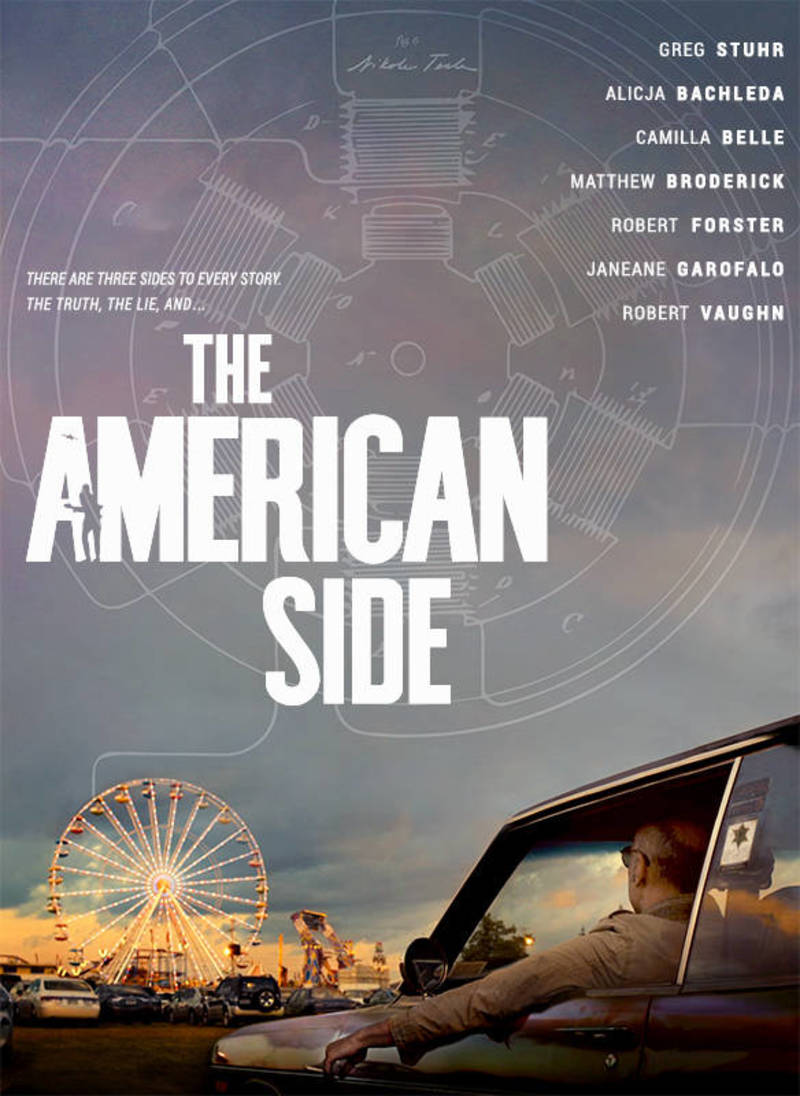
The American Side

D: Jenna Ricker / 102m

Cast: Greg Stuhr, Alicja Bachleda, Camilla Belle, Matthew Broderick, Robert Forster, Janeane Garofalo, Grant Shaud, Harris Yulin, Joe Grifasi, Stephen Henderson, Kelsey Siepser, Robert Vaughn

Some movies give the impression that they should be longer, that their proper running time has been truncated during the editing and post-production process. These movies seem to be saying that there’s something missing, an element that would enable the movie to be better than it is, sharper, clearer, more dynamic, more interesting, funnier, darker, better focused all round. And then there are the movies where that same impression is made, but no matter how much you may think that a longer cut might be the answer, the truth is, it wouldn’t make a difference.

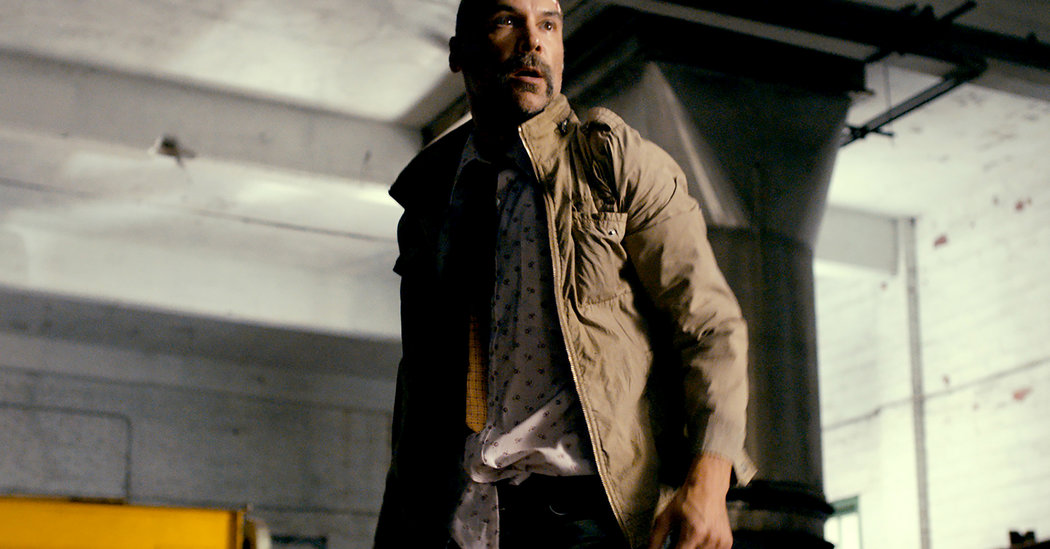
Such is the case with The American Side. It’s ostensibly a modern noir thriller, with many familiar elements to ground it in that particular genre. There’s a grizzled, world-weary private detective, Charlie Paczynski (Stuhr); a damsel in distress, Nikki Meeker (Bachleda), who knows too much and whose life appears to be in danger; a femme fatale, Emily Chase (Belle), who may or may not be on the side of the bad guys; two competing businessmen – Borden Chase (Broderick) (Emily’s older brother) and Sterling Whitmore (Forster) – either of whom could be the main bad guy; and a McGuffin in the form of a mechanical design by Nikola Tesla that could be used as a weapon. In some respects its noir business as usual, and while these familiar elements should allow for a degree of comfort in navigating the twists and turns of the script, in reality they’re only used to reel in any curious – potential – viewers.

The American Side - scene1

Once the movie gets started, most viewers could be forgiven for thinking that The American Side, with its early murder of a minor character and Charlie’s determined attitude in finding their killer would be the kind of investigation that leads to corruption in high places, and the private detective realising that he can’t trust anyone. Alas, here, this is only partially true, as Charlie trusts one too many people in his quest to find his friend’s killer, and a wider conspiracy begins to make itself felt. Charlie also comes across as a little too gullible, a fact that doesn’t help him with his investigations, and which leads to his being easily fobbed off or deflected by everyone around him. And as the mystery deepens, the script – courtesy of director Ricker and star Stuhr – becomes an erratic mix of noir beats and muddled plotting.

It begins simply enough, establishing Charlie as a low-rent private eye who works out of a bar and who uses a stripper, Kat (Siepser), to help catch cheating husbands, who he then blackmails so that he receives payment from both the errant husband and the suspicious wife. It’s not a particularly lucrative business, and Charlie isn’t the most likeable of guys, but he gets by. But when Kat is killed by a man they both believe will fit the brief of cheating spouse, Charlie finds himself looking for a college professor called Soberin (Yulin) who’s mixed up in a plot to build a directed energy weapon designed by Tesla.

Sadly, what up til now has been a fairly straightforward, if gloomily shot movie, becomes a puzzle that goes off in various different directions, many of which lack a purpose other than to make things even more mysterious or inexplicable. Charlie’s own investigation sees him (traditionally) one step behind everyone else, but even when he does get up to speed the viewer is left with the sense that he’s only pretending to understand what’s going on, and in reality still doesn’t have a clue as to who’s doing what, and why. It’s not even that the plot, such as it is, is unusually complex. It’s that when explanations are forthcoming, and motivations are revealed, they just don’t make any sense. The viewer is left scratching their head and wondering if they’ve missed something.

The American Side - scene2

Ricker and Stuhr’s intention seems to have been a pretty simple one: combine basic noir components with a low-budget indie sensibility and stir together accordingly. But there’s something missing from the recipe, and the movie ends up sacrificing clarity in favour of providing uneven twists and turns, some of which feel awkward and contrived rather than organic. As the plot unfolds, some narrative decisions prove so unwieldy that you begin to suspect the script is a first draft that no one got around to looking at for errors or inconsistencies. It’s a shame as there’s the germ of a great idea here, and Tesla was enough of a maverick inventor for any movie maker to “have fun with”, but Ricker and Stuhr use him sparingly as a character, preferring instead to refer to him constantly as an under-appreciated genius who knew what was best for the world.

One of the movie’s main distractions is the continual referral to Niagara Falls and its history. The Falls are used as a backdrop – Charlie catches up with Soberin there – and events there in the past serve as clues to what Tesla was up to with his directed energy weapon, but this inclusion leads to more questions than the script can answer, and it makes for at least two unsatisfactory moments at the movie’s climax (which is also set at the Falls). This fascination also explains the movie’s title: no one has gone over the Falls from the American side and lived. (Alas, this isn’t a metaphor for anything that happens in the movie.)

The American Side - scene3

By making so much of the movie incomprehensible, or just plain confusing, Ricker and Stuhr have undermined their own project in such a comprehensive manner that the cast have no other choice but to make the best of it. Stuhr is a relaxed, no frills actor who’s not quite hard-boiled enough to make Charlie the anti-hero the script wants him to be, and he serves as the stooge in too many scenes where he should be in control. Bachleda’s role is underwritten, Belle struggles to keep her character on the right side of believable, while Broderick has his own problems with the kind of arch, mannered dialogue that even the most inexperienced of actors would run a mile from.

Under Ricker’s purview, The American Side ends up being a cumbersome, cruelly ill-considered movie that evinces little sympathy for its characters, and which proves very difficult to care about beyond a superficial level. It’s not a bad movie per se, just one that takes what should be a simple storyline and plot, and buries both of them under a pile of unnecessary implausibilities and contradictions. And it’s a movie where continuity screams excised scenes, as Charlie suffers head lacerations that happen entirely off camera and without being referred to by anyone. Somewhere there’s a longer cut of this movie, and someone needs to release it. Only then will the movie have a real chance of impressing its audience.

Rating: 5/10 – a film noir wannabe that neglects both its storyline and its plot, The American Side is so preoccupied with prolonging its inherent mystery that it can’t resist keeping it’s distance from the viewer; as a result everything suffers, and the movie never recovers from Ricker and Stuhr’s apparent insistence on filming their script as is.

Share this:

  • Click to share on X (Opens in new window) X
  • Click to share on Facebook (Opens in new window) Facebook
  • More
  • Click to print (Opens in new window) Print
  • Click to email a link to a friend (Opens in new window) Email
Like Loading...

Blog Stats

  • 486,528 hits

Recent Posts

  • 10 Reasons to Remember Bibi Andersson (1935-2019)
  • Fantasia (1940)
  • Dances With Wolves (1990) – The Special Edition
  • Kiss of the Spider Woman (1985)
  • The Three Musketeers (1973)

Top Posts & Pages

  • Lost for Life (2013) - Another Look
    Lost for Life (2013) - Another Look
  • Lost for Life (2013)
    Lost for Life (2013)
  • About
    About
  • Mr. Topaze (1961)
    Mr. Topaze (1961)
  • Billy Lynn's Long Halftime Walk (2016)
    Billy Lynn's Long Halftime Walk (2016)
  • Winter's Tale (2014)
    Winter's Tale (2014)
  • The Hitman's Bodyguard (2017)
    The Hitman's Bodyguard (2017)
  • 5 Famous Movie Roles That Nearly Went to Someone Else
    5 Famous Movie Roles That Nearly Went to Someone Else
  • The Layover (2017)
    The Layover (2017)
  • Transcendence (2014)
    Transcendence (2014)
Follow thedullwoodexperiment on WordPress.com

Blogs I Follow

  • Rubbish Talk
  • Film 4 Fan
  • Fast Film Reviews
  • The Film Blog
  • All Things Movies UK
  • Interpreting the Stars
  • Let's Go To The Movies
  • Movie Reviews 101
  • TMI News
  • Dan the Man's Movie Reviews
  • Film History
  • Jordan and Eddie (The Movie Guys)

Archives

  • April 2019 (13)
  • March 2019 (28)
  • February 2019 (28)
  • January 2019 (32)
  • December 2018 (28)
  • November 2018 (30)
  • October 2018 (29)
  • September 2018 (29)
  • August 2018 (29)
  • July 2018 (30)
  • June 2018 (28)
  • May 2018 (24)
  • April 2018 (21)
  • March 2018 (31)
  • February 2018 (25)
  • January 2018 (30)
  • December 2017 (30)
  • November 2017 (27)
  • October 2017 (27)
  • September 2017 (26)
  • August 2017 (32)
  • July 2017 (32)
  • June 2017 (30)
  • May 2017 (29)
  • April 2017 (29)
  • March 2017 (30)
  • February 2017 (27)
  • January 2017 (32)
  • December 2016 (30)
  • November 2016 (28)
  • October 2016 (30)
  • September 2016 (27)
  • August 2016 (30)
  • July 2016 (30)
  • June 2016 (31)
  • May 2016 (34)
  • April 2016 (30)
  • March 2016 (30)
  • February 2016 (28)
  • January 2016 (35)
  • December 2015 (34)
  • November 2015 (31)
  • October 2015 (31)
  • September 2015 (34)
  • August 2015 (31)
  • July 2015 (33)
  • June 2015 (12)
  • May 2015 (31)
  • April 2015 (32)
  • March 2015 (30)
  • February 2015 (37)
  • January 2015 (39)
  • December 2014 (34)
  • November 2014 (34)
  • October 2014 (36)
  • September 2014 (25)
  • August 2014 (29)
  • July 2014 (29)
  • June 2014 (28)
  • May 2014 (23)
  • April 2014 (21)
  • March 2014 (42)
  • February 2014 (38)
  • January 2014 (29)
  • December 2013 (28)
  • November 2013 (34)
  • October 2013 (4)

Create a free website or blog at WordPress.com.

Rubbish Talk

Film 4 Fan

A Movie Blog

Fast Film Reviews

The Film Blog

The official blog of everything in film

All Things Movies UK

Movie Reviews and Original Articles

Interpreting the Stars

Dave Examines Movies

Let's Go To The Movies

Film and Theatre Lover!

Movie Reviews 101

Daily Movie Reviews

TMI News

Latest weather, crime and breaking news

Dan the Man's Movie Reviews

All my aimless thoughts, ideas, and ramblings, all packed into one site!

Film History

Telling the story of film

Jordan and Eddie (The Movie Guys)

Movie Reviews & Ramblings from an Australian Based Film Fan

Privacy & Cookies: This site uses cookies. By continuing to use this website, you agree to their use.
To find out more, including how to control cookies, see here: Cookie Policy
  • Subscribe Subscribed
    • thedullwoodexperiment
    • Join 481 other subscribers
    • Already have a WordPress.com account? Log in now.
    • thedullwoodexperiment
    • Subscribe Subscribed
    • Sign up
    • Log in
    • Report this content
    • View site in Reader
    • Manage subscriptions
    • Collapse this bar
 

Loading Comments...
 

    %d