• 10 Reasons to Remember…
  • A Brief Word About…
  • About
  • For One Week Only
  • Happy Birthday
  • Monthly Roundup
  • Old-Time Crime
  • Other Posts
  • Poster of the Week
  • Question of the Week
  • Reviews
  • Trailers

thedullwoodexperiment

~ Viewing movies in a different light

thedullwoodexperiment

Tag Archives: 1936 Olympics

Race (2016)

30 Monday May 2016

Posted by dullwood68 in Movies

≈ Leave a comment

Tags

1936 Olympics, Athletics, Biography, Carice van Houten, Drama, Four gold medals, Germany, Jason Sudeikis, Jeremy Irons, Jesse Owens, Larry Snyder, Leni Riefenstahl, Nazis, Racism, Review, Stephan James, Stephen Hopkins, True story
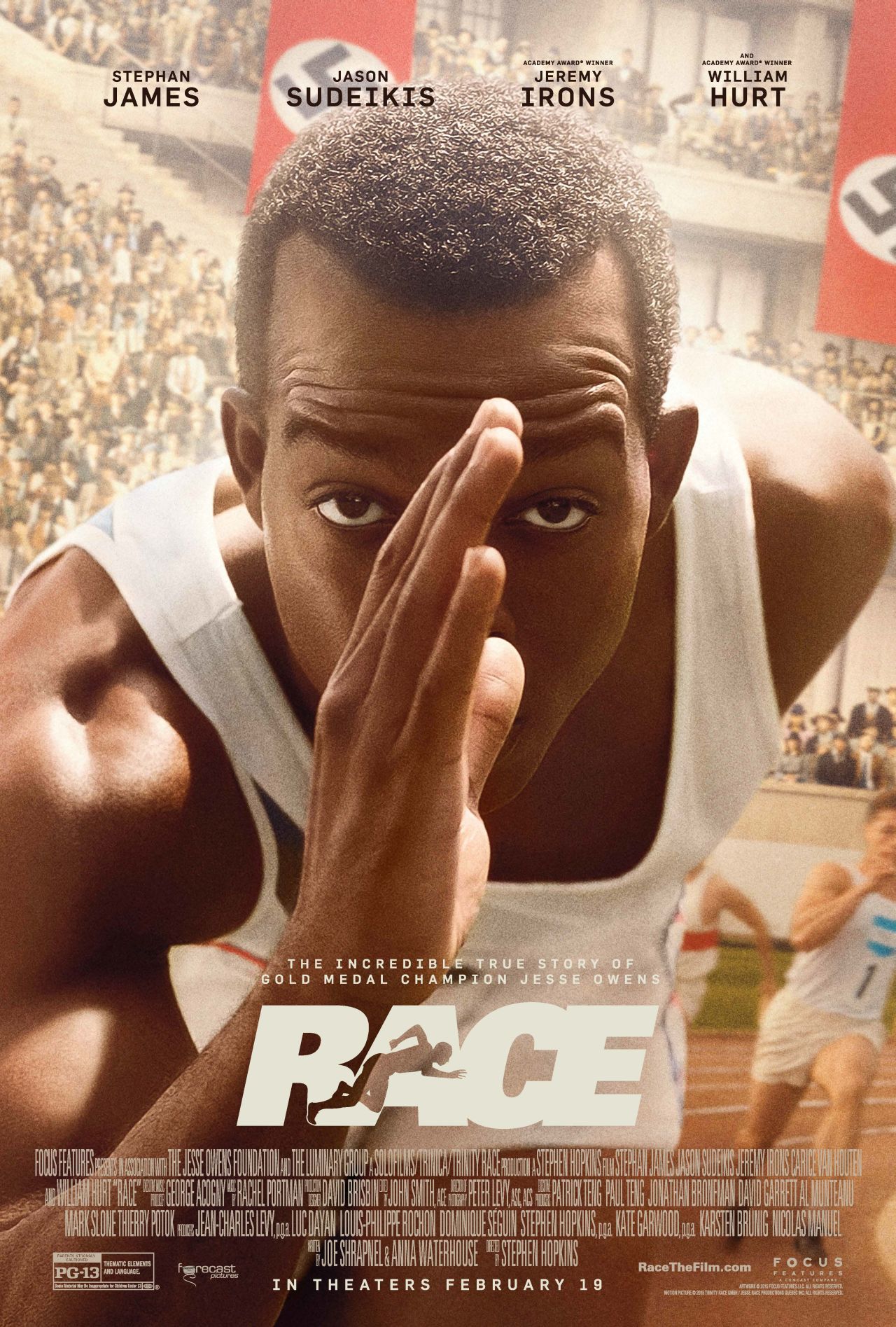
Race

D: Stephen Hopkins / 134m

Cast: Stephan James, Jason Sudeikis, Jeremy Irons, Carice van Houten, Eli Goree, Shanice Banton, David Kross, Jonathan Higgins, Tony Curran, Barnaby Metschurat, Chantel Riley, William Hurt, Glynn Turman

Made with the support of Jesse Owens’ family, Race follows Owens as he enrols at Ohio State University in 1933, meets athletics coach Larry Snyder who teaches him how to be a better sprinter, and on through until his appearance at the 1936 Olympics, held in Berlin. It’s a powerful story, and Owens’ performance at the Games is legendary… which makes Race all the more surprising for how tame it is, and how unsure it is in what it wants to say.

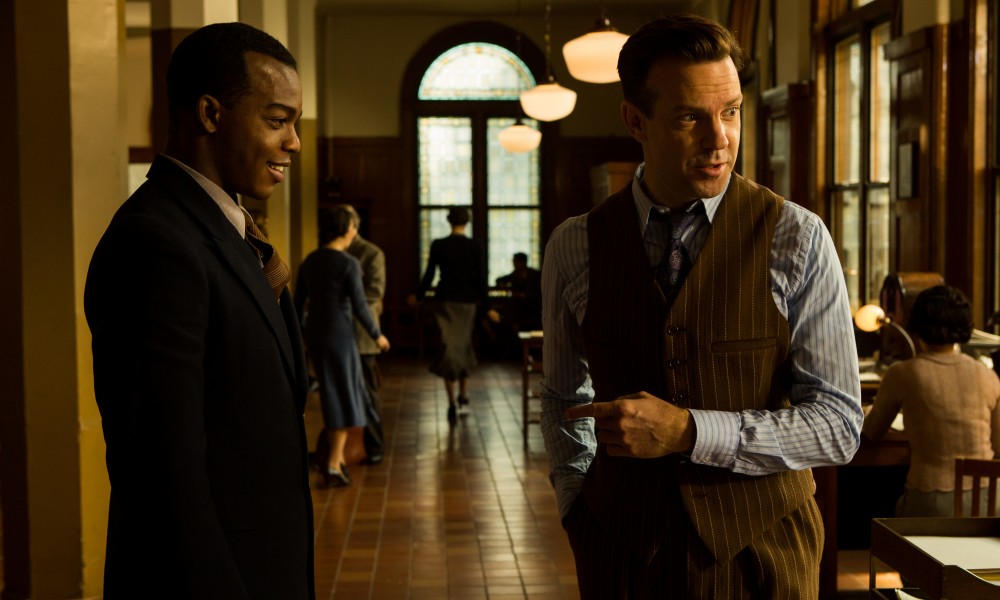
As biopics go, it’s all standard stuff. We see Owens (James) as a young man saying goodbye to his sweetheart (and mother of his child), Ruth (Banton) before he heads off to Ohio State University. Once there, he encounters a predictable amount of systemic and endemic racism from pupils and staff alike, but concentrates on what he can do on the running track. Attracting the attention of athletics coach Larry Snyder (Sudeikis), Owens dispels any doubts about his abilities by matching the fastest recorded time in the 100 metre dash, and doing it as casually as if it were just “one of those things”. It’s not long before Snyder is talking about the 1936 Olympics, and Owens representing his country in Nazi Germany.

Race - scene3

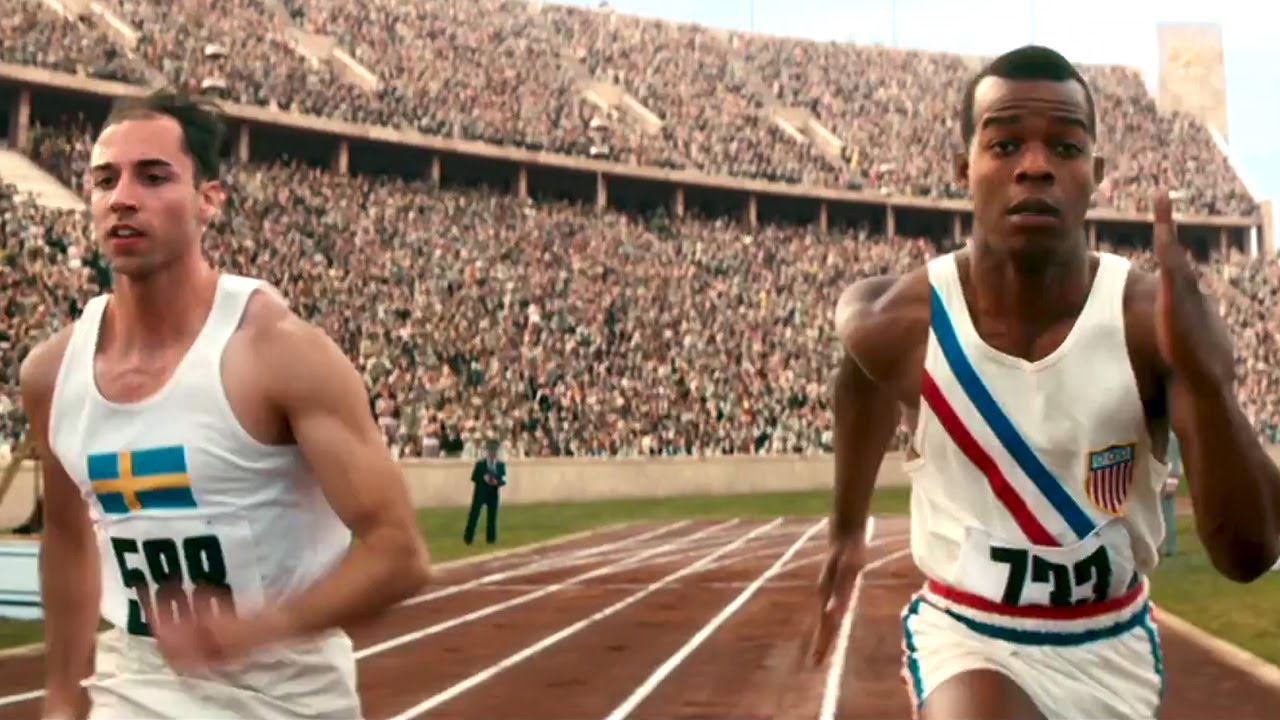
Before then there’s the small matter of the 1935 Big Ten track meet in Ann Arbor, Michigan where Owens’ set three world records and tied a fourth in under an hour, his marriage to Ruth, and the political manoeuvrings that saw the US agree to compete in the 1936 Olympics once their envoy, construction magnate Avery Brundage (Irons), had negotiated terms with Dr Goebbels (Metschurat). With these things in place, Owens and the US team arrive in Berlin and begin preparations for the Games. Once they begin, it doesn’t take Owens long to disprove the Nazis’ idea of Aryan supremacy. He wins four gold medals: in the 100 metres, the 200 metres, the broad (long) jump, and the 4×100 metre relay (which was ironic as he replaced a Jewish runner who was dropped thanks to last-minute political expediency). History is made, and in the most bittersweet of circumstances.

Race covers all this, and more, but fails to make it interesting for the viewer, instead falling back on the kind of biopic clichés that were old back in the era Owens was breaking track records like they were nothing of importance. It also tries to cram in too much in the way of subplots, particularly in the way that Leni Riefenstahl (van Houten) goes about filming the Games, and often in defiance of Goebbels and his indifference to her efforts. Riefenstahl’s presence in the movie is surprising, as the movie could have worked well enough without her. Instead we’re treated to Riefenstahl acting as an unofficial interpreter/translator for Goebbels, and van Houten struggling to look intimidated when necessary. Riefenstahl keeps cropping up, and after a while you begin to wonder if she was as involved as the movie makes her out to be.
Race - scene2

The effect of all these subplots and extraneous storylines is to (almost) make Owens a secondary character in his own biopic. And one unfortunate romantic dalliance aside, Owens is given the kind of never-do-wrong attributes that hype the legend instead of portraying the man behind the legend. As Owens, James is confident enough, but doesn’t seem able to go beyond the script’s insistence on making Owens as unaffectedly noble as possible, and in some respects, operating in a vacuum that leaves him unaware of the political and racial maelstrom going on around him once he’s in Germany. This leads to an awkward scene where Snyder wanders around Berlin and just happens to see a group of Jews being rounded up at the end of a back street. There are other moments where the era’s ugly racism is pushed to the forefront, but strangely, there’s more of it on display in the US than there is in Berlin.

By failing to make the inherent drama of Owens’ participation, well… dramatic, the movie never fully engages the audience, or allows it to become emotionally invested in the man’s achievements (although the focus is rightly on the Olympics, his achievement at Ann Arbor carries more resonance). Left with little to identify with beyond the casual attempts at characterisation made by Joe Shrapnel and Anna Waterhouse’s banal script, the viewer has no choice but to sit back and hope that the movie remembers he or she is there at some point, but without any guarantees that this will happen.
Race - scene1

The cast do their best but the odds are stacked against them. Sudeikis dials down the comic charm he uses elsewhere but can do little with a role that requires him to take a back seat once Berlin rolls around, and which seems there to mainly provide Owens with motivational pep talks when he needs them. Irons is all capitalist swagger as the man who demanded superficial concessions from Nazi Germany in return for the US’s taking part in the Games, while as mentioned above, van Houten enjoys a bigger role as Riefenstahl than it’s likely she had historically. Of the rest of the cast, only Metschurat stands out as an icy, thuggish-looking Goebbels who wouldn’t look out of character if he was wearing braces and Doctor Martens boots.

Attempting to make a cohesive whole out of so many disparate strands, director Stephen Hopkins instead places a similar feel and importance on all of them, leading to a movie that moves seamlessly from one scene to the next without ever rising or falling in terms of the low-key drama, or tinkering with the tone of the movie. Hopkins has had a varied career, but while this isn’t his first biopic – he also made The Life and Death of Peter Sellers (2004) – this is his first “prestige” picture, and he falls back on the kind of easy choices that a first-timer might make, and in doing so, fails to charge the movie with the kind of energy that would draw in an audience and keep them glued to their seats.

Rating: 5/10 – not quite an also-ran, but near enough, Race plays liberally with the connotations of its title but is ultimately too lightweight in its execution to be a pointed, and poignant, reflection of the period it covers; Owens was an exceptional athlete, and while the movie does acknowledge this, what it doesn’t do is raise its own game to match that of its subject.
Share this:

  • Click to share on X (Opens in new window) X
  • Click to share on Facebook (Opens in new window) Facebook
  • More
  • Click to print (Opens in new window) Print
  • Click to email a link to a friend (Opens in new window) Email
Like Loading...

Unbroken (2014)

26 Thursday Feb 2015

Posted by dullwood68 in Movies

≈ 1 Comment

Tags

1936 Olympics, Angelina Jolie, Athlete, Domhnall Gleeson, Jack O'Connell, Japan, Literary adaptation, Louis Zamperini, Miyavi, Mutsuhito "Bird" Watanabe, P.O.W. camp, Review, World War II

Unbroken

D: Angelina Jolie / 137m

Cast: Jack O’Connell, Domhnall Gleeson, Miyavi, Garrett Hedlund, Finn Wittrock, Jai Courtney, Luke Treadaway, C.J. Valleroy

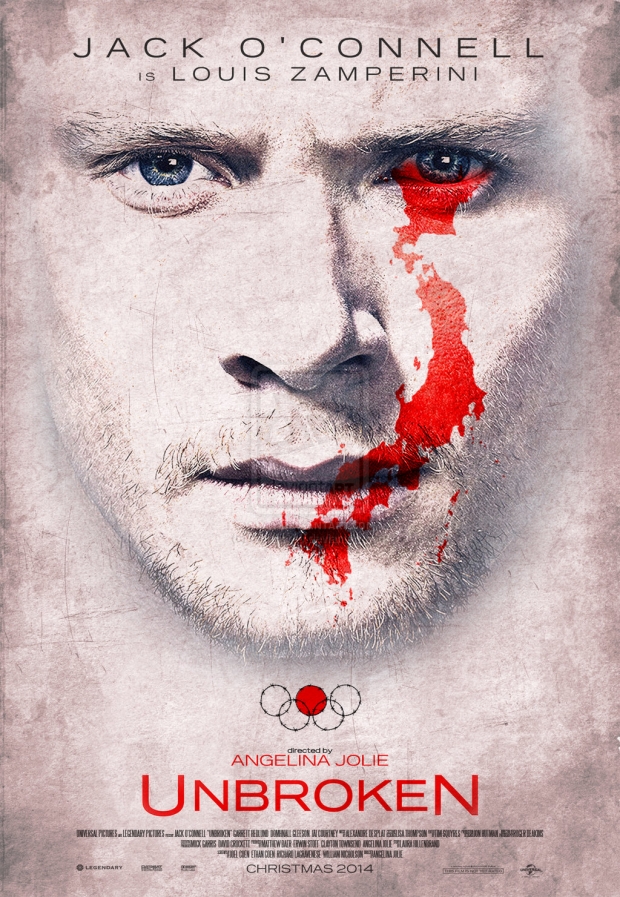
As a young child, Louis “Louie” Zamperini (Valleroy) is always getting into trouble, whether it’s through stealing or drinking. He’s also bullied at school because of his Italian roots. One day he’s caught looking up women’s dresses from beneath the bleachers at a track meet. He makes a run for it which is witnessed by his older brother, Pete. Realising how fast Louie can run, Pete decides to train him to be a runner. Louie earns a name for himself and as a young man (O’Connell) is chosen to represent the US at the 1936 Olympics in Berlin. He does well and sets a record for running the final lap of the 5000 metre race.

In 1943, Louie is a bombardier in the United States Army Air Force, stationed in the Pacific. On a search and rescue mission, his plane crashes into the ocean, leaving himself and two of his crew, Phil (Gleeson) and Mac (Wittrock), adrift in two inflatable rafts. Fighting off starvation and the attention of marauding sharks, they survive as a trio until the thirty-third day when Mac dies. On the forty-seventh day Louie and Phil are rescued by a Japanese military ship. Now prisoners of war they’re initially interrogated for information about the Allies and then transferred to separate P.O.W. camps. Louie ends up at a camp in Tokyo that is overseen by Corporal Mutsuhito “Bird” Watanabe (Miyavi). Watanabe makes a point of mistreating Louie, partly because of his fame as an Olympian, and partly out of jealousy.

Louis is given the opportunity to make a radio broadcast that will be heard in the US. He’s able to reassure his family that he’s alive, but when he’s asked to make a second broadcast that’s critical of the US, he refuses. Sent back to the camp, Watanabe makes all the other prisoners line up and punch Louie in the face as a punishment for not making the broadcast. Two years pass. Watanabe is promoted and leaves the camp, much to Louie’s relief. But when the camp is damaged in a bombing raid by US planes, the prisoners are moved to another camp where it transpires that Watanabe is in charge. Watanabe’s mistreatment of Louie continues, until one day when Louie’s resilience and inner strength lead to Watanabe being embarrassed in front of his men and the rest of the P.O.W.s.

Unbroken - scene

Adapted from the book Unbroken: A World War II Story of Survival, Resilience, and Redemption by Laura Hillenbrand, Angelina Jolie’s directorial debut is a sincere yet curiously dull affair that never quite engages the viewer, despite its obviously worthy subject matter. Zamperini’s plight was horrendous and yet this is a surprisingly sanitised version of events, with only Watanabe’s bouts of cruelty giving the movie any edge (it’s a strange movie that makes the viewer want to see more abuse in order to make it more involving).

This is partly to do with the script – a combination of drafts and rewrites carried out by William Nicholson, Richard LaGravenese and Joel and Ethan Coen – and the directorial decisions made by Jolie. The script does a good job in reflecting Louie’s life as a child, and it’s these early scenes that have the greatest impact, with their nostalgic appreciation for an earlier, more innocent time. Jolie paints these scenes in a rosy hue and quickly establishes a mood for the movie that the audience can appreciate as being straightforward and unfussy. But once Louie is adrift on the ocean it’s where things begin to unravel, and the movie loses traction. The drama begins to leak out of the movie just as it should start to be truly engrossing, and nothing Jolie does from then on ever comes close to retrieving it.

Once Louie arrives at the P.O.W. camp and encounters Watanabe, Unbroken settles into a predictable series of abusive moments that give O’Connell repeated chances to adequately display Louie’s agony and suffering, and Miyavi the chance to impart a degree of homoerotic self-loathing. There’s a surprising lack of tension to these scenes, and Jolie’s direction of them seems to be carried out at a distance, as if her respect for the material is stopping her from taking any risks. As a result, the audience becomes more of a spectator than a participant and the movie becomes unrewarding.

The movie isn’t helped either by some annoying inconsistencies. After spending forty-seven days adrift at sea, Louie and Phil’s physical deterioration is persuasively shown in a scene where they’re made to strip naked (Gleeson looks really awful). And yet it’s all undone by their carefully groomed facial hair – or lack of it – and equal lack of sunburn. It all contributes to the idea that what Jolie is going for is war-lite, a diffusion of the horrors that really happened, and while this isn’t a bad idea per se – we don’t always need to see just how bad things actually were – here it’s as if she’s taken basic notions of heroism and courage and made them more about stoicism and acceptance.

Unfortunately as well, Jolie fails to raise her cast’s performances above the level of satisfactory, with only Miyavi making any impression, his bland mask of a face hiding a dangerous sadism that seems to pain him as much as it pleases him. In contrast, O’Connell’s rise to international stardom takes a stumble. It’s not his fault, he’s just not given much to work with other than “look worried, look despairing, and grimace in pain”. With these constraints in place, he looks stranded at times, as if he knows he should be giving more but has been instructed not to.

Despite all this, there are some good things about the movie, not the least of which is Alexandre Desplat’s emotive, intimate score, and Roger Deakins’ Oscar nominated cinematography. The former is one of the composer’s best works in recent years and lifts the movie out of the doldrums with ease, and unobtrusively as well. Deakins is a master of lighting and mood, and he has an instinctive way of placing the camera, which helps Jolie’s pedestrian approach tremendously. Together, these two elements give the movie a boost it would have missed out on altogether.

Rating: 5/10 – lacking passion and drive, Unbroken is a dull, ponderous affair that is a less than rewarding experience for the viewer; as a tribute to Louis Zamperini’s fortitude and spirit, it could certainly have been more dramatic, but as a (very) low-key examination of one man’s will to survive it fares slightly better.

Share this:

  • Click to share on X (Opens in new window) X
  • Click to share on Facebook (Opens in new window) Facebook
  • More
  • Click to print (Opens in new window) Print
  • Click to email a link to a friend (Opens in new window) Email
Like Loading...

Blog Stats

  • 486,528 hits

Recent Posts

  • 10 Reasons to Remember Bibi Andersson (1935-2019)
  • Fantasia (1940)
  • Dances With Wolves (1990) – The Special Edition
  • Kiss of the Spider Woman (1985)
  • The Three Musketeers (1973)

Top Posts & Pages

  • Lost for Life (2013) - Another Look
    Lost for Life (2013) - Another Look
  • Lost for Life (2013)
    Lost for Life (2013)
  • About
    About
  • Mr. Topaze (1961)
    Mr. Topaze (1961)
  • Billy Lynn's Long Halftime Walk (2016)
    Billy Lynn's Long Halftime Walk (2016)
  • Winter's Tale (2014)
    Winter's Tale (2014)
  • The Hitman's Bodyguard (2017)
    The Hitman's Bodyguard (2017)
  • 5 Famous Movie Roles That Nearly Went to Someone Else
    5 Famous Movie Roles That Nearly Went to Someone Else
  • The Layover (2017)
    The Layover (2017)
  • Transcendence (2014)
    Transcendence (2014)
Follow thedullwoodexperiment on WordPress.com

Blogs I Follow

  • Rubbish Talk
  • Film 4 Fan
  • Fast Film Reviews
  • The Film Blog
  • All Things Movies UK
  • Interpreting the Stars
  • Let's Go To The Movies
  • Movie Reviews 101
  • TMI News
  • Dan the Man's Movie Reviews
  • Film History
  • Jordan and Eddie (The Movie Guys)

Archives

  • April 2019 (13)
  • March 2019 (28)
  • February 2019 (28)
  • January 2019 (32)
  • December 2018 (28)
  • November 2018 (30)
  • October 2018 (29)
  • September 2018 (29)
  • August 2018 (29)
  • July 2018 (30)
  • June 2018 (28)
  • May 2018 (24)
  • April 2018 (21)
  • March 2018 (31)
  • February 2018 (25)
  • January 2018 (30)
  • December 2017 (30)
  • November 2017 (27)
  • October 2017 (27)
  • September 2017 (26)
  • August 2017 (32)
  • July 2017 (32)
  • June 2017 (30)
  • May 2017 (29)
  • April 2017 (29)
  • March 2017 (30)
  • February 2017 (27)
  • January 2017 (32)
  • December 2016 (30)
  • November 2016 (28)
  • October 2016 (30)
  • September 2016 (27)
  • August 2016 (30)
  • July 2016 (30)
  • June 2016 (31)
  • May 2016 (34)
  • April 2016 (30)
  • March 2016 (30)
  • February 2016 (28)
  • January 2016 (35)
  • December 2015 (34)
  • November 2015 (31)
  • October 2015 (31)
  • September 2015 (34)
  • August 2015 (31)
  • July 2015 (33)
  • June 2015 (12)
  • May 2015 (31)
  • April 2015 (32)
  • March 2015 (30)
  • February 2015 (37)
  • January 2015 (39)
  • December 2014 (34)
  • November 2014 (34)
  • October 2014 (36)
  • September 2014 (25)
  • August 2014 (29)
  • July 2014 (29)
  • June 2014 (28)
  • May 2014 (23)
  • April 2014 (21)
  • March 2014 (42)
  • February 2014 (38)
  • January 2014 (29)
  • December 2013 (28)
  • November 2013 (34)
  • October 2013 (4)

Blog at WordPress.com.

Rubbish Talk

Film 4 Fan

A Movie Blog

Fast Film Reviews

The Film Blog

The official blog of everything in film

All Things Movies UK

Movie Reviews and Original Articles

Interpreting the Stars

Dave Examines Movies

Let's Go To The Movies

Film and Theatre Lover!

Movie Reviews 101

Daily Movie Reviews

TMI News

Latest weather, crime and breaking news

Dan the Man's Movie Reviews

All my aimless thoughts, ideas, and ramblings, all packed into one site!

Film History

Telling the story of film

Jordan and Eddie (The Movie Guys)

Movie Reviews & Ramblings from an Australian Based Film Fan

Privacy & Cookies: This site uses cookies. By continuing to use this website, you agree to their use.
To find out more, including how to control cookies, see here: Cookie Policy
  • Subscribe Subscribed
    • thedullwoodexperiment
    • Join 481 other subscribers
    • Already have a WordPress.com account? Log in now.
    • thedullwoodexperiment
    • Subscribe Subscribed
    • Sign up
    • Log in
    • Report this content
    • View site in Reader
    • Manage subscriptions
    • Collapse this bar
 

Loading Comments...
 

    %d