• 10 Reasons to Remember…
  • A Brief Word About…
  • About
  • For One Week Only
  • Happy Birthday
  • Monthly Roundup
  • Old-Time Crime
  • Other Posts
  • Poster of the Week
  • Question of the Week
  • Reviews
  • Trailers

thedullwoodexperiment

~ Viewing movies in a different light

thedullwoodexperiment

Tag Archives: Adaptation

A Long Way Down (2014)

14 Monday Jul 2014

Posted by dullwood68 in Movies

≈ 1 Comment

Tags

Aaron Paul, Adaptation, Comedy, Drama, Imogen Poots, New Year's Eve, Nick Hornby, Pascal Chaumeil, Pierce Brosnan, Suicide, Toni Collette, Valentine's Day
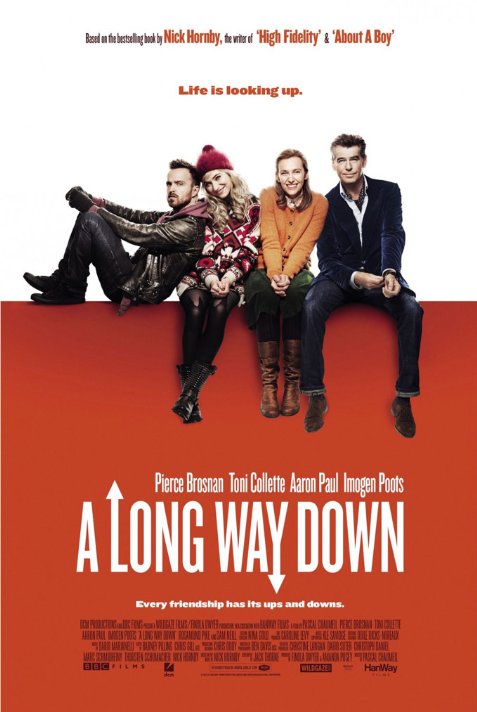
Long Way Down, A

D: Pascal Chaumeil / 96m

Cast: Pierce Brosnan, Toni Collette, Imogen Poots, Aaron Paul, Sam Neill, Rosamund Pike, Tuppence Middleton, Joe Cole, Leo Bill, Josef Altin

On New Year’s Eve, four very different people find themselves on the roof of a London tower block, and all with the same idea: to commit suicide.  There’s disgraced TV celebrity Martin (Brosnan), shy, apologetic Maureen (Collette), politician’s daughter Jess (Poots), and pizza delivery guy JJ (Paul).  With all of them unable to go through with their plans (and each actively stopping the rest from jumping), the quartet decide to make a pact: that none of them will try to kill themselves until Valentine’s Day.  Later that night, Jess accidentally O.D.’s in a club; with the aid of Jess’s boyfriend, Chas (Cole), the others get her to hospital.  News of their attempted suicides reaches the press and they all become minor celebrities. Martin suggests they use the attention to make some money, and they take part in interviews, and talk shows.  When one talk show appearance goes wrong, the four decide to go away together on holiday.

The trip proves to be yet another disaster, with JJ unknowingly befriending a journalist (Middleton) and further tensions arise when he also reveals something about himself that only Jess knows (and has kept to herself).  The group return to London and go their separate ways (though each in their own way keeps tabs on the others, except for JJ).  As Valentine’s Day draws near, JJ vanishes.  On the day itself, the others find him back on the roof of the tower block, and ready to kill himself.
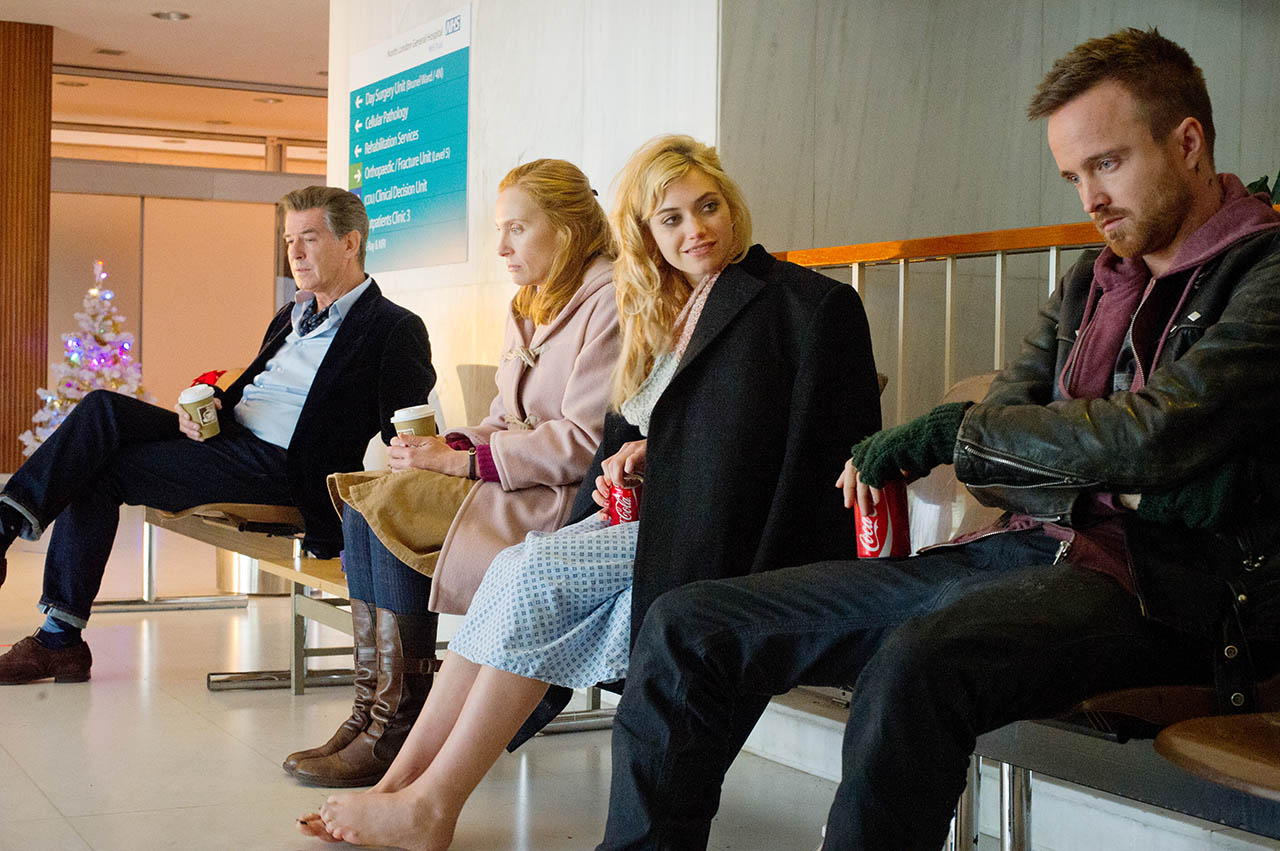
Long Way Down, A - scene

Adapted from the novel by Nick Hornby, A Long Way Down takes a serious subject and uses it as the springboard for a sporadically dramatic, essentially lightweight comedy that never quite fires on all cylinders, and has enough awkward moments for two movies, let alone one.  The problems lie in the characters themselves.  Martin’s back story includes time in prison for sleeping inadvertently with a fifteen year old girl, and this is treated largely as an excuse for amusement, with Brosnan mugging for all he’s worth when the subject is brought up.  Maureen has a severely disabled son, Matty (Altin) that she no longer feels she can support adequately, but it’s obvious that she has a really good support network around her so the dramatic elements of her situation never really ring true.  Jess is almost a caricature of every wild child and rebellious daughter of an establishment figure you’re ever likely to encounter, and her sadness over the disappearance of her sister is briefly explored and then forgotten.  As for JJ, his character is the most maddening of them all, with his failed musical background and resulting depression proving hard to sympathise with, or appreciate.

While the movie works hard to flesh out these characters, and make their individual problems worthy of our concern, it’s unable to do so by virtue of their predicament being too artificial for its own good.  At no time in the movie do you really feel that any one of these disparate people really, truly wants to kill themselves, and so any drama in the two rooftop sequences that bookend the movie is immediately eliminated.  And as mentioned above, their individual dilemmas, particularly Martin’s, don’t hold the attention as well, or as much, as they should.  This all leaves the movie lurching from one lacklustre scene to another, its attempts at humour proving occasionally successful, its dramatic approach having no bite, and its supporting characters – from Jess’s dad (Neill) to Pike’s deliberately insensitive talk show host – endorsing the view that the main four characters aren’t that interesting.

As a result, it’s fitting that the performances are as equally uninspired as the movie itself.  Brosnan plays Martin as a bit of a buffoon, good-natured but with an often spectacular misunderstanding of the people around him, his unfortunate “indiscretion” treated like a minor inconvenience blown out of all proportion.  Brosnan’s an accomplished actor but here he seems unable to get to grips with such a poorly crafted character.  Collette has the least showy role, and fares better than the rest, her understated performance as Maureen the nearest the movie gets to providing someone for the audience to relate to; her scenes with Altin are genuinely affecting, but belong in a different movie.  Poots plays Jess as a whirling dervish, snappy and borderline obnoxious, her quieter scenes more convincing than the ones where she’s supposed to be the challenging anti-establishment rebel.  Paul, meanwhile – the predictably token American in the cast – does his best with a role that becomes more and more important as the movie goes on, but he can’t overcome the clumsy way in which JJ is written.

There’s a better movie to be made here, and while it’s clear the material is a challenge, A Long Way Down doesn’t even attempt to play up the more darkly humorous aspects of the group’s situation or elevate the drama inherent in such a premise.  The movie seems determined not to make things too uncomfortable for the audience, to play things down to make them more palatable (and presumably, more box office friendly).  It’s an obvious decision on the part of the producers (unfortunately) but it doesn’t help the movie at all.

Rating: 5/10 – not as dramatic or as funny as it looks, A Long Way Down struggles to be as emotionally involving as it should be; with no one to connect with, the movie loses focus early on and never really recovers, leaving its characters to stumble on until the movie’s predictably feel good ending.



Share this:

  • Click to share on X (Opens in new window) X
  • Click to share on Facebook (Opens in new window) Facebook
  • More
  • Click to print (Opens in new window) Print
  • Click to email a link to a friend (Opens in new window) Email
Like Loading...

Endless Love (2014)

08 Tuesday Jul 2014

Posted by dullwood68 in Movies

≈ Leave a comment

Tags

Adaptation, Alex Pettyfer, Bruce Greenwood, Drama, Gabriella Wilde, High School, Remake, Romance, Scott Spencer novel, Shana Feste, Violent past

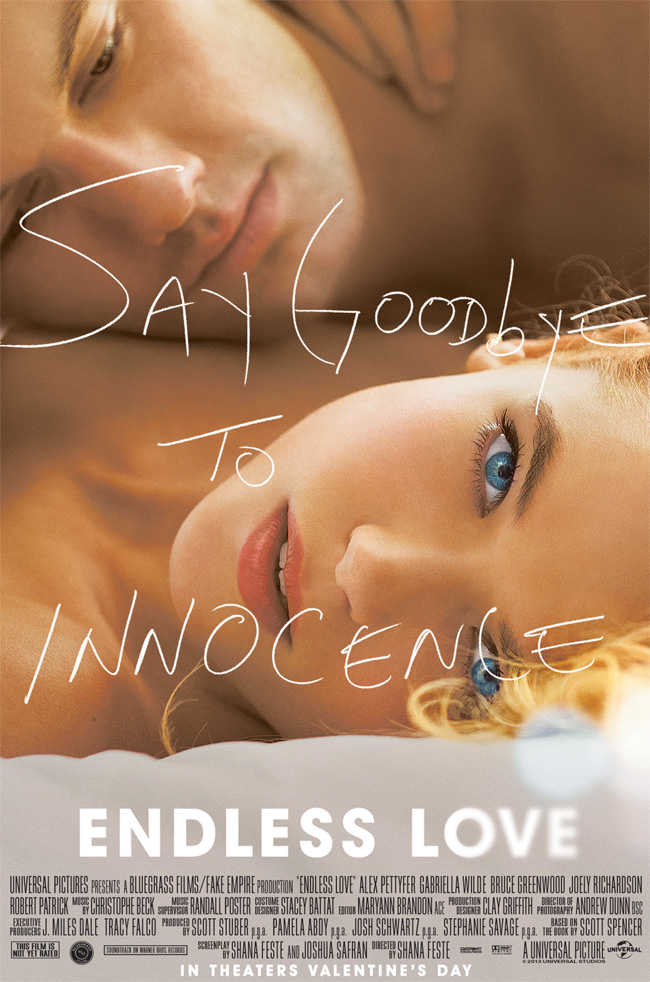
Endless Love (2014)

D: Shana Feste / 104m

Cast: Alex Pettyfer, Gabriella Wilde, Bruce Greenwood, Joely Richardson, Robert Patrick, Rhys Wakefield, Dayo Okeniyi, Emma Rigby, Anna Enger

Jade Butterfield (Wilde) is a quiet, studious teenager just graduated from high school.  She hasn’t made many friends, but she has caught the attention of David Elliot (Pettyfer).  He catches her eye at their graduation ceremony, and so begins a tentative romance made awkward by the difference in their social standing.  Jade’s father, Hugh (Greenwood) is an eminent surgeon; David’s father, Harry (Patrick) has an auto shop in town.  Jade is due to take up a medical internship in two weeks and follow in her father’s footsteps; David wants to follow in his father’s footsteps too – each has a sense of familial duty that’s important to them.  When Jade decides to hold a party for everyone in her year, it’s only David who turns up.  With help from his friend, Mace (Okeniyi), David manipulates their high school friends into attending.  Jade and David realise their attraction for each other, and Hugh becomes aware of this as well.  He’s not happy about it, though, and does his best to stop any relationship before it begins.

Despite his best efforts, Jade and David spend more and more time together.  They’re so passionate about each other that Jade decides not to leave to begin her internship, and instead opts to spend the rest of the summer with David.  When she tells her father this he reacts by forcing her to join him and the rest of the family – mum Anne (Richardson), brother Keith (Wakefield) and his girlfriend, Sabine (Enger) – on a trip to their lakeside summer home.  Jade retaliates by inviting David along.  Her father continues his enmity toward David and learns he has a history of violence.  When Jade and David run into Mace and David’s ex-girlfriend Jenny (Rigby), they’re persuaded to go with them to a zoo after it’s closed.  When Jenny (who still harbours hopes of winning David back) sees how Jade means to him, she calls the police and rats them all out.  When the police arrive, David draws them away from everyone else, but is arrested.

Jade expects her dad to help get David out of jail but he refuses and he tells her about David’s violent past.  Seeing how important David is to her, Hugh relents and gets David sprung from jail but they argue and David knocks Hugh to the ground.  When she confronts David about it, it leads to her being in a car accident.  Later, at the hospital, Hugh tells Harry he’s taken out a restraining order to keep David from coming within fifty feet of Jade.  With their relationship apparently over, Jade leaves for college and begins seeing a fellow student.  David meanwhile, stays at home, until a chance encounter with Anne leads to the realisation that, restraining order or not, he has to see Jade and win her back.

Endless Love - scene

The second adaptation of Scott Spencer’s novel, Endless Love is endlessly sappy, and endlessly derivative of just about every other teen romance you’ve ever seen (viewers unaware of the movie’s literary origin could be forgiven for thinking they’re watching another Nicholas Sparks adaptation).  David only has to glance in Jade’s direction and she’s instantly smitten, her years of social and personal reserve dumped by the wayside in a matter of seconds.  She also turns out to be quite the hussy, acting provocatively and kittenish around David until the night she decides it’s time they should take things to the “next level”.  Throughout this period of getting to know each other, it becomes clear that Jade is the subtly demanding modern princess, and David the noble savage she has ensnared.  It’s an interesting take on the standard roles you might expect from the scenario quoted above, but it’s abandoned as soon as the script requires Hugh to take centre stage and amp up the villainy needed to give the story some actual bite.

Of course, Hugh is meant to be a misunderstood, over-protective father (more so in the wake of the recent death of Jade’s other brother, Chris), but as Jade and David are staple characters in this kind of thing, so too is Hugh that other staple of the romantic drama, the man that David has to wrest Jade away from.  Sadly, the script tries to give Hugh some depth, and has him vacillate over whether to welcome David with open arms or closed fists.  With Greenwood required to leap both ways – often in the same scene – and on more than one occasion, Hugh becomes a bit of a distraction, but unfortunately a necessary one, as leading thesps Pettyfer and Wilde have their work cut out for them making their characters worth spending time with in the first place.  It’s not their fault, it’s just that Jade and David are about as exciting to watch as those airplane safety videos.  Once they’ve had sex, their story heads for their inevitable falling out with all the haste of a marathon runner intent on reaching the next water station.

If there’s anything about Endless Love that isn’t dispiriting it’s the performance of Richardson; she at least recognises the paucity of the drama on offer and adapts her depiction of Anne’s unhappiness accordingly.  Whenever she’s on screen the movie seems to improve just by having her there.  The same can’t be said of Pettyfer, who looks uncomfortable throughout, while Wilde seems intent on doing the bare minimum required to  make her dialogue sound just this side of reasonable.  Both actors are more than capable but here they seem unable to raise their game and defeat the shopworn elements that make up writer/director Feste’s lukewarm script.  Her direction is unfortunately quite pedestrian and the movie lacks a definitive visual style that might have lifted it up a little.  With a soundtrack that offers songs as indicators of the emotional content on screen (like Cliff notes, but with added harmonies), Endless Love has the feel of a movie that had better intentions than those that were actually delivered.

Rating: 4/10 – bland, and with plot developments that are signposted in bright neon lights, Endless Love is a remake that probably sounded like a good idea at the time; however, the finished product is a salient reminder that not every “good” idea should be acted upon.

Share this:

  • Click to share on X (Opens in new window) X
  • Click to share on Facebook (Opens in new window) Facebook
  • More
  • Click to print (Opens in new window) Print
  • Click to email a link to a friend (Opens in new window) Email
Like Loading...

The End (2012)

03 Thursday Jul 2014

Posted by dullwood68 in Movies

≈ Leave a comment

Tags

Adaptation, Clara Lago, Daniel Grao, Drama, End of the world, Fin, Jorge Terregrossa, Maribel Verdú, Mountains, Sci-fi, Spain, The Prophet, Vanishing people

Fin

Original title: Fin

D: Jorge Terregrossa / 92m

Cast: Maribel Verdú, Daniel Grao, Clara Lago, Carmen Ruiz, Andrés Velencoso, Miquel Fernández, Blanca Romero, Antonio Garrido, Eugenio Mira, Sofía Herraiz

Six friends who haven’t gotten together in twenty years meet up at a cabin in the mountains for a reunion.  Félix (Grao) brings along his new girlfriend, Eva (Lago), while Hugo (Velencoso) brings his wife, Cova (Romero).  Sara (Ruiz), who contacted everyone, is single, as is Sergio (Fernández).  This leaves the two friends who have married each other, Maribel (Verdú) and Rafa (Garrido).  With everyone arrived, there’s only Ángel (Mira) to wait for.  Ángel isn’t well-liked by the men in the group, their behaviour toward him in the past leading to Ángel having a breakdown and spending most of the next twenty years in a mental institution; only Sara has kept in touch with him.  It’s not long before old feuds and animosities begin to be aired, and round a campfire that first night, various personal grievances are revealed as still being close to the surface.  And with Ángel still not having arrived, things get heated until there they all hear a strange sound that seems to tear apart the very air. Moments later, they realise that there is no electrical power, and that batteries won’t work either.

The next morning, the group learns that there is still no mains power, that the telephone doesn’t work, and that Rafa has disappeared.  Everyone hikes down to the nearest house but they find it deserted, though there is evidence that whoever lived there, they left in a hurry.  Deciding to carry on to the nearest town, the group takes a short cut through a gorge but along the way, a member of the group vanishes into thin air.  Frightened by all these strange events, and by the realisation that any one of them might be the next to disappear, they continue to head for the nearest town.  The next morning, someone else has disappeared but the remainder continue their journey; the scene of a car crash provides a startling discovery, and stopping at a pool later on, the group is reduced to four.  At one house they find themselves pursued by a pack of hungry dogs, and this leads to four becoming three.  These three reach the town, and there they encounter a little girl.  The girl runs from them but when they finally catch up with her, it’s only one of them who discovers exactly what’s happening…

End, The - scene

Adapted from the novel by David Monteagudo, The End is a somewhat languidly paced end-of-the-world drama that, wisely, never attempts to explain what’s happening or why, and keeps itself focused settled on the characters and how they cope with the mystery unfolding around them.  The early scenes, with the friends’ long-buried grievances quickly being disinterred, suggest that the movie’s title may well be a metaphor for the end of the group’s closeness and love for each other (though the inter-relationships do appear fragile from the outset).  But from the moment when Félix notices that Sirius is no longer visible in the night sky, the movie begins to shift into something more threatening and mysterious.  Practical considerations give way to a growing sense of unease as their journey sees their numbers dwindle, and hidden truths are revealed.  It’s a deliberately low-key approach, with the screenplay by Sergio G. Sánchez and Jorge Guerricaechevarría providing sparse character histories and yet making Ángel a key player despite his absence.

There’s much to like here but under the direction of Torregrossa there’s also a lack of heightened tension, with only one disappearance given its proper due, a beautifully awful moment that occurs in the aftermath of the remaining group being chased by dogs.  The rest of the journey fails to match up to that one moment and is more a matter of guessing which character will vanish next (and even that’s not too difficult to work out).  With such a limitation built in from the outset, The End risks underselling the gravity and enormity of its central conceit, and there are too many instances where the same observations are made over and over again, but thanks to some enthusiastic, resolute performances, the movie overcomes these obstacles with a large measure of understated confidence.  As one-time lovers, Verdú and Grao give the most appealing and solid performances, and there’s able support from Lago and newcomer Velencoso, but it’s Ruiz who captures the attention, her growing panic and fear realised with sweaty intensity.

The movie makes the most of its mountain locations and the sweeping vistas are breathtakingly filmed by cinematographer José David Montero (indeed, some shots wouldn’t have gone amiss in the Lord of the Rings trilogy).  There’s an interesting, relaxed score courtesy of Lucio Godoy that supports the emotional and dramatic currents that run throughout the movie, and despite the slow, deliberate pace, the whole thing is assiduously edited by Carolina Martínez Urbina.  Torregrossa handles the themes of betrayal, regret and redemption with assurance, and if not every plot strand is resolved or addressed it’s because the nature of the drama prevents it.  And the ending, despite all that’s gone before, ends on a hopeful note that stops the movie from being completely nihilistic.

Rating: 7/10 – a quietly atmospheric drama that unsettles its audience in small, unobtrusive ways, The End builds uncomfortably to an ending that is both tragic and promising; far more affecting than at first viewing, this is one movie that makes a virtue of being modest.

Share this:

  • Click to share on X (Opens in new window) X
  • Click to share on Facebook (Opens in new window) Facebook
  • More
  • Click to print (Opens in new window) Print
  • Click to email a link to a friend (Opens in new window) Email
Like Loading...

Blog Stats

  • 480,357 hits

Recent Posts

  • 10 Reasons to Remember Bibi Andersson (1935-2019)
  • Fantasia (1940)
  • Dances With Wolves (1990) – The Special Edition
  • Kiss of the Spider Woman (1985)
  • The Three Musketeers (1973)

Top Posts & Pages

  • Lost for Life (2013) - Another Look
    Lost for Life (2013) - Another Look
  • Lost for Life (2013)
    Lost for Life (2013)
  • Cardboard Boxer (2016)
    Cardboard Boxer (2016)
  • Bone Tomahawk (2015)
    Bone Tomahawk (2015)
  • Spotlight (2015)
    Spotlight (2015)
  • Jungle (2017)
    Jungle (2017)
  • Lost and Delirious (2001)
    Lost and Delirious (2001)
  • The Monuments Men (2014)
    The Monuments Men (2014)
  • About
    About
  • Homefront (2013)
    Homefront (2013)
Follow thedullwoodexperiment on WordPress.com

Blogs I Follow

  • Rubbish Talk
  • Film 4 Fan
  • Fast Film Reviews
  • The Film Blog
  • All Things Movies UK
  • Interpreting the Stars
  • Let's Go To The Movies
  • Movie Reviews 101
  • TMI News
  • Dan the Man's Movie Reviews
  • Film History
  • Jordan and Eddie (The Movie Guys)

Archives

  • April 2019 (13)
  • March 2019 (28)
  • February 2019 (28)
  • January 2019 (32)
  • December 2018 (28)
  • November 2018 (30)
  • October 2018 (29)
  • September 2018 (29)
  • August 2018 (29)
  • July 2018 (30)
  • June 2018 (28)
  • May 2018 (24)
  • April 2018 (21)
  • March 2018 (31)
  • February 2018 (25)
  • January 2018 (30)
  • December 2017 (30)
  • November 2017 (27)
  • October 2017 (27)
  • September 2017 (26)
  • August 2017 (32)
  • July 2017 (32)
  • June 2017 (30)
  • May 2017 (29)
  • April 2017 (29)
  • March 2017 (30)
  • February 2017 (27)
  • January 2017 (32)
  • December 2016 (30)
  • November 2016 (28)
  • October 2016 (30)
  • September 2016 (27)
  • August 2016 (30)
  • July 2016 (30)
  • June 2016 (31)
  • May 2016 (34)
  • April 2016 (30)
  • March 2016 (30)
  • February 2016 (28)
  • January 2016 (35)
  • December 2015 (34)
  • November 2015 (31)
  • October 2015 (31)
  • September 2015 (34)
  • August 2015 (31)
  • July 2015 (33)
  • June 2015 (12)
  • May 2015 (31)
  • April 2015 (32)
  • March 2015 (30)
  • February 2015 (37)
  • January 2015 (39)
  • December 2014 (34)
  • November 2014 (34)
  • October 2014 (36)
  • September 2014 (25)
  • August 2014 (29)
  • July 2014 (29)
  • June 2014 (28)
  • May 2014 (23)
  • April 2014 (21)
  • March 2014 (42)
  • February 2014 (38)
  • January 2014 (29)
  • December 2013 (28)
  • November 2013 (34)
  • October 2013 (4)

Blog at WordPress.com.

Rubbish Talk

Film 4 Fan

A Movie Blog

Fast Film Reviews

The Film Blog

The official blog of everything in film

All Things Movies UK

Movie Reviews and Original Articles

Interpreting the Stars

Dave Examines Movies

Let's Go To The Movies

Film and Theatre Lover!

Movie Reviews 101

Daily Movie Reviews

TMI News

Latest weather, crime and breaking news

Dan the Man's Movie Reviews

All my aimless thoughts, ideas, and ramblings, all packed into one site!

Film History

Telling the story of film

Jordan and Eddie (The Movie Guys)

Movie Reviews & Ramblings from an Australian Based Film Fan

Privacy & Cookies: This site uses cookies. By continuing to use this website, you agree to their use.
To find out more, including how to control cookies, see here: Cookie Policy
  • Subscribe Subscribed
    • thedullwoodexperiment
    • Join 481 other subscribers
    • Already have a WordPress.com account? Log in now.
    • thedullwoodexperiment
    • Subscribe Subscribed
    • Sign up
    • Log in
    • Report this content
    • View site in Reader
    • Manage subscriptions
    • Collapse this bar
 

Loading Comments...
 

    %d