• 10 Reasons to Remember…
  • A Brief Word About…
  • About
  • For One Week Only
  • Happy Birthday
  • Monthly Roundup
  • Old-Time Crime
  • Other Posts
  • Poster of the Week
  • Question of the Week
  • Reviews
  • Trailers

thedullwoodexperiment

~ Viewing movies in a different light

thedullwoodexperiment

Tag Archives: Alzheimers

Alive Inside (2014)

26 Friday Aug 2016

Posted by dullwood68 in Movies

≈ Leave a comment

Tags

Alzheimers, Bobby McFerrin, Care homes, Dan Cohen, Documentary, Elder care, Gregory Petsko, iPod, Memory, Michael Rossato-Bennett, Music, Music & Memory, Oliver Sacks, Review, Samite Mulando
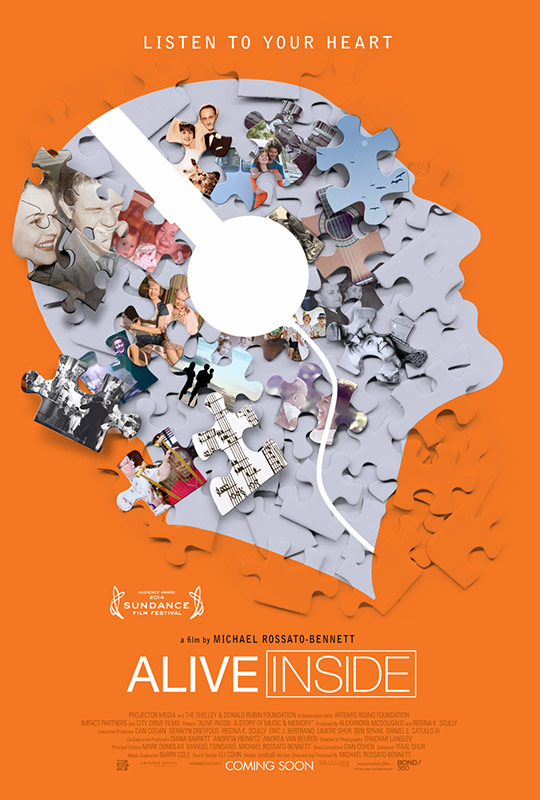
Alive Inside

aka Personal Song

D: Michael Rossato-Bennett / 78m

With: Dan Cohen, Oliver Sacks, Gregory Petsko, Samite Mulando, Bobby McFerrin, William Thomas, Michael Rossato-Bennett

It’s estimated that as many as 5.1 million Americans may have Alzheimer’s disease. If this figure is correct then the US healthcare system is in for a rocky ride in the decades to come, as that figure rises in line with a rapidly aging – and longer living – population, and the cost of medication to treat the condition rises right alongside it. But what if there was an alternative to the use of drugs such as NAMENDA XR®, or Aricept, an alternative that was also cheaper to implement?

Step forward Dan Cohen, founder of Music & Memory, “a non-profit organization that brings personalized music into the lives of the elderly or infirm through digital music technology”. Michael Rossato-Bennett’s inspiring documentary introduces us to the former consultant/trainer for the U.S. Department of Education as he attempts to convince healthcare professionals and pretty much anyone who will take notice, of the beneficial effects of music on the memories and cognisance of Alzheimer’s sufferers. Originally, Rossato-Bennett was meant to follow Cohen around for one day only, filming his attendance at a care home and recording the effects – if any – on the residents there. Using iPods and music choices that reflected the eras when these people were young, Cohen was able to prove that music could “reawaken” Alzheimer’s sufferers, and retrieve memories long believed lost.
Alive Inside - scene2

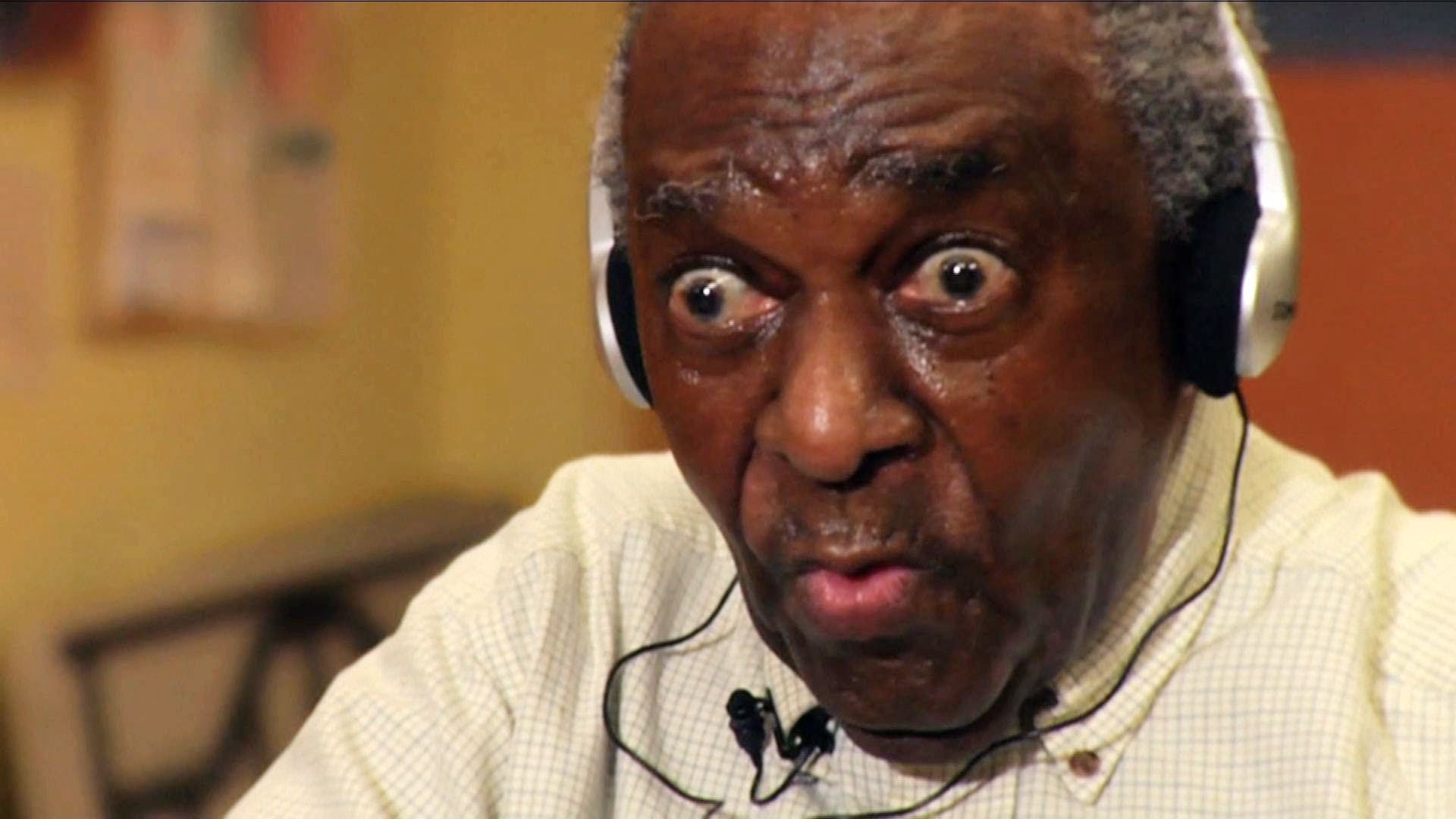
Cohen found a perfect example in Henry, a ninety-four year old who was withdrawn and barely able to speak. Within moments of Henry’s being fitted with headphones and music from his youth played for him, he reacted with spontaneous enthusiasm. Henry responded in a way that amazed everyone, and the longer he listened the more articulate he became. He was able to tell Cohen how the music made him feel, and soon he was able to sing independently of the iPod, revealing a deep melodic voice almost unaffected by the passing of the years. (At this point, Rossato-Bennett decided one day of filming Cohen wasn’t enough: he followed him for the next three years.)

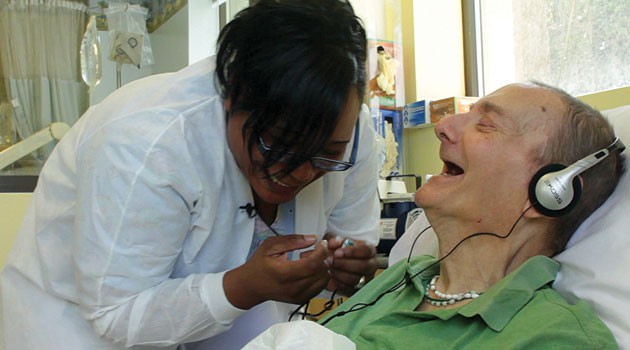
Other patients benefitted from Cohen’s approach to palliative care. While the drugs they were taking each day did little to alleviate their isolation, Cohen’s iPods brought people out of their lethargy. Families could reconnect with their loved ones again, and those sufferers who were still able to understand what the disease was doing to them were able to appreciate the renewed lease of life this music therapy afforded them. People like Denise, a bipolar schizophrenic who felt every emotion so intensely that her life was like being on an emotional rollercoaster. Cohen’s “intervention” saw her do away with the walking frame she’d been using constantly for the previous two years, and dance. And for the first time in a long time, she could honestly say she was happy.
Alive Inside - scene3

With such dramatic but telling effects on a range of Alzheimer’s sufferers, it would seem absurd for the US healthcare system to ignore Cohen’s work. But you’d be wrong (if unsurprised). As Gregory Petsko, Professor of Bio-Chemistry and Chemistry at Brandeis University puts it so tellingly, he could write a prescription for a thousand dollar drug and no one would bat an eyelid. But if he wanted to prescribe a forty dollar iPod, then questions would be asked. It’s at this point that Cohen begins to encounter all manner of excuses from doctors and care providers unwilling to adopt his unique methods. (It’s not mainstream enough for them.)

Cohen perseveres though, focusing on the US care home system, but he makes a limited amount of headway, despite continued, and incontrovertible, evidence that his idea works. When the uptake of iPods ends up being less than one per cent, an exasperated Cohen throws in the towel. But the story doesn’t end there. Some time later, footage of Henry is posted on Reddit, and it goes viral, and now Cohen is appearing on television and promoting his use of iPods…

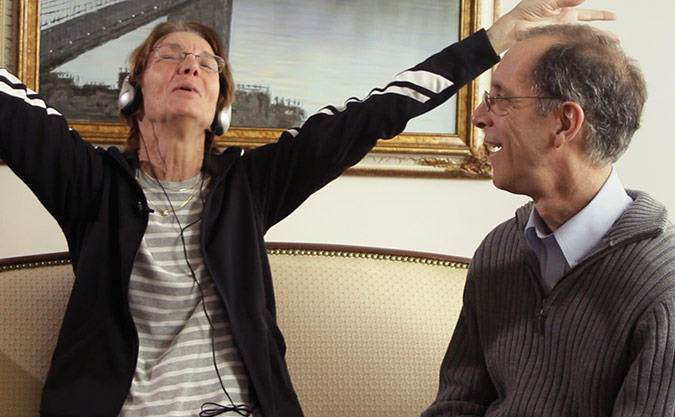
There’s a great deal of joy to be had from Alive Inside. Joy at seeing Alzheimer’s sufferers regain a semblance of their old selves, joy at knowing that this particular form of therapy works independently of any drugs, joy at seeing the relief and happiness it brings to families and loved ones, and joy that Cohen’s efforts haven’t all been for nothing. There’s something incredibly powerful and uplifting in seeing someone who is withdrawn – mentally, emotionally and physically – emerge as if from a deep sleep and re-engage with their past and their present surroundings. There are several of these moments in the movie, and rather than become expected or commonplace, each is a moment to be thankful for, a transformation that reinstates identity and awareness.
Alive Inside - scene1

In between these powerful moments, Rossato-Bennett is astute enough to provide viewers with historical, social, medical and political contexts for the current state of care home facilities, particularly in light of the introduction in 1965 of Medicare and Medicaid. By treating Alzheimer’s sufferers as patients, the elder care programme has effectively mistreated millions of people in the forty-plus years since; they’ve been victims of a system that has failed to do anything other than make them physically comfortable for as long as possible. As one esteemed physician and researcher puts it, he’s worked in the field of dementia for thirty-eight years and he’s not been able to do anything as productive for dementia sufferers as Cohen has with his iPods. It’s admissions like these that add to the emotional impact of seeing the effect of music on so many people, especially when you have someone as authoritative as Oliver Sacks confirming that musical memories are able to withstand the ravages of Alzheimer’s far better than other kinds of memory. (If this is the case then why the hesitation in adopting Cohen’s idea?)

Cohen himself comes across as a committed, dedicated individual with a great deal of empathy for the people he meets, be they Alzheimer’s sufferers, care providers such as nurses, or the families struggling to come to terms with the premature “loss” of a loved one. As the movie follows him on his quest to improve the lives of so many “lost souls”, his approach and consideration of others serves as a reminder that we should cherish our time with our elders, and recognise their value as individuals, even if they are distant or unresponsive. It’s an important message, and one that shouldn’t be diluted or allowed to fade away. Thanks to Cohen and his efforts, and the reawakening of a man named Henry, that’s unlikely to happen anytime in the near future.

Rating: 8/10 – an impressive, solidly mounted documentary, Alive Inside skimps on statistics in its attempt to put across its feelgood story, but that’s a minor quibble when there’s so much that’s delightful to be had; Rossato-Bennett should be congratulated for his efforts, as his movie tells what could have been a remarkable if dour story with careful consideration and passion.

For further information about Dan Cohen and his work, visit http://musicandmemory.org
Share this:

  • Click to share on X (Opens in new window) X
  • Click to share on Facebook (Opens in new window) Facebook
  • More
  • Click to print (Opens in new window) Print
  • Click to email a link to a friend (Opens in new window) Email
Like Loading...

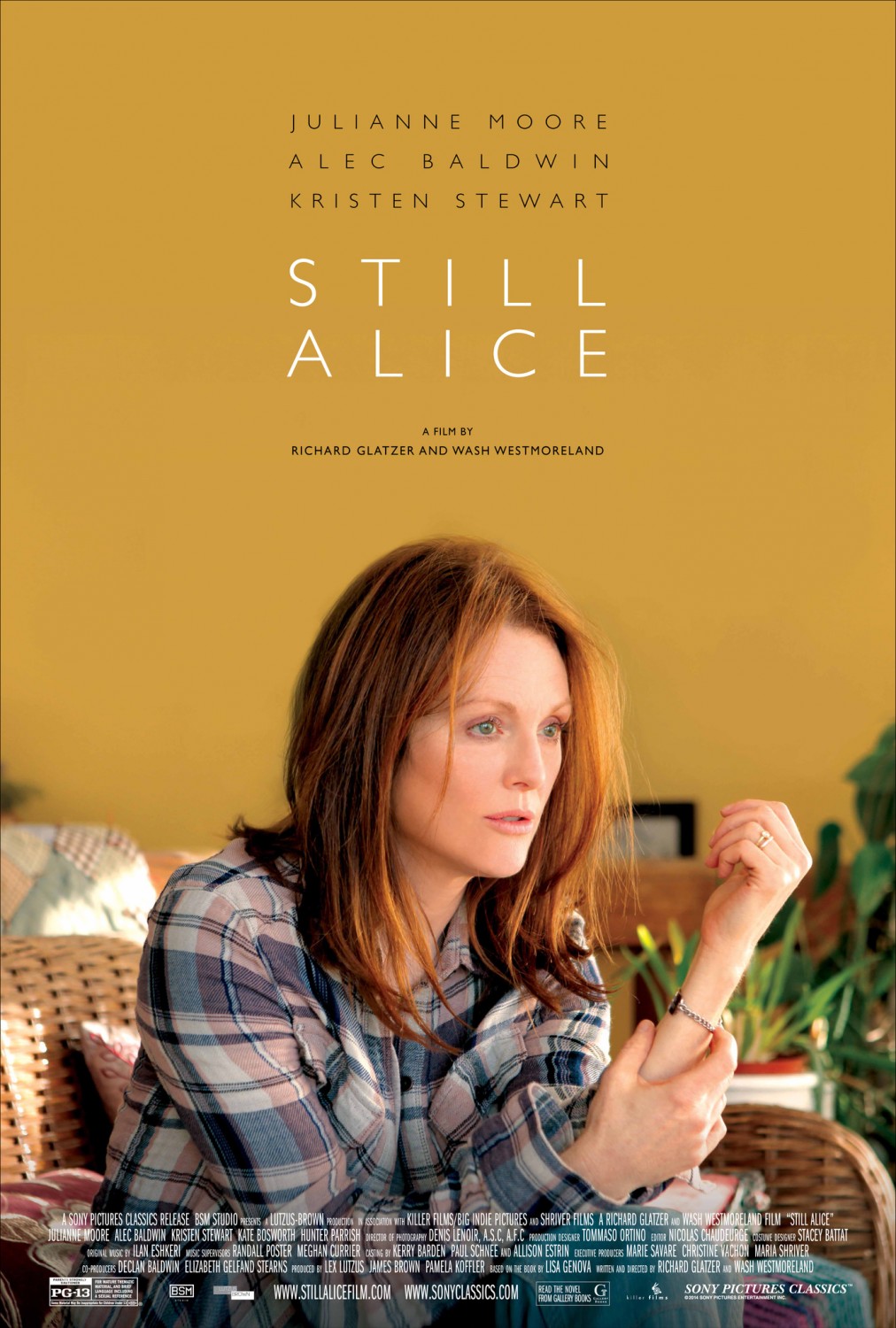
Still Alice (2014)

05 Monday Jan 2015

Posted by dullwood68 in Movies

≈ Leave a comment

Tags

Alec Baldwin, Alzheimers, Drama, Early onset Alzheimers, Julianne Moore, Kate Bosworth, Kristen Stewart, Lisa Genova, Literary adaptation, Memory loss, Review, Richard Glatzer, Wash Westmoreland

Still Alice

D: Richard Glatzer, Wash Westmoreland / 101m

Cast: Julianne Moore, Alec Baldwin, Kristen Stewart, Kate Bosworth, Hunter Parrish, Shane McRae, Stephen Kunken

Alice Howland (Moore) is a respected linguistics professor at Columbia University. She has a loving husband, John (Baldwin), and three grown up children, Anna (Bosworth), Tom (Parrish), and Lydia (Stewart). Shortly after her fiftieth birthday she gives a lecture and forgets the word ‘lexicon’. She brushes it off but when she’s out running one day she reaches the campus and for one disorientating moment she has no idea where she is. She begins to see a neurologist (Kunken) and undergoes various tests. When it comes, the diagnosis is a shock: she has early onset Alzheimers. Further tests also reveal that it’s familial, and her children are at risk of carrying the recessive gene that causes it.

As expected, the news is a blow to Alice’s family, but she is determined to fight the disease for as long as she can. Her children have different reactions: Anna is tested and is positive; she and her husband, Charlie (McRae), are trying for a baby via an infertility clinic and need to know. Tom tests negative, while Lydia, who is a budding actress living on the West Coast and a bit of a free spirit, decides not to find out. But they and their father all do their best to support Alice as she comes to terms with what her life will become.

But the illness is aggressive, and Alice’s initial coping mechanisms of using her mobile phone to record information, and setting herself little memory tests, lose their effectiveness, and she begins to forget even more. Her awareness of the speed at which her illness is affecting her, leads Alice to record a video message advising her future self to commit suicide by taking a bottle of pills. One day, while she and John are at their beach house, she forgets where the bathroom is and wets herself. As she begins to forget more and more, she receives an invitation to speak at an Alzheimers convention. There she gives a moving description of the ways in which the disease is affecting her but also the ways in which she deals with it.

Alice’s deteriorating mental abilities become more and more obvious. When Lydia performs at a local theatre, Alice forgets her name when they meet up afterwards. And she becomes anxious when John receives an offer to work at the Mayo Clinic, which will mean moving. And then Alice discovers the video message she made earlier…

Still Alice - scene

Adapted from the novel by Lisa Genova, Still Alice is a gloomy, yet also affecting look at the debilitating effects of Alzheimers on an intelligent, academically respected individual, and her immediate family. It’s a straightforward, no frills movie that aims to pull no punches regarding the debilitating aspects of the disease, but can’t quite stop itself from trying to salvage a degree of personal triumph out of Alice’s dilemma. In fact, Still Alice tries so hard to make Alice’s fight against Alzheimers laudatory that it almost misses the tragedy that goes with it hand in hand.

In telling Alice’s story, writer/directors Gratzer and Westmoreland have resorted to charting the gradual effects of the disease by signposting them with often clumsy simplicity. First Alice forgets a word in a lecture, next she forgets where she is, then she forgets someone’s name and their address in a test. As each lapse in memory and example of cognitive impairment is trotted out, their presence in the narrative seems to be crying out, “See? She’s getting worse!”, as if the viewer couldn’t work that out for themselves. And when she’s told that her form of Alzheimers, matched by her intelligence and mental acuity, means that the disease will have a more rapid effect on her, it’s almost like kicking someone when they’re down; not only is Alice already unlucky to be suffering at so young an age, but because she’s so smart it’s another point against her.

This kind of unnecessary melodrama hurts the middle third of the movie so much that it’s only thanks to Moore’s superb performance that it remains so affecting and watchable. Even when the script piles on the pain and anguish she remains utterly believable, painting a sincere, credible portrait of a woman losing her sense of herself, and portraying the terrible ramifications of having her personality destroyed from within. The scene where Alice can’t find the bathroom is a powerful example, as the camera stays with her at waist height as she rushes through the house. When she stops the camera focuses on her face and the evident torment she’s experiencing. The viewer knows exactly what’s happening, from the shame and distress Alice is feeling to the moment where the inevitable happens, and when the camera pans back to reveal the stain down the front of her jogging bottoms it’s nowhere near as effective as the acting masterclass that Moore has honoured us with. Simply put, Moore is astonishing, and when the disease has robbed Alice of nearly all cognisance of the world around her, and her eyes are dulled by incomprehension, it’s heartbreaking.

Sadly, Moore is the best thing in a movie that fails to paint convincing portraits of Alice’s family and resorts to their providing implausible levels of support throughout. Not once does any one of them lose their temper, or voice their own distress at what’s happening to her, or display any hesitation in doing what they can. Even when John is offered the job at the Mayo Clinic and Alice states her reluctance of doing so, the scene is set for the kind of antagonism that must surely happen in these situations. But instead, John swallows his disappointment in seconds and the moment passes. It’s an uncomfortable moment because it feels so false, and Baldwin doesn’t pull it off (for once though, we see another character looking as lost as Alice is). But Baldwin isn’t alone. Each of the supporting cast has their “uncomfortable moment”, Stewart early on when Alice and Lydia have one of those awkward mother-daughter conversations about careers that seems to have been cribbed from a thousand and one other similar mother-daughter conversations in the movies, and which leaves Stewart struggling to make her supposedly independent-minded character sound anything other than petulant. In contrast, Bosworth is the waspish eldest daughter, saddled with lines that are largely derogatory of others and with no obvious reason for her being that way. And Parrish is sidelined pretty much throughout as Alice’s son, allowed only a brief moment to shine (but not say much) at the Alzheimers convention.

With Moore’s formidable performance taken out of the equation, Still Alice skirts perilously close to formulaic disease-of-the-week TV movie status. It’s a movie that wants to say something profound about the way in which a disease as awful as Alzheimers can be managed – albeit in its early stages – and while Alice’s address to the conference is genuinely moving, it relies too heavily on her normal mental capability to be completely persuasive. With other dramatic flaws that weigh the movie down, Glatzer and Westmoreland’s efforts remain lumbering and inconsequential. The movie is also curiously bland to watch, with too many neutral colours in the background, and Alice aside, too many characters who evince emotion with restraint. There’s also a mawkish score by Ilan Eshkeri that only occasionally matches the action for poignancy.

Rating: 6/10 – gaining two points because of the sheer brilliance and sensitivity of Moore’s performance, Still Alice is gripping stuff when Moore is onscreen but turgid and lacking validity when she isn’t; if it wasn’t for her this would be one movie that could be so easily forgotten, and without any attendant grief.

Share this:

  • Click to share on X (Opens in new window) X
  • Click to share on Facebook (Opens in new window) Facebook
  • More
  • Click to print (Opens in new window) Print
  • Click to email a link to a friend (Opens in new window) Email
Like Loading...

Blog Stats

  • 491,358 hits

Recent Posts

  • 10 Reasons to Remember Bibi Andersson (1935-2019)
  • Fantasia (1940)
  • Dances With Wolves (1990) – The Special Edition
  • Kiss of the Spider Woman (1985)
  • The Three Musketeers (1973)

Top Posts & Pages

  • Cardboard Boxer (2016)
    Cardboard Boxer (2016)
  • Carrie (2013)
    Carrie (2013)
  • Hickey (2016)
    Hickey (2016)
  • I Origins (2014)
    I Origins (2014)
  • Lone Survivor (2013)
    Lone Survivor (2013)
  • Iris (2016)
    Iris (2016)
  • Happy Hunting (2017)
    Happy Hunting (2017)
  • The Inner Circle (1946)
    The Inner Circle (1946)
  • Death in High Heels (1947)
    Death in High Heels (1947)
  • Speak (2004)
    Speak (2004)
Follow thedullwoodexperiment on WordPress.com

Blogs I Follow

  • Rubbish Talk
  • Film 4 Fan
  • Fast Film Reviews
  • The Film Blog
  • All Things Movies UK
  • Interpreting the Stars
  • Let's Go To The Movies
  • Movie Reviews 101
  • TMI News
  • Dan the Man's Movie Reviews
  • Film History
  • Jordan and Eddie (The Movie Guys)

Archives

  • April 2019 (13)
  • March 2019 (28)
  • February 2019 (28)
  • January 2019 (32)
  • December 2018 (28)
  • November 2018 (30)
  • October 2018 (29)
  • September 2018 (29)
  • August 2018 (29)
  • July 2018 (30)
  • June 2018 (28)
  • May 2018 (24)
  • April 2018 (21)
  • March 2018 (31)
  • February 2018 (25)
  • January 2018 (30)
  • December 2017 (30)
  • November 2017 (27)
  • October 2017 (27)
  • September 2017 (26)
  • August 2017 (32)
  • July 2017 (32)
  • June 2017 (30)
  • May 2017 (29)
  • April 2017 (29)
  • March 2017 (30)
  • February 2017 (27)
  • January 2017 (32)
  • December 2016 (30)
  • November 2016 (28)
  • October 2016 (30)
  • September 2016 (27)
  • August 2016 (30)
  • July 2016 (30)
  • June 2016 (31)
  • May 2016 (34)
  • April 2016 (30)
  • March 2016 (30)
  • February 2016 (28)
  • January 2016 (35)
  • December 2015 (34)
  • November 2015 (31)
  • October 2015 (31)
  • September 2015 (34)
  • August 2015 (31)
  • July 2015 (33)
  • June 2015 (12)
  • May 2015 (31)
  • April 2015 (32)
  • March 2015 (30)
  • February 2015 (37)
  • January 2015 (39)
  • December 2014 (34)
  • November 2014 (34)
  • October 2014 (36)
  • September 2014 (25)
  • August 2014 (29)
  • July 2014 (29)
  • June 2014 (28)
  • May 2014 (23)
  • April 2014 (21)
  • March 2014 (42)
  • February 2014 (38)
  • January 2014 (29)
  • December 2013 (28)
  • November 2013 (34)
  • October 2013 (4)

Blog at WordPress.com.

Rubbish Talk

Film 4 Fan

A Movie Blog

Fast Film Reviews

The Film Blog

The official blog of everything in film

All Things Movies UK

Movie Reviews and Original Articles

Interpreting the Stars

Dave Examines Movies

Let's Go To The Movies

Film and Theatre Lover!

Movie Reviews 101

Daily Movie Reviews

TMI News

Latest weather, crime and breaking news

Dan the Man's Movie Reviews

All my aimless thoughts, ideas, and ramblings, all packed into one site!

Film History

Telling the story of film

Jordan and Eddie (The Movie Guys)

Movie Reviews & Ramblings from an Australian Based Film Fan

Privacy & Cookies: This site uses cookies. By continuing to use this website, you agree to their use.
To find out more, including how to control cookies, see here: Cookie Policy
  • Subscribe Subscribed
    • thedullwoodexperiment
    • Join 481 other subscribers
    • Already have a WordPress.com account? Log in now.
    • thedullwoodexperiment
    • Subscribe Subscribed
    • Sign up
    • Log in
    • Report this content
    • View site in Reader
    • Manage subscriptions
    • Collapse this bar
 

Loading Comments...
 

    %d