• 10 Reasons to Remember…
  • A Brief Word About…
  • About
  • For One Week Only
  • Happy Birthday
  • Monthly Roundup
  • Old-Time Crime
  • Other Posts
  • Poster of the Week
  • Question of the Week
  • Reviews
  • Trailers

thedullwoodexperiment

~ Viewing movies in a different light

thedullwoodexperiment

Tag Archives: Apartheid

The World Unseen (2007)

12 Thursday Apr 2018

Posted by dullwood68 in Movies

≈ 1 Comment

Tags

Apartheid, Cape Town, Drama, LGBTQ+, Lisa Ray, Literary adaptation, Location Cafe, Parvin Dabas, Review, Romance, Shamim Sarif, Sheetal Sheth
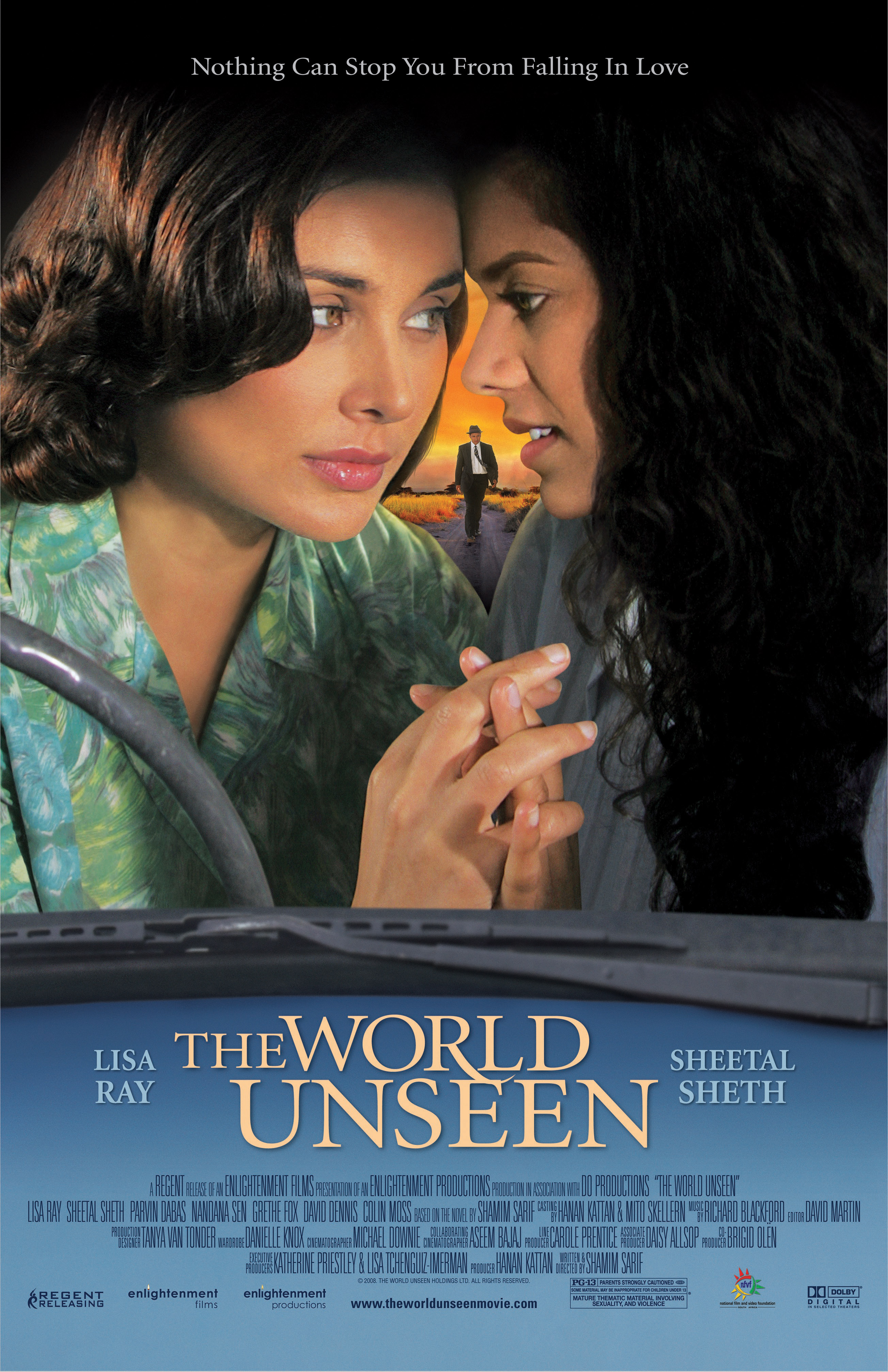
D: Shamim Sarif / 90m

Cast: Lisa Ray, Sheetal Sheth, Parvin Dabas, Nandana Sen, David Dennis, Grethe Fox, Colin Moss, Natalie Becker, Rajesh Gopie, Bernard White, Avantika Akerkar

Cape Town, 1952. Amina (Sheth) is a young Indian woman who owns and runs the Location Cafe, a haven for both the local Indian community and the blacks. Miriam (Ray) is an Indian housewife and mother of three who visits the cafe and finds herself fascinated by Amina’s seemingly carefree, yet proud attitude. Her husband, Omar (Dabas), opens a general store on the outskirts of the city, and for a while, things progress as expected. Omar’s sister, though, puts them in danger when she comes to visit from Paris with her white husband. The police discover their presence, and Omar’s sister, Rehmat (Sen), is only saved from arrest by Amina’s hiding her. This helps to build Amina and Miriam’s friendship, something that is aided by Omar’s decision to hire Amina to create a vegetable garden behind the store. The two women spend more and more time together, and their friendship deepens until each begins to acknowledge the attraction they have for each other. But how can their love flourish when they have to contend with the social, sexual, cultural and political milieu they’re a part of?

A romantic drama set in a time and place that would have heavily condemned the sexual love of two women for each other, The World Unseen is a carefully paced, judiciously mounted movie that isn’t too interested in putting its central characters in too much jeopardy, while it explores themes related to the racism and homophobia of the period. Adapted from writer-director Sarif’s own novel, her tale of fledgling love amidst the trials and tribulations of apartheid South Africa is a low-key affair, telling its story simply and with due care and attention to the characters of Amina and Miriam. Thanks to Sarif’s script and the performances of Ray and Sheth, both women are sharply drawn, and their thoughts and feelings expertly expressed through covert looks, cautious body language, and coded language. The slow reveal of their feelings for each other is hidden behind a veil of subterfuge, and Sarif shows the mounting tension between Amina’s longing for Miriam and Miriam’s hesitancy over what it will mean to her marriage and her children, in such a way that the sincerity of their emotions is never in doubt.

With the movie’s central relationship locked in, Sarif is free to build around it, adding sub-plots and minor incidents to help flesh out the running time. Sadly, not all of these sub-plots are as successful as they could have been, and though they don’t do anything to hurt the pace of the movie – Sarif’s measured direction ensures everything proceeds at an even pace – there are too many that feel as if they’ve been lifted from a soap opera. Amina’s silent partner in the cafe, Jacob (Dennis), has a predictably short relationship with a white postmistress (Fox), Omar has a secret that Miriam has no choice but to tolerate (at first), and Amina’s grandmother tries to push her into an arranged marriage. Most of these elements end as quietly as they began, and lack any appreciable impact, but thanks to the engaging quality of the material as a whole, the movie doesn’t suffer as dramatically as it might have done. The rest of the performances are adequate (though Moss’s permanently aggressive policeman is particularly one-note), and the visual style is consistently muted in terms of colour and light, something that robs it of any further appeal, but overall this is a quietly persuasive movie that does very well by its central characters.

Rating: 7/10 – with its well conceived romance, and passive recreation of the time period it’s set in, The World Unseen is exemplary when focusing on its central characters’ hopes and dreams, but less so when the focus switches elsewhere; Sarif’s first outing as a writer and a director shows promise, and there’s a clear message about female empowerment, but in the end, there’s too much that feels perfunctory instead of important.
Share this:

  • Click to share on X (Opens in new window) X
  • Click to share on Facebook (Opens in new window) Facebook
  • More
  • Click to print (Opens in new window) Print
  • Click to email a link to a friend (Opens in new window) Email
Like Loading...

Mandela: Long Walk to Freedom (2013)

02 Sunday Mar 2014

Posted by dullwood68 in Movies

≈ Leave a comment

Tags

ANC, Apartheid, Idris Elba, Justin Chadwick, Long trousers, Naomie Harris, Nelson Mandela, President de Klerk, Prisoner, Review, Robben Island, South Africa, True story, Winnie Mandela

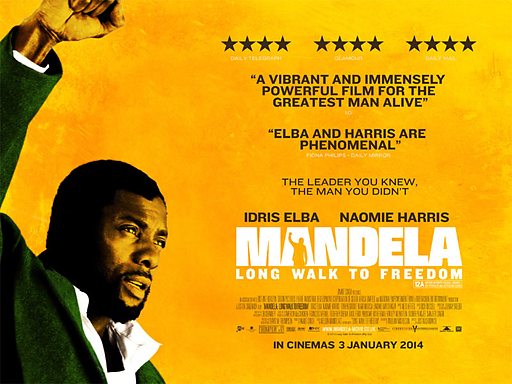
Mandela Long Walk to Freedom

D: Justin Chadwick / 141m

Cast: Idris Elba, Naomie Harris, Tony Kgoroge, Riaad Moosa, Zolani Mkiva, Simo Mogwaza, Fana Mokoena, Thapelo Mokoena

Since its publication in 1995, Nelson Mandela’s autobiography, Long Walk to Freedom has been one of those books that was always going to be adapted for the big screen; Mandela’s life was just too extraordinary to be ignored.  And now, thanks to producer Anant Singh, overseer of the project since the book’s publication, we now have fifty years of Mandela’s life condensed down into two hours and twenty one minutes.  Is it enough?  Perhaps…

The movie opens in 1942.  Mandela is a lawyer along with Oliver Tambo.  He works within the courts system and in his spare time, boxes.  He marries and has two children.  He is aware of the political injustice prevalent in South Africa, but has yet to become politicised.  When, in 1950, he witnesses a demonstration that advocates boycotting the buses – because the fares have increased unfairly – it triggers something inside him that makes him join the African National Congress.  Now a revolutionary, he supports non-violent means of attacking the system, but when the massacre at Sharpeville occurs in 1960, he realises that violence is a necessary tool against the Afrikaaners.  During this period, he also meets and takes as his second wife Winnie Madikizela (Harris), his first marriage having ended when he became radicalised.  Arrested in 1962 (according to the movie), Mandela is tried and sentenced to life imprisonment.  Along with seven other ANC members he is transported to Robben Island.  During his internment he remains an important figure within the ANC, but while he learns to approach the problem of apartheid by promoting peace, violent demonstrations and clashes with the police continue to occur across South Africa.  When the government comes calling with the promise of his being released if he helps quell the violence – by renouncing it – Mandela is faced with opposition from both Winnie and right-wing factions within the ANC.  He gains his release, begins to put into place his vision for a united South Africa, and this is where the movie ends, with Mandela having become president.

Mandela Long Walk to Freedom - scene

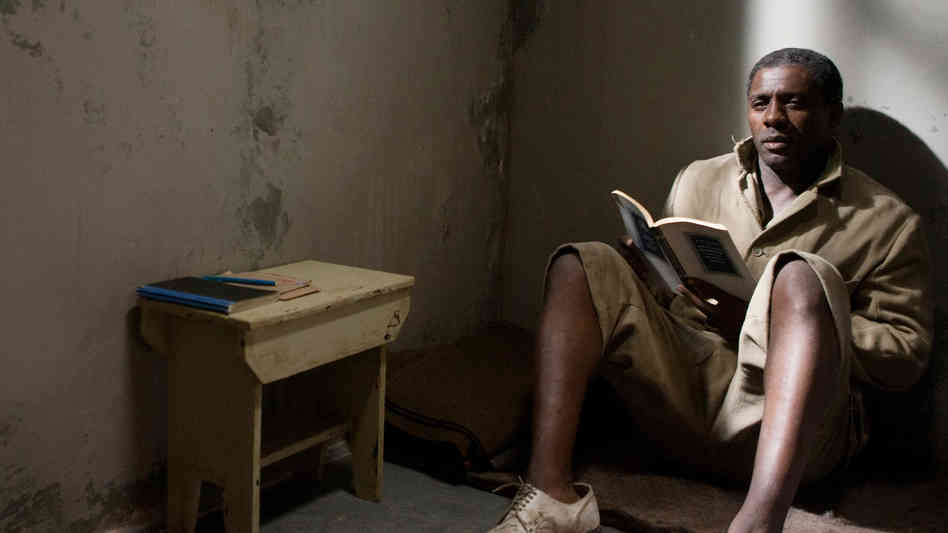
Adapting such a complex book was always going to be a challenge, and in the hands of William Nicholson, the screenplay does its best to cover the key moments in Mandela’s life without seeming like a hagiography.  However, this leads to many events being given a brief amount of screen time, and it becomes difficult on occasion to judge the importance of some of those events – for example, when Mandela and his fellow ANC members arrive at Robben Island, only one of them is given long trousers to wear, the rest, including Mandela, have to wear shorts.  Mandela campaigns to have long trousers for everyone, but his persistence – as well as the script’s – is free from explanation.  Elsewhere, Winnie’s own imprisonment – sixteen months in solitary confinement at one point – is referred to only when she gets out.  And therein lies another problem: the script shies away from making anything too unpalatable for the viewer.  Robben Island was an awful place, with cells that were too small, and living conditions that were designed to sap the will.  And yet, Mandela seems to get on okay there; you could argue that he even flourishes.  Winnie’s change from supportive wife and mother to violence advocating activist is presented in broad brush strokes, and while Harris convinces in an otherwise underwritten role, there’s too little character development for her, or the viewer, to latch onto.  (It doesn’t help that, due to the need to focus on Mandela, Winnie appears only here and there in the narrative, and in the end, she becomes the violent “face” of the ANC, a political boogeyman that Mandela is forced to distance himself from.)

With too many years to cover and too many incidents and events to fit in, Mandela: Long Walk to Freedom suffers in the long run, and ends up like a potted history of one man’s turbulent life.  There’s also a semi-reverential tone that stops the movie from being too emotive, even when the characters are suffering or events such as the Sharpeville massacre take centre stage (this tragedy, where children were killed as well as adults, is over in a matter of minutes; there’s no time to fully appreciate the horror of the impending situation nor its aftermath, and not in the way that, say, Richard Attenborough addressed the massacre at Amritsar in Gandhi).  With the movie thus appearing flat and with no appreciable highs and lows, it’s like being told about someone’s life but by someone who can’t quite connect with, or understand, the events they’re relating.

As Mandela, Elba gives a superb, measured performance that, thankfully, makes up for  a lot of the movie’s inefficiencies (good luck to anyone trying to work out who’s who in the ANC and on Robben Island; they may have names in the credits but they’re certainly not identified in the movie).  Elba dominates the movie, nailing the husky cadences of Mandela’s speech, and projecting an authoritative aura in the movie’s later stages when dealing with the government’s representatives and the political liability that Winnie has become.  He is never less than convincing throughout, and it’s a tribute to Elba that he manages to imbue Mandela with a spiritual quality that the script downplays and which might otherwise have been missed.  In support, Harris matches Elba for commitment and avoids demonising Winnie for her beliefs.  It’s a far more subtle performance than it first appears.

Hampered by the script, director Chadwick nevertheless manages to keep the movie interesting and rightly trains the camera on Elba as much as he can.  There’s a fine score courtesy of Alex Heffes, as well as crisp, warm cinematography from Lol Crawley.  With glorious location work, and good performances  all round, Mandela: Long Walk to Freedom doesn’t fly as high as you’d hope, but it does offer a fairly straightforward account of Mandela’s life over fifty years and the struggles he – and his country – endured during that period.

Rating: 7/10 – solid if unspectacular production raised up a notch or two by Elba’s excellent performance; worthy, yes, but also dull in places, and lacking in verve.

Share this:

  • Click to share on X (Opens in new window) X
  • Click to share on Facebook (Opens in new window) Facebook
  • More
  • Click to print (Opens in new window) Print
  • Click to email a link to a friend (Opens in new window) Email
Like Loading...

Blog Stats

  • 491,358 hits

Recent Posts

  • 10 Reasons to Remember Bibi Andersson (1935-2019)
  • Fantasia (1940)
  • Dances With Wolves (1990) – The Special Edition
  • Kiss of the Spider Woman (1985)
  • The Three Musketeers (1973)

Top Posts & Pages

  • Cardboard Boxer (2016)
    Cardboard Boxer (2016)
  • Carrie (2013)
    Carrie (2013)
  • Hickey (2016)
    Hickey (2016)
  • I Origins (2014)
    I Origins (2014)
  • Lone Survivor (2013)
    Lone Survivor (2013)
  • Iris (2016)
    Iris (2016)
  • Happy Hunting (2017)
    Happy Hunting (2017)
  • The Inner Circle (1946)
    The Inner Circle (1946)
  • Death in High Heels (1947)
    Death in High Heels (1947)
  • Speak (2004)
    Speak (2004)
Follow thedullwoodexperiment on WordPress.com

Blogs I Follow

  • Rubbish Talk
  • Film 4 Fan
  • Fast Film Reviews
  • The Film Blog
  • All Things Movies UK
  • Interpreting the Stars
  • Let's Go To The Movies
  • Movie Reviews 101
  • TMI News
  • Dan the Man's Movie Reviews
  • Film History
  • Jordan and Eddie (The Movie Guys)

Archives

  • April 2019 (13)
  • March 2019 (28)
  • February 2019 (28)
  • January 2019 (32)
  • December 2018 (28)
  • November 2018 (30)
  • October 2018 (29)
  • September 2018 (29)
  • August 2018 (29)
  • July 2018 (30)
  • June 2018 (28)
  • May 2018 (24)
  • April 2018 (21)
  • March 2018 (31)
  • February 2018 (25)
  • January 2018 (30)
  • December 2017 (30)
  • November 2017 (27)
  • October 2017 (27)
  • September 2017 (26)
  • August 2017 (32)
  • July 2017 (32)
  • June 2017 (30)
  • May 2017 (29)
  • April 2017 (29)
  • March 2017 (30)
  • February 2017 (27)
  • January 2017 (32)
  • December 2016 (30)
  • November 2016 (28)
  • October 2016 (30)
  • September 2016 (27)
  • August 2016 (30)
  • July 2016 (30)
  • June 2016 (31)
  • May 2016 (34)
  • April 2016 (30)
  • March 2016 (30)
  • February 2016 (28)
  • January 2016 (35)
  • December 2015 (34)
  • November 2015 (31)
  • October 2015 (31)
  • September 2015 (34)
  • August 2015 (31)
  • July 2015 (33)
  • June 2015 (12)
  • May 2015 (31)
  • April 2015 (32)
  • March 2015 (30)
  • February 2015 (37)
  • January 2015 (39)
  • December 2014 (34)
  • November 2014 (34)
  • October 2014 (36)
  • September 2014 (25)
  • August 2014 (29)
  • July 2014 (29)
  • June 2014 (28)
  • May 2014 (23)
  • April 2014 (21)
  • March 2014 (42)
  • February 2014 (38)
  • January 2014 (29)
  • December 2013 (28)
  • November 2013 (34)
  • October 2013 (4)

Create a free website or blog at WordPress.com.

Rubbish Talk

Film 4 Fan

A Movie Blog

Fast Film Reviews

The Film Blog

The official blog of everything in film

All Things Movies UK

Movie Reviews and Original Articles

Interpreting the Stars

Dave Examines Movies

Let's Go To The Movies

Film and Theatre Lover!

Movie Reviews 101

Daily Movie Reviews

TMI News

Latest weather, crime and breaking news

Dan the Man's Movie Reviews

All my aimless thoughts, ideas, and ramblings, all packed into one site!

Film History

Telling the story of film

Jordan and Eddie (The Movie Guys)

Movie Reviews & Ramblings from an Australian Based Film Fan

Privacy & Cookies: This site uses cookies. By continuing to use this website, you agree to their use.
To find out more, including how to control cookies, see here: Cookie Policy
  • Subscribe Subscribed
    • thedullwoodexperiment
    • Join 481 other subscribers
    • Already have a WordPress.com account? Log in now.
    • thedullwoodexperiment
    • Subscribe Subscribed
    • Sign up
    • Log in
    • Report this content
    • View site in Reader
    • Manage subscriptions
    • Collapse this bar
 

Loading Comments...
 

    %d