• 10 Reasons to Remember…
  • A Brief Word About…
  • About
  • For One Week Only
  • Happy Birthday
  • Monthly Roundup
  • Old-Time Crime
  • Other Posts
  • Poster of the Week
  • Question of the Week
  • Reviews
  • Trailers

thedullwoodexperiment

~ Viewing movies in a different light

thedullwoodexperiment

Tag Archives: Catholic Church

Spotlight (2015)

29 Tuesday Dec 2015

Posted by dullwood68 in Movies

≈ 4 Comments

Tags

Boston Globe, Cardinal Law, Catholic Church, Drama, Investigation, Liev Schreiber, Mark Ruffalo, Michael Keaton, Priests, Rachel McAdams, Review, Sexual abuse, Stanley Tucci, Tom McCarthy, True story

Spotlight

D: Tom McCarthy / 128m

Cast: Mark Ruffalo, Michael Keaton, Rachel McAdams, Liev Schreiber, John Slattery, Brian d’Arcy James, Stanley Tucci, Billy Crudup, Jamey Sheridan, Paul Guilfoyle, Len Cariou, Neal Huff, Michael Cyril Creighton, Richard Jenkins

In 2001, the Boston Globe newspaper hired a new editor, Marty Baron (Schreiber). Baron noticed a column in the paper about a Catholic priest, John Geoghan, who was known to be a paedophile, and a lawyer, Mitchell Garabedian (Tucci) who claimed he had evidence that the Archbishop of Boston, Cardinal Law (Cariou), knew all about it and did nothing to stop Geoghan’s activities. Urging the paper’s Spotlight section – an investigative team made up of four people – to look more closely at the matter, Baron set in motion an investigation that would expand rapidly to reveal a far greater problem than one errant priest.

This is the story that Spotlight tells: the investigation into one priest’s predatory behaviour that revealed the systemic abuse of children over decades, and which had been covered up by the Catholic Church. It’s a tale of widespread abuse, and the political and legal corruption, and immorality, that goes with it. As the team – editor Walter “Robby” Robinson (Keaton), and reporters Mike Resendez (Ruffalo), Sacha Pfeiffer (McAdams), and Matt Carroll (James) – begin looking into the story they learn that the Globe was aware of some of the allegations being made as far back as 1996 following a similar case, but these were never followed up. They speak to the founder of a support group for people who have been abused by priests, Phil Saviano (Huff), who reveals that, based on what he’s been told, Goeghan is one of thirteen priests in the Boston area that have molested children over the years.

Spotlight - scene3

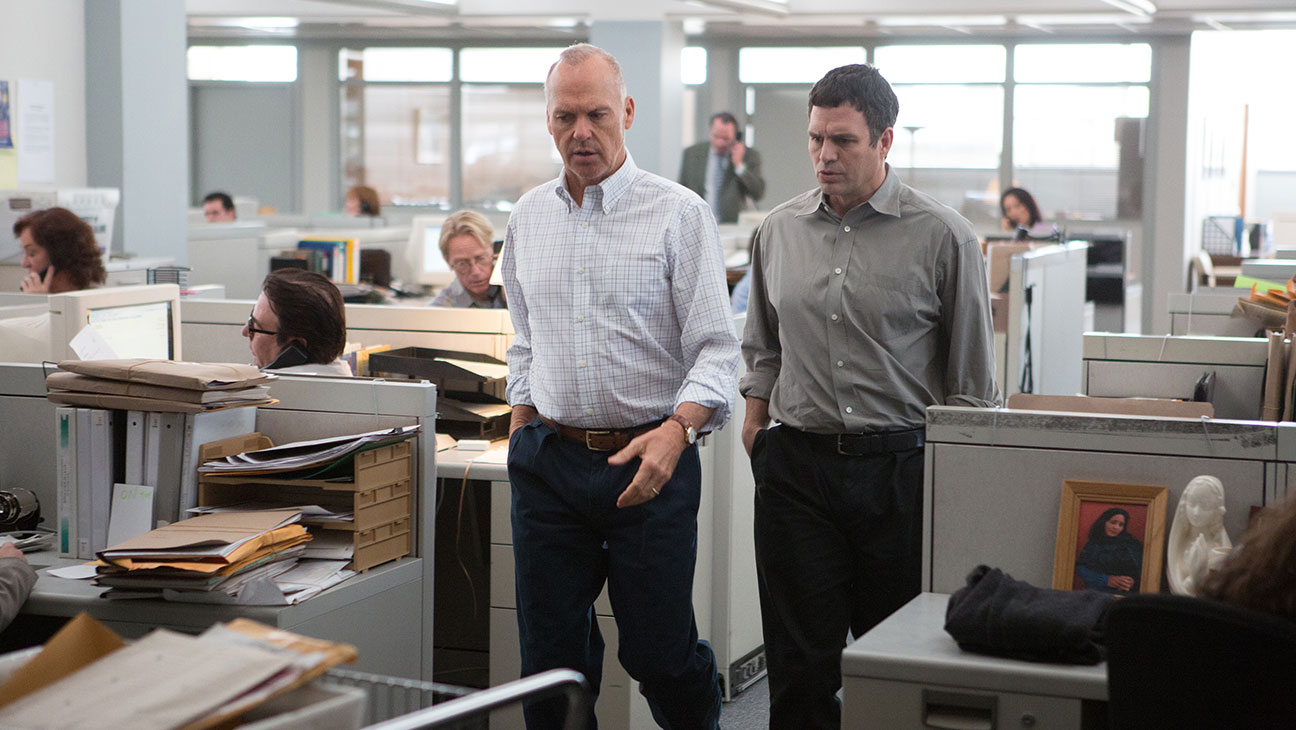
Shocked by this, the team divide their attention in different areas: Resendez contacts the lawyer, Garabedian, in order to find out what evidence he has; Pfeiffer meets with a victim, Joe Crawley (Creighton); and Carroll starts looking into the backgrounds of the priests Saviano has named. What emerges is a picture of abuse that appears to have been ignored or covered up by the Church, and which is still continuing. They also get in touch with an ex-priest, Richard Sipe (Jenkins), who worked at a “treatment centre” back in the Sixties. Since leaving the Church he’s made a thorough study of the “phenomena” of sexual abuse wihtin the priesthood, and in one particularly chilling telephone conversation with the Spotlight team he tells them his findings indicate that 6% of priests abuse children. Now the team has to rethink their strategy: based on Sipe’s findings, they’re no longer looking at thirteen priests in the Boston area, but ninety.

With the enormity of the problem now fully revealed, the team have to tread even more carefully, and refocus their investigation; it’s no longer enough to target Cardinal Law and his tacit allowance of the abuse. It’s now obvious that the abuse isn’t confined to Boston, it happens everywhere. The story becomes about how the Church itself allows this to happen and never disciplines its priests, preferring instead to move them around and still allowing them to have unsupervised access to children.

In the end, Spotlight broke the story in early 2002. It was the major news story of its day, and the movie recounts those days with a measured simplicity that avoids any potential hyperbole or grandstanding. Thanks to an intelligently constructed script by McCarthy and Josh Singer, the way in which the story unfolded is handled with a sensitivity and compassion for the victims that is offset by the Spotlight team’s increasing sense of disgust at the Church’s mistreatment of them. Each of the team is affected in their own way, showing just how pervasive the issue was, and without anyone realising. It’s a sobering realisation, that the abuse of children by a powerful organisation such as the Catholic Church – such a huge presence in so many people’s lives – can have such far-reaching consequences.
S_09159.CR2

Thanks again to the script, the legal and moral issues surrounding the cases are clearly laid out on both sides, and Mitchell Garabedian aside, the lawyers involved in out of court settlements fare badly, as they put ethical issues aside and justify their actions by virtue of “just doing their job”. As one of these lawyers, Billy Crudup has a small but crucial role that highlights just how much one section of the Boston legal system was prepared to look the other way. And the Cardinal’s spokesman, a wily operator called Joe Connelly (Guilfoyle), is on hand to show how the political machine tried to keep the Church from being exposed by attempting to make it seem that the revelations would be bad for the city.

It’s safe to say that the movie exposes a lot more than the hypocrisy of the city’s movers and shakers, and it does so in a low key dramatic manner that allows the horror of the situation to seep through as the movie progresses. McCarthy and his talented cast never let us forget just how awful the amount of abuse was, and through their pursuit of the truth we get to see levels of betrayal that most of us would be hard pressed to even consider let alone believe in. And when a necessary delay in printing the story leads to an angry outburst by Resendez, we can sympathise with him, because by then the audience wants the story to be told equally as much as he does.

In many ways, Spotlight‘s steady pace and determined approach is unexpectedly gripping. As each new development unfolds, the movie steps up a gear, until the viewer is completely enthralled and can’t look away. It doesn’t matter that you know the outcome in advance, this is one of those movies that is so well constructed that you can’t help but be drawn along with it. Helping McCarthy make such an impact is his cast. Keaton is the wise old newspaperman, determined not to let the story get away and the Church off the hook, and patient enough to wait for the right evidence to come along. Ruffalo is the cocksure reporter who feels too much too often, and who uses his anger and disgust at the abuse to fuel his work. By contrast, McAdams’ lone female is affected in small ways, as in the way in which the news will be hurtful to her devout grandmother. And James’ dogged researcher learns that the issue is much closer to home than he’d realised (and which leads to one of the movie’s rare moments of humour).

Spotlight - scene1

It’s a powerful movie about a powerful subject and although the naysayers will point to diffusions and imperfections in the story – this didn’t happen like that, that didn’t happen like they say it did – the truth is still clear: abuse happened and the Church covered it up. In 2002 alone, Spotlight ran a further 600 articles based on what they learned from victims. What the movie reminds us is that looking the other way can be even more uncomfortable than looking straight at something that’s too horrible to contemplate.

Rating: 9/10 – one of 2015’s best movies, Spotlight is tense, absorbing, horrifying, and a must-see, with superb performances and and one of the year’s best scripts; it’s already won a shedload of well-deserved awards, and as a movie that tackles a disturbing subject with tact and sensitivity, should gain even more further down the road – it’s that good.
Share this:

  • Click to share on X (Opens in new window) X
  • Click to share on Facebook (Opens in new window) Facebook
  • More
  • Click to print (Opens in new window) Print
  • Click to email a link to a friend (Opens in new window) Email
Like Loading...

Jimmy’s Hall (2014)

22 Sunday Jun 2014

Posted by dullwood68 in Movies

≈ Leave a comment

Tags

Barry Ward, Catholic Church, Community hall, County Leitrim, Deportation, History, Ireland, Jimmy Gralton, Ken Loach, Paul Laverty, Simone Kirby, True story

Jimmy's Hall

D: Ken Loach / 109m

Cast: Barry Ward, Simone Kirby, Jim Norton, Francis Magee, Brían F. O’Byrne, Aisling Franciosi, Martin Lucey, Aileen Henry, Andrew Scott

Returning home to Ireland in 1932 after ten years living in New York, communist sympathiser Jimmy Gralton (Ward) finds himself welcomed by his mother and the rest of the local community.  He’s looked upon as a hero by both his own generation and the younger generation who’ve grown up on tales of his standing up to the church when he ran the local hall.  Jimmy fled then to avoid being arrested, and the hall has fallen into disrepair in the years since.  The church, represented by Father Sheridan (Norton), viewed the hall as promoting wickedness, with its dance classes and social events.  When the news of Jimmy’s return reaches him, Sheridan does his best to coerce the locals, and Jimmy himself, to leave the hall as it is, and makes it clear that if the hall does reopen, it will mean trouble for everyone.

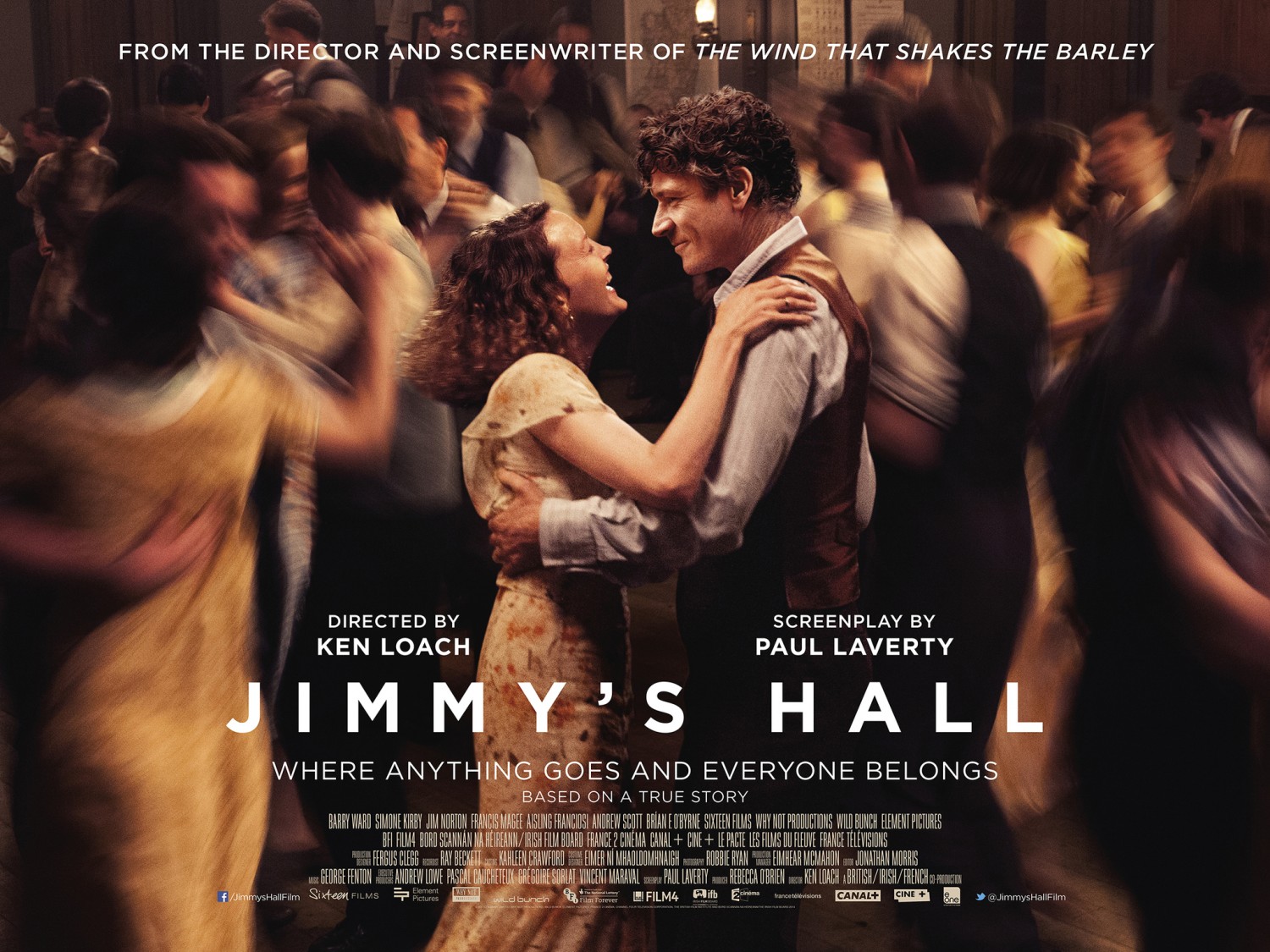
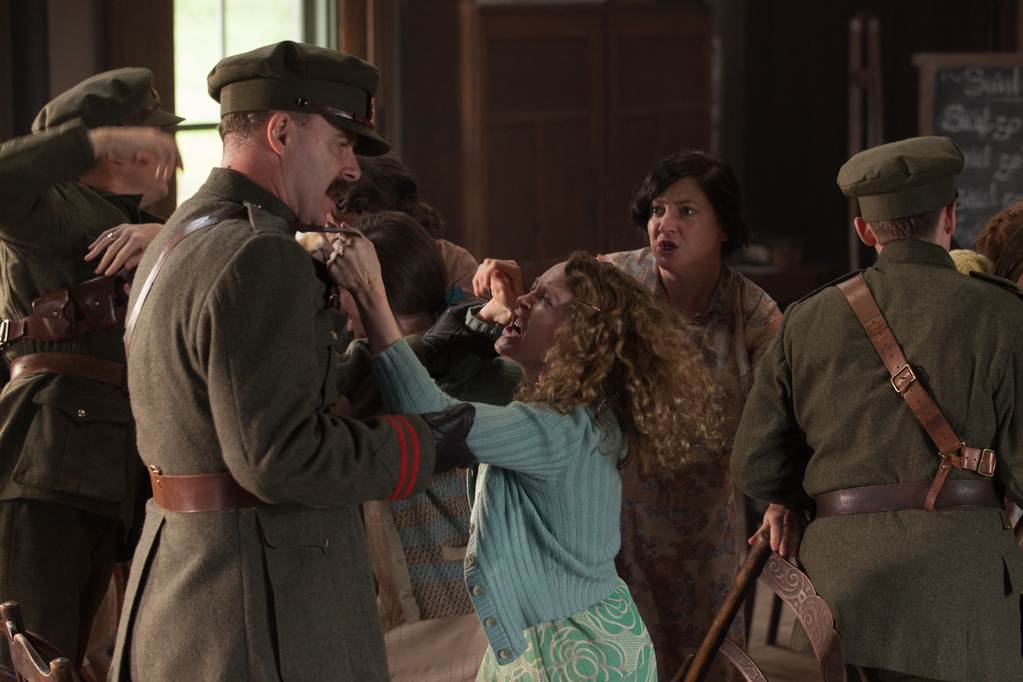
Encouraged by the support of the local community, and undaunted by Father Sheridan’s threats, Jimmy decides to reopen the hall.  In doing so, he rekindles a romance he had with Oonagh (Kirby), even though she married while he was gone, and has had two children.  On the opening night, the hall is packed, much to Father Sheridan’s displeasure, and despite his taking the names of the people who attend.  Things begin to get out of hand when Marie (Franciosi) is beaten by her father (O’Byrne) for being there, and threats are made against Jimmy and the hall.  Soon, Father Sheridan is using Jimmy’s radicalism as a reason for having the hall closed, and with the local landowners – who stood with the church ten years before – accuses Jimmy of trying to introduce communist ideology into the community via the open door policy at the hall.  The state becomes involved, and it’s not long before there’s a warrant issued for his arrest.

Jimmy's Hall - scene

Purportedly Loach’s farewell to moviemaking, Jimmy’s Hall, at times, plays like a movie that someone attempting to imitate Ken Loach might make.  It’s got his political and religious points of view, it celebrates the underdog, it has a real sense of the community it’s presenting, and it takes melodrama and makes it appear matter-of-fact.  There’s the expected camaraderie amongst Jimmy and his friends and neighbours, the hissable villain representing repressive authority, outbursts of unjustifiable violence, a clearly defined historical perspective, and naturalistic acting from its cast.  (In one sense, it’s like a “greatest hits” package.)

And yet this is also very much Loach-lite, as it were.  It doesn’t have the impact needed to elevate the material beyond its basic structure and set up, and it lacks the passion that the people at the time must have felt about the issue.  Watching Jimmy’s Hall is like hearing someone describe something really terrible but in a completely even tone of voice.  And even though it’s based on a true story, there’s little here that merits a whole movie’s worth of attention.  Gralton, as played by Ward, is a sincere man, thoughtful, considerate, politically astute, romantic, but even with all that in his favour, he’s a bit colourless at the same time.  Long stretches of the movie go by without his being on screen at all, and when he is on screen, he’s often the secondary focus or part of the crowd, leaving the audience to wonder just what it is about the man that has warranted so much attention.  Aside from a scene where he shows off his dance moves, and a showdown with Father Sheridan (that changes nothing), Gralton is almost a bystander in his own story.  (There is his affair with Oonagh but that feels like it’s there to add further tragedy to events that are already fairly tragic on their own.)

The movie firmly supports Gralton and the villagers in their aims regarding the hall – poetry and dance classes, social events etc. – and the importance of the hall in their lives is portrayed effortlessly and with approval, Loach emphasising the need for it in broad but efficient brush strokes.  With the cause given such attention, the opponents are given less consideration, and appear needlessly narrow minded.  Sheridan is blinkered in his approach to Gralton and the hall, and with Paul Laverty’s script demonising the man at every turn, it quickly becomes draining watching him refute the good the hall engenders, and all because of some misguided notion that it will encourage lewd behaviour.  It’s a measure of Norton’s abilities as an actor that Sheridan isn’t completely free of introspection, and a scene with Father Seamus (Scott) and a phonograph gives more insight into the man but arrives too late in the movie to do any good.  And then there’s Marie’s father, the opponents’ blunt instrument, a character whose sole purpose in the movie is to show brute, unreasoning force was used against the villagers and by doing so, elicit more sympathy for them (as if we might not have enough already).

This simplistic approach stops Loach from captivating his audience, and while his usual polemical outlook is well established, the actual slightness of the material as well stops the movie from achieving anything more meaningful.  That said, the assembled cast are well chosen and there’s not a false note to be found in their performances (even if their character appears underwritten).  Magee and Franciosi, in particular, deserve a mention.  The movie is also beautiful to look at, Robbie Ryan’s cinematography bringing out the best of the County Leitrim locations (where the original events took place), and there’s a fine score courtesy of regular contributor George Fenton that mixes Irish music with jazz and blues to often moving effect.  Loach’s direction is as effortless as ever, and while the material may be modest in its ambition and scope, he’s still able to place often quietly moving moments and some subtle humour in amongst the political diatribes.

Rating: 7/10 – not as sharp or poignant as expected, Jimmy’s Hall has more to say about what makes a community than it does the political landscape of the times; however, a Ken Loach movie is always worth seeing, and despite reservations, this is no different.

Share this:

  • Click to share on X (Opens in new window) X
  • Click to share on Facebook (Opens in new window) Facebook
  • More
  • Click to print (Opens in new window) Print
  • Click to email a link to a friend (Opens in new window) Email
Like Loading...

Philomena (2013)

07 Friday Mar 2014

Posted by dullwood68 in Movies

≈ 1 Comment

Tags

Abuse, Adoption, Catholic Church, Judi Dench, Martin Sixsmith, Michael Hess, Nuns, Philomena Lee, Review, Roscrea, Sean Ross Abbey, Stephen Frears, Steve Coogan, True story

Philomena

D: Stephen Frears / 98m

Cast: Judi Dench, Steve Coogan, Michelle Fairley, Sophie Kennedy Clark, Mare Winningham, Barbara Jefford, Ruth McCabe, Peter Hermann, Sean Mahon, Anna Maxwell Martin

In 2004, and finding himself at a bit of a loss as to what to do after losing his job as a Labour government advisor, ex-journalist Martin Sixsmith (Coogan) is approached by the daughter of Philomena Lee (Dench) who suggests he writes a story about her.  Fifty years before, Philomena was forced to give up her baby boy, Anthony, by the nuns she was staying with at Sean Ross Abbey in Roscrea.  She has been trying to find him ever since but the nuns have always said they are unable to provide any information as to his whereabouts.

Intrigued, Sixsmith agrees to pursue the story after he meets Philomena, and they travel to Roscrea to see if they can find out anything further.  Advised by Mother Barbara (McCabe) that the records relating to Philomena were lost in a fire, they later discover that the records were destroyed by the nuns in a bonfire.  They also learn that the nuns were selling the children under their care, and mostly to Americans.

Martin and Philomena follow Anthony’s trail to the US.  Through Martin’s contacts, he discovers that Anthony was adopted by Doc and Marge Hess, and that they renamed him Michael; they also adopted another child, Mary, the daughter of one of Philomena’s friends at the abbey.  Michael grew up to be a lawyer and senior official in both the Reagan and Bush administrations, but sadly, he died in 1995.  Philomena decides she wants to meet some of the people who knew Michael, including his adopted sister, Mary (Winningham).  This leads to revelations about Michael’s life, and his death, that lead Philomena and Martin back to Roscrea.

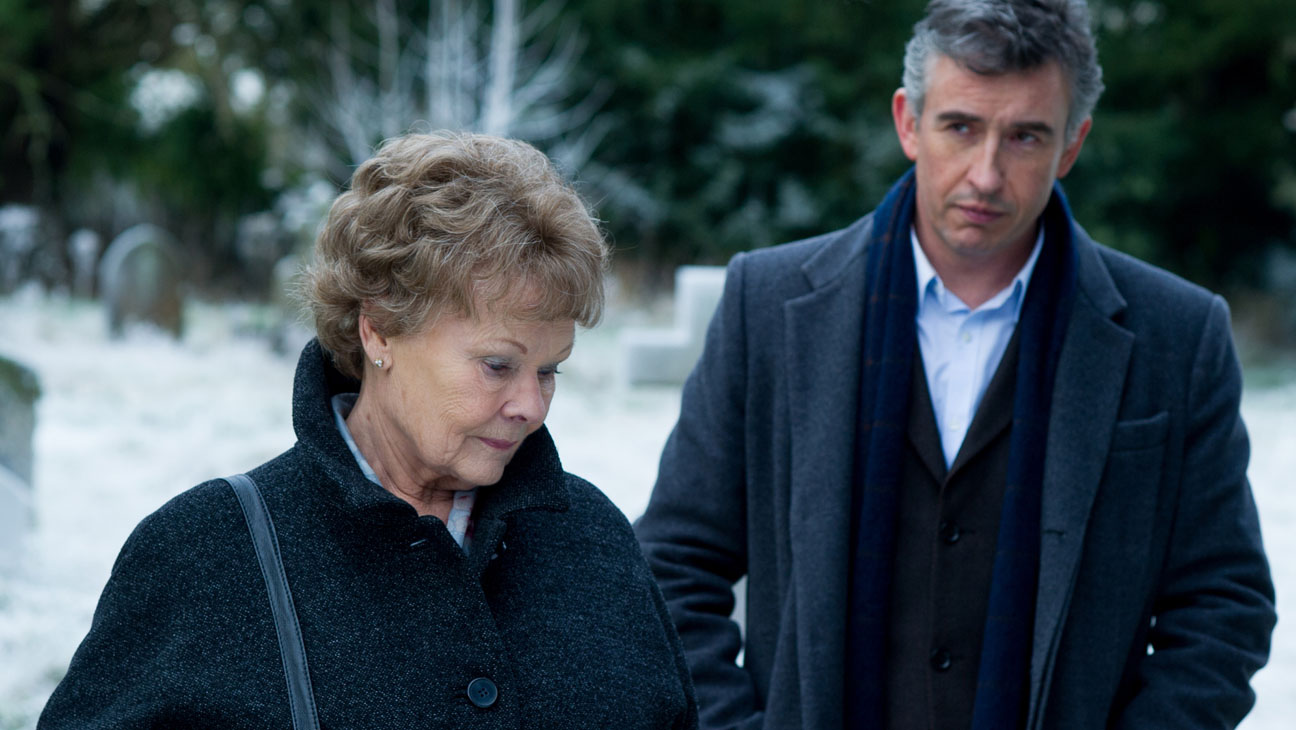
_D3S1363.NEF

With such an emotive subject, the script by Coogan and Jeff Pope, combines drama and humour and outrage in (nearly) equal measure.  The early scenes, showing some of the experiences the young Philomena (Clark) endured at the abbey are quite disturbing, and while we’ve seen a more systematic, and horrifying, appraisal of this type of religious “care” in Peter Mullen’s The Magdalene Sisters, they’re still distressing enough to get across the unfeeling and harsh approach of the nuns to the young women’s “sin of fornication”.  As their attempts to find out what happened to Anthony are blocked by the nuns, the movie deftly sidesteps the wider issue of Church-sanctioned neglect, and focuses on Philomena’s story instead.  It’s a wise move, and allows the movie to progress almost as a mystery, with discoveries made that add to the depth of the nuns’ deception.

Once in the US, the script adds elements of Philomena’s naïveté, at the same time as revealing she knows more about certain subjects than might be expected.  While there’s a certain amount of gentle mockery in these moments – she refers to several people as being “one in a million” – they’re offset by Philomena’s certainty in her own behaviour and outlook.  As played by Dench, Philomena is by turns, sad, angry, resourceful, determined, resigned, grieving, and ultimately, quite heroic.  There are several moments where Dench, in close-up, displays a range of emotions, and the viewer is left in no doubt as to what those emotions are, thanks to Dench’s skill as an actress.  There’s not one false note in her whole performance.

Thankfully, she’s matched by Coogan, whose performance begins more as a comic turn but soon develops into a dramatic one, his character finding his way into the story more and more and becoming as determined to discover the truth as Philomena.  As depicted here, Sixsmith is a bit ill-mannered, very dismissive of religion, and at times, manipulative.  His attitude compliments the more open and receptive nature that Philomena displays, and as a “team” their respective strengths make them both resourceful and disarming.  As they discover more and more about Michael, their reactions compliment each other as well.

Philomena is also buoyed up by confident, often impressive direction courtesy of Stephen Frears.  Frears is one of the most consistently thought-provoking directors working today, and he’s particularly good at taking complex material and making it accessible to audiences.  He’s helped here by the script, and by the wonderful performances, and orchestrates the various developments with great skill, making Philomena a particular pleasure to watch.  In many ways, it’s British filmmaking at its best: thoughtful, intelligent, humorous, well-mounted and inspiring.

Rating: 9/10 – aside from some deviations to the actual course of events, Philomena is a poignant, uplifting tale that can raise a tear as often as a smile; a triumph for all concerned and entirely deserving of the awards it’s won so far.

Share this:

  • Click to share on X (Opens in new window) X
  • Click to share on Facebook (Opens in new window) Facebook
  • More
  • Click to print (Opens in new window) Print
  • Click to email a link to a friend (Opens in new window) Email
Like Loading...

Blog Stats

  • 486,620 hits

Recent Posts

  • 10 Reasons to Remember Bibi Andersson (1935-2019)
  • Fantasia (1940)
  • Dances With Wolves (1990) – The Special Edition
  • Kiss of the Spider Woman (1985)
  • The Three Musketeers (1973)

Top Posts & Pages

  • Lost for Life (2013) - Another Look
    Lost for Life (2013) - Another Look
  • Lost for Life (2013)
    Lost for Life (2013)
  • About
    About
  • Mr. Topaze (1961)
    Mr. Topaze (1961)
  • Hunt for the Wilderpeople (2016)
    Hunt for the Wilderpeople (2016)
  • Shock and Awe (2017)
    Shock and Awe (2017)
  • Cardboard Boxer (2016)
    Cardboard Boxer (2016)
  • Billy Lynn's Long Halftime Walk (2016)
    Billy Lynn's Long Halftime Walk (2016)
  • Winter's Tale (2014)
    Winter's Tale (2014)
  • The Haunting of Harry Payne (2014)
    The Haunting of Harry Payne (2014)
Follow thedullwoodexperiment on WordPress.com

Blogs I Follow

  • Rubbish Talk
  • Film 4 Fan
  • Fast Film Reviews
  • The Film Blog
  • All Things Movies UK
  • Interpreting the Stars
  • Let's Go To The Movies
  • Movie Reviews 101
  • TMI News
  • Dan the Man's Movie Reviews
  • Film History
  • Jordan and Eddie (The Movie Guys)

Archives

  • April 2019 (13)
  • March 2019 (28)
  • February 2019 (28)
  • January 2019 (32)
  • December 2018 (28)
  • November 2018 (30)
  • October 2018 (29)
  • September 2018 (29)
  • August 2018 (29)
  • July 2018 (30)
  • June 2018 (28)
  • May 2018 (24)
  • April 2018 (21)
  • March 2018 (31)
  • February 2018 (25)
  • January 2018 (30)
  • December 2017 (30)
  • November 2017 (27)
  • October 2017 (27)
  • September 2017 (26)
  • August 2017 (32)
  • July 2017 (32)
  • June 2017 (30)
  • May 2017 (29)
  • April 2017 (29)
  • March 2017 (30)
  • February 2017 (27)
  • January 2017 (32)
  • December 2016 (30)
  • November 2016 (28)
  • October 2016 (30)
  • September 2016 (27)
  • August 2016 (30)
  • July 2016 (30)
  • June 2016 (31)
  • May 2016 (34)
  • April 2016 (30)
  • March 2016 (30)
  • February 2016 (28)
  • January 2016 (35)
  • December 2015 (34)
  • November 2015 (31)
  • October 2015 (31)
  • September 2015 (34)
  • August 2015 (31)
  • July 2015 (33)
  • June 2015 (12)
  • May 2015 (31)
  • April 2015 (32)
  • March 2015 (30)
  • February 2015 (37)
  • January 2015 (39)
  • December 2014 (34)
  • November 2014 (34)
  • October 2014 (36)
  • September 2014 (25)
  • August 2014 (29)
  • July 2014 (29)
  • June 2014 (28)
  • May 2014 (23)
  • April 2014 (21)
  • March 2014 (42)
  • February 2014 (38)
  • January 2014 (29)
  • December 2013 (28)
  • November 2013 (34)
  • October 2013 (4)

Blog at WordPress.com.

Rubbish Talk

Film 4 Fan

A Movie Blog

Fast Film Reviews

The Film Blog

The official blog of everything in film

All Things Movies UK

Movie Reviews and Original Articles

Interpreting the Stars

Dave Examines Movies

Let's Go To The Movies

Film and Theatre Lover!

Movie Reviews 101

Daily Movie Reviews

TMI News

Latest weather, crime and breaking news

Dan the Man's Movie Reviews

All my aimless thoughts, ideas, and ramblings, all packed into one site!

Film History

Telling the story of film

Jordan and Eddie (The Movie Guys)

Movie Reviews & Ramblings from an Australian Based Film Fan

Privacy & Cookies: This site uses cookies. By continuing to use this website, you agree to their use.
To find out more, including how to control cookies, see here: Cookie Policy
  • Subscribe Subscribed
    • thedullwoodexperiment
    • Join 481 other subscribers
    • Already have a WordPress.com account? Log in now.
    • thedullwoodexperiment
    • Subscribe Subscribed
    • Sign up
    • Log in
    • Report this content
    • View site in Reader
    • Manage subscriptions
    • Collapse this bar
 

Loading Comments...
 

    %d