There are dozens, nay hundreds of movie awards ceremonies that take place every year, but there’s only one that sucks the air out of the room and leaves everyone dizzy with anticipation and excitement. The Oscars occupy their own rarefied atmosphere, the awards ceremony that demands more attention than any other, and which is seen as the pinnacle of any winner’s career. In recent years it’s been dogged by controversy, from accusations of racial inequality in its membership, to the mix up over the Best Film winner (Moonlight? La La Land?), and this year, whether Kevin Hart should or shouldn’t be the host (when the better question was, aside from Ellen DeGeneres, was anyone really excited when his name came up?). This year’s crop of nominees was announced today, and looking through the main categories, it’s hard not to wonder if the Oscars pre-eminence in the world of awards-giving is entirely deserved. Perhaps this year’s social media trend should be, #OscarsTooSafe.
The Best Film – sorry, Motion Picture of the Year (how grand!) – category is particularly dismaying. Can anyone really say that Bohemian Rhapsody or Vice deserve to be there when the likes of First Reformed, Leave No Trace, and Eighth Grade were also released in 2018? How can the Academy justify such safe choices when up to ten movies can be nominated? There’s not even a dark horse to make it look even halfway interesting (how cool would it have been to have seen Mission: Impossible – Fallout make the list, a movie that critics and audiences both agreed was one of the very best movies of 2018). And don’t get me wrong, but good as Black Panther was, Avengers: Infinity War was easily the better movie. So why isn’t that nominated instead if it’s time to be acknowledging superhero movies?
The acting categories also reflect the Academy’s inability to sort the wheat ffrom the chaff, with the same names showing up for tuxedo/gown duty like regulars at an all you can eat buffet. Good as he was in Vice, Christian Bale has given better performances in other movies, while Willem Dafoe’s portrayal of Vincent Van Gogh in At Eternity’s Gate is one of the Academy’s usual attempts at highlighting a performance hardly anyone has seen. You want to applaud this, but the likelihood of Dafoe winning on the night seems as likely as Kevin Spacey turning up as a surprise presenter. On the distaff side, it’s hard not to be cynical over the choices of Lady Gaga (nominated for playing herself), and Melissa McCarthy (nominated for being serious), while anyone who has seen The Favourite is probably wondering why Olivia Colman isn’t the only actress to be nominated (she’s that good). Oh, and if you were Nicole Kidman, you might also be wondering what you had to do to get noticed.
If the Oscars are truly about recognising the best that 2018 had to offer (or any year for that matter), then they desperately need a major overhaul. With all the talk of inclusivity over the last few years, let’s jettison ideas such as needing to separate animated and foreign language movies into their own categories; why can’t they be Best Motion Pictures too? (And can anyone explain how Roma can be up for Best Motion Picture and Best Foreign Language Film this year?) Conversely though, can we please stop pitting black and white movies against their colour counterparts in the Best Achievement in Cinematography category; these are two entirely different disciplines – and besides, black and white should win hands down every time. And lastly, whoever does host the show, is it too much to ask that they actually be funny for a change? (Silly question; of course it is.)
Cast: Christian Bale, Amy Adams, Steve Carell, Sam Rockwell, Jesse Plemons, Tyler Perry, Alison Pill, Lily Rabe, Eddie Marsan, Justin Kirk, LisaGay Hamilton, Bill Camp, Don McManus, Shea Whigham, Stephen Adly Guirgis
In 1963, future vice president Dick Cheney (Bale) is working as a lineman because his alcoholism got him kicked out of Yale. Given an ultimatum by his wife, Lynne (Adams), to shape up and make something of his life, Cheney goes into politics, securing an internship at the White House during the Nixon administration. There he works for Nixon’s economic advisor Donald Rumsfeld (Carell). The two become friends (of a sort) and as the years pass, they both fall in and out of favour with the ruling elite, until during the Clinton era, Cheney becomes CEO of Halliburton, and Rumsfeld holds a variety of positions in the private sector. When he’s asked to be the running mate of George W. Bush (Rockwell) when Bush runs for president, Cheney sees an opportunity to occupy a unique position of power. But it’s in the wake of the terrorist attacks that occurred on 9/11 that Cheney sees his ambition begin to come to fruition. Without recourse to just cause, and ignoring his own intelligence agencies, Cheney orchestrates an unnecessary war in Iraq…
Although it’s perfectly well made, and intelligently constructed, Adam McKay’s foray into US politics lacks the urgency of his previous outing, The Big Short (2015), and the impact, with much of what we know about Cheney and his unrepentant manipulation of the facts post-9/11, still fresh in our memories. And it’s hard to be outraged by what Cheney did when the current incumbent of the White House abuses his position so appallingly (and deliberately), and on an almost daily basis. This leaves Vice at a bit of a disadvantage, with McKay’s screenplay laying it all out for us, but in a way that doesn’t feel fresh or surprising, but rather more like reportage. The facts are there, but the emotion isn’t, and this leaves the viewer in an awkward position: working out how to engage with a movie that should be hitting home quite forcefully, but which settles instead for telling its story too matter-of-factly for its own good (it doesn’t help that McKay lumbers his movie with having to stop and explain things such as the unitary executive theory… not the most exciting of topics). There’s also the hint of a longer movie as well, with incidents such as the Valerie Plame affair, and the accidental shooting of Harry Whittington, added to the narrative but ultimately carrying little or no dramatic weight.
And we never get to know Cheney the man, or his motives. Played with a marked reticence that makes Cheney look like a less amiable Chevy Chase, Bale is physically intimidating but often reduced to uttering grunts instead of sentences, and looking disinterested or dismissive. Cheney may have been a ruthless, calculating politician post-9/11, but a lot of the time he just looks like your average grumpy grandpa. Even the one good thing that Cheney did – retiring from public life in order to shield his daughter, Mary (Pill), from media scrutiny over being a lesbian – is tarnished by his later actions in supporting the political ambitions of his other daughter, Liz (Rabe). Rare moments such as these make Cheney appear more recognisably human, and not the unknowable cypher he is the rest of the time. All in all, it’s still a good performance from Bale, but it’s the likes of Adams and Plemons (as a fictional Iraq War veteran with an unlikely tie to Cheney) who make the material resonate more. Again, it’s intelligently constructed, and McKay sprinkles the narrative with some caustic humour to leaven the gloom, while DoP Greig Fraser ensures the sense of dirty deeds carried out behind closed doors is portrayed through tight close ups and the use of shadowy lighting. It’s a movie that speaks plainly about the issues it’s addressing, but sadly, a little too plainly to be effective.
Rating: 6/10 – dry and only fitfully engaging, Vice has the feel of a movie that’s telling its story as if everyone’s already been briefed and the movie itself is something of a formality; when a movie that seeks to recount seismic events in recent US history lacks immediacy and verve then something is very wrong indeed.
Cast: Christian Bale, Woody Harrelson, Casey Affleck, Forest Whitaker, Willem Dafoe, Zoe Saldana, Tom Bower, Sam Shepard
There is a song by Sparks called Talent Is an Asset. It’s a turn of a phrase to remember when watching Out of the Furnace, the second feature by Scott Cooper, because without its very talented cast, the movie would not be as good as it is, and it wouldn’t be as persuasive. Cooper has taken a spec script by Brad Inglesby (who receives a co-writing credit) – and which originally had Leonardo DiCaprio and Ridley Scott attached to it – and made a movie that alternately baffles and convinces with its plotting. It’s a movie that takes over half its running time to get to the meat of the story, and which throws in a couple of sub-plots for good measure in order to pad out said running time.
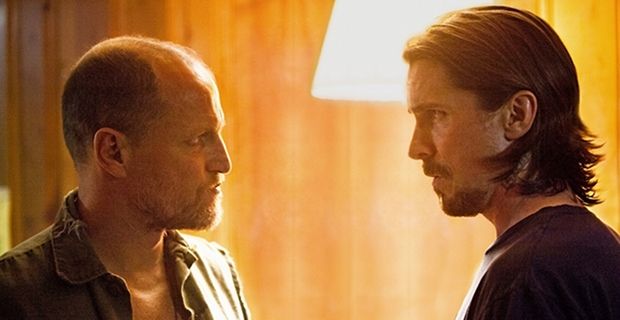
It’s a tale that begins inauspiciously, in the small town of Braddock, with steel mill worker Russell Baze (Bale) discovering that his younger brother, Iraq War veteran Rodney (Affleck), is in serious debt to local bar owner and small town criminal John Petty (Dafoe). Without telling Rodney, Russell begins paying off his debt, but an unexpected and tragic accident sees Russell sent to prison. In the meantime, Rodney returns to Iraq for another tour of duty, their terminally ill father dies, and Russell’s girlfriend, Lena (Saldana), takes up with the town sheriff, Wesley Barnes (Whitaker) without even telling him. When he eventually gets out, he soon discovers that Rodney, who is now back home for good, is taking part in illegal bare knuckle fights in order to pay off his debt to Petty. Russell challenges him to work at the steel mill instead but Rodney refuses.
Rodney compels Petty to set up one last fight, one with a big enough payout that he can clear his debt and start his life afresh. Against his better judgment, Petty arranges a fight through one of his criminal contacts, a vicious drug dealer from the Ramapo Mountains called Harlan DeGroat (Harrelson). After the fight, evidence points to DeGroat having killed Rodney and Petty, but the police are hampered by the uncooperative nature of the Ramapo community, and DeGroat never being in the same place twice. Russell decides he has to take the law into his own hands, and he goes looking for DeGroat, but has the same luck as the police. And then he hits on an idea that will bring DeGroat to him…
Out of the Furnace has two clear ambitions: to be a tough, uncompromising drama, and to provide a snapshot of rural communities along the Eastern Seaboard of America, and their daily struggles to keep their heads above water. For the most part, Cooper succeeds in making the movie tough and uncompromising, and there are several scenes that exert a morbid fascination in terms of the characters and their acceptance of the way Life makes their situations worse than they need to be. Rodney can’t see a better way out of his financial situation, and so gets regularly beaten and bruised and bloodied. Russell comes out of prison and makes only a half-hearted attempt to reconnect with Lena (an attempt that is shot down in flames in moments). And Lena rues the decision she made in leaving Russell but is in a position where she can’t back out anymore. All this makes everyone’s life that much harder, and their various predicaments are what drive the movie forward. And then Russell finds himself in another corner, the one where he feels compelled to seek revenge for what’s happened to his brother.
Decisions and consequences, then, but ones that aren’t handled that well by Cooper, and ones that follow a very prescribed pattern. A scene showing DeGroat making and injecting heroin is interspersed with shots of a SWAT team advancing on the house where DeGroat is supposed to live. Not one viewer should be surprised when the SWAT raid reveals DeGroat isn’t home and that he’s somewhere else. This scene and others play out as if we’ve never seen them before, and while familiarity can be used to a director’s advantage, here they’re just stepping stones on a path too many of us have witnessed before. Cooper also connects the dots for the viewer at almost every turn, and there’s too much unnecessary exposition propping up these scenes to make them anywhere near effective. As for the backdrop of the town’s misfortune, aside from a brief mention that the mill is expected to close, the precarious nature of people’s lives and the decline of Braddock’s infrastructure is glimpsed but receives no further exploration.
With the story following a familiar through line, and Cooper finding it difficult to make the action as urgent as it needs to be, it’s left to the cast to rescue things. Bale gives a magnetic performance as Russell, a man with a strong moral code that brooks no compromise, and he’s matched by Affleck’s tightly-wound portrayal of Rodney, an Iraq War veteran whose seen too much and uses bare knuckle fighting to punish himself for being a part of it all (an aspect of his character which is barely explored but is a more effective reason for his fighting than paying off a debt). Whitaker, Saldana, and Dafoe offer strong support, taking largely underwritten characters and fleshing them out to good effect, but it’s Harrelson who steals the movie, making DeGroat one of the scariest, and yet charismatic villains of recent years. There’s something about Harrelson playing a psychopath that always seems just right, and here the actor gives an hypnotic performance that chills and repulses at the same time. In assembling such a great cast, Cooper has been lucky in that the material has been given a massive boost thanks to their overall commitment; but if they hadn’t agreed to take part…
Rating: 5/10 – an ambitious, rural-based thriller that isn’t as muscular or compelling as its writer/director intended, Out of the Furnace suffers from a muddled structure and too many scenes that exist in isolation of each other; saved by a clutch of very good performances, it remains a movie that should have made more of its deprived-area backdrop and even more of its generic revenge-based denouement. (20/31)
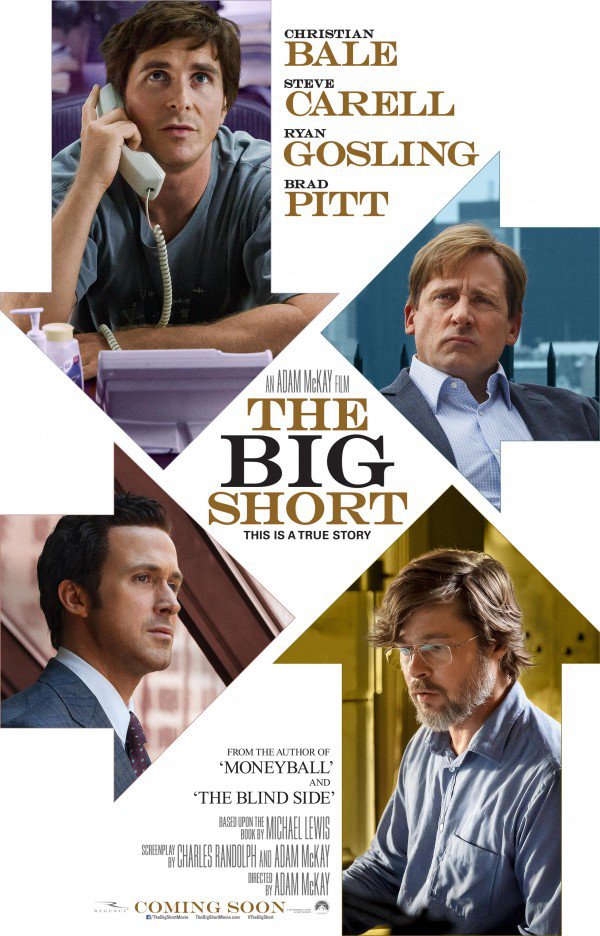
Cast: Christian Bale, Steve Carell, Ryan Gosling, Brad Pitt, John Magaro, Finn Wittrock, Marisa Tomei, Melissa Leo, Rafe Spall, Jeremy Strong, Hamish Linklater, Adepero Oduye, Byron Mann
It seems a little odd now that next year, 2017, will see the tenth anniversary of the collapse of the US housing market. Thanks to the greed of the Wall Street banks, in the US alone, eight million people lost their jobs and six million people lost their homes. It was a national scandal. But how did it all come about? Well, it’s fairly complicated, but The Big Short does a good job of explaining it all.
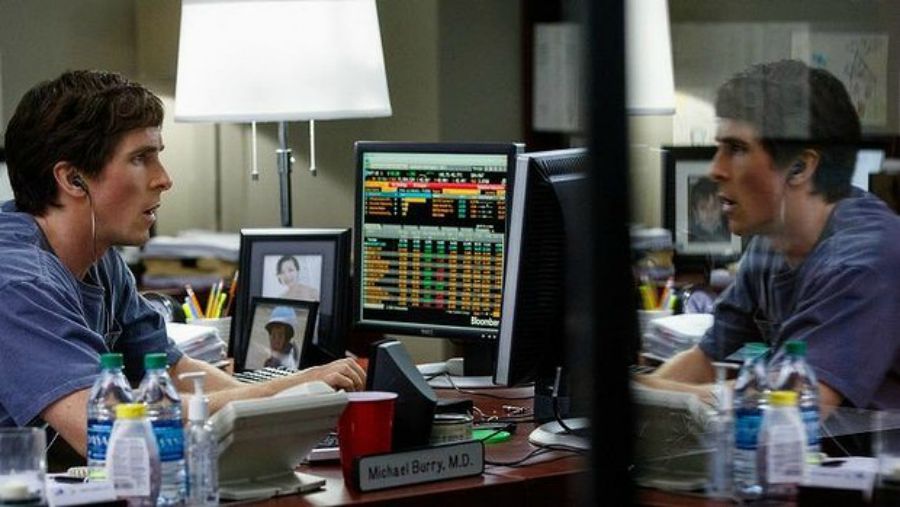
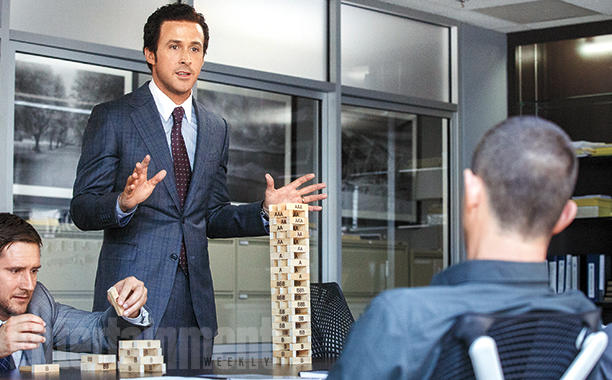
Adapted from the book by Michael Lewis, the movie looks at the people who first realised that the US housing market was a timebomb waiting to happen. It begins with a hedge fund manager, Dr Michael Burry (Bale). He had been analysing mortgage lending practices and discovered that mortgages were being sold at an alarming, and unchecked rate. With increasing defaults at the lower end of the market, a collapse was inevitable, and Burry predicted it would happen in 2007. Burry then approaches several of the big name banks, including Goldman Sachs, and persuades them to let him take out credit default swaps, an insurance against the collapse happening. If it does, they pay him a major return on his premiums.
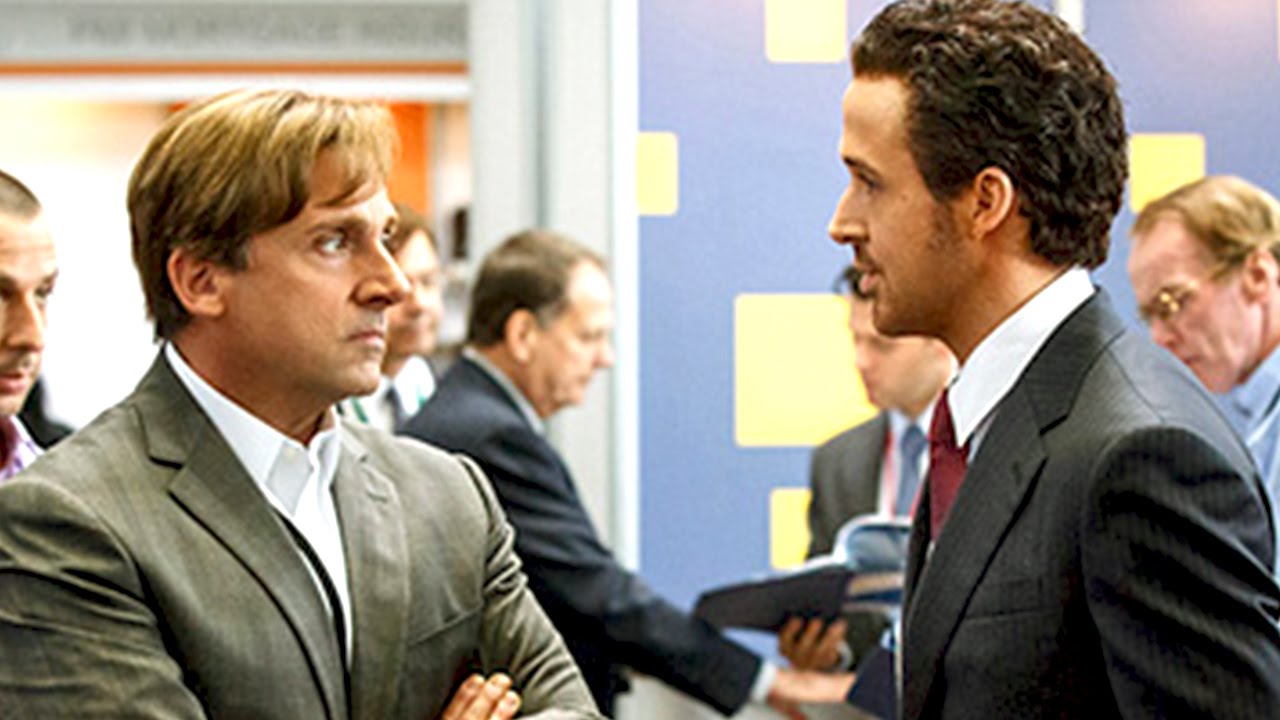
Burry’s actions attract the attention of a trader at Goldman Sachs, Jared Vennett (Gosling). At first, like everyone else, Vennett thinks that Burry’s idea is completely ridiculous. But he does what Burry did and digs a little deeper, until he too sees the likelihood of the collapse happening. He attempts to do what Burry has done using his own funds but a misplaced phone call ends up putting him in touch with Mark Baum (Carell), another hedge fund manager. Baum and his small team begin to create their own credit default swaps.
In addition, two young investors, Charlie Geller (Magaro) and Jamie Shipley (Wittrock) hear about the default credit swaps, and with the aid of industry veteran Ben Rickert (Pitt), they too manage to raise their own swaps. Burry faces the ire of his bosses at the company where he works (who can’t see that the housing market could collapse – because it’s never happened before) because of the size of the premiums he’s paying, while Baum’s investigation into the pending collapse begins to show the enormous effect it will have on the public, as well as the financial system. The sheer size and scope of the fallout, they realise, won’t just affect the US economy, but the global economy as well.
As Baum and his team look further into the reasons why the collapse will occur, they discover that the banks and mortgage lenders are complicit in keeping the status quo, preferring to get rich off of short term investments instead of long term ones. And they also discover the existence of CDO’s (collateralized debt obligations), groups of poor loans that are packaged together and given incorrect ratings in order that they can be sold on. These packages are essentially worthless but are being used to a) prop up the already wobbly housing market, and b) to further ensure quick, easy profits for the banks.
But it all proves to be too much and too late. In 2007 the markets defaulted and the collapse began in earnest. The ripple effect of foreclosure after foreclosure began to cripple the banks, and many closed for business, owing billions of dollars (the movie states that $5 trillion was lost in total). But – and here’s the irony – Burry, Baum, Vennett, Geller and Shipley all profited from the collapse. Their credit default swaps allowed them to make millions off of the back of everyone else’s misery. The movie acknowledges this around halfway through, and while up til then the viewer might be regarding these guys as the heroes of the story, by the end it’s doubtful you’ll see them in the same light. When Burry leaves his office once his company’s credit default swaps have been honoured you see the amount they’ve made written on a board: $2.69 billion.
By focusing on the people who warned the system what was going to happen, and who benefitted from it in the long run, The Big Short is able to show us what was happening on the inside, and how pervasive the fraud related to mortgage lending was. It’s a morality tale where no one gets off lightly. Geller and Shipley, once they realise the effect the collapse will have on ordinary people they try and warn their friends and families, but they’ve made no effort to warn anyone else during the whole time. Baum approaches one of the Ratings agencies, to see how they can justify giving approval ratings to the CDO’s, only to be told that if they didn’t the banks would take their business elsewhere; and yet Baum doesn’t warn anyone outside his own team about what this means. And Burry sits back in his office and watches it all unfold with the view that he’s just doing his job.
That the US financial institutions of the time were amoral in their approach to protecting their clients is something we’ve long been aware of, but the point The Big Short makes with absolute clarity is that everyone was too busy getting rich to even care. What makes matters worse is that the banks weren’t even worried; they knew that the government – the people, if you like – would have to bail them out if anything did go wrong. It’s this nasty, reprehensible lack of responsibility, and the extent of it, that really comes across, and even though Baum in particular bemoans the industry’s fraudulent activities, it still remains that few efforts were made to avoid the collapse when it was known about and accurately predicted.
As the movie’s anti-heroes, Bale is on nervous, Asperger’s-type form as Burry, supposedly with a glass eye (the left one), and working with absolute certainty that his projections are correct. Burry is a character that comes across as indifferent to anyone around him, and dismissive of others when challenged, but Bale makes him into a weary financial warrior, determined to make a profit for his investors at the expense of millions of ordinary non-investors. He’s likeable enough but some viewers may find him cold and distant. Carell plays Baum as the script – by McKay and Charles Randolph – has set him up: as the tale’s sole source of any conscience. With an unflattering wig perched on his head to add to his woes, Carell looks crestfallen and morose throughout, as if the weight of the (financial) world was all on his shoulders alone. It’s less of a performance than an extended mope-athon, and aside from a few moments of outrage, Baum looks and sounds like someone who’s got inside the cookie jar, has stuffed them all in his mouth, and only then discovered that he doesn’t like the flavour.
In support, Gosling sports a hideous hairstyle and struts around breaking the fourth wall with undisguised glee (as do several other characters), while Pitt buries himself beneath another odd wig and a scruffy beard. Magaro and Shipley adequately put across the eagerness and the excitement of being in on what could be termed an “industry secret”, and their scenes together are eloquent for how they go from earnest and enthusiastic to demoralised and dismayed. The rest of the cast do well with sometimes sketchily written characters, though Mann comes in towards the end as an investment manager that the banks use to create synthetic CDO’s (even worse than the real thing) and who is scarily unconcerned about the consequences of what he’s doing.
McKay – better known for his work with Will Ferrell – has made a movie that exposes the indolence and the greed at the heart of Wall Street during the last decade, and he’s done it with no small amount of style. When something complicated needs explaining, instead of getting one of the characters to explain it, the movie is effectively paused while a celebrity does so in terms that the average viewer can understand (which leads to the surreal moment when Selena Gomez explains what synthetic CDO’s are). With the intricacies of the financial jargon overcome, McKay looks to emphasise the human cost of the banks’ endeavours and does so with a pointed, judgmental approach that can be hugely effective.
The Big Short may not be everyone’s idea of a movie to crack open a few beers with, or indeed one that could be enjoyable, but there’s much to warrant giving it a try, and if you pay attention to what’s being said, there’s a lot to be understood about what went wrong in 2007 and why it was inevitable. As a cautionary tale it’s perhaps a little too late in the telling, but it does leave the viewer with one very clear warning right at the end: beware of “bespoke tranche opportunities”. They’re the new version of CDO’s and the banks are pushing them with all the gusto did in the past.
Rating: 8/10 – well focused on both the financial and human sides of the crisis, The Big Short is a scary look at a situation that nearly caused a global financial meltdown, and why it came about; fascinating and horrific on a continually WtF? level, the movie is at its best when its skewering the antipathy and the greed of the banks and their seemingly pathological determination to screw over everybody for the sake of a quick buck.
Cast: Christian Bale, Joel Edgerton, John Turturro, Aaron Paul, Ben Mendelsohn, María Valverde, Sigourney Weaver, Ben Kingsley, Hiam Abbass, Isaac Andrews, Ewen Bremner, Indira Varma, Golshifteh Farahani, Ghassan Massoud, Tara Fitzgerald
Ancient Egypt, 1300 BC. In the holy city of Memphis, Pharaoh Seti (Turturro) has learnt that the Hittite army is nearby. He sends his two sons, Ramses (Edgerton) and Moses (Bale) to rout them, which they do, but not before Moses saves Ramses’ life on the battlefield, thus fulfilling a prophecy that says one of them will be saved by the other who will become a leader. When they return, Seti orders Ramses to travel to Pithom in order to assess the slaves working there. Moses goes instead and meets the Viceroy, Hegep (Mendelsohn).
Hegep is crooked and treats the slaves poorly. During his visit, Moses meets a man called Nun (Kingsley) who tells him that he is a Hebrew and that the circumstances of his birth are not as he believes. Moses refutes this and returns to Memphis, but the story is overheard and reported to Hegep. Soon after, Seti dies and Ramses becomes Pharaoh. When Hegep comes to Memphis he tells Ramses of Moses’ history; this leads to Moses being sent into exile. He travels to Midian where he settles down as a shepherd and marries Zipporah; they have a son, Gershom. Meanwhile, Ramses marries Nefertari and they too have a son.
Nine years pass. During a storm, Moses pursues some stray lambs onto a nearby mountain. A rock slide renders him unconscious; when he comes to he finds himself confronted by a young boy, Malak (Andrews) who is God’s messenger. He gives Moses a task to do, one that brings him back to Memphis and a meeting with Ramses where he warns the Pharaoh to set the Hebrews free or there will be consequences. Moses prepares the Hebrews for conflict, while Ramses targets them in the hope that Moses will give himself up. But Malak appears to him again and warns him that Moses’ lack of progress means “something is coming”.
“Something” proves to be a series of plagues that wreak havoc on Memphis and the Egyptian people, culminating in a cull of all the Egyptian firstborns, including Ramses’ infant son. Ramses, in despair, tells Moses to take his people and leave. But once they’ve done so he takes four thousand men and pursues them all the way to the Red Sea, with the intention of slaughtering them all.
It could be argued that the need for a re-telling of the Moses story isn’t exactly high on anyone’s agenda at the moment, but nevertheless here it is, and directed by one of the few directors able to orchestrate a movie on such an epic scale. However, while Exodus: Gods and Kings is as visually impressive as you might expect given that Darius Wolski is behind the camera and Ridley Scott is overseeing things, the movie as a whole is a leaden, passion-free exercise in big-budget movie making.
Considering both the material and the cast taking part, the movie struggles to engage the audience from the off, proving largely uninteresting and a frustratingly bland experience. As happens every so often with the projects Scott chooses – 1492: Conquest of Paradise (1992) and Hannibal (2001) are just two examples – Exodus: Gods and Kings is a) too long, and b) too tedious.
With the story of Moses, the ten plagues, and the crossing of the Red Sea being one of the most dramatic Biblical tales, the fact that this incarnation loses its way so quickly (and never recovers) is a little embarrassing. The criticism that Scott focuses too much on the design and look of a movie is upheld here by a range of performances that give new meaning to the word “undercooked”. Bale’s portrayal of Moses lacks the intensity of feeling that the part demands, and his discovery of his roots is reduced to a brief scene that gives way to an even briefer fight scene; it’s as if he’s more irritated than devastated. Edgerton plays Ramses as an indecisive, self-doubting pharaoh who looks like he needs a comforter (or his mommy). As the dramatic foil to Moses, Ramses’ character carries all the weight of a feather duster, and Bale and Edgerton’s scenes together quickly become repetitive in nature: Moses shows his annoyance/anger/disappointment in Ramses, Ramses does his best not to look as if he’s going to cry.
Thus any clash between the two is always going to be heavily weighted in Moses’ favour, but Bale never takes full advantage of the way the script orchestrates these encounters (he’s also able to get to Ramses without being detected, and to leave without being pursued). He and Egerton aren’t bad per se, but they don’t spark off each other. If it weren’t for the fact that both actors are clearly physically present in their scenes together, you could be forgiven for believing that they filmed them separately and were “united” in post-production.
As for the rest of the cast, their roles are generally too small for them to make much of an impression, with the notable exception of Mendelsohn, who takes Hegep and invests him with a surprising mixture of flippancy and menace. It’s the best performance in the whole movie, and when he’s on screen, the discrepancy between his approach and Bale’s (in particular) is all too apparent. In even minor roles, Weaver, Paul, Turturro, Kingsley and Farahani are there to make up the numbers, while Valverde is stranded by the script’s need to tick off the boxes in Moses’ life without providing any depth to it. It’s unfortunate, as well, that Valverde’s appearance is during the film’s middle section, where Moses strives to be a shepherd before his first meeting with Malak (there is a burning bush but with Malak acting as God’s mouthpiece, it just looks superfluous). This stretch of the movie has all the pace of a snail race, and thanks to the indolent editing – courtesy of Billy Rich – seems to go on for much longer than it actually does.
With so many scenes either dragging on or lacking in energy, Exodus: Gods and Kings regularly falls back on its special effects, but even here the spectacular appears commonplace, our familiarity with what CGI can achieve blunting the effect of seeing Memphis from the air, or giant crocodiles attacking ships on the Nile. It also leaves the crossing of the Red Sea, and its fast-approaching ten-storey wave, feeling less impressive and/or intimidating than it should be. Again, Scott and his cast and crew fail to heighten the drama and leave the viewer struggling to work out where everyone is in relation to a constantly changing topography (not to mention a wave that appears to be advancing from at least three directions at once).
Scott’s ardor seems to have waned recently, with his last two movies – The Counselor (2013) and Prometheus (2012) – showing clear signs of a director unable to spot, or deal with, or overcome, the faults in each movie’s screenplay, and sadly, the same is true here. The script – by Adam Cooper and Bill Collage, with assists from Jeffrey Caine and Steven Zaillian – aims for intimacy amid the spectacle but ends up skirting it instead, and any notions of leadership, duty, fraternal betrayal, faith or destiny, rather than being placed front and centre, are given a passing nod whenever the movie appears to need them.
Rating: 5/10 – visually stunning but dramatically redundant, Exodus: Gods and Kings is a disappointing, mediocre piece that fails to inject any fervour into the story of Moses and his efforts to free the Hebrews from the pharaohs’ tyranny; stilted and dull, this becomes as much an epic of endurance (for the audience) as it does for its characters.
Cast: Christian Bale, Bradley Cooper, Amy Adams, Jeremy Renner, Jennifer Lawrence, Louis C.K., Jack Huston, Michael Peña, Shea Whigham, Alessandro Nivola, Elisabeth Röhm
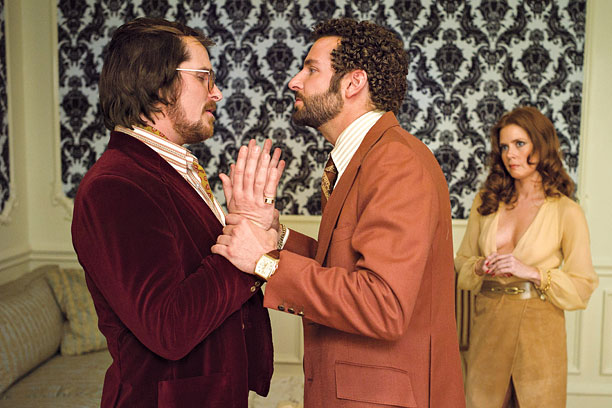
Small-time hustlers Irving Rosenfeld (Bale) and Sydney Prosser (Adams) have made a success out of an investment scam that involves Sydney posing as an English aristocrat with British banking connections. They become so successful that they soon attract the attention of ambitious FBI agent Richie DiMaso. DiMaso gives them a choice: either be prosecuted or help him go after local mayor Carmine Polito (Renner) who he suspects of being corrupt. Not really having a choice, Irving and Sydney go along with DiMaso’s plan, only to find the plan mutating beyond the scope of exposing Polito’s possible corruption. Soon the Mob is involved and DiMaso’s ambitions are jeopardising both the scam he’s set up, and their lives. With Irving’s wife, Rosalyn (Lawrence) causing unexpected complications as well, it’s up to Irving and Sydney to come up with one more scam to save their necks.
Apparently based on the ABSCAM scandal from the late Seventies – where the FBI attempted to expose corrupt politicians and senators by dressing up as Arab sheikhs and offering them bribes for a wide range of illegal requests – American Hustle is a weird movie in many ways. It celebrates Irving and Sydney’s love for each other while at the same time eulogising Irving’s faithfulness to his wife and adopted child. The movie also presents their investment scam as essentially victimless. This sets up DiMaso as the movie’s villain-in-residence, and encourages us to root for Irving and Sydney from the very beginning, and while pretty much every movie under the sun has a protagonist that the audience is supposed to identify or empathise with, the fact that Russell so blatantly overlooks their criminal tendencies – other than as necessary for the plot – is immediately disarming: we’re actively complicit in their criminal behaviour. Where’s the moral ambiguity?
While Irving and Sydney are clearly “nice” criminals, Richie is the “bad” cop: manipulative, self-aggrandising, violent, and arrogant. He attempts to come between Irving and Sydney, shows his impatience at every turn, and due to his eagerness to get ahead, rarely makes the right move when part of the scam is in progress. So bad is he, it’s almost funny, as if he’s an unfortunate composite of every bumbling FBI agent ever portrayed on the big screen. Rosalyn, initially dim-witted and somewhat agoraphobic, develops into a player overnight, eventually “showing” Irving the way out of their shared predicament. She’s a brash, outspoken character who never once rings true except when lambasting Irving for getting involved with Sydney. And then there’s Carmine, a well-meaning politician whose naïveté gets him into so much trouble, and so quickly, you wonder how he ever managed to become mayor in the first place. These are the main characters that Russell has admitted he cared more about than the story.
With such a focus, it’s a relief then that the performances by all concerned are uniformly excellent. Bale, sporting a hideous comb-over and a beer gut, gives one of his best performances as the love-struck, hen-pecked, slightly less clever than he thinks Irving. With each scene he peels back another layer of a man who at first seems one-dimensional and hollow, but who is actually heartfelt and loyal to those he cares about. It’s a carefully structured performance and reminds anyone who might have forgotten that Bale is as adept at playing ordinary characters as he is damaged or vengeful ones. Adams offers equally good support – and a decent British accent – as the emotionally torn Sydney, battling her burgeoning feelings for Richie before realising he’s using her as much as she’s used her marks in the past. As the wildly out of control Richie, Cooper excels, adding to the kudos he gained from The Place Beyond the Pines with a controlled yet seething reading of a man with too much ambition for his own good, and a frightening lack of empathy or understanding of the people around him. Renner has the least showy role, but manages to breathe life into a character who, at first, lacks any depth. As the movie progresses, his need to help the people is shown as a personal crusade and his inevitable downfall a sad indictment of the collateral damage that can occur in these situations. And lastly, there’s Lawrence, possibly the finest actress of her generation, imbuing Rosalyn with a vulnerability and tenacity that more than make up for the deficiencies in the characterisation. She’s nothing short of miraculous.
With such a concentration on the characters, rather than the story or indeed the script – there’s a great deal of improvisation throughout – American Hustle ultimately falls short of its potential. The story and plot are predictable, with any quirks that may have been part of the real-life scam ironed out in favour of more time with Irving and Sydney and Rosalyn and Richie and Carmine. Russell directs with his usual flair, and while his focus may have been misguided, the look and feel of the Seventies is recreated effectively – those clothes! – and the structure of the movie is almost flawless. Danny Elfman’s music, along with a carefully selected soundtrack, helps heighten the mood of the period and complements Linus Sandgren’s warm-toned cinematography, while Judy Becker’s production design provides a subtler evocation of time and place than most “period” pieces.
In essence, this isn’t the polished gem that most would have it but more of a rough diamond. Russell is incapable of making a dull movie, but he nearly pulls it off here. This is a character piece, not the crime drama the trailers and the advertising make it out to be, and while there’s always room for a character piece, with this movie’s background, more attention to those aspects would have made the movie a stronger, more interesting watch.
Rating: 8/10 – with a great cast – and one notable cameo – keeping things from being too dull, American Hustle doesn’t quite make the grade as a modern classic; absorbing and awkward to watch in equal measure, there’s another movie in there somewhere but not the one that Russell wants us to see.





 thedullwoodexperiment