• 10 Reasons to Remember…
  • A Brief Word About…
  • About
  • For One Week Only
  • Happy Birthday
  • Monthly Roundup
  • Old-Time Crime
  • Other Posts
  • Poster of the Week
  • Question of the Week
  • Reviews
  • Trailers

thedullwoodexperiment

~ Viewing movies in a different light

thedullwoodexperiment

Tag Archives: Creature

The Shape of Water (2017)

19 Friday Jan 2018

Posted by dullwood68 in Movies

≈ 1 Comment

Tags

Baltimore, Cold War, Creature, Doug Jones, Drama, Guillermo del Toro, Michael Shannon, Michael Stuhlbarg, Music, Octavia Spencer, Review, Richard Jenkins, Romance, Sally Hawkins, Sci-fi, The Sixties
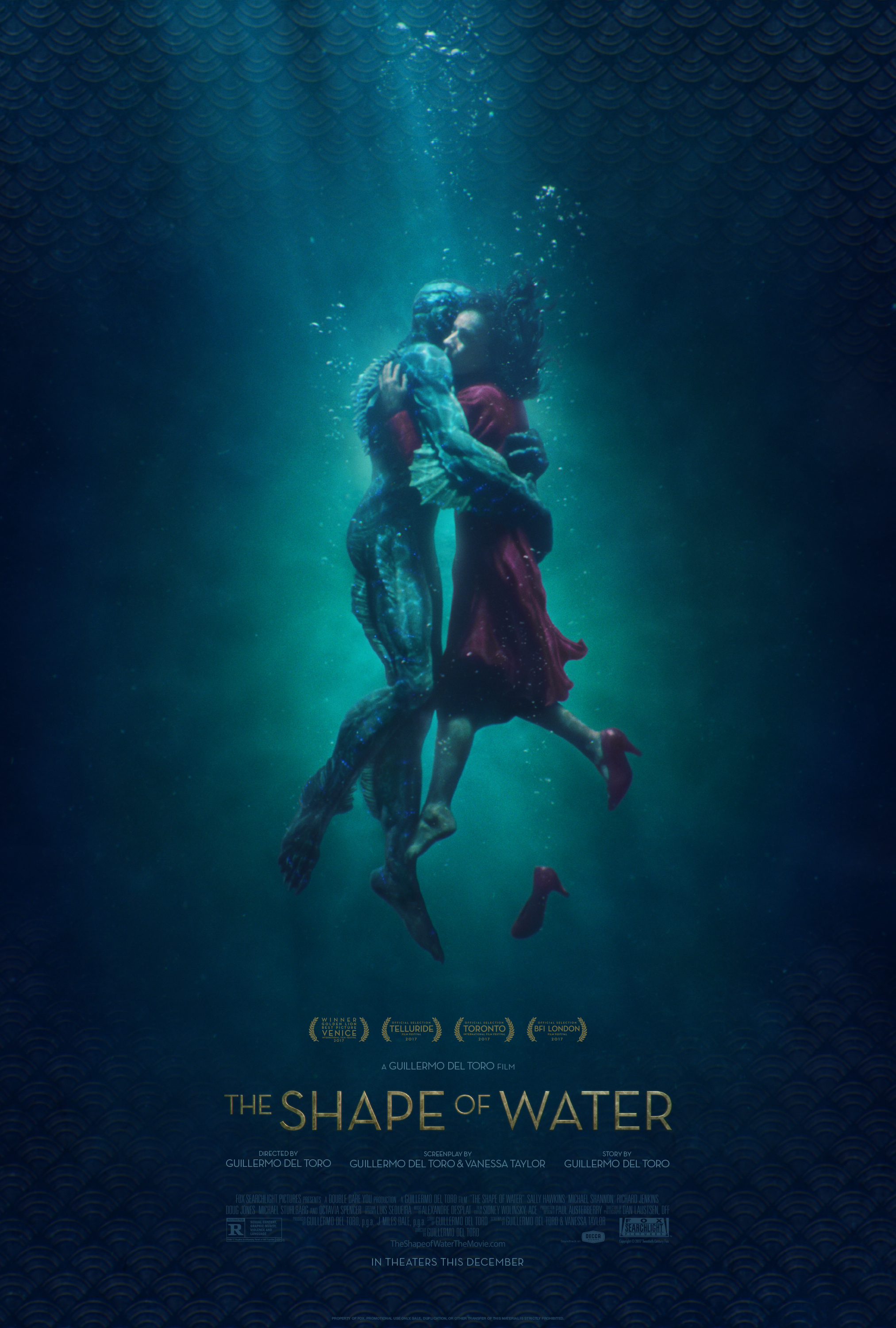
D: Guillermo del Toro / 123m

Cast: Sally Hawkins, Michael Shannon, Richard Jenkins, Octavia Spencer, Michael Stuhlbarg, Doug Jones, David Hewlett, Nick Searcy, Lauren Lee Smith

A romantic fairy tale set during the Cold War era of the Sixties, Guillermo del Toro’s latest feature is set in a secret government laboratory in Baltimore. Elisa Esposito (Hawkins) is a cleaner who works the night shift. She’s also mute from birth. One night the laboratory receives a new “asset”, an amphibious creature (Jones) captured in the Amazon river by military man Richard Strickland (Shannon). The creature proves to be humanoid, and though it’s ostensibly dangerous, Elisa develops a bond with it, and even uses sign language to communicate with it on a basic level. With the creature able to breathe in and out of water, the intricacies of its anatomy lead to the decision to have it vivisected. Elisa is horrified by this, and with the aid of her fellow cleaner, Zelda (Spencer), and her neighbour, elderly artist Giles (Jenkins), she determines to free the creature and return it to the sea. As she puts her plan into action, she finds unexpected assistance from one of the scientists at the laboratory, Dr Hoffstetler (Stuhlbarg), and unwanted attention from Strickland.

Fully and firmly back on track after the disappointment that was Crimson Peak (2015), Guillermo del Toro has made perhaps his best movie yet. The Shape of Water is a veritable treasure trove of delights. By turns funny, dramatic, sad, tender, exciting, joyous, imaginative, bold, romantic, uplifting, and poignant, it’s a movie that crams so much into its two hour running time that it should feel heavy-handed. Instead it feels like the lightest of confections, even with the overtly darker undertones that are threaded throughout the narrative and which help the movie add a credible and palpable sense of menace to the overall tone. del Toro has long wanted to make a movie inspired by Creature from the Black Lagoon (1954), but it’s unlikely even he could have predicted just how good the end result would be. From Paul D. Austerberry’s masterful period production design, to the efforts of the set dressers (so much detail), this is a movie that is constantly inviting the viewer to come nearer and peer closely at all the objects that fill each frame. And then there are the small yet seemingly effortless moments that pepper the movie, moments such as Elisa and Giles’ seated dance routine, or the man at the bus stop with the partially eaten cake. It all adds up to a richness of texture that is nigh-on faultless.

But the movie isn’t just beautiful to look at, it’s also an old-fashioned love story (an inter-species love story, to be fair, but hey, so what? As Joe E. Brown says at the end of Some Like It Hot (1959), “Nobody’s perfect”). It would have been so easy to misjudge the tone and the mood in presenting this romance, but del Toro and co-screenwriter Vanessa Taylor handle it perfectly, combining elements of magical realism and the aforementioned fairy tale aspect to wonderful effect. Hawkins – for whom the role of Elisa was written – gives a mesmerising performance, passionate and vulnerable, determined and caring, and capable of expressing any of Elisa’s emotions through the delicate shading of her features. As the principal villain, Shannon gets to add unexpected psychological layers to the role of Strickland, something that keeps the part from being that of a stereotypical bad guy, while Jenkins provides the majority of the laughs (and a great deal of pathos) as Giles, an elderly gay man still hoping to find love himself. Everything is rounded off by the music, as del Toro harks back to the golden era of Hollywood musicals. And just when you think he can’t squeeze in anything else, he gives us a black and white dance number featuring Elisa and the creature which is a tribute to Follow the Fleet (1936). This all leaves just one option: this much confidence must be applauded.

Rating: 9/10 – made with an intense amount of love and affection for its central characters, and with an elegance that shines throughout, The Shape of Water is a triumph of both style and substance; look closely, though, and you’ll find del Toro being quietly and unobtrusively subversive: ask yourself – which other movie are you likely to see where the heroes are in turn disabled, gay, black, and a Communist?

Share this:

  • Click to share on X (Opens in new window) X
  • Click to share on Facebook (Opens in new window) Facebook
  • More
  • Click to print (Opens in new window) Print
  • Click to email a link to a friend (Opens in new window) Email
Like Loading...

Dark Was the Night (2014)

03 Thursday Sep 2015

Posted by dullwood68 in Movies

≈ Leave a comment

Tags

Bianca Kajlich, Creature, Drama, Hollywood Black List, Horror, Jack Heller, Kevin Durand, Lukas Haas, Maiden Woods, Review, Sheriff, The Trees, Thriller, Tyler Hisel, Wendigo

Dark Was the Night

D: Jack Heller / 98m

Cast: Kevin Durand, Lukas Haas, Bianca Kajlich, Nick Damici, Heath Freeman, Ethan Khusidman, Sabina Gadecki, Billy Paterson

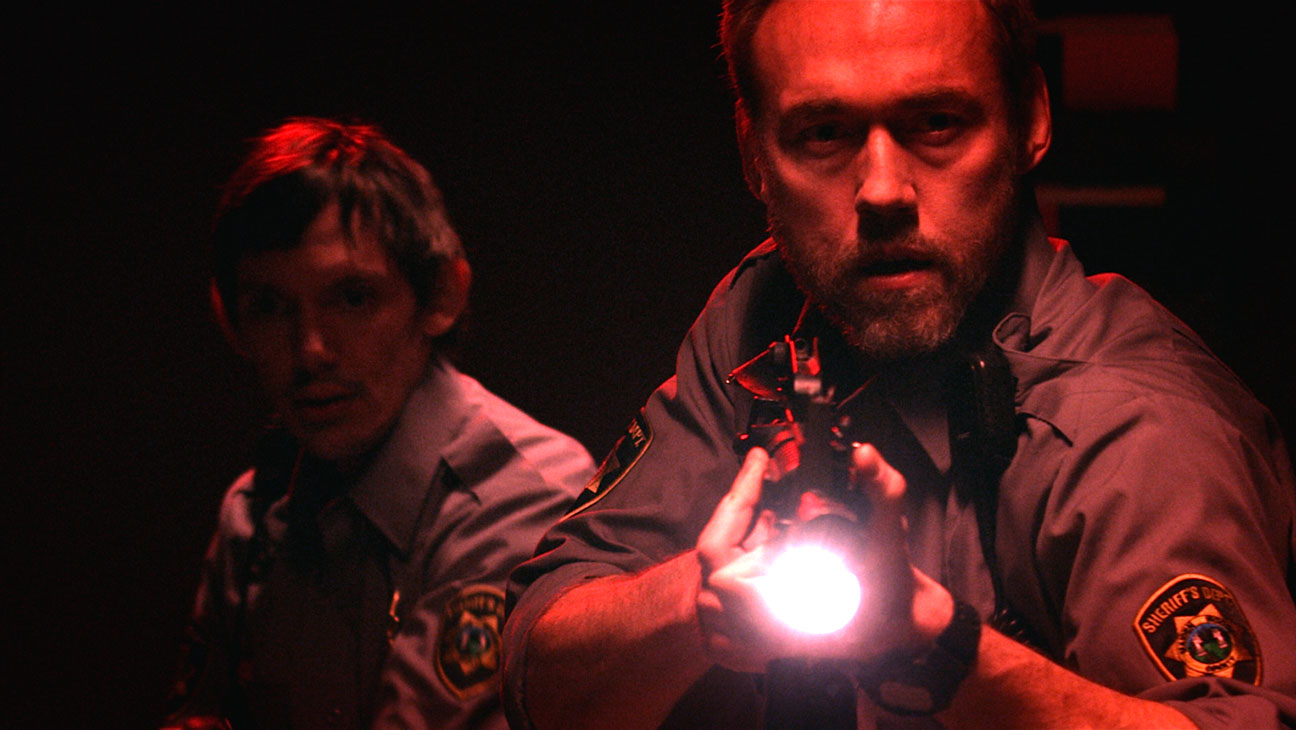
The small town of Maiden Woods is a quiet, peaceful place where everyone knows everyone else, and whose sheriff is a man named Paul Shields (Durand). Grieving the loss of his young son Tim, Paul has split from his wife Susan (Kajlich) and their older son Adam (Khusidman) through his feelings of guilt (he was looking after Tim when he died). Estranged and lacking faith in himself, he’s called out to a farm by the owner, Ron (Paterson), who’s missing one of his horses. Certain that there’s nothing suspicious going on, he puts it down to Ron leaving a gate open. Back in town, Susan tries to get Paul to confront his feelings but he doesn’t want to, but he does agree to look after Adam for the night. While they have dinner, Adam sees something outside, but when Paul investigates he doesn’t find anything.

The next morning, Paul’s deputy, Donny Saunders (Haas) calls at Paul’s home and asks him if he’s been outside yet. Paul follows him out and finds a line of muddy hoof prints that circle his house and then head further into town, and then out into the woods where they disappear abruptly. The puzzling thing about them is that whatever animal made them, it was walking on two legs. While Paul starts to look into the matter, and does his best to reassure the worried townspeople, Donny hears about the local legend of a creature that lives in the nearby woods, and how it hunts by using the upper branches of trees as cover.

Paul has an encounter one night on the road with a dead deer. He hears something in amongst the trees, and rattled, gets back in his car only to find the deer has disappeared. He checks with the sheriff of a neighbouring county to see if there have been any animal attacks there recently. He learns that a logging crew were found dead not too long ago, and there have been a number of animal killings. Between them, Paul and Donny come to the conclusion that the logging company’s efforts have forced the legendary creature of the woods out of its natural habitat and it’s now trying to take over a new territory for itself, namely, Maiden Woods.

When a fierce snowstorm cuts off the town and the few remaining inhabitants who haven’t already evacuated, Paul decides to get everyone holed up in the church and to wait it out until morning when the storm has passed; then they can get help. But the creature proves unwilling to wait and launches an assault on the church and the fearful townsfolk inside…

Dark Was the Night - scene

Back in 2009, Tyler Hisel’s script The Trees was included in the annual Hollywood Black List, the list of the 100 best unproduced screenplays. Based loosely on real-life events that occurred in 1855 in Topsham, England, when the inhabitants woke to find freshly fallen snow and biped hoof prints tracing the landscape, Hisel’s script was eventually picked up for production in 2012, and though filming was completed in the same year, it remained unseen until a showing at the Screamfest Horror Film Festival in 2014. Such a delayed release usually speaks of either production problems or a lack of confidence in the final product. But either way, potential viewers who might be put off by such a delay would be doing themselves a disservice, because said final product is one of the better creature features out there and well worth seeing.

Part of the movie’s appeal is the performance by Durand, an actor usually employed to play bad guys. Here he gets a chance at playing the hero plagued both by self-doubt and being out of his depth. His reactions to the increasing weirdness in his town are flecked with small moments of subdued panic, and it’s this considered approach to both the character and the material that raises what would normally be a stock role into something much more subtle and much richer. Even when the narrative requires Paul to play the action hero, his taking charge plays better as a result of the work Durand has already put in, and instead of it feeling clichéd or forced, Paul’s heroism becomes a natural consequence of his dealing with his guilty feelings.

Having such a degree of depth in its main character, the movie has a grounding that makes the fantasy and horror elements feel more credible, even if the creature, when it’s finally revealed, is not as scary or convincing as it needs to be. It’s a shame as up until then the movie does a very good job of keeping it out of the spotlight, and the brief glimpses we do see of it are carefully chosen to good effect (and to meet the demands of the budget). The creature has its roots in Native American myths and legends, including that of the wendigo, and the concept of its being disturbed from its natural habitat is another of Hisel’s ideas that carries some extra weight (and adds some subtext about endangered species).

Thanks to Heller – who also directed the under-rated Enter Nowhere (2011) – the plot unfolds at a measured pace, with equal time given to the mystery of what’s happening in and around Maiden Woods, and the emotional problems that Paul is trying to deal with. As both storylines converge, Heller increases the tension through judicious use of close ups and sound effects, and manages the unenviable task of having his two leads come to the conclusion that there might be a supernatural answer to what’s happening by emphasising their own doubts and disbelief, even though everything tells them otherwise. It makes for one of the more convincing “it-must-be-a-monster” moments in creature feature history, and is one more example of the care and attention taken by Heller, his cast and crew.

Rating: 7/10 – much better than most other movies of the same ilk, Dark Was the Night is a minor gem that shouldn’t be missed; thanks to the efforts of all concerned this is a much more meticulous and rewarding experience than could be gleaned from at first glance, and proof that low budget horror doesn’t have to be witless or exploitative.

Share this:

  • Click to share on X (Opens in new window) X
  • Click to share on Facebook (Opens in new window) Facebook
  • More
  • Click to print (Opens in new window) Print
  • Click to email a link to a friend (Opens in new window) Email
Like Loading...

The Babadook (2014)

30 Sunday Nov 2014

Posted by dullwood68 in Movies

≈ 5 Comments

Tags

Australian movie, Creature, Dead husband, Drama, Essie Davis, Grief, Horror, Jennifer Kent, Mother/son relationship, Noah Wiseman, Possession, Review, Thriller

Babadook, The

D: Jennifer Kent / 93m

Cast: Essie Davis, Noah Wiseman, Hayley McElhinney, Daniel Henshall, Barbara West, Benjamin Winspear, Tim Purcell

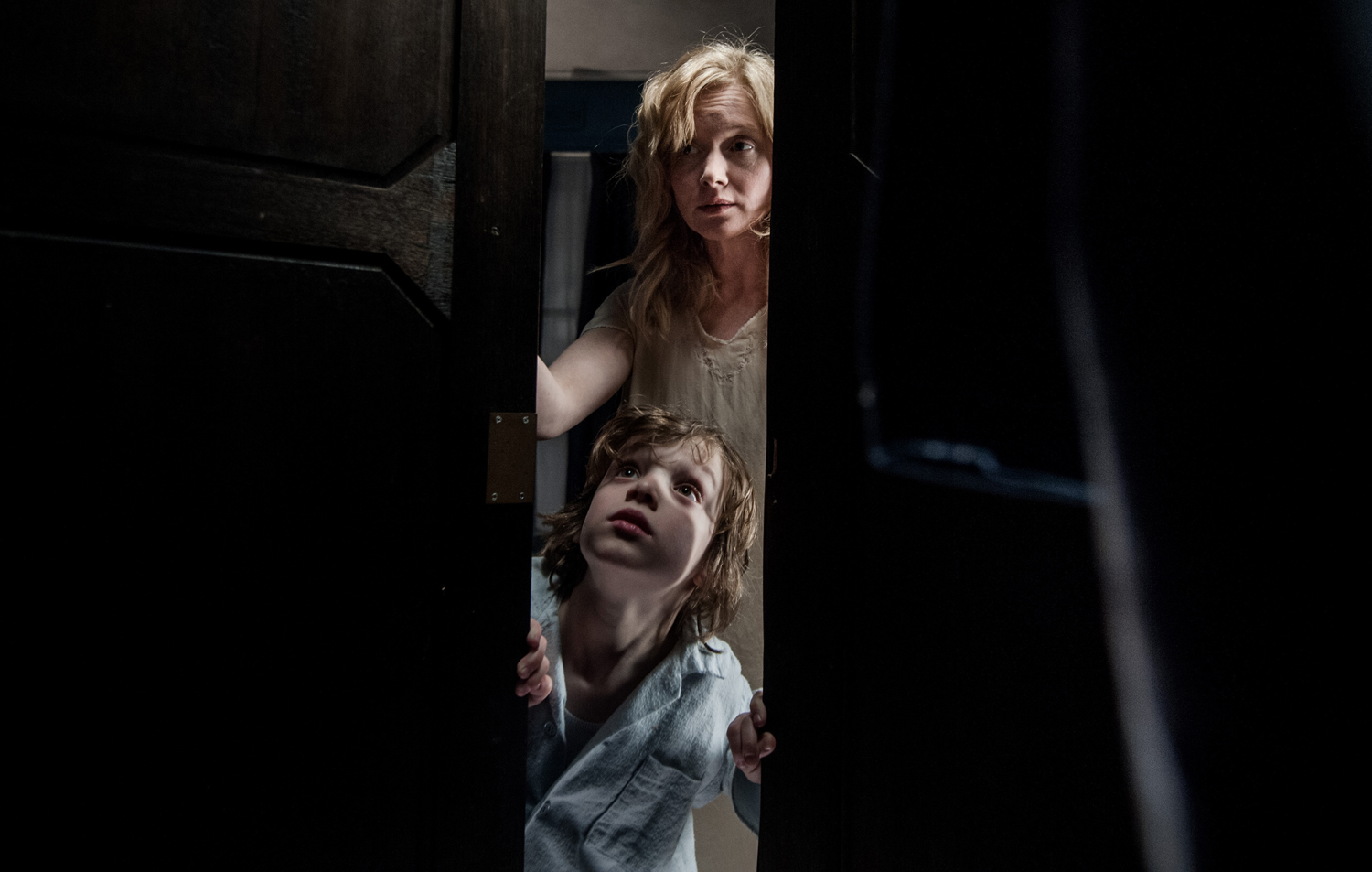
Six-year-old Samuel (Wiseman) has a deep-rooted fear of monsters. Each night he makes sure his mother, Amelia (Davis) checks under the bed and inside his wardrobe to ensure nothing lurks in his room. Most nights, though, Samuel’s fear leads to his sleeping with his mother; this in turn leads to Amelia being constantly tired. With his fear of monsters becoming obsessive – Samuel is convinced they’re real and constructs weapons to kill them – his behaviour begins to have an isolating effect. His school doesn’t know how to deal with him, and Amelia’s sister, Claire (McElhinney) is sufficiently worried to want to keep her daughter away from him.

One night, Samuel chooses a book for Amelia to read to him at bedtime. The book is called The Babadook, and shows a menacing creature trying to prey on a young child; strangely, the last few pages are blank. Amelia is disturbed by the book, but not as much as Samuel. His behaviour worsens as he refers to the Babadook as being real. Unable to cope at work, and struggling with Samuel’s “acting up”, Amelia rips the book into pieces and throws it into the trash. Soon after, there is a loud knocking at the front door. Amelia finds the book on the doorstep, its pages reassembled, and with the last few pages now depicting her murdering their dog, and then Samuel before taking her own life. Horrified, this time she burns the book.

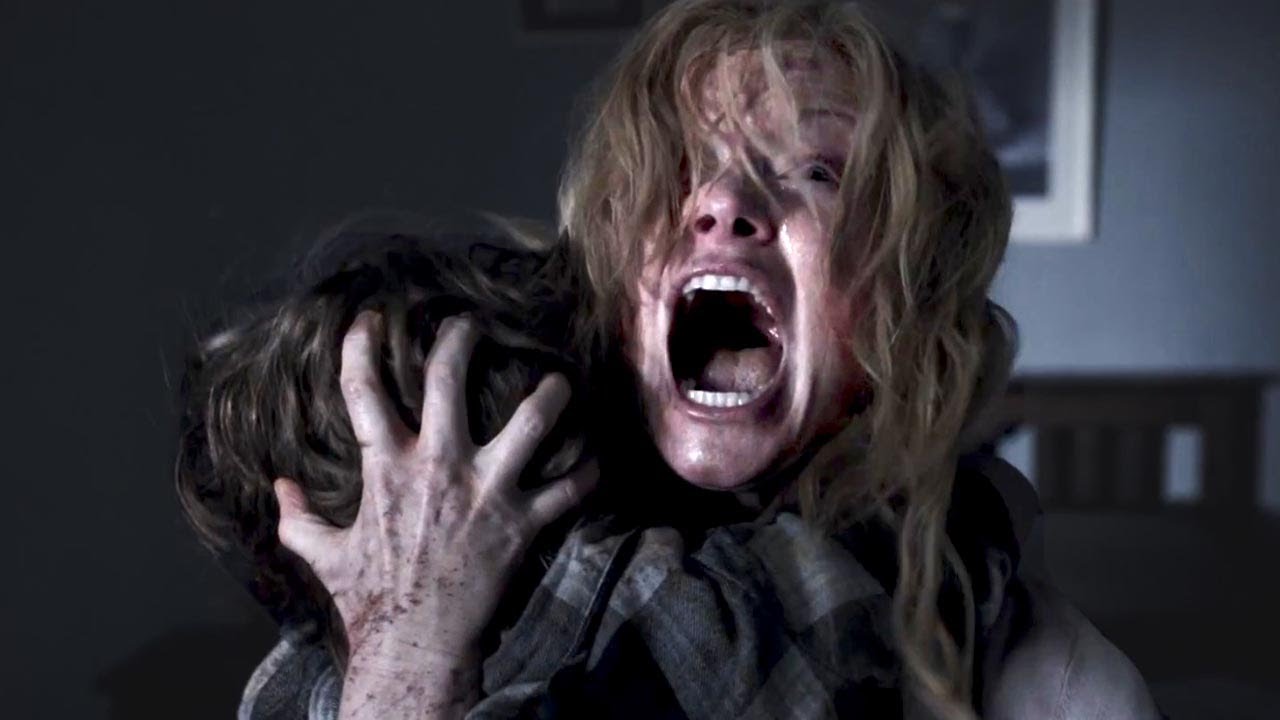
Amelia also starts to receive phone calls where a voice chants “ba-BA-ba Dook! Dook! Dook!” Then one night she sees the creature in her room. Terrified, but unsure of what to do, Amelia attempts to carry on as usual but Samuel becomes increasingly wary of her. When he has a fit in the back of their car, she keeps him off school, but her attempts to look after him are hampered by sudden mood swings and angry outbursts. Samuel becomes convinced she’s been possessed by the Babadook, and tells her so. And soon, the book’s added illustrations start to come true…

Babadook, The - scene

Expanded from Kent’s debut short, Monster (2005), The Babadook is an occasionally chilling examination of childhood terror and adult paranoia. It opens with the accident that claims the life of Oskar (Winspear), Amelia’s husband. This pivotal moment is at the heart of Amelia’s troubles, her unresolved grief keeping her from moving on with her life and hindering her from properly dealing with Samuel’s fear of monsters. Of the two, she is the more susceptible to the attentions of the Babadook, and so it proves, the creature targeting the weaker inhabitant of the house. It’s a frightening scenario for any child: to see their parent turning into the very creature they’re most afraid of, and it’s this very real terror that the movie exploits so effectively.

However, the concept of the Babadook itself is less successful. As the latest boogeyman to hit our screens, its look a combination of German Expressionism and Freddy Krueger’s favourite manicure, the creature is kept hidden for the most part, Kent preferring to use Oskar as its more user-friendly incarnation. This decision is a wise one on the writer/director’s part, as when the Babadook does appear in the flesh, the nightmarish quality of the book’s rendering of it is undermined, and there’s just too much of a resemblance to Conrad Veidt in The Cabinet of Dr. Caligari (1920). (There’s also a moment when the Babadook, hidden in the darkness of Amelia’s bedroom, extends its arms in a wing-like effect; it’s meant to be terrifying but instead is puzzling as there’s no follow up.) Used largely as a shock effect, the Babadook isn’t quite as scary as might be expected, and Kent doesn’t do full justice to the opportunities the creature could have afforded.

The Babadook is more effective, however, as a study of one woman’s extreme mental breakdown. Taking the death of her husband as a starting point, Amelia’s inability to cope is more understandable. There’s a scene with her sister where Amelia admits she doesn’t talk about Oskar’s death but it’s still a source of pain; it’s clear from this that she’s never properly dealt with the feelings and emotions that have developed over the years since he died (there is an added level of heartache to Oskar’s death: he was driving Amelia to the hospital so she could give birth to Samuel when the accident happened). With Samuel’s seventh birthday fast approaching, and his insistence on the reality of monsters – in particular the Babadook – Amelia’s descent into murderous psychosis is a credible alternative to the idea of a creature in the shadows. To back this up, Amelia is shown in various fugue states, and her mood swings revolve around items belonging to Oskar, or Samuel’s own need for reassurance and comfort. As she clings to the past and deflects the concerns of the present, her grip on reality loosens to the point where her mania is all-encompassing, and where any lucid moments are short-lived.

In this context, the Babadook is an obvious extension of Amelia’s mania, but the script calls for a more traditional showdown, though even here Kent can’t resist throwing a twist into the mix, and the movie ends by creating a fresh mystery (viewers can decide for themselves just what it all means in relation to what’s gone before). With its drab, murky interiors and deep shadows, Amelia and Samuel’s home is yet another movie location where the lighting is largely ineffectual (or never used), and there’s a conveniently placed kitchen window that allows Amelia to view the Babadook in their neighbour’s home (and which violates the creature’s own mythology for the sake of a cheap scare). Unable to resist the inclusion of some standard horror tropes – bumps in the night, the wardrobe door that was shut and is later mysteriously open – Kent’s script also offers up some very minor subplots that aren’t developed fully, and keeps its secondary characters firmly in the background. Away from the script, Kent directs with a confidence that stands her in good stead when the focus is on the relationship between Amelia and Samuel, but less so when she’s trying to inject some terror into the proceedings.

Babadook, The - scene2

If you’re someone who rarely watches horror movies, and really this is more of a domestic drama with horror themes attached, then it’s likely you’ll find The Babadook quite disturbing. However, fans of the genre will find less to celebrate, and may well feel let down by all the hype that’s surrounded the movie since its release. Kent has done a proficient job of expanding her original short film (which is well worth checking out), but the main problem in that version remains here: just what does the Babadook represent, and why?

Rating: 6/10 – uneven, and with too many longueurs holding up the action, The Babadook never quite lives up to its potential; only occasionally scary, and with performances from Davis and Wiseman that don’t resonate or impress as much as they should, this is yet another reminder of how difficult it is nowadays to create a truly terrifying horror movie.

Share this:

  • Click to share on X (Opens in new window) X
  • Click to share on Facebook (Opens in new window) Facebook
  • More
  • Click to print (Opens in new window) Print
  • Click to email a link to a friend (Opens in new window) Email
Like Loading...

The Brain That Wouldn’t Die (1962)

18 Tuesday Nov 2014

Posted by dullwood68 in Movies

≈ 2 Comments

Tags

Creature, Eddie Carmel, Exploitation, Horror, Jason Evers, Joseph Green, Review, Strippers, Thriller, Transplants, Virginia Leith

Brain That Wouldn't Die, The

D: Joseph Green / 82m

Cast: Herb Evers, Virginia Leith, Leslie Daniel, Adele Lamont, Bonnie Sharie, Paula Maurice, Bruce Brighton

Dr Bill Cortner (Evers) is assisting his father (Brighton) in an operation on a man whose life is slipping away. Cortner Sr is prepared to accept the man’s passing, but Bill persuades his father to let him try something experimental. By a combination of heart massage and brain cortex manipulation, Bill’s efforts prove successful and the man’s life is saved. Afterwards, Bill tells his father about the experiments he’s been carrying out, experiments that involve limb and organ transplants from deceased patients. Cortner Sr voices his concerns but his son remains adamant that his experiments will lead to a time when illness and disease can be conquered by the use of transplanted organs and tissue.

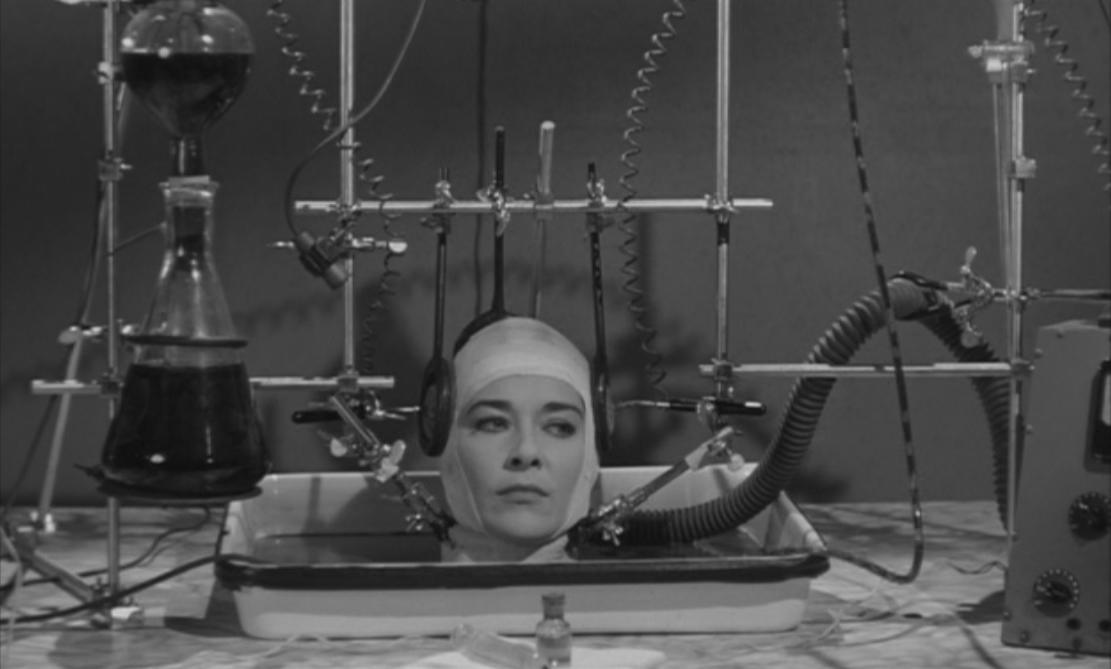
The Cortners are joined by Bill’s fianceé, Jan Compton (Leith). They have a weekend trip planned to the Cortners’ country house (also where Bill has been conducting his research). An urgent call from the house sees Bill rushing to get there, and in the process, causing the car to go off the road. The ensuing crash sees Bill thrown clear but Jan is decapitated and killed. However, Bill flees the scene and heads for the house – with Jan’s head wrapped in his jacket. At the house he’s met by his assistant, Kurt (Daniel), and he quickly arranges Jan’s head in a tray of rejuvenating serum that he’s developed. Once Jan’s consciousness is revived, Bill tells Kurt his plan next is to find a body he can attach Jan’s head to.

Kurt manages to tell Bill about the reason for the urgent call: one of Bill’s experiments in limb transplantation has gone awry, and the “patient” is currently locked away in a room in the cellar where Bill works. Bill dismisses Kurt’s fears and goes in search of a “donor” body for Jan. While he’s gone, Jan wakes up and is horrified at what’s happened to her; she also finds she can communicate with Bill’s previous “patient”. Determined to make Bill pay for what he’s done to her, Jan plans her revenge. Meanwhile, Bill’s search for a woman with an appropriately attractive body proves unsuccessful. He returns to the house to find Kurt even more anxious than before and Jan threatening to stop him. He continues to ignore any warnings, and leaves again to find a suitable woman. Through an old flame he’s reminded of someone they used to know who’s suffered a facial disfigurement. Bill visits the woman, Doris Powell (Lamont), and on the pretext of correcting her scarring, convinces her to come with him to the house. But when they get there, not everything is as Bill left it…

Brain That Wouldn't Die, The - scene

Confusingly (or mistakenly) titled The Head That Wouldn’t Die at the very end of the movie, The Brain That Wouldn’t Die is a semi-exploitation movie that surprisingly spends several occasions questioning the lengths to which medical science should go in order to save lives. This philosophical and ethical approach serves to ground the movie more effectively than the standard mad-scientist-playing-at-God scenario it otherwise plays with. That Bill Cortner experiments with dead tissue in his efforts to perfect his transplants – a predictable nod to Frankenstein – it’s ironic that if he’d used live tissue (however unethically), he’d likely be regarded as a true saviour of people’s lives (he even mentions the “recent eye cornea transplants” that have been carried out). Ironic, but not quite as lurid as required.

Scientific discussions aside, there’s a marked prurience on display here, with Bill’s first search for a donor body taking him to a strip club. Cue a scene where a blonde “exotic” dancer (Sharie) moves around with all the flair of a barely animated mannequin, and a follow-on scene where another stripper (Maurice) removes her dress for no other reason than because the script requires her to. And as if that wasn’t enough for early Sixties audiences, there’s a swimsuit contest, and Bill’s eventual intended victim, Doris, is shown in her part-time role as a photographer’s model, dressed only in a bikini. It’s all quaint enough by today’s standards but back then would have been considered quite racy, and in terms of the narrative it’s probably as lurid as the producers could get away with.

As with most “creature features” from the Fifties and Sixties, the movie holds off on revealing its monster until the end. Usually the build-up is more impressive than the actual monster itself, but here that’s not the case. Played by Eddie Carmel, who was 7′ 6¾” tall and suffered from acromegaly, the make-up applied to his face and head is suitably horrific, even if it is reminiscent of The Monster from Hammer’s The Curse of Frankenstein (1957). When he’s first seen it’s a real jolt, and even afterwards, he commands the viewer’s attention, despite whatever else is going on in the frame.

As the increasingly megalomaniacal Bill, Evers is a poor choice for the committed doctor, his acting skills ranging from cursory to absent, often within the same scene. It’s a struggle to listen to him expound on Bill’s medical theories; even he doesn’t sound that convinced by them. Forced to act with her head through a table for most of the movie, Leith is at least able to provide two separate characterisations for Jan. First, and briefly, there’s the happy-go-lucky bride-to-be, and then there’s the embittered head in a tray. She’s asked to laugh and cackle a little too much but her performance is still the nearest to satisfactory that the movie manages to achieve. Daniel gives the impression that the conversations he has with Jan are all happening in his head, and chews so much of the scenery it’s amazing there’s any left by the movie’s end.

The script, written by Green, is unnecessarily padded out by both its dissertations on medical ethics (they could have been gone over in half the time), and Bill’s tour of places filled with scantily clad females. Once it enters the last ten minutes the movie picks up speed, but the final shot prompts more questions than it can answer. The production values are predictably low – Bill apparently has the use of just a table and a few tubes and beakers for his experiments – and Stephen Hajnal’s camerawork is particularly awkward when asked to provide something more than a standard medium shot. Green directs competently enough but doesn’t have the experience – this was his first movie – to make it visually interesting (despite all the heaving bosoms) and to avoid things becoming too melodramatic. And the uncredited score is as derivative as they come for this type of movie, and in that era.

Rating: 4/10 – filmed in 1959, and regarded by some as a cult classic, The Brain That Wouldn’t Die is only occasionally diverting, and only occasionally satisfying; with the look and feel of a movie assembled from rehearsal footage, this is still worth seeking out, if only to see just how badly an exploitation movie can turn out when there’s so little exploitation actually included.

Share this:

  • Click to share on X (Opens in new window) X
  • Click to share on Facebook (Opens in new window) Facebook
  • More
  • Click to print (Opens in new window) Print
  • Click to email a link to a friend (Opens in new window) Email
Like Loading...

Evidence (2011)

10 Monday Mar 2014

Posted by dullwood68 in Movies

≈ 1 Comment

Tags

Abigail Richie, Ashley Bracken, Camping trip, Creature, Found footage, Howie Askins, Review, Twist

Evidence

D: Howie Askins / 78m

Cast: Abigail Richie, Ashley Bracken, Ryan McCoy, Brett Rosenberg

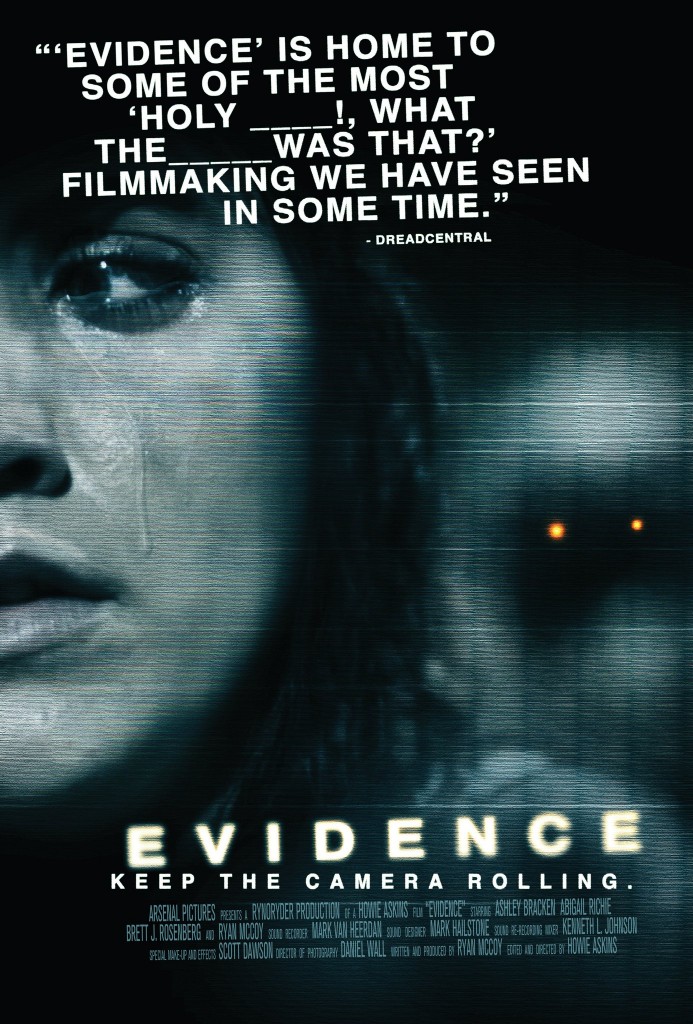
Yet another entry in the found-footage sub-genre of horror movies, Evidence is a low-budget exercise in misdirection that pulls the rug out from under its audience at the midway mark.  Ryan (McCoy, also the movie’s writer) is making a documentary about his friend Brett (Rosenberg) going on his first camping trip.  It’s a fairly inane reason for making a documentary and for the first twenty minutes or so it’s taken up with Brett voicing his dislike of being filmed, and Ryan being pretentious.  Along for the trip are their respective girlfriends, Ashley (Bracken) and Abigail (Richie).  On the first night they hear a noise that Ryan dismisses as a coyote.  The next day they see a strange creature in a nearby ravine.  That night the noise escalates, and stranger things begin to happen.

By this stage, Evidence is shaping up to be a Bigfoot-style movie.  And if it had continued in that vein the movie might have been less effective than it actually turns out.  And while the twist that happens after that second night takes the movie into a more nightmarish arena, there’s still something about the direction it takes that makes you want to find out if the filmmakers could have pulled off a more focused creature feature.  The creature itself is well-realised and mirrors the creature effects in Attack the Block (2011).  Once the twist is revealed, the movie does little but offer its two female leads running around and screaming a lot, while being chased.  For a while it even takes us into first-person-shooter territory with an approach that wouldn’t look out-of-place in a Resident: Evil game.  The filmmakers have strived to provide the audience with something different from the usual found-footage movies out there, and while they certainly succeed – two shots are as disturbing as anything seen in modern horror – the repetition that goes along with the change in direction undercuts the tension.

Evidence - scene

Director Askins (Devil Girl (2007), several shorts) moves the story along at a brisk pace suited to the running time, and McCoy’s script sticks closely to formula in that whatever is “out there” is shown fleetingly (until the end), and that whenever one of the characters is attacked, the camera is conveniently on the ground or out of focus.  (At least, on this occasion, there is a good reason for the characters to keep filming: most of the time it’s night and the light from the camera let’s them see what they’re doing and where they’re going.)

Richie and Bracken give good performances, even if some of their dialogue early on seems forced, but as mentioned before, once the twist kicks in they have little to do but run and scream a lot.  Rosenberg seems uncomfortable throughout, while McCoy is unafraid to play the jerk, and while other characters do appear, they’re not around for long.

Evidence does suffer at times from ploughing the same furrow as other found-footage movies, but its willingness to try something different is to its credit.  While it’s not entirely successful, and some elements appear lifted from other horror sub-genres, it’s nevertheless worth seeing.  One word of warning though: be prepared for maximum frustration in the last ten minutes as the filmmakers take video and audio fragmentation to its most annoying level ever.

Rating: 6/10 – for once, you won’t see what’s coming, and when you do you’ll find it’s more disturbing than you could have expected; uneven, it’s true, but still more of an achievement than a failure.

Originally posted on thedullwoodexperiment website.

Share this:

  • Click to share on X (Opens in new window) X
  • Click to share on Facebook (Opens in new window) Facebook
  • More
  • Click to print (Opens in new window) Print
  • Click to email a link to a friend (Opens in new window) Email
Like Loading...

Blog Stats

  • 486,528 hits

Recent Posts

  • 10 Reasons to Remember Bibi Andersson (1935-2019)
  • Fantasia (1940)
  • Dances With Wolves (1990) – The Special Edition
  • Kiss of the Spider Woman (1985)
  • The Three Musketeers (1973)

Top Posts & Pages

  • Lost for Life (2013) - Another Look
    Lost for Life (2013) - Another Look
  • Lost for Life (2013)
    Lost for Life (2013)
  • About
    About
  • Mr. Topaze (1961)
    Mr. Topaze (1961)
  • Billy Lynn's Long Halftime Walk (2016)
    Billy Lynn's Long Halftime Walk (2016)
  • Winter's Tale (2014)
    Winter's Tale (2014)
  • The Hitman's Bodyguard (2017)
    The Hitman's Bodyguard (2017)
  • 5 Famous Movie Roles That Nearly Went to Someone Else
    5 Famous Movie Roles That Nearly Went to Someone Else
  • The Layover (2017)
    The Layover (2017)
  • Transcendence (2014)
    Transcendence (2014)
Follow thedullwoodexperiment on WordPress.com

Blogs I Follow

  • Rubbish Talk
  • Film 4 Fan
  • Fast Film Reviews
  • The Film Blog
  • All Things Movies UK
  • Interpreting the Stars
  • Let's Go To The Movies
  • Movie Reviews 101
  • TMI News
  • Dan the Man's Movie Reviews
  • Film History
  • Jordan and Eddie (The Movie Guys)

Archives

  • April 2019 (13)
  • March 2019 (28)
  • February 2019 (28)
  • January 2019 (32)
  • December 2018 (28)
  • November 2018 (30)
  • October 2018 (29)
  • September 2018 (29)
  • August 2018 (29)
  • July 2018 (30)
  • June 2018 (28)
  • May 2018 (24)
  • April 2018 (21)
  • March 2018 (31)
  • February 2018 (25)
  • January 2018 (30)
  • December 2017 (30)
  • November 2017 (27)
  • October 2017 (27)
  • September 2017 (26)
  • August 2017 (32)
  • July 2017 (32)
  • June 2017 (30)
  • May 2017 (29)
  • April 2017 (29)
  • March 2017 (30)
  • February 2017 (27)
  • January 2017 (32)
  • December 2016 (30)
  • November 2016 (28)
  • October 2016 (30)
  • September 2016 (27)
  • August 2016 (30)
  • July 2016 (30)
  • June 2016 (31)
  • May 2016 (34)
  • April 2016 (30)
  • March 2016 (30)
  • February 2016 (28)
  • January 2016 (35)
  • December 2015 (34)
  • November 2015 (31)
  • October 2015 (31)
  • September 2015 (34)
  • August 2015 (31)
  • July 2015 (33)
  • June 2015 (12)
  • May 2015 (31)
  • April 2015 (32)
  • March 2015 (30)
  • February 2015 (37)
  • January 2015 (39)
  • December 2014 (34)
  • November 2014 (34)
  • October 2014 (36)
  • September 2014 (25)
  • August 2014 (29)
  • July 2014 (29)
  • June 2014 (28)
  • May 2014 (23)
  • April 2014 (21)
  • March 2014 (42)
  • February 2014 (38)
  • January 2014 (29)
  • December 2013 (28)
  • November 2013 (34)
  • October 2013 (4)

Blog at WordPress.com.

Rubbish Talk

Film 4 Fan

A Movie Blog

Fast Film Reviews

The Film Blog

The official blog of everything in film

All Things Movies UK

Movie Reviews and Original Articles

Interpreting the Stars

Dave Examines Movies

Let's Go To The Movies

Film and Theatre Lover!

Movie Reviews 101

Daily Movie Reviews

TMI News

Latest weather, crime and breaking news

Dan the Man's Movie Reviews

All my aimless thoughts, ideas, and ramblings, all packed into one site!

Film History

Telling the story of film

Jordan and Eddie (The Movie Guys)

Movie Reviews & Ramblings from an Australian Based Film Fan

Privacy & Cookies: This site uses cookies. By continuing to use this website, you agree to their use.
To find out more, including how to control cookies, see here: Cookie Policy
  • Subscribe Subscribed
    • thedullwoodexperiment
    • Join 481 other subscribers
    • Already have a WordPress.com account? Log in now.
    • thedullwoodexperiment
    • Subscribe Subscribed
    • Sign up
    • Log in
    • Report this content
    • View site in Reader
    • Manage subscriptions
    • Collapse this bar
 

Loading Comments...
 

    %d