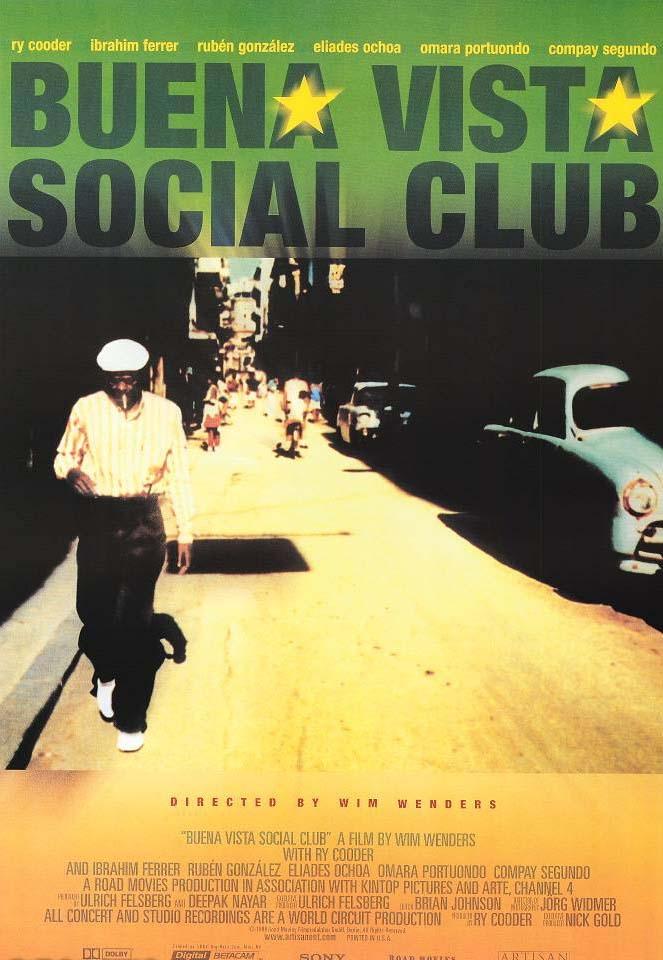
With: Ry Cooder, Rubén González, Compay Segundo, Ibrahim Ferrer, Omara Portuondo, Eliades Ochoa, Orlando “Cachaito” López, Manuel “Guajiro” Mirabal, Joachim Cooder
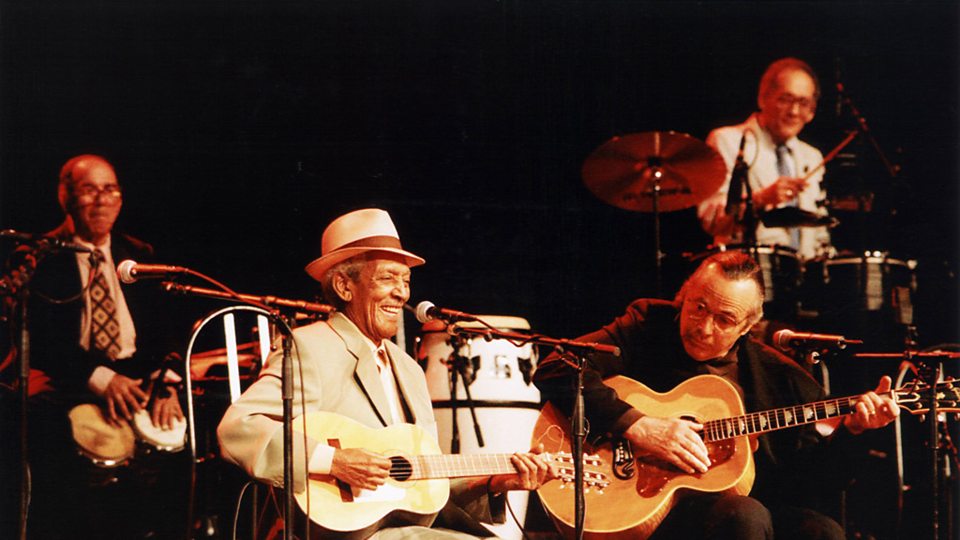
Ry Cooder had always wanted to make an album featuring the hugely talented musicians who’d been making Cuban music back in the Fifties and Sixties. Finding himself heading to Havana, Cuba, Cooder was surprised to find as well that most of those musicians were still alive, and better yet, still performing the songs that had made them famous (albeit in Cuba alone). Bringing many of them together for the first time in decades, Cooder began recording his album, and was amazed at the quality of their playing after so long. Along with making an album, Cooder had an idea that they should all play together at a handful of concerts. And so, in April 1988, the Buena Vista Social Club played two nights in Amsterdam, and then in July, a single night at New York’s famed Carnegie Hall. Wim Wenders’ movie shows how Cooder assembled this amazing group, the group’s commitment to the music, and the pleasure they gained from playing live to non-Cuban audiences, and all while managing to retain (with apparent ease) a keen sense of their identity as Cubans.
The movie that made the rest of the world sit up and take notice of Cuban music, Buena Vista Social Club is a pure blast of joy from beginning to end. Seeing performers like Segundo (in his early Nineties at the time of the movie’s release) still playing to such a high standard, still enjoying the music they’re playing, and still able to find new ways of interpreting the songs they’ve all known for a lifetime, is both inspiring and moving in equal measure. Their enthusiasm is infectious. When Ry Cooder made the decision to head down to Cuba with his son, Joachim, to make an album of Cuban music featuring the very musicians who’d made danzón (the official musical genre and dance of Cuba) so popular in their own country, he couldn’t have known just how much of an impact the resulting album, and this movie about the making of said album, would have worldwide. The music itself is beautiful, full of emotion and played with a delicacy and finesse that pushes it toward being simply sublime. The live performance sections of the movie are as joyous as you could possibly hope for.
Wenders (who’s made more than a few documentaries over the years) highlights the relish shown by the singers and musicians who bring this music to life, capturing through performances and often surprisingly candid interviews, a sense of the music’s importance in their lives, and it’s importance in Cuban culture in general. It’s a celebration of their lives and the musical heritage that has inspired them, and which continues to do so after fifty, sixty, seventy or more years of living and breathing danzón – and achieving the natural high that keeps them going, keeps them reaching for improvement and mastery over the songs they know so well and love so much. There’s pride there too, in each other, and in their country, a pride that finds meaningful expression in songs such as Chan Chan and Candela. In the end, it’s unsurprising that the music of the Buena Vista Social Club crosses so many international and cultural boundaries; these are songs from the heart, sung and played by artists whose only ambition is to pass on as much of the joy and fervour they themselves feel. Wenders rightly focuses on the Cubans – Cooder barely gets a look-in by comparison – and in doing so, he makes us all wish we had that same attachment to music that the likes of González and Ochoa and Portuondo have.
Rating: 9/10 – an uplifting and inspiring documentary, Buena Vista Social Club is difficult to ignore, or overlook thanks to the sheer exuberance of the music, and the passionate interpretations of the songs by such a talented group of musicians; Cooder’s initial idea proved to be a godsend, and even now, it remains a marvelous, delightful examination of a marvelous, delightful, musically magical moment in time.
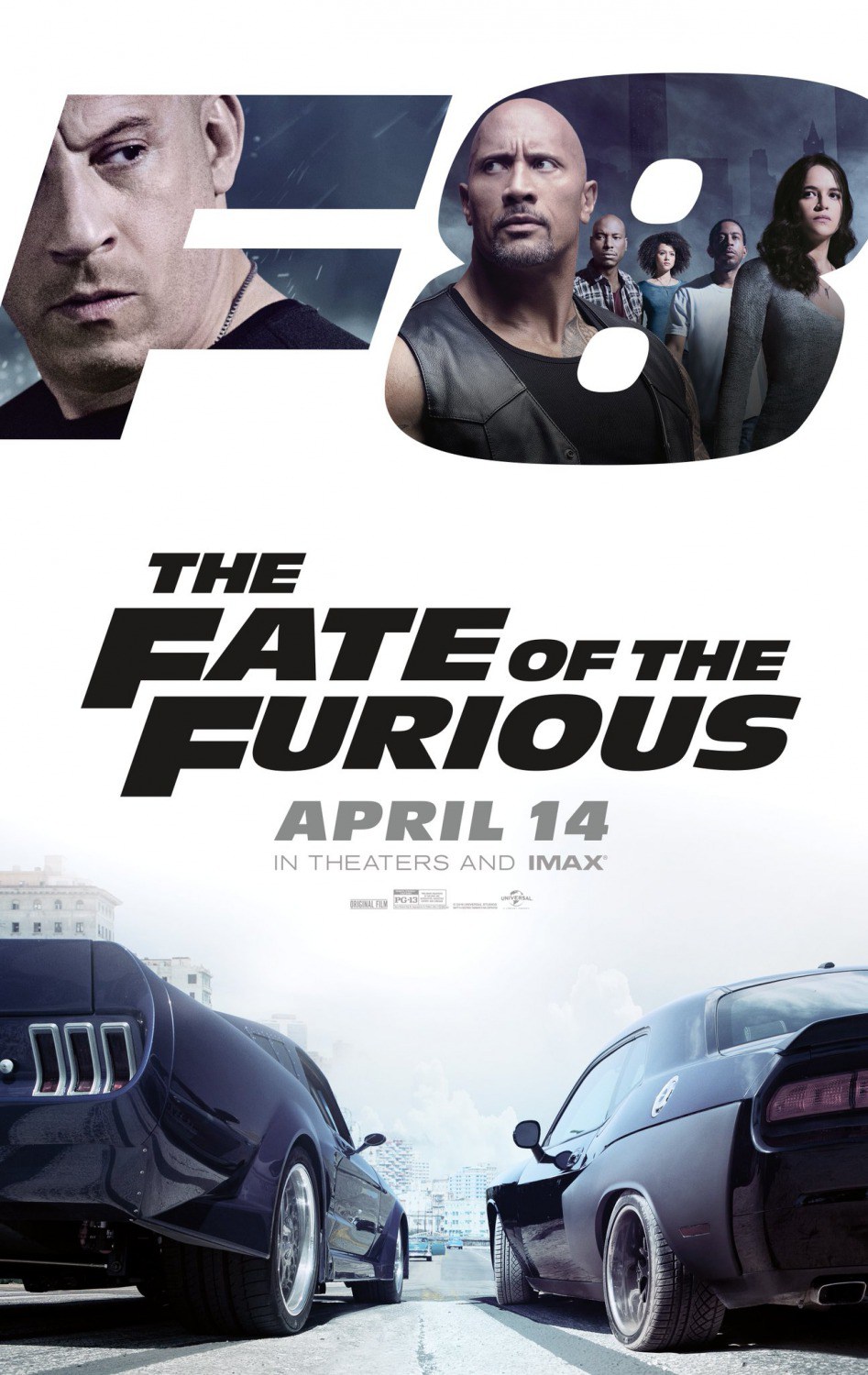
Cast: Vin Diesel, Dwayne Johnson, Jason Statham, Michelle Rodriguez, Charlize Theron, Tyrese Gibson, Chris “Ludacris” Bridges, Nathalie Emmanuel, Scott Eastwood, Kurt Russell, Elsa Pataky, Helen Mirren, Kristofer Hivju
And so we come to episode eight in the ongoing Fast and Furious franchise, the series that just keeps on giving and giving… and giving and giving and giving and giving. This is a movie, one of several that we’ll see this year, that will do incredibly well at the international box office, and which will be hugely successful no matter what critics or bloggers or anyone and their auntie says about it. It’s a movie that exists in its own little cinematic bubble, oblivious to movie making trends, advances or developments. If you live in the UK, it’s the equivalent of those Ronseal adverts that state, “It does what it says on the tin”. And if you don’t live in the UK, then try this comparison: it’s like going to McDonalds and ordering a Big Mac, fries and a Coke. You know exactly what you’re getting, and it doesn’t matter if you’ve had that particular combo more times than you can remember, that’s also kind of the point. Here, familiarity breeds expectation, and the makers of the Fast and Furious movies know exactly how to satisfy that expectation.
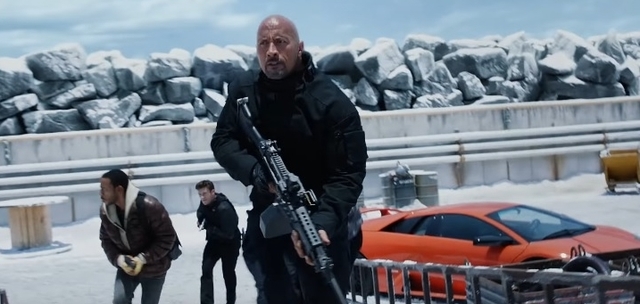
All the familiar elements are here: exotic locations (Iceland, Cuba, New York?), Diesel being taciturn and glowering a lot (he even shouts a few times, which is new), Johnson looking like a poster boy for steroid abuse, Rodriguez glowering a lot like Diesel, Gibson acting unconscionably stupid, Bridges giving nerds a fairly good name for once, over-the-top action sequences that regularly and deliberately challenge the laws of physics, and cars, lots of shiny, sleek, expensive cars. Relative series newbies Russell, Emmanuel and Statham slot in neatly amidst the rest of the cast, while complete newbies Eastwood (good guy) and Theron (bad guy) add little and a lot respectively. Throw in some old faces from previous entries, and a storyline that’s been built on the back of the last two outings, and you have another patchy, under-developed crowd-pleaser that does enough to keep its audience interested while at the same time giving said audience very very very little that’s new. And it’s the opener for a closing trilogy of movies that will see the franchise come to an end in April 2021.
If there’s anything interesting about the movie, it’s the way in which it harkens back to earlier entries, and tries to incorporate the look and feel of those earlier movies. The opening sequence, set in Cuba, is a throwback to the approach and feel of the first and third movies, with its street-level, underground racing vibe, and beautiful hangers-on to some of the ugliest drivers ever seen on screen. There’s a car up for grabs, a sneering minor villain who thinks he can outwit Dominic Toretto (foolish man!), and some very impressive stunt driving. But it’s a measure of how far the series has come in terms of its tone and style, that this sequence – which starts off well – soon descends into the kind of ridiculous, credibility-free, and excessive action set-piece that the series has become known for. Seeing Toretto winning the race in a stripped-down junker, in reverse, and with the engine on fire no less, serves as an acknowledgement that while the series wants to honour its more scaled-back origins, it’s grown too big and excessive to be able to.
Much has been made of this movie’s main storyline – Toretto betrays his “family” – but as a plot device it’s one of the weaker ideas in the series, and all because we know that there’s no way it’s “for real”. As expected, there’s a reason for his “betrayal”, and while it’s played out with as much sincerity as returning scribe Chris Morgan can instil in his by-the-numbers screenplay, it shows a complete disregard for the character of Letty (Rodriguez) and the trials she’s endured since “dying” in part four (and especially in relation to a scene between Letty and Toretto early on in Cuba). Worse still, the whole thing leads to a scene involving Statham’s returning nemesis Deckard Shaw, and the complete reversal of his character from murderous psychopath to genial funster. It’s as if the makers have seen his performance in Spy (2015) and thought to themselves, how can we exploit this?
Character assassination apart, the movie follows the tried and tested formula of the previous three movies, and never deviates from its cookie-cutter approach. It’s no secret that the franchise thinks up its action sequences first and fits a story and plot around them later, but this time the obvious nature of such a design is even more noticeable than before. An attack on a Russian minister on the streets of New York occurs at the halfway mark, and includes the appropriation by über-villain Cipher (Theron) of any car in the area that has an on-board computer system. Why she has to activate all of them makes no sense, but it does lead to mass collisions and vehicles falling from multi-storey car parks and no end of unconvincing CGI. Far better? The scenes predceeding this where Toretto has to escape Cipher’s surveillance in order to put his own plans into action. Short, simple, and so much more effective.
One thing The Fate of the Furious does get right – finally – is its choice of villain. Stepping out of the shadows no one knew she inhabited, Cipher is played with chilling conviction by Theron, and if as seems likely, she’s going to be the villain for the last two movies as well, then her involvement could be the best thing about them – as it is here. With Statham’s character now reformed, the movie needed someone to be a real villain, and Theron comes through in spades. She’s icy, mad, and bad to the core. Theron shares most of her scenes with Diesel, and every time it’s a no contest: she acts him off the plane Cipher uses, and off the screen as well (which is a shame, as away from all his franchise movies, Pitch Black (2000) excepted, he can be a very good actor indeed).
But what about those action sequences? And what about that submarine smashing through the ice? And all those explosions? Everything we’ve seen in the various trailers? Well, they’re all as slickly produced and homogeneously exciting as those in previous entries, and they’re fine examples of modern day action heroics, but even so they remain curiously thrill-free. A prison riot does Statham and Johnson no favours thanks to having been shot in a jerky, shaky style that makes focusing on the various punches and kicks both actors dish out quite difficult to follow. It’s a sequence that could have benefitted from having a few more bone-crunching sound effects thrown in as well. The submarine sequence is reminiscent of the ending to Furious 6 (2013) (justly famous for its neverending runway), but is surprisingly restrained for all that, while the movie’s biggest explosion – naturally saved for last – also gives rise to the movie’s most ridiculous and risible moment.
But none of this matters. Not Helen Mirren’s awful Cockney accent, not Hivju’s distracting resemblance to a young James Cosmo, not even the sight of Johnson manhandling a torpedo as it races across the ice. The Fate of the Furious can do what it likes and audiences will lap it up regardless. Does this make it a bad movie? On the whole, yes, it does. But for all that, is it entertaining? Weirdly, yes, but in a subdued, stopgap kind of fashion, as if this entry in the series was a bridge between previous episodes and the ones to come, ones that will (hopefully) up the series’ game considerably. After eight movies the franchise has reached a kind of tipping point: the final two outings need to be much stronger and more focused on what they’re trying to do. The series hasn’t quite run out of mileage yet, but it’s running perilously close, and if the makers aren’t careful, the remaining movies will most likely be running on fumes.
Rating: 5/10 – fans will lap this up, but The Fate of the Furious, with its tangled ideas about family and betrayal, doesn’t add up to much, and relies too heavily on its action sequences to prop up its awkward script; the cast have to make do with the same character beats they’ve been given in previous movies, and franchise first-timer Gray isn’t allowed to do anything different with the formula, making this a movie generated and made by committee, and as a result, lacking a distinct identity to make it stand out from the rest of the series.
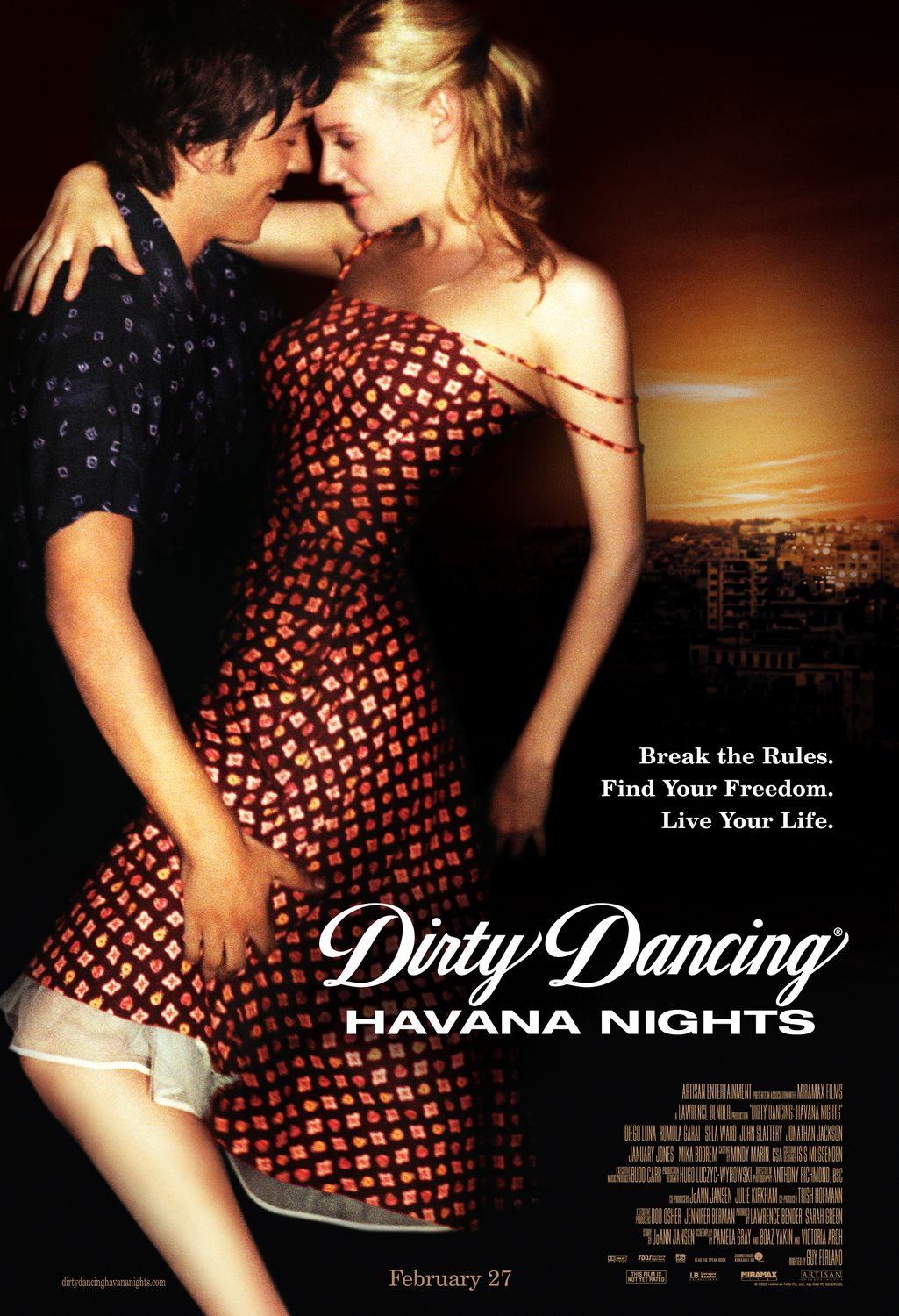
There are dozens of sequels that turn up uninvited, years after their predecessor was first released. Some arrive without any kind of fanfare, while others appear with all the promotional backing available under the sun. Beware of those that arrive under the latter circumstances – sometimes the hype is designed to grab as much at the box office as the movie can manage before word of mouth kicks in and people begin to realise the movie is one to avoid. When the movie in question is a belated sequel to a much-loved original, any abundance of hype is perhaps the biggest clue that the sequel should be avoided. Here is one such example, a movie that came along seventeen years after the original, and still begs the question, why? (Read on for the answer.)
Cast: Diego Luna, Romola Garai, Sela Ward, John Slattery, Jonathan Jackson, Mika Boorem, January Jones, René Lavan, Patrick Swayze, Mya
If you watch the opening credits of Dirty Dancing: Havana Nights closely, you’ll find that one of the producers is called JoAnn Fregalette Jansen (she also has a small, non-speaking role in the movie itself). Jansen lived in Cuba, aged fifteen, during the period the movie is set in, 1958. Playwright Peter Sagal wrote a screenplay based on Jansen’s experiences of the Cuban Revolution, and her relationship with a Cuban revolutionary. The screenplay was titled Cuba Mine and was a serious examination of the events that occurred in Cuba at the time, and how the country’s political idealism became polluted by the Communist ideology that replaced the more liberal regime that existed in the Fifties.
The script was commissioned by Lawrence Bender in 1992. Bender was fresh from the success of producing Reservoir Dogs (1992), but the script went unproduced until Bender revisited it again ten years later. However, Sagal’s script was only used as the basis of a completely new script by Boaz Yakin and Victoria Arch. The end result? A disastrous attempt to recreate the magic of Dirty Dancing (1987).
With the original having proved so successful, and having gained a place within the cultural zeitgeist (“Nobody puts Baby in a corner”), a sequel was always likely to appear eventually, but this is a movie that spends its thankfully short running time replicating the original’s storyline instead of coming up with something new. It’s the eternal problem facing sequels everywhere: how to combine enough DNA from the original movie with newer, fresher elements to make a satisfying whole. Sadly, Dirty Dancing: Havana Nights is a sequel that can’t even assemble enough DNA from its predecessor to make much of a difference. It’s perfunctory, lazy, and lacks impact.
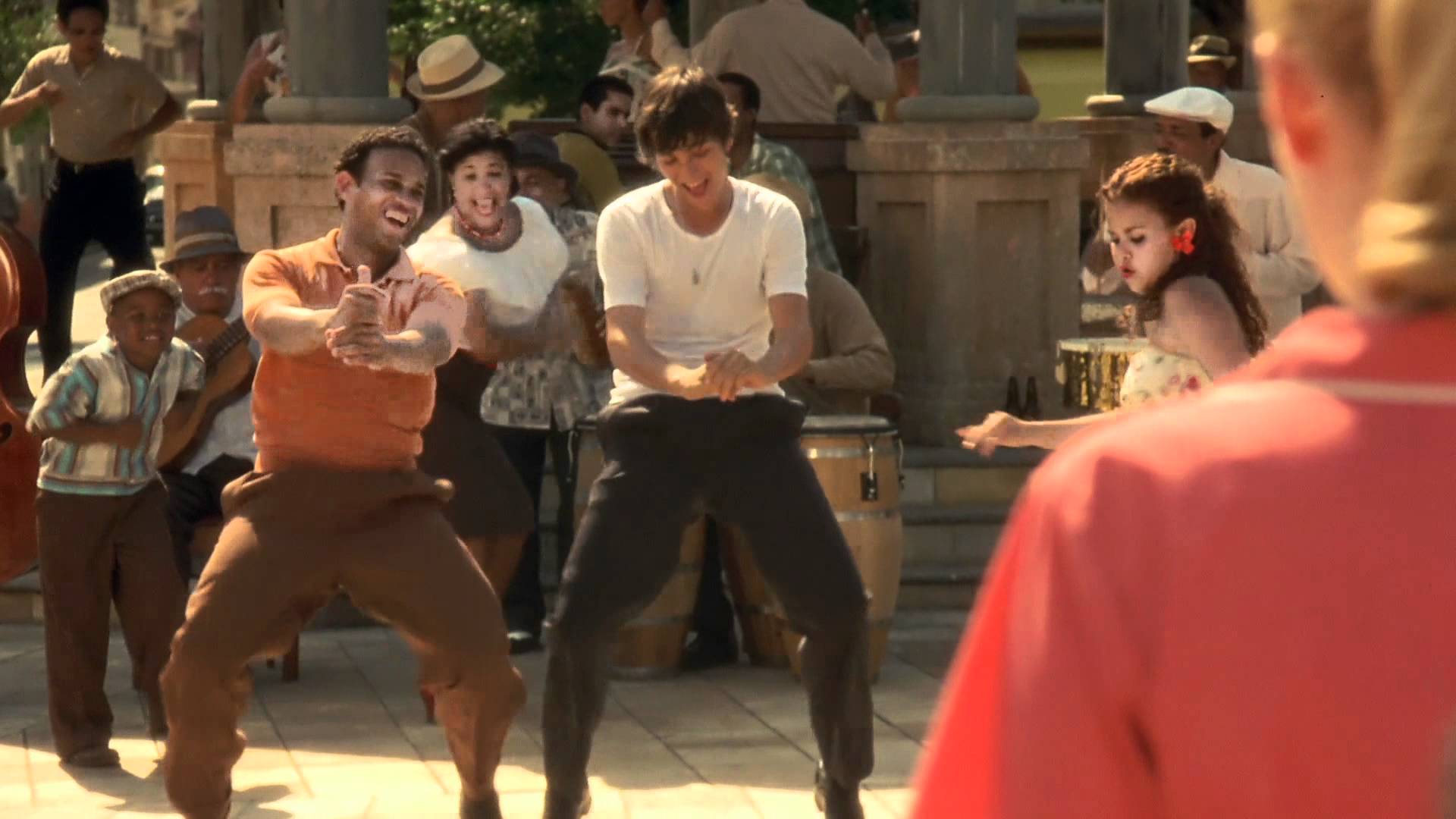
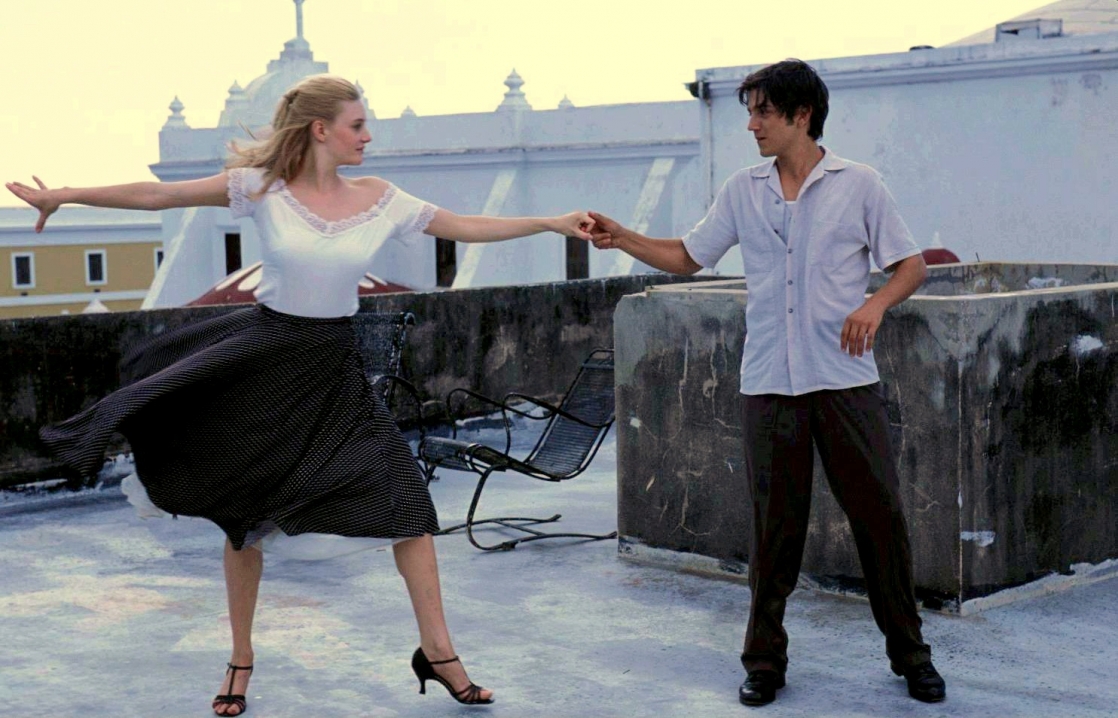
It also has a hard time doing the one thing that it should get right above all else, namely the dance routines. Thanks to the movie’s Cuban setting, the music and dance numbers are meant to be energetic, effortlessly fluid, and somewhat mildly erotic, but thanks to the movie’s determined efforts to edit the dance sequences into bite-sized shots that often don’t match the moves on show immediately before and after each shot, the very elements that are meant to draw in an audience are undermined from the word go. Now this could be a conscious, artisitic decision made by director Guy Ferland and his editors, Luis Colina and Scott Richter, in which case the trio have no idea of how to put together a dance sequence; or it could be that Luna and Garai’s moves weren’t quite as impressive as everyone hoped and they needed a little “help” in looking so accomplished (you decide).
Elsewhere the movie is equally determined to rely on cinematic and cultural clichés in order to tell its story. If the movie was even remotely realistic, it would be easy to believe that, before the revolution, all Cubans were happy-go-lucky souls who never tired of singing and dancing on pretty much every street corner. There are moments of casual racism that don’t amount to anything in terms of the drama, as well as cursory references to the political struggle happening at the time. Luna’s hotel waiter, Javier, evinces his distrust of Americans only until Garai’s preppy Katey waves the lure of competition prize money under his nose, while Katey’s family hang around in the background waiting to be given something to do.
The performances are average, with Luna and Garai developing an uneasy chemistry that seems more convincing on the dance floor than anywhere else, while Ward and Slattery get to play good cop/bad cop once Katey’s relationship with Javier is revealed (the scene in question is notable for playing like an outtake from a TV soap opera). Spare a thought though for poor old Patrick Swayze, co-opted into the script as a dance class instructor who gets to show Katey some moves before being reduced to providing reaction shots during the dance competition. Swayze looks uncomfortable in his scenes, as if he’s having second thoughts about being in the movie but also realising it’s too late to back out.
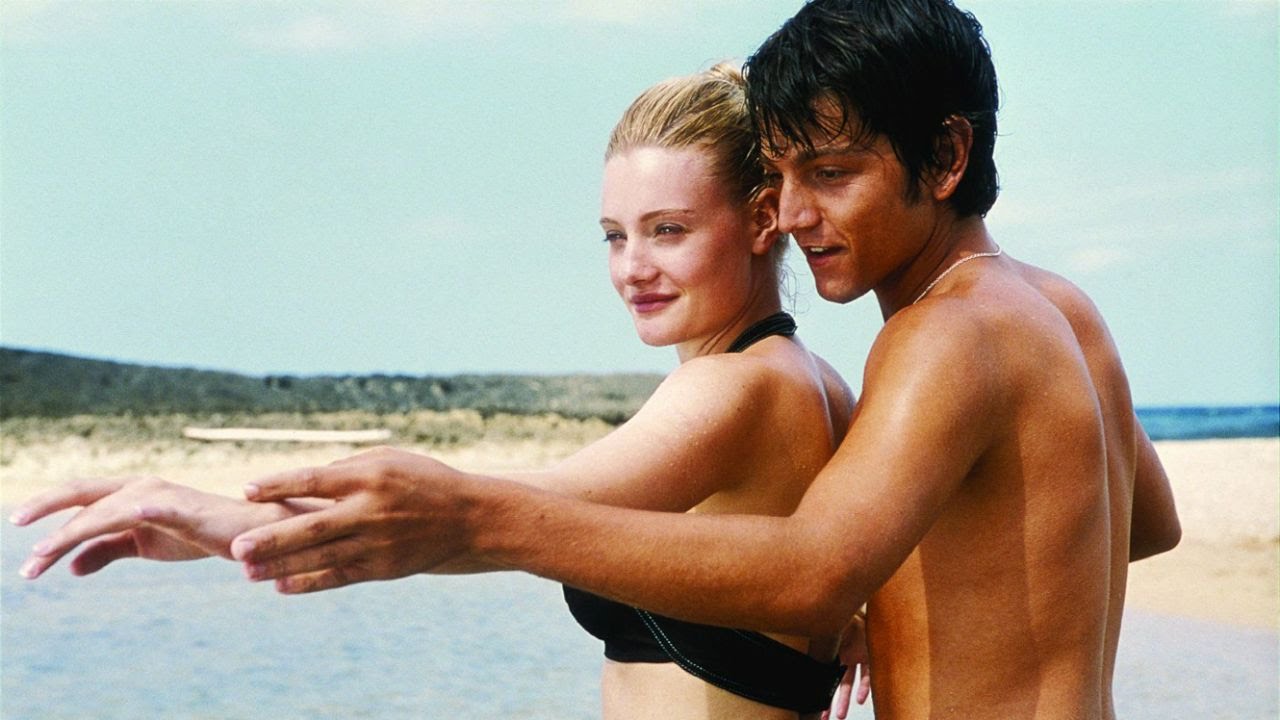
The movie is a sloppy mess, shot through with an earnest quality that wants to be taken for drama. But like so much on display it’s often involuntary, as if the various elements of the screenplay were put together in a blender rather than a word processor. Ferland directs it all with little or no attention to the emotions of the characters – Garai spends quite a bit of time looking upset but gets over it all just as quickly as it’s started – but at least he manages to make the Puerto Rican locations look suitably beautiful, throwing in wondrous sunsets and sunrises with giddy, artistic abandon.
Rating: 3/10 – unimaginative, even in its dance routines, Dirty Dancing: Havana Nights lacks a compelling storyline and characters to care about; with so many aspects not working to their full potential, the movie proves to be inferior in almost every way to its predecessor – and no one should be surprised.




 thedullwoodexperiment