• 10 Reasons to Remember…
  • A Brief Word About…
  • About
  • For One Week Only
  • Happy Birthday
  • Monthly Roundup
  • Old-Time Crime
  • Other Posts
  • Poster of the Week
  • Question of the Week
  • Reviews
  • Trailers

thedullwoodexperiment

~ Viewing movies in a different light

thedullwoodexperiment

Tag Archives: Disco

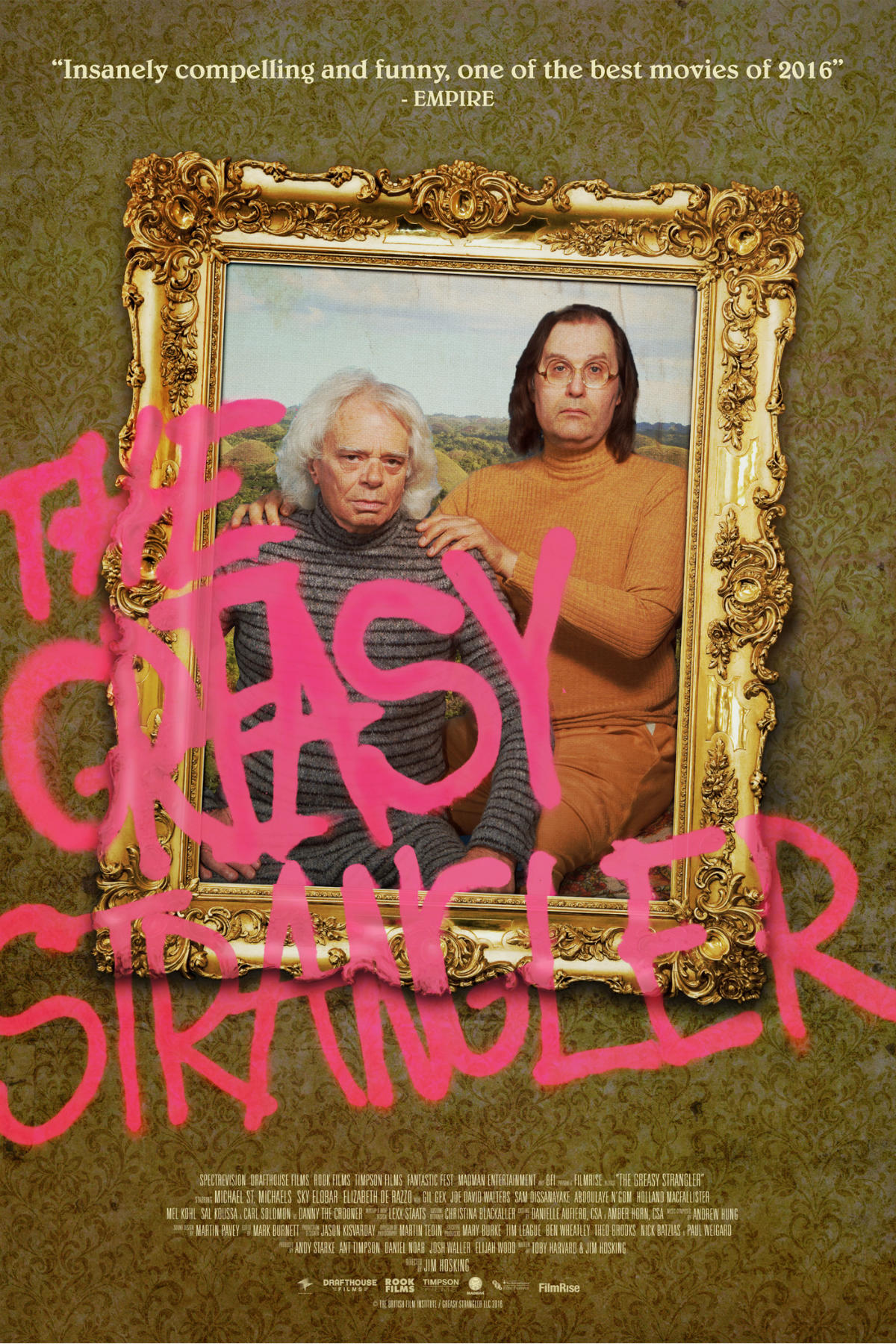
Mini-Review: The Greasy Strangler (2016)

12 Wednesday Oct 2016

Posted by dullwood68 in Movies

≈ Leave a comment

Tags

Big Brayden, Big Ronnie, Comedy, Disco, Drama, Elizabeth De Razzo, Horror, Jim Hosking, Michael St. Michaels, Murder, Sky Elobar, Thriller
the-greasy-strangler

D: Jim Hosking / 93m

Cast: Michael St. Michaels, Sky Elobar, Elizabeth De Razzo, Gil Gex, Joe David Walters, Abdoulaye NGom, Sam Dissanayake, Holland MacFallister, Mel Kohl

Big Ronnie (St. Michaels), an ex-disco entrepreneur back in the Seventies, lives with his middle-aged son, Big Brayden (Elobar). When they’re not bickering, they run a tour guide business where they show unsuspecting tourists various sites “supposedly” connected to the heyday of disco. Big Ronnie likes his food cooked in a lot of oil and grease, the oilier and greasier the better, because when he’s not chiding Big Brayden, or ripping off tourists, he’s the Greasy Strangler, a maniacal killer who has claimed several victims so far and whom the police are no nearer catching than when he started.

Big Ronnie and Big Brayden’s relationship is shaken up by the appearance of Janet (De Razzo). Much to Big Ronnie’s displeasure, Janet takes a shine to Big Brayden, and they begin dating. This makes Big Ronnie so angry that he claims more victims, including friends such as Oinker (Walters). Big Brayden begins to have his suspicions about the Greasy Strangler’s identity, and when Big Ronnie behaves “all smooth” and persuades Janet to be his girlfriend, the stage is set for a showdown between father and son, killer and self-appointed vigilante, that will (inevitably) change their lives forever – but not necessarily in a way that either could have foreseen.

tgs-scene

Already being hailed as a cult favourite, and having a level of critical approval that most low-budget, indie horrors would themselves kill for, The Greasy Strangler is a funny, awful, side-splitting, appalling, blackly comic, dreadful movie that works very well in stretches but makes too much use of verbal and visual repetition to pad out its running time. Depending on your tolerance, conversations involving the phrase “bullshit artist” may prove to be annoying, as might seeing over and over again, Big Ronnie getting cleaned up in a car wash after a bout of killing as the Greasy Strangler. Co-writer/director Jim Hosking appears to be striving for some kind of banality here, a further example of the monotonous lives that Big Ronnie and Big Brayden live – they do little beyond the tours, eating together, and arguing – but it’s a device that soon wears out its welcome.

Alternatively, the movie is on firmer ground when it’s trying to be shocking and distasteful. Prosthetic penises and exploding eyeballs are the order of the day, and there’s a pleasing, sleazy Eighties vibe to it all (the special effects reflect the quality of the period). It’s also very funny in a “you shouldn’t really be laughing” kind of way, particularly in the ongoing war of attrition that makes for the relationship between Big Ronnie and Big Brayden; dysfunctional doesn’t even cover it. St. Michaels and Elobar are both excellent, pushing a number of physical and emotional boundaries in the script’s pursuit of ever more alienating content. Love ’em or want to get as far away from ’em as possible, Big Ronnie and Big Brayden are characters you won’t forget in a hurry, and the movie is on very firm ground when they’re on screen together.

Rating: 7/10 – a breath of welcome bad air in a year where few movies have dared to be different, The Greasy Strangler doesn’t always overcome its low-budget origins, but it does have a number of moments where the viewer will be thinking “No way“; bold in both tone and content, the movie never tries to be likeable or elicit sympathy for its lead characters, meaning it is what it is, and it’s entirely unapologetic about everything it depicts, which in this genre, is exactly what it should be doing.

Share this:

  • Click to share on X (Opens in new window) X
  • Click to share on Facebook (Opens in new window) Facebook
  • More
  • Click to print (Opens in new window) Print
  • Click to email a link to a friend (Opens in new window) Email
Like Loading...

Summer of Sam (1999)

01 Sunday Mar 2015

Posted by dullwood68 in Movies

≈ Leave a comment

Tags

1977, Adrien Brody, Ben Gazzara, CBGB's, David Berkowitz, Disco, Drama, Drugs, Homosexuality, Jennifer Esposito, John Leguizamo, Mira Sorvino, Punk, Relationships, Serial killings, Sex, Son of Sam, Spike Lee, True story

Summer of Sam

D: Spike Lee / 142m

Cast: John Leguizamo, Adrien Brody, Mira Sorvino, Jennifer Esposito, Michael Rispoli, Saverio Guerra, Brian Tarantina, Al Palagonia, Ken Garito, Bebe Neuwirth, Patti LuPone, Mike Starr, Anthony LaPaglia, Roger Guenveur Smith, Ben Gazzara, John Savage, Michael Badalucco, Spike Lee, Jimmy Breslin

New York City, 1977. The serial killer known as Son of Sam (Badalucco) is terrorising the city, randomly shooting people. He sends taunting messages to the police who are no nearer to catching him after seven murders than they were after the first. Against this backdrop, a group of friends try to make sense of what’s happening as well as trying to deal with their own problems. Vinny (Leguizamo) is a hairdresser working in the Bronx. He’s married to Dionna (Sorvino) but cheats on her every chance he gets. His best friend, Ritchie (Brody) has adopted a punk lifestyle, complete with spiked hair and punk clothing. It bothers Vinny and the rest of their friends, but proves attractive to Ruby (Esposito), who’s treated poorly by everyone else because she’s perceived as “easy”.

With the police struggling to make any headway in the Son of Sam case, the lead detective, Petrocelli (LaPaglia) approaches local crime boss, Luigi (Gazzara) for help in catching him. His men begin compiling a list of suspects, an idea that spreads throughout the neighbourhood and which is taken up by Vinny’s friends, led by Joey T (Rispoli). Suspicious of Ritchie’s new lifestyle, they add him to their list. Meanwhile, Vinny and Dionna’s marriage is unravelling. Vinny is still seeing other women – including his boss, Gloria (Neuwirth) – and he’s flirting more and more with drugs. He and Dionna are invited to a gig that Ritchie’s band is playing at CBGB’s but Dionna refuses to go inside. Vinny suggests they go to Studio 54 instead but they’re not able to get in. A photographer (Savage) who’s coming out of Studio 54 takes a liking to Vinny and they go with him to Plato’s Retreat, a swingers club. There, Dionna and Vinny have sex with other people, but on the way home Vinny becomes resentful and accuses Dionna of being a “lesbian freak”. Outraged by his accusation (and his double standards) she reveals she knows about his affairs and leaves him stranded at the side of the road.

Ritchie’s relationship with Ruby, however, is going from strength to strength, even though he dances at a gay club and prostitutes himself with the clientele. When Brian (Garito), one of Vinny’s friends, discovers this and tells Joey, it serves to make Ritchie more suspicious in everyone’s eyes, and when an artist’s impression of Son of Sam is published in the newspapers it looks enough like Ritchie for Joey to believe he is the killer. With Dionna having ended things with Vinny, and his reliance on drugs taking over his life, he’s persuaded by Joey to lure Ritchie out into the street where he can be attacked by his “friends”. But what none of them realise is that the police have made a breakthrough in the case, and that a terrible injustice is about to be carried out.

Summer of Sam - scene

Filmed in and around the actual areas where David Berkowitz killed six people and wounded seven others between July 1976 and July 1977, Summer of Sam is a jarring, hedonistic movie that paints an hallucinatory portrait of the time, and which acts like a fever dream of desire and mistrust. It’s a scurrilous, profane movie, sometimes scabrous and full of bile, as its characters deal with their own personal hells, all potent counterpoints to the madness experienced by Berkowitz. It deals with themes of betrayal and promiscuity, xenophobia and suspicion, and is unforgiving in its attempts to shine an unforgiving light on the social mores of the time.

The time period is recreated with verve and attention to detail (though it does get quite a few of the punk-related details wrong), and Ellen Kuras’ cinematography captures the vibrancy of the era, as disco battled with punk, and misogynism and distrust maintained a firm stronghold in Italian neighbourhoods. The lighting often makes scenes, and especially interiors, look grimy and slightly soiled, a trenchant reflection of the characters and their rude approach to life and each other. Lee explores and exploits the late Seventies with gusto, ramping up the intensity of the emotions and the spirit of the times, and encouraging a handful of career-best performances from his cast. The movie benefits enormously from its depiction of the fear and terror people felt in the wake of Berkowitz’s murderous activities, and the closed-minded vigilantism that grew out of them.

The movie generates such a speed and a momentum that it propels the viewer toward its denouement with alacrity, and through the machinations of Vinny and his friends, with undisguised relish. All this leads to a movie that operates at such a pitch that there’s little room for subtlety or tenderness. However, Lee’s confident handling of the narrative more than compensates for any rough handling or delirious imagery. When the heatwave of the time results in a power outage which in turn leads to rioting and vandalism, it’s depicted with a torrid matter-of-fact quality that it fits in completely with Lee and co-scripters Victor Colicchio and Michael Imperioli’s aggressive, no holds barred approach to the various storylines.

Lee is incredibly well served by his cast, who enter into things with complete commitment. Leguizamo, one of the most prolific and versatile actors working today – he currently has five movies in various stages of post-production – puts in a career best performance, expertly displaying the narcissistic selfishness of a man who projects strength but who is battling his fear of commitment every day. It’s a riveting portrayal, and even when he’s not the focus of a scene the viewer’s eye is drawn to him, as if at any moment he’s going to demand their attention again. He’s matched by Sorvino, whose quiet, unassuming portrayal of Dionna in the movie’s early stages gives way to a gutsy, impassioned performance that matches Leguizamo’s for emotional ferocity. Like her co-star, it’s a career best outing, and it’s a shame that post-Summer of Sam she’s not appeared in any movies that have allowed her to shine as she does here.

Brody offers strong support though he’s given less and less to do as the movie progresses, while Esposito suffers the same fate. Badalucco is an imposing presence as Berkowitz, and sharp-eared viewers will recognise John Turturro’s voice as Harvey the Dog (who tells Berkowitz to “kill”). LaPaglia’s detective flits in and out of the narrative (and is nowhere to be seen when Berkowitz is arrested), Gazzara coasts as the local mob boss, and Savage is on screen for all of a minute. The soundtrack consists of a great mix of contemporary songs alongside Terence Blanchard’s driving score, and there’s terrific use of The Who’s Baba O’Riley two thirds of the way in to accompany a brilliant montage (another song by The Who, Won’t Get Fooled Again, is used near the end for another very dramatic sequence, but it’s not as effective).

Rating: 9/10 – Summer of Sam won’t be to everyone’s taste, but it is one of Lee’s most daring, uncompromising movies, and has a charge that few other movie makers could achieve or maintain over such a long running time; demanding and uncompromising, it’s a movie that doesn’t pull any punches and is all the better for it.

Share this:

  • Click to share on X (Opens in new window) X
  • Click to share on Facebook (Opens in new window) Facebook
  • More
  • Click to print (Opens in new window) Print
  • Click to email a link to a friend (Opens in new window) Email
Like Loading...

I Am Divine (2013)

21 Monday Jul 2014

Posted by dullwood68 in Movies

≈ Leave a comment

Tags

Biopic, Cross-dressing, Disco, Divine, Documentary, Frances Milstead, Harris Glenn Milstead, Jeffrey Schwarz, John Waters, Movies, Pink Flamingos, Women Behind Bars

I Am Divine

D: Jeffrey Schwarz / 90m

Divine, John Waters, Frances Milstead, Mink Stole, Michael Musto, Greg Gorman, Holly Woodlawn, Jay Bennett, Helen Hanft, Tab Hunter, Belle Zwerdling, Rob Saduski, Ricki Lake

In most movie buffs’ lives, there is that moment when they become aware of a Baltimore-based writer/director called John Waters.  And unless that first exposure is one of the five movies he’s made post-1988, or 1977’s Desperate Living, then said movie buff will have also become aware of the extreme force of nature that was… Divine.  In a world where image is everything, and glamour is often very rigidly defined, Divine was the overweight, over-made up anti-hero who shocked everyone with her aggressive nature and perverse behaviour.  She was relentless in her efforts to unnerve and confound people’s expectations, and found fame (if not a fortune) in pursuing that same avenue of expression, and across a variety of entertainment formats.  She was a stage performer, a disco queen, a probable TV star, but most of all, she was – and will remain – a movie icon.

Of course, she was a he, Harris Glenn Milstead, a kid from Baltimore who grew up with a liking for women’s fashions, and a desire to be in movies.  Teased and bullied at school on a daily basis, Glenn was a compulsive eater who never stopped dreaming, despite his weight going up and up and his increasingly feminine tendencies.  An early relationship ended when Glenn discovered the gay scene in Baltimore, and that led to drugs – Waters talks of having LSD “early” in 1964 – and a lifelong use of pot.  But it was when he met Waters that Glenn’s life really changed, and his dreams of being a movie star began to be realised, starting off with an uncredited appearance in Waters’ second short movie, Roman Candles (1966).  It was Waters who saw the potential in the Divine character, and he tapped into Glen’s suppressed anger.  Writing specifically with this in mind, Waters created the first in a series of over-the-top cinematic monsters that would define Glen’s career, and make Divine notorious for her on-screen antics.

With Divine’s celluloid persona duly cemented in place over the course of four wildly degenerate movies – Mondo Trasho (1969), Multiple Maniacs (1970), Pink Flamingos (1972), and Female Trouble (1974) – she became instantly recognisable thanks to the roles Waters created for her, and also thanks to the look created for her by make up artist and costume designer Van Smith (Glenn’s hairline was shaved back to the top of his head because Smith thought there wasn’t enough room on his face for all the make up that Smith needed for Divine’s “look”).  As a “freak”, Divine took to performing in night clubs and theatres, touring America and spawning an even larger fan base, and leading to a secondary career as a disco star, as well as a stint in the play Women Behind Bars.  Reunited with Waters for two further movies, Polyester (1981) and Hairspray (1988), Divine’s acting ability became more featured, and she began receiving more and more positive reviews.  Sadly, a foray into TV with a guest appearance on the sitcom Married… with Children never materialised: the night before filming, Glenn died in his sleep from a heart attack, his weight and unhealthy diet putting an end to a remarkable life.

I Am Divine - scene

There are several moments in I Am Divine where Glenn talks about Divine as another person entirely, and it’s clear from these moments that Divine is indeed a character that Glenn played, an extension of his own personality (as devised by Waters), but separate from his daily life and expectations.  It’s perhaps the most surprising revelation the movie has to offer, reminding fans or anyone who didn’t take to the character’s outrageous exploits, that being Divine was a job, and one that, most days, Glenn couldn’t wait to put aside.  In various contemporary interviews, he comes across as unfailingly polite, thoughtful, self-effacing and kind-hearted, the complete antithesis of his drag queen alter-ego.  It’s a reminder (not that it should be needed) that the person we see on screen or on stage, is playing a role, and not themselves.

At the heart of the movie is Glenn’s relationship with his mother, Frances, a bit of a glamour girl in her day, but unable to deal with his choices as an adult.  They were estranged for a long time, and the pain of that separation shows clearly when Frances talks about Glenn, her obvious pride in his achievements offset by a regret that they weren’t reunited any sooner than a short while before he died.  Frances talks candidly about Glenn with undisguised affection, and it’s these moments when she’s on screen that give the movie an unexpected emotional intensity.  As his best friend, Waters guides the viewer through Divine’s development from Elizabeth Taylor wannabe to gun-toting mistress of filth, and provides a unique insight into what made Glenn tick.  (In a cinematic sense, they were the movies’ first real odd couple, a depraved Laurel and Hardy doing their best to upset the establishment.  That both men’s sensibilities moved more toward the mainstream and wider acceptance as they got older is strangely comforting; shock and outrage are definitely pastimes for the young.)

I Am Divine brings forward a lot of friends and colleagues and co-stars to talk about both the private man and the public icon, and there’s enough  here to reinforce the image of a man who was larger than life and refreshingly down to earth at the same time.  Some aspects of his later life – his feeling suicidal when he couldn’t find acting jobs, his continued ingestion of marijuana – are glossed over or ignored, but on the whole, the movie is a compassionate, non-judgmental appreciation of a star unlike any other, and who Tab Hunter said was “one of [his] finest leading ladies”.  Anyone looking for a warts n’ all exposé of a star with terrible personal problems that they hid from view will be disappointed, but for those fans who want to know a little bit more about their favourite trash goddess – and thanks to director Jeffrey Schwarz’s skilful handling of the wealth of archive material and contemporary interviews – they will be entertained and informed throughout.

Rating: 8/10 – I Am Divine provides the cross-dressing diva with a heartwarming tribute and, in doing so, heaps praise on the most unlikeliest of stars; once described as “a Miss Piggy for the blissfully depraved”, the man also known as Harris Glenn Milstead would have laughed his filthy laugh, and heartily approved of all the attention.

Share this:

  • Click to share on X (Opens in new window) X
  • Click to share on Facebook (Opens in new window) Facebook
  • More
  • Click to print (Opens in new window) Print
  • Click to email a link to a friend (Opens in new window) Email
Like Loading...

Blog Stats

  • 486,826 hits

Recent Posts

  • 10 Reasons to Remember Bibi Andersson (1935-2019)
  • Fantasia (1940)
  • Dances With Wolves (1990) – The Special Edition
  • Kiss of the Spider Woman (1985)
  • The Three Musketeers (1973)

Top Posts & Pages

  • Lost for Life (2013) - Another Look
    Lost for Life (2013) - Another Look
  • Lost for Life (2013)
    Lost for Life (2013)
  • About
    About
  • Exposed (2016)
    Exposed (2016)
  • A Brief Word About La La Land (2016)
    A Brief Word About La La Land (2016)
  • Cardboard Boxer (2016)
    Cardboard Boxer (2016)
  • Irrational Man (2015)
    Irrational Man (2015)
  • The Monuments Men (2014)
    The Monuments Men (2014)
  • BFI London Film Festival 2015
    BFI London Film Festival 2015
  • A Brief Word About Netflix Original Comedies
    A Brief Word About Netflix Original Comedies
Follow thedullwoodexperiment on WordPress.com

Blogs I Follow

  • Rubbish Talk
  • Film 4 Fan
  • Fast Film Reviews
  • The Film Blog
  • All Things Movies UK
  • Interpreting the Stars
  • Let's Go To The Movies
  • Movie Reviews 101
  • TMI News
  • Dan the Man's Movie Reviews
  • Film History
  • Jordan and Eddie (The Movie Guys)

Archives

  • April 2019 (13)
  • March 2019 (28)
  • February 2019 (28)
  • January 2019 (32)
  • December 2018 (28)
  • November 2018 (30)
  • October 2018 (29)
  • September 2018 (29)
  • August 2018 (29)
  • July 2018 (30)
  • June 2018 (28)
  • May 2018 (24)
  • April 2018 (21)
  • March 2018 (31)
  • February 2018 (25)
  • January 2018 (30)
  • December 2017 (30)
  • November 2017 (27)
  • October 2017 (27)
  • September 2017 (26)
  • August 2017 (32)
  • July 2017 (32)
  • June 2017 (30)
  • May 2017 (29)
  • April 2017 (29)
  • March 2017 (30)
  • February 2017 (27)
  • January 2017 (32)
  • December 2016 (30)
  • November 2016 (28)
  • October 2016 (30)
  • September 2016 (27)
  • August 2016 (30)
  • July 2016 (30)
  • June 2016 (31)
  • May 2016 (34)
  • April 2016 (30)
  • March 2016 (30)
  • February 2016 (28)
  • January 2016 (35)
  • December 2015 (34)
  • November 2015 (31)
  • October 2015 (31)
  • September 2015 (34)
  • August 2015 (31)
  • July 2015 (33)
  • June 2015 (12)
  • May 2015 (31)
  • April 2015 (32)
  • March 2015 (30)
  • February 2015 (37)
  • January 2015 (39)
  • December 2014 (34)
  • November 2014 (34)
  • October 2014 (36)
  • September 2014 (25)
  • August 2014 (29)
  • July 2014 (29)
  • June 2014 (28)
  • May 2014 (23)
  • April 2014 (21)
  • March 2014 (42)
  • February 2014 (38)
  • January 2014 (29)
  • December 2013 (28)
  • November 2013 (34)
  • October 2013 (4)

Blog at WordPress.com.

Rubbish Talk

Film 4 Fan

A Movie Blog

Fast Film Reviews

The Film Blog

The official blog of everything in film

All Things Movies UK

Movie Reviews and Original Articles

Interpreting the Stars

Dave Examines Movies

Let's Go To The Movies

Film and Theatre Lover!

Movie Reviews 101

Daily Movie Reviews

TMI News

Latest weather, crime and breaking news

Dan the Man's Movie Reviews

All my aimless thoughts, ideas, and ramblings, all packed into one site!

Film History

Telling the story of film

Jordan and Eddie (The Movie Guys)

Movie Reviews & Ramblings from an Australian Based Film Fan

Privacy & Cookies: This site uses cookies. By continuing to use this website, you agree to their use.
To find out more, including how to control cookies, see here: Cookie Policy
  • Subscribe Subscribed
    • thedullwoodexperiment
    • Join 481 other subscribers
    • Already have a WordPress.com account? Log in now.
    • thedullwoodexperiment
    • Subscribe Subscribed
    • Sign up
    • Log in
    • Report this content
    • View site in Reader
    • Manage subscriptions
    • Collapse this bar
 

Loading Comments...
 

    %d