• 10 Reasons to Remember…
  • A Brief Word About…
  • About
  • For One Week Only
  • Happy Birthday
  • Monthly Roundup
  • Old-Time Crime
  • Other Posts
  • Poster of the Week
  • Question of the Week
  • Reviews
  • Trailers

thedullwoodexperiment

~ Viewing movies in a different light

thedullwoodexperiment

Tag Archives: Gay

Closet Monster (2015)

08 Sunday Jan 2017

Posted by dullwood68 in Movies

≈ Leave a comment

Tags

Aaron Abrams, Aliocha Schneider, Buffy, Coming of age, Connor Jessup, Drama, Gay, Hamster, Isabella Rossellini, Review, Sexuality, Stephen Dunn

closet-monster

D: Stephen Dunn / 90m

Cast: Connor Jessup, Isabella Rossellini, Aaron Abrams, Aliocha Schneider, Joanne Kelly, Sofia Banzhaf, Jack Fulton, Mary Walsh

A coming of age tale, Closet Monster seems hell-bent on making things ultra-difficult for its central protagonist, eighteen year old Oscar (Jessup). Not only is his surname Madly – no, really – and not only are his parents divorced, but he’s pretty sure he’s gay, though at this point he’s still pretty much in the closet of the title. As if that wasn’t enough, when he was much younger he witnessed a brutal homophobic attack that left its victim paralysed from the waist down. The combination of these events has left Oscar with mixed feelings about himself, his life, and his sexuality. The only thing he’s sure about is that he wants to be a make-up artist in the movies, and to this end he’s putting together a portfolio that will hopefully get him accepted into a Joe Blasco training centre. He’s helped in this by his best friend, Gemma (Banzhaf), who, as if he didn’t have enough problems, likes him a little too much.

Oscar lives with his dad, Peter (Abrams), and sometimes spends time at his mother’s new home. His mother, Brin (Kelly), has another family now (“the Brady Bunch”), and Oscar still hasn’t forgiven her for being the one to leave. But he’s also got issues with his father, and their relationship is nearly as strained. Add a drab, dead-end job at a local hardware store to the mix, and Oscar has so many problems he could keep a TV soap opera going for months. And then, as if things couldn’t get any more confusing or difficult, Oscar meets Wilder (Schneider), a guy at work, and straight away he’s head over heels in – well, not love per se, but definitely infatuation. The only problem (as if)? Oscar can’t tell if Wilder is definitely gay. What’s a horny, probably gay young man to do?
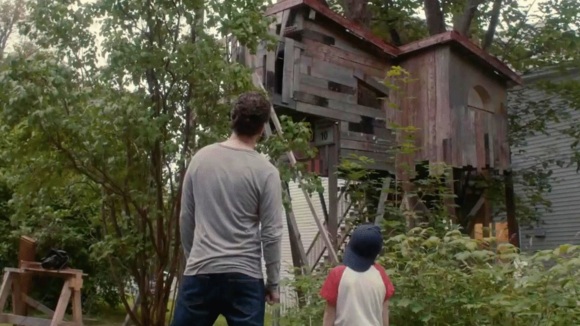
closet_monster__2015_1377

The answer involves one of Wilder’s shirts and a bathroom cubicle at work, and it’s here that writer/director Stephen Dunn begins to pull together all the jigsaw pieces that make up Oscar’s life. As Oscar indulges in a spot of self-release he experiences flashbacks to the assault he witnessed when he was younger. These images shock him out of his sexual reverie, and point toward the reason why he hasn’t “come out” yet: if he does, what happened to that other teenager could happen to him. It’s a recognisable and understandable fear, and goes some way to explaining why Oscar, through his make-up ambitions (his designs are all heavily influenced by fantasy and horror), retreats so often into a world where he feels safe, and where his best friend isn’t Gemma, but his talking hamster, Buffy (Rossellini).

Yes, that’s right, a talking hamster called Buffy. Now, if at this point you’re asking yourself, can this movie get any stranger, well, yes it can, and it does. But Dunn is canny enough to introduce us to Buffy when Oscar is younger, where a small boy talking and listening to a hamster doesn’t seem so strange. And so well established is Buffy’s presence in Oscar’s interior life, it makes it that much easier to accept when he’s eighteen and still struggling to make sense of things. And the way in which Rossellini brings Buffy to life, so to speak (excuse the pun), is charming and agreeable. And Buffy proves to be pretty much the only source of humour in a movie that’s often deliberately downbeat and angst-ridden.

yjvvh

The movie is based on Dunn’s own experiences of growing up as a gay teenager in Canada, and while it’s probably safe to assume that he’s taken a degree of artistic licence with his own life, there are times throughout the movie where it seems that he’s trying a little too hard in getting across the message that making sense of being gay when you’re a teenager isn’t easy. While this may be true – and the movie goes some way to make sure the audience understands this – Dunn’s message isn’t helped by Oscar being resolutely unsympathetic (and let’s hope Dunn wasn’t like this when he was younger). Yes, Oscar has a lot of problems, and yes, getting out of his hometown will probably go a long way towards helping him get past some of those problems, but in the meantime all he does is act petulantly, antagonise or upset everyone (except Wilder), and generally behave in a selfish, dismissive manner. Though Jessup is very good as Oscar, he can’t quite bring the viewer over to Oscar’s side, and by the time he’s punting his father into a wardrobe and heading off to a party to (hopefully) get somewhere with Wilder, you can’t help but wish for him to experience a massive fail (and in some ways he does).

There are problems too with Oscar’s father, Peter. In the beginning, Peter is the kind of dad every child wishes they had: loving, supportive, and there. But divorce brings out the moody, boozy homophobe in him, and the character quickly descends into a slightly more challenging stereotype than usual, but a stereotype nonetheless. By the time he’s shouting at Brin on the front lawn and the movie is morphing into a David Cronenberg body horror, his transformation is complete, and Oscar’s view of him as Deadbeat Dad has come to fruition. It’s a shame, but you can see why Dunn has chosen to make Peter such a douchebag: it’s one more thing that Oscar has to deal with, and it adds a degree of conflict that doesn’t exist solely within Oscar’s head.

CLOSET MONSTER

With all this – and more – Dunn’s narrative stumbles from time to time, and certain scenes don’t flow as easily as others. As mentioned already, Jessup is very good as Oscar, and even if he can’t make him sympathetic, he does make his predicament a credible one. There’s fine support from Abrams, who does his best to ground Peter even when he’s behaving badly thanks to the script, and Schneider as Wilder, who may or may not be gay, or straight, or bisexual; neither Dunn nor Schneider makes any attempt to confirm Wilder’s sexual orientation, and this ambiguity is something that strengthens the movie and makes the potential in Oscar and Wilder’s relationship all the more intriguing.

Dunn has made a movie out of his own personal experiences that looks and feels like the fevered imaginings of a kid in great need of psychiatric help. Oscar behaves foolishly and without due care for the people around him, and the movie doesn’t offer him any happiness, which amounts to a bitter pill indeed – for Oscar, and the audience. It’s a movie that paints a portrait of an angry, confused young man, then puts him through even more of an emotional wringer than he’s already been through, and finally offers him a way out through the experience of a waking nightmare. It’s a tough love movie about a teenager who doesn’t know how to love, and thanks to Dunn’s confidence as a director, where his script lets him down, he’s able to compensate by showing us Oscar’s world as he sees it: compromised, disheartening and frightening. And unfortunately, that’s a world that many teenagers will recognise.

Rating: 6/10 – Dunn the screenwriter lets down Dunn the director too many times for Closet Monster to work completely, but there are enough good ideas and directorial flourishes for Dunn to be someone to keep an eye on as their career unfolds; slow-paced but aided by a terrific soundtrack and some effective, roving camerawork courtesy of Bobby Shore, the movie has enough thought behind it that it shouldn’t be dismissed as superficial, and is surprisingly rewarding despite its flaws.

Share this:

  • Click to share on X (Opens in new window) X
  • Click to share on Facebook (Opens in new window) Facebook
  • More
  • Click to print (Opens in new window) Print
  • Click to email a link to a friend (Opens in new window) Email
Like Loading...

Geography Club (2013)

17 Thursday Apr 2014

Posted by dullwood68 in Movies

≈ Leave a comment

Tags

Andrew Caldwell, Bullying, Cameron Deane Stewart, Gary Entin, Gay, High School, Homophobia, Homosexual, Lesbian, Review, Support group, Teenagers

Geography Club

D: Gary Entin / 80m

Cast: Cameron Deane Stewart, Justin Deeley, Andrew Caldwell, Meaghan Martin, Allie Gonino, Ally Maki, Nikki Blonsky, Alex Newell, Teo Olivares, Ana Gasteyer, Marin Hinkle, Scott Bakula

It’s a sad fact that even today, with society supposedly more tolerant, and understanding, of different sexual orientations that a movie such as Geography Club can still be relevant in addressing the issue of homophobia.  Set in Goodkind High School – a misnomer if ever there was one – the movie begins with Russell arranging to meet a guy he’s met online.  He’s nervous, and unsure of his sexuality, but the meet is mainly a test of his feelings.  At the park he bumps into fellow high schooler Kevin (Deeley), and when Kevin walks away after an awkward conversation, Russell realises it was Kevin he was due to meet.

Later, on a school field trip, Russell and Kevin get to know each other better and one night they kiss.  The kiss is witnessed by Min (Maki), a fellow student.  Back at Goodkind, Min leaves Russell a message to meet her in one of the classrooms after school the next day.  Worried that she plans to blackmail him and Kevin, Russell goes to the classroom, and finds not only Min, but also Terese (Blonsky), Min’s partner, and Ike (Newell).  All three are gay and have formed the Geography Club in order to provide support for each other.  Min wants Russell to join them, but at first he refuses.  However, he goes back the next day, and in time becomes a member of the club.

Running parallel to all this are the efforts of his best friend Gunnar (Caldwell) to go out with Kimberly (Gonino), the object of Gunnar’s not inconsiderable lust.  While Russell tries to maintain a clandestine relationship with Kevin (who’s the star player on the school football team), his friendship with Gunnar threatens to fragment altogether, culminating in a disastrous weekend trip to Kimberly’s folks’ summer place.  With Gunnar counting on Russell’s support, his unwillingness to pair off with Kimberly’s friend Trish (Martin) leads to Russell being outed at school.  Determined not to let himself be categorised so unfairly, he feels it’s time for the Geography Club to go public.

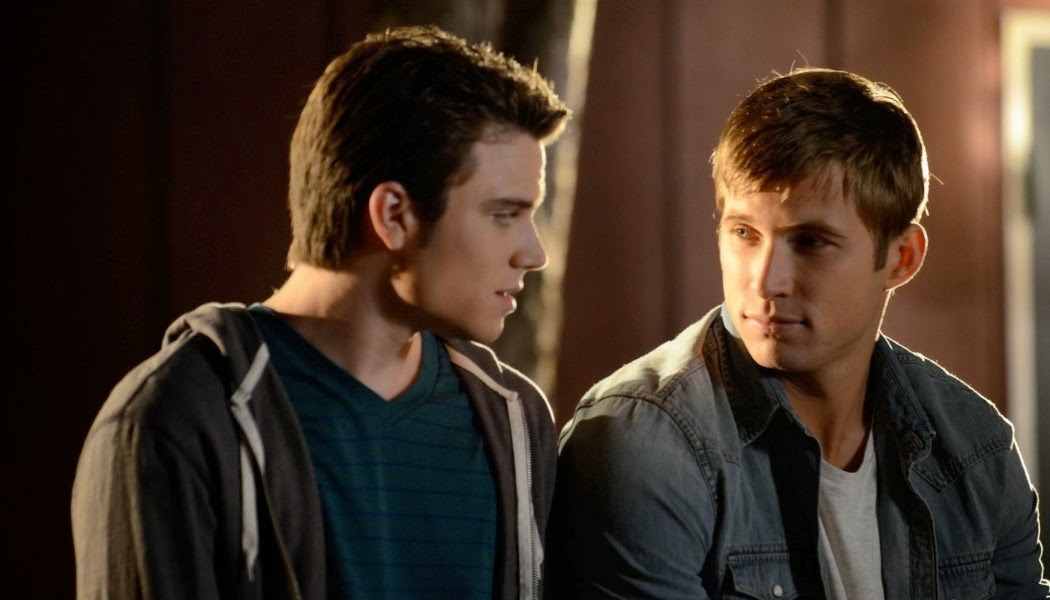
Geography Club - scene

As an expose of what it’s like to be a teenager and either gay or lesbian, Geography Club falls a little short in its intentions, taking a serious subject – from the bestselling book by Brent Hartinger – and often undercutting that seriousness by placing the emphasis on humour, or by adopting a superficial approach to the material.  While the movie looks at ostracism, peer pressure, sexism, bullying, parental expectations, personal freedoms, teenage sexuality and its potential pitfalls, the perils of someone trying to find their place in the world, and the difficulty in being true to yourself (if you’re even sure what that means), this is all perhaps too much for Geography Club to address properly and with the right amount of attention for each issue.

Russell’s struggle is initially with his uncertainty about being gay, even after he and Kevin kiss.  But Min’s “intervention” has the effect of deciding the issue for him, and the rest of the movie settles for the inevitable how-long-will-it-be-before-the-main-character-is-honest-with-everyone? approach so prevalent in this type of movie.  As a result, Russell is forced to hide his true feelings for fear of being found out; he also takes part in bullying another student, Brian (Olivares), and with barely a moment’s hesitation (it’s a scene that involves Brian being humiliated in front of everyone in the school cafeteria, and yet Russell and his “friends” from the football team get away with it completely; there’s no punishment for their behaviour at all, one of the weirder instances that pop up throughout the movie).  And Russell would rather upset his best friend instead of trusting Gunnar with the knowledge that he’s gay.  With the movie changing focus so often, it’s hard to work out if there’s a main point trying to be made – be nice to gay people? bullying is an awful thing to do? friendships should be more important than emotional self-doubt?

The relationships in the movie range from the non-existent (Russell’s father is referred to but never seen, as if the family dynamic that would need to be addressed by his being gay was one issue too many for the filmmakers) to the predictable (Gunnar accepts Russell’s being gay without batting an eyelid).  Kevin is the jock who won’t commit to being homosexual because it would ruin his need to be “normal” (but he still wants to see Russell at the same time); Min and Terese appear more like lipstick lesbians than a real couple; Trish’s predatory attempts at making out with Russell are badly handled – and misconceived – considering her apparent experience with other guys; and Brian readily forgives Russell for his involvement in the cafeteria incident (but only after Russell is outed).

With the characters behaving either too predictably, or in ways that serve to advance the script rather than giving them some much-needed depth, the cast are constantly in danger of having their performances derailed by Edmund Entin’s lightweight script and Gary Entin’s overstretched direction.  Blonsky is wasted in a role that either has her playing the guitar or looking cynically at everyone else, while Martin is saddled with a one-note character and no chance of making Trish any or more interesting.  Deeley has less to do than most but what he does have to do is repetitive, and Kevin is so selfish and callow you hope he and Russell don’t end up together.  With a humorous turn from Gasteyer as an oddball teacher, and Caldwell stealing the movie as a desperate virgin (he’s like a young Jack Black at times), it’s left to Stewart to keep the audience’s attention and provide the sympathetic character the audience needs to make it through.  Fortunately he does just enough to engage our sympathies, but it’s a close run thing, and as expected, once Russell is outed, he becomes less annoying as well.

Rating: 6/10 – not quite as involving as was hoped for, perhaps, but still a pleasant enough way to spend eighty minutes, provided you have a tolerance for less than convincing character motivation; a decent enough effort, and a worthy subject matter, but too lacking in real drama to make much of an impact.

Share this:

  • Click to share on X (Opens in new window) X
  • Click to share on Facebook (Opens in new window) Facebook
  • More
  • Click to print (Opens in new window) Print
  • Click to email a link to a friend (Opens in new window) Email
Like Loading...

Blog Stats

  • 486,641 hits

Recent Posts

  • 10 Reasons to Remember Bibi Andersson (1935-2019)
  • Fantasia (1940)
  • Dances With Wolves (1990) – The Special Edition
  • Kiss of the Spider Woman (1985)
  • The Three Musketeers (1973)

Top Posts & Pages

  • Lost for Life (2013) - Another Look
    Lost for Life (2013) - Another Look
  • Lost for Life (2013)
    Lost for Life (2013)
  • About
    About
  • BFI London Film Festival 2015
    BFI London Film Festival 2015
  • Mr. Topaze (1961)
    Mr. Topaze (1961)
  • Hunt for the Wilderpeople (2016)
    Hunt for the Wilderpeople (2016)
  • Shock and Awe (2017)
    Shock and Awe (2017)
  • Cardboard Boxer (2016)
    Cardboard Boxer (2016)
  • Billy Lynn's Long Halftime Walk (2016)
    Billy Lynn's Long Halftime Walk (2016)
  • Winter's Tale (2014)
    Winter's Tale (2014)
Follow thedullwoodexperiment on WordPress.com

Blogs I Follow

  • Rubbish Talk
  • Film 4 Fan
  • Fast Film Reviews
  • The Film Blog
  • All Things Movies UK
  • Interpreting the Stars
  • Let's Go To The Movies
  • Movie Reviews 101
  • TMI News
  • Dan the Man's Movie Reviews
  • Film History
  • Jordan and Eddie (The Movie Guys)

Archives

  • April 2019 (13)
  • March 2019 (28)
  • February 2019 (28)
  • January 2019 (32)
  • December 2018 (28)
  • November 2018 (30)
  • October 2018 (29)
  • September 2018 (29)
  • August 2018 (29)
  • July 2018 (30)
  • June 2018 (28)
  • May 2018 (24)
  • April 2018 (21)
  • March 2018 (31)
  • February 2018 (25)
  • January 2018 (30)
  • December 2017 (30)
  • November 2017 (27)
  • October 2017 (27)
  • September 2017 (26)
  • August 2017 (32)
  • July 2017 (32)
  • June 2017 (30)
  • May 2017 (29)
  • April 2017 (29)
  • March 2017 (30)
  • February 2017 (27)
  • January 2017 (32)
  • December 2016 (30)
  • November 2016 (28)
  • October 2016 (30)
  • September 2016 (27)
  • August 2016 (30)
  • July 2016 (30)
  • June 2016 (31)
  • May 2016 (34)
  • April 2016 (30)
  • March 2016 (30)
  • February 2016 (28)
  • January 2016 (35)
  • December 2015 (34)
  • November 2015 (31)
  • October 2015 (31)
  • September 2015 (34)
  • August 2015 (31)
  • July 2015 (33)
  • June 2015 (12)
  • May 2015 (31)
  • April 2015 (32)
  • March 2015 (30)
  • February 2015 (37)
  • January 2015 (39)
  • December 2014 (34)
  • November 2014 (34)
  • October 2014 (36)
  • September 2014 (25)
  • August 2014 (29)
  • July 2014 (29)
  • June 2014 (28)
  • May 2014 (23)
  • April 2014 (21)
  • March 2014 (42)
  • February 2014 (38)
  • January 2014 (29)
  • December 2013 (28)
  • November 2013 (34)
  • October 2013 (4)

Blog at WordPress.com.

Rubbish Talk

Film 4 Fan

A Movie Blog

Fast Film Reviews

The Film Blog

The official blog of everything in film

All Things Movies UK

Movie Reviews and Original Articles

Interpreting the Stars

Dave Examines Movies

Let's Go To The Movies

Film and Theatre Lover!

Movie Reviews 101

Daily Movie Reviews

TMI News

Latest weather, crime and breaking news

Dan the Man's Movie Reviews

All my aimless thoughts, ideas, and ramblings, all packed into one site!

Film History

Telling the story of film

Jordan and Eddie (The Movie Guys)

Movie Reviews & Ramblings from an Australian Based Film Fan

Privacy & Cookies: This site uses cookies. By continuing to use this website, you agree to their use.
To find out more, including how to control cookies, see here: Cookie Policy
  • Subscribe Subscribed
    • thedullwoodexperiment
    • Join 481 other subscribers
    • Already have a WordPress.com account? Log in now.
    • thedullwoodexperiment
    • Subscribe Subscribed
    • Sign up
    • Log in
    • Report this content
    • View site in Reader
    • Manage subscriptions
    • Collapse this bar
 

Loading Comments...
 

    %d