• 10 Reasons to Remember…
  • A Brief Word About…
  • About
  • For One Week Only
  • Happy Birthday
  • Monthly Roundup
  • Old-Time Crime
  • Other Posts
  • Poster of the Week
  • Question of the Week
  • Reviews
  • Trailers

thedullwoodexperiment

~ Viewing movies in a different light

thedullwoodexperiment

Tag Archives: Hugh Bonneville

Viceroy’s House (2017)

22 Wednesday Mar 2017

Posted by dullwood68 in Movies

≈ Leave a comment

Tags

Drama, Gillian Anderson, Gurinder Chadha, Hindus, Historical drama, Hugh Bonneville, Huma Qureshi, India, Manish Dayal, Michael Gambon, Muslims, Pakistan, Partition, Politics, Review, Sikhs, True story

D: Gurinder Chadha / 106m

Cast: Hugh Bonneville, Gillian Anderson, Manish Dayal, Huma Qureshi, Michael Gambon, Om Puri, Simon Callow, Lily Travers, Tanveer Ghani, Denzil Smith, Neeraj Kabi, Darshan Jariwala

The awkwardly titled Viceroy’s House opens with a quote by Winston Churchill: “History is written by the victors.” Bearing in mind the story that follows, it’s hard to see why this particular quote has been chosen to open the movie. Perhaps director Gurinder Chadha is using it in an ironic fashion; any winners borne out of the terrible circumstances and outcomes surrounding the partition of India in 1947 may not have been aware of their having “won” anything at the time – even those who wanted the creation of Pakistan.

One thing that soon becomes apparent from watching the movie is that it’s going to be a politics-lite experience, with little depth beyond that given to an adaptation being shown on UK Sunday evening television. This means that some viewers, especially those with little awareness of the period when the British withdrew from India, and the terrible consequences that followed, will take much of what the movie tells them to heart. What should be made clear from the start is that Viceroy’s House is better viewed as an impression of those events than as a recreation.

The problem here is that one of the most traumatic upheavals of the 20th Century that involved a country and fifteen million of its inhabitants – those who were displaced – is given an unremarkable soap opera sheen that paints the British as saviours, and the Indian people as the authors of their own downfall. As an interpretation of what actually occurred on the Indian sub-continent, the movie takes several factual liberties with the events surrounding partition, and panders to the idea that the frustration experienced by Lord Louis Mountbatten (known more familiarly as “Dickie”) (Bonneville) is somehow more affecting and deserving of our sympathy than the political and social upheavals being experienced by India’s Hindu, Muslim and Sikh communities. As a dramatic approach to the material, it’s akin to asking an audience to be more sympathetic towards someone with a slight case of sunburn than someone who’s lost a limb.

The obvious comparison here is with the TV series Upstairs, Downstairs (or Downton Abbey for that matter, which also stars Bonneville). By attempting to focus on both the political machinations going on above stairs and the social upheavals occurring below stairs, Viceroy’s House tries to show the effect of partition on the British and the Indians alike. But the script – by Paul Mayeda Berges, Moira Buffini, and Chadha – takes an uncomfortable approach to the historical material, and tries to add a standard Romeo and Juliet-style romance to proceedings through the attraction between valet Jeet Kumar (Dayal) and lady’s attendant Aalia Noor (Qureshi). Alas, and despite the best efforts of Dayal and Qureshi, their romance is a tepid affair that occupies too much screen time, and lacks the kind of epic passion that could be seen as a compelling reflection of the violent passions of a country expressing itself through mounting conflict.

Other members of the Viceroy’s staff have arguments and cause problems from time to time, and Mountbatten is seen to berate them as if they were all naughty children. It’s a condescending attitude that extends to Mountbatten’s meetings with India’s leading politicians. Whether it’s Nehru (Ghani), Jinnah (Smith) or Ghandi (Dabi), the movie has “Dickie” treating them as if they should all just get along because he needs them to. And as a sop to the current need for strong female characters in pretty much every movie being made, Lady Edwina Mountbatten (Anderson) is portrayed as the “brains of the outfit”, while at the same time falling victim to the idea that their predicament is worse than that of the Indian people (“How can it be getting worse under us?”).

As the inevitability of partition looms ever nearer, and outbreaks of violence become the norm, Mountbatten is pushed into a corner and forced to accept that there can’t be a united India. With Pakistan now a certainty, he’s required to divide India into two, and enlists British lawyer Sir Cyril Radcliffe (Callow) to carry out the task. But it proves too difficult, until he’s advised by General Ismay (Gambon), Mountbatten’s advisor on all things Indian and political, that there is a solution. It’s here that the movie cements its appreciation and sympathy for the Viceroy by showing him as having been tricked by the British Government and set up for a fall if the violence continues and/or escalates out of control. It’s a moment that should elicit a good deal of compassion for “poor old” Mountbatten, but instead makes the viewer realise that Chadha feels more for him than she does for the Indian people.

Much else in the movie is perfunctory stuff designed to move the story forward with the least amount of effort or acknowledgment as to how dry and uninvolving it all is. Chadha directs with a minimum of fuss or apparent enthusiasm, leaving some scenes feeling cursory and superficial. Against this, the cast can only do their best, though Anderson manages to imbue Lady Mountbatten with a supportive, agreeable nature that makes her feel like more of a fully rounded character than anyone else. Bonneville is a good choice for “Dickie” (though he doesn’t look anything like him), but even he’s held back by a script that paints Mountbatten, somewhat plainly, as a good man in a bad situation (though if you need someone to portray “pained frustration” then Bonneville’s your man).

For someone whose family were involved in the partition and the subsequent resettlement of so many people, Chadha doesn’t always seem interested in telling a coherent, responsible story. Muslims are unlikely to be happy about the way in which they are shown to be the main instigators of the violence depicted, while the religious enmities between Muslims and Hindus are reduced to petty squabbling, a direction that is extended to the encounters between Nehru and Jinnah – if you believe the movie, then neither man could be in the same room as the other without resorting to childish bickering. By reducing the key players’ importance in this way, and by playing up the ineffective nature of Mountbatten’s tenure as Viceroy, the movie ends up paying lip service to a terrible period in India’s history, a period that deserves a much more focused and intelligent approach than is featured here.

Rating: 4/10 – sporadically effective as a heritage picture, Viceroy’s House is let down by its one-sided consideration of British colonialism, and by its insistence on depicting Indians of the time as quarreling malcontents; nowhere is freedom from oppression expressed as forcibly as needed, and the movie’s tacit exoneration of Great Britain’s often brutal occupation makes for an uncomfortable viewing experience throughout.
Share this:

  • Click to share on X (Opens in new window) X
  • Click to share on Facebook (Opens in new window) Facebook
  • More
  • Click to print (Opens in new window) Print
  • Click to email a link to a friend (Opens in new window) Email
Like Loading...

The Monuments Men (2014)

21 Friday Feb 2014

Posted by dullwood68 in Movies

≈ 7 Comments

Tags

Bill Murray, Bob Balaban, Cate Blanchett, George Clooney, Ghent Altarpiece, Hidden treasures, Hugh Bonneville, Jean Dujardin, John Goodman, Madonna of Bruges, Matt Damon, Nazis, Review, Stolen art, True story, World War II

Monuments Men, The

D: George Clooney / 118m

Cast: George Clooney, Matt Damon, Bill Murray, Cate Blanchett, John Goodman, Jean Dujardin, Hugh Bonneville, Bob Balaban, Dimitri Leonidas, Justus von Dohnányi, Holger Handtke

When you see the phrase “Based on a true story” at the beginning of a movie, there’s an expectation that what you’re about to see really happened, and in the way that it’s portrayed.  But the key word is “based”.  The word serves as a get-out clause for filmmakers the world over, so that when anyone criticises a movie for its accuracy they can say it’s not meant to be taken as a de facto retelling of events but as an interpretation.

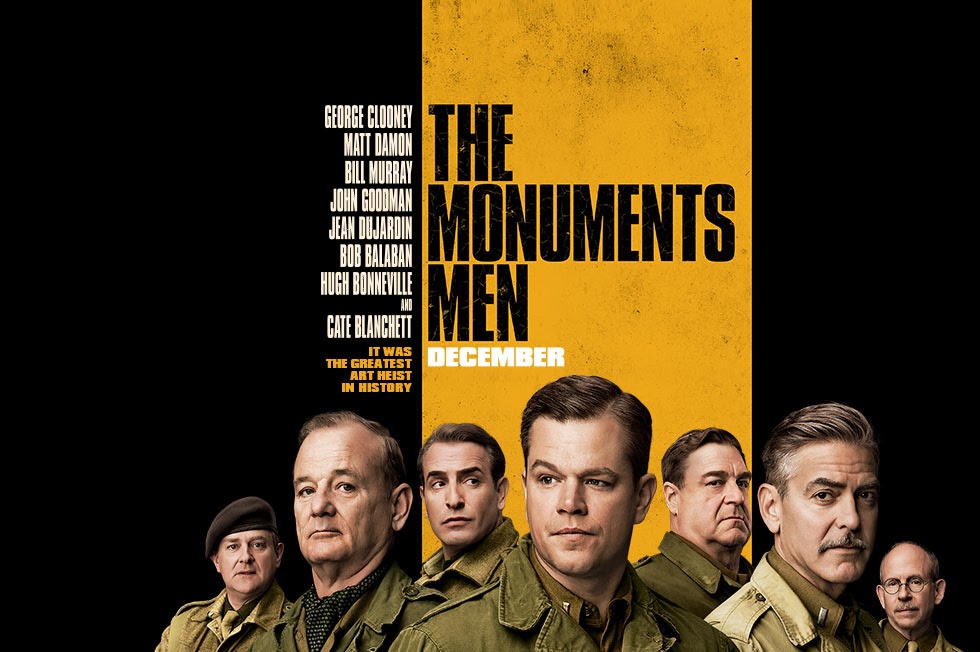
With The Monuments Men, actor/director and co-scripter Clooney has taken a relatively unknown tale from World War II and – forgive the clumsy analogy – used broad brush strokes to bring it to the screen.  Playing Frank Stokes, we first see him in 1943 canvassing President Roosevelt about the importance of finding and safeguarding the huge amount of art that the Nazis are plundering across Europe, as well as asking for the military’s cooperation in avoiding unnecessary damage to important historical buildings and monuments.  Asked by Roosevelt how many men he needs, Stokes tells him six.

The six men are Americans James Granger (Damon), Richard Campbell (Miurray), Walter Garfield (Goodman), and Preston Savitz (Balaban), plus Brit Donald Jeffries (Bonneville), and Frenchman Jean Claude Clermont (Dujardin).  All six have the skills and the experience Stokes needs to identify, trace and recover the stolen art, and two pieces in particular: Michelangelo’s Madonna of Bruges and Jan van Eyck’s Ghent Altarpiece.  Splitting up to cover as much ground as possible the men set about tracing various treasures and seeking the cooperation necessary to avoid the continued ruinous bombing of buildings such as Monte Cassino.  In this respect, and despite clear orders from Roosevelt, they find themselves rebuffed at every turn.  They have better luck tracing the routes the Nazis are using to hide everything, but they still always seem to be one step behind.

In Paris, Granger is put in touch with Claire Simone (Blanchett).  She has a detailed list of all the artwork and treasures that were stolen by the Nazis in Paris, as well as who they belonged to and where they were to be taken.  Using this list, Stokes and co are able to discover the locations the Nazis chose to hide everything.  With the war now drawing to a close they face a race against time to reach the treasures before the approaching Russians.

Monuments Men, The - scene

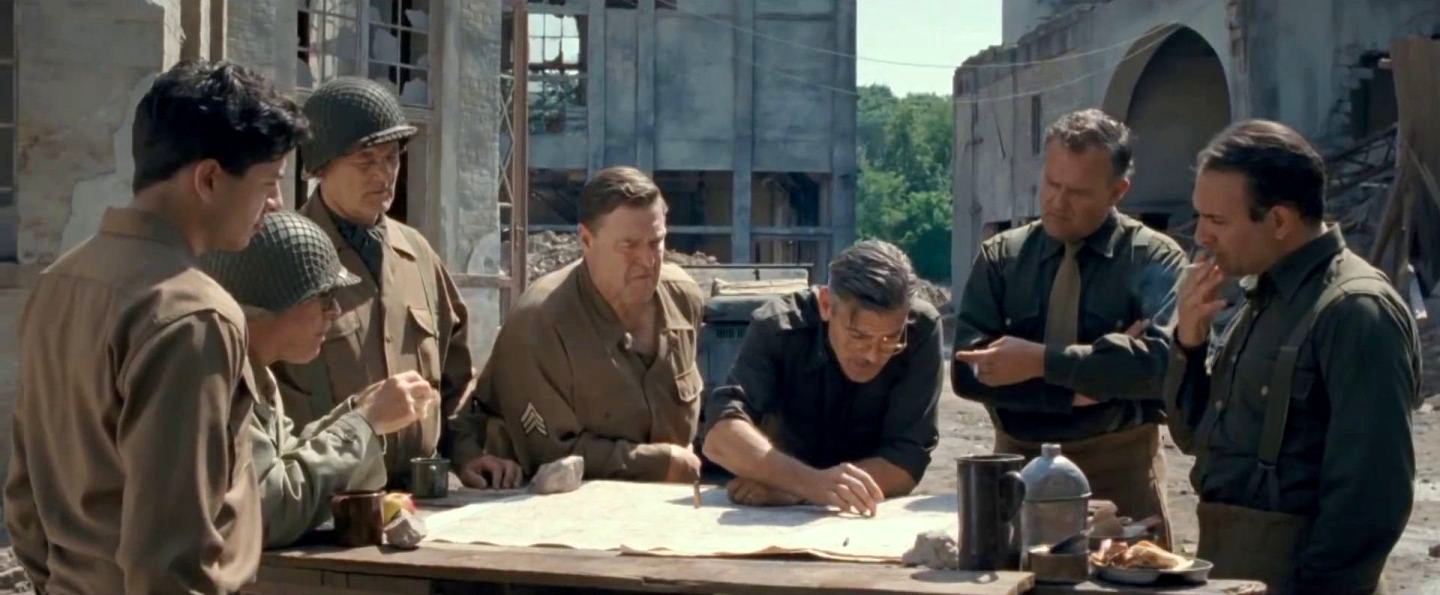
The story of the Monuments Men and their achievements makes for a thrilling read but on screen it’s a different matter.  Clooney and co-scripter (and long-time collaborator) Grant Heslov have fashioned a story from the facts that has all the hallmarks of a rush job.  Character development is perfunctory and relies on the actors to fill in the gaps by using established traits: Dujardin flashes the winning smile seen in The Artist, Murray rehashes his bucolic approach to Lost in Translation, and Goodman continues to play the same role he’s played for the last ten years.  In a way it’s a clever approach, a kind of cinematic shorthand to help introduce the characters quickly and then get on with things, but other than the fact that these men all knew (or knew of) each other before coming together, we don’t really get to know them.  As Stokes, Clooney takes a back seat, giving himself a couple of rousing, authoritative speeches, and generally directing traffic – that’s not a criticism, there is an awful lot of poring over maps and working out which direction to take.  Damon and Blanchett struggle to make her initial distrust of Granger credible, while Bonneville’s turn as the plucky Brit using the mission to overcome his drink problem, though one of the (slightly) better performances, is undermined when you realise his drink problem isn’t going to reoccur and jeopardise things.

The movie also jumps about quite a bit as it attempts to cover both time and distance.  The events shown take place between 1943 and the end of the war.  Some scenes, particularly Garfield and Clermont’s encounter with a sniper, seem included for no other reason than they might prove exciting, but this rarely works out.  Clooney tries to instil a sense of urgency, but the timescale defeats him every time.  Even towards the end with the Russians right around the corner and the Madonna of Bruges to be rescued, there’s just no excitement to be had.  And when the team are put in harm’s way, it’s hard to be concerned because a) you don’t care enough them (see previous paragraph) and Clooney’s direction doesn’t stretch itself enough to provide any tension.

What you have then is a strangely flat movie that never really takes off but which, thanks to both the art and Phedon Papamichael’s wonderful photography, looks good and is handsomely mounted.  Clooney does have a good eye for composition, and he uses the camera to good effect throughout but by the end it’s not enough to distract from the disappointment that will have already been felt.  There’s also some misguided humour, along with a few too many one-liners (there are times when the movie skirts perilously close to coming across as a kind of Ocean’s Seven).  One moment, though, that does deserve a mention: Campbell, having received a recording from his daughter, hears it played over the camp tannoy system while in the shower.  As his tears mingle with the water from the shower, it’s an instance of emotional beauty in amongst all that glorious art.

Rating: 6/10 – a missed opportunity, too lacking in focus and without a cohesive script; a great story that will hopefully be revisited at a later date.

Share this:

  • Click to share on X (Opens in new window) X
  • Click to share on Facebook (Opens in new window) Facebook
  • More
  • Click to print (Opens in new window) Print
  • Click to email a link to a friend (Opens in new window) Email
Like Loading...

Blog Stats

  • 486,528 hits

Recent Posts

  • 10 Reasons to Remember Bibi Andersson (1935-2019)
  • Fantasia (1940)
  • Dances With Wolves (1990) – The Special Edition
  • Kiss of the Spider Woman (1985)
  • The Three Musketeers (1973)

Top Posts & Pages

  • Lost for Life (2013) - Another Look
    Lost for Life (2013) - Another Look
  • Lost for Life (2013)
    Lost for Life (2013)
  • About
    About
  • Mr. Topaze (1961)
    Mr. Topaze (1961)
  • Winter's Tale (2014)
    Winter's Tale (2014)
  • Billy Lynn's Long Halftime Walk (2016)
    Billy Lynn's Long Halftime Walk (2016)
  • The Hitman's Bodyguard (2017)
    The Hitman's Bodyguard (2017)
  • Shock and Awe (2017)
    Shock and Awe (2017)
  • 5 Famous Movie Roles That Nearly Went to Someone Else
    5 Famous Movie Roles That Nearly Went to Someone Else
  • The Layover (2017)
    The Layover (2017)
Follow thedullwoodexperiment on WordPress.com

Blogs I Follow

  • Rubbish Talk
  • Film 4 Fan
  • Fast Film Reviews
  • The Film Blog
  • All Things Movies UK
  • Interpreting the Stars
  • Let's Go To The Movies
  • Movie Reviews 101
  • TMI News
  • Dan the Man's Movie Reviews
  • Film History
  • Jordan and Eddie (The Movie Guys)

Archives

  • April 2019 (13)
  • March 2019 (28)
  • February 2019 (28)
  • January 2019 (32)
  • December 2018 (28)
  • November 2018 (30)
  • October 2018 (29)
  • September 2018 (29)
  • August 2018 (29)
  • July 2018 (30)
  • June 2018 (28)
  • May 2018 (24)
  • April 2018 (21)
  • March 2018 (31)
  • February 2018 (25)
  • January 2018 (30)
  • December 2017 (30)
  • November 2017 (27)
  • October 2017 (27)
  • September 2017 (26)
  • August 2017 (32)
  • July 2017 (32)
  • June 2017 (30)
  • May 2017 (29)
  • April 2017 (29)
  • March 2017 (30)
  • February 2017 (27)
  • January 2017 (32)
  • December 2016 (30)
  • November 2016 (28)
  • October 2016 (30)
  • September 2016 (27)
  • August 2016 (30)
  • July 2016 (30)
  • June 2016 (31)
  • May 2016 (34)
  • April 2016 (30)
  • March 2016 (30)
  • February 2016 (28)
  • January 2016 (35)
  • December 2015 (34)
  • November 2015 (31)
  • October 2015 (31)
  • September 2015 (34)
  • August 2015 (31)
  • July 2015 (33)
  • June 2015 (12)
  • May 2015 (31)
  • April 2015 (32)
  • March 2015 (30)
  • February 2015 (37)
  • January 2015 (39)
  • December 2014 (34)
  • November 2014 (34)
  • October 2014 (36)
  • September 2014 (25)
  • August 2014 (29)
  • July 2014 (29)
  • June 2014 (28)
  • May 2014 (23)
  • April 2014 (21)
  • March 2014 (42)
  • February 2014 (38)
  • January 2014 (29)
  • December 2013 (28)
  • November 2013 (34)
  • October 2013 (4)

Create a free website or blog at WordPress.com.

Rubbish Talk

Film 4 Fan

A Movie Blog

Fast Film Reviews

The Film Blog

The official blog of everything in film

All Things Movies UK

Movie Reviews and Original Articles

Interpreting the Stars

Dave Examines Movies

Let's Go To The Movies

Film and Theatre Lover!

Movie Reviews 101

Daily Movie Reviews

TMI News

Latest weather, crime and breaking news

Dan the Man's Movie Reviews

All my aimless thoughts, ideas, and ramblings, all packed into one site!

Film History

Telling the story of film

Jordan and Eddie (The Movie Guys)

Movie Reviews & Ramblings from an Australian Based Film Fan

Privacy & Cookies: This site uses cookies. By continuing to use this website, you agree to their use.
To find out more, including how to control cookies, see here: Cookie Policy
  • Subscribe Subscribed
    • thedullwoodexperiment
    • Join 481 other subscribers
    • Already have a WordPress.com account? Log in now.
    • thedullwoodexperiment
    • Subscribe Subscribed
    • Sign up
    • Log in
    • Report this content
    • View site in Reader
    • Manage subscriptions
    • Collapse this bar
 

Loading Comments...
 

    %d