• 10 Reasons to Remember…
  • A Brief Word About…
  • About
  • For One Week Only
  • Happy Birthday
  • Monthly Roundup
  • Old-Time Crime
  • Other Posts
  • Poster of the Week
  • Question of the Week
  • Reviews
  • Trailers

thedullwoodexperiment

~ Viewing movies in a different light

thedullwoodexperiment

Tag Archives: Imprisonment

Hannah (2017)

14 Saturday Jul 2018

Posted by dullwood68 in Movies

≈ Leave a comment

Tags

André Wilms, Andrea Pallaoro, Arthouse, Charlotte Rampling, Drama, France, Imprisonment, Review

D: Andrea Pallaoro / 93m

Cast: Charlotte Rampling, André Wilms, Stéphanie Van Vyve, Simon Bisschop, Fatou Traoré, Julien Vargas, Gaspard Savini

Hannah (Rampling) is a quiet woman, not given to speaking much, and not given to engaging with people unless it’s the woman whose house she cleans, Elaine (Van Vyve), or Elaine’s blind son, Nicholas (Bisschop). Her usual reticence has been exacerbated though, by the imminent imprisonment of her husband (Wilms). She’s a dutiful wife who stands by him, even though his crime appears to be of a predatory sexual nature. Once he begins his prison sentence, Hannah becomes even more withdrawn, with only her cleaning job and an acting group that she attends regularly, to break up the monotony of being alone at home. There are further setbacks: her membership at the local baths is revoked, she’s turned away from her grandson’s birthday party, and she makes a discovery at home that has a profound effect on her relationship with her husband. Hannah tries to get her life back in order, but it’s increasingly difficult, and as she negotiates the new terrain of her life, letting go of the past proves more of a struggle than she could ever have expected…

From the start, Hannah is a movie that is likely to divide audiences. For those looking for more mainstream fare, Hannah will be a challenge that may find them abandoning the movie part way through, while those looking for arthouse fare that explores the “human condition”, this will be an unalloyed pleasure. Replete with takes and scenes that depict Hannah either staring glumly off into the distance, or staring glumly into the foreground, or even staring glumly while in repose, Andrea Pallaoro’s ultra-leisurely depiction of one lonely woman’s faltering attempts at personal rehabilitation is easily the kind of movie that will have some viewers asking themselves, “when is something going to happen?” But as the phrase has it, the devil is in the details, and while at first glance Hannah’s life is full of small, inconsequential moments, it’s precisely these moments and their gradual accumulation that carry an unexpected emotional heft. Hannah may be occupying a world that only she has access to, but it’s a world that is keeping her afloat following her husband’s incarceration. Here there aren’t any sudden life-changing decisions that solve all her problems overnight (as might happen in more mainstream fare), just a number of hesitant steps toward a newer, better life.
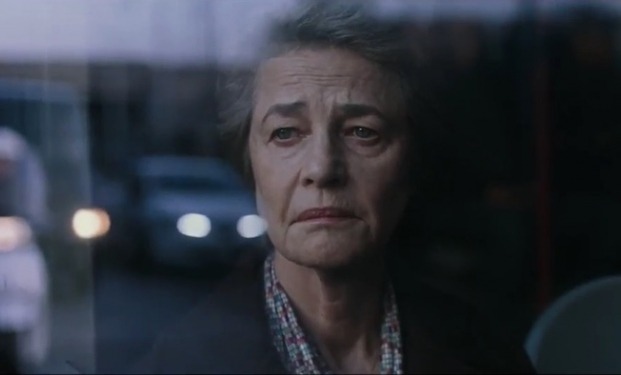
It helps that Pallaoro has enlisted the aid of Charlotte Rampling to tell Hannah’s story. Rampling is one of the few actresses who can display a range of emotions with just a glance, and here she’s on magnificent form, giving a performance that gets to the heart of Hannah’s predicament. Behind that seemingly passive face, with its mouth permanently turned down (when she does smile it’s misinterpreted), Rampling perfectly captures the hopes and fears and muted dreams and feelings that Hannah struggles to express, even to herself. We learn nothing of Hannah’s back story, never find out what she was like before her husband’s crime turned everything upside down (or even if it did), but Rampling shows us a woman seemingly trying to reconnect with herself as well as the wider world. There’s a scene towards the end with a beached whale that Hannah feels compelled to go and see, and though the symbolism is clumsy in a movie that is otherwise compellingly subtle, it’s a moment of hope for Hannah. The only question that remains – and it’s one that Pallaoro is rightly uninterested in answering – is whether or not Hannah can take this newfound hope and use it to push herself forward to where she needs to be. But that’s a tale for another movie…

Rating: 8/10 – not for all tastes, but intriguing and fascinating nevertheless for the way it paints a portrait of personal reclamation through the accumulated minutiae of daily endeavour, Hannah is an affecting drama with far more to say than at first glance; Pallaoro keeps the focus on Rampling throughout, a decision that allows his story to be given the fullest expression possible, and which allows the patient viewer to become heavily invested in its troubled central character.
Share this:

  • Click to share on X (Opens in new window) X
  • Click to share on Facebook (Opens in new window) Facebook
  • More
  • Click to print (Opens in new window) Print
  • Click to email a link to a friend (Opens in new window) Email
Like Loading...

Rosewater (2014)

17 Friday Oct 2014

Posted by dullwood68 in Movies

≈ 1 Comment

Tags

2009 Election, Drama, Gael García Bernal, Imprisonment, Iran, Jon Stewart, Kim Bodnia, Maziar Bahari, Mir-Hossein Mousavi, President Ahmadinejad, Review, Tehran, Then They Came for Me, True story

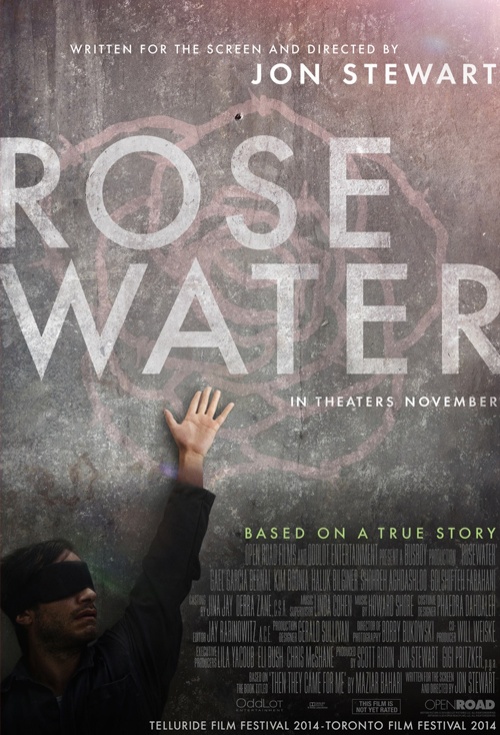
Rosewater

D: Jon Stewart / 103m

Cast: Gael García Bernal, Kim Bodnia, Shohreh Aghdashloo, Haluk Bilginer, Golshifteh Farahani, Claire Foy, Dimitri Leonidas, Nasser Faris, Jason Jones

An Iranian-born journalist, Maziar Bahari (Bernal), travels to Tehran in June 2009 to cover the Presidential election for Newsweek.  In the run up he speaks to supporters of both President Ahmadinejad and his main rival Mir-Hossein Mousavi, and while his own opinions favour Mousavi, he remains outwardly neutral in his reporting, even when on the day of the election he finds himself barred from an open polling station at the same time that news is being broadcast that Ahmadinejad has won.

In the days that follow, Bahari films on the streets as the Iranian people protest against what they feel have been rigged elections.  During one such protest, Bahari films a crowd outside a military barracks that come under fire from the militia in the building.  He arranges for the footage to be seen outside Iran.  On June 21, while staying with his mother, Moloojoon (Aghdashloo), Bahari is arrested and taken to Evin prison where he is charged with being a spy.

Kept in solitary confinement, Bahari is regularly taken to a room where he is made to sit facing a wall but with a blindfold on.  Here his interrogator (Bodnia) keeps asking him who he is spying for, and is it with the aim of trying to undermine and/or overthrow the Iranian government.  Bahari rejects the idea, and does his best to convince his interrogator that he is just a journalist but the interrogator, in turn, rejects his assertions.  Days pass in this way as various forms of psychological and physical torture are used to break Bahari and get him to confess.  Eventually, after several weeks he makes a televised confession that he is a spy.

Despite being what the Iranian authorities have wanted all along, the confession serves only to highlight Bahari’s plight on an international level, and helps his pregnant wife, Paola (Foy), with her campaign to get him released.  Back in the prison, the interrogations continue but now Bahari begins to regain some level footing by making up stories about his travels, stories that his interrogator believes wholeheartedly.  And then, on October 20, after a hundred and eighteen days, Bahari is offered a chance at freedom: agree to be a spy for the Iranian government and he will be released.

Rosewater - scene

Based on the memoir, Then They Came for Me, that Bahari co-wrote with Aimee Molloy, Rosewater is a compelling, occasionally provocative drama that benefits from solid performances, a clever script courtesy of first-time writer/director Stewart, and a skilful re-creation of the events that led up to Bahari’s confinement.  The movie begins with Bahari’s arrest, a tense scene that carries an uncomfortable hint of menace towards his mother.  From there we flash back to Bahari preparing to leave London for Tehran; the audience gets to see how confidently Stewart is able to set up the story, explaining concisely the basic political situation in Iran, and the importance for the people of the election.

The concise nature of the opening scenes allows the audience to spend more time with Bahari in Evin prison, and it’s here that the movie explores the surprising nature of captivity and its effect on the individual.  Bahari is never conventionally tortured.  There are no beatings, no physical restraints put in place (other than the blindfold), and only one attempt at violence that is conducted more out of frustration on the interrogator’s part than from any premeditated action.  But it has a profound psychological effect on Bahari, and Stewart – aided greatly by Bernal – shows how he did his best to survive by creating interior dialogues with his deceased father and sister.  These scenes are among the most effective in the movie as, for the most part, despite it seeming that Bahari is able to come up with a constructive way of dealing with his captors, by and large he’s unable to do so.  These dialogues allow him to feel and be strong in his own mind, but not in the interrogation room.  It’s a subtle acknowledgment – that often, our strength is something we can only convince ourselves of – but one that Stewart pulls off with deliberately muted style.

With much of the prison scenes allowing little of the outside world to creep in, Bahari’s loneliness and isolation is powerfully presented, though as time goes on and he becomes almost inured to the passage of time, Stewart gradually opens up the movie to show us what’s been going on in the meantime.  Again, it’s a clever move, and adds to the sense that time is passing slowly (which, for Bahari, it must have done).  It’s not until a guard refers to him as “Mr Hillary Clinton” that we – and he – begin to realise that he’s not been quite as alone as it’s seemed.  From there the movie begins to gain pace as the prospect of Bahari’s release becomes more likely, and Stewart allows the tension to unwind.  It’s a slightly counter-intuitive approach but it works in the movie’s favour.

Rosewater - scene2

With Stewart so firmly in control of the material it’s good to see he’s also firmly in control of the performances.  Bernal is an actor who continually impresses, and here he inhabits Bahari with ease, displaying his nervousness and fear and desperation with conviction (though perhaps his best moment is when he dances around his cell to a song only he can hear).  It’s a measured, contemplative performance, one that brings a greater depth to Bahari as a man than audiences might expect.  As his nemesis, and user of the titular liquid, Bodnia is also on fine form, a more traditional style of interrogator who would usually favour a more physical approach, but who finds himself increasingly out of his comfort zone.  When Bahari talks about his “obsession” with sexual massages, his willingness to believe these stories is both comic and pathetic.  The two actors spar around each other with skill, and both are equally mesmerising in their scenes together.

The rest of the cast haven’t quite as much to do in comparison, though Leonidas stands out as Bahari’s “driver”, Davood, and Faris plays the interrogator’s boss with patronising detachment.  Aghdashloo and Bilginer are persuasive as always as Maziar’s parents, though as his sister, Farahani has too little screen time to make any real impression.  This being a Jon Stewart movie there’s also plenty of humour to be had in amongst all the drama, and one scene will have audiences laughing out loud thanks to Bernal and Bodnia’s skill as actors.  The photography is sharply detailed and the movie is brightly lit throughout, at odds with the more gloomy aspects of events.  There’s also an effective score courtesy of Howard Shore that adds weight to the emotional content, but doesn’t overwhelm it.  A couple of gripes aside – Bahari’s hair and beard remain the same throughout the entire hundred and eighteen days he’s imprisoned, the interrogator seems a little too out of his depth to be kept on board the whole time – this is riveting, engrossing stuff, and a triumph for all concerned.

Rating: 9/10 – Rosewater takes a tale of imprisonment and loss of personal freedom but somehow makes it completely accessible and not in the least claustrophobic, while still reinforcing the seriousness of the situation; a great debut for Stewart and one that  succeeds with apparent ease.

Share this:

  • Click to share on X (Opens in new window) X
  • Click to share on Facebook (Opens in new window) Facebook
  • More
  • Click to print (Opens in new window) Print
  • Click to email a link to a friend (Opens in new window) Email
Like Loading...

Mini-Review: Oldboy (2013)

19 Wednesday Feb 2014

Posted by dullwood68 in Movies

≈ 1 Comment

Tags

Drama, Elizabeth Olsen, Hollywood remake, Imprisonment, Josh Brolin, Revenge, Review, Samuel L. Jackson, Sharlto Copley, Spike Lee, Thriller

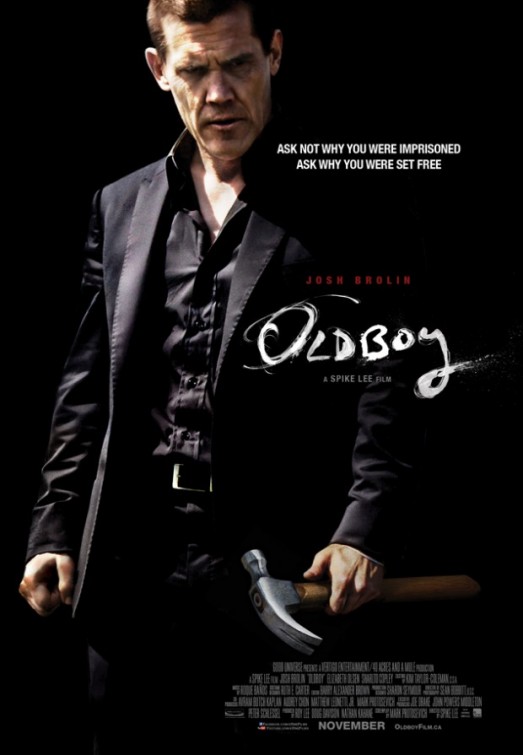
Oldboy (2013)

D: Spike Lee / 104m

Cast: Josh Brolin, Elizabeth Olsen, Sharlto Copley, Samuel L. Jackson, Michael Imperioli, Pom Klementieff, James Ransone, Max Casella, Linda Emond

There are times when you just know that the phrase “just because you can doesn’t mean you should” is going to apply to an upcoming remake or sequel, and that what will eventually hit cinemas – if the movie’s that lucky (or has enough money behind it) – is going to be as disappointing as sunbathing during an eclipse.  It’s a very rare remake indeed that comes out as well as the original, and that’s mostly because those originals are lightning-in-a-bottle moments.  From Gus Van Sant’s ill-advised and unexpectedly dull shot-for-shot remake of Psycho (1998) to the current vogue for remaking what seems like every horror movie from the Eighties, remakes are the lazy filmmaker’s way of keeping busy.  And so it proves with Oldboy, Spike Lee’s remake of Chan-wook Park’s modern classic.

Oldboy (2013) - scene

Even with Lee and writer Mark Protosevich saying they’ve gone back to the original manga that Park based his movie on, this version still fails on so many levels.  The main character, Joe Doucett (played with his usual intensity by Brolin) is unlikeable from the start, so any sympathy we might have for him is dispensed with before he’s even held captive.  There’s a cartoonish performance from Samuel L. Jackson as chief gaoler Chaney that comes complete with blond ponytail and which sits at odds with the rest of the performances, and the tone of the movie as a whole.  When Joe meets Marie (Olsen) she gives him her number almost straight away in case he needs any help; yes, she’s an aid worker but would she really do that (but then how would the rest of the movie develop if she didn’t)?

The villain of the piece is played with pantomime bravura by Copley, and the only thing that’s missing from his performance is a bit of moustache-twirling (his vocal styling is quite irritating too).  The sequence where Joe takes on Chaney’s goons with just a hammer now looks over-rehearsed and lacks any visceral quality.  And the revelation of why Joe has been released is given a mock-opera makeover that resists any emotional engagement by the viewer because, in the set up, it appears that Copley’s character is able to install surveillance equipment wherever Joe goes and in advance of his knowing he’s going there.

In short, the movie relies on contrivance after contrivance and gives the viewer nothing to connect with.  As a reinterpretation (which sounds more like prevarication than anything else), Oldboy ends up being like a mime interpreting a song: you wonder what was the point.

Rating: 5/10 – proficient on a technical level with excellent photography courtesy of Sean Bobbitt, Oldboy strips away the cultural depth of Chan’s version and gives us nothing in return; even judged on its own merits it’s still a movie that doesn’t work.

Share this:

  • Click to share on X (Opens in new window) X
  • Click to share on Facebook (Opens in new window) Facebook
  • More
  • Click to print (Opens in new window) Print
  • Click to email a link to a friend (Opens in new window) Email
Like Loading...

Blog Stats

  • 486,528 hits

Recent Posts

  • 10 Reasons to Remember Bibi Andersson (1935-2019)
  • Fantasia (1940)
  • Dances With Wolves (1990) – The Special Edition
  • Kiss of the Spider Woman (1985)
  • The Three Musketeers (1973)

Top Posts & Pages

  • Lost for Life (2013) - Another Look
    Lost for Life (2013) - Another Look
  • Lost for Life (2013)
    Lost for Life (2013)
  • About
    About
  • Mr. Topaze (1961)
    Mr. Topaze (1961)
  • Billy Lynn's Long Halftime Walk (2016)
    Billy Lynn's Long Halftime Walk (2016)
  • Winter's Tale (2014)
    Winter's Tale (2014)
  • The Hitman's Bodyguard (2017)
    The Hitman's Bodyguard (2017)
  • 5 Famous Movie Roles That Nearly Went to Someone Else
    5 Famous Movie Roles That Nearly Went to Someone Else
  • The Layover (2017)
    The Layover (2017)
  • Transcendence (2014)
    Transcendence (2014)
Follow thedullwoodexperiment on WordPress.com

Blogs I Follow

  • Rubbish Talk
  • Film 4 Fan
  • Fast Film Reviews
  • The Film Blog
  • All Things Movies UK
  • Interpreting the Stars
  • Let's Go To The Movies
  • Movie Reviews 101
  • TMI News
  • Dan the Man's Movie Reviews
  • Film History
  • Jordan and Eddie (The Movie Guys)

Archives

  • April 2019 (13)
  • March 2019 (28)
  • February 2019 (28)
  • January 2019 (32)
  • December 2018 (28)
  • November 2018 (30)
  • October 2018 (29)
  • September 2018 (29)
  • August 2018 (29)
  • July 2018 (30)
  • June 2018 (28)
  • May 2018 (24)
  • April 2018 (21)
  • March 2018 (31)
  • February 2018 (25)
  • January 2018 (30)
  • December 2017 (30)
  • November 2017 (27)
  • October 2017 (27)
  • September 2017 (26)
  • August 2017 (32)
  • July 2017 (32)
  • June 2017 (30)
  • May 2017 (29)
  • April 2017 (29)
  • March 2017 (30)
  • February 2017 (27)
  • January 2017 (32)
  • December 2016 (30)
  • November 2016 (28)
  • October 2016 (30)
  • September 2016 (27)
  • August 2016 (30)
  • July 2016 (30)
  • June 2016 (31)
  • May 2016 (34)
  • April 2016 (30)
  • March 2016 (30)
  • February 2016 (28)
  • January 2016 (35)
  • December 2015 (34)
  • November 2015 (31)
  • October 2015 (31)
  • September 2015 (34)
  • August 2015 (31)
  • July 2015 (33)
  • June 2015 (12)
  • May 2015 (31)
  • April 2015 (32)
  • March 2015 (30)
  • February 2015 (37)
  • January 2015 (39)
  • December 2014 (34)
  • November 2014 (34)
  • October 2014 (36)
  • September 2014 (25)
  • August 2014 (29)
  • July 2014 (29)
  • June 2014 (28)
  • May 2014 (23)
  • April 2014 (21)
  • March 2014 (42)
  • February 2014 (38)
  • January 2014 (29)
  • December 2013 (28)
  • November 2013 (34)
  • October 2013 (4)

Blog at WordPress.com.

Rubbish Talk

Film 4 Fan

A Movie Blog

Fast Film Reviews

The Film Blog

The official blog of everything in film

All Things Movies UK

Movie Reviews and Original Articles

Interpreting the Stars

Dave Examines Movies

Let's Go To The Movies

Film and Theatre Lover!

Movie Reviews 101

Daily Movie Reviews

TMI News

Latest weather, crime and breaking news

Dan the Man's Movie Reviews

All my aimless thoughts, ideas, and ramblings, all packed into one site!

Film History

Telling the story of film

Jordan and Eddie (The Movie Guys)

Movie Reviews & Ramblings from an Australian Based Film Fan

Privacy & Cookies: This site uses cookies. By continuing to use this website, you agree to their use.
To find out more, including how to control cookies, see here: Cookie Policy
  • Subscribe Subscribed
    • thedullwoodexperiment
    • Join 481 other subscribers
    • Already have a WordPress.com account? Log in now.
    • thedullwoodexperiment
    • Subscribe Subscribed
    • Sign up
    • Log in
    • Report this content
    • View site in Reader
    • Manage subscriptions
    • Collapse this bar
 

Loading Comments...
 

    %d