• 10 Reasons to Remember…
  • A Brief Word About…
  • About
  • For One Week Only
  • Happy Birthday
  • Monthly Roundup
  • Old-Time Crime
  • Other Posts
  • Poster of the Week
  • Question of the Week
  • Reviews
  • Trailers

thedullwoodexperiment

~ Viewing movies in a different light

thedullwoodexperiment

Tag Archives: James Badge Dale

The Walk (2015)

14 Wednesday Oct 2015

Posted by dullwood68 in Movies

≈ 1 Comment

Tags

Ben Kingsley, Charlotte Le Bon, Drama, High wire, James Badge Dale, Joseph-Gordon-Levitt, Literary adaptation, Philippe Petit, Review, Robert Zemeckis, Tightrope, True story, Twin Towers, World Trade Center

Walk, The

D: Robert Zemeckis / 123m

Cast: Joseph Gordon-Levitt, Ben Kingsley, Charlotte Le Bon, James Badge Dale, Clément Sibony, César Domboy, Steve Valentine, Ben Schwartz, Benedict Samuel

1973. Philippe Petit (Gordon-Levitt) is a street entertainer in Paris, France, who includes some wire work in his act, usually strung between two trees and without the benefit of having a permit. One day he accepts a gobstopper from a young girl in his audience, but when he bites into it, it causes a painful problem that he goes straight to the dentist with. While in the waiting-room he sees a magazine article on New York’s Twin Towers. Straightaway, Petit knows what he has to do: he has to learn the intricacies of high wire work, and from the acknowledged master, Papa Rudy (Kingsley), in order that he can fulfil his dream of walking between the Twin Towers on just a length of cable. Rudy agrees to teach him. Aided by his girlfriend, Annie (Le Bon), and mutual friend, Jean-Louis (Sibony), Petit determines to travel to New York and carry out his dream.

Once there, Petit enlists the aid of further “accomplices”, such as J.P. (Dale) and Barry Greenhouse (Valentine), who works in the South Tower. Several visits to the site are made in an effort to discover the best time for stringing the cable between the two buildings, and more importantly, when Petit should make the crossing. Petit, though, steps on a nail and injures his right foot, but won’t hear of cancelling or postponing the high wire walk (which has been set for 6 August 1974, and is called The Coup). Aided by Jean-Francois (aka Jeff) (Domboy) and two others recruited by J.P., Petit forges ahead with his plan and they manage to sneak all the relevant equipment into both buildings. But on the night of the 5th, with Petit planning to commence his walk across “the Void” at 6am, the presence of a night guard, and some unexpected problems with the cable and the lines used to stop it from wobbling, throw the endeavour off schedule. Eventually, with Jeff to help him, and Jean-Louis on the other tower, and with Annie, J.P. and Barry watching from the street, Petit takes his first steps out onto the wire…
Walk, The - scene

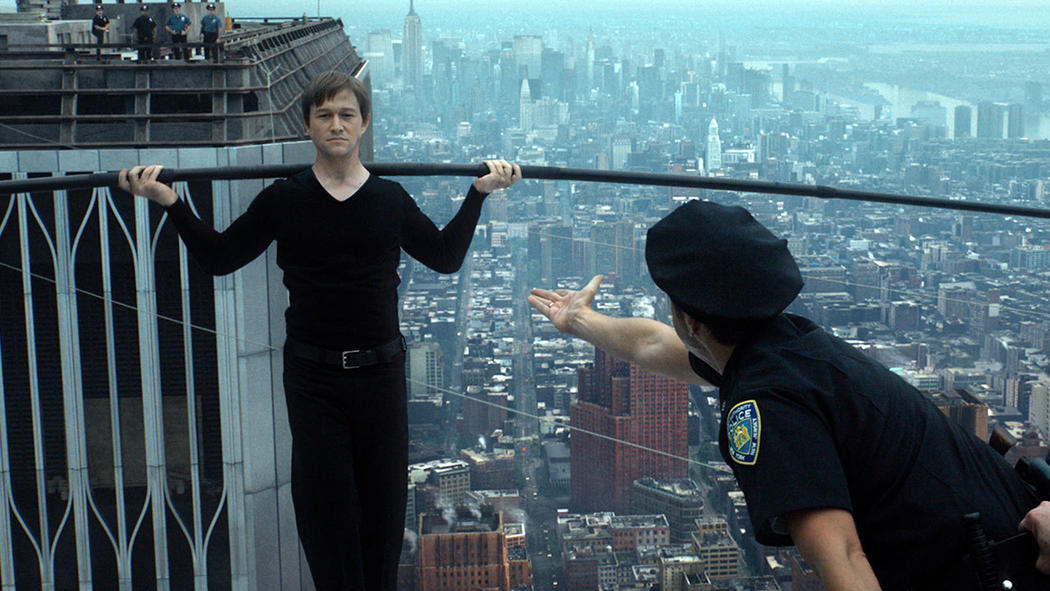
James Marsh’s documentary on Philippe Petit, Man on Wire (2008), won the Best Documentary Feature Oscar in 2009, as well as a whole raft of other awards from around the world. The one criticism that can be levelled against what is otherwise a very good examination of Petit’s particular brand of “artistic madness”, is that there’s no footage of Petit walking between the Twin Towers. In the hands of Robert Zemeckis, The Walk seeks to remedy this by putting the audience up there with Petit, and by showing just how dangerous it was. However, the key phrase here is “seeks to remedy”, as by and large, Zemeckis takes his cue from Petit himself and dismisses any attempt to instil any fear or heart-pounding terror into the walk itself. While it may well be true that Petit was confident of his abilities, and that the walk – or walks: he traversed the wire several times – was easier than he’d expected, but once he’s out there, the tension that Zemeckis and co-screenwriter Christopher Browne have so successfully created in the movie’s third act (of four) swiftly evaporates.

The movie takes an odd approach to the material, and feels schizophrenic as a result, with a first half that concentrates, in a very old-fashioned Hollywood way, on Petit as a young man just starting out as a street performer, before becoming inspired to walk between the towers. It has the look and feel of a regular biography, with key moments ticked off against a list, and with any potential spontaneity halted before it’s given a chance to start (there’s even a scene where Petit and Annie are getting to know each other by romantic candlelight). And if truth be told, these scenes aren’t even that interesting, delaying as they do the central focus of the movie, namely that walk. Petit shows off his arrogance, Annie melts under his charm too quickly, and things happen with a convenience and disregard for clarity that it’s easier just to go along with it all and wait for the movie to pick up by itself.

Which it does once Petit and friends start “casing the joint” and begin installing the equipment they need. This stretch of the movie contains the most tension and is easily the most compelling, as obstacles need to be overcome and the Coup becomes in danger of being cancelled indefinitely. As the fiercely determined Petit, Gordon-Levitt holds it all together, and if his accent slips from time to time, it’s not the end of the world. He channels Petit’s passion for high wire work with aplomb, even if the character – as written – isn’t as socially aloof or as difficult to work with as Man on Wire revealed. Gordon-Levitt also proves to be a proficient high wire walker, having spent time learning how to do it for real. It’s this level of commitment that helps the movie overcome the weakness inherent in the narrative, the one that doesn’t allow the other characters to be as fleshed out as Petit.

Annie (Charlotte Le Bon) and Philippe Petit (Joseph Gordon-Levitt) in TriStar Pictures' THE WALK.

While people like Le Bon, Valentine, and Dale left to stand on the sidewalk and stare at proceedings through binoculars, it’s left to Gordon-Levitt and Domboy to ratchet up the tension, especially Domboy, whose character Jeff, is terrified of heights. Kingsley floats in and out of the narrative and acts purely as a mine of information or encouraging mentor. But while the main performances, however truncated by the need to fit as much in as possible, are comfortably undemanding of the cast, don’t let them die.

Another issue is the unconvincing CGI work carried out once Petit and Jeff are on the roof of the South Tower. The backdrops are impressively detailed, but it’s not enough to allow them to look any better. They stand out against their surroundings, and unfortunately, it’s distracting, as well as a shock to see that an innovator like Zemeckis can’t overcome the lighting issues that have caused this effect. And even more unfortunately, when the camera swings or pans its way over and around Petit’s head when he’s on the wire, there’s no real sense of depth to the image, no sense that this is a very long way down (or somewhere very high up). Petit’s own storytelling image, the emphasis he puts on the danger, and the awkward position it puts him in with the authorities is nicely handled but it’s all too little, too late. And the decision to have Petit holding forth on his exploits from the top of the Statue of Liberty may have semed like a good idea at the time, but in actuality it’s off-putting and makes for dramatically turgid viewing.

The movie does benefit from a classy, contemporary score by the ever reliable Alan Silvestri, while the movie – on the ground, at least – offers some superb visuals courtesy of Dariusz Wolski. If the movie tries to include too much of Petit’s history for its own good, then the end result is a little uneven, and still very ragged in places, but overall the movie does have its charms, and some viewers may yet find themselves overcome by some of the aerial shots

Rating: 6/10 – too uneven and too much like a soap opera in the first half, The Walk treads the Hollywood line once too often to create a movie no one will be able to remember even when they’re buying it; a disappointment then (even in IMAX 3D), and not as gripping as it should have been, it’s still a much more attractive proposition than most movies that are out at the moment.

Share this:

  • Click to share on X (Opens in new window) X
  • Click to share on Facebook (Opens in new window) Facebook
  • More
  • Click to print (Opens in new window) Print
  • Click to email a link to a friend (Opens in new window) Email
Like Loading...

Stretch (2014)

11 Monday May 2015

Posted by dullwood68 in Movies

≈ Leave a comment

Tags

Chris Pine, Comedy, Crime, Drama, Ed Helms, FBI, Gambling debt, James Badge Dale, Jessica Alba, Joe Carnahan, Limo driver, Patrick Wilson, Review

Stretch

D: Joe Carnahan / 94m

Cast: Patrick Wilson, Chris Pine, Ed Helms, James Badge Dale, Brooklyn Decker, Jessica Alba, Shaun Toub, Randy Couture, Matthew Willig, Ben Bray, David Hasselhoff, Ray Liotta, Norman Reedus

Following the unexpected break up of his relationship with the love of his life, Candace (Decker), would-be actor and ex-cocaine and gambling addict Stretch (Wilson) turns to limo driving to make ends meet. With his life coasting along in neutral, it comes as a shock when one day a gambling debt he thought had lapsed, is taken over by Ignacio (Bray), who wants payment by midnight of the same day. With little chance of coming up with the $6,000 he owes, Stretch convinces one of his co-workers, Charlie (Alba), to steer any high-paying customers his way during the evening, in the hope that he’ll earn enough in tips to pay off Ignacio.

With his boss Naseem (Toub) worried about a rival limo company run by the mysterious Jovi (Couture), Stretch sees his first pick-up, David Hasselhoff, persuaded to go with the Jovi. In an attempt at getting his own back, Stretch gets to the Jovi’s next client, Ray Liotta, first. Picking him up from a movie set, Liotta leaves with a prop gun and fake police I.D., but insists that Stretch return them to the studio. Before he can do so, Charlie sets him up with another client, an eccentric businessman called Roger Karos (Pine). Knowing that he’s a renowned big tipper, Stretch tells Karos about his gambling debt; Karos agrees to tip Stretch that amount if he takes him wherever he wants to go.

“Wherever” turns out to be a secret sex club. When they get there, Karos gives Stretch a task: to visit another club, see a Frenchman called Laurent (Dale) and obtain a specific briefcase, plus locate a supply of cocaine, and all within one hundred minutes – without fail. But Laurent is expecting Karos to hand over some ledgers in exchange for the briefcase (which contains a lot of money). Using Ray Liotta’s fake police I.D., Stretch bluffs his way out of the club with the briefcase, and by chance runs into Candace. Without batting an eyelid he tells her he’s doing really well and when she shows a renewed interest in him, Stretch turns her down flat.

He gets hold of some cocaine but the limo gets stolen. With the briefcase hidden inside it, he tracks it down, only for it to be towed by the Jovi’s brother, Boris (Willig). Stretch manages to get the limo back and returns to pick up Karos. But Karos reneges on his deal to pay Stretch the $6,000, saying he was a minute late in returning to collect him. So when Ignacio calls demanding the money, Stretch tells him to meet him where Karos wants to go next. But when they all meet up, Stretch’s plans go awry when the Jovi appears and Karos hands Stretch over to him.

Stretch - scene

You know, a funny thing happened on the way to the box office…

Stretch was originally scheduled for release in March 2014, but with two months to go, Universal scrapped the release and allowed producer Jason Blum to offer the movie to other distributors. But no one picked it up, and it came back to Universal. Eventually the movie was released on iTunes and Amazon.com, and VOD, in October 2014. Which begs the question, if Universal were so eager to disown it, then just how bad a movie is it?

The answer is: not that bad. It is rough and ready though, and often threatens to disappear up its own backside by trying to be edgy and complicated, but on the whole Joe Carnahan’s blackly comic limo ride is a bit of a guilty pleasure. He’s helped immensely by the casting of Wilson in the title role, his resigned, long-suffering features put to excellent use throughout as Stretch manoeuvres his way through the kind of night that only happens to characters in the movies. It’s Scorsese’s After Hours (1985) given a more modern sensibility and with a higher absurdity quotient.

It does, however, take an age to get going. It’s not until Ray Liotta’s dropped off at his hotel that the movie begins to move up a gear, and Stretch’s evening really starts to fall apart. Up until then we’re treated to too many scenes that show just how much his life sucks, and how everything he tries never quite works out how he needs it to. By the third or fourth example we get the idea, but Carnahan isn’t finished, and Stretch’s humiliation continues, right up until the moment he cons the briefcase from Laurent. From then on he begins to fight back – against Naseem, the Jovi and Boris, Ignacio, and Karos. It’s great to see this particular worm turning, and Wilson’s unprotesting features change to reflect the smug satisfaction Stretch begins to experience as he turns the tables on everyone. It’s a winning performance, and one that makes the viewer root for Stretch at every turn.

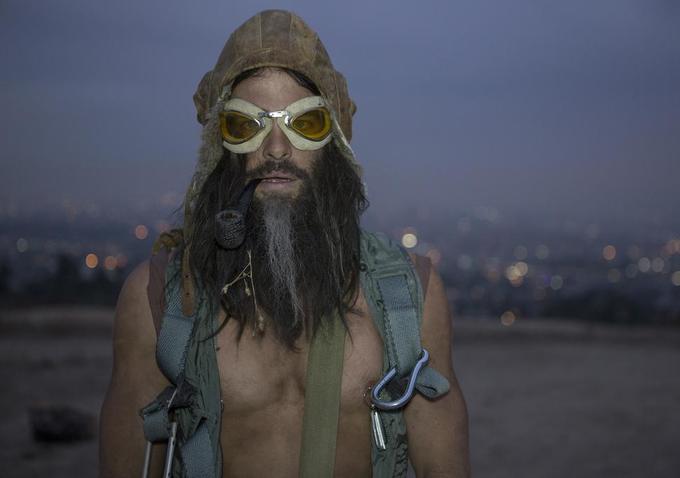
Wilson is the calm centre at the midst of what is an otherwise wild and wacky tale of male empowerment gone AWOL, but more than holds his own when up against the feverish performance given by an uncredited Pine. Sporting a bushy hairstyle and beard, and making his appearance semi-naked in a parachute, Pine gives such a larger than life performance it’s almost as if he’s been given carte blanche by Carnahan to do and say whatever he wants (such as setting fire to the inside of the limo, or punching himself in the face for “clarity”). Luckily, he’s not so over-the-top that he proves too much of a distraction, but when he isn’t on screen, his absence is palpable; full marks to Carnahan then for not over-relying on him, or letting the character take over.

But while Wilson and Pine have fun with their roles, fun that translates as unwavering commitment in front of the camera, spare a thought for poor Ed Helms, saddled with playing Karl, the ghost of an ex-limo driver. The script requires him to pop up at odd moments and either point out Stretch’s failings, or pass comment on the action. He’s meant to be a source of humour, and Helms plays him that way, but alas nobody thought to tell Carnahan, who provides him with some of the most awkward dialogue this side of a later entry in the Saw series. To compensate, though, the cameos – from Hasselhoff, Liotta, Shaun White, and Norman Reedus – are all hilarious (especially Reedus’s).

Stretch - scene2

With the movie pushing credibility further and further under the wheels of absurdity, Stretch often comes perilously close to derailing, but at each crazy turn Carnahan reins it in and finds some plausibility – however weak – from somewhere, and the movie carries on regardless. It’s a movie that comes self-contained and relies on its own twisted logic to work, and  for the most part, that’s exactly what happens: it works. There’s a romantic sub-plot involving Stretch and a woman he’s met online, plus the whole running-scared-of-the-Jovi-and-his-brother routine, and they add nicely to the mix, adding some small amount of depth to the story and providing some secondary amusement.

If its’ all a little too far-fetched then it’s to be expected. And though being a little far-fetched doesn’t necessarily hurt the movie, it does raise that question again: just what bee had gotten into Universal’s bonnet? Because from here, Carnahan’s crazy thrill ride has a lot to offer once that shaky start has passed.

Rating: 7/10 – with a very slow start leading eventually to all sorts of comic encounters and dialogue – “I’m sorry, I didn’t see the light.” “Well, don’t go towards it now.” – Stretch is an imperfect but still hugely enjoyable comedy-thriller; best viewed with any expectations dialled down so that it can (again eventually) surprise you and make you glad you watched it.

Share this:

  • Click to share on X (Opens in new window) X
  • Click to share on Facebook (Opens in new window) Facebook
  • More
  • Click to print (Opens in new window) Print
  • Click to email a link to a friend (Opens in new window) Email
Like Loading...

Miss Meadows (2014)

22 Saturday Nov 2014

Posted by dullwood68 in Movies

≈ 1 Comment

Tags

Black comedy, Callan Mulvey, Drama, James Badge Dale, Karen Leigh Hopkins, Katie Holmes, Murder, Review, Romance, Sheriff, Substitute teacher, Vigilante

Miss Meadows

D: Karen Leigh Hopkins / 88m

Cast: Katie Holmes, James Badge Dale, Callan Mulvey, Ava Kolker, Mary Kay Place, Jean Smart, Stephen Bishop

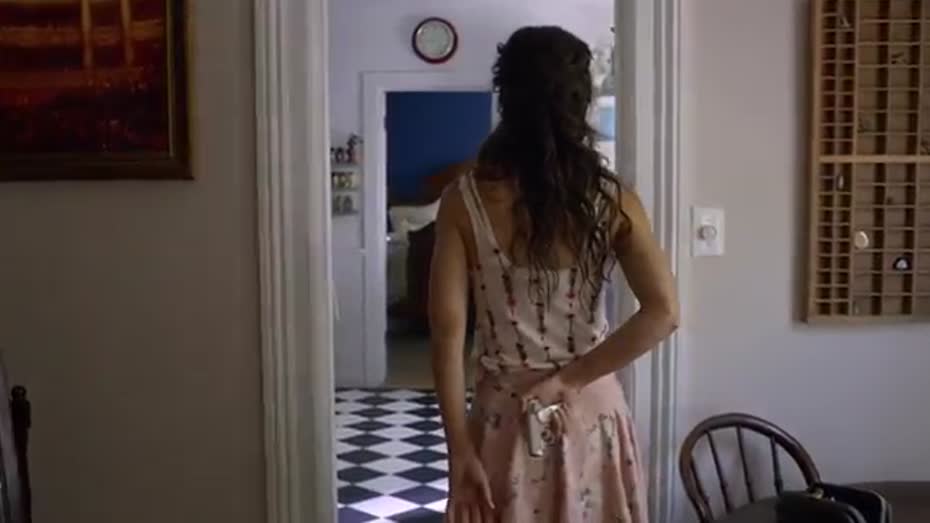
Miss Meadows (Holmes) is a sweet-natured, well-mannered substitute school teacher who hides a dark secret: she’s a vigilante, dedicated to “removing” anyone whose moral compass isn’t attuned as finely as her own. On her way home one day, she’s threatened by a gun-wielding kerb crawler who points a gun at her and tells her to get in his car. Miss Meadows promptly shoots him dead with her own gun… and carries on walking as if nothing has happened.

At the elementary school, Miss Meadows is put in charge of a class whose teacher has just died of cancer. One little girl, Heather (Kolker), has been seriously upset by this and Miss Meadows does her best to console her, and eventually earns her trust. In the meantime, she also meets the town Sheriff (Dale); there’s an immediate attraction but neither of them pursue it immediately. It’s left to the Sheriff to do the pursuing, and he takes Miss Meadows for a drive. As their romance blossoms, a school trip to a local park eventually sees Miss Meadows entering a fast food restaurant in order to get the school children some hot dogs. There she finds a young man has killed all the staff and customers and wants to kill himself. When she tells him he should, he attempts to kill Miss Meadows instead, but she proves quicker on the draw than he does, and she kills him.

Faced with a vigilante in his town, the Sheriff is suspicious that it might be Miss Meadows but he doesn’t have any evidence, other than that she’s lived in previous towns where a vigilante has been on the loose. Meanwhile, Miss Meadows learns that she’s pregnant with the Sheriff’s baby; she doesn’t tell him straight away but when she does he asks her to marry him, and she says yes. Around this time a convicted child molester called Skylar (Mulvey) moves into the neighbourhood. Miss Meadows tries to warn him off but he ignores her and starts hanging around the school. And Heather reveals that she saw Miss Meadows shoot the man in the fast food restaurant.

An incident with a priest leads to Miss Meadows killing him as well but this time she leaves behind a clue, and one that the Sheriff recognises. He confronts her, and out of love for her, tells Miss Meadows her vigilante days are over. But then on their wedding day, Skylar abducts Heather…

Miss Meadows - scene

A quirky mix of drama, comedy, romance and the kind of vigilante thrillers Charles Bronson made in the Seventies and Eighties, Miss Meadows gives Katie Holmes her best role since Batman Begins (2005). As the unfeasibly sweet and wholesome Miss Meadows (we never learn her first name), Holmes embraces the role and gives a tremendous performance, doing full justice to the duality of the character and the changes in tone such a character demands. It’s an assured, confident performance – the kind Holmes hasn’t given in a very long time – but it’s so good that Miss Meadows the movie sadly doesn’t match the  quality of Miss Meadows the character.

While Holmes is mesmerising throughout, her understanding of the role so complete she doesn’t put a foot wrong at any point, the rest of the movie stumbles along around her, the various strands and shifts in tone not quite gelling to create a balanced, effective whole. Matching Miss Meadows with the equally good-natured Sheriff (we don’t learn either of his names) lessens the chance of any real tension between the two when his suspicions are confirmed. Because the script avoids the Sheriff experiencing any personal dilemma at all, the confrontation between the two has no depth to it at all, and it’s almost perfunctory in its execution. Similarly, the scene where Miss Meadows confronts Skylar over tea in his home feels forced because of its mixture of genteel manners and unequivocal threat.

There are other scenes and moments that don’t quite work. The cause of Miss Meadows antipathy towards wrongdoers is due to a childhood trauma that is teased out as the movie progresses, but there are clues to be had in the character’s talks with her mother (Smart). And as those clues are revealed before the full tragedy of the traumatic incident is shown, the viewer is effectively given the same information twice, leaving the incident to play out with little dramatic resonance or emotional impact. It’s poor choices like this that undermine the movie’s persuasiveness, and leave the cast adrift within scenes that often bear no relation to the ones that have gone before, or follow on. The scenes in the Sheriff’s office are the best examples of this, taking place almost in isolation of the rest of the plot, and again feeling more perfunctory than essential to the story.

It’s not all bad, though. Holmes’ mannered, skilful performance anchors the movie, and is so rich it bolsters the movie during those short stretches when she’s not on screen. Dale and Mulvey are more than competent foils for Holmes’ ultra-proper, Fifties influenced femme fatale – the scene where Miss Meadows and the Sheriff make love for the first time is worth seeing all by itself just for her delighted reaction; it’s not just their first time – and the photography by Barry Markowitz is almost painterly in its depiction of small-town life. There’s also an amusing, wistful score courtesy of Jeff Cardoni that is appropriately idiosyncratic, and matches Miss Meadows’ prim nature perfectly. And even though her script doesn’t always meet the challenges it sets itself, Hopkins is on firmer ground in her choice of shots and the way in which she places the camera to achieve the desired comic or dramatic effect (this is a very good-looking, carefully composed movie).

Rating: 5/10 – without Holmes’ assured, ironic performance, Miss Meadows would swiftly become a chore to sit through, even though the premise is a shrewd one; uneven and unsure of which impression to make, the movie aims for a John Waters-style vibe but is ultimately too lightweight to succeed completely.

Share this:

  • Click to share on X (Opens in new window) X
  • Click to share on Facebook (Opens in new window) Facebook
  • More
  • Click to print (Opens in new window) Print
  • Click to email a link to a friend (Opens in new window) Email
Like Loading...

Mini-Review: Parkland (2013)

11 Tuesday Feb 2014

Posted by dullwood68 in Movies

≈ Leave a comment

Tags

Abraham Zapruder, Billy Bob Thornton, Dallas, Drama, Jacki Weaver, James Badge Dale, JFK, Lee Harvey Oswald, Parkland Hospital, Paul Giamatti, Peter Landesman, Review, True story, Zac Efron

Parkland

D: Peter Landesman / 93m

Cast: James Badge Dale, Zac Efron, Paul Giamatti, Jackie Earle Haley, Colin Hanks, David Harbour, Marcia Gay Harden, Ron Livingston, Jeremy Strong, Billy Bob Thornton, Jacki Weaver, Tom Welling

Covering events in Dallas, Texas from 22-25 November 1963, Parkland takes a behind-the-scenes look at the assassination of President John F. Kennedy, and the people who were involved both on the day and in the aftermath. From the opening showing Kennedy at Fort Worth before travelling to Dallas to the final scenes involving the burial of Lee Harvey Oswald (Strong), the movie paints an intimate portrait of the men and women who dealt with one of the most emotive events in American history, from the trainee doctors and nursing staff at Parkland hospital – where Kennedy and Oswald were both taken after they were shot – to the President’s Secret Service detail led by Forrest Sorrels (Thornton), to Oswald’s brother Robert (Dale) and mother Marguerite (a frightening Weaver), to the local FBI office who had Oswald there only a week before, and most effectively, to Abraham Zapruder (Giamatti), the man fated to film the death of a President.

Parkland - scene

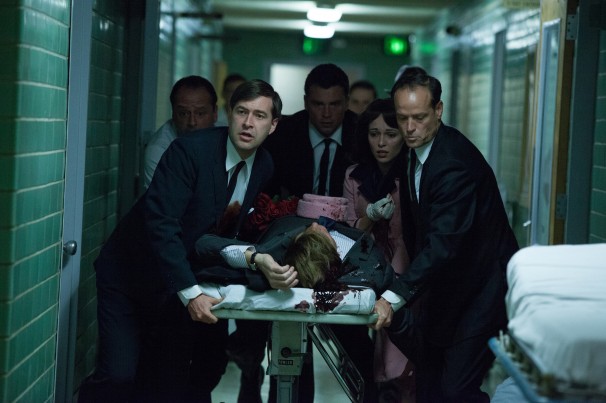
All these stories coalesce to make Parkland an engrossing, gripping drama where some of the smaller details have the greatest effect: the sheer number of people who gather in the emergency room where Kennedy is worked on; Robert Oswald asking a member of the press to be a pallbearer; Zapruder asking a lab technician for three copies of the film, one for the Secret Service, one for the FBI, and one for himself; and Jackie Kennedy clutching something in her hand that proves to be a piece of her husband’s skull. First-time director Landesman juggles the various story lines with an ease that belies his lack of experience, and the cast raise their game accordingly; Giamatti in particular is a standout. A fine addition to that sub-genre of American history movies, the JFK era, Parkland impresses with its level of detail and its clearcut approach to what is still a very contentious event.

Rating: 8/10 – studious and compelling in equal measure, Landesman’s debut draws you in and never lets go.

Share this:

  • Click to share on X (Opens in new window) X
  • Click to share on Facebook (Opens in new window) Facebook
  • More
  • Click to print (Opens in new window) Print
  • Click to email a link to a friend (Opens in new window) Email
Like Loading...

Blog Stats

  • 486,528 hits

Recent Posts

  • 10 Reasons to Remember Bibi Andersson (1935-2019)
  • Fantasia (1940)
  • Dances With Wolves (1990) – The Special Edition
  • Kiss of the Spider Woman (1985)
  • The Three Musketeers (1973)

Top Posts & Pages

  • Lost for Life (2013) - Another Look
    Lost for Life (2013) - Another Look
  • Lost for Life (2013)
    Lost for Life (2013)
  • About
    About
  • Mr. Topaze (1961)
    Mr. Topaze (1961)
  • Billy Lynn's Long Halftime Walk (2016)
    Billy Lynn's Long Halftime Walk (2016)
  • Winter's Tale (2014)
    Winter's Tale (2014)
  • The Hitman's Bodyguard (2017)
    The Hitman's Bodyguard (2017)
  • 5 Famous Movie Roles That Nearly Went to Someone Else
    5 Famous Movie Roles That Nearly Went to Someone Else
  • The Layover (2017)
    The Layover (2017)
  • Transcendence (2014)
    Transcendence (2014)
Follow thedullwoodexperiment on WordPress.com

Blogs I Follow

  • Rubbish Talk
  • Film 4 Fan
  • Fast Film Reviews
  • The Film Blog
  • All Things Movies UK
  • Interpreting the Stars
  • Let's Go To The Movies
  • Movie Reviews 101
  • TMI News
  • Dan the Man's Movie Reviews
  • Film History
  • Jordan and Eddie (The Movie Guys)

Archives

  • April 2019 (13)
  • March 2019 (28)
  • February 2019 (28)
  • January 2019 (32)
  • December 2018 (28)
  • November 2018 (30)
  • October 2018 (29)
  • September 2018 (29)
  • August 2018 (29)
  • July 2018 (30)
  • June 2018 (28)
  • May 2018 (24)
  • April 2018 (21)
  • March 2018 (31)
  • February 2018 (25)
  • January 2018 (30)
  • December 2017 (30)
  • November 2017 (27)
  • October 2017 (27)
  • September 2017 (26)
  • August 2017 (32)
  • July 2017 (32)
  • June 2017 (30)
  • May 2017 (29)
  • April 2017 (29)
  • March 2017 (30)
  • February 2017 (27)
  • January 2017 (32)
  • December 2016 (30)
  • November 2016 (28)
  • October 2016 (30)
  • September 2016 (27)
  • August 2016 (30)
  • July 2016 (30)
  • June 2016 (31)
  • May 2016 (34)
  • April 2016 (30)
  • March 2016 (30)
  • February 2016 (28)
  • January 2016 (35)
  • December 2015 (34)
  • November 2015 (31)
  • October 2015 (31)
  • September 2015 (34)
  • August 2015 (31)
  • July 2015 (33)
  • June 2015 (12)
  • May 2015 (31)
  • April 2015 (32)
  • March 2015 (30)
  • February 2015 (37)
  • January 2015 (39)
  • December 2014 (34)
  • November 2014 (34)
  • October 2014 (36)
  • September 2014 (25)
  • August 2014 (29)
  • July 2014 (29)
  • June 2014 (28)
  • May 2014 (23)
  • April 2014 (21)
  • March 2014 (42)
  • February 2014 (38)
  • January 2014 (29)
  • December 2013 (28)
  • November 2013 (34)
  • October 2013 (4)

Blog at WordPress.com.

Rubbish Talk

Film 4 Fan

A Movie Blog

Fast Film Reviews

The Film Blog

The official blog of everything in film

All Things Movies UK

Movie Reviews and Original Articles

Interpreting the Stars

Dave Examines Movies

Let's Go To The Movies

Film and Theatre Lover!

Movie Reviews 101

Daily Movie Reviews

TMI News

Latest weather, crime and breaking news

Dan the Man's Movie Reviews

All my aimless thoughts, ideas, and ramblings, all packed into one site!

Film History

Telling the story of film

Jordan and Eddie (The Movie Guys)

Movie Reviews & Ramblings from an Australian Based Film Fan

Privacy & Cookies: This site uses cookies. By continuing to use this website, you agree to their use.
To find out more, including how to control cookies, see here: Cookie Policy
  • Subscribe Subscribed
    • thedullwoodexperiment
    • Join 481 other subscribers
    • Already have a WordPress.com account? Log in now.
    • thedullwoodexperiment
    • Subscribe Subscribed
    • Sign up
    • Log in
    • Report this content
    • View site in Reader
    • Manage subscriptions
    • Collapse this bar
 

Loading Comments...
 

    %d