Cast: Jesse Plemons, Molly Shannon, Bradley Whitford, Maude Apatow, Madisen Beaty, John Early, Zach Woods, Paul Dooley, June Squibb
Twenty-nine year old David Mulcahey (Plemons) is an aspiring comedy writer living in New York who decides to return home to Sacramento when his mother, Joanne (Shannon), is diagnosed with leiomyosarcoma, a form of cancer involving malignant tumours. Adopting the role of her primary carer at home, David tries to support his mother while dealing with a variety of issues in his own life, from the disappointment of a pilot TV show he’s written not being optioned, to the break up of his relationship of five years with Paul (Woods), to the continuing homophobia displayed by his otherwise loving father, Norman (Whitford), and his own doubts as to whether or not he’ll be able to cope “when the time comes”. Over the course of a year, David sees at first hand the struggle his mother has to maintain a semblance of normal life, and the efforts she makes to remain a caring mother to David and his two sisters, Alexandra (Apatow) and Rebeccah (Beaty), while negotiating the trials of funeral planning, quitting chemotherapy, and preparing for the inevitable…
Loosely based on writer/director Kelly’s own experiences with his mother’s death from cancer, Other People is a sobering yet darkly humorous movie that treats the subject of cancer with unflinching honesty while also showing that it doesn’t have to mean that life can’t continue, especially for those who are ill. It also avoids the clichés that come with this particular territory in movies, showing the various stages that Joanne experiences as she comes to terms with her cancer, but in a way that isn’t patronising or condescending. Several times we see David and Joanne taking a walk in their local park, and each occasion acts as a barometer for Joanne’s current state of health, Kelly using this cinematic shorthand to avoid big speeches or teary confessions. It’s one of many ways that the script makes subtle declarations about Joanne’s health, and about cancer in general. As a result, when it is referred to directly, it’s something of a surprise, though a welcome one at that; there shouldn’t be any avoidance of the topic at hand. And no one is shown to be particuarly brave. Instead, Kelly has everyone finding it difficult to adjust to the idea of a loved one dying, something that rings true throughout, as well as David’s reticence to talk about his own problems, and everyone else’s dismay and confusion.
In amongst the main narrative thread of Joanne’s illness, issues concerning the rest of her family crop up quite often, from David’s inability to recognise that his sisters need his support as well, to the sad acceptance of Joanne’s parents (Dooley, Squibb) that they’re going to lose their only child. Kelly sidesteps any potential melodrama by keeping things simple, and by ensuring that any histrionics are kept to a minimum, saving it all for a scene in a supermarket where David can’t find the laxatives that are on a shelf right in front of him. Plemons, who gives the kind of break out performance he’s always been capable of, perfectly captures the despair, anger and panic that being on the verge of losing his mother is causing him. Kelly is also on firm ground when dealing with David’s homosexuality, planting the seeds for Norman’s discomfort in the family’s conservative religious background, but without being explicit about it. Much is left unacknowledged – verbally at least – but the script makes it clear how each character is feeling, and the family dynamic is well thought out and developed. And to cap it all off, Shannon is simply tremendous as Joanne: funny, angry, sad, but interestingly, never hopeful for herself, another thing that Kelly gets absolutely, completely right.
Rating: 8/10 – the subject matter may sound off-putting, but even though Other People pulls no punches, there’s a streak of black comedy that runs throughout the movie and helps the leaven the drama; Plemons and Shannon give career best performances, and Kelly (making his feature debut) shows the kind of promise that means his next project should receive plenty of deserving attention.
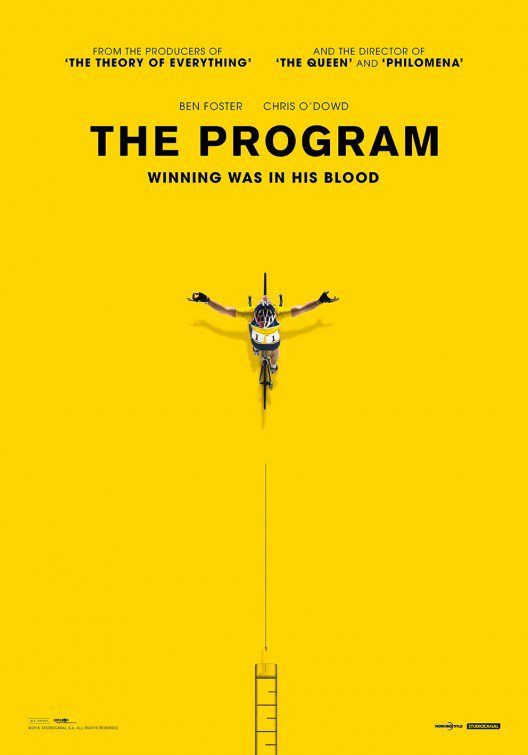
Cast: Ben Foster, Chris O’Dowd, Guillaume Canet, Jesse Plemons, Lee Pace, Denis Ménochet, Dustin Hoffman, Edward Hogg, Elaine Cassidy, Laura Donnelly, Peter Wight
In 1993, Irish sports journalist David Walsh (O’Dowd) met and interviewed Lance Armstrong (Foster) for the first time. Armstong was a newcomer to the Tour de France, and when asked by Walsh what he hoped to achieve, the young rider’s answer was, “to finish”. He did, but so far down the field that he made next to no impact on his rivals. Armstorng became aware that his stronger, faster adversaries were able to beat him because their blood was more richly oxygenated than his… and that there was a reason for this.
The reason was a banned substance called erythropoietin – EPO. It was administered by the advising doctor of the team winning all the Tour de France stages (and the tournament over all). Armstrong persuaded the team’s doctor, Michele Ferrari (Canet), to provide him with EPO as well. But before his “treatment” could make a distinct difference in his performance, Armstrong was diagnosed with stage three testicular cancer in October 1996. He underwent an intensive series of treatments that involved the removal of a diseased testicle, four cycles of chemotherapy, and surgery to remove several brain lesions. Amazingly, in February 1997, Armstrong was given the all clear. And he was determined to return to professional cycling.
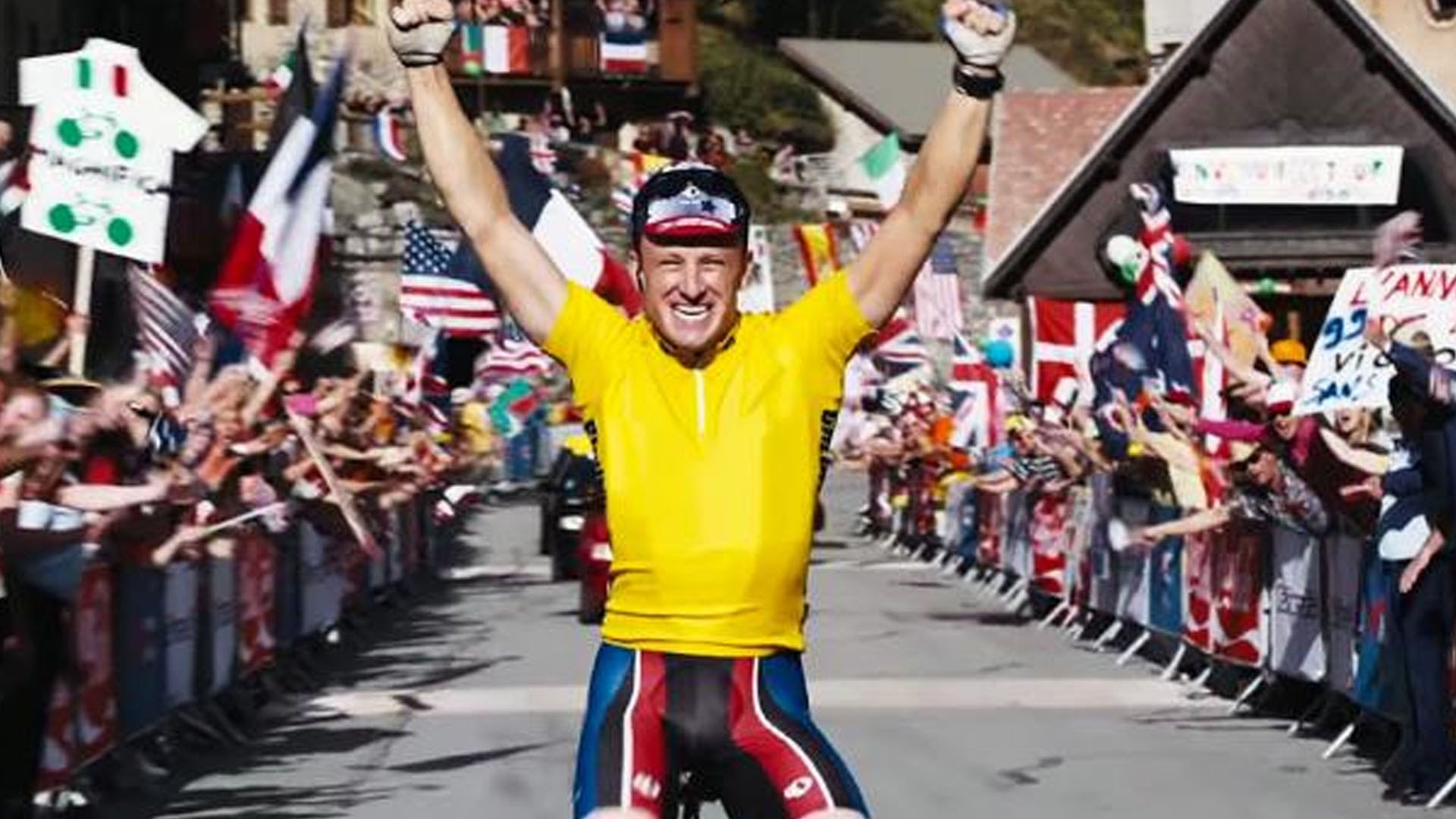
But he had no team to come back to. Eventually he hooked up with the American Team Postal, and soon he was winning races, and impressively so. And two years later, in 1999, he won the Tour de France for the first in what would be seven consecutive years. But while everyone celebrated Armstrong’s tenacious comeback and fierce will to win, it was journalist David Walsh who suspected that something wasn’t quite right. How, he asked, had a middling rider with unimpressive riding times, and after an albeit short battle with cancer, returned to cycling only fitter, faster, and stronger, and been able to win the Tour de France so easily (he won by seven minutes and thirty-seven seconds)? And why wasn’t anyone else asking the question? And, more importantly, why wasn’t anyone asking the question when Armstrong kept winning year after year?
There are many reasons, as it happens, but the main one was that Armstrong became so successful, so famous as the face of cycling, that no one within the industry was able (or willing) to challenge him, even the officials in charge of the Cycling Federation. So powerful was he that when he tested positive for corticosteroids he was able to get his personal team to supply backdated prescriptions for cortisone as a treatment for saddle sores, and so avoid any charges of drug taking. Throughout his career, Armstrong was able to bluff and bully and wriggle his way out of any accusations of drug taking, blood doping or any other form of cheating. He became famous for avoiding the question of whether he’d taken drugs by saying he’d “never tested positive for performance enhancing drugs”.
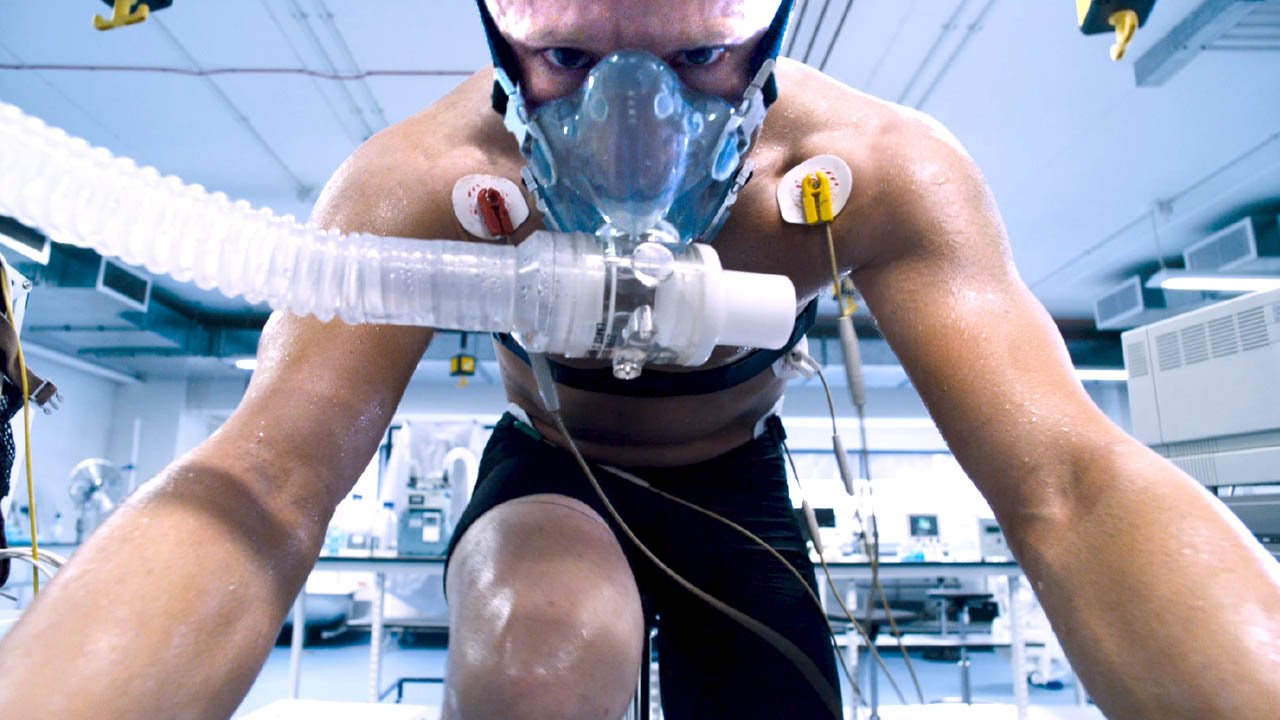
As Armstrong did take EPO on many occasions, so The Program shows him doing it over and over as well. In fact it shows Armstrong shooting up or drawing off his own blood on several more occasions than is absoutely necessary. We know it’s endemic to the sport because we’re told this almost right away, and it loses its dramatic effectiveness very quickly. It’s a problem the movie suffers from throughout, a lack of dramatic effectiveness, and this in turn leads to the movie becoming perfunctory, and in places quite dull. It also makes the mistake of focusing too much on Armstrong – an obvious mistake, but one the makers should have avoided.
The problem with Armstrong as your main character is that no matter how much you try and shade his character with visits to a children’s cancer ward, or have him ride out into the Texas desert to stare meaningfully at naturally occurring pools of water, he’s still the villain of the piece and the architect of his own downfall. And yes, sometimes that’s enough, but even David Walsh, in his book on which the movie is partly based, Seven Deadly Sins: My Pursuit of Lance Armstrong, couldn’t answer the one question that the average viewer is likely to be asking all the way through: just why did he do it? Because, without an answer, Armstrong just goes from ambitious cyclist to arrogant, self-serving bastard in the drop of a hat.
And once he’s there the script by John Hodge stops looking for answers and becomes a braodly faithful retelling of the facts as they transpired once Floyd Landis (Plemons) joined Team Postal and everything began to unravel. The complexities of Armstrong’s story are smoothed over and/or ignored, Walsh’s tenacity in the face of almost everyone in his profession treating him like a pariah is given short shrift, and the nature of cycling’s unspoken acceptance of the cheating going on under its nose – these are all passed over in favour of following Armstrong from one non-illuminating scene to another. Even Foster, normally a more than capable actor, can’t stop his performance from becoming tedious by the end; it’s almost as if even he’s recognised that he can’t make any more out of Lance’s character as written.
With the script continually taking a backward step when it should have been ploughing forward, and with no sense of outrage at what Armstrong did – and encouraged others to do – the movie lacks passion and feels remote from its subject matter. There are a number of people who played a large part in Walsh’s investigation into doping in cycling, and while they are represented, they’re also marginalised along with the very important knowledge they have about Armstrong’s activities. It was a very big thing when Armstrong admitted that he took performance enhancing drugs when asked by a doctor during his cancer treatment, but here it’s referenced and then ignored as if of little or no importance. And then there’s Armstrong’s appearance on The Oprah Winfrey Show, a move he thought would help him retain the public’s admiration for him, but which backfired on him spectacularly when Oprah wouldn’t accept that he was remorseful.
It’s when moments like these are not given their due place in proceedings that The Program stumbles and fails to achieve any relevance as a recounting of Armstrong’s career. He was a lot more manipulative and a lot less caring of others, even his closest confidantes, and he had no qualms about trying to ruin the lives of those he thought weren’t being “team players”. His antipathy towards Walsh, at least, is given some expression, particularly when his one of his colleagues stops him from travelling between Tour de France stages with them as they used to, a good example of how Lance got what Lance wanted. But otherwise, the movie manages only to keep Armstrong at a remove from others, and in consequence from the audience.
Unable to find a way around the sedate nature of the script, Frears is left with trying to coax good performances out of his cast, and make the cycling sequences exciting to watch. As mentioned above, Foster can only do so much, but he’s very good in the earlier, pre-cancer scenes, showing Armstrong’s determination and will to succeed to very good effect. O’Dowd has a limited number of scenes in which to make an impression, and two of those involve him answering a phone and acting surprised. As the doping Doctor Ferrari, Canet is the movie’s liveliest, most effusive character, but his appearance and his demeanour make him look like he’s stepped out of a Seventies porn movie. Pace struts and swaggers his way through as Armstrong’s lawyer, and Ménochet makes the most of playing Armstrong’s righ hand man on the team, Johan Bruyneel. Only Plemons makes any kind of an impact, as the morally confused farmboy who joins the team but finds himself cut adrift when he gets “caught” taking testosterone.
On a visual level the movie works better when it’s out of doors, and by and large it successfully recreates the buzz of the races, though it can be off-putting when you realise you’re watching archival footage instead of a re-enactment. Foster looks persuasive in these scenes (even if you’re pretty sure the other cyclists have been told to go slower), and there’s at least a sense that this isn’t “fun” but quite punishing in its own unique way. Inside however, and the movie seems cramped – sometimes stifled – as if Frears’ visual creativity had deserted him. But by the time you notice all this, you probably won’t care too much, what with all the other deficiencies on display.
Rating: 5/10 – a middling, disappointing examination of one man’s renunciation of professional ethics and personal morality, The Program rarely succeeds in raising any indignation at Armstrong’s attitude or behaviour; for a more fastidious, much more involving look at Armstrong’s fall from grace, you’d be far better off watching The Armstrong Lie (2013) than this pallid endeavour.




 thedullwoodexperiment