• 10 Reasons to Remember…
  • A Brief Word About…
  • About
  • For One Week Only
  • Happy Birthday
  • Monthly Roundup
  • Old-Time Crime
  • Other Posts
  • Poster of the Week
  • Question of the Week
  • Reviews
  • Trailers

thedullwoodexperiment

~ Viewing movies in a different light

thedullwoodexperiment

Tag Archives: Lakeith Stanfield

Come Sunday (2018)

14 Friday Dec 2018

Posted by dullwood68 in Movies

≈ Leave a comment

Tags

Carlton Pearson, Chiwetel Ejiofor, Condola Rashad, Drama, Heresy, Jason Segel, Joshua Marston, Lakeith Stanfield, Religion, Review, True story, Tulsa, Universal reconciliation
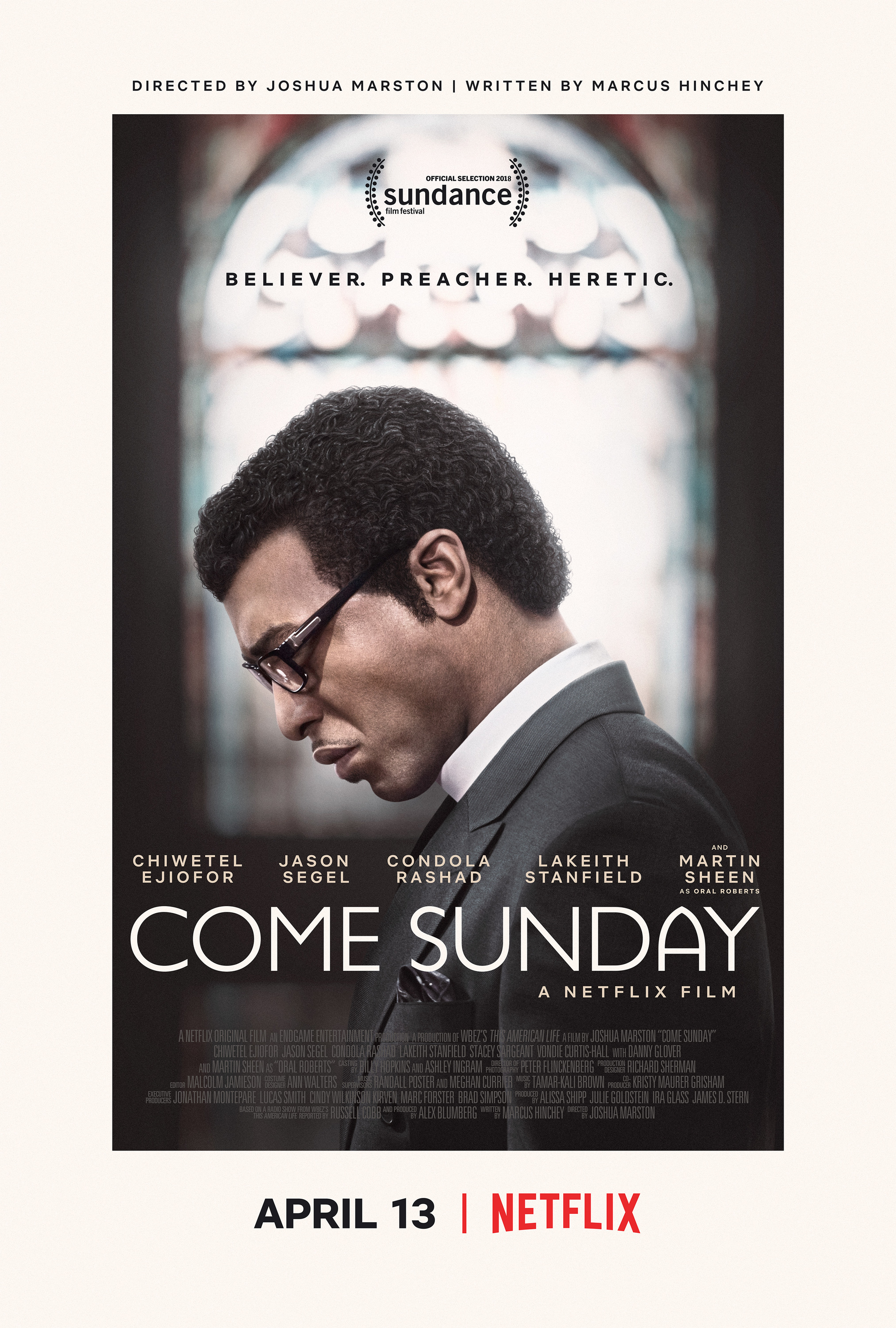
D: Joshua Marston / 105m

Cast: Chiwetel Ejiofor, Jason Segel, Condola Rashad, Lakeith Stanfield, Martin Sheen, Stacey Sargeant, Danny Glover, Vondie Curtis-Hall, Ric Reitz

1998, Tulsa, Oklahoma. Carlton Pearson (Ejiofor) is the pastor of the Higher Dimensions Family Church. His congregation is a mix of blacks and whites and his services are attracting around six thousand members each week. He is highly regarded in the community, and has the respect of his peers, and the people who work for him at the church. Things begin to change, though, after he watches a programme about the Rwandan genocide. Believing that he has received an epiphany from God, Carlton begins to refute the notion that non-Christians will automatically go to Hell, and asserts that Jesus Christ died to absolve all of humanity’s sins, not just those who are saved or given absolution. This goes against the received teaching of the church, and it proves too much for many in his congregation, who elect to leave and worship elsewhere. The loss of so many parishioners is further exacerbated by his being declared a heretic by the Joint College of African-American Pentecostal Bishops. Throughout it all, Carlton wrestles with his faith, but remains true to his belief that God has spoken to him, even when it seems that God has now deserted him…

When watching a movie that explores notions of faith and religious belief, it’s often tempting to ask the question, just how is that faith going to be portrayed? Are we going to be treated to a blood and thunder show of Biblical proportions, or a quieter, more considered affair? Come Sunday, the true story of Carlton Pearson and his belief in universal reconciliation, opts for the second approach, but there are certain moments where a bit of blood and thunder wouldn’t have gone amiss. Despite the inherent drama that overtakes Carlton’s life, and which sees him lose his ministry, there’s much about Marcus Hinchey’s otherwise well constructed screenplay that keeps the movie from being as dramatic as it should be. Too many confrontational scenes – between Carlton and his associate, Henry (Segel); between Carlton and his mentor, Oral Roberts (Sheen); between Carlton and the Bishops – lack the vitality and energy that would allow them to stand out from the connective scenes around them. It’s like going to a revivalist meeting, only to find that everyone in the choir has laryngitis and they’re singing in a whisper. Even the scenes between Carlton and his wife, Gina (Rashad), where we learn there are marital problems, have a restraint about them that makes them feel of little consequence in the overall scheme of things.

But where a quieter approach proves more effective is when Carlton begins to question if his new-found belief is right. When everyone except for Gina and his assistant, Nicky (Sargeant), desert him, Carlton’s faith is rocked, and he begins to feel that God has deserted him too. Thanks to a terrific performance from Ejiofor, Carlton’s growing anguish is revealed through the star seeming to shrink physically on screen, while relaying the character’s conflicting emotions through a range of searching looks and pained expressions. There’s subtlety and range to Ejiofor’s performance, and it’s a good thing too, as Marston relies on his star more and more as the movie progresses. The director’s cautious development of the material is another reason why the movie doesn’t soar as it should, and why its examination of true faith feels laboured whenever it’s debated. There are fine supporting turns from Segel and Stanfield (as Carlton’s AIDS-affected musical director), but Sheen is miscast as Roberts, and Rashad is stifled by a role that borders on caricature. In the end, it’s a pallid movie that lacks energy, and which spends much of its running time steering clear of being anywhere near as controversial as Pearson was.

Rating: 5/10 – with its neutered narrative and sub-par dramatics, Come Sunday treats Pearson’s struggle to be explain his epiphany and subsequent denunciation as a heretic as if it were a footnote in a much larger story; with an ending that’s even more low-key than what’s gone before, the message seems to be clear: God isn’t the sure-fire draw He used to be.

Share this:

  • Click to share on X (Opens in new window) X
  • Click to share on Facebook (Opens in new window) Facebook
  • More
  • Click to print (Opens in new window) Print
  • Click to email a link to a friend (Opens in new window) Email
Like Loading...

Sorry to Bother You (2018)

10 Wednesday Oct 2018

Posted by dullwood68 in Movies

≈ 2 Comments

Tags

Armie Hammer, Boots Riley, Comedy, Drama, Lakeith Stanfield, Power Caller, RegalView, Review, Satire, Telemarketing, Tessa Thompson, WorryFree

D: Boots Riley / 111m

Cast: Lakeith Stanfield, Tessa Thompson, Armie Hammer, Jermaine Fowler, Omari Hardwick, Steven Yeun, Terry Crews, Kate Berlant, Michael X. Sommers, Danny Glover, Robert Longstreet, Patton Oswalt, David Cross

For Cassius Green (Stanfield), life in an alternative-present Oakland is something of a struggle. When he lands a job at RegalView, a telemarketing company, things look like they might be about to improve. But despite his eagerness to succeed, he finds it hard to get anywhere with the sales leads he’s given. It’s not until a colleague, Langston (Glover), advises him to use his “white voice” that Cassius sees his fortunes improve. Soon he’s RegalView’s top salesman, but at the same time that the workforce are being prompted to strike for better pay and conditions by union organiser Squeeze (Yeun). Promoted to the position of Power Caller, Cassius opts for more money and prestige over helping his friends and colleagues, including his girlfriend, Detroit (Thompson). But entry to the upper echelons of RegalView reveal a side to the company that sits uncomfortably with Cassius’s political and social beliefs, beliefs that are challenged even further when he discovers a connection to WorryFree, an organisation that promotes a life of free food and lodging, plus no bills, but on condition that people accept a lifetime’s working contract…

For much of the its first hour, Sorry to Bother You is a sharply detailed, refreshingly adept satire that pokes fun at working-class aspirations and the various ways that the lower middle-class stops those aspirations from being successful. The sales floor at RegalView is used as a metaphor for those aspirations that remain stifled at every turn, while the management provide their workers with mixed messages and false assurances that success is only a few calls – or a positive attitude – away. Cassius’ eventual rise to the level of Power Caller serves as a further satirical swipe at the establishment’s exploitation and integration of talented individuals for its own nefarious purposes. It’s a little bit obvious, and borders on being a little trite in its execution, as are the problems it causes for Cassius with Detroit and his friends at work, but first-time writer/director Boots Riley gives the material a fresh enough reworking to offset any real concerns, and once the viewer has settled into the movie’s comfortable narrative groove, he introduces Cassius to WorryFree’s head honcho, Steve Lift (Hammer). And from there, the movie goes in a completely unexpected direction.

As the poster has it, this is “something you need to see to believe”. What Riley has up his sleeve will either grab you and keep you watching thanks to the sheer lunatic audacity of it all, or it will make you say to yourself, “nope, that’s it, I’m out of here”. But it does put an entirely different spin on things, and is a completely original take on the lengths that corporations will go to to maximise profits while exploiting their workforce. It’s a brave approach by Riley, but also one that makes Sorry to Bother You an unforgettable experience that really takes huge, confident strides forward in its second half, both in terms of the narrative, and in terms of the characters’ involvement. Cassius is torn between securing a good life for himself and the extent of the growing social responsibility he feels once he discovers what WorryFree is up to. Stanfield, whose potential as an actor has been obvious for a while now, grabs the role with both hands and gives a terrific performance that’s far more difficult than it seems because for most of the movie Cassius is more passive than aggressive. There’s terrific support too from Thompson as Detroit (whose choice of earrings is something to keep track of), and Hammer as Lift, the entrepreneur without a soul or a social conscience.

Rating: 8/10 – with an arresting visual style, and no shortage of humour, Sorry to Bother You is an audacious, bold, and confidently handled exposé of the perils of unchecked elitism and its association with new capitalism; it may get “weird” but by (mostly) playing it straight, the movie still makes a considerable impact, and is definitely not a movie that you’ll forget in a hurry – and that is very much a good thing.

Share this:

  • Click to share on X (Opens in new window) X
  • Click to share on Facebook (Opens in new window) Facebook
  • More
  • Click to print (Opens in new window) Print
  • Click to email a link to a friend (Opens in new window) Email
Like Loading...

Crown Heights (2017)

22 Wednesday Nov 2017

Posted by dullwood68 in Movies

≈ Leave a comment

Tags

Carl 'KC' King, Colin Warner, Drama, Lakeith Stanfield, Matt Ruskin, Miscarriage of justice, Murder, Natalie Paul, Nnamdi Asomugha, Review, True story

D: Matt Ruskin / 100m

Cast: Lakeith Stanfield, Nnamdi Asomugha, Natalie Paul, Amari Cheatom, Marsha Stephanie Blake, Bill Camp, Luke Forbes, Zach Grenier, Josh Pais, Ron Canada, Nestor Carbonell, Skylan Brooks, Sarah Goldberg, Adriane Lenox

Crown Heights ends with a sobering statistic: of the 2.4 million people currently in prison in the US, it’s estimated that 120,000 are likely to be innocent. The movie, winner of the Audience Award for US Dramatic Film at this year’s Sundance Film Festival, examines a case that, though it all began back in April 1980, could still be relevant today, both for its victim and his friends and family. Following the murder of sixteen year old Melvin Grant in a reported drive-by shooting, eighteen year old Colin Warner (Stanfield), is arrested and accused of being the driver when the murder was committed. Despite his protests, the police tell Colin that they have an eyewitness and they know he’s guilty. The case proceeds slowly but inexorably to trial, where the eyewitness, fourteen year old Clarence Lewis (Brooks), retracts his original testimony and clears Colin of any involvement. But it makes no difference. With Colin connected to his co-defendent (and actual shooter) Anthony Gibson (Forbes), he’s convicted and sentenced to fifteen years to life.

And so begins twenty-one years of incarceration thanks to a combination of mistaken identity, perjury and official misconduct. The police aren’t interested in whether or not Colin is innocent, the district attorney is in cahoots with the police, and it doesn’t matter that there’s no physical evidence or actual eyewitness testimony to place Colin at the scene of the crime – his fate has miscarriage of justice written all over it. Once in prison, Colin pins his hopes on various appeals but they’re all denied. On the outside, his friend Carl ‘KC’ King (Asomugha), tries his best to have Colin’s conviction overturned but encounters setback after setback. It’s not until Carl meets attorney William Robedee (Camp) that there’s a glimpse of light at the end of the tunnel. Robedee examines the case and determines that the only way for Colin to have a chance of being released is not to try and have his conviction overturned, but to reinvestigate the case and prove once and for all that Colin wasn’t involved in the murder of Melvin Grant.

How Robedee and Carl achieve this is forms the basis of the movie’s final half hour, but before then director and screenwriter Matt Ruskin confidently and credibly explores the way in which Colin was effectively framed by the police, first as Melvin’s killer, and then, when Gibson was arrested and admitted committing the murder, as his accomplice. The relentless nature of the police’s efforts to see Colin convicted is reflected in scenes where the lead detective (Grenier) goads and intimidates potential witnesses (whether they are or not) into identifying Colin as the killer. And in some of them the district attorney (Pais) hovers in the background, impassive and implacable. It’s a tragic situation, made all the worse by the implicit sense of impotency that soon settles on Colin as his fate slowly unfolds and the enormity of the injustice he’s facing becomes more and more apparent, and more and more soul-destroying. Once in prison, Colin struggles to find his place, briefly uniting with his Trinidadian brethren, and challenging the authority of the guards before settling into a more stoic existence.

Further injury is added to the insult he’s already experienced when his parole hearing focuses on his previous bad behaviour rather than the strides he’s made since then. Even a blossoming romance involving Antoinette (Paul), a young woman from his neighbourhood (the Crown Heights of the title), isn’t enough to completely dispel the despair Colin begins to feel more strongly as the years pass by. As the beleaguered Colin, Stanfield plays him throughout and is quietly impressive, drawing out a solid portrayal of a man betrayed and ignored by an unjust system, and sometimes justifiably angry at the way he’s treated. It’s not a showy, attention-seeking performance, but rather an attempt to reflect the ways in which Colin sought to keep himself from submitting to self-pity or just giving up altogether (though he comes perilously close to doing both at times). Ever since his debut in the original, short version of Short Term 12 (2008), Stanfield has become an actor to watch, and here he shows an empathy and an understanding for Colin’s situation that is both intuitive and well judged, impassioned and subtly observed as well.

The movie stays with Colin for most of the first hour, and charts the various setbacks he experiences, until it shifts the focus to Carl and his renewed efforts to see his friend restored to freedom. This section of the movie is just as much about one man’s determination to see justice done as it is about the price that justice demands. Carl nearly loses his wife, Briana (Blake), and his children in his efforts to free Colin, and the movie asks the question, is such a selfless and dogged pursuit ever worth the potential pitfalls or drawbacks? Sensibly it leaves the answer for the viewer to decide, but Carl’s commitment and the subsequent drawing together of the people who can prove Colin’s innocence is assembled with a methodical adherence to the rules of evidentiary procedure, and proves unexpectedly gripping. As the final pieces of the puzzle fall into place, the viewer should be asking themselves, why didn’t the police do this in the first place?

Questions such as these arise throughout the movie, but Ruskin is wise not to explore them too closely or for too long. He even avoids highlighting the obvious issue of the institutionalised racism prevalent in the police force at the time, and leaves it unsaid, more of a given than something that needs explaining. Similarly the pressures of being in prison are given expression through Colin’s attempts to fit in, and Ruskin allows these moments to play out matter-of-factly and with few overly dramatic embellishments. The movie remains steadfast in its approach from start to finish, with Ruskin displaying a command of the material that makes it all the more effective, and all the more emotive when it needs to be. Aside from a handful of sequences where Colin imagines he’s free – sequences that have a hallucinatory, visually powerful feel to them – the movie has a dour, unsettling visual style to it that reflects Colin’s mindset and situation, and which is used with an admirable sense of restraint. Ruskin has put together a modest, yet haunting movie that tells its tale simply but with a depth that’s borne out of the writing and the performances, both of which complement and dovetail around each other with a modest skill that is the hallmark of the movie as a whole.

Rating: 8/10 – a low-key gem that sneaks up on the viewer and gradually reveals just how good it really is, this could have been yet another angry tirade against an uncaring and unfair system, but Crown Heights is more than that, and it deserves a much wider exposure than it’s likely to receive; with Stanfield and Asomugha heading up a splendid cast, and Ruskin able to subvert or overcome so many of the clichés that are inherent in this type of movie, this is sincere, moving, and if those statistics are to be believed, entirely relevant as a commentary on the current US criminal justice system.

Share this:

  • Click to share on X (Opens in new window) X
  • Click to share on Facebook (Opens in new window) Facebook
  • More
  • Click to print (Opens in new window) Print
  • Click to email a link to a friend (Opens in new window) Email
Like Loading...

The Incredible Jessica James (2017)

02 Monday Oct 2017

Posted by dullwood68 in Movies

≈ Leave a comment

Tags

Chris O'Dowd, Comedy, Drama, Jessica Williams, Jim Strouse, Lakeith Stanfield, Love, Noël Wells, Relationships, Review, Romance, Romantic comedy

D: Jim Strouse / 84m

Cast: Jessica Williams, Chris O’Dowd, Lakeith Stanfield, Noël Wells, Taliyah Whitaker

Despite having their name plastered all over the advertising, potential viewers of The Incredible Jessica James can rest easy – this is not a Netflix original. Instead it’s a movie that Netflix picked up for distribution after it debuted at this year’s Sundance Film Festival. With that near miss taken care of, it’s unsurprising to learn that the latest from the writer/director of People Places Things (2015) is on a par with that movie, and head and shoulders above many other so-called romantic comedies released this year. Shot through with Strouse’s gift for natural-sounding dialogue, the movie brings together two characters who are trying hard to deal with the fallout from relationships that have recently ended. How good are they at doing this? Does the phrase “cyber stalking” give you a clue?

The title character, Jessica James (Williams), has split up from her boyfriend, Damon (Stanfield). She’s not sure how it happened, but she is sure she still has feelings for him. Well, confused feelings, as she arranges dates with guys on Tinder and meets them in places where she knows she’s likely to bump into Damon, just so she can tell him how well she’s doing without him (she also continues to follow him on social media). Three and a half months have passed since their relationship ended, and while it seems Damon has moved on, Jessica is so critical of anyone else she meets that she might as well not bother. Then her friend, Tasha (Wells), suggests Jessica go on a blind date with someone she knows called Boone (O’Dowd). Boone is eight months divorced, and is prone to following his ex’s Instagram account, as well as hanging around outside the apartment she shares with her new partner. Their date doesn’t go too well at first, but once they agree to talk honestly about their previous relationships, the pair find themselves hitting it off. So well, in fact, that they end up spending the night together.

The rest is almost entirely predictable, and follows such a standard arc that the average viewer could probably describe it in their sleep. But in amongst the familiar tropes and romantic ups and downs, Strouse weaves a charming tale of burgeoning love that is anything but formulaic, and which owes a lot of its success to Strouse’s gifts as a writer, and the easy way in which he translates his screenplay into well structured yet seemingly carefree incidents. We follow Jessica as she navigates this new friendship with Boone, as well as teaching at a children’s theatre workshop, and trying to get her work as a playwright recognised by a theatre company. She’s smart, she’s intelligent, she’s sexy, she’s trying hard not to be a slave to her emotions, and she’s taking it all one step at a time. Two things stop her from moving forward with confidence or the appropriate speed: her mixed feelings for Damon, and Boone’s mixed feelings for his ex, Mandy Moore (not the singer/actress).

Boone is plagued by similar doubts, but of the two of them he seems to be the more prepared to commit to Jessica and forge a new relationship. Inevitably there’s a stumbling block, a situation that pulls them apart before they’re reunited at the end, but it’s all done with an honesty and a simplicity that is in many ways, quite refreshing to witness. Strouse uses dialogue as a way of exploring the characters’ emotional needs, and to draw out small but effective contributions to the way in which both of them deal with disappointment and pain, and being hurt. They’re both vulnerable people, determined to be honest with each other as a relationship “best policy” and to protect themselves, and Strouse is on fine form when it’s just the two of them, happily tiptoe-ing through the minefield of a new romance and largely unafraid of losing a metaphorical limb.

Strouse is helped immensely by relaxed, detailed performances by Williams and O’Dowd, a romantic “odd couple” you probably wouldn’t have put together in a million years. And yet, there’s a definite chemistry there (if not a completely convincing physical one; when they kiss it’s like watching two people trying it out for the first time and getting the basic idea from a manual). Williams has a very likeable screen presence, and she uses her expressive features and comic timing to very good effect. Those viewers who only know her from US TV’s The Daily Show (where she’s played roles as varied as Abraham Lincoln and Lorena Bobbitt), may well be surprised by the way in which she handles the more serious elements of Strouse’s script, but when she is called upon to jettison the comedy and hit up the drama, you can see just what an all-rounder she really is. She’s in good company with O’Dowd, who, no matter what movie he appears in, is pretty much the definition of relaxed and easy-going. He’s proven his range on many occasions, and though Boone is something of a supporting character, O’Dowd plays him as if he’s integral to the whole movie, and makes him both inherently credible and hugely sympathetic; you want Boone to find happiness with Jessica (and vice versa).

Strouse, who’s work as a writer/director seems to get better and better with every movie, handles a number of subplots with aplomb as well, gaining extra mileage from the situations his romantic duo find themselves in when they’re not together. Jessica tries to persuade the mother of one of her pupils of the importance of the class itself, while Boone is confronted by his ex-wife’s new partner and only barely survives the encounter without sounding like a complete ass. Strouse isn’t afraid as well to make Jessica initially unsympathetic, with her treatment of potential suitors brought into question by her abrupt manners and rude dissemination of why she doesn’t want to be there. But as she begins to find love with Boone, Jessica mellows and allows herself to trust a lot more, and the character blossoms as a result. Again, it’s all held together by the quality of Strouse’s writing, and the quality of Williams’ and O’Dowd’s portrayals, and in the end, the movie ends up being a more than pleasant way of spending eighty-four minutes, and one that makes you wonder just what kind of a life the pair will have long after the credits roll.

Rating: 8/10 – somewhat of a surprise (though it shouldn’t be given Strouse’s involvement), The Incredible Jessica James is a sure-fire winner that doesn’t have a lot to shout about on the surface (in terms of originality), but which is deceptively graceful below it; a low-key experience that rewards dramatically and comedically, this is a movie that works to its strengths throughout, and in doing so, stakes a claim to being one of the most intelligent and pleasurable romantic comedies of the year.

Share this:

  • Click to share on X (Opens in new window) X
  • Click to share on Facebook (Opens in new window) Facebook
  • More
  • Click to print (Opens in new window) Print
  • Click to email a link to a friend (Opens in new window) Email
Like Loading...

Blog Stats

  • 486,528 hits

Recent Posts

  • 10 Reasons to Remember Bibi Andersson (1935-2019)
  • Fantasia (1940)
  • Dances With Wolves (1990) – The Special Edition
  • Kiss of the Spider Woman (1985)
  • The Three Musketeers (1973)

Top Posts & Pages

  • Lost for Life (2013) - Another Look
    Lost for Life (2013) - Another Look
  • Lost for Life (2013)
    Lost for Life (2013)
  • About
    About
  • Mr. Topaze (1961)
    Mr. Topaze (1961)
  • Billy Lynn's Long Halftime Walk (2016)
    Billy Lynn's Long Halftime Walk (2016)
  • Winter's Tale (2014)
    Winter's Tale (2014)
  • The Hitman's Bodyguard (2017)
    The Hitman's Bodyguard (2017)
  • 5 Famous Movie Roles That Nearly Went to Someone Else
    5 Famous Movie Roles That Nearly Went to Someone Else
  • The Layover (2017)
    The Layover (2017)
  • Transcendence (2014)
    Transcendence (2014)
Follow thedullwoodexperiment on WordPress.com

Blogs I Follow

  • Rubbish Talk
  • Film 4 Fan
  • Fast Film Reviews
  • The Film Blog
  • All Things Movies UK
  • Interpreting the Stars
  • Let's Go To The Movies
  • Movie Reviews 101
  • TMI News
  • Dan the Man's Movie Reviews
  • Film History
  • Jordan and Eddie (The Movie Guys)

Archives

  • April 2019 (13)
  • March 2019 (28)
  • February 2019 (28)
  • January 2019 (32)
  • December 2018 (28)
  • November 2018 (30)
  • October 2018 (29)
  • September 2018 (29)
  • August 2018 (29)
  • July 2018 (30)
  • June 2018 (28)
  • May 2018 (24)
  • April 2018 (21)
  • March 2018 (31)
  • February 2018 (25)
  • January 2018 (30)
  • December 2017 (30)
  • November 2017 (27)
  • October 2017 (27)
  • September 2017 (26)
  • August 2017 (32)
  • July 2017 (32)
  • June 2017 (30)
  • May 2017 (29)
  • April 2017 (29)
  • March 2017 (30)
  • February 2017 (27)
  • January 2017 (32)
  • December 2016 (30)
  • November 2016 (28)
  • October 2016 (30)
  • September 2016 (27)
  • August 2016 (30)
  • July 2016 (30)
  • June 2016 (31)
  • May 2016 (34)
  • April 2016 (30)
  • March 2016 (30)
  • February 2016 (28)
  • January 2016 (35)
  • December 2015 (34)
  • November 2015 (31)
  • October 2015 (31)
  • September 2015 (34)
  • August 2015 (31)
  • July 2015 (33)
  • June 2015 (12)
  • May 2015 (31)
  • April 2015 (32)
  • March 2015 (30)
  • February 2015 (37)
  • January 2015 (39)
  • December 2014 (34)
  • November 2014 (34)
  • October 2014 (36)
  • September 2014 (25)
  • August 2014 (29)
  • July 2014 (29)
  • June 2014 (28)
  • May 2014 (23)
  • April 2014 (21)
  • March 2014 (42)
  • February 2014 (38)
  • January 2014 (29)
  • December 2013 (28)
  • November 2013 (34)
  • October 2013 (4)

Blog at WordPress.com.

Rubbish Talk

Film 4 Fan

A Movie Blog

Fast Film Reviews

The Film Blog

The official blog of everything in film

All Things Movies UK

Movie Reviews and Original Articles

Interpreting the Stars

Dave Examines Movies

Let's Go To The Movies

Film and Theatre Lover!

Movie Reviews 101

Daily Movie Reviews

TMI News

Latest weather, crime and breaking news

Dan the Man's Movie Reviews

All my aimless thoughts, ideas, and ramblings, all packed into one site!

Film History

Telling the story of film

Jordan and Eddie (The Movie Guys)

Movie Reviews & Ramblings from an Australian Based Film Fan

Privacy & Cookies: This site uses cookies. By continuing to use this website, you agree to their use.
To find out more, including how to control cookies, see here: Cookie Policy
  • Subscribe Subscribed
    • thedullwoodexperiment
    • Join 481 other subscribers
    • Already have a WordPress.com account? Log in now.
    • thedullwoodexperiment
    • Subscribe Subscribed
    • Sign up
    • Log in
    • Report this content
    • View site in Reader
    • Manage subscriptions
    • Collapse this bar
 

Loading Comments...
 

    %d