If you type in the words “meh meaning” into Google, it’ll give you 762,000 results in 0.59 seconds. The first result will include the following definitions:
exclamation 1. expressing a lack of interest or enthusiasm. “meh, I’m not impressed so far” adjective 1. uninspiring; unexceptional. “a lot of his movies are … meh”
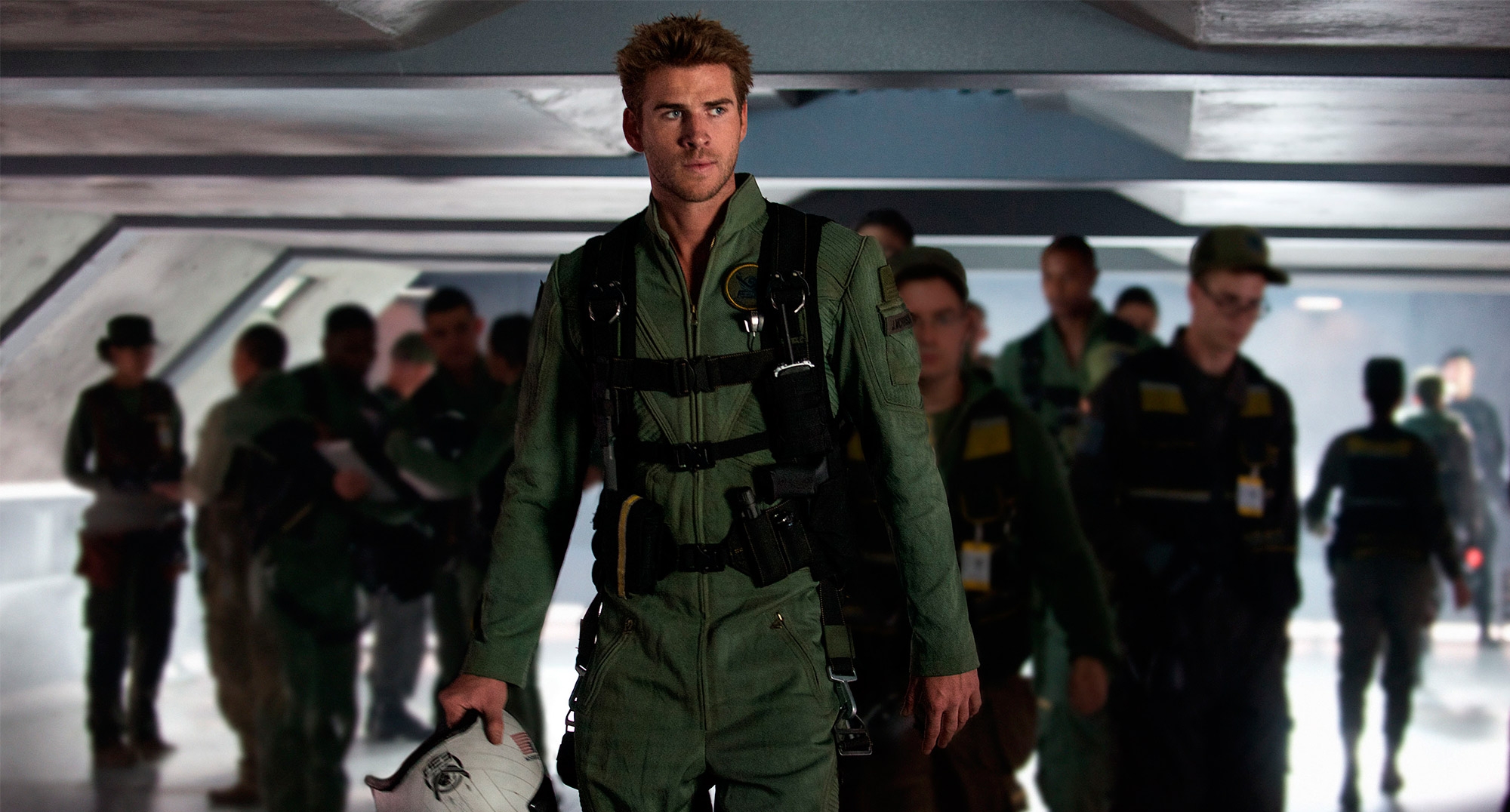
It’s appropriate (and a little unsurprising) that one of the examples mentions movies. Recently, I’ve watched a few movies that have prompted that very response: meh. The movies in question have been Mechanic: Resurrection, Bastille Day, and Neighbors 2: Sorority Rising (all 2016). These are all very bad movies, movies so bad that they carry their own aura of awfulness about them. They are to moviemaking what Donald Trump is to race relations, or Liam Hemsworth is to Method acting (yes, that bad). And they, along with many other movies reviewed here this year, all have one thing in common: their makers (apparently) didn’t seem to care that they were so bad. How else can you explain the dire nature of all three movies? And not just those movies, but the myriad others that have been released this year? Movies such as Grimsby, Independence Day: Resurgence, and Misconduct? All featuring big names in their casts, all made by well-regarded moviemakers, and all with the potential to surprise, reward and entertain us.
But they all fell short of that ambition, and horribly so. And it’s these movies that the multiplexes offer us year after year, week after week, and no matter how many times we’re disappointed and made to feel that we’ve wasted our money on tickets, we still go back, year after year, and week after week. And nothing changes.
Well, thedullwoodexperiment, in its own small way, is calling time on the credibility-free blockbuster; the unnecessary, lacklustre sequel; the poorly executed original concept movie; and any movie that attempts to fool people into believing that it’s better than it is just because it has a couple of big names heading up the cast list (and especially if their roles only amount to cameos). These movies will no longer get the exposure that a main review would give them – they already get enough of that from other blogs and websites, critics, and a wide variety of journalistic outlets. As of today, these movies’ presence on this site will be reduced to the standard mentions given to movies in the Monthly Roundups.
Instead, thedullwoodexperiment will focus on bringing more thoughtful and thought-provoking movies to a wider audience, and from a wide variety of genres and sources. Some may be dramas, some may be comedies, some may be documentaries or defy easy categorisation – some will definitely be foreign language movies. But all of them will be chosen with the intention of bringing something a little different to the table, and giving exposure to movies that might not otherwise get as much of a look-in as they deserve. I’m pretty sure that I’ll get it wrong from time to time, and some of these more thoughtful and thought-provoking movies will turn out to be anything but. But they will have been chosen because they don’t follow the standard formulas and predictable plotting of more mainstream features. Until Hollywood and the large independent production companies and distributors, e.g. Warner Bros. and Lionsgate, realise that they need to up their game considerably, then this site will boycott them as much as possible until they do.
Who cares? you might ask. Well, increasingly, I do. And as the song has it (kind of), “It’s my party, and I’ll review what I want to”. Now, let’s see where that takes us…
Oh dear, oh dear, oh dear. Lionsgate have announced that they’re thinking of releasing the last movie in the Divergent series, Ascendant, on the small screen instead of in cinemas. And with new characters that will allow the company to develop a spin-off TV series.
Now, if you’re a fan of the Divergent series – and if box office returns for Allegiant are any indication, there are fewer of you than when Insurgent was released – this might feel as though Lionsgate have betrayed their initial promise to bring Veronica Roth’s YA novels to the big screen. But while Allegiant was very disappointing due to its downplaying of Tris’s role and revelation that the Big Bad behind everything was a bean counter, you could argue that Lionsgate did themselves no favours by splitting the last novel into two movies.
Which makes their decision to move forward with a TV movie and spin-off series all the more confusing. If audiences are dwindling so badly, and interest in the movie series is waning, on what creative or financial level is it a good idea to develop a TV show from the same material? Lionsgate have been greedy before, and it’s worked, with two-part releases for Twilight: Breaking Dawn and The Hunger Games: Mockingjay being very successful indeed. But clearly their strategy has backfired on them this time. So with this in mind, this week’s question is:
Should companies adapting book trilogies for the big screen adopt a movie-by-movie approach to making them, or should they take the approach used on the Lord of the Rings and Hobbit movies and make them all at once?
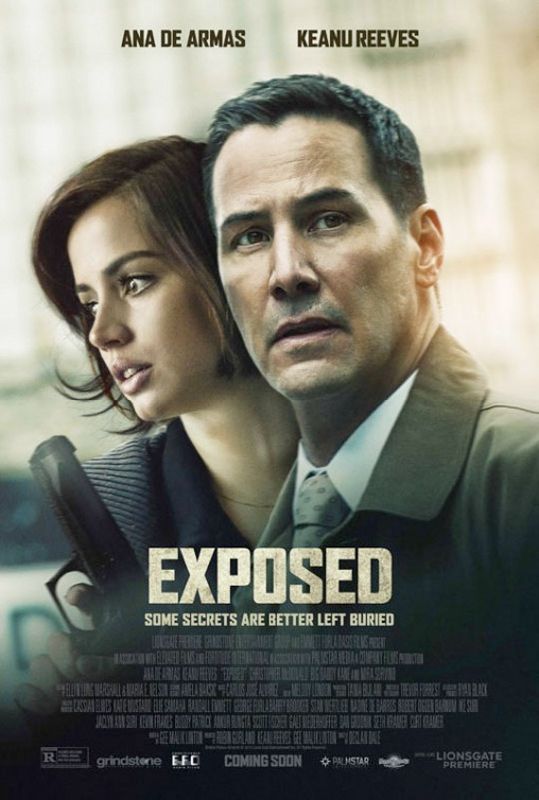
Cast: Ana de Armas, Keanu Reeves, Christopher McDonald, Mira Sorvino, Big Daddy Kane, Venus Ariel, Gabriel Vargas, Melissa Linton, Michael Rispoli
Hands up anyone who’s heard of Declan Dale. Maybe you’ve seen his last movie. Well, actually, you couldn’t have because Declan Dale doesn’t exist, he’s the pseudonym of writer/director Gee Malik Linton, Exposed‘s director when it was called Daughter of God, and when it didn’t try to be two movies at the same time. Thanks to the intervention of distributor Lionsgate – who thought they were getting a gritty police drama starring Keanu Reeves – Linton’s stark, character-driven bi-lingual drama focusing on child abuse and violence towards women was emasculated, and the movie became a sluggish crime thriller instead (just watch the trailer below to see how determined Lionsgate were to make Exposed seem like an exciting, must-see thriller).
The result is astonishingly bad. In its current form, Exposed has the potential of being one of the year’s worst movies, a terrible disaster brought about, not by one of the production companies involved, but by a distributor who thought it knew better. In downplaying Isabel’s story in favour of Galban’s glum search for his partner’s killer, the less than competent folks at Lionsgate have made a potentially absorbing, surrealist drama into a muddled snoozefest that clumps along like an amputee getting used to a badly fitting prosthesis. Again, the result is astonishingly bad – really, seriously, completely, astonishingly, bad.
It’s hard to believe, but the movie’s editor, Melody London, has a great track record. She’s worked with Jim Jarmusch on movies such as Down by Law (1986) and Mystery Train (1989), and contributed greatly to the success of documentaries such as Going Upriver: The Long War of John Kerry (2004) and Apache 8 (2011). With that in mind, it’s hard to understand just how wretchedly Exposed has been stitched together, and just how deluded the “good” folks at Lionsgate were when they came to giving London their feedback on how to “improve” the movie’s chances at the box office. Because ultimately that was Lionsgate’s fear: that Linton’s original version, Daughter of God, would fail to make a dent at the box office. They were actively saying to Linton, this movie will sink without trace unless we intervene.
Well, hubris is a wonderful thing – except when it’s unfounded. Exposed has been released in eight countries at time of writing, and while exact figures aren’t available, the movie appears to have made only $205,703 worldwide (it made just $122 in the UK, while US returns haven’t even been revealed). If anyone at Lionsgate is still trying to say they did the right thing, then any production companies planning to let them distribute their latest feature, should turn around and run as far away as possible in the opposite direction.
So just how bad is Exposed? It’s astonishingly bad (but we’ve established that). Why is it so bad? Here are just three examples (there could have been more but this review has to end at some point): Detective Galban (Reeves) is allowed to investigate the death of his partner, Cullen, even though he’s still grieving over the loss of his wife; when it becomes clear that his partner was corrupt, Galban is warned off the investigation by his boss, Lieutenant Galway (McDonald), in order to avoid Cullen’s wife, Janine (Sorvino), losing out on his pension rights; and when Janine is informed that her husband’s death isn’t going to be investigated, she’s incensed – until the next scene where she attempts to seduce Galban while also admitting that Cullen was as crooked as everyone said.
What investigation there is – Janine insists her husband’s murderer is caught – depends on photos found on a camera at the murder scene. In them, there are several Latinos, including Manuel de La Cruz (Vargas) and his sister-in-law, Isabel (de Armas). Manuel seems to be focus of Cullen’s surveillance, and when the other people in the pictures start turning up dead, the main suspect in their deaths, and Cullen’s, is local crime boss Jonathan “Black” Jones (Kane). He denies any involvement but Galban is convinced he’s guilty. All Galban really knows for sure is that the girl in the photos is probably the key to everything. But Galban is such a terrible detective that he can’t even track her down, even though it should be easy.
Meanwhile, Isabel has problems of her own. On the night that Cullen was killed (and on the same subway platform) she has a vision: an albino man who walks on air above the tracks. With her husband away in Iraq, and living with her devout in-laws, Isabel’s faith is challenged when she begins seeing another strange being. She comes to believe that God has a plan for her, and that these beings she’s seeing are angels. But when her husband is killed and she later discovers that she’s pregnant, her in-laws disown her, despite her saying it’s a miracle (her husband was in Iraq for over a year). Ostracised, she turns her attention to a little girl, Elisa (Ariel), who appears to be suffering abuse at the hands of her father. This leads to a tragedy that reveals the reason for her pregnancy, and explains much of what happened the night that Cullen died.
In essence, there are two very different stories here, and they clash with each other at every turn. Galban’s investigation goes nowhere, partly because he’s apparently useless at his job (at one point he whinges that “nobody’s talking”), and partly because the revised storyline doesn’t know what to do with him. Reeves is a producer on the movie; one would have thought he would have more input into how the character is presented, but it’s soon obvious he either didn’t have as much clout as you’d expect, or he realised early on that, once Lionsgate got their hands on the movie, it was all over bar the crying. Either way, Reeves gives one of the most lethargic, barely involved performances of his career. For everyone who thought he’d turned his career slump around with John Wick (2014), think again. This and Knock Knock (2015) are clear indicators that John Wick was an unexpected blip on the radar.
de Armas has the better, more developed role, and she’s very effective in an emotionally confused, gamine kind of way, but as Isabel’s story takes her to some very dark places indeed, the actress’s performance is undervalued by the arbitrary twists and turns of Lionsgate’s re-edit. There are moments when the power of Linton’s original cut is able to shine through, notably in the sequences with the angels, and later as we realise just how fragile Isabel’s grip on reality really is. But there are long stretches where her story sits there like a stalled car, and as with Galban’s story, this version of her story doesn’t always know how to move forward without looking and feeling clumsy (and which it never comes close to overcoming).
At least there is some closure to Isabel’s story, even if it is rushed and overly melodramatic. Other characters come and go without the viewer even realising, and there’s a confrontation between Manuel and “Black” Jones that comes out of nowhere and then returns there as soon as it’s done. But by the time this encounter pops up the average viewer will be checking their watch and wondering just how longer this farrago has got to go. There are just so many wretchedly glum and dispiriting scenes that have come before, suspended moments that lack resonance or emotion, for anyone to really care how it all turns out. And when it finally does, the only reaction left to the viewer who’s got that far is relief.
Rating: 3/10 – a spectacular misfire of a movie, Exposed is so bad that William Goldman’s classic quote, “In Hollywood, nobody knows anything”, should have the qualifier, “especially Lionsgate” added to it; let’s hope that Linton’s original cut eventually sees the light of day, and this dull, leaden, dreary mess can be consigned to the cinematic landfill where it belongs.




 thedullwoodexperiment