• 10 Reasons to Remember…
  • A Brief Word About…
  • About
  • For One Week Only
  • Happy Birthday
  • Monthly Roundup
  • Old-Time Crime
  • Other Posts
  • Poster of the Week
  • Question of the Week
  • Reviews
  • Trailers

thedullwoodexperiment

~ Viewing movies in a different light

thedullwoodexperiment

Tag Archives: Magic

Doctor Strange (2016)

25 Tuesday Oct 2016

Posted by dullwood68 in Movies

≈ 3 Comments

Tags

Action, Astral plane, Baron Mordo, Benedict Cumberbatch, Chiwetel Ejiofor, Cloak of Levitation, Drama, Fantasy, Mads Mikkelsen, Magic, Marvel, Marvel Cinematic Universe, Rachel McAdams, Review, Scott Derrickson, Sorcerer Supreme, The Ancient One, Tilda Swinton
doctor-strange-2016-poster-impossibilities

D: Scott Derrickson / 115m

Cast: Benedict Cumberbatch, Chiwetel Ejiofor, Rachel McAdams, Tilda Swinton, Mads Mikkelsen, Benedict Wong, Michael Stuhlbarg, Benjamin Bratt, Scott Adkins

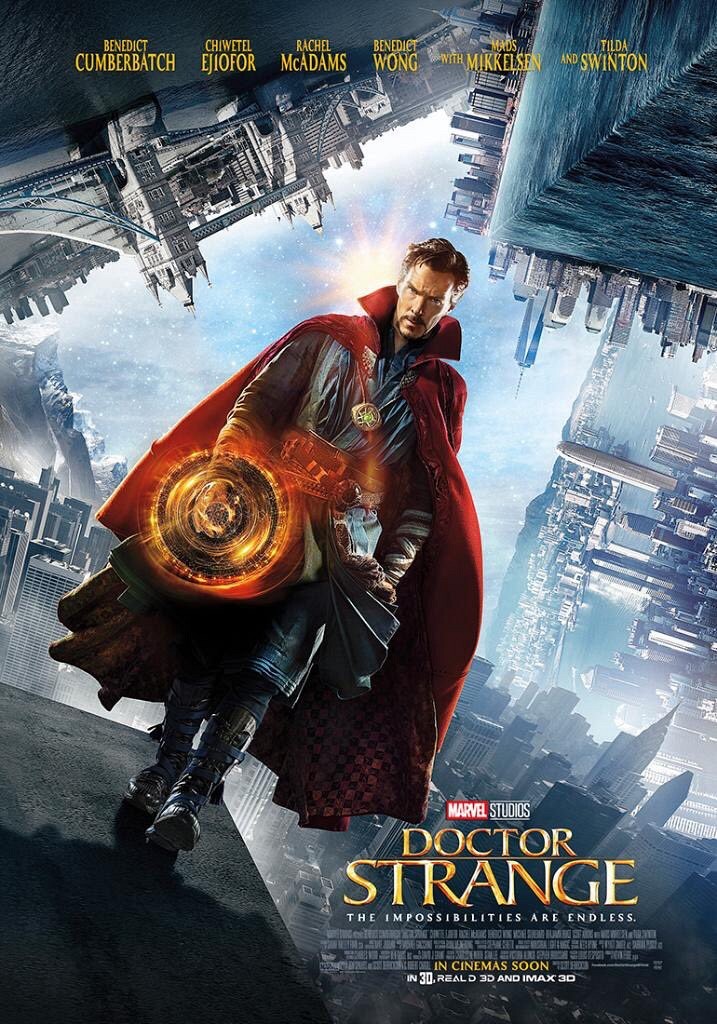
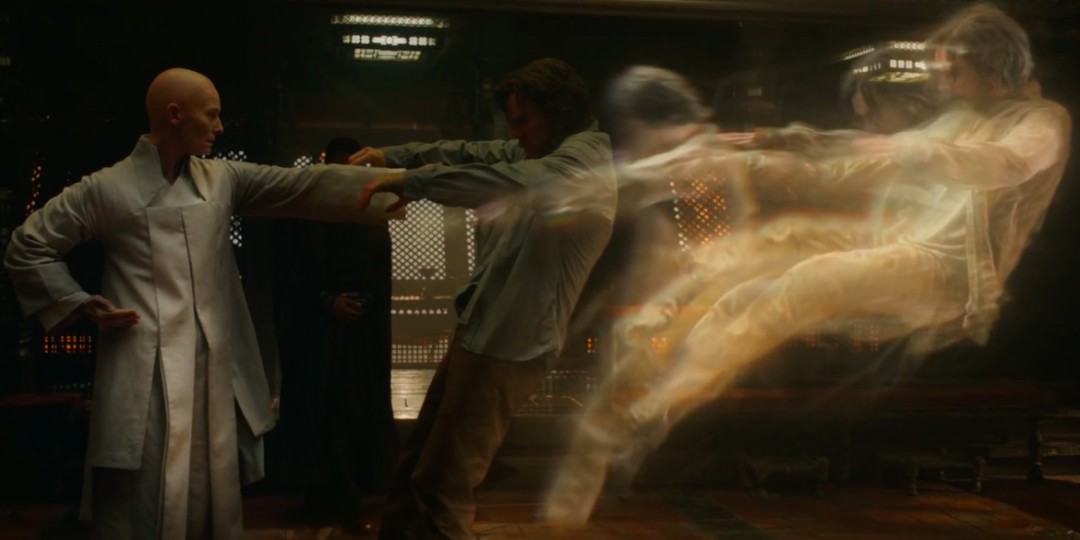
Stephen Strange (Cumberbatch) is a gifted neurosurgeon. He’s also an arrogant pain in the ass. His ego is on a par with Tony Stark’s, and he enjoys reminding people just how good he is. But one rainy evening, Strange’s car ends up in the river and his hands are so badly damaged that he’ll never be able to operate again. Angry and full of self-pity, Strange learns of a man who suffered a severed spine and was paralysed from the chest down, but who somehow managed to walk again. Strange tracks the man (Bratt) down, and is told of a monastery in Kathmandu, Nepal, where he learned how to walk again. Strange travels there and meets The Ancient One (Swinton), a mystic who teaches him that their plane of existence is one of many, and that Strange must let go of everything he thinks he knows in order to achieve “enlightenment”.

Strange proves to be an eager and willing (if still slightly sceptical) pupil. He learns how to cast spells, how to travel from one place to another by visualising it in his mind and creating a portal through which to get there, and the existence of a former pupil, Master Kaecilius (Mikkelsen), who believes he can gain immortality by helping a creature from the Dark Dimension, Dormammu, take over the Earth. As Strange’s powers grow, Kaecilius begins attacking the three sanctums that help keep Dormammu and his like from entering our world. Aided by another Master, Baron Mordo (Ejiofor), Strange attempts to stop Kaecilius from bringing about the end of the world; he also receives help from an unlikely source: the Cloak of Levitation, which chooses Strange as its master.
13-120647-marvel_debuts_doctor_strange_teaser_trailer

But the London sanctum falls to Kaecilius’s onslaught, and he moves on to attack the sanctum in Hong Kong. Strange and Mordo arrive too late to avoid its destruction and the arrival of Dormammu in our world, but Strange has an idea that will counter-act all the death and destruction that has followed in Dormammu’s wake. If he fails, however, it will mean the end of all life on Earth…

Another Marvel movie, another origin story. But Stephen Strange has always been the odd character out in the Marvel Universe (cinematic or otherwise), a humbled physician redeemed by the power of magic and able to deal with the kind of villains that would give the likes of Iron Man and Captain America more than a run for their money. (Not that Strange is in any immediate danger here; Kaecilius isn’t exactly the most threatening villain Marvel has come up with, but he is good at running a lot.) With Phase Three of the Marvel Cinematic Universe now under way, this gives Marvel the opportunity to add fresh characters to the roster, and take their ongoing series of movies in a new direction.

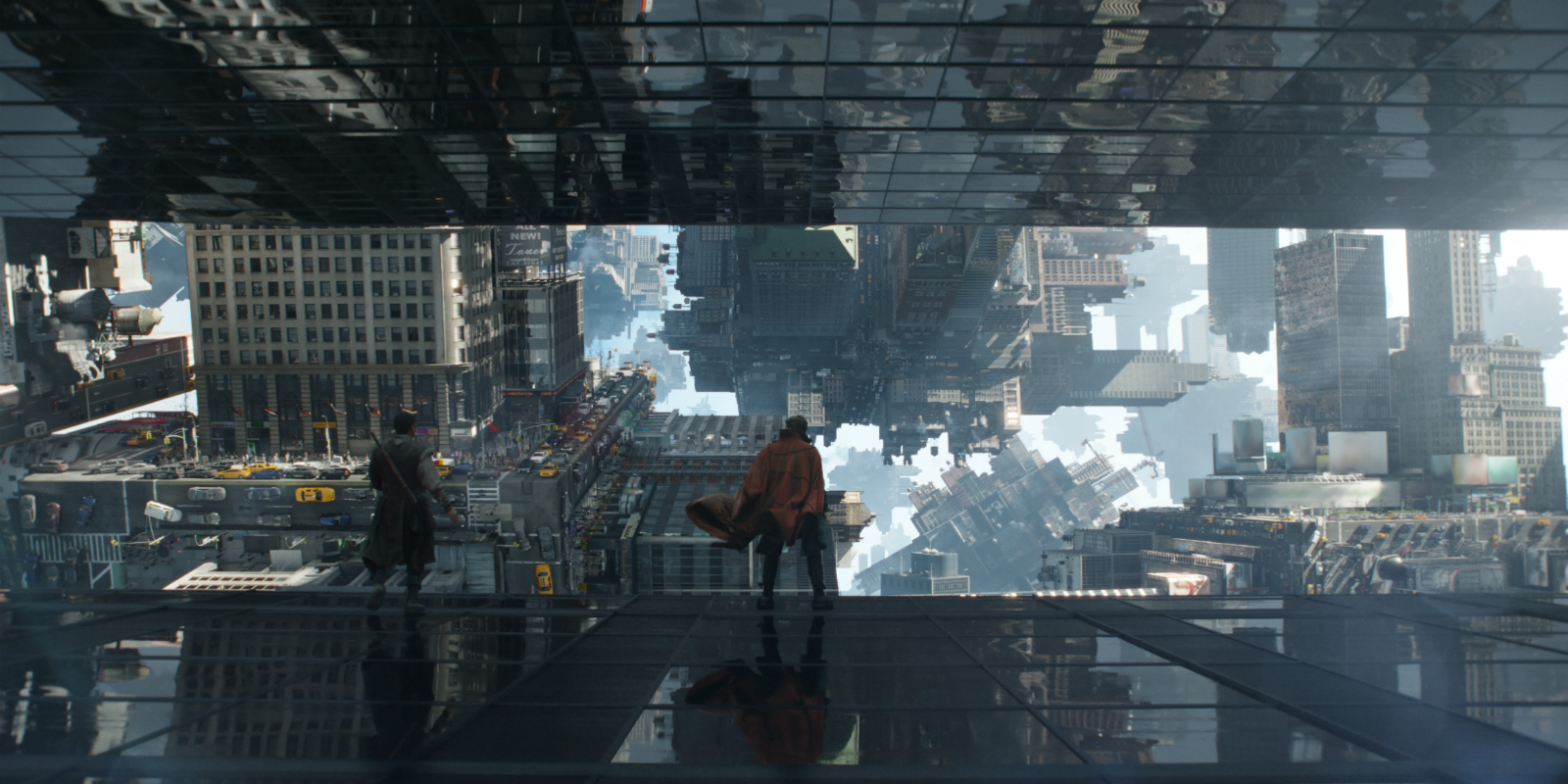
But is it any good? Well, predictably, the answer is Yes – for the most part. The standard Marvel formula is firmly in place, although there is less humour to be had this time round, and while the template is tweaked here and there, most viewers will be reassured that the House of Spidey hasn’t strayed too far from the formula that has made their movies so successful in the past. What is different, and markedly so, is the visual style adopted for the movie. Away from all the mind-bending, Inception-style graphics, Doctor Strange is both darker in tone and look. Even the hospital where Strange works isn’t as brightly lit as you might expect. But it’s not a gloomy movie over all, it’s just that for once, Marvel have realised that – scenes involving the Cloak of Levitation aside, and Strange’s “borrowing” habits in the library – this needs to be a serious piece above all.
doctor-strange-movie-image-gallery

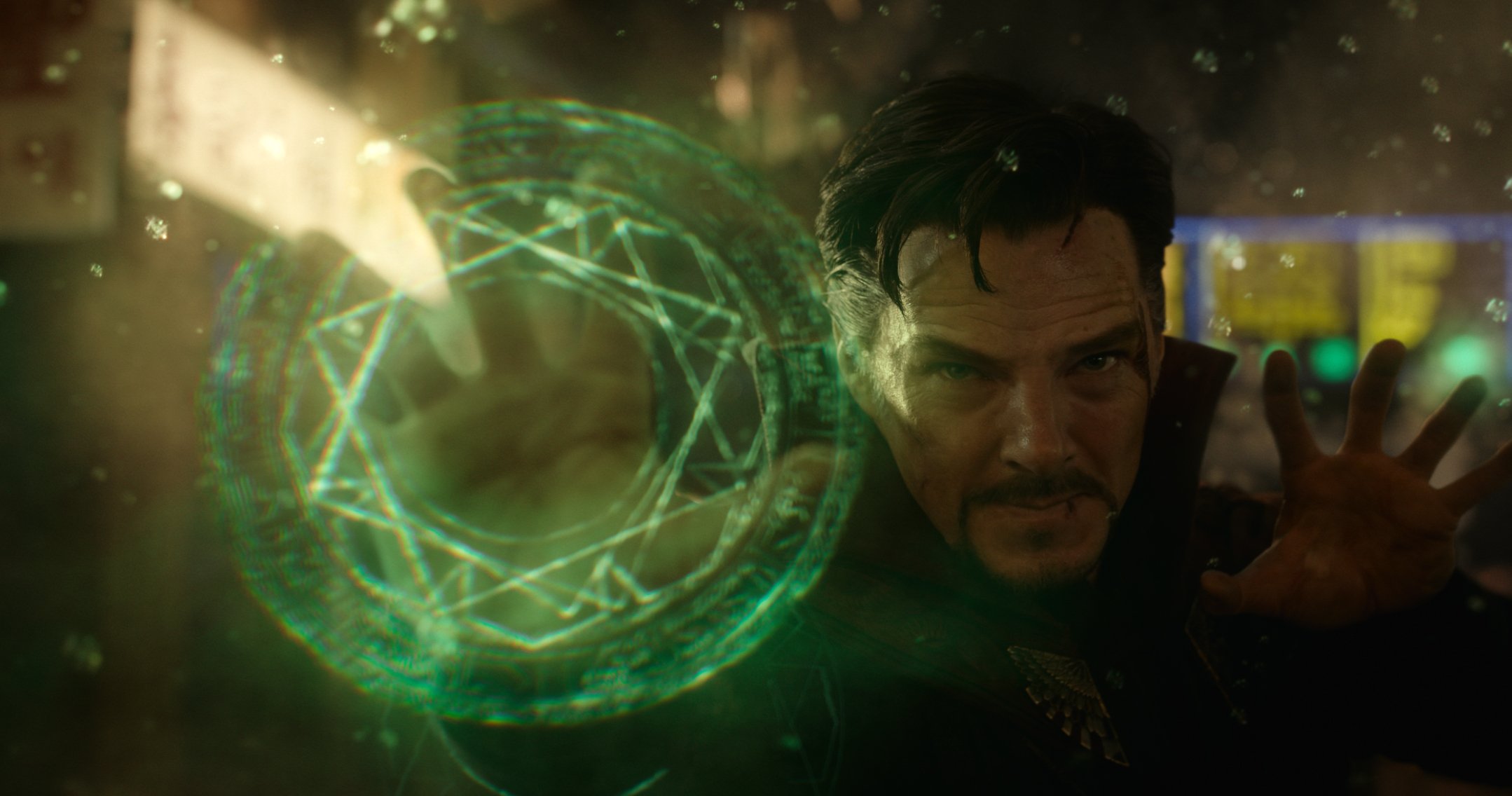
Strange’s arrogance, and then his anger, in the beginning gives Cumberbatch the opportunity to play unlikeable with an unexpected fierceness. One scene in particular with McAdams as Strange’s one-time significant other, Christine Palmer, sees the actor deliver cruel lines of dialogue in a way that hasn’t been done before in a Marvel movie (he’s the hero and he’s being delberately objectionable). Even when he begins to accept that magic really does exist, he’s still an egotist, making snarky, caustic comments, but thanks to the script – by Derrickson, Jon Spaihts, and C. Robert Cargill – he’s also on a journey of self-discovery, and this comes across more and more effectively as the movie progresses.

With the main character in good hands (Cumberbatch inhabits the role with his customary panache, and even slips in an Alan Rickman tribute for those paying attention), it’s a shame that the rest are painted in such broad strokes. Baron Mordo, Strange’s arch-nemesis in the comics, is here very much a secondary character whose time will come in a later movie, while The Ancient One, despite being well-played by Swinton, is burdened with some astonishingly po-faced dialogue (“I spent so many years peering through time… looking for you.”) that you start to wonder if the half-smile Swinton adopts at times is in acknowledgment of how daft some of her lines truly are. As mentioned before, Mikkelsen’s master-turned-bad is not one of Marvel’s best villains, while McAdams is sidelined for much of the movie, though at least she’s not there as a damsel in need of being rescued.
null

The visuals are, unsurprisingly, stunning. The folding of cityscapes and the weird monstrosities glimpsed in the Dark Dimension are both equally impressive, but there is one sequence which stands head and shoulders above all the others: when Strange reverses the destruction of the Hong Kong sanctum. If anyone wants a clue as to why Marvel is more successful at the box office, and critically, than DC, then it’s this particular sequence that should be watched for one of the answers. Both DC and Marvel have been guilty of going down the destruction-porn road before, and audiences have begun to voice their dislike of these big, CGI-driven demolition extravaganzas. But here, we don’t see the destruction of the Hong Kong sanctum, just the aftermath, and then, in a complete stroke of genius, we see the destruction in reverse – and it’s so much more effective for being shown in this way. Clearly, someone at Marvel is listening.

Where Stephen Strange will fit into the wider Marvel Cinematic Universe remains to be seen (though a pre-end credits scene points him in one particular direction), and he won’t be back in another solo outing for some time, but as an introduction to a character with so much more to be explored, Doctor Strange has to be considered a success. Like most of Marvel’s output in the last eight years, though, it does have its fair share of pitfalls, and it does stumble at times in trying to simplify the more esoteric aspects of playing with magic, but overall this is an exciting, well-crafted, rewarding, and enjoyable first outing for the future Sorcerer Supreme.

Rating: 8/10 – superb spectacle can’t compensate for some poor decisions when it comes to the secondary characters, or the tangled logic surrounding Kaecilius’ need to bring Dormammu into this world, but these are minor gripes in a movie that takes a challenging character and does him justice from start to finish; by doing more than enough with the formula to make it more interesting, Doctor Strange becomes a movie that contradicts the claim that Marvel are just churning out the same movie over and over again.

Share this:

  • Click to share on X (Opens in new window) X
  • Click to share on Facebook (Opens in new window) Facebook
  • More
  • Click to print (Opens in new window) Print
  • Click to email a link to a friend (Opens in new window) Email
Like Loading...

Now You See Me 2 (2016)

27 Saturday Aug 2016

Posted by dullwood68 in Movies

≈ 1 Comment

Tags

Daniel Radcliffe, Dave Franco, Drama, FBI, Jesse Eisenberg, Jon M. Chu, Lizzy Caplan, London, Macau, Magic, Magicians, Mark Ruffalo, Michael Caine, Morgan Freeman, New York, The Eye, The Horsemen, Thriller, Woody Harrelson

Now You See Me 2

D: Jon M. Chu / 129m

Cast: Jesse Eisenberg, Mark Ruffalo, Woody Harrelson, Dave Franco, Daniel Radcliffe, Lizzy Caplan, Morgan Freeman, Jay Chou, Sanaa Lathan, Michael Caine, David Warshofsky, Tsai Chin

Ten questions you need to ask yourself while watching Now You See Me 2:

  1. Why would prison authorities allow convicted criminal Thaddeus Bradley (Freeman) access to computer equipment that would enable him to make threats against the Four Horsemen (“You will get what’s coming to you. In ways you can’t expect.”)?
  2. Pigeons? (Yes, pigeons.)
  3. How does Lula (Caplan) know so much about the Four Horsemen, including the reason why Henley Reeves (Isla Fisher’s character from the first movie) isn’t around any longer?
  4. Why is Dylan Rhodes’ (Ruffalo) attendance at a Four Horsemen “event” more suspicious to his FBI colleagues than his talking into his sleeve?
  5. How convenient is it that Bradley has just the form Rhodes needs to get Bradley out of jail?
  6. Chase McKinney (Harrelson) – unfortunate stereotype or unfortunate stereotype?
  7. How likely is it, in a sequence that lasts nearly four and a half minutes, that not one of the security guards notice the playing card as it’s whipped, zipped and slipped from one Horseman to another?
  8. How do lines such as, “But I don’t agree that we have a sackful of nada, ’cause we’re all here. That’s a sackful of something” get past the first draft stage?
  9. When did the FBI’s remit extend outside of the US?
  10. Could the screenplay by Ed Solomon have ended on a more absurd, ridiculous note than the surprise reveals made by Bradley?

Now You See Me 2 - scene

Rating: 4/10 – another poorly constructed sequel that plays fast and loose with logic, Now You See Me 2 wants the audience to like it as much as the mass London crowds go crazy for the Horsemen; slickly made but soulless, only Caplan makes an impact, and the magic tricks lack the first movie’s sense of fun, leaving the movie to rattle on for two hours without anyone having to care what happens to the characters (which is both a bonus and a relief).

Share this:

  • Click to share on X (Opens in new window) X
  • Click to share on Facebook (Opens in new window) Facebook
  • More
  • Click to print (Opens in new window) Print
  • Click to email a link to a friend (Opens in new window) Email
Like Loading...

The Huntsman: Winter’s War (2016)

05 Tuesday Apr 2016

Posted by dullwood68 in Movies

≈ 1 Comment

Tags

Action, Cedric Nicolas-Troyan, Charlize Theron, Chris Hemsworth, Drama, Dwarves, Emily Blunt, Fantasy, Goblins, Ice Queen, Jessica Chastain, Magic, Mirror, Nick Frost, Prequel, Review, Rob Brydon, Sequel, Sorcery

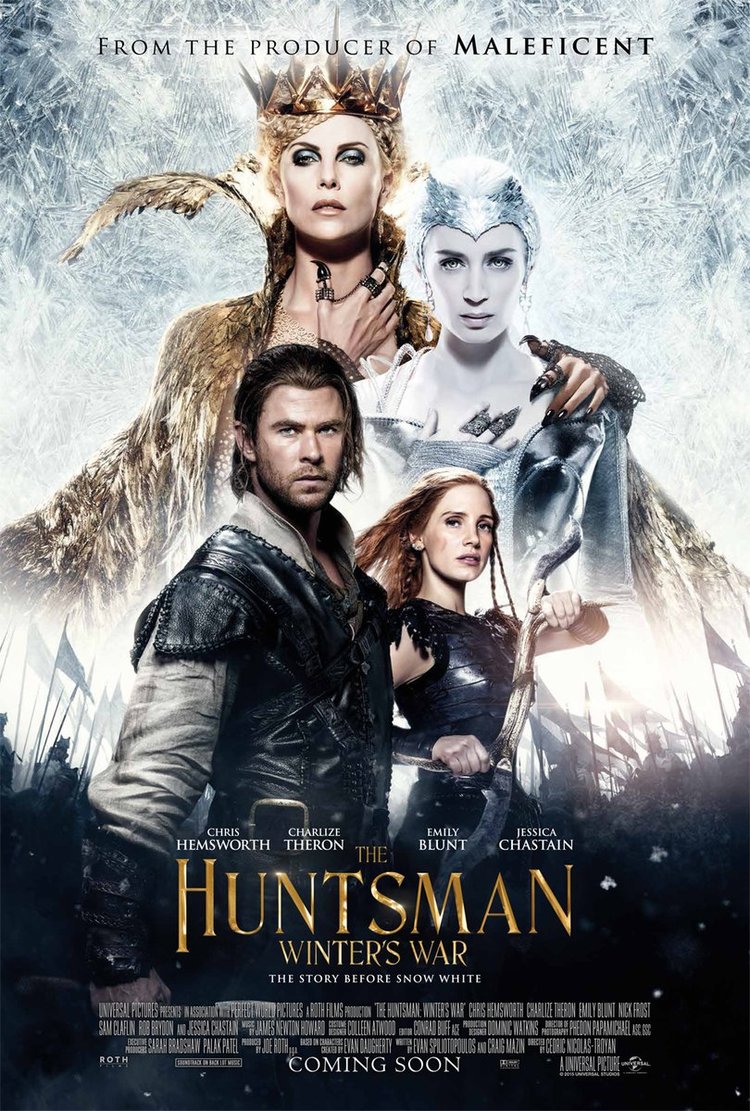
The Huntsman Winter's War

D: Cedric Nicolas-Troyan / 114m

Cast: Chris Hemsworth, Charlize Theron, Emily Blunt, Jessica Chastain, Nick Frost, Rob Brydon, Sam Claflin, Sheridan Smith, Alexandra Roach, Sope Dirisu

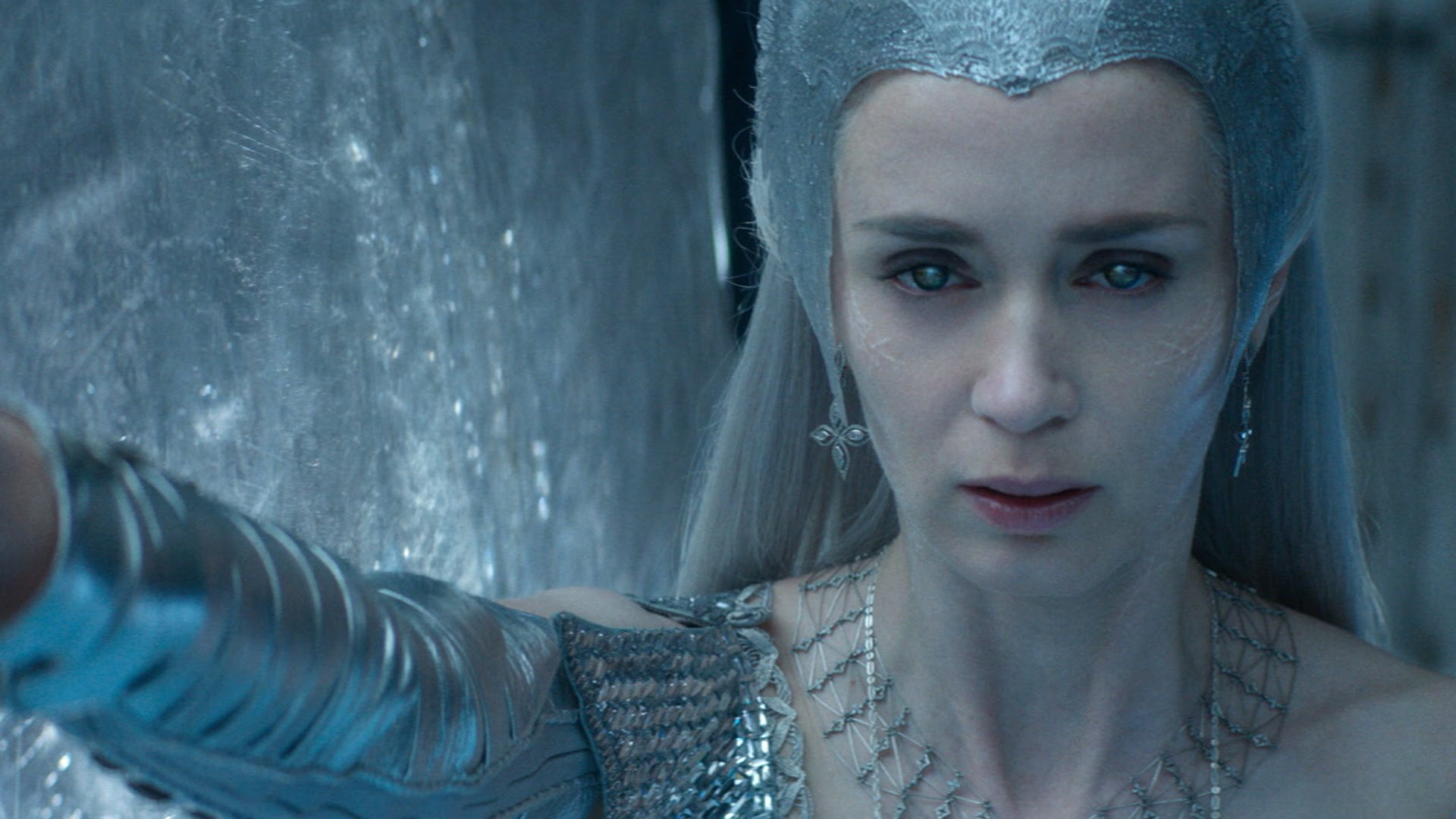
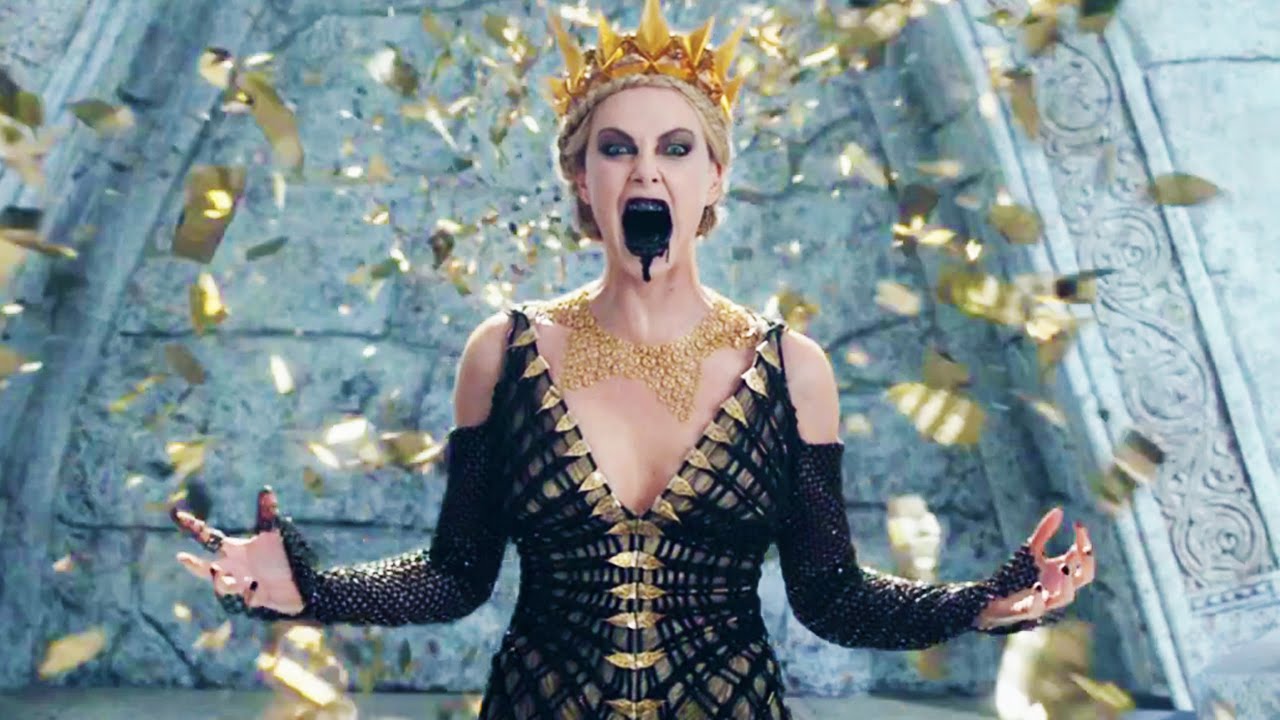
Once upon a time there were two sisters. One, Ravenna (Theron), lusted for power, and used her dark magic to take over kingdoms and rule them with an iron fist. The other, Freya (Blunt), had yet to find the magic gift she possessed, but Ravenna assured her the day would come when her power would assert itself. And then Freya fell pregnant, and had a baby. But then a tragedy occurred and her baby died in a fire, apparently caused by her baby’s father, her one true love. Her powers exerted themselves then, and Freya’s gift was to be able to control ice in all its forms. She exerted her revenge on her one true love, then left Ravenna’s care to make a kingdom for herself in the North. She became known as the Ice Queen, and she was feared by all.

Her pain found expression in a strange way. She would order the children from the villages in her kingdom to be rounded and trained as warriors for her growing army. All these children had to do was swear allegiance to her and foreswear any notion of love. In return she would give their lives meaning in their service to her. But love will out, and two children grew up to love each other, despite Freya’s law. Eric (Hemsworth) and Sarah (Chastain) made plans to leave Freya’s stronghold and their roles as huntsmen. But Freya learned of their plans and saw to it that they didn’t come to fruition. Eric saw Sarah killed, and he was knocked unconscious and thrown into the river to die.

THWW - scene3

But Eric survived. Time passed. Seven years, during which time he helped Snow White rid her kingdom of the villainous Ravenna. But now a new threat is in place. Ravenna’s mirror, a source of very powerful magic, has been stolen, and Eric is tasked with finding it and taking it to a sanctuary where it can be made safe. He agrees to the task, and is joined by two dwarves, Nion (Frost) and Gryff (Brydon). Soon they discover that Freya is trying to find the mirror as well. They seek help from two female dwarves, Mrs Bronwyn (Smith) and Doreena (Roach), and journey into a hidden forest inhabited by goblins to take back the mirror. But once they do they find themselves caught in a trap of Freya’s devising, leading to the mirror’s capture, and only one course of action left to them: to follow the Ice Queen back to her stronghold and destroy her and the mirror once and for all.

Snow White and the Huntsman (2012) was an unexpected success, trading on Theron’s evil hearted queen and Kristen Stewart’s take on Snow White as a fantasy version of Joan of Arc. It had an impressive budget – $170 million – and made back nearly $400 million at the international box office. A sequel was always on the cards, it was just a matter of when. But here’s the rub: The Huntsman: Winter’s War isn’t just a sequel, it’s also a prequel. In it we see the Huntsman’s back story, his childhood years as a trainee in Freya’s huntsman army and his eventual love affair with Sarah, whom he marries in secret. When she dies, fate spares his life and the movie skims over the events of its predecessor with a single line of narrated dialogue (courtesy of Liam Neeson).

THWW - scene1

Then we’re fully in sequel mode, as Sam Claflin’s earnest prince convinces Eric to look for the mirror. And Freya, who has been adding nearby kingdoms to her own over the past seven years, gets wind of the mirror and its magical properties. A race against time, then, to see who reaches the mirror first. Alas, no, not really. Instead, after an eventful and encouraging first half hour, the movie settles down into fantasy adventure mode, with humour provided by Frost and Brydon. Freya’s threat is put on the back burner and Eric is confronted with a figure from his past who provides complications for his quest. It’s all serviceable enough, and despite everyone’s best efforts, all entirely forgettable.

The problem lies both with the script by Evan Spiliotopoulos and Craig Mazin, and Nicolas-Troyan’s direction. The script lumbers from one unconnected scene to the next, straining the audience’s patience thanks to semi-amusing quips and snide remarks courtesy of Brydon, cowardly assertions from Frost, an drab, wearing performance from Chastain, and Hemsworth’s assumption that a big grin can pass for acting when he so desires (sorry, Chris, it doesn’t). Ravenna remains the primary adversary, despite being off screen for two thirds of the movie, and Freya’s delusional take on love and its inability to offer true contentment is recounted so often it’s as if the makers weren’t sure an audience would grasp the idea the first time around.

THWW - scene2

But if the movie’s storyline and plotting are a cause for alarm, spare a thought for Nicolas-Troyan, bumped up from second unit director on the first movie, and a poor second choice after Frank Darabont, who was attached to the project for some time before he dropped out. He’s not so bad when it comes to the action sequences, but in between times, when the characters have to display their feelings, or the script calls for another bout of humorous insults (which are pretty much all of Brydon’s lines), his lack of experience shines through. Too many scenes fall flat or fail to make much of an impact, and the cast are left to inject whatever energy they can, but with the script and their director seemingly working against them, it’s an uphill struggle for all of them.

This being a big budget fantasy movie, however, it does score highly for its production design, its costumes, and its special effects (though an encounter with a goblin isn’t as effective as it should be, thanks to its looking like an angry ape with a liking for bling). The ice effects are cleverly done, and there’s a pleasing sense of a real world lurking behind all the CGI, while James Newton Howard contributes a suitably stirring score to help prop things up when it all gets a little too silly (which is most of the middle section). And of course, the makers can’t help themselves at the end, and leave a way open for a further (full-fledged) sequel. But if anyone really cares by that stage, then the movie will have truly worked its magic.

Rating: 5/10 – a superficially appealing prequel/sequel, The Huntsman: Winter’s War isn’t the most memorable of fantasy movies, and chances are, viewers will have forgotten most of its content a short while after seeing it; it’s not a bad movie per se, but then it’s not a good movie either, and sometimes, that’s the worst anyone can say about any movie.

Share this:

  • Click to share on X (Opens in new window) X
  • Click to share on Facebook (Opens in new window) Facebook
  • More
  • Click to print (Opens in new window) Print
  • Click to email a link to a friend (Opens in new window) Email
Like Loading...

The Last Witch Hunter (2015)

02 Monday Nov 2015

Posted by dullwood68 in Movies

≈ 1 Comment

Tags

Breck Eisner, Curse, Drama, Elijah Wood, Fantasy, Horror, Immortal, Magic, Michael Caine, Review, Rose Leslie, Thriller, Vin Diesel, Witch Queen, Witches

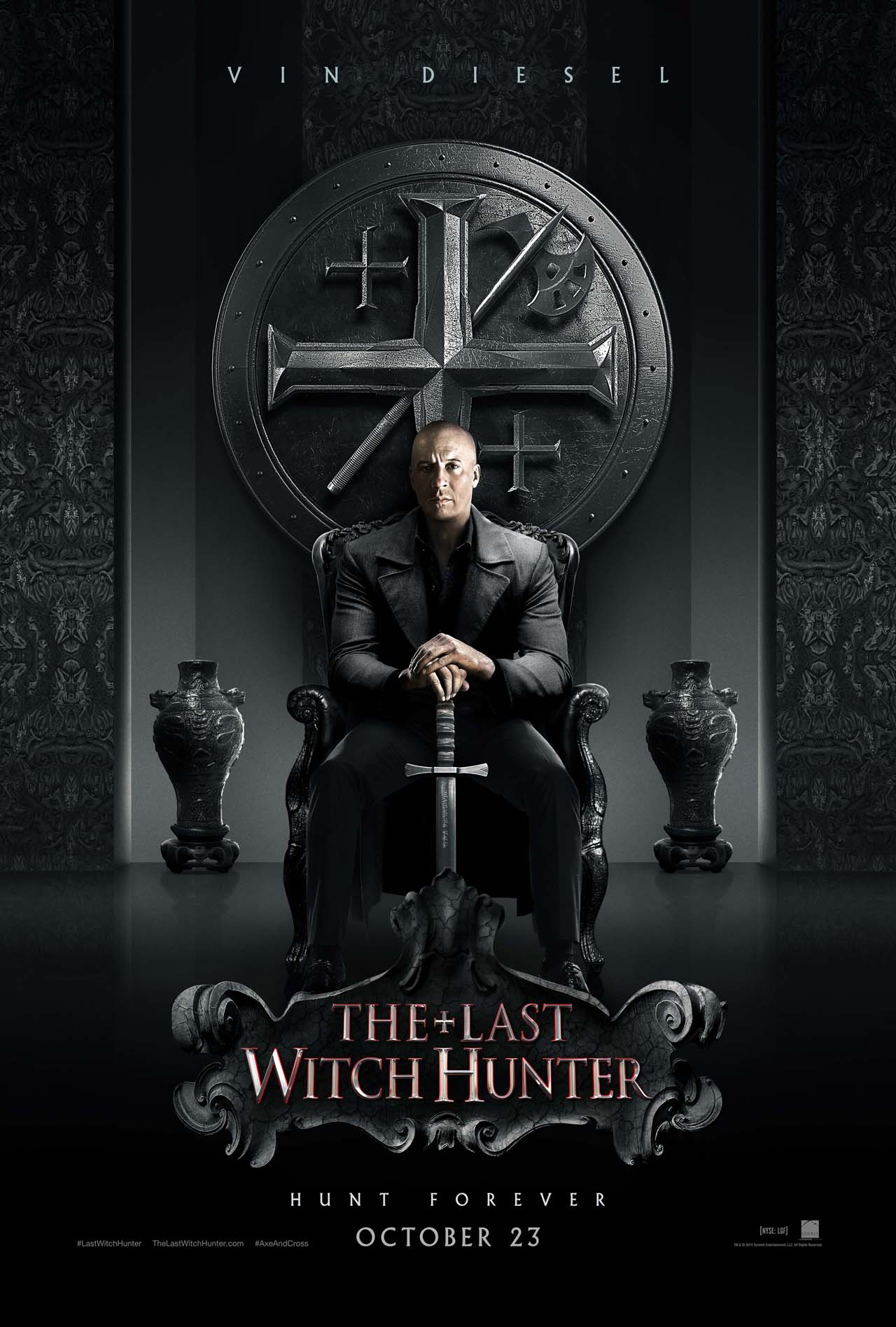
Last Witch Hunter, The

D: Breck Eisner / 106m

Cast: Vin Diesel, Rose Leslie, Elijah Wood, Ólafur Darri Ólafsson, Michael Caine, Julie Engelbrecht, Joseph Gilgun, Isaach De Bankolé, Rena Owen

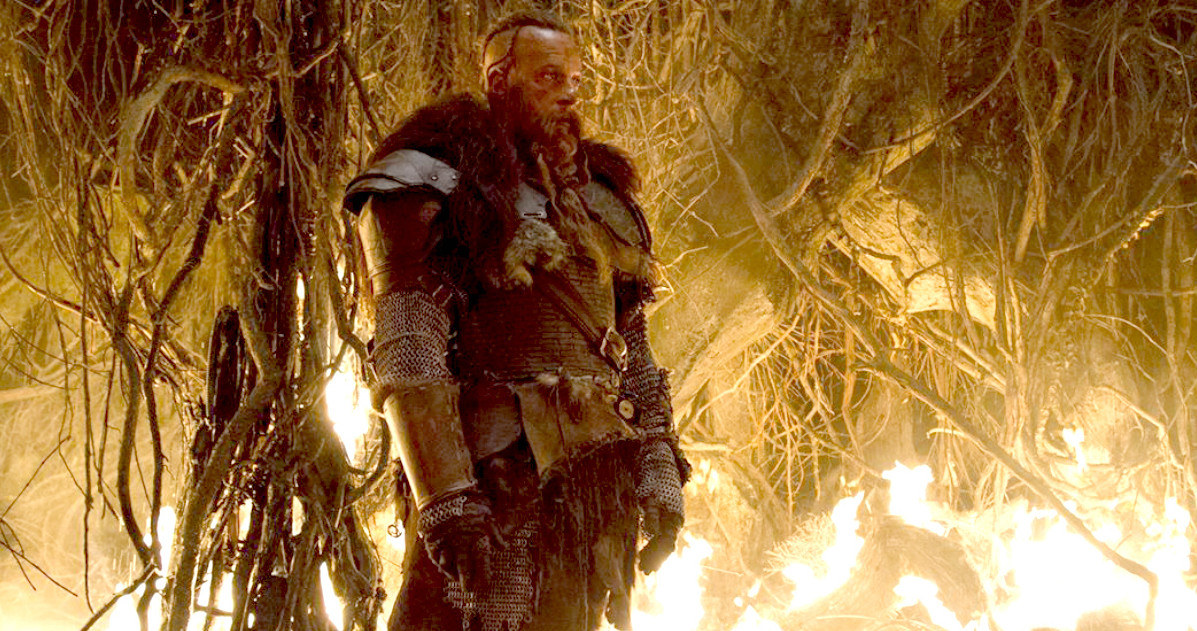
The fantasy-horror movie has been less than entertaining in recent years, what with Van Helsing (2004), the Underworld series (2003-2012), and I, Frankenstein (2014) showing just how it shouldn’t be done. And yet despite these weary efforts we now have The Last Witch Hunter, a movie that remains as jumbled and ineffectual as its genre predecessors. It’s a project that began life as a featured screenplay in the 2010 Blacklist, and was originally set to be directed by Timur Bekmambetov back in 2012. But those plans fell through, and with the project being championed by Vin Diesel (an avid fan of fantasy role playing games), it made it into production once its star was free after the interrupted filming of Furious 7 (2015).

If the movie proves anything, it’s that scripts on the Blacklist aren’t always filmed as written – the original script by Cory Goodman was rewritten by Dante Harper and Melissa Walack before Matt Sazama and Burk Sharpless finally ended up with the on-screen credit. Well, gentlemen, don’t be so proud, because if Goodman’s original script was really that good, then let’s make it clear: you guys went and ruined it.

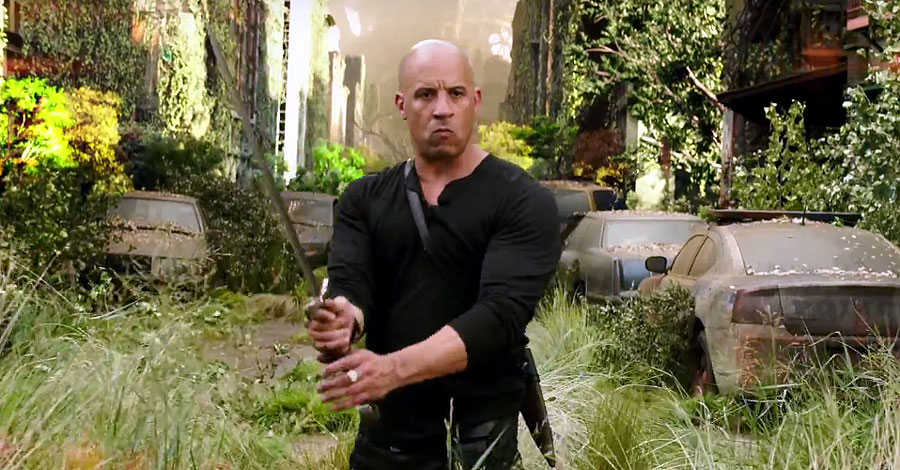
It’s a movie that remains frustratingly remote from its audience throughout, and which fails to make its witchcraft-plunging-the-world-into-darkness storyline and plot even halfway exciting or dramatic. It’s a lot more serious than most, and not as po-faced as some of its competitors, but aside from one terrific joke involving a selfie, this is dour stuff that takes the end of the world as we know it and manages to make it about as threatening as flipping a pancake. And no matter how much Diesel glowers and frets, and no matter how much Ólafsson speaks of the world swallowed up by doom, we all know that whatever happens, Leslie is probably going to be the best bet for helping Kaulder – Diesel’s character – as he fights to discover who tried to kill his mentor and friend Father Dolan (Caine). (Oh, and we can be fairly certain that one character will prove to be less than they appear.)

Last Witch Hunter, The - scene

Fantasy movies have a tough time now, what with the likes of Game of Thrones showing just how it can, and should, be done, and Diesel’s pet project suffers in much the same way as others of its ilk have done: in trying to set their bizarre plots and outlandish characters against the recognisable backdrop of modern times, they then go and wilfully ignore that backdrop in favour of elaborate special effects sequences where anything goes, and where any carefully established grounding in the here and now is catapulted right out of the narrative. If you’re going to have a showdown between good and evil, don’t hide it away in dingy basements or abandoned churches, where the viewer can ogle the impressive art direction or set design, but have it right out in the open: make magic a shocking, but real part of our daily existence (part of the fun of Ghost Busters (1984) is that everyone in New York sees the Stay-Puft Man).

And then there’s the plot itself, which sees Diesel’s barbarian warrior and his pals take on the Witch Queen (Engelbrecht) in pre-medieval times, only for them to fall one by one until it’s left to Kaulder to save the day. But in doing so she curses him to immortality – and provides a handy way for her to be resurrected in the future. And therein lies the movie’s first problem: Kaulder isn’t the last witch hunter, he’s the only witch hunter. But put that aside and then we have another problem: why is it that it always takes so long for the villain of the piece to be able to make a comeback? Here it’s eight hundred years, during which time Kaulder has played policeman in the witch community, and everything is predictably hunky dory (it all has something to do with the Witch Queen’s heart, which apparently, can still beat long after she’s dead – obviously).

Last Witch Hunter, The - scene2

Tasked to “Remember your death” by Father Dolan in the form of a handy clue made while he was being killed, Kaulder can’t just cast his mind back and remember it for himself. Instead he has to enlist the aid of a witch, the conveniently to hand Chloe (Leslie) who has to concoct a potion that will allow him to re-experience that fateful moment. Only that just leads to the next problem: he didn’t die, so why all this rigmarole? Could it be that old screenwriter’s fallback, padding? Or is it just a poorly conceived idea that nobody could fix during shooting (or wanted to)? There’s lots more that doesn’t add up or make sense, and it all goes to reinforce the idea that when it comes to fantasy, as long as the movie looks good – and The Last Witch Hunter does look good – then the story and the dialogue can be as ridiculous as it wants.

With a sequel already in pre-production, and despite a lukewarm reception at the box office, it’s clear that this is an attempt by Diesel to kick-start another franchise he can head up. But while he may be committed to telling further tales as Kaulder, he might just find, based on this “opener”, that not everyone will be as willing to follow him on that particular journey as they are when he gets behind a muscle car and trades macho stares with Dwayne Johnson.

Rating: 5/10 – genre conventions abound in this absurdly watchable yet majorly disappointing piece of fantasy, that at least sees its star smile more in one movie than he’s done in five (and a bit) Fast & Furious outings; derivative and lacking in real purpose, The Last Witch Hunter has neither the style nor the wit to help itself stand out from an already dispiriting crowd.

Share this:

  • Click to share on X (Opens in new window) X
  • Click to share on Facebook (Opens in new window) Facebook
  • More
  • Click to print (Opens in new window) Print
  • Click to email a link to a friend (Opens in new window) Email
Like Loading...

Magic in the Moonlight (2014)

28 Sunday Sep 2014

Posted by dullwood68 in Movies

≈ 1 Comment

Tags

Colin Firth, Comedy, Eileen Atkins, Emma Stone, Fraud, Magic, Magician, Medium, Review, Romance, Romantic comedy, Séance, South of France, Wei Ling Soo, Woody Allen

Magic in the Moonlight

D: Woody Allen / 97m

Cast: Colin Firth, Emma Stone, Simon McBurney, Eileen Atkins, Hamish Linklater, Marcia Gay Harden, Jacki Weaver, Erica Leerhsen, Jeremy Shamos, Catherine McCormack

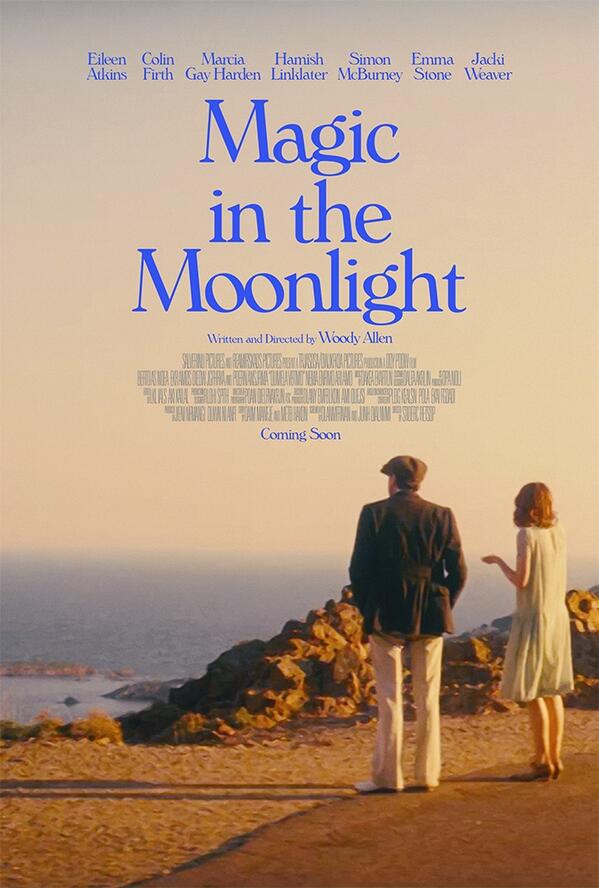
Berlin, 1928.  British magician Stanley Crawford (Firth) astounds audiences as Chinese illusionist Wei Ling Soo, making elephants disappear and appearing to materialise himself out of thin air.  After another successful show, the arrogant, rude-minded Stanley is met by his old friend from childhood Howard Burkan (McBurney).  Burkan is also a magician, and he comes with a proposal: for Stanley to travel with him to the Côte d’Azur and expose a young American woman who is posing as a medium and exploiting Burkan’s friends, the Catledges.  Stanley, who abhors fake mediums and enjoys exposing them, agrees to go.

At the Catledges, Stanley is introduced to the young woman in question, Sophie Baker (Stone), and her mother (Harden).  He pretends to be a businessman called Taplinger but he is unable to restrain his skepticism, and although he does his best to hide his true identity, Sophie proves adept at “receiving” clues as to who he really is.  Still convinced she’s a fraud, he observes her during a séance but is unable to detect any trickery.  The next day, Sophie reveals she knows who Stanley is, and she warns him that she really has a gift, and that he shouldn’t doubt her.  But Stanley is becoming increasingly besotted with her, and while he has some lingering doubts, he finds himself spending more and more time with her, despite Sophie being wooed by Brice Catledge (Linklater).

Stanley takes Sophie to see his Aunt Vanessa (Atkins).  Sophie asks to hold a piece of Vanessa’s jewellery, and when she does, she reveals information about an affair that Vanessa had, and which Sophie couldn’t possibly have any knowledge of.  Now convinced that Sophie has a gift, he determines to hold a press conference where he will admit that his previous disbelief has been overturned.  The results of a further séance reinforces Stanley’s change of mind and heart.  Later, at a ball, Sophie asks him if he has any other feelings about her, but Stanley is baffled by her questions, and she leaves, disappointed.  Things come to a head when Aunt Vanessa is involved in a car crash, and Stanley finds himself praying for her survival on the operating table.  Will he embrace his newfound regard for the unseen, or will his skepticism return in the face of such a calamity?

Magic in the Moonlight - scene

This year’s annual movie offering from Woody Allen follows on from the sublime Blue Jasmine, and in comparison with that movie, Magic in the Moonlight is more Woody-lite than anything more substantial.  It’s a whimsical tale for the most part, anchored by a Scrooge-like performance by Firth that at times skirts perilously close to complete misanthropy, but which is rescued by the sheer pomposity of the character and his outlook on Life.  Crawford’s petulant skepticism and sarcastic attitude verges on the unpalatable throughout, but thanks to Firth, and Allen’s skill as a writer, he has just enough hidden vulnerability for the audience to connect with.  However, for large stretches of the movie he’s deliberately insufferable, and it’s difficult to understand what on earth Sophie could see in him (opposites do attract, but here it’s a little too extraordinary).

With its lead character so defiantly unlikeable for so much of the time, it falls to Stone to put some warmth and heart into the proceedings.  As the good-natured ingénue, Sophie, Stone is affecting, appealing, effortlessly lively, and the complete antithesis to Stanley, her winning smile and wide-eyed features both endearing and captivating.  It’s a more extrovert performance, but with a degree of subtlety that is best seen when Sophie enquires after Stanley’s feelings for her.  Her earnest entreaties, and her reaction to Stanley’s dismissal of the notion that he has a romantic interest in her, is cleverly done, and mesmerising to watch.

However, two good central performances aside, this is still a movie that trundles from one scene to the next without requiring much of a response from the audience, or indeed, any real investment in the plot or the characters.  The plotting is predictable, and the theme of science versus religion (or at least, the paranormal) is handled with Allen’s usual surety, but there’s still something lacking, a spark, perhaps, that stops the movie from being either memorable or touching.  The outcome is never in doubt, and while Allen pulls a dubious sleight-of-hand to get there – as well as twisting Stanley’s arm mercilessly towards the very end – a less conventional conclusion would have made all the difference.  (And how many more times will Allen trot out the old May-December romance we’ve seen so often in the past?)

The supporting cast – Atkins aside – have little to do except make up the numbers, and if no other characters stand out as much then it’s no one’s fault but Allen’s, his less than absorbing approach, and lightweight direction failing to lift the admittedly unsubstantial material.  That said, there are some delicious lines of dialogue here and there (as you’d expect, even in Allen’s lesser works), and the South of France is beautifully lensed by Darius Khondji, the colours (of the surrounding countryside in particular) popping and flaring in a way that hasn’t been seen in any of Allen’s previous work.  There’s the usual round up of jazz favourites from the Twenties and Thirties, but not all the compositions fit in this time, and Alisa Lepselter’s editing often leaves scenes hanging around just those few frames longer than necessary.  It all adds up to a Woody Allen movie that feels like a stopgap before the next really good project.

Rating: 6/10 – there’s just enough here to keep audiences occupied, but Magic in the Moonlight isn’t the romantic comedy delight of say, Midnight in Paris (2011); with a curmudgeonly central character holding it back, the movie ends up feeling like a magician’s parlour trick, but one where everybody knows how the trick is done.

Share this:

  • Click to share on X (Opens in new window) X
  • Click to share on Facebook (Opens in new window) Facebook
  • More
  • Click to print (Opens in new window) Print
  • Click to email a link to a friend (Opens in new window) Email
Like Loading...

Blog Stats

  • 486,537 hits

Recent Posts

  • 10 Reasons to Remember Bibi Andersson (1935-2019)
  • Fantasia (1940)
  • Dances With Wolves (1990) – The Special Edition
  • Kiss of the Spider Woman (1985)
  • The Three Musketeers (1973)

Top Posts & Pages

  • Lost for Life (2013) - Another Look
    Lost for Life (2013) - Another Look
  • Lost for Life (2013)
    Lost for Life (2013)
  • About
    About
  • Mr. Topaze (1961)
    Mr. Topaze (1961)
  • Billy Lynn's Long Halftime Walk (2016)
    Billy Lynn's Long Halftime Walk (2016)
  • Winter's Tale (2014)
    Winter's Tale (2014)
  • Hunt for the Wilderpeople (2016)
    Hunt for the Wilderpeople (2016)
  • Irrational Man (2015)
    Irrational Man (2015)
  • Transcendence (2014)
    Transcendence (2014)
  • Kubo and the Two Strings (2016)
    Kubo and the Two Strings (2016)
Follow thedullwoodexperiment on WordPress.com

Blogs I Follow

  • Rubbish Talk
  • Film 4 Fan
  • Fast Film Reviews
  • The Film Blog
  • All Things Movies UK
  • Interpreting the Stars
  • Let's Go To The Movies
  • Movie Reviews 101
  • TMI News
  • Dan the Man's Movie Reviews
  • Film History
  • Jordan and Eddie (The Movie Guys)

Archives

  • April 2019 (13)
  • March 2019 (28)
  • February 2019 (28)
  • January 2019 (32)
  • December 2018 (28)
  • November 2018 (30)
  • October 2018 (29)
  • September 2018 (29)
  • August 2018 (29)
  • July 2018 (30)
  • June 2018 (28)
  • May 2018 (24)
  • April 2018 (21)
  • March 2018 (31)
  • February 2018 (25)
  • January 2018 (30)
  • December 2017 (30)
  • November 2017 (27)
  • October 2017 (27)
  • September 2017 (26)
  • August 2017 (32)
  • July 2017 (32)
  • June 2017 (30)
  • May 2017 (29)
  • April 2017 (29)
  • March 2017 (30)
  • February 2017 (27)
  • January 2017 (32)
  • December 2016 (30)
  • November 2016 (28)
  • October 2016 (30)
  • September 2016 (27)
  • August 2016 (30)
  • July 2016 (30)
  • June 2016 (31)
  • May 2016 (34)
  • April 2016 (30)
  • March 2016 (30)
  • February 2016 (28)
  • January 2016 (35)
  • December 2015 (34)
  • November 2015 (31)
  • October 2015 (31)
  • September 2015 (34)
  • August 2015 (31)
  • July 2015 (33)
  • June 2015 (12)
  • May 2015 (31)
  • April 2015 (32)
  • March 2015 (30)
  • February 2015 (37)
  • January 2015 (39)
  • December 2014 (34)
  • November 2014 (34)
  • October 2014 (36)
  • September 2014 (25)
  • August 2014 (29)
  • July 2014 (29)
  • June 2014 (28)
  • May 2014 (23)
  • April 2014 (21)
  • March 2014 (42)
  • February 2014 (38)
  • January 2014 (29)
  • December 2013 (28)
  • November 2013 (34)
  • October 2013 (4)

Blog at WordPress.com.

Rubbish Talk

Film 4 Fan

A Movie Blog

Fast Film Reviews

The Film Blog

The official blog of everything in film

All Things Movies UK

Movie Reviews and Original Articles

Interpreting the Stars

Dave Examines Movies

Let's Go To The Movies

Film and Theatre Lover!

Movie Reviews 101

Daily Movie Reviews

TMI News

Latest weather, crime and breaking news

Dan the Man's Movie Reviews

All my aimless thoughts, ideas, and ramblings, all packed into one site!

Film History

Telling the story of film

Jordan and Eddie (The Movie Guys)

Movie Reviews & Ramblings from an Australian Based Film Fan

Privacy & Cookies: This site uses cookies. By continuing to use this website, you agree to their use.
To find out more, including how to control cookies, see here: Cookie Policy
  • Subscribe Subscribed
    • thedullwoodexperiment
    • Join 481 other subscribers
    • Already have a WordPress.com account? Log in now.
    • thedullwoodexperiment
    • Subscribe Subscribed
    • Sign up
    • Log in
    • Report this content
    • View site in Reader
    • Manage subscriptions
    • Collapse this bar
 

Loading Comments...
 

    %d