• 10 Reasons to Remember…
  • A Brief Word About…
  • About
  • For One Week Only
  • Happy Birthday
  • Monthly Roundup
  • Old-Time Crime
  • Other Posts
  • Poster of the Week
  • Question of the Week
  • Reviews
  • Trailers

thedullwoodexperiment

~ Viewing movies in a different light

thedullwoodexperiment

Tag Archives: Matt Reeves

War for the Planet of the Apes (2017)

10 Thursday Aug 2017

Posted by dullwood68 in Movies

≈ 2 Comments

Tags

Alpha-Omega, Andy Serkis, Caesar, Drama, Karin Konoval, Matt Reeves, Review, Sequel, Steve Zahn, Thriller, Trilogy, Woody Harrelson
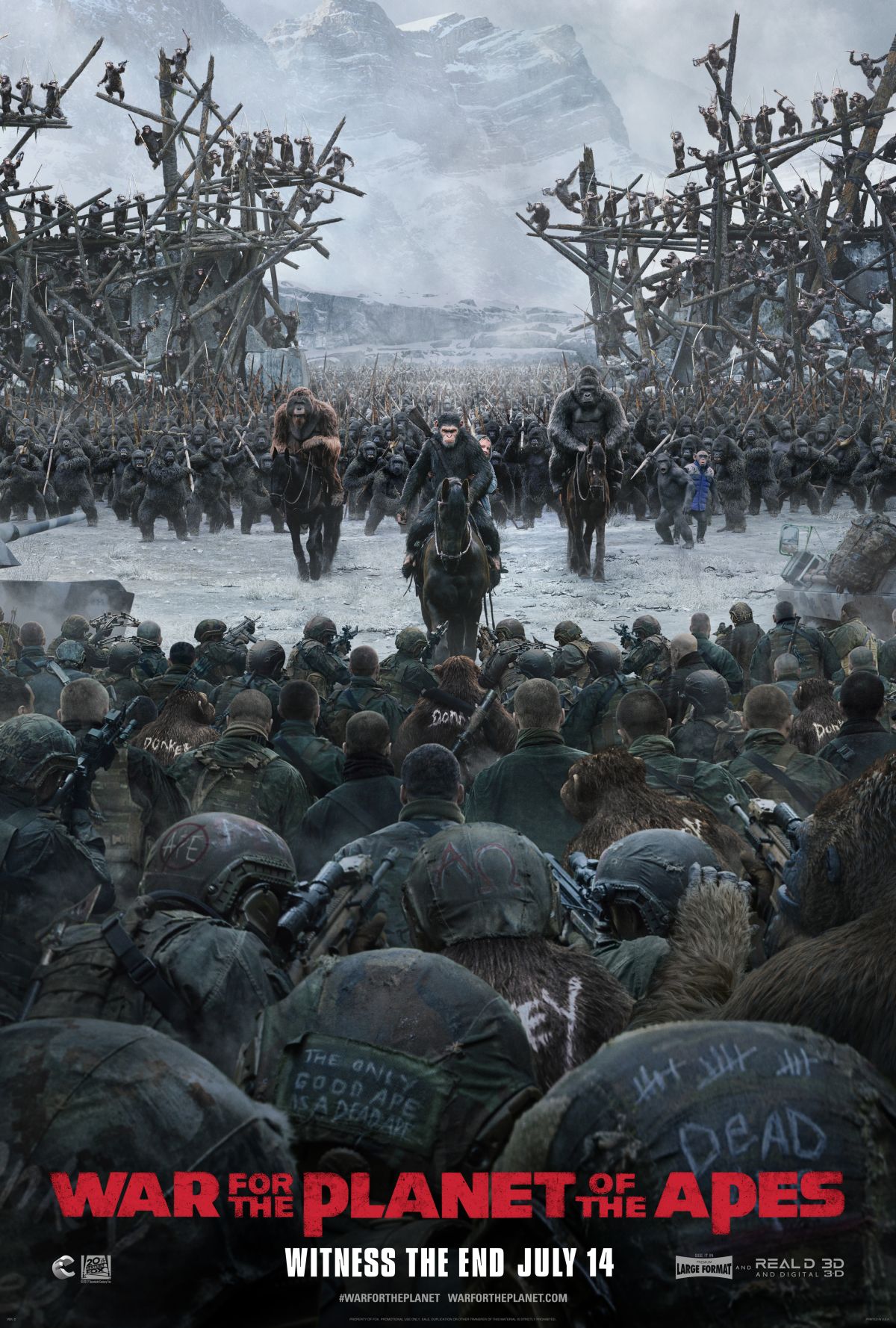
D: Matt Reeves / 140m

Cast: Andy Serkis, Woody Harrelson, Steve Zahn, Karin Konoval, Amiah Miller, Terry Notary, Ty Olsson, Michael Adamthwaite, Toby Kebbell, Gabriel Chavarria, Judy Greer

With so many franchise trilogies out there at the moment, and with so many of them failing to maintain a consistent level of quality across all three movies, what are the odds that a series based on a previous five-movie saga – which went from genre classic to tired afterthought – would prove to be the trilogy that bucked the trend and have the most impact? For such is the case thanks to War for the Planet of the Apes, the final entry in a trilogy that has been consistently impressive from start to finish, and which has raised the bar significantly in terms of motion capture performances.

The success of the series can be attributed to the seriousness, and the sense of purpose with which each entry has been approached. Rise of the Planet of the Apes (2011) introduced us to a world where the potential of apes superseding humans was a tantalising prospect. Dawn of the Planet of the Apes (2014) took us deeper into that world and showed how intolerance and distrust on both sides could be exploited by personal agendas. And in War for the Planet of the Apes we see the inevitable consequences that arise from attempting to avoid a future that has been predestined ever since Will Rodman created ALZ 112. The whole trilogy has been a triumph of storytelling and characterisation, and thanks to the efforts of everyone involved, has ended on such a high note that if Chernin Entertainment and 20th Century Fox do decide to continue the saga (as seems to be the plan) then they will have a massive job on their hands to equal or improve upon what’s gone before.

Since the events of Dawn… Caesar (Serkis) and his tribe have retreated further into California’s Muir Woods, but their hope for a peaceful, undisturbed existence is short-lived. A paramilitary group called Alpha-Omega has tracked them down. The group launches an attack on the apes’ home, but are repelled. Caesar spares the lives of four men, and tells them to report back to their leader, Colonel McCullough (Harrelson), that he hasn’t started this war, and he just wants his tribe to be left alone. Later, the soldiers return at night, and this time the apes suffer greater casualties than before. Caesar, determined to put an end to these endless skirmishes once and for all, decides to find the colonel and kill him. He intends to go alone, but his chief advisor, orang-utan Maurice (Konoval), gorilla Luca (Adamthwaite), and chimpanzee Rocket (Notary), all follow after him. Caesar allows them to accompany him, and while the rest of the tribe journey in search of a new home, the quartet travel to the “border” where the colonel has his base. Along the way, they encounter the daughter of a soldier, Nova (Miller), who cannot speak; Maurice insists that she continue on with them. Further on they meet Bad Ape (Zahn), a chimpanzee who helps them locate McCullough’s compound.

By this stage of the movie, many viewers may feel that they know what will happen next, and how, but one of the strengths of Mark Bomback and Matt Reeves’ script is its willingness to take the material into much darker territory than anyone might expect. To this end, Caesar undergoes both a crisis of faith and an apotheosis, and the moral certainties and imperatives that govern the actions and motives of both Caesar and McCullough are thrown into sharp relief by the similarities they exhibit. Although nominally the movie’s villain, and despite his resemblance to Colonel Kurtz from Apocalypse Now (1979), McCullough isn’t the cut-and-dried bad guy that he first appears to be. Driven by the same fears of species annihilation that occupy Caesar, McCullough has glimpsed humanity’s future and the sight has scared him badly. Operating out of fear and a desperate sense of protectionism, the colonel behaves in ways that are both understandable and reprehensible, and it’s this dichotomy that makes the character such a good adversary for Caesar.

For his part, Caesar is still trying to deal with the ramifications of his killing Koba (Kebbell), and what that might imply in terms of his ability to lead his tribe. This element of self-doubt, itself riffing off the precept that “ape shall not kill ape”, adds further depth to a character who has always challenged the assumption that the apes’ fate is pre-determined. As time has gone by and his goal of peaceful assimilation has been repeatedly derailed by human intransigence, Caesar has become all too aware that mutual annihilation may be the eventual outcome of the apes’ struggle with their human counterparts. He knows that killing McCullough is necessary but finds that it’s not as simple as he thought it would be, partly because of the nature of the colonel’s compound (where apes are used as slave labour), and partly because he can’t fully excuse some of his own behaviour (which he sees reflected in McCullough’s actions).

The movie also deals with issues of social exclusion, both ape and human, and has a political edge that adds further realism to what is essentially a fantasy-based parable of human folly on a grand scale. There are succinct parallels to modern-day events happening in the real world that make it seem as if Bomback and Reeves have a prophetic ability that the movie can capitalise on, while for those who want to explore the idea, there’s the possibility that the apes represent another tribe searching for a place to settle in peace. All this aside, War… is further strengthened by a tremendous central performance by Serkis as Caesar. It’s been mentioned elsewhere, but Serkis’s performance is so powerful and so emotionally layered that if he’s not nominated for any acting trophies come awards season, then maybe a boycott is in order. Without Serkis, there’s little doubt that the trilogy would not have been as impressive and as compelling as it is. We’ve watched the character evolve over the course of three increasingly remarkable movies, and Serkis’s equally remarkable achievement deserves appropriate recognition.

Rating: 9/10 – a superb example of how to end a trilogy by not deviating from the path originally set out in the first movie, and by not sanitising it in any way, War for the Planet of the Apes is intelligent, emotive and complex movie making that wears its confidence on its sleeve as a badge of merit; featuring breathtaking cinematography by Michael Seresin (who was for a long time the go-to DoP for Alan Parker), expertly choreographed action sequences, clever references to the original Planet of the Apes movies, and by turns, a charged, stirring and poignant score courtesy of Michael Giacchino, this is easily one of the best movies of 2017 – paws down.

Share this:

  • Click to share on X (Opens in new window) X
  • Click to share on Facebook (Opens in new window) Facebook
  • More
  • Click to print (Opens in new window) Print
  • Click to email a link to a friend (Opens in new window) Email
Like Loading...

Dawn of the Planet of the Apes (2014)

31 Thursday Jul 2014

Posted by dullwood68 in Movies

≈ 1 Comment

Tags

Andy Serkis, Apes, Caesar, Gary Oldman, Jason Clarke, Koba, Matt Reeves, Motion capture, Planet of the Apes, Sci-fi, Sequel, Toby Kebbell

Dawn of the Planet of the Apes

D: Matt Reeves / 130m

Cast: Andy Serkis, Jason Clarke, Gary Oldman, Keri Russell, Toby Kebbell, Kodi Smit-McPhee, Kirk Acevedo, Nick Thurston, Terry Notary, Karin Konoval, Judy Greer

Set ten years on from the outbreak of the ALZ-113 virus, and which has decimated the human population, Dawn of the Planet of the Apes opens with Caesar (Serkis) and his fellow simians having made a home in the woods north of San Francisco.  They have an education system, and a code of behaviour that allows each sub-species of ape to live in harmony; their most important rule is that “ape shall not kill ape”.  Caesar has a wife, Cornelia (Greer), and son Blue Eyes (Thurston); Cornelia is pregnant with their second child.  On a deer hunt, Blue Eyes is attacked and wounded by a bear.  Caesar comes to his aid but the bear is too formidable an opponent.  It’s only when Caesar’s friend Koba (Kebbell) joins the fray that the bear is killed.  With Caesar admonishing his son for getting into such a predicament, Blue Eyes is hurt and upset and begins to resent his father’s attitude.

Later, Blue Eyes and his friend, Ash (Doc Shaw) encounter a human, Carver (Acevedo).  He panics and shoots Ash.  Alerted by the gunshot, Caesar and several other apes rush to the scene.  They find that Carver is part of a small party of humans led by Malcolm (Clarke).  Caesar tells the humans to leave but sends Koba and two other chimps to follow them.  Malcolm and his party return to their base in San Francisco where it becomes clear their fuel reserves are close to running out and their purpose in being in the woods was to find the nearby hydroelectric dam that could be restarted and restore power to the city.  The humans’ leader, Dreyfus (Oldman) is suspicious of the apes and frightened by how advanced they have become.  When Caesar rides in to their sanctuary and tells them he doesn’t want any conflict but will fight the humans if necessary, Dreyfus in turn escalates the tensions the humans already feel, and prepares them for “a war”.

Malcolm convinces Dreyfus to let him and a team – including his wife, Ellie (Russell) and son Alex (Smit-McPhee) – have three days to get the dam running again.  Caesar agrees to help them but Koba mistrusts the humans and fears Caesar is too soft on them.  Again, an incident involving Carver and a gun has Caesar telling the humans to leave but this time Caesar allows them to stay in order to help Cornelia who has fallen sick since giving birth.  Koba, who has been scouting the humans’ compound and is aware of their arsenal, accuses Caesar of loving humans more than apes.  Caesar attacks him but stops short of killing him.  Koba returns to the compound and seizes some weapons, killing two men in the process.  He then returns to the forest where he uses a rifle to shoot Caesar who falls through the tree canopy.  Malcolm’s group run for their lives and in the process find Caesar’s body.  He guides them to his old home with Will Rodman (James Franco), where he begins to recuperate.  Meanwhile, Koba, having made it look like the humans have killed Caesar, attacks the human compound.  Dreyfus and the humans mount a defence but are soon overrun.  Now it is the humans’ turn to feel what it’s like to be caged…

Dawn of the Planet of the Apes - scene

The unexpected success of Rise of the Planet of the Apes (2011) was due largely to that movie’s intelligent handling of its plot and various storylines, allied to some of the most impressive motion capture performances seen since the conclusion of The Lord of the Rings trilogy.  With Rise proving such a formidable reimagining of the Planet of the Apes franchise, it seemed unlikely that a sequel would be as good, but thanks to an equally impressive script – by Mark Bomback, Rick Jaffa and Amanda Silver – and virtually a quantum leap forward in mo-cap rendering, Dawn more than holds its own against its predecessor, and does so with a darker visual style and more interplay between the apes.  It’s a feast for the eyes, the ears, the heart and the soul, gripping throughout, with trenchant observations about the (not-so-many) differences between humans and apes, and how mistrust can so easily spawn unwanted bloodshed.

The focus is firmly on Caesar in this outing, his leadership abilities and how they shape his approach to the humans, brought to the fore from the beginning, his memories of his previous life still haunting him.  The movie shows his strength and compassion, matching his awareness of the humans capability for duplicity with his knowledge that, like himself and his extended family, they’re just trying to survive.  Caesar’s matched by the character of Malcolm, two “people” who are able to acknowledge the benefits that can be found in the two groups’ working together; it’s not unfair to say that during the course of the movie the two become friends, and this adds an extra layer of meaning to the cooperation between the two species.  As Caesar says at one point, in respect of Will Rodman, “[He was] a good man… like you.”

The movie pits Caesar and Malcolm against more fundamentalist characters in each faction, with Koba’s animosity towards the humans borne out of the pain and terror he experienced as a lab animal, while Dreyfus sees the apes as the cause of humanity’s destruction.  Neither character has much time for unity or the notion of making peace between the two groups, but they are both passionate in their own ways, even if their actions are potentially disastrous to both groups; that their personal feelings are allowed to sway their actions – in the same way that Caesar and Malcolm are able to generate mutual self-respect and understanding – show clearly, and quite cleverly, that whichever side of the argument characters are on, the similarities between the groups are many.

With this dramatic groundwork in place the movie is free to embellish upon those themes with an emotional layer that acts as an evincive counterpart to the action, and underpins those sequences with simplicity and conviction.  It’s an often delicate balancing act, but again, the script is well-constructed and while the course of events is in many ways as predictable as the flow of a river, it’s the many unexpected undercurrents that are continually surprising and moving.  Reeves, who is already attached as writer/director of the next Apes movie, due in 2016, allows the action to flow organically from the drama of each development in the plot, and extracts excellent performances all round.  He maintains the visual style of Rise while augmenting it with a more subdued approach to the lighting (but then this is meant to be a “darker” movie), and keeps the camera moving in ever more inventive, and unexpected, ways.

On the performance side, Serkis and Kebbell offer truly astonishing performances, making it even more difficult to say that motion capture isn’t a valid form of acting, the two actors’ expressions clearly conveying their characters’ emotions through the digital assembly.  There’s not a single misstep in either of their portrayals, and while Serkis’ innate understanding of mo-cap is as commanding as ever, it’s Kebbell’s performance that is the more compelling, making the traumatised Koba one of the most remarkable, and memorable, characters seen in recent years.  By comparison, the (recognisably) human cast offer sterling performances but have to make more of an effort to make an impact.  Clarke, one of Australia’s best exports, overcomes some perfunctory characterisation to breathe life into Malcolm and make him more accessible than he at first appears, and Oldman does the same with Dreyfus, heightening the character’s paranoid leadership through the sadness he still carries with him over the loss of his family.  In support, Russell is solid despite having little to do, Smit-McPhee is in the same boat, while Acevedo makes Carver’s xenophobia vivid and deplorable at the same time.

If the movie stumbles once or twice – and it does – it quickly picks itself up again and marches on boldly, its intelligence and surprisingly complex take on what it means to be “human” carrying it forward with an almost Shakespearean air of confidence.  The CGI apes fit seamlessly into the forest surroundings, and if sometimes their facial expressions aren’t quite as sharply detailed in medium shot as they are in close-up, it’s a minor distraction (and is no doubt already being addressed for the next movie).  With an even greater threat facing Caesar and the ape community in the future, Dawn serves as notice that science fiction, when it’s as well thought out and assembled as this movie is, can be as compelling and significant as any modern day drama, and just as impressive.

Rating: 9/10 – thought-provoking and convincing in equal measure, Dawn of the Planet of the Apes is that rare sequel: one that complements and expands on its predecessor with accomplished ease; with some knowing references to the original series of films, and a firm grip on what it wants to say, this instalment rewards the viewer on so many levels it’s as brilliant an accomplishment as you’re likely to see all year.

Share this:

  • Click to share on X (Opens in new window) X
  • Click to share on Facebook (Opens in new window) Facebook
  • More
  • Click to print (Opens in new window) Print
  • Click to email a link to a friend (Opens in new window) Email
Like Loading...

Blog Stats

  • 486,653 hits

Recent Posts

  • 10 Reasons to Remember Bibi Andersson (1935-2019)
  • Fantasia (1940)
  • Dances With Wolves (1990) – The Special Edition
  • Kiss of the Spider Woman (1985)
  • The Three Musketeers (1973)

Top Posts & Pages

  • Lost for Life (2013) - Another Look
    Lost for Life (2013) - Another Look
  • Lost for Life (2013)
    Lost for Life (2013)
  • About
    About
  • BFI London Film Festival 2015
    BFI London Film Festival 2015
  • Mr. Topaze (1961)
    Mr. Topaze (1961)
  • Shock and Awe (2017)
    Shock and Awe (2017)
  • Hunt for the Wilderpeople (2016)
    Hunt for the Wilderpeople (2016)
  • Cardboard Boxer (2016)
    Cardboard Boxer (2016)
  • Exposed (2016)
    Exposed (2016)
  • Billy Lynn's Long Halftime Walk (2016)
    Billy Lynn's Long Halftime Walk (2016)
Follow thedullwoodexperiment on WordPress.com

Blogs I Follow

  • Rubbish Talk
  • Film 4 Fan
  • Fast Film Reviews
  • The Film Blog
  • All Things Movies UK
  • Interpreting the Stars
  • Let's Go To The Movies
  • Movie Reviews 101
  • TMI News
  • Dan the Man's Movie Reviews
  • Film History
  • Jordan and Eddie (The Movie Guys)

Archives

  • April 2019 (13)
  • March 2019 (28)
  • February 2019 (28)
  • January 2019 (32)
  • December 2018 (28)
  • November 2018 (30)
  • October 2018 (29)
  • September 2018 (29)
  • August 2018 (29)
  • July 2018 (30)
  • June 2018 (28)
  • May 2018 (24)
  • April 2018 (21)
  • March 2018 (31)
  • February 2018 (25)
  • January 2018 (30)
  • December 2017 (30)
  • November 2017 (27)
  • October 2017 (27)
  • September 2017 (26)
  • August 2017 (32)
  • July 2017 (32)
  • June 2017 (30)
  • May 2017 (29)
  • April 2017 (29)
  • March 2017 (30)
  • February 2017 (27)
  • January 2017 (32)
  • December 2016 (30)
  • November 2016 (28)
  • October 2016 (30)
  • September 2016 (27)
  • August 2016 (30)
  • July 2016 (30)
  • June 2016 (31)
  • May 2016 (34)
  • April 2016 (30)
  • March 2016 (30)
  • February 2016 (28)
  • January 2016 (35)
  • December 2015 (34)
  • November 2015 (31)
  • October 2015 (31)
  • September 2015 (34)
  • August 2015 (31)
  • July 2015 (33)
  • June 2015 (12)
  • May 2015 (31)
  • April 2015 (32)
  • March 2015 (30)
  • February 2015 (37)
  • January 2015 (39)
  • December 2014 (34)
  • November 2014 (34)
  • October 2014 (36)
  • September 2014 (25)
  • August 2014 (29)
  • July 2014 (29)
  • June 2014 (28)
  • May 2014 (23)
  • April 2014 (21)
  • March 2014 (42)
  • February 2014 (38)
  • January 2014 (29)
  • December 2013 (28)
  • November 2013 (34)
  • October 2013 (4)

Blog at WordPress.com.

Rubbish Talk

Film 4 Fan

A Movie Blog

Fast Film Reviews

The Film Blog

The official blog of everything in film

All Things Movies UK

Movie Reviews and Original Articles

Interpreting the Stars

Dave Examines Movies

Let's Go To The Movies

Film and Theatre Lover!

Movie Reviews 101

Daily Movie Reviews

TMI News

Latest weather, crime and breaking news

Dan the Man's Movie Reviews

All my aimless thoughts, ideas, and ramblings, all packed into one site!

Film History

Telling the story of film

Jordan and Eddie (The Movie Guys)

Movie Reviews & Ramblings from an Australian Based Film Fan

Privacy & Cookies: This site uses cookies. By continuing to use this website, you agree to their use.
To find out more, including how to control cookies, see here: Cookie Policy
  • Subscribe Subscribed
    • thedullwoodexperiment
    • Join 481 other subscribers
    • Already have a WordPress.com account? Log in now.
    • thedullwoodexperiment
    • Subscribe Subscribed
    • Sign up
    • Log in
    • Report this content
    • View site in Reader
    • Manage subscriptions
    • Collapse this bar
 

Loading Comments...
 

    %d