
Tags
Abel Gance, Albert Dieudonné, Drama, French movie, History, Kevin Brownlow, Napoleon, Review, Silent film, Triptych, True story
Napoléon (1927)
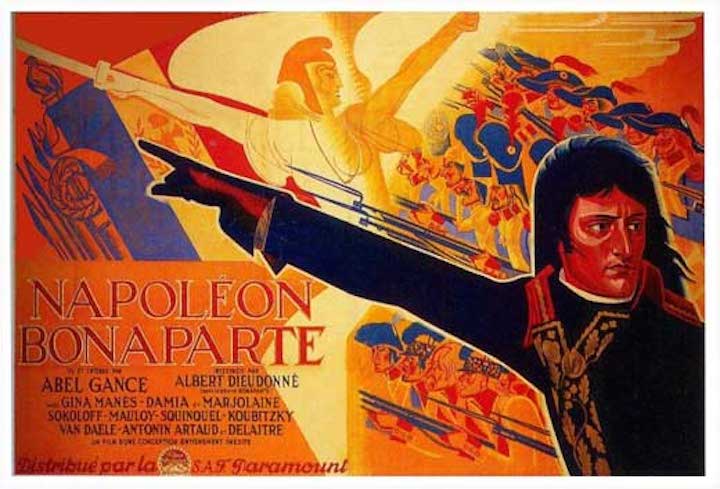
D: Abel Gance / 330m
Cast: Albert Dieudonné, Vladimir Roudenko, Edmond Van Daële, Gina Manès, Antonin Artaud, Alexandre Koubitzky, Marguerite Gance, Yvette Dieudonné, Philippe Hériat, Abel Gance
A five and a half hour silent movie? One that’s unavailable in any home video format, and is unlikely to be for the very foreseeable future? A rich visual spectacle that impresses from its opening snow fight sequence to its stunning triptych finale? I have only one word as my answer: Absolutely!
Before I saw Napoléon, my exposure to silent movies had been restricted largely to comedies featuring the likes of Charlie Chaplin, Buster Keaton, Larry Semon etc. The Keystone Kops were a favourite, and Harold Lloyd impressed me even more when I discovered he’d lost his right thumb and forefinger in an accident involving a bomb prop (I know, it’s a bit shallow, but in mitigation I was around nine or ten). I remember seeing most of The Iron Horse (1924) on TV, and it had the effect of making me realise that silent movies could last longer than twenty minutes, but UK TV wasn’t in the habit of showing anything other than the short films already mentioned. When Napoléon was shown as part of a nationwide tour in 1980 at my local arts theatre – with live piano accompaniment – I saw the advert for it and took out my trusty copy of Halliwell’s Film Guide to find out more about it.
It was the length of the movie that intrigued me. At that time – and my memory is a bit hazy on this – the available print ran to just over five hours. The idea of sitting in a theatre for that length of time, plus interval, was daunting, but equally an attractive one. It’s a little shallow (again) but I wanted to see if I could “stay the course” and be able to say – if anyone I knew had even cared! – that I had seen, all the way through, the five hour plus silent movie set during the French Revolution and beyond. It was like having a badge of honour.
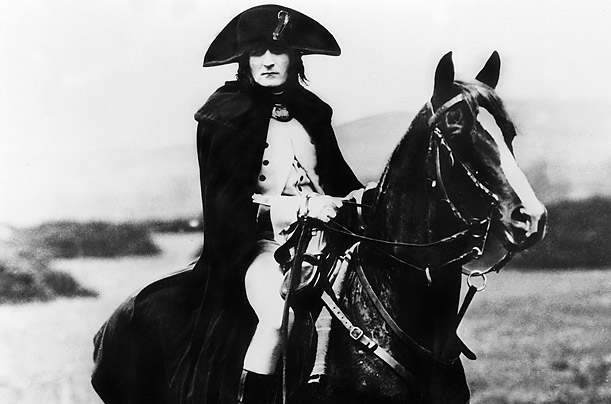
Imagine my surprise (and delight) when the movie began and I found myself swept up by the depth and breadth of Gance’s technical mastery of the silent medium. By the intensity of the performances, the sweep of the narrative, the visual panache of the battle scenes – Gance put his camera in the middle of the action, unheard of up until then – and the effectiveness of the quieter moments against the stirring swirl of historical events. Those five hours flew by. At the interval, I can remember coming out of the auditorium (and into the light) and feeling overwhelmed. Aside from 2001: A Space Odyssey (1968), I’d never been affected as much by a movie, and definitely not by a silent movie. I was seeing techniques and a visual language that were truly amazing; this was breathtaking stuff and I couldn’t wait to go back in and see if the rest of the movie was as incredible. And, of course, it was.
Since then I’ve seen Napoléon four more times. (Sadly, I was out of the country for its most recent UK screening, on 30 November 2013.) Each time I’ve revelled in its complexity and the sheer joy it provides, and each time I’ve come away wanting someone, anyone – but preferably Kevin Brownlow – to come along and say, “We’ve found all the missing footage, and will be presenting the original premiere version of Napoléon in just a few months’ time”. I know this is unlikely, and Brownlow has said himself that the current version is probably the longest it will be for some time to come. (But, what’s the world without a little hope, eh?) Perhaps the best screening was the premiere of Carl Davis’s score for the movie shown at the Royal Festival Hall on London’s south bank. The addition of an orchestra made the whole event even more wonderful and fulfilling.
Napoléon was the first movie that really engaged my heart and my mind and wouldn’t let go. It holds a special place for me as the one movie that remains an event each time I see it. In these days of instant streaming and fast downloads and blu ray discs, the notion of only being able to see a film at a cinema or a concert hall is somehow reassuring, that we haven’t lost that true element of spectacle that we take now for granted. This was how audiences were first exposed to movies, not with ads for the latest trainers or holiday destinations, but with a sense of scale and excitement, a palpable tension at being swept away by what was unfolding on screen. The language of cinema was being created by these movies, and it’s this aspect that shouldn’t be overlooked or forgotten. Without trailblazers such as Gance, a lot of what we take for granted about movies today (or don’t even notice), would be missing. That we’ve lost some of that grandeur is simply disappointing.
Sadly, it will be some time before Napoléon will be seen again on the big screen. But when it is, you can rest assured that I’ll be there (if it’s in the UK), and ready to be enthralled and transported and amazed all over again.
 thedullwoodexperiment