• 10 Reasons to Remember…
  • A Brief Word About…
  • About
  • For One Week Only
  • Happy Birthday
  • Monthly Roundup
  • Old-Time Crime
  • Other Posts
  • Poster of the Week
  • Question of the Week
  • Reviews
  • Trailers

thedullwoodexperiment

~ Viewing movies in a different light

thedullwoodexperiment

Tag Archives: Robert Zemeckis

Welcome to Marwen (2018)

05 Saturday Jan 2019

Posted by dullwood68 in Movies

≈ Leave a comment

Tags

Diane Kruger, Drama, Fantasy, Leslie Mann, Mark Hogancamp, Marwen, PTSD, Review, Robert Zemeckis, Steve Carell, True story, World War II
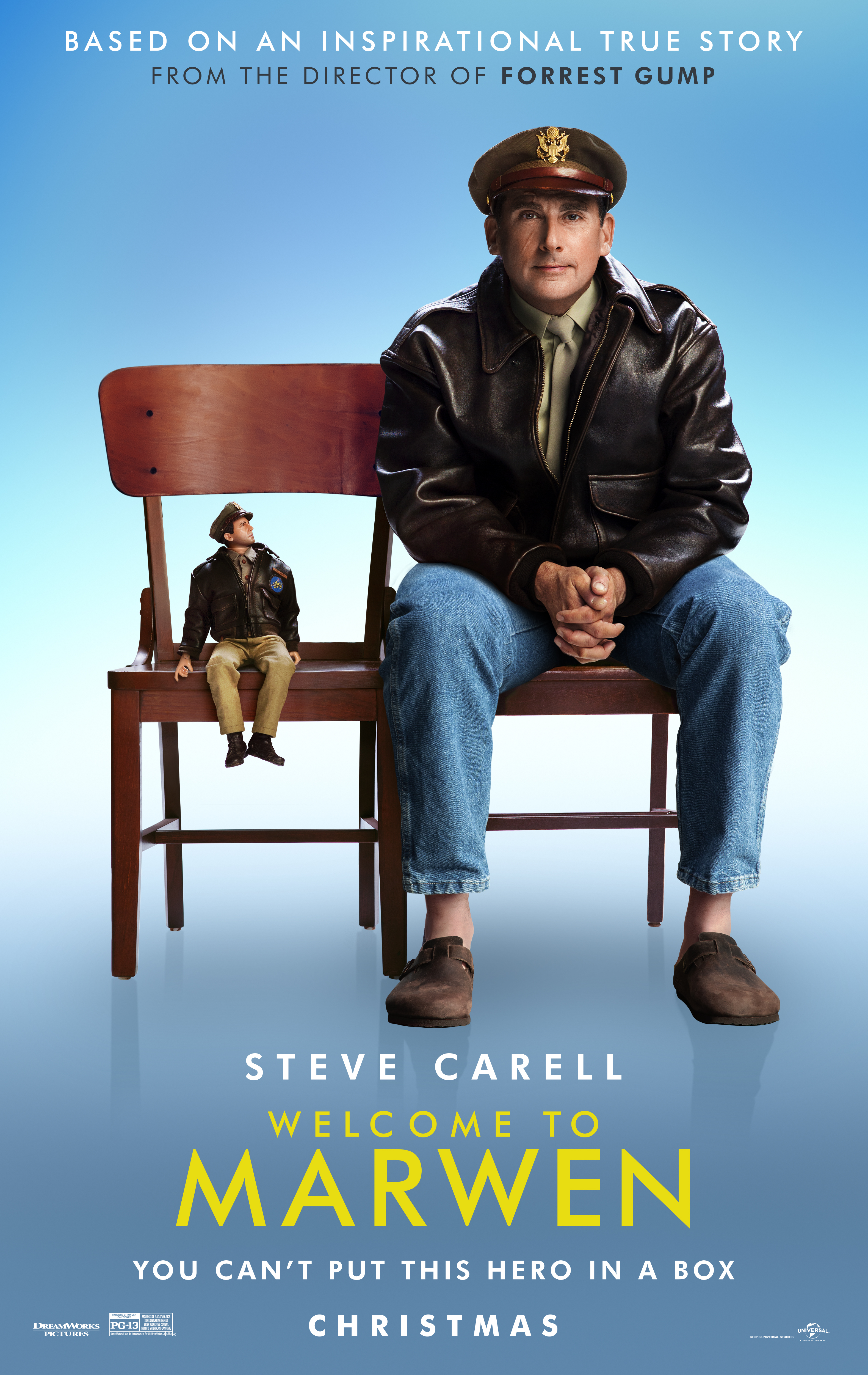
D: Robert Zemeckis / 116m

Cast: Steve Carell, Leslie Mann, Diane Kruger, Janelle Monáe, Gwendoline Christie, Merritt Wever, Eiza González, Leslie Zemeckis, Stefanie von Pfetten, Neil Jackson, Falk Hentschel, Conrad Coates

Following a vicious beating by five white supremacists that robbed him of any personal memories he had before the attack, illustrator Mark Hogancamp (Carell) has managed to rebuild much of his life, but he’s no longer able to draw. Instead, he has created the fictional Belgian town of Marwen, a one-sixth scale model of which he’s built in his yard. Populated by dolls that represent some of the people who have been important to him since the attack, Mark has created a World War II storyline for the dolls of Marwen, and he takes photographs of them in carefully staged positions. These photographs have become regarded as art, and an exhibition of his work is due to take place in the near future. Also due to take place is the sentencing hearing of the men who attacked him, something that Mark’s lawyer (Coates) is pressing him to attend. But with Mark suffering from PTSD, and the Marwen stories occupying so much of his time, it’s only the sympathetic attention of a new neighbour, Nicol (Mann), that starts to bring Mark back to reality…
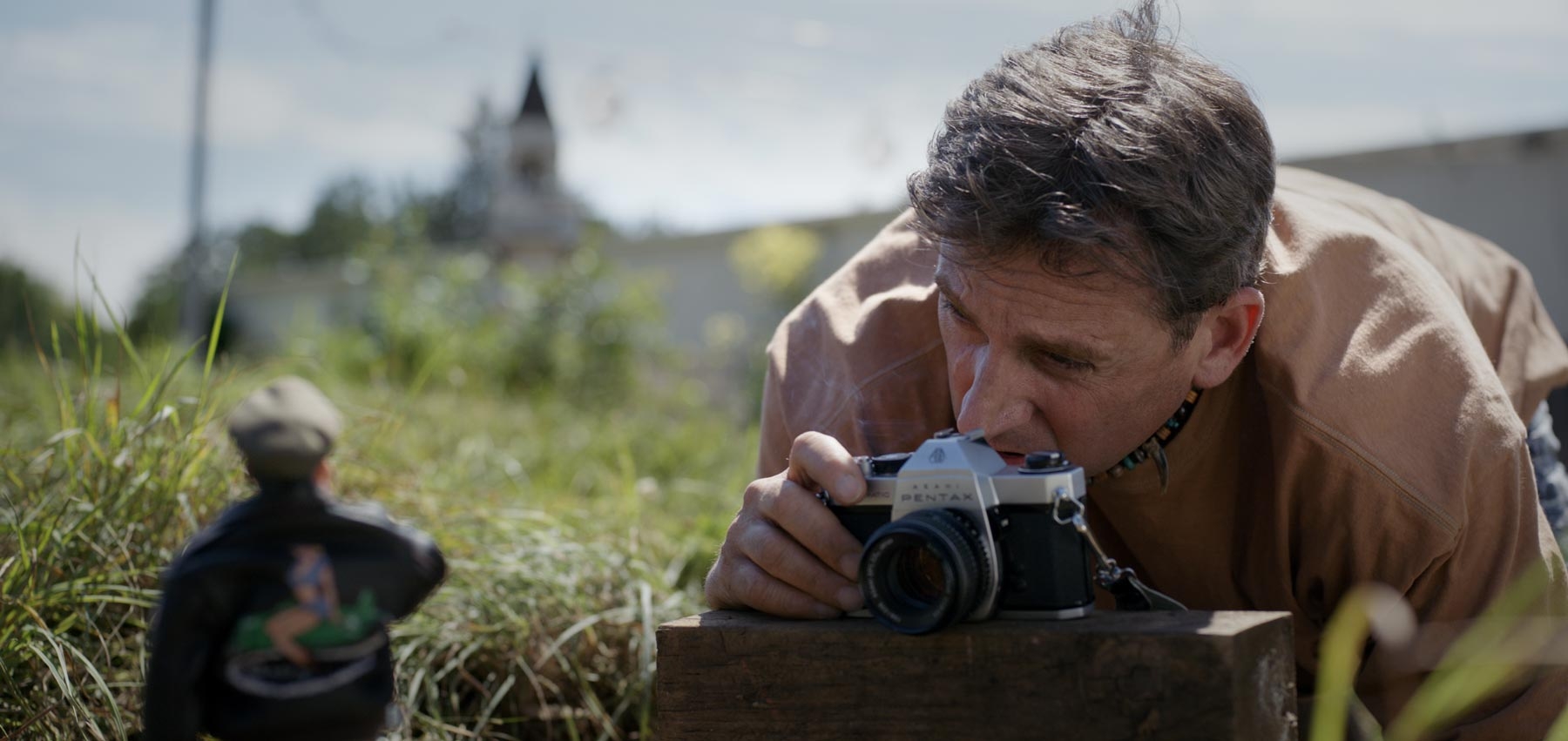
They say that truth is stranger than fiction, and that’s certainly the case with Mark Hogancamp, a man so violently assaulted that his attackers literally “kicked the memory” out of him. In creating the fictional village of Marwen, Hogancamp gave himself a way back to “normality”, even if it was through the use of an alternate, fantasy world populated by revamped Barbie dolls and Nazi soldiers who never die. It’s this aspect of the movie, with its model sets and plastic toy figures and props that makes the most impression, and Zemeckis – no stranger to giving life to CGI characters based on real people and performances – gives these scenes an urgency and a vibrancy that makes Marwen the kind of place we’d all like to visit (even if we’re likely to be shot at by marauding Nazis). With a great deal of charm, and visual wit, Zemeckis and co-scripter Caroline Thompson have created a cinematic variation of Hogancamp’s imagination and story-telling that is in its own way, brave and affecting, and which touches on more serious themes such as gender identity, persistent emotional trauma, drug addiction, and social isolation. There’s plenty of humour here too, but it’s more knowing than it is overt, and there’s a sadness behind it that make it all the more effective.

But while the scenes with Cap’n Hogie and his female coterie are the backbone of the movie and its MVP, the rest of the movie feels more fanciful and fictitious than the idea of dolls toting sub-machine guns and wearing stilettoes during wartime (look it up). Hogancamp is portrayed as a lovable yet tormented man who is personable yet reserved, and socially awkward, yet the introduction of Nicol, whose character feels like a stock idea lifted wholesale from Screenplay 101, grates with every scene she appears in (despite the best efforts of both Carell and Mann), while Hogancamp’s PTSD is laid on with the thickest of dramatic trowels. Carell at least has the measure of the character, but is hampered by the script’s insistence on making him depth-free, and something of a perennial man-child. Elsewhere in the “real world”, there are a number of stodgy contrivances – Nicol’s ex-boyfriend and nasty piece of work, Kurt (Jackson), exists only so he can double for the chief Nazi in Marwen, Nicol is completely unfazed and unconcerned by Hogancamp’s liking for wearing women’s shoes – and after a while any excuse to return to Marwen is likely to be gratefully accepted by the viewer, because that’s where the movie’s true heart and soul resides.

Rating: 6/10 – immensely enjoyable when the action is based in and around Marwen, but stilted and perfunctory when set away from there, Welcome to Marwen is a movie that struggles to balance both halves of its necessarily fractured narrative; Zemeckis directs with his usual flair and gift for visual flamboyance (and gets to include a clever nod to Back to the Future), but is let down by his own decision to make the real world look and sound like a bad soap opera, and by making the dolls more human than the humans.
Share this:

  • Click to share on X (Opens in new window) X
  • Click to share on Facebook (Opens in new window) Facebook
  • More
  • Click to print (Opens in new window) Print
  • Click to email a link to a friend (Opens in new window) Email
Like Loading...

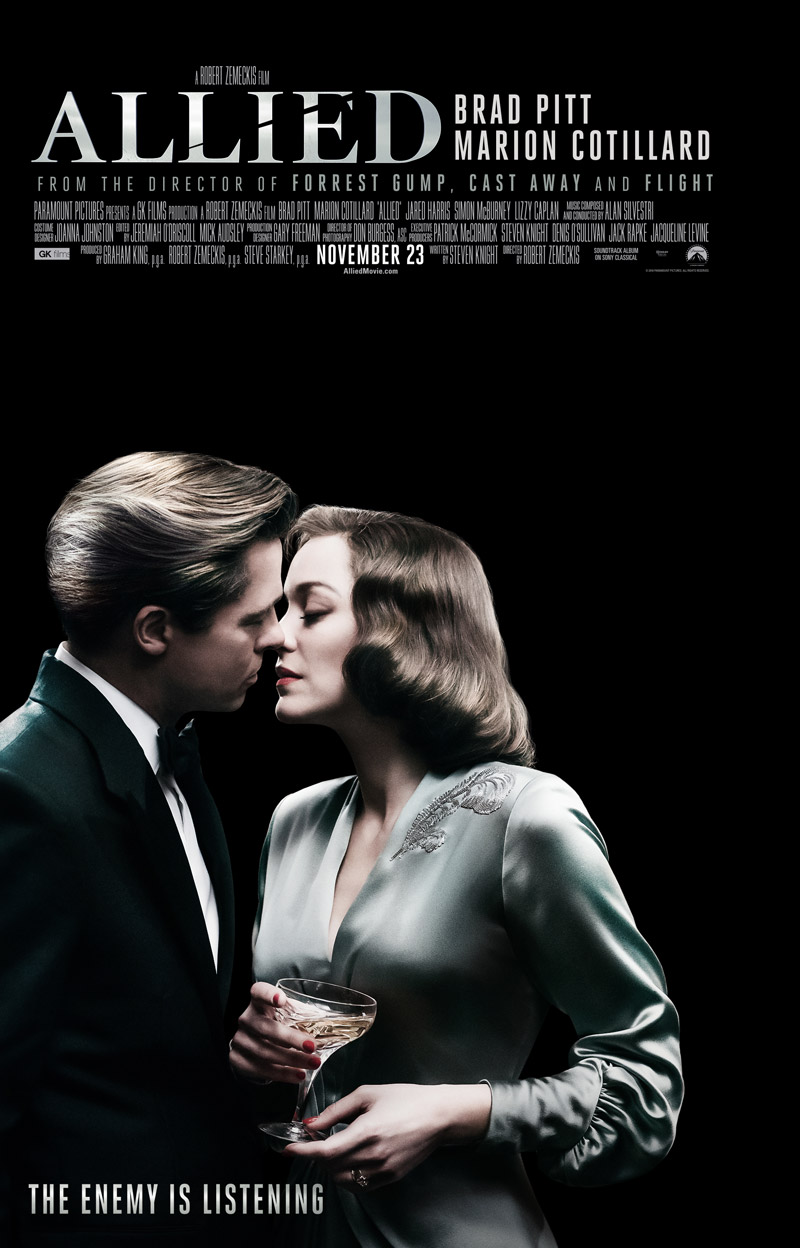
Allied (2016)

16 Friday Dec 2016

Posted by dullwood68 in Movies

≈ 1 Comment

Tags

Action, Brad Pitt, Drama, French Morocco, Jared Harris, Marion Cotillard, Review, Robert Zemeckis, Spy, Thriller, World War II

alliedposter

D: Robert Zemeckis / 124m

Cast: Brad Pitt, Marion Cotillard, Jared Harris, Simon McBurney, Lizzy Caplan, Daniel Betts, Camille Cottin, August Diehl, Matthew Goode, Thierry Frémont, Anton Lesser

French Morocco, 1940. Max Vatan (Pitt), a Canadian officer attached to the British army, is on a mission to assassinate a Nazi ambassador. He rendezvous’s with a French resistance fighter called Marianne Beauséjour (Cotillard). Posing as a married couple, they obtain an invitation to a party that will be attended by the ambassador and several other high-ranking Nazi officials. In the meantime, their posing as a married couple begins to awaken in each of them feelings for the other. When the mission is over, Max and Marianne realise they have fallen in love; he asks her to come to London  so they can marry. After a few months waiting for the red tape to be worked through, Marianne is allowed to join Max, and when she does she reveals that she’s expecting their child.

With their child, a girl, born during an air raid, Max and Marianne’s life begins to settle down into a more sedate existence. With Max rumoured to be in the running for a promotion, he’s called in one day by his superior officer, Frank Heslop (Harris). Frank introduces him to an S.O.E. operative (McBurney) who wastes no time in telling Max that they suspect Marianne is a German spy. Max refuses to believe it, but he’s charged with aiding the S.O.E. in their investigation. He has to receive a telephone call later that night, write down the details of the call and leave them where Marianne will see them, and then wait forty-eight hours until the S.O.E. will know one way or the other if the details have been transmitted to Germany. And there’s a further catch: if Marianne is revealed to be a German spy, then Max has to be the one to kill her.

screen-shot-2016-08-12-at-9-10-35-am

Despite being told not to, the next day Max decides to launch his own investigation. Aiming to prove Marianne’s innocence, he tracks down a British officer (Goode) who knew her before Max did. But the officer is unable to help him. At a party they’re hosting that night, Max sees Marianne talking to an old man (Lesser) he doesn’t recognise; the man turns out to be a jeweller, but Max’s suspicions are increased. With time running out, Max has no option but to travel to Occupied France and seek out the one man he’s certain can tell him if Marianne is who she says she is, a resistance fighter named Paul Delamare (Frémont). He finds the man in gaol, and learns something about Marianne that will answer the question of her guilt or innocence once and for all.

Some directors – many, in fact – have careers that initially show a lot of promise, are very successful once they’ve made four or five movies and have become internationally well-known, but then find their later projects failing to attract both the same audience levels and continuing critical acclaim. Robert Zemeckis is just such a director. Used Cars (1980) is a great, largely unsung comedy that features one of Kurt Russell’s best performances. The Back to the Future trilogy cemented his place in movie history, and Forrest Gump (1994) reinforced his stature as a mainstream director. But since then, and with the possible exception of Cast Away (2000), Zemeckis’ output – including three excursions into the world of performance motion capture – has been less than stellar, and The Walk (2015), a movie that looked as if it could arrest the slow decline in Zemeckis’ career, proved not to be up to the task.

allied-e14604399752361

And sadly, with Allied, Zemeckis has still to reverse that decline. Working from a tired, ineffective screenplay by perennial under-performer Steven Knight, Zemeckis has tried to make an old-fashioned romantic drama that harks back to classic wartime movies such as Casablanca (1942), while also presenting said drama with a more modern visual sheen. The mix, though, doesn’t aid a movie that is difficult to engage with, and which never does enough to make you care about either Max or Marianne. With no one to root for, Knight’s screenplay becomes a matter of pushing the basic storyline through to an incredibly unsatisfactory ending, one that will have audiences shaking their heads in disbelief (though there are plenty of other occasions where they’ll be doing this as well). And Zemeckis, a director whose visual acuity shouldn’t be in doubt, doesn’t seem able to enhance the narrative in any meaningful way, leaving Don Burgess’s cinematography to look and feel as tired as everything else – which is an incredible thing to realise, as Burgess is Zemeckis’ usual DoP, and has lensed non-Zemeckis movies such as Enchanted (2007) and The Book of Eli (2010).

Against this surprisingly dour visual backdrop, Pitt and Cotillard are left “holding the bag” as they try to inject a sense of immediacy into proceedings, and also try to convince the audience that they’re involved in a great love affair. Thanks to Knight’s script, though, neither star has a chance, as they’re hampered by some awful dialogue – “There’s a thing called the soul. I’ve looked into her soul.” – and the kind of motivations that don’t sound credible once they’ve been said out loud. Cotillard fares better than Pitt, but that’s only because she has less to do. Left stranded by virtue of having to carry the movie’s second half on his own, Pitt looks pained and unhappy, and though this could be attributed to his character’s state of mind, it always seems more likely that it’s a reflection of the star’s awareness that the movie isn’t turning out as well as it should.

ALLIED

The rest of the cast pop in and out of the narrative, often for one or two scenes, and fail to make any impact. Harris is the kind of gruff, good-natured senior officer we’d all like to think existed at the Ministry of Defense, McBurney plays an historical predecessor of the role he portrayed in Mission Impossible: Rogue Nation (2015), and Caplan is tucked away at the back of a few scenes as Max’s (apparently) openly lesbian sister, Bridget. While some of these characters are important in terms of moving the story forward, none of them have any depth, and again, thanks to Knight’s tortuous way with dialogue, none of them sound convincing (check out the dialogue Harris is stuck with in the movie’s denouement).

With Zemeckis bringing very little to the project other than his name and an occasional flash of the visual style that he’s most famous for, it’s difficult to work out what attracted him to the project, and very seriously, why he completed it. Coming so soon after The Walk, perhaps he didn’t have as much prep time as he’s used to. Perhaps the initial concept became altered and irretrievably lost during production, leaving Zemeckis stuck with seeing it through. Perhaps he did, genuinely feel that this was a project that he could make an entertaining, thrilling, exciting movie out of. Whatever the reason for his participation, this leaden, dreary, unappealing movie is the result, and it does the man and his career no favours at all.

Rating: 5/10 – yet to recoup its $85 million budget at the international box office, Allied is a movie that tests its audience’s patience, and gives it very little to care about; a dismal experience overall, and a reminder that the combination of a big name director and big name stars doesn’t always guarantee good value or an entertaining couple of hours.

Share this:

  • Click to share on X (Opens in new window) X
  • Click to share on Facebook (Opens in new window) Facebook
  • More
  • Click to print (Opens in new window) Print
  • Click to email a link to a friend (Opens in new window) Email
Like Loading...

Robert Zemeckis’ 10 Most Successful Movies at the International Box Office

10 Monday Oct 2016

Posted by dullwood68 in Movies

≈ Leave a comment

Tags

Career, Director, International Box Office, Robert Zemeckis, Top 10

Robert Zemeckis has been making movies for nearly forty years. He’s been at the forefront of a variety of technical firsts, from motion capture (on The Polar Express) to digital effects (Lieutenant Dan’s missing legs in Forrest Gump), but despite all this he’s still an actors’ director at heart, and he loves to tell a story. Even when his aim is to tell a serious story, such as in The Walk (2015), he still wants to entertain the audience, and to take them on a journey to a place they’ve never seen or experienced before. Along the way he’s made a handful of movies that are bona fide modern classics, and made a little town called Hill Valley into a place we’d all like to visit. For providing us with so many wonderful movie memories, here’s how we’ve repaid him at the international box office.

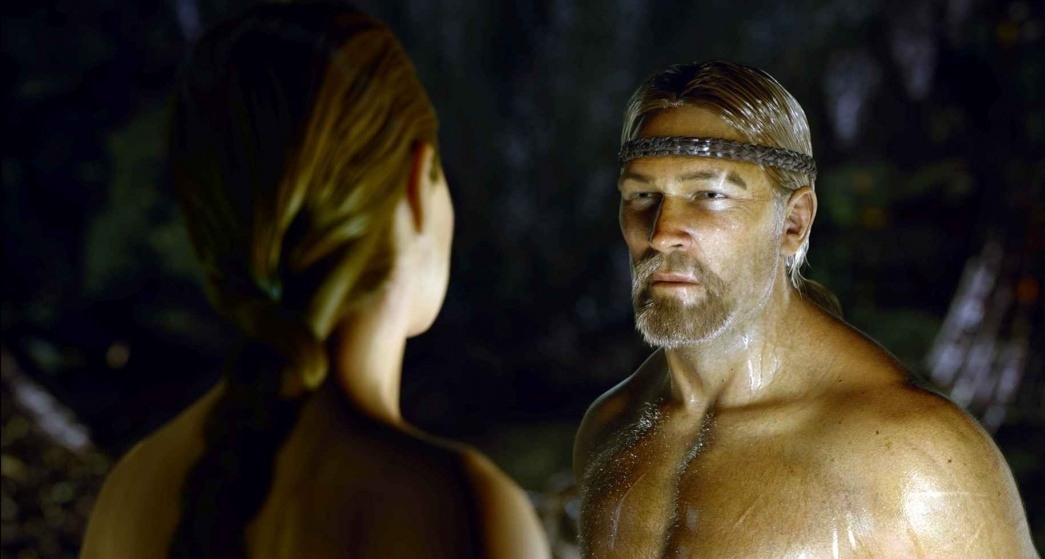
10 – Beowulf (2007) – $196,393,745

The middle picture in Zemeckis’ motion capture trilogy, Beowulf sees him trying to stretch the boundaries of both motion capture and 3D but with predictably mixed results. While his use of 3D is exemplary, the problems that prevented The Polar Express from being completely effective – the dullness of the eyes, the subtleties of lip movement – remain to make for some awkward moments. Nevertheless, the final showdown with the dragon is still one of the best fantasy sequences yet committed to screen (in any format), and Angelina Jolie is a great choice for Grendel’s mother.

beowulf

9 – Back to the Future Part III (1990) – $244,527,583

The last in the trilogy was always going to divide audiences. Some were always going to love it for its Western setting, others were going to hate it for exactly the same reason. Whatever your leaning, what is unassailable is the movie’s appreciation for the genre, and the very satisfactory way in which Zemeckis and co-writer Bob Gale have wound up the overall story. Few trilogy closers are this triumphal, and fewer still are as emotionally astute – only Toy Story 3 (2010) springs to mind – but when you’re having this much fun saying goodbye, it seems right and proper to such a degree that you never think about just how much you’re going to miss the characters when it’s done.

8 – What Lies Beneath (2000) – $291,420,351

Zemeckis tries his hand at a psycho-drama with supernatural overtones, ropes in Michelle Pfeiffer and Harrison Ford as the leads, and manages to pull off a number of effective sequences, but ultimately, What Lies Beneath is a movie that doesn’t quite work in the way that Zemeckis and screenwriter Clark Gregg want it to. The tone of the movie fluctuates too often, leaving viewers uncertain if they’re watching a bloodless horror, a taut thriller, or a domestic drama gone awry. There are elements of all three on display, but it’s when they’re all combined in the same scene that things go badly wrong. Still, the scene where Pfeiffer is paralysed in the bathtub is unbearably tense, and Zemeckis handles it with accomplished ease.

7 – The Polar Express (2004) – $307,514,317

Best seen in its IMAX 3D format, The Polar Express (now a Xmas staple) sees Zemeckis experimenting for the first time with motion capture and gives Tom Hanks the chance to emulate Alec Guinness’s eight role appearance in Kind Hearts and Coronets (1949). It’s a heartwarming tale, with a plethora of breathtaking visuals and sequences – the train racing across a frozen lake as the ice breaks up is simply stunning – and if it’s a little too smothered in saccharine at times, then it’s a small price to pay for a movie that in terms of its original look (and the problems that come with it) is endlessly fascinating to watch.

the-polar-express

6 – A Christmas Carol (2009) – $325,855,863

Zemeckis teams with Jim Carrey for a version of Dickens’ classic tale that dials back on The Polar Express‘s sometimes overbearing sentimentality, and offers all kinds of visual tricks and complexities as the director tries once more to convince audiences that motion capture is the way of the future. But even though many of the issues surrounding facial expressions and physical movement that hampered The Polar Express and Beowulf have been addressed, there’s still an inherent “unreality” to the characters that, in the end (and despite the movie’s success), audiences couldn’t ignore, or overlook.

5 – Who Framed Roger Rabbit (1988) – $329,803,958

When Who Framed Roger Rabbit was first released, there were plenty of people who were fooled by the opening Baby Herman cartoon into thinking the whole movie was going to be animated. That might have been a good move on Zemeckis’ part, but how less satisfying it would have been than this perennial crowd-pleaser, both an homage to the Golden Age of Animation, and the most expensive movie (animated or otherwise) made in the Eighties. It’s an almost perfect blend of comedy, drama, pathos and nostalgia that moves at a cracking pace, and has so many visual gags in it you can’t catch them all in a single viewing. Roger is adorable, his wife Jessica Rabbit “isn’t bad… [she’s] just drawn that way”, and when revealed, Judge Doom is one of the scariest villains in any movie, period.

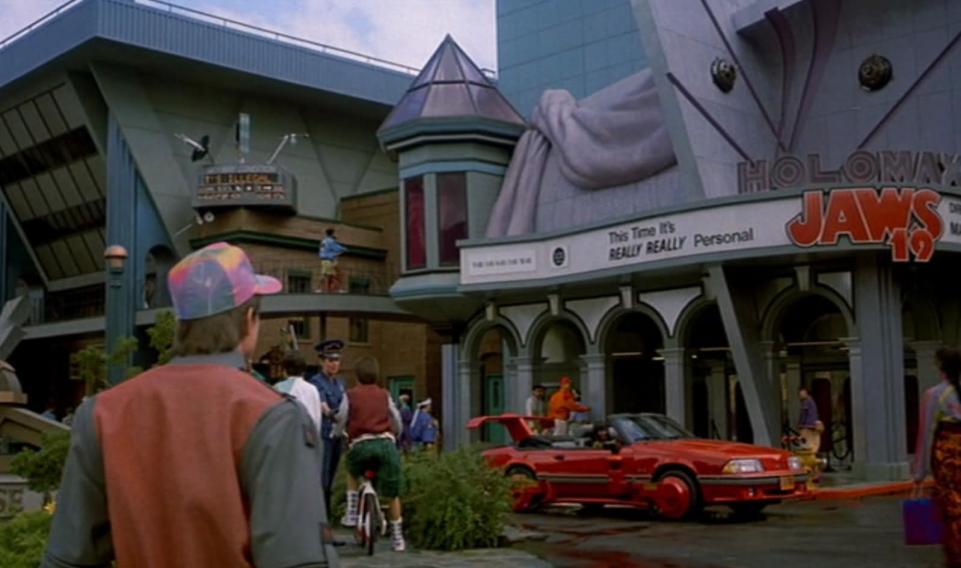
4 – Back to the Future Part II (1989) – $331,950,002

Many people felt that Back to the Future Part II was too complex, too convoluted, and too much of a head-scratcher, especially when Marty travelled back to 1955 to ensure his parents got together – again. But it’s the movie’s complex understanding of time travel, and the consequences that can arise when time is tinkered with, that makes this first sequel such an unexpected joy to watch. It’s also darker and more cynical than the first and third movies, but Zemeckis handles the material with confidence and no small amount of flair. For some fans, this is the best movie in the trilogy.

back-to-the-future-part-ii

3 – Back to the Future (1985) – $381,109,762

The movie that made Zemeckis’ career, Back to the Future is a delight from start to finish, a beautifully rendered love poem to a bygone era, and one of the smartest sci-fi comedies ever made (if not the smartest). Michael J. Fox and Christopher Lloyd make for an inspired teaming, and the whole thing is both whimsical and irresistible, with some classic lines of dialogue (“Roads? Where we’re going, we don’t need roads.”), and a whole raft of smart, enagaging performances. A movie you can watch over and over again and never tire of it.

2 – Cast Away (2000) – $429,632,142

If all you take away from Cast Away is that Tom Hanks lost an awful lot of weight to convince viewers his character was living on a desert island, and that he talked (a lot) to a volleyball called Wilson, then you’re missing the point of a movie that paints a vivid, unsentimental portrait of a man believed missing at sea who learns the art of survival the hard way. Hanks gives one of his best-ever performances, but the script includes too many longeuers for comfort, and the final third fails to match the impetus of the opening scenes. Zemeckis shows a keen eye for the practicalities of surviving on a desert island, and along with a committed Hanks, ensures the audience is just as invested in Hanks’s character getting off the island as he is.

1 – Forrest Gump (1994) – $677,945,399

Unsurprisingly, it’s the Oscar-winning home run that is Forrest Gump which sits atop this list. A perfect combination of director, script and star, the movie blends so many disparate elements, both thematically and visually (and with such confidence), that it’s easy to forget just how much of a surprise this movie was when it appeared over twenty years ago. Hanks, arguably, has never been better, and the same can be said of Zemeckis, who displays a fearlessness in handling the material that he’s never quite managed to recapture in his work since then.

forrest-gump

Share this:

  • Click to share on X (Opens in new window) X
  • Click to share on Facebook (Opens in new window) Facebook
  • More
  • Click to print (Opens in new window) Print
  • Click to email a link to a friend (Opens in new window) Email
Like Loading...

Back in Time (2015)

13 Friday Nov 2015

Posted by dullwood68 in Movies

≈ Leave a comment

Tags

1955, 1985, 2015, Back to the Future, Back to the Future Part II, Back to the Future Part III, Backtothefuture.com, Bob Gale, Christopher Lloyd, Crispin Glover, DeLorean, Doc Brown, Documentary, Hoverboard, Lea Thompson, Marty McFly, Michael J. Fox, Princess Diana, Review, Robert Zemeckis, Thomas F. Wilson, Time travel

Back in Time

D: Jason Aron / 95m

With: Bob Gale, Robert Zemeckis, Michael J. Fox, Christopher Lloyd, Lea Thompson, Steven Spielberg, Frank Price, Donald Fullilove, Huey Lewis, Claudia Wells, James Tolkan, Alan Silvestri, Dean Cundey, Dan Harmon, Adam F. Goldberg, Jeffrey Weissman, Andrew Probert, Kevin Pike, Michael Scheffe

The enduring appeal of the Back to the Future trilogy is due to one inescapable fact: the scripts – by Bob Gale and Robert Zemeckis on Part I, and Gale alone on parts II and III – are some of the best screenplays ever written. Forget that these aren’t movies that explore in depth the meaning of life, or what it is to be human, or any other deep, meaningful topics. Remember instead that these movies, taken together, constitute one of the most enjoyable, most rewarding movie trilogies this side of the Toy Story series (and if you ignore animation altogether, then they win hands down – sorry anyone waving the Star Wars Original Trilogy at me; I have just one word for you: Ewoks).

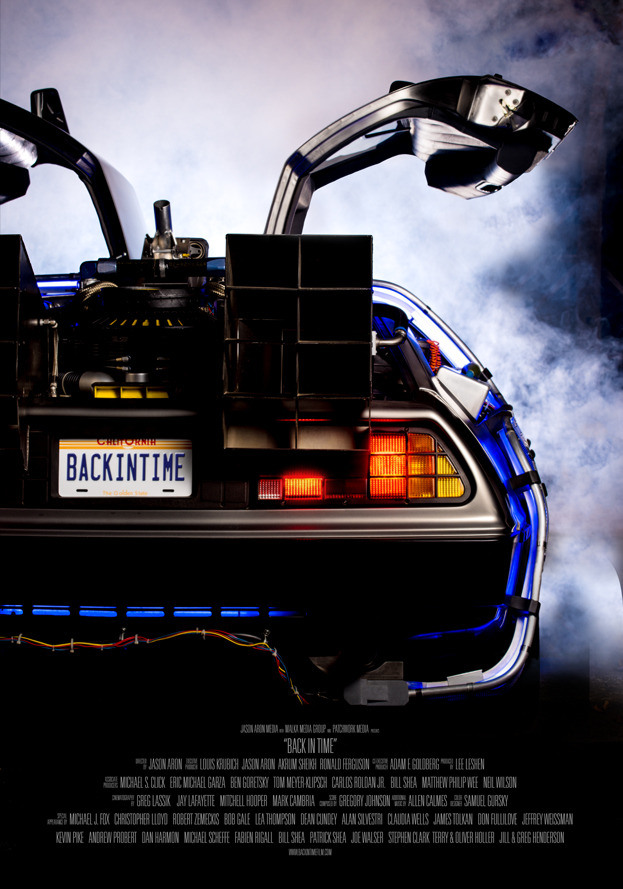
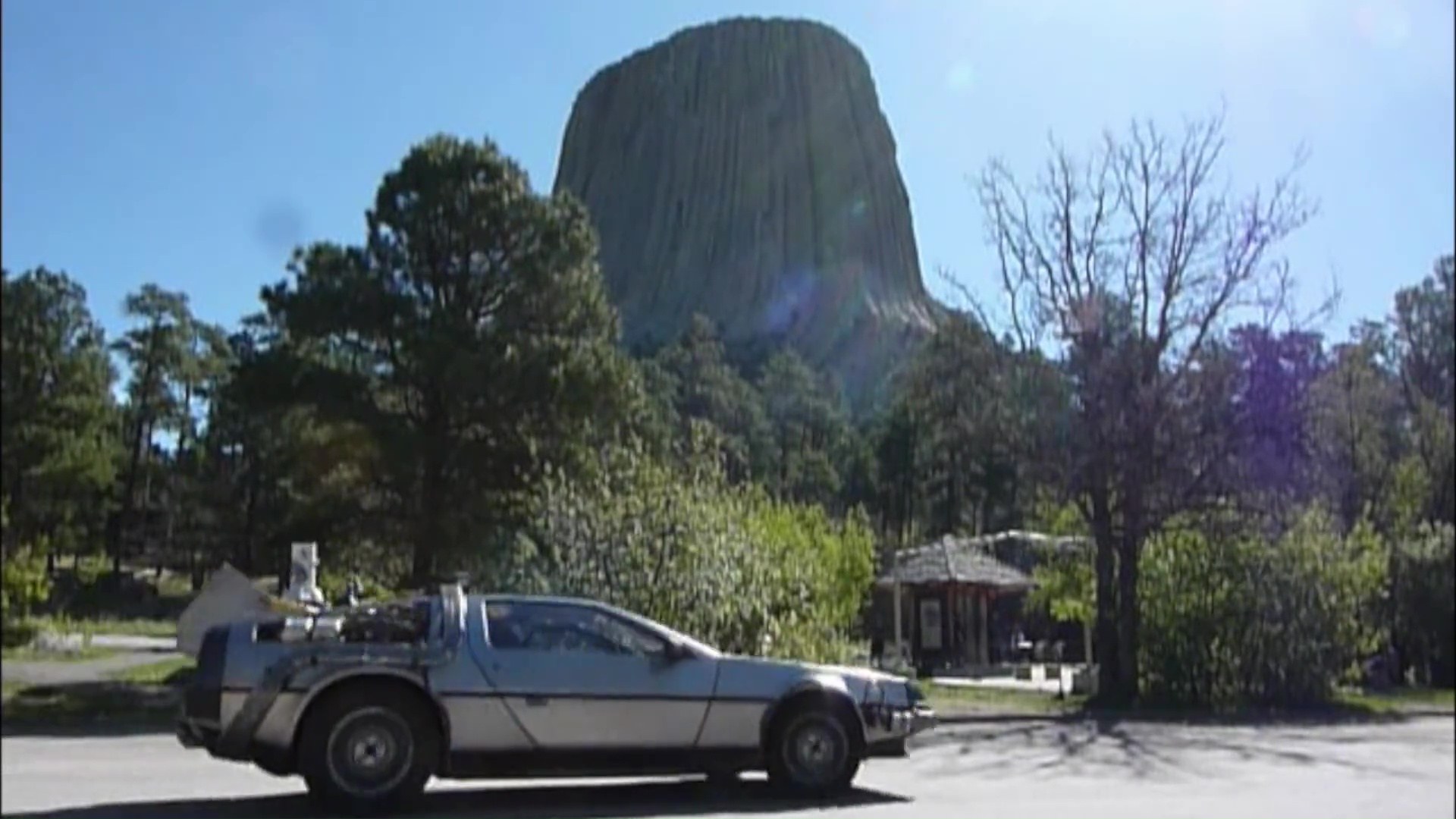
Jason Aron’s likeable, though fumbled, documentary looks at the story behind the making of the first movie, and then widens its scope to look at how it’s affected the lives of some of its fans, people like Stephen Clark, who became the Executive Director of Backtothefuture.com, the one-stop shop for anyone looking for information or merchandise relating to the series. Or Terry and Oliver Holler, who bought a DeLorean as a Bucket List idea when Oliver was diagnosed with cancer; now they travel around the US in their BttF-style DeLorean raising money for Michael J. Fox’s Parkinson’s charity. Or Greg and Jill Henderson, who through their company Arx Pax, have created a working hoverboard.

vlcsnap-00001

While these stories are interesting in and of themselves, and the people recounting them are engaging and refreshingly down-to-earth about their love for the movies and the work they do as a result of that love, it all comes at the expense of the movies themselves. If you’re a fan of Parts II and III, then this is not the movie for you if you’re looking for insights into the making of those movies, or any anecdotes relating to them. Part II gets a brief look, while Part III is practically ignored. The focus is squarely on Part I as the launching point for all the fan activity that followed in its wake.

So this leaves the movie feeling, initially, like it’s going to be about the making of all three movies. But it keeps veering away, jumping from personal recollections to detailed analyses of how several DeLoreans were transformed (by several different people) into copies of the cars used in the movies. There’s feedback from other entertainers/writers/directors, such as Dan Harmon, who created Community, and Adam F. Goldberg, the creator of The Goldbergs. And there are glimpses of conventions and public events, including the Secret Cinema presentation of Back to the Future from 2014. The movie covers a lot of ground, but in doing so, misses out on quite a lot also.

vlcsnap-00003

Part of the issue is, as mentioned above, the way in which Back in Time‘s structure reduces the amount of time we have to find out about one of the most respected and well-regarded cultural icons of the last thirty years. There are some great anecdotes about the making of the first movie, including Disney’s reaction to the script, and Gale is a great guide for the viewer, but without the contributions of Fox, Lloyd and Thompson in particular, this would be a rather dry examination of a wonderful movie (Zemeckis looks uncomfortable throughout, as if looking back on such a long-ago project detracts from the work he’s doing today).

There’s a flatness about the movie as well, a quality that makes it difficult for the viewer to become completely engaged with it. Whole stretches pass by in such a plain, matter-of-fact way that anyone watching from the comfort of their armchair might be inclined to skip ahead to the next section and see if it’s any more interesting. Aron also  keeps the shooting style pretty plain and simple, and the static talking head approach is rarely abandoned for anything different.

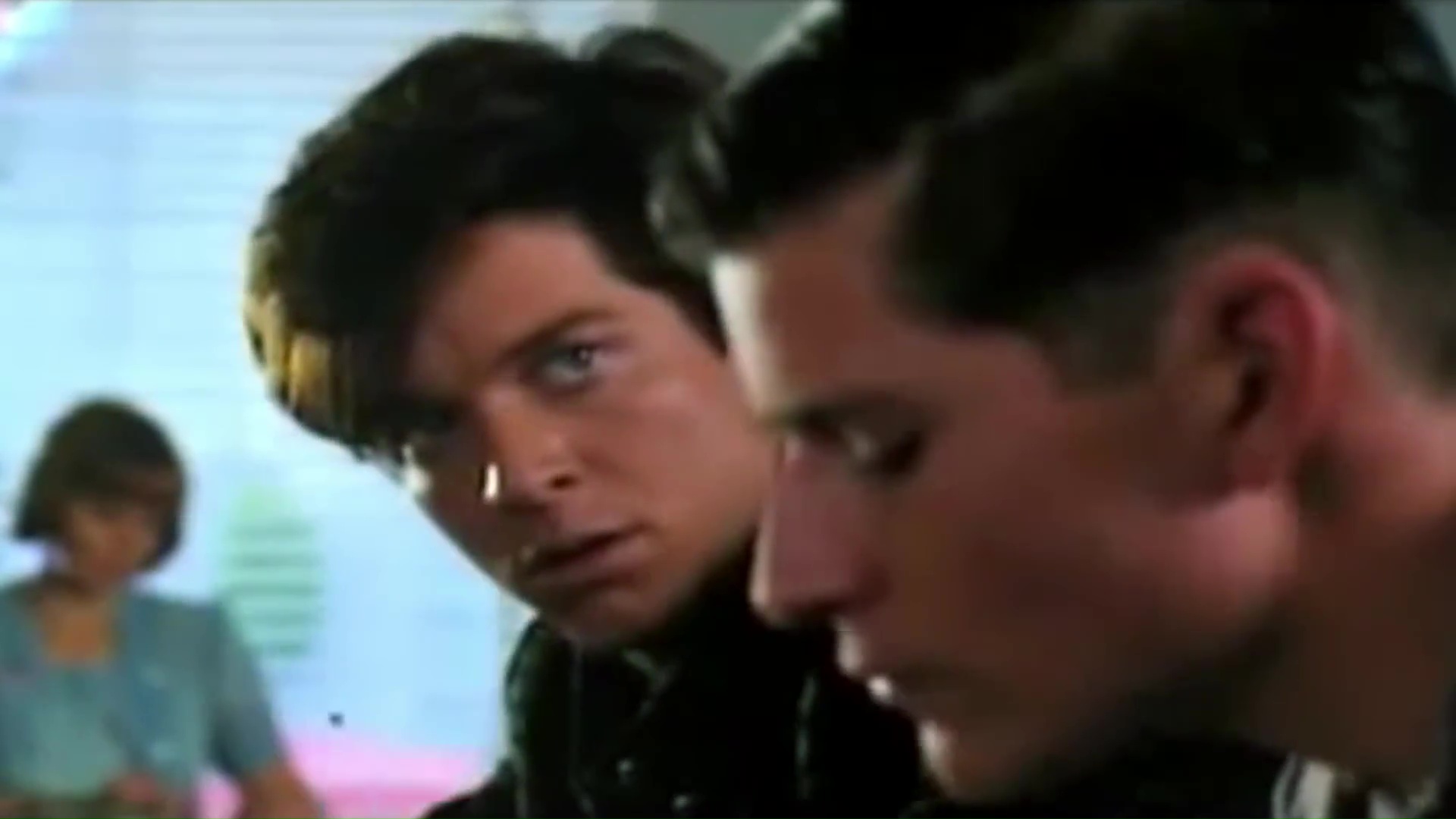
As for the cast and crew of Back to the Future, the absence of Thomas F. Wilson (any Tannen you care to mention), and Crispin Glover (George McFly in Part I) is disappointing even though it’s expected. Aside from voicing his characters on various video games over the years, Wilson hasn’t milked his association with the series in the way that, say, Wells and Fullilove have (just watch the movie to find out how), but it would have been interesting to hear what he recalls about making the movies*. Glover, of course, shot himself in the foot when negotiating his contract for Parts II and III, but again, his contribution to such a terrific movie would be great to hear about. (The same goes for Eric Stoltz, but that’s probably not going to happen either.)

vlcsnap-00002

With the movie not quite working at the level it needs to, and even though there are some priceless moments – Fox referring to Princess Diana as “smokin’ hot”; Greg Henderson saying if he could time travel he’d like to go back and “bitch slap” a couple of people – it’s perhaps fitting to end this review with an absolutely brilliant quote from Dan Harmon: “We actually use the same logic when we go to see movies as we do walking into a casino. We largely know we’re gonna get ripped off, but the chance is worth it. If it were any other industry, we would have long ago shut it down and sued everybody. Because if it was cans of tuna, the equivalent would be like every third can had a human finger in it. Movies are so bad now.” And amen to that.

Rating: 6/10 – imperfectly assembled and with too many distractions from the “main feature”, Back in Time is only occasionally successful in doing justice to the movie series it has such high regard for; a once only viewing experience that will only have viewers clamouring for more about the movies and not the fans – they should have been saved for another movie all their own.


*If you want to have some idea of how Thomas F. Wilson feels about his association with Back to the Future, check this out:

Share this:

  • Click to share on X (Opens in new window) X
  • Click to share on Facebook (Opens in new window) Facebook
  • More
  • Click to print (Opens in new window) Print
  • Click to email a link to a friend (Opens in new window) Email
Like Loading...

The Walk (2015)

14 Wednesday Oct 2015

Posted by dullwood68 in Movies

≈ 1 Comment

Tags

Ben Kingsley, Charlotte Le Bon, Drama, High wire, James Badge Dale, Joseph-Gordon-Levitt, Literary adaptation, Philippe Petit, Review, Robert Zemeckis, Tightrope, True story, Twin Towers, World Trade Center

Walk, The

D: Robert Zemeckis / 123m

Cast: Joseph Gordon-Levitt, Ben Kingsley, Charlotte Le Bon, James Badge Dale, Clément Sibony, César Domboy, Steve Valentine, Ben Schwartz, Benedict Samuel

1973. Philippe Petit (Gordon-Levitt) is a street entertainer in Paris, France, who includes some wire work in his act, usually strung between two trees and without the benefit of having a permit. One day he accepts a gobstopper from a young girl in his audience, but when he bites into it, it causes a painful problem that he goes straight to the dentist with. While in the waiting-room he sees a magazine article on New York’s Twin Towers. Straightaway, Petit knows what he has to do: he has to learn the intricacies of high wire work, and from the acknowledged master, Papa Rudy (Kingsley), in order that he can fulfil his dream of walking between the Twin Towers on just a length of cable. Rudy agrees to teach him. Aided by his girlfriend, Annie (Le Bon), and mutual friend, Jean-Louis (Sibony), Petit determines to travel to New York and carry out his dream.

Once there, Petit enlists the aid of further “accomplices”, such as J.P. (Dale) and Barry Greenhouse (Valentine), who works in the South Tower. Several visits to the site are made in an effort to discover the best time for stringing the cable between the two buildings, and more importantly, when Petit should make the crossing. Petit, though, steps on a nail and injures his right foot, but won’t hear of cancelling or postponing the high wire walk (which has been set for 6 August 1974, and is called The Coup). Aided by Jean-Francois (aka Jeff) (Domboy) and two others recruited by J.P., Petit forges ahead with his plan and they manage to sneak all the relevant equipment into both buildings. But on the night of the 5th, with Petit planning to commence his walk across “the Void” at 6am, the presence of a night guard, and some unexpected problems with the cable and the lines used to stop it from wobbling, throw the endeavour off schedule. Eventually, with Jeff to help him, and Jean-Louis on the other tower, and with Annie, J.P. and Barry watching from the street, Petit takes his first steps out onto the wire…

Walk, The - scene

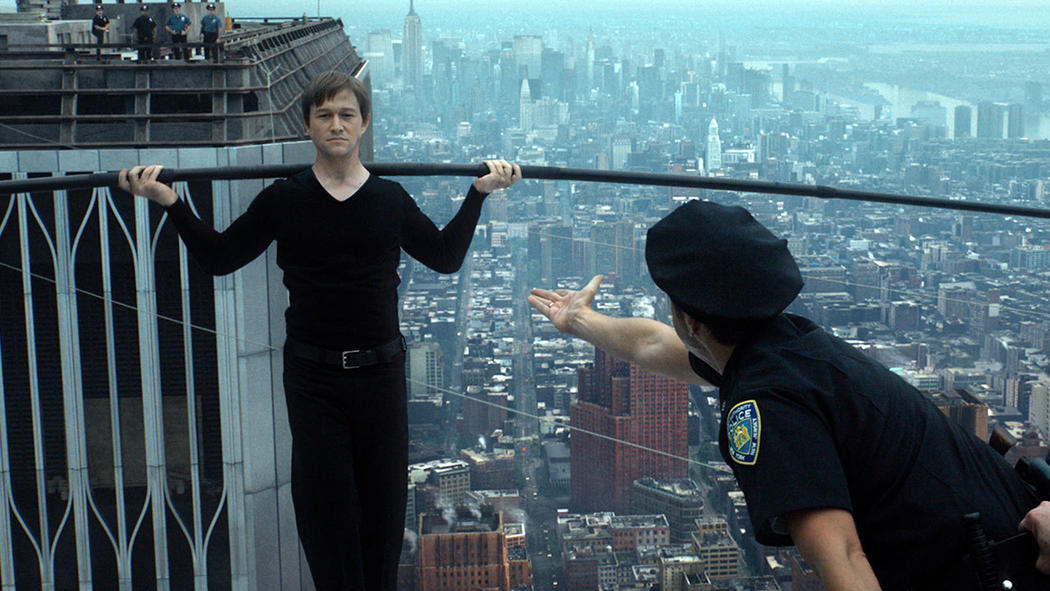
James Marsh’s documentary on Philippe Petit, Man on Wire (2008), won the Best Documentary Feature Oscar in 2009, as well as a whole raft of other awards from around the world. The one criticism that can be levelled against what is otherwise a very good examination of Petit’s particular brand of “artistic madness”, is that there’s no footage of Petit walking between the Twin Towers. In the hands of Robert Zemeckis, The Walk seeks to remedy this by putting the audience up there with Petit, and by showing just how dangerous it was. However, the key phrase here is “seeks to remedy”, as by and large, Zemeckis takes his cue from Petit himself and dismisses any attempt to instil any fear or heart-pounding terror into the walk itself. While it may well be true that Petit was confident of his abilities, and that the walk – or walks: he traversed the wire several times – was easier than he’d expected, but once he’s out there, the tension that Zemeckis and co-screenwriter Christopher Browne have so successfully created in the movie’s third act (of four) swiftly evaporates.

The movie takes an odd approach to the material, and feels schizophrenic as a result, with a first half that concentrates, in a very old-fashioned Hollywood way, on Petit as a young man just starting out as a street performer, before becoming inspired to walk between the towers. It has the look and feel of a regular biography, with key moments ticked off against a list, and with any potential spontaneity halted before it’s given a chance to start (there’s even a scene where Petit and Annie are getting to know each other by romantic candlelight). And if truth be told, these scenes aren’t even that interesting, delaying as they do the central focus of the movie, namely that walk. Petit shows off his arrogance, Annie melts under his charm too quickly, and things happen with a convenience and disregard for clarity that it’s easier just to go along with it all and wait for the movie to pick up by itself.

Which it does once Petit and friends start “casing the joint” and begin installing the equipment they need. This stretch of the movie contains the most tension and is easily the most compelling, as obstacles need to be overcome and the Coup becomes in danger of being cancelled indefinitely. As the fiercely determined Petit, Gordon-Levitt holds it all together, and if his accent slips from time to time, it’s not the end of the world. He channels Petit’s passion for high wire work with aplomb, even if the character – as written – isn’t as socially aloof or as difficult to work with as Man on Wire revealed. Gordon-Levitt also proves to be a proficient high wire walker, having spent time learning how to do it for real. It’s this level of commitment that helps the movie overcome the weakness inherent in the narrative, the one that doesn’t allow the other characters to be as fleshed out as Petit.

Annie (Charlotte Le Bon) and Philippe Petit (Joseph Gordon-Levitt) in TriStar Pictures' THE WALK.

While people like Le Bon, Valentine, and Dale left to stand on the sidewalk and stare at proceedings through binoculars, it’s left to Gordon-Levitt and Domboy to ratchet up the tension, especially Domboy, whose character Jeff, is terrified of heights. Kingsley floats in and out of the narrative and acts purely as a mine of information or encouraging mentor. But while the main performances, however truncated by the need to fit as much in as possible, are comfortably undemanding of the cast, don’t let them die.

Another issue is the unconvincing CGI work carried out once Petit and Jeff are on the roof of the South Tower. The backdrops are impressively detailed, but it’s not enough to allow them to look any better. They stand out against their surroundings, and unfortunately, it’s distracting, as well as a shock to see that an innovator like Zemeckis can’t overcome the lighting issues that have caused this effect. And even more unfortunately, when the camera swings or pans its way over and around Petit’s head when he’s on the wire, there’s no real sense of depth to the image, no sense that this is a very long way down (or somewhere very high up). Petit’s own storytelling image, the emphasis he puts on the danger, and the awkward position it puts him in with the authorities is nicely handled but it’s all too little, too late. And the decision to have Petit holding forth on his exploits from the top of the Statue of Liberty may have semed like a good idea at the time, but in actuality it’s off-putting and makes for dramatically turgid viewing.

The movie does benefit from a classy, contemporary score by the ever reliable Alan Silvestri, while the movie – on the ground, at least – offers some superb visuals courtesy of Dariusz Wolski. If the movie tries to include too much of Petit’s history for its own good, then the end result is a little uneven, and still very ragged in places, but overall the movie does have its charms, and some viewers may yet find themselves overcome by some of the aerial shots

Rating: 6/10 – too uneven and too much like a soap opera in the first half, The Walk treads the Hollywood line once too often to create a movie no one will be able to remember even when they’re buying it; a disappointment then (even in IMAX 3D), and not as gripping as it should have been, it’s still a much more attractive proposition than most movies that are out at the moment.

Share this:

  • Click to share on X (Opens in new window) X
  • Click to share on Facebook (Opens in new window) Facebook
  • More
  • Click to print (Opens in new window) Print
  • Click to email a link to a friend (Opens in new window) Email
Like Loading...

Blog Stats

  • 486,619 hits

Recent Posts

  • 10 Reasons to Remember Bibi Andersson (1935-2019)
  • Fantasia (1940)
  • Dances With Wolves (1990) – The Special Edition
  • Kiss of the Spider Woman (1985)
  • The Three Musketeers (1973)

Top Posts & Pages

  • Lost for Life (2013) - Another Look
    Lost for Life (2013) - Another Look
  • Lost for Life (2013)
    Lost for Life (2013)
  • About
    About
  • Mr. Topaze (1961)
    Mr. Topaze (1961)
  • Shock and Awe (2017)
    Shock and Awe (2017)
  • Hunt for the Wilderpeople (2016)
    Hunt for the Wilderpeople (2016)
  • Cardboard Boxer (2016)
    Cardboard Boxer (2016)
  • Billy Lynn's Long Halftime Walk (2016)
    Billy Lynn's Long Halftime Walk (2016)
  • Winter's Tale (2014)
    Winter's Tale (2014)
  • Exposed (2016)
    Exposed (2016)
Follow thedullwoodexperiment on WordPress.com

Blogs I Follow

  • Rubbish Talk
  • Film 4 Fan
  • Fast Film Reviews
  • The Film Blog
  • All Things Movies UK
  • Interpreting the Stars
  • Let's Go To The Movies
  • Movie Reviews 101
  • TMI News
  • Dan the Man's Movie Reviews
  • Film History
  • Jordan and Eddie (The Movie Guys)

Archives

  • April 2019 (13)
  • March 2019 (28)
  • February 2019 (28)
  • January 2019 (32)
  • December 2018 (28)
  • November 2018 (30)
  • October 2018 (29)
  • September 2018 (29)
  • August 2018 (29)
  • July 2018 (30)
  • June 2018 (28)
  • May 2018 (24)
  • April 2018 (21)
  • March 2018 (31)
  • February 2018 (25)
  • January 2018 (30)
  • December 2017 (30)
  • November 2017 (27)
  • October 2017 (27)
  • September 2017 (26)
  • August 2017 (32)
  • July 2017 (32)
  • June 2017 (30)
  • May 2017 (29)
  • April 2017 (29)
  • March 2017 (30)
  • February 2017 (27)
  • January 2017 (32)
  • December 2016 (30)
  • November 2016 (28)
  • October 2016 (30)
  • September 2016 (27)
  • August 2016 (30)
  • July 2016 (30)
  • June 2016 (31)
  • May 2016 (34)
  • April 2016 (30)
  • March 2016 (30)
  • February 2016 (28)
  • January 2016 (35)
  • December 2015 (34)
  • November 2015 (31)
  • October 2015 (31)
  • September 2015 (34)
  • August 2015 (31)
  • July 2015 (33)
  • June 2015 (12)
  • May 2015 (31)
  • April 2015 (32)
  • March 2015 (30)
  • February 2015 (37)
  • January 2015 (39)
  • December 2014 (34)
  • November 2014 (34)
  • October 2014 (36)
  • September 2014 (25)
  • August 2014 (29)
  • July 2014 (29)
  • June 2014 (28)
  • May 2014 (23)
  • April 2014 (21)
  • March 2014 (42)
  • February 2014 (38)
  • January 2014 (29)
  • December 2013 (28)
  • November 2013 (34)
  • October 2013 (4)

Blog at WordPress.com.

Rubbish Talk

Film 4 Fan

A Movie Blog

Fast Film Reviews

The Film Blog

The official blog of everything in film

All Things Movies UK

Movie Reviews and Original Articles

Interpreting the Stars

Dave Examines Movies

Let's Go To The Movies

Film and Theatre Lover!

Movie Reviews 101

Daily Movie Reviews

TMI News

Latest weather, crime and breaking news

Dan the Man's Movie Reviews

All my aimless thoughts, ideas, and ramblings, all packed into one site!

Film History

Telling the story of film

Jordan and Eddie (The Movie Guys)

Movie Reviews & Ramblings from an Australian Based Film Fan

Privacy & Cookies: This site uses cookies. By continuing to use this website, you agree to their use.
To find out more, including how to control cookies, see here: Cookie Policy
  • Subscribe Subscribed
    • thedullwoodexperiment
    • Join 481 other subscribers
    • Already have a WordPress.com account? Log in now.
    • thedullwoodexperiment
    • Subscribe Subscribed
    • Sign up
    • Log in
    • Report this content
    • View site in Reader
    • Manage subscriptions
    • Collapse this bar
 

Loading Comments...
 

    %d