• 10 Reasons to Remember…
  • A Brief Word About…
  • About
  • For One Week Only
  • Happy Birthday
  • Monthly Roundup
  • Old-Time Crime
  • Other Posts
  • Poster of the Week
  • Question of the Week
  • Reviews
  • Trailers

thedullwoodexperiment

~ Viewing movies in a different light

thedullwoodexperiment

Tag Archives: Samurai

Blade of the Immortal (2017)

14 Monday May 2018

Posted by dullwood68 in Movies

≈ Leave a comment

Tags

Action, Drama, Japan, Kimura Takuya, Manga adaptation, Review, Samurai, Sugisaki Hana, Takashi Miike, Thriller

Original title: Mugen no jûnin

D: Takashi Miike / 141m

Cast: Kimura Takuya, Sugisaki Hana, Fukushi Sôta, Ichihara Hayato, Toda Erika, Kitamura Kazuki, Kuriyama Chiaki, Mitsushima Shinnosuke, Tanaka Min, Yamamoto Yôko

Manji (Kimura) is a man haunted by a tragic past involving the death of his sister, an incident that left him unable to die thanks to the intervention of a mysterious woman (Yamamoto). Fifty-two years later, a young girl, Rin (Sugisaki), approaches him to be her bodyguard and help gain revenge for the death of her father at the hands of Kagehisa Anotsu (Fukushi), the head of a new martial arts school. Manji refuses at first, but when Rin is attacked by one of Kagehisa’s men, he changes his mind. When news reaches Kagehisa that his man is dead, so begins a series of encounters as Kagehisa’s followers – aware that Manji cannot be killed – try various ways and means to defeat him. Meanwhile, Kagehisa attempts to influence the Shogun training school into joining his own school, but his plan fails. As Manji’s body suffers more and more from each encounter, circumstances bring him and Kagehisa together against an army of Shogun warriors, and if fate has a hand, then against each other…
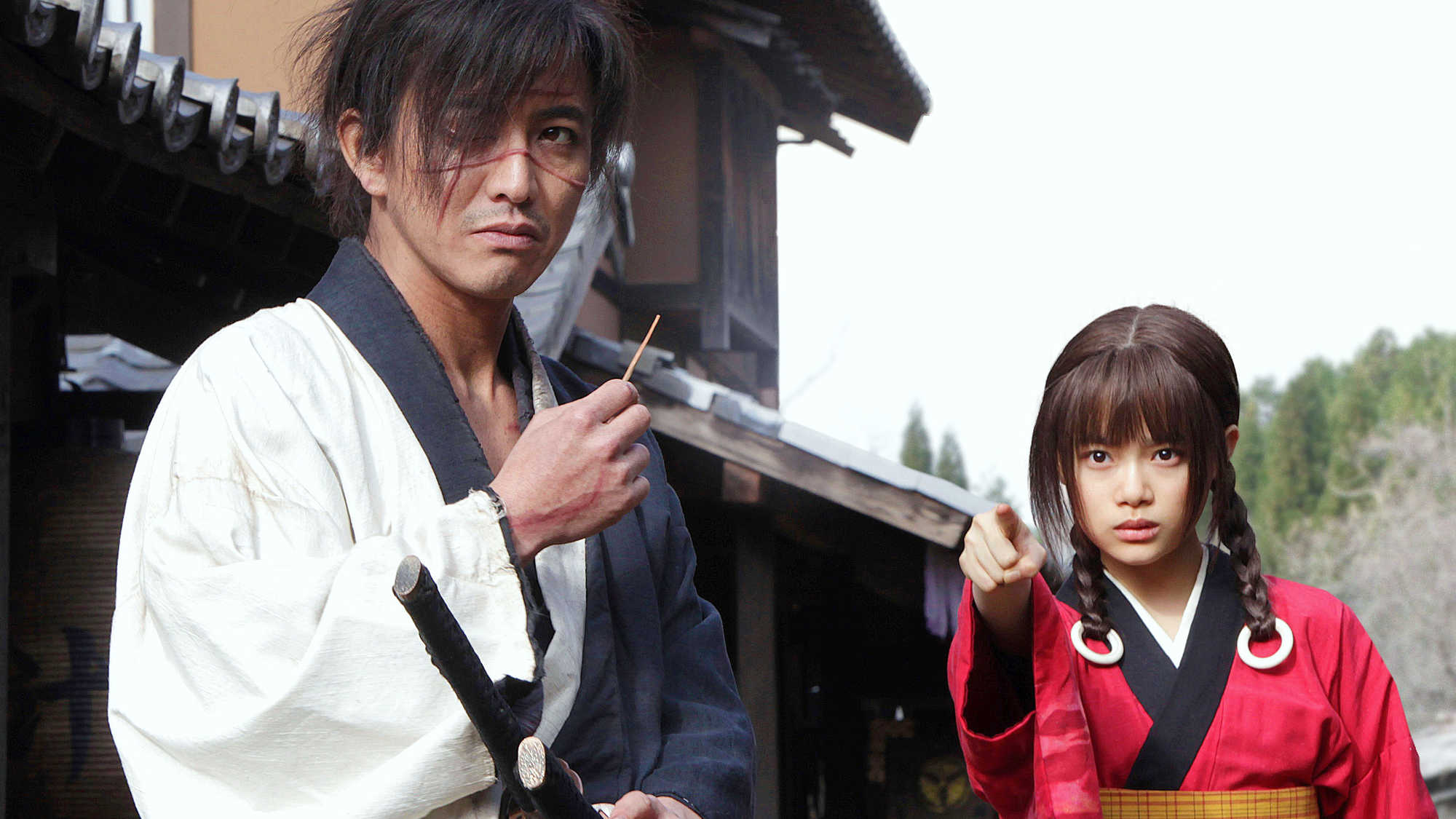
Blade of the Immortal is Takashi Miike’s one hundredth movie, a feat that he’s achieved since his debut in 1991 (and he’s made two further movies since). Returning to the samurai arena he visited so effectively in 13 Assassins (2010), Takashi takes on another manga/anime adaptation and throws the audience headlong into a world of treachery, violence, political intrigue, vengeance, and misplaced codes of honour. As expected, it’s a bravura piece of movie making from Takashi, visually striking – the opening sequence is in black and white – bold in its execution with several stunningly mounted action set pieces, and a central character in Manji whose plight is weighing him down with every passing year. There’s a melancholy air to Manji’s situation that the script by Oishi Tetsuya maintains throughout, imbuing the character with a fatalism that gives depth to the part and helps ensure Manji isn’t just another invincible hero. Kimura is terrific in the role, Manji’s scarred features reflecting the pain of being immortal, and his interaction with Rin (who is a dead ringer for his sister; as she should be, as Sugisaki plays both roles) offering him both unexpected hope and potential redemption.

These themes play out against the kind of feudal backdrop that we’ve all become familiar with, and it’s these elements that don’t have the effect they should have. Kagehiso’s plan to appropriate all the teaching schools under one banner (and leader) never quite grips as a villainous ambition, though the personal reasons for his actions revealed later in the movie almost make it more convincing. The middle section of the movie suffers accordingly, as Kagehiso’s machinations and an unlikely alliance between Manji and members of a school who’ve yet to be assimilated stretch out the running time unnecessarily. Thankfully there’s a handful of superbly choreographed action scenes to offset what feels like too much filler, particularly in terms of the various examples of exotic weaponry on display, and the endlessly roving camerawork of Kita Nobuyasu. The performances are uniformly good as well, the quality of the characterisations allowing the likes of Sugisaki, Fukushi, Tanaka (as a duplicitous advisor to Kagehisa), and Toda (as a repentant member of Kagehisa’s clan) to add layers to their roles that might not otherwise have been possible. But at the end of the day it’s Takashi’s movie, and while this may be one of his more accessible movies, it’s clear that the enfant terrible of Japanese cinema is showing no sign of slowing down or avoiding challenges.

Rating: 7/10 – though Takashi’s propensity for extreme violence is dialled down, there’s still more than enough bloodshed on display in Blade of the Immortal to keep long-time fans, and newer viewers, happy; bold and thrilling (for the most part), this is stirring stuff supported by strong characterisations and a knowing sense of how outlandish it all is.
Share this:

  • Click to share on X (Opens in new window) X
  • Click to share on Facebook (Opens in new window) Facebook
  • More
  • Click to print (Opens in new window) Print
  • Click to email a link to a friend (Opens in new window) Email
Like Loading...

Zatoichi on the Road (1963)

28 Monday Dec 2015

Posted by dullwood68 in Movies

≈ Leave a comment

Tags

Action, Blind swordsman, Daiei Studios, Drama, Feudal Japan, Kimiyoshi Yasuda, Masseur, Review, Samurai, Shiho Fujimura, Shintarô Katsu, Yakuza

Zatoichi on the Road

Original title: Zatôichi kenka-tabi

aka Zatoichi’s Fighting Journey

D: Kimiyoshi Yasuda / 87m

Cast: Shintarô Katsu, Shiho Fujimura, Ryûzô Shimada, Reiko Fujiwara, Matasaburo Niwa, Yoshio Yoshida, Sônosuke Sawamura, Shôsaku Sugiyama, Yutaka Nakamura

The fifth entry in the series sees our hero being escorted to meet a prospective employer. Zatoichi (Katsu) is spotted by members of a yakuza clan who are aware that the propsective employer the blind swordsman is to meet is their sworn enemy, the head of a rival yakuza clan. With a showdown happening soon between the two clans, Zatoichi’s presence can mean only one thing: the rival boss is looking to hire him, and thereby swing matters in his favour. In an attempt to stop Zatoichi being hired, the gang members ambush him and his guide. Zatoichi despatches them with ease but not before his guide is killed.

The wife of one his would-be killers, Hisa (Fujiwara), witnesses the aftermath of the attack and learns Zatoichi’s identity. She takes this information back to the clan boss who, quite rightly, is disturbed by this development. But he has another plan in motion, one that involves the kidnapping of a young girl, Mitsu (Fujimura), for ransom. By luck, Zatoichi almost literally stumbles across a dying man who implores him to “save Mitsu”. Gaining her trust, Zatoichi determines to help her get back home. But it turns out that both yakuza clans have the same idea, and the blind masseur finds himself having to avoid both gangs, as well as the criminal intentions of a crooked innkeeper.

ZOTR - SCENE3

Five movies in and you could be forgiven for thinking that the series should already be running out of steam, but Zatoichi on the Road sees the franchise taking the basic “wandering swordsman” premise and putting a clever spin on things. Here, Zatoichi’s pledge to a dying man exposes the character’s nobility and selflessness to an even greater extent than in previous entries, as he shepherds Mitsu to her home in Edo, protecting her and keeping her safe. There is the usual romantic angle thrown in, but where before, Zatoichi has fallen in love with the lead female character, here his romantic feelings are held in check by his own awareness that there’s no chance of a relationship developing between them (though he does remain initially hopeful, as always).

Romanticism aside, the movie focuses on traditional notions of honour and fealty to the samurai code, with Zatoichi upholding these in isolation while – again – those who profess to follow the same code pay lip service to it. Both clan bosses are venal, greedy men who use the code for their own ends, and Zatoichi’s innate sense of propriety remains in stark contrast to the corruption that surrounds him. While each boss schemes and plots the end of the other, Zatoichi turns the tables on them, even when one of them finally manages to kidnap Mitsu and hold her hostage. By using their own avarice against them, Zatoichi highlights the ways in which their covetous natures will always undermine their criminal intentions. It’s a moral approach that everyone can relate to, and is played out with confidence and straightforward charm.

ZOTR - SCENE2

One of the series’ strengths is Zatoichi’s avoidance of violence wherever possible. Of course he’s going to find himself in situations where he has no choice but to fight, but here Minoru Inuzuka’s screenplay features a scene of such simple brilliance that it’s worth watching over and over again for Katsu’s superb performance and Yasuda’s assured direction. In it, Zatoichi rescues Mitsu from the clutches of a crooked innkeeper and does so without resorting to using his sword. It’s a tense, riveting scene, and sees Zatoichi attack the innkeeper and his men verbally over and over, denigrating their position and their competence. It’s further enhanced by their awareness of who Zatoichi is, and what he’s capable of; no one wants to risk their lives and prove him right.

But when there is a fight that Zatoichi can’t avoid, the sadness and melancholy that afflicts him is touchingly rendered by Katsu, whose immersion in the role is by now complete. He’s a wonderfully expressive actor, vulnerable and strong at the same time, and with no airs or graces about him. Whether he’s expressing his disappointment at the situations he finds himself in, or marvelling at some of the simpler pleasures in life (tea, for example), Katsu’s Zatoichi is a fully rounded character that any viewer can relate to. And he portrays the character’s loneliness so vividly that there’s very little further information we need to know about him in order to understand why he gets involved in righting wrongs and defeating injustice.

ZOTR - SCENE1

As the object of everyone’s crooked intentions, Mitsu is essentially a McGuffin decked out in a kimono, a hook to hang the plot on. But Fujiwara imbues her with a childlike artlessness that makes her more than just an object of lust and financial gain for the two clans. Her quiet, subservient nature is so calming that it’s no wonder Zatoichi finds himself falling for her, offering as she does a peaceful alternative to the wandering, often violent life he leads. Zatoichi’s search for peace is a constant theme in the series, but it’s here, where the chance of his attaining it is so close (and yet so far) that gives his yearning such resonance.

Filmed largely on location, with some poorly lit interiors doubling as the outdoors from time to time, Zatoichi on the Road retains the visual strengths of the previous colour entries, and the sword fights are still as well choreographed as before. Yasuda’s first outing as director on a Zatoichi movie proves both absorbing and resplendent, his positioning of the camera yet another example of how determined Daiei Studios had become in ensuring that each movie had its own identity while adhering to the overall tone and and accessibility of the series.

Rating: 7/10 – another successful entry in the series, Zatoichi on the Road is as engaging and captivating as its previous outings, and manages to provide further evidence that the character can – and will – avoid the pitfalls of series’ ennui; with Katsu providing yet another polished, emotionally astute performance, the movie never once takes the easy route in telling its deceptively simple story.

NOTE: Alas, the following trailer is free from subtitles.

Share this:

  • Click to share on X (Opens in new window) X
  • Click to share on Facebook (Opens in new window) Facebook
  • More
  • Click to print (Opens in new window) Print
  • Click to email a link to a friend (Opens in new window) Email
Like Loading...

Ninja Scroll (1993)

26 Monday Jan 2015

Posted by dullwood68 in Movies

≈ Leave a comment

Tags

Action, Anime, Dakuan, Devils of Kimon, Drama, Emi Shinohara, Feudal Japan, Futaro Yamada, Genma, Jubei Kibagami, Kôichi Yamadera, Kogera, Review, Samurai, Shogun of the Dark, Stolen gold, Takuan Sōhō, Yoshiaki Kawajiri

Ninja Scroll

Original title: Jûbê ninpûchô

aka Jubei Ninpucho: The Wind Ninja Chronicles; Jubei the Wind Ninja

D: Yoshiaki Kawajiri / 94m

Cast: Kôichi Yamadera, Emi Shinohara, Takeshi Aono, Daisuke Gôri, Toshihiko Seki, Masako Katsuki, Shûichirô Moriyama, Ryûzaburô Ôtomo

In feudal Japan the village of Shimoda is wiped out by a mysterious plague. A team of Mochizuki ninja are sent by their chamberlain, Sakaki Hyobu (Moriyama) to investigate but are ambushed by a giant whose body is made of stone. He kills them all except for Kagero (Shinohara), the only female in the team. The giant, Tessai (Ôtomo), intends to use her for sex but is interrupted by a lone samurai called Jubei (Yamadera). Jubei Blinds Tessai in one eye and he and Kagero escape. She continues with her mission to discover the reason for the plague at Shimoda village, while Jubei finds himself pursued by Tessai; they fight a second time and Jubei is able to defeat him.

Afterwards, Jubei meets Dakuan (Aono), an old monk working for the government who  tells him that Tessai was one of the Devils of Kimon, seven supernatural entities under the control of Genma Himura (Gôri). Jubei is shocked as he had killed Genma five years before. Jubei was part of a ninja team led by Genma, and he was betrayed by him when Genma attempted to steal a horde of gold from his Lord; Jubei is shocked because Genma was beheaded. Dakuan informs him Genma now has the ability to reanimate himself, no matter how he’s killed. He also tells Jubei that with the death of Tessai the remaining Devils will seek him out to exact their revenge. Dakuan tries to hire Jubei to help him but he refuses; unwilling to accept his answer, Dakuan then poisons Jubei with the promise that if he assists the monk he’ll be given the antidote and a hundred pieces of gold.

True to the old monk’s warning, the remaining devils attack Jubei in turn. He defeats them, and as he does he learns that the gold that Genma tried to steal was on a ship that was sunk in a storm on the coast near to Shimoda village. He and the devils are in the process of recovering the gold. Jubei is rejoined by Kogera and also learns that she has a special gift: as her master’s poison expert her body is so full of toxins that she is immune to them; if anyone gets too close to her they run the risk of being poisoned themselves. Together, and only occasionally aided by Dakuan (who is using them as a distraction), they track the devils to Kishima Harbour where the gold is being loaded on to another ship. Once on board, they plan to sink the ship, but Genma and a remaining devil have other ideas.

Ninja Scroll - scene

Viewed over twenty years on from its debut, Ninja Scroll is still an exciting, vividly hand drawn (no CGI here) animated movie that stands head and shoulders above the majority of similar movies that have followed in its wake. It’s violent, unafraid to throw in some sexual activity (one scene is a little uncomfortable to watch), has a thin streak of malicious humour, and has some of the best choreographed fight scenes witnessed in an anime movie.

The storyline is almost classical in its simplicity, although the feudal politics might have some viewers reaching for the pause button if watching at home (good luck if you’re in the cinema). With its background of warring shogunates and treacherous clan retainers and double crosses, the history surrounding the gold and its whereabouts can be a mite confusing. But Kawajiri keeps it all brief enough to be ignored if the viewer wants to go that way, and concentrates on the clashes between Jubei and the devils, and his awkward romance with Kogera. Each of the showdowns features a devil with a particular way of fighting, from Tessai and his stone-like body to Yurimaru (Seki) and his command of electricity, and each makes for a continually compelling (and dangerous) series of foes for Jubei to defeat. It’s to Kawajiri’s credit that these encounters go such a long way to making the movie as successful as it is. The romance between Jubei and Kagero is equally well constructed and played out, its unrequited nature having a greater emotional depth than is usual, and the two characters’ scenes together add an extra punch to proceedings and benefit immeasurably from the voice talents of Yamadera and Shinohara.

The lone samurai figure is a staple of Japanese feudal fiction, and while Ninja Scroll is an homage to Futaro Yamada’s Ninpōchō novels, there’s much here that resonates beyond the source material. The themes of betrayal, honour, sacrifice, revenge and greed lie heavily on the narrative, but are complemented and enhanced further by aspects of love, duty, loyalty and compassion. All these add up to a storyline that is rich in potential, and which is used by Kawajiri to extremely impressive effect. He’s aided by an equally impressive voice cast, with Yamadera and Shinohara being superbly abetted by Aono (in a role that’s a homage to the famous Japanese monk Takuan Sōhō), Seki as the most debonair of the devils, and Gôri as the malignant sounding Genma.

The animation in Ninja Scroll is often stunning to look at, even if some of the imagery doesn’t always maintain the high standard set by surrounding scenes or shots – the hornets controlled by the devil Mushizo spring to mind – but this is a minor gripe in a movie that offers arresting image after arresting image (it’s a rare movie that can boast a death caused by head-butting). Again, Kawajiri assembles and orchestrates the material with undisguised skill, and is ably supported by Hitoshi Yamaguchi’s redolent cinematography, and the editing expertise of Yukiko Ito and Harutoshi Ogata.

Rating: 8/10 – an iconic anime that has stood the test of time (and what seems like a million and one imitators), Ninja Scroll has all the ingredients of a rousing samurai drama – and then some; bold, inventive, and endlessly enjoyable, it’s one animated movie that you just know will never be bettered by a live-action version.

Share this:

  • Click to share on X (Opens in new window) X
  • Click to share on Facebook (Opens in new window) Facebook
  • More
  • Click to print (Opens in new window) Print
  • Click to email a link to a friend (Opens in new window) Email
Like Loading...

Zatoichi the Fugitive (1963)

13 Saturday Sep 2014

Posted by dullwood68 in Movies

≈ 1 Comment

Tags

Blind swordsman, Japanese film, Masayo Banri, Masseur, Otane, Rival yakuza gangs, Samurai, Shintarô Katsu, Yakuza, Zatoichi

Zatoichi the Fugitive

Original title: Zatôichi kyôjô-tabi

D: Tokuzô Tanaka / 86m

Cast: Shintarô Katsu, Miwa Takada, Masayo Banri, Jun’ichirô Narita, Tôru Abe, Jutarô Hojo, Sachiko Murase

Zatoichi (Katsu) is travelling alone in the countryside when he reaches a town where a sumo challenge is taking place.  Having won the challenge, the blind masseur is relaxing by a river when he is attacked by a lone yakuza.  Zatoichi defends himself, and as the yakuza lies dying from his wounds, he tells Zatoichi he only attacked him for his mother’s sake.  Zatoichi learns the man’s name and out of duty to him, learns where she lives and offers her his apologies.  The man’s mother, Maki (Murase), forgives him, but as Zatoichi leaves he’s stopped by the man’s clan boss, Yagiri (Abe), who demands his life in return.  But before any more blood can be spilt, Maki and the boss of another clan, Sakichi (Narita) intervene.  Sakichi takes on the responsibility for taking Zatoichi’s life, sparing him until the end of the festival that is taking place.

Zatoichi decides to rest at a local inn.  He is tended by Onobu (Takada), who is in love with Sakichi, though her father is against any match.  Also staying at the inn is a drunken ronin, Tanakura (Hojo) and his wife.  Zatoichi is surprised to find that she is Otane (Banri), the woman he was in love with.  As he begins to deal with the emotions this brings up, Zatoichi becomes aware of a plot involving Yagiri and the innkeeper to take over Sakichi’s territory; Tanakura is there to aid them.  With the festival drawing to a close, Yagiri tries to engineer matters so that Sakichi has to confront Zatoichi, but the young boss is too much of a coward to actually do so.  A fight between Zatoichi and some of Yagiri’s men leads to a final showdown between the masseur and Tanakura, and a tragic outcome.

Zatoichi the Fugitive - scene

The fourth in the series, Zatoichi the Fugitive is a slightly misleading title in that Zatoichi isn’t on the run, and everyone knows exactly where he is throughout.  What isn’t in any doubt, though, is that this instalment of the Zatoichi saga is just as well realised and absorbing as the previous entries.

The basic template is also firmly in place.  Zatoichi arrives in a small town, there’s bitter rivalry between two yakuza gangs, an innkeeper’s daughter may or may not provide a romantic interlude for our hero, various swordsmen will try their luck singly or in groups to kill Zatocihi, domestic intrigues will come to the fore, betrayal and treachery will occur as naturally as the characters breathe, and there is an eventual showdown between Zatoichi and an equally proficient samurai.  It’s all very familiar but it’s all so well executed that it’s almost comforting to watch.

While the sword fights are, on the surface, the main reason to watch a Zatoichi movie, it’s the drama that sets up these encounters that makes all the difference, and prove why the series is so effective four movies in (and with twenty-one still to come).  The script by Seiji Hoshikawa retains Zatoichi’s sense of honour and his deep sense of regret when he’s forced to kill someone, Katsu’s troubled looks and humble demeanour perfectly encapsulating the profound respect he has for (most of) those around him.  Here we see a little more of his anger than before, and directed at more than just the main villain, Yagiri.  With the character’s stoic nature already established, to see him more emotionally invested in his swordplay makes for an interesting broadening of the character and his humanity.  And, for the first time, we see how physically vulnerable he can be when Tanakura manages to wound him (though not too seriously, of course).

Zatoichi’s interplay with Onobu and Otane are given roughly equal screen time, and the distinction between them is made clear by their feelings about their own lives.  Onobu wishes to be with Sakichi and sees happiness for them both, while Otane regrets the future she’s already chosen.  Both actresses give impressive performances, though it’s Banri (playing Otane for the third time) who demands the most attention, her sorrow and despair at the way Otane’s life has turned out etched on her face like a mask she can’t remove.

With so much going on beneath the surface of all the characters, returning director Tanaka’s confident approach pays dividends throughout, and the movie looks glorious thanks to the vibrant colours of the Japanese countryside which are often stunning to look at.  The sword fights are the most exhilarating yet, and there’s a very clever display of Zatoichi’s “sword drawing” skills.  With a quietly emotive score by Akira Ifukube that complements the mounting tension, this entry in the long-running series is as effective and commanding as its predecessors (and how many Part Fours can say that?).

Rating: 9/10 – another superb entry in the series, Zatoichi the Fugitive ups the emotional content and has a gripping denouement that resonates long after the movie sees Zatoichi moving on; with Katsu giving yet another flawless performance, this is better than anyone – perhaps even production company Daiei – could hope for.

Share this:

  • Click to share on X (Opens in new window) X
  • Click to share on Facebook (Opens in new window) Facebook
  • More
  • Click to print (Opens in new window) Print
  • Click to email a link to a friend (Opens in new window) Email
Like Loading...

New Tale of Zatoichi (1963)

05 Saturday Jul 2014

Posted by dullwood68 in Movies

≈ 1 Comment

Tags

Blind swordsman, Japanese film, Masseur, Mikiko Tsubouchi, Revenge, Samurai, Sensei, Shintarô Katsu, Yakuza, Zatoichi

New Tale of Zatoichi

Original title: Shin Zatôichi monogatari

D: Tokuzô Tanaka / 91m

Cast: Shintarô Katsu, Mikiko Tsubouchi, Seizaburô Kawazu, Fujio Suga, Yutaka Nakamura, Mieko Kondô, Tatsuo Endô, Kanae Kobayashi

Following on from the events of The Tale of Zatoichi Continues (1962), New Tale of Zatoichi sees the blind masseur returning to his home village, there to find some peace after the showdown with his brother, Yoshiro.  Zatoichi (Katsu) is in a melancholy mood, and as reluctant to fight as ever, but it’s not long before he’s challenged by Yasuhiko (Suga), the brother of Boss Kanbei, who Zatoichi killed in the previous movie.  They fight, but it’s interrupted by the appearance of Zatoichi’s sensei, Master Banno (Kawazu).  Banno makes Zatoichi a guest at his training school, and introduces him to his younger sister Yayoi (Tsubouchi); she is meant to marry a samurai called Mooroke but has no love for him.  Her brother, meanwhile, is conspiring with a band of thieves called the Mito Tengo.  They plan to kidnap the son of a local businessman and hold him to ransom.

A bond develops between Zatoichi and Yayoi, one that leads to her falling in love with him.  She asks that he marry her and after confessing his past sins to her, and being forgiven for them, Zatoichi agrees and tells her he will renounce his old ways, including his sword fighting, in order that they might have a peaceful life together.  At that moment, Yasuhiko calls on Zatoichi to finish their duel.  He begs for mercy, leading Yasuhiko to devise an alternative plan for settling the issue between them: a throw of the dice – if Yasuhiko wins, Zatoichi will lose his right arm.  Zatoichi does lose, but Yasuhiko takes pity on the couple and lies about the result.  Later, Yayoi tells Banno of her love for the blind masseur, but her brother rejects her entreaties and tells Zatoichi to leave.

The kidnapping goes ahead as planned but Zatoichi becomes aware of Banno’s involvement, as does Yayoi.  He saves the businessman’s son, and faces off against the Mito Tengo.  He must then face Banno, knowing all the while that it will mean the end of his relationship with Yayoi.

New Tale of Zatoichi - scene

The third entry in the series, New Tale of Zatoichi retains the usual themes of betrayal and redemption, and adds the prospect of a romantic, settled future for our wandering hero.  If this had been the last in the series, such an ending might have been entirely appropriate, but the increasingly rootless nature of Zatoichi’s existence precludes such a conclusion (that and the success of the series so far).  He’s a tragic figure, always seeking a peaceful existence but doomed to a life of violence.  He’s also increasingly unlucky, both in love, and with his closest male relationships: first his brother betrays him, then his sensei.  With Fate proving so ineluctable, Zatoichi can only struggle on, hoping that his continued loneliness will eventually come to an end (though his love for Yayoi appears to be the closest he’ll come to achieving that).  It’s the kind of depth you don’t often find in a long-running series, and the fact that the makers have strived to maintain these themes throughout the series so far, is refreshing to watch.

Of course, such a wonderful character needs a wonderful actor, and once again Katsu puts in an incredible performance, his tender, compassionate nature seemingly at odds with his more aggressive abilities, but combining to paint a portrait of a man whose dual nature makes him so fascinating to watch.  It’s a beautifully modulated achievement, the quiet power of his scenes with Tsubouchi holding the audience’s attention like a vice, their characters’ mutual desire for happiness – against all the odds – breathtaking in both its painful longing and its simplicity.  That a movie which is essentially known for its fight scenes and good versus bad scenario can take the time to focus on its main character’s attempts to find joy, and make those scenes even more gripping than the rest, is truly impressive.

The first in the series to be filmed in colour, New Tale of Zatoichi doesn’t opt for a bright, colourful palette but settles instead for a dark-hued colour scheme that befits the subdued, sober approach to the material.  (In comparison with the first two movies, which were shot in dazzling black and white, this entry doesn’t look half as good.)  Behind the camera, director Tanaka retains many of the visual motifs used before, and encourages good performances from all concerned, especially Tsubouchi as Banno’s tender-hearted sister, the scene where she declares her love for Zatoichi demonstrating her skill at portraying someone whose yearning for happiness means everything.  Suga too gives a good portrayal of a vengeful samurai out-manoeuvred by love.  And there’s a terrific score by Akira Ifukube that complements both the emotional and the dramatic scenes, and is consistently rewarding.

Rating: 8/10 – another beautifully realised entry in the series, and one that reconfirms the care and attention that goes into each movie; more emotionally powerful than the first two movies, New Tale of Zatoichi takes its time with its characters, and this care pays off in dividends making the movie that rare beast: a second sequel that is as good as its predecessors.

Share this:

  • Click to share on X (Opens in new window) X
  • Click to share on Facebook (Opens in new window) Facebook
  • More
  • Click to print (Opens in new window) Print
  • Click to email a link to a friend (Opens in new window) Email
Like Loading...

Blog Stats

  • 486,528 hits

Recent Posts

  • 10 Reasons to Remember Bibi Andersson (1935-2019)
  • Fantasia (1940)
  • Dances With Wolves (1990) – The Special Edition
  • Kiss of the Spider Woman (1985)
  • The Three Musketeers (1973)

Top Posts & Pages

  • Lost for Life (2013) - Another Look
    Lost for Life (2013) - Another Look
  • Lost for Life (2013)
    Lost for Life (2013)
  • About
    About
  • Mr. Topaze (1961)
    Mr. Topaze (1961)
  • Billy Lynn's Long Halftime Walk (2016)
    Billy Lynn's Long Halftime Walk (2016)
  • Winter's Tale (2014)
    Winter's Tale (2014)
  • The Hitman's Bodyguard (2017)
    The Hitman's Bodyguard (2017)
  • 5 Famous Movie Roles That Nearly Went to Someone Else
    5 Famous Movie Roles That Nearly Went to Someone Else
  • The Layover (2017)
    The Layover (2017)
  • Transcendence (2014)
    Transcendence (2014)
Follow thedullwoodexperiment on WordPress.com

Blogs I Follow

  • Rubbish Talk
  • Film 4 Fan
  • Fast Film Reviews
  • The Film Blog
  • All Things Movies UK
  • Interpreting the Stars
  • Let's Go To The Movies
  • Movie Reviews 101
  • TMI News
  • Dan the Man's Movie Reviews
  • Film History
  • Jordan and Eddie (The Movie Guys)

Archives

  • April 2019 (13)
  • March 2019 (28)
  • February 2019 (28)
  • January 2019 (32)
  • December 2018 (28)
  • November 2018 (30)
  • October 2018 (29)
  • September 2018 (29)
  • August 2018 (29)
  • July 2018 (30)
  • June 2018 (28)
  • May 2018 (24)
  • April 2018 (21)
  • March 2018 (31)
  • February 2018 (25)
  • January 2018 (30)
  • December 2017 (30)
  • November 2017 (27)
  • October 2017 (27)
  • September 2017 (26)
  • August 2017 (32)
  • July 2017 (32)
  • June 2017 (30)
  • May 2017 (29)
  • April 2017 (29)
  • March 2017 (30)
  • February 2017 (27)
  • January 2017 (32)
  • December 2016 (30)
  • November 2016 (28)
  • October 2016 (30)
  • September 2016 (27)
  • August 2016 (30)
  • July 2016 (30)
  • June 2016 (31)
  • May 2016 (34)
  • April 2016 (30)
  • March 2016 (30)
  • February 2016 (28)
  • January 2016 (35)
  • December 2015 (34)
  • November 2015 (31)
  • October 2015 (31)
  • September 2015 (34)
  • August 2015 (31)
  • July 2015 (33)
  • June 2015 (12)
  • May 2015 (31)
  • April 2015 (32)
  • March 2015 (30)
  • February 2015 (37)
  • January 2015 (39)
  • December 2014 (34)
  • November 2014 (34)
  • October 2014 (36)
  • September 2014 (25)
  • August 2014 (29)
  • July 2014 (29)
  • June 2014 (28)
  • May 2014 (23)
  • April 2014 (21)
  • March 2014 (42)
  • February 2014 (38)
  • January 2014 (29)
  • December 2013 (28)
  • November 2013 (34)
  • October 2013 (4)

Create a free website or blog at WordPress.com.

Rubbish Talk

Film 4 Fan

A Movie Blog

Fast Film Reviews

The Film Blog

The official blog of everything in film

All Things Movies UK

Movie Reviews and Original Articles

Interpreting the Stars

Dave Examines Movies

Let's Go To The Movies

Film and Theatre Lover!

Movie Reviews 101

Daily Movie Reviews

TMI News

Latest weather, crime and breaking news

Dan the Man's Movie Reviews

All my aimless thoughts, ideas, and ramblings, all packed into one site!

Film History

Telling the story of film

Jordan and Eddie (The Movie Guys)

Movie Reviews & Ramblings from an Australian Based Film Fan

Privacy & Cookies: This site uses cookies. By continuing to use this website, you agree to their use.
To find out more, including how to control cookies, see here: Cookie Policy
  • Subscribe Subscribed
    • thedullwoodexperiment
    • Join 481 other subscribers
    • Already have a WordPress.com account? Log in now.
    • thedullwoodexperiment
    • Subscribe Subscribed
    • Sign up
    • Log in
    • Report this content
    • View site in Reader
    • Manage subscriptions
    • Collapse this bar
 

Loading Comments...
 

    %d