• 10 Reasons to Remember…
  • A Brief Word About…
  • About
  • For One Week Only
  • Happy Birthday
  • Monthly Roundup
  • Old-Time Crime
  • Other Posts
  • Poster of the Week
  • Question of the Week
  • Reviews
  • Trailers

thedullwoodexperiment

~ Viewing movies in a different light

thedullwoodexperiment

Tag Archives: Short film

Kung Fury (2015)

31 Sunday May 2015

Posted by dullwood68 in Movies

≈ 3 Comments

Tags

Action, Adventure, David Sandberg, Drama, Jorma Taccone, Kickstarter, Kung fu, Laser raptors, Leopold Nilsson, Martial arts, Short film, Thor, Thriller, Triceracop

Kung Fury

D: David Sandberg / 31m

Cast: David Sandberg, Jorma Taccone, Leopold Nilsson, Steven Chew, Andreas Cahling, Erik Hörnqvist, Eleni Young, Helene Ahlson, Per-Henrik Arvidius, Eos Karlsson, David Hasselhoff

1985, Miami. When an arcade machine turns killer robot, there’s only one man for the police call on: Kung Fury! Destroying the robot proves easy for the Chosen One who was once just an ordinary cop. While chasing down a ninja (Karlsson) with his partner, Dragon (Chew), he was struck by lightning… and bitten by a cobra. From then on, and in line with an ancient prophecy, he became Kung Fury, the master of all kung fu, and the greatest crime fighter in the world.

Chewed out by his chief (Arvidius) over the amount of destruction Fury caused in disposing of the robot, he’s alarmed to find he’s got to work with a new partner, Triceracop (Hörnqvist). Refusing the idea point blank, Fury quits. When he learns that Adolf Hitler has travelled from the past to challenge Kung Fury’s position as the Chosen One, he decides there’s only one thing he can do: travel back to Nazi Germany and kill Hitler. With the help of Hackerman (Nilsson), Fury travels back in time, but instead of arriving in the 1940’s he ends up facing a laser raptor in the time of the Vikings. He also meets two Viking women, Barbarianna (Young), and Katana (Ahlson); when he tells them of his dilemma, they introduce him to Thor, the God of Thunder. Thor uses his hammer, Mjolnir, to create a time portal that will take Fury forward to Nazi Germany.

When he arrives, he crashes a rally being given by Hitler and proceeds to take on the assembled Nazi soldiers. Using his kung fu powers he dispatches them with ease, but when Hitler unloads with a machine gun, not even Kung Fury can survive the hail of bullets… or can he?

Kung Fury - scene

Part-funded by Kickstarter contributions, Kung Fury is an absolute blast, a knowing homage/pastiche of Eighties action and cop movies that goes to extreme lengths to entertain its target audience – and succeeds with a great deal of low budget panache. In realising that its budget required a novel approach to the material (written and directed by Swedish filmmaker Sandberg), the movie has been fashioned to look like a degraded copy of an Eighties video release. This allows the movie to hide a variety of problems such as Ahlson’s having replaced Joanna Häggblom, who filmed the scene where Katana summons Thor for the movie’s trailer. With the same footage being used in the completed short, visual scratches and distortion effects are used to hide the change in actress. In addition, the whole visual look of Kung Fury, from its softened colour palette and grainy film stock effect, gives it a pleasing retro feel that adds to the overall result.

The actual storyline is peppered with some of the craziest visual gags you’re likely to see for some time to come, as Sandberg challenges his special effects team in ways that seem impossible to complete on such a small budget: just $630,019. With digital effects, composite effects, model work, and a shed load of green screen work, Sandberg has made a movie that packs more into thirty-one minutes than some movies pack into two hours. Rampaging killer arcade machines, explosions, fight scenes, exploding heads, a giant Norse god, a talking dinosaur, Viking warrior women (with high-tech weapons), time travel, cars being tossed around like toys, gratuitous violence, a giant metal eagle, and Hitler as the Kung Führer – all this and more Sandberg manages to include in his movie, and every insane minute of it is more fun than fans of this twisted kind of thing could ever hope for.

Kung Fury‘s bizarre world is the distillation of every Eighties action cliché imaginable, from Fury being given a tongue lashing over the damage to the city he’s caused, to the absurd computations of Hackerman regarding time travel, to every macho pose that Fury strikes, all the way to Sandberg growling his lines like he gargles with gravel. There are scowling close ups, a portrayal of Hitler that veers between megalomania and whimsy, and in a great cameo, David Hasselhoff as the computer in Fury’s car, the Hoff9000 (he also gets to sing the movie’s theme tune, True Survivor).

It’s a fast, furious, absurdly entertaining fun ride, complete with an animated sequence two thirds of the way through, as well as an epilogue that sets up either a sequel or a full-length feature (either would be welcome). It’s not a movie, though, that will impress the serious cinéaste and is definitely – and defiantly – aimed at the type of movie goer who loves Chuck Norris, movies like Cobra (1986), and recent outings such as Iron Sky (2012). It’s a potent mix, full of WtF? moments, and as crazy funny (or funny crazy) as you’re ever likely to see, the cinematic equivalent of wading naked through a sea of jellyfish. Sandberg is to be congratulated for getting his project off the ground, and for getting it as far the Cannes Film Festival and since its upload to YouTube, an astonishing eight million plus views.

Rating: 8/10 – a few unnecessarily cheesy moments aside, Kung Fury is nothing short of astounding; with its cast and crew judging everything else perfectly, this is one movie that defies all logic by being so (deliberately) bad it’s brilliant.

Share this:

  • Click to share on X (Opens in new window) X
  • Click to share on Facebook (Opens in new window) Facebook
  • More
  • Click to print (Opens in new window) Print
  • Click to email a link to a friend (Opens in new window) Email
Like Loading...

The Red Balloon (1956)

10 Saturday Jan 2015

Posted by dullwood68 in Movies

≈ Leave a comment

Tags

Albert Lamorisse, Belleville, Blue balloon, Drama, French movie, Magical realism, Ménilmontant, Paris, Pascal Lamorisse, Red balloon, Review, Short film

Red Balloon, The

Original title: Le ballon rouge

D: Albert Lamorisse / 34m

Cast: Pascal Lamorisse, Georges Sellier, Wladimir Popov, Paul Perey, Sabine Lamorisse, Michel Pezin

On his way to school one morning, a little boy, Pascal (Lamorisse), finds a red balloon tied to a railing. He takes it with him to school where he asks the caretaker to look after it for him until classes are over. The boy then takes the balloon home with him, but his mother releases it out of the window. However, instead of floating away, the balloon (which seems to have a mind of its own) merely hovers outside the window where the boy can see it.

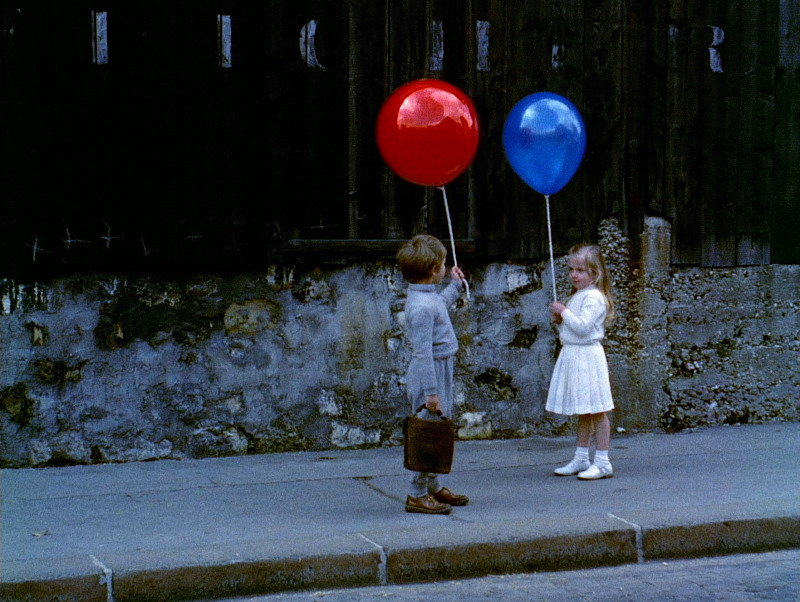
The next morning Pascal calls to the balloon and it follows him as he heads off to school. He makes several attempts to grab the balloon but it keeps itself just out of reach. At school the balloon manages to get into his classroom which causes an uproar and the principal locks Pascal in his office; the balloon meanwhile has floated off. Reunited at the end of the school day, Pascal and the balloon head home, and encounter a little girl (Sabine Lamorisse) who has a blue balloon. The blue balloon reacts in a similar way to the red one, and follows Pascal until he can elude it. But then he encounters a group of boys who, urged on by jealousy, chase Pascal and try to destroy the red balloon.

Red Balloon, The - scene

A simple yet wonderfully filmed piece of magical realism, The Red Balloon is a movie that appeals to the child in all of us. Made in the post-war Belleville area of Paris, the movie serves as a record of the area during the Fifties before it was torn down and redeveloped. As Pascal travels from home to school and back again, the often austere backgrounds serve to highlight the enchanting nature of the story and the unlikely possibility of a red balloon with a mind of its own. It’s a tribute to Lamorisse’s vision though, that the balloon doesn’t feel out of place, even when you can clearly see various Parisians reacting to it with amusement and surprise.

Whimsical it may be, but the movie is also a poignant reminder of the innocence of youth and the power of the imagination. Pascal represents the inner child we all cling on to as adults, his acceptance of the balloon as natural as breathing. Seeing him being followed by the balloon and stopping every now and then to try and catch it is like seeing two friends playing a game together. It’s carefree and irreproachable, a gentle yet effective expression of the simple joys childhood can bring when everything around us excites our curiosity. It’s also no surprise that Pascal’s headmaster doesn’t view it in the same way, punishing him for what he sees as insubordination instead of youthful exuberance. Lamorisse is saying – quite rightly – that we should hold on to as much of that youthful exuberance as we can as adults; otherwise, how terrible will our lives become?

With the introduction of the gang (which leads to the balloon’s ultimate fate), the tale darkens, but necessarily so. Lamorisse is clever enough to realise that the innocence of youth doesn’t always last, and that some children lose it sooner than others. The gang are youth corrupted, their mean-spirited actions and envious behaviour the flipside to Pascal’s purity of mind and heart. They want to destroy the red balloon out of malicious spite, to see Pascal as defrauded of his decency as much as they have been. It’s one of Life’s hard lessons, that not everyone is as nice as you’d like them to be. And for a child like Pascal it’s possibly the hardest lesson to learn.

Lamorisse isn’t prepared to leave Pascal downhearted and dejected, though. As if further proof were needed that there is indeed magic – real magic – in the world, Pascal is given succour in such a wonderful, compassionate way that the movie’s conclusion gives the viewer no option but to grin with shared happiness (and maybe shed a tear or two as well). It’s one of the most uplifting endings to a movie ever, and a perfect finale for a tale that is honest and affecting throughout.

The Red Balloon carries such an emotional charge in its short running time that at times it’s hard to reconcile its faux-documentary presentation with the lyricism it displays at every turn. It’s a fascinating mix, and a spectacular achievement by Lamorisse that is a potent now as it was when it was first released. Belleville is filmed with such a candid eye for the decay of its surroundings that the area is almost a secondary character in itself, and Edmond Séchan’s photography is striking and evocative in equal measure.

Red Balloon, The - scene2

But all this, finally, is underpinned by a sincere, genuine performance by Lamorisse’s son, Pascal. There’s a moment where he’s looking up at the balloon as it floats away from him. His gaze is querulous but unperturbed, as if he can’t quite work out why the balloon is behaving the way it is, but isn’t worried in the least that it won’t return to him. It’s like he’s trying to decipher the inner workings of the balloon’s “mind’ or the mechanics of the game they’re playing. It’s a peaceful moment of natural reflection that Pascal carries off as if he’s not even trying – he’s that good.

Rating: 9/10 – a sublime piece of movie making that warms the heart and reminds us what it is to be young and without a care in the world, The Red Balloon is a jewel to be treasured with every viewing; heartfelt, touching and inspirational, this is a bona fide classic that shouldn’t be missed.

Share this:

  • Click to share on X (Opens in new window) X
  • Click to share on Facebook (Opens in new window) Facebook
  • More
  • Click to print (Opens in new window) Print
  • Click to email a link to a friend (Opens in new window) Email
Like Loading...

Loom (2012)

02 Thursday Oct 2014

Posted by dullwood68 in Movies

≈ 1 Comment

Tags

4K, Cloning, Drama, Genetics, Giovanni Ribisi, Jellybean Howie, Luke Scott, Review, Sci-fi, Short film

Loom

D: Luke Scott / 21m

Cast: Giovanni Ribisi, Jellybean Howie, Jae Jung, Patrick Foy, Evelyn Edwards, Gino Aquino, Erica Piccininni

Tommi Galvin (Ribisi) is a technician in a protein growth factory, monitoring and manipulating meat products for the mass consumer market.  He’s quiet, fastidious, and apparently conscientious about his work: with colleagues he’s peremptory and quite curt.  What they don’t know is that Tommi is stealing growth hormones to help with a project that he’s working on at home.

His latest theft of the growth hormone appears to have the desired effect on his “experiment”, but the arrival of two law enforcement agents (Jung, Foy) leads to an unexpected, unfortunate reversal of fortune.

Loom - scene

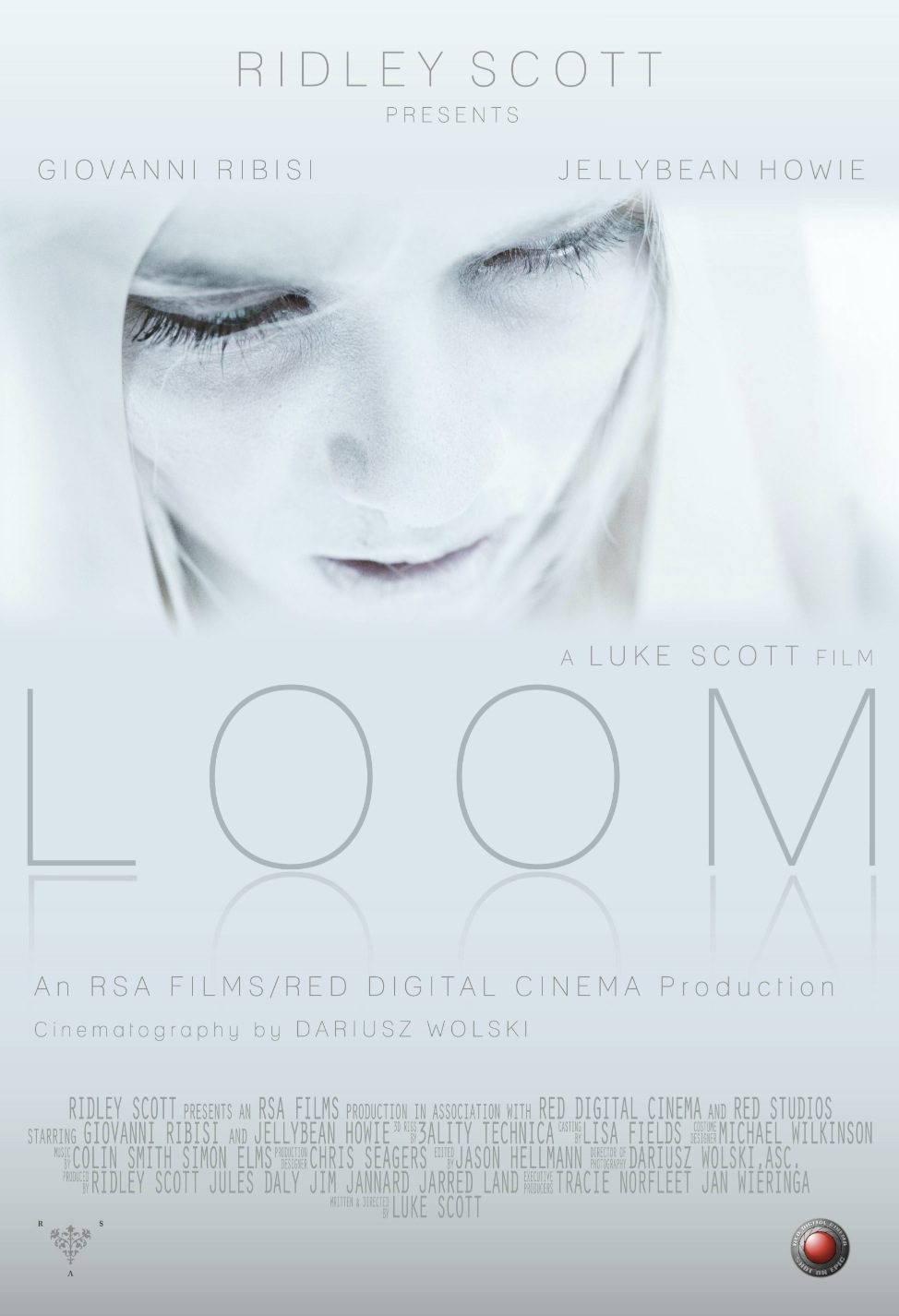
Made to showcase the new 4K camera technology, Loom is a bleak, dystopian piece of science fiction directed by Ridley Scott’s son, Luke.  The world of the future is presented as a bland, antiseptic place where Man interacts on a conservative, non-social level, and where the environment is regulated and controlled for the greater good.  It’s a largely sterile world, all neutral colours and impersonal living and work spaces.  The production design by Chris Seagers is crisp and precise and expands on current architecture to provide a convincing look at the future, and supports the storyline’s examination of how we connect with other people in the face of an a sterile, distant social order.

With the world around Galvin so well constructed, Loom focuses on the sense of alienation he feels; even when he’s spending time with his “partner”, Escha (Howie), there’s a disconnect that you can see he wants to overcome but is struggling with.  His agitation at the arrival of agents Seville and Walton gives rise to an emotional reaction to subsequent events that is reassuring for his continued humanity (though it’s likely he’ll be either on the run or in prison).  Galvin’s calm, measured demeanour is impressively played by Ribisi, his passive features hiding a personality that’s striving to make a difference, if only for himself.  As Escha, Howie has a difficult role that requires her to behave with a childlike detachment, though she’s scarily effective too when the agents turn up, and she and Galvin’s relationship is threatened.

In the director’s chair, Scott displays a confidence and control in the material that augurs well for future projects, and aided by cinematographer Darius Wolski, paints a picture of the future that feels eerily prescient.  The movie is often deceptively beautiful to look at, and the clarity of the image more than upholds the decision to use the 4K cameras.

Rating: 8/10 – intriguing – though not as thought-provoking as its set up might lead viewers to expect – Loom is an impressive debut from Scott, and features a surprisingly complex performance from Ribisi; well worth seeing, and a movie that leaves you wondering what happens next.

Share this:

  • Click to share on X (Opens in new window) X
  • Click to share on Facebook (Opens in new window) Facebook
  • More
  • Click to print (Opens in new window) Print
  • Click to email a link to a friend (Opens in new window) Email
Like Loading...

Mr Hublot. (2013)

29 Saturday Mar 2014

Posted by dullwood68 in Movies

≈ Leave a comment

Tags

Alexandre Espigares, Animal rescue, Animation, Laurent Witz, Oscar winner, Review, Robot Pet, Short film, Stéphane Halleux, Steampunk

Mr Hublot.

D: Laurent Witz, Alexandre Espigares / 11m

Winner of this year’s Oscar for Best Animated Short Film, Mr Hublot. is the simple tale of a little man with OCD who spends his days checking that the pictures on his walls are aligned correctly, turning his lights on and off a proscribed number of times, while also managing to work from home.  He doesn’t appear to go anywhere, or have any hobbies.  He does appear to be happy though.  One day he hears the screech of brakes outside his apartment.  He goes to his balcony and sees that a robot dog has been abandoned on the sidewalk across the street.  At first he’s only mildly concerned and returns to his daily routine.  Later, when it’s raining, he hears the dog crying.  He looks out again and sees the dog cowering from the storm in a cardboard box.  The next morning, he looks out and is horrified to see the refuse collectors putting several cardboard boxes into the back of the truck where they are being crushed.  He dashes down to the street but is too late: the boxes are all crushed and the refuse truck has moved on.  But the dog is still alive.  Overjoyed, Mr Hublot takes him back to his apartment.

How the robot dog settles into Mr Hublot’s life and apartment makes up for the rest of the movie, and perhaps it’s a good idea to mention that when they first meet, the dog is a puppy.  As he grows it causes all sorts of problems for our bespectacled hero (not least when it comes to watching television), and it’s not long before Mr Hublot is forced to make a difficult decision about the dog’s future.

Mr Hublot. - scene

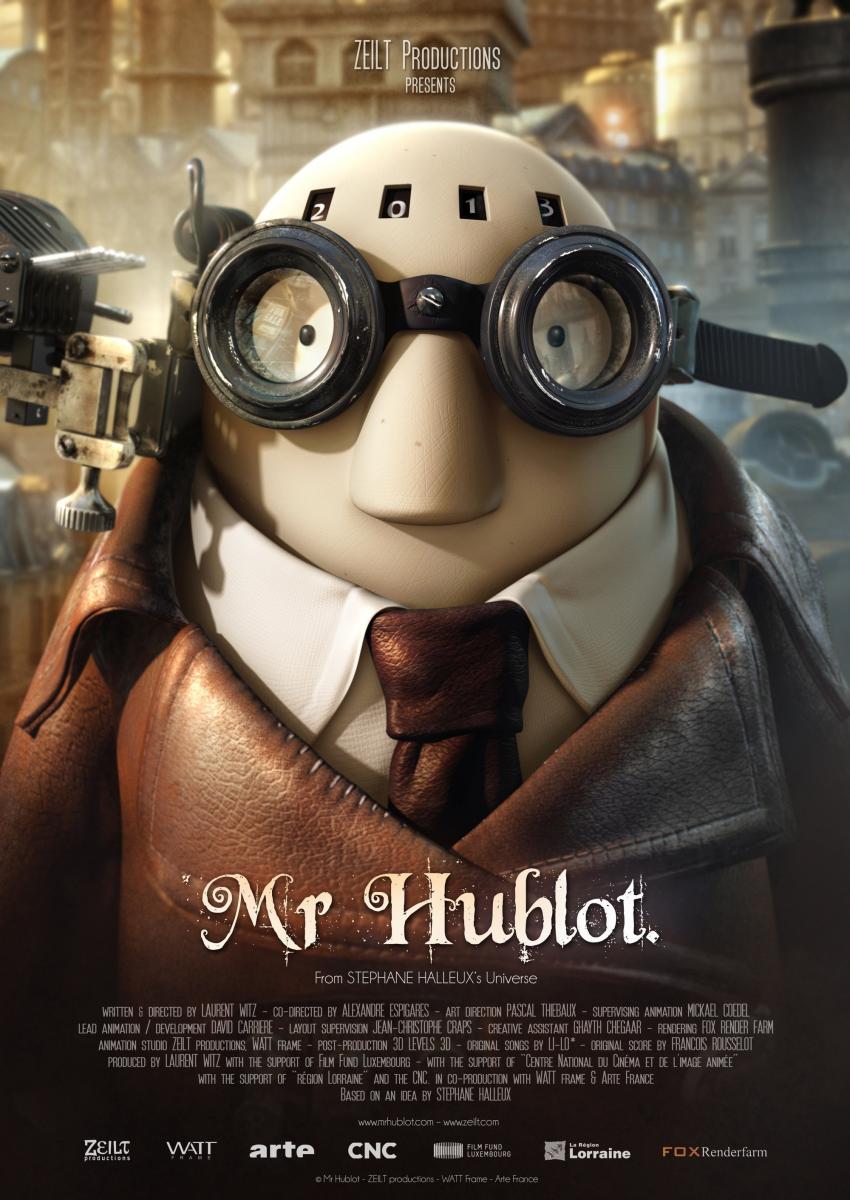
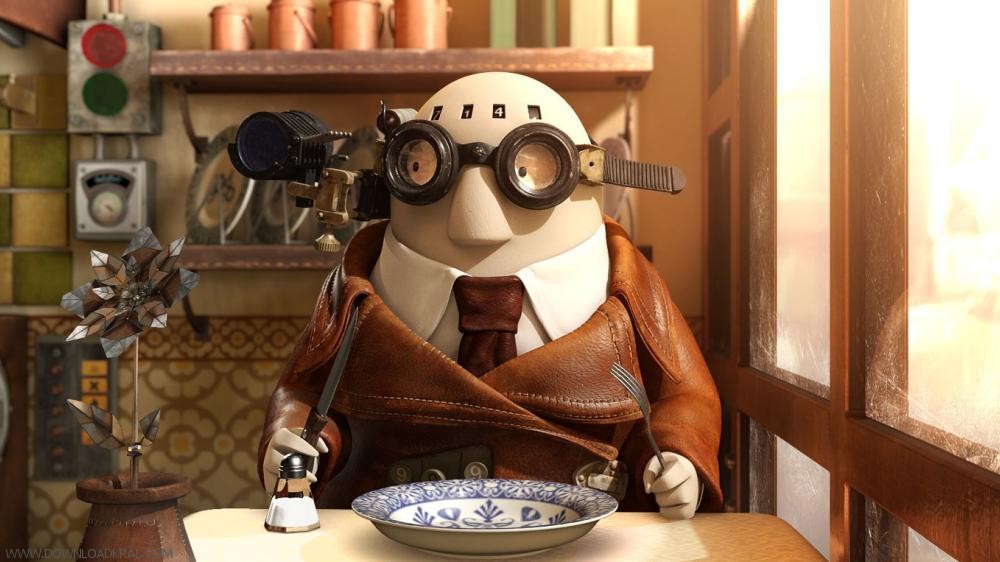
There is much to admire in Mr Hublot., from the steampunk world he lives in (inspired by the work of Belgian sculptor and artist Stéphane Halleux) to the convincing detail of the apartment he lives in.  There are Victorian elements to the set design that offset beautifully the mechanical devices, and the array of implements and machinery adds a commendable layer of authenticity to the surroundings.  With such a fully realised world to lose oneself in, it’s good to have Mr Hublot along as our guide, OCD and all (watch for the quandary he has to deal with when leaving the apartment in order to save the dog).  With his Gru-like dome of a head, complete with thought counter(?), and aviator-style goggles, Mr Hublot is like an eccentric uncle, one your parents don’t talk about much but who charms you from the moment you meet him.

The robot dog is a great character as well, a lively, attention-seeking puppy that turns into a destructive, immovable adult (but still retains his likeability).  As a grown dog a resemblance to the Iron Giant comes to the fore, and his strong metal jaw manages to give the impression that he’s smiling a lot of the time.  Even without a name, this robot pet is cute, adorable, annoying, stubborn, infuriating and even more cute the longer he stays with Mr Hublot.  It’s an inspired match, pairing a reclusive gentleman with a lively pet (though the effect the dog has on Mr Hublot’s OCD is less pronounced than you might expect).  There’s an emotional bond there too, and an entirely credible one at that.  It helps to ground some of the movie’s more whimsical moments, and provides the audience with a layer of depth that might otherwise be missing.

Co-director and writer – and first-timer – Laurent Witz has created a character and a world that is enjoyably realistic in its presentation.  He’s also taken a predictable storyline – one man and his dog – and managed to include a few surprises along the way, making Mr Hublot. a rewarding experience from beginning to end.  If there are to be any more adventures involving Mr Hublot, then they can’t come soon enough.

Rating: 9/10 – a beautifully realised “alternative” world that has been brought to life with amazing attention to detail; with its loveable and endearing central character, Mr Hublot. is a treat for fans of animation everywhere.


Share this:

  • Click to share on X (Opens in new window) X
  • Click to share on Facebook (Opens in new window) Facebook
  • More
  • Click to print (Opens in new window) Print
  • Click to email a link to a friend (Opens in new window) Email
Like Loading...

21/12/12 (2010)

10 Tuesday Dec 2013

Posted by dullwood68 in Movies

≈ Leave a comment

Tags

Chris Scheuerman, Drama, End of the world, Murders, New Image College of the Arts, Review, Short film, Suicide, Taylor Hastings

21:12:12

D: Chris Scheuerman / 16m

Cast: Taylor Hastings, Chris Donoghue, Aaron Baker, Edna Rojas, Beth Cantor, Anthony MacLean, Jordan Smith, Marianne Tikkanen

An intriguing short film from the New Image College of the Arts in Vancouver, 21/12/12 is set an hour before a mysterious event is due to bring about the end of the world.  Various individuals’ lives collide and interconnect, and each tries to deal with what’s happening in different ways.  One man tries to unburden himself by telling the woman he loves about two murders he committed, another gets himself shot while visiting an apartment to buy drugs, and the woman who shoots him finds herself stopping another man from jumping off their building.  At the end, two women witness for themselves the mysterious event.

The question, What would you do if you only had an hour to live, is answered here in a variety of ways.  The would-be suicide is reminded he doesn’t have to go to all the trouble when the event is bound to kill him anyway.  A woman leaves her deluded boss – he wants to make last-minute transactions on the stock market to make himself a rich man when he dies – to find the woman she has been looking for for some time; it’s they who witness the mysterious event.  And the woman who shoots the drug addict, goes out for some air.

21:12:12 - scene

A collection of untidy vignettes that vary in quality and significance, what stops 21/12/12 from being the small gem its writer/director/producer Scheuerman probably hoped for are its unexceptional characters, one-note for the most part, and matter-of-fact approach to the end of the world.  Nobody displays any signs of panic or look upset, everybody is going about their business – the murderer aside – almost as if it were just another normal day in the big city.  On the soundtrack there’s the sounds of rioting and looting, but again, the characters remain unaffected by it.  If Scheuerman is saying that, even facing impending doom, people will remain self-centred and insular – even with the end of the world an hour away – then as an hypothesis he has a sound anthropological idea.

However, the dialogue is awkward and occasionally stilted, and not all the cast are as adept at coping with its idiosyncrasies as the rest.  Two scenes, meant to be overtly dramatic, are undermined by the cast – and Scheuerman’s – inexperience.  One is rushed, the other played more for laughs than it should be.  The photography helps isolate the characters as they face the end, but the editing could have been a bit tighter: some scenes play out a little longer than necessary.

Rating: 5/10 – not bad for a college short film but 21/12/12 is worryingly vague about its intentions; a good idea that works intermittently and at the expense of a cohesive narrative.

Share this:

  • Click to share on X (Opens in new window) X
  • Click to share on Facebook (Opens in new window) Facebook
  • More
  • Click to print (Opens in new window) Print
  • Click to email a link to a friend (Opens in new window) Email
Like Loading...

Blog Stats

  • 482,608 hits

Recent Posts

  • 10 Reasons to Remember Bibi Andersson (1935-2019)
  • Fantasia (1940)
  • Dances With Wolves (1990) – The Special Edition
  • Kiss of the Spider Woman (1985)
  • The Three Musketeers (1973)

Top Posts & Pages

  • Lost for Life (2013) - Another Look
    Lost for Life (2013) - Another Look
  • Lost for Life (2013)
    Lost for Life (2013)
  • Removal (2010)
    Removal (2010)
  • Cardboard Boxer (2016)
    Cardboard Boxer (2016)
  • 10 Best Explosions in the Movies
    10 Best Explosions in the Movies
  • Summer of Sam (1999)
    Summer of Sam (1999)
  • Free Fire (2016)
    Free Fire (2016)
  • Speak (2004)
    Speak (2004)
  • Come and Find Me (2016)
    Come and Find Me (2016)
  • Miss Peregrine's Home for Peculiar Children (2016)
    Miss Peregrine's Home for Peculiar Children (2016)
Follow thedullwoodexperiment on WordPress.com

Blogs I Follow

  • Rubbish Talk
  • Film 4 Fan
  • Fast Film Reviews
  • The Film Blog
  • All Things Movies UK
  • Interpreting the Stars
  • Let's Go To The Movies
  • Movie Reviews 101
  • TMI News
  • Dan the Man's Movie Reviews
  • Film History
  • Jordan and Eddie (The Movie Guys)

Archives

  • April 2019 (13)
  • March 2019 (28)
  • February 2019 (28)
  • January 2019 (32)
  • December 2018 (28)
  • November 2018 (30)
  • October 2018 (29)
  • September 2018 (29)
  • August 2018 (29)
  • July 2018 (30)
  • June 2018 (28)
  • May 2018 (24)
  • April 2018 (21)
  • March 2018 (31)
  • February 2018 (25)
  • January 2018 (30)
  • December 2017 (30)
  • November 2017 (27)
  • October 2017 (27)
  • September 2017 (26)
  • August 2017 (32)
  • July 2017 (32)
  • June 2017 (30)
  • May 2017 (29)
  • April 2017 (29)
  • March 2017 (30)
  • February 2017 (27)
  • January 2017 (32)
  • December 2016 (30)
  • November 2016 (28)
  • October 2016 (30)
  • September 2016 (27)
  • August 2016 (30)
  • July 2016 (30)
  • June 2016 (31)
  • May 2016 (34)
  • April 2016 (30)
  • March 2016 (30)
  • February 2016 (28)
  • January 2016 (35)
  • December 2015 (34)
  • November 2015 (31)
  • October 2015 (31)
  • September 2015 (34)
  • August 2015 (31)
  • July 2015 (33)
  • June 2015 (12)
  • May 2015 (31)
  • April 2015 (32)
  • March 2015 (30)
  • February 2015 (37)
  • January 2015 (39)
  • December 2014 (34)
  • November 2014 (34)
  • October 2014 (36)
  • September 2014 (25)
  • August 2014 (29)
  • July 2014 (29)
  • June 2014 (28)
  • May 2014 (23)
  • April 2014 (21)
  • March 2014 (42)
  • February 2014 (38)
  • January 2014 (29)
  • December 2013 (28)
  • November 2013 (34)
  • October 2013 (4)

Create a free website or blog at WordPress.com.

Rubbish Talk

Film 4 Fan

A Movie Blog

Fast Film Reviews

The Film Blog

The official blog of everything in film

All Things Movies UK

Movie Reviews and Original Articles

Interpreting the Stars

Dave Examines Movies

Let's Go To The Movies

Film and Theatre Lover!

Movie Reviews 101

Daily Movie Reviews

TMI News

Latest weather, crime and breaking news

Dan the Man's Movie Reviews

All my aimless thoughts, ideas, and ramblings, all packed into one site!

Film History

Telling the story of film

Jordan and Eddie (The Movie Guys)

Movie Reviews & Ramblings from an Australian Based Film Fan

Privacy & Cookies: This site uses cookies. By continuing to use this website, you agree to their use.
To find out more, including how to control cookies, see here: Cookie Policy
  • Subscribe Subscribed
    • thedullwoodexperiment
    • Join 481 other subscribers
    • Already have a WordPress.com account? Log in now.
    • thedullwoodexperiment
    • Subscribe Subscribed
    • Sign up
    • Log in
    • Report this content
    • View site in Reader
    • Manage subscriptions
    • Collapse this bar
 

Loading Comments...
 

    %d