• 10 Reasons to Remember…
  • A Brief Word About…
  • About
  • For One Week Only
  • Happy Birthday
  • Monthly Roundup
  • Old-Time Crime
  • Other Posts
  • Poster of the Week
  • Question of the Week
  • Reviews
  • Trailers

thedullwoodexperiment

~ Viewing movies in a different light

thedullwoodexperiment

Tag Archives: Tehran

Tehran Taboo (2017)

19 Saturday May 2018

Posted by dullwood68 in Movies

≈ 2 Comments

Tags

Ali Soozandeh, Animation, Arash Marandi, Drama, Elmira Rafizadeh, Iran, Prostitution, Review, Sex, Tehran, Virginity, Zhara Amir Ebrahimi

D: Ali Soozandeh / 96m

Cast: Elmira Rafizadeh, Zhara Amir Ebrahimi, Arash Marandi, Bilal Yasar, Negar Mona Alizadeh, Morteza Tavakoli, Alireza Bayram, Hasan Ali Mete

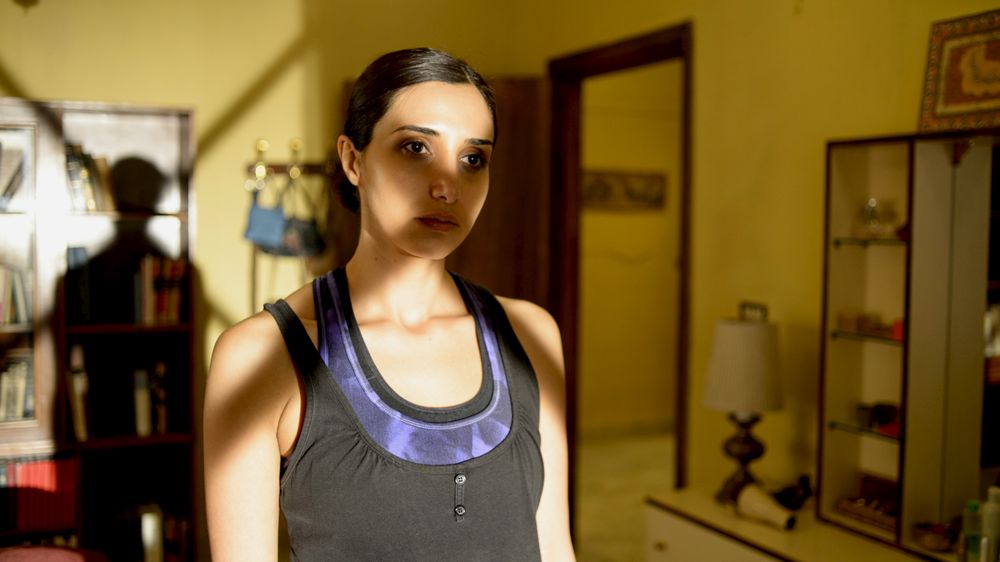
Pari (Rafizadeh) is a wife and mother whose husband is a drug addict and in prison; she wants a divorce but he won’t agree to it. Sara (Ebrahimi) is a wife and mother-to-be who wants a job; her husband, Mohsen (Bayram), won’t allow it. Babak (Marandi) is an aspiring musician who has a one-night stand with Donya (Alizadeh) who is due to marry in a week’s time; this means she is no longer a virgin, something her fiancé is expecting her to be when they marry. Babak must arrange for Donya to have an operation to “restore” her maidenhood. Pari resorts to prostitution in order to get by; a chance encounter with a judge (Mete) sees her and her son, Elias (Yasar) set up in the same apartment block that Sara and Babak live in. Pari and Sara become friends, while  Pari finds herself helping Babak and Donya. As their lives intertwine, and secrets are revealed, each of the four must make decisions that will affect each of their futures, some of them irrevocably…

A movie that perhaps could only be presented in the rotoscoping animated format that director Ali Soozandeh has opted for, Tehran Taboo creditably and credibly explores the hypocrisy and double standards inherent in Iranian society today. Just how deep-rooted this is, is best illustrated by an early scene where Pari negotiates a sexual favour for a taxi driver. With the act and its price agreed, Pari sets to only for the taxi driver to spot his daughter walking along hand in hand with a boy. His sense of outrage is almost incandescent. That Iranian society is overwhelmingly patriarchal, and its laws designed to keep women firmly in the places prescribed for them, is nothing new, but the way in which Soozandeh and script collaborator Grit Kienzlen have constructed the interlocking stories of Pari, Sara, Babak and Donya, is to show just how far-reaching its effects can be. This is reflected in the lengths that Pari will go to to provide for herself and Elias, and the desperation that Sara feels at Mohsen’s unwillingness to agree to let her work. Likewise, Babak’s good intentions in supporting Donya lead him into unfamiiar social and political territory. They’re all trying to do what’s best, but at a continual cost to themselves.

Soozandeh is savvy enough to ensure that not everyone makes the best decisions, and though some of what transpires can be guessed at way in advance, the situations his characters find themselves in are compelling enough that the movie’s obvious lack of subtlety isn’t a hindrance (plus you could argue that with Iranian laws lacking their own subtlety, why bother?). At one point, Babak’s friend Amir (Tavakoli) says, “Saying no is more important than breathing in Tehran!”, and it’s the most persuasive observation in the whole movie, a moment of carefree discourse that sums up the oppressive nature of Iranian law as a whole. With its focus on various sexual proclivities, and moments of female nudity, this is definitely not a movie that could have been made in Tehran (or anywhere in Iran for that matter), and the rotoscoping effect adds an emotional currency that might not have been present otherwise, with expressions highlighting the characters’ feelings in ways that feel far more intriguing than usual. Soozandeh is aided immensely by a very talented cast, with Rafizadeh particularly impressive as the world-weary yet still optimistic Pari, while it should be noted that, thanks to editors Frank Geiger and Andrea Mertens, the movie has a brisk sense of immediacy about it that helps make it absorbing to watch.

Rating: 8/10 – while some of the traditional background animation feels flat and in need of development, and some of the more political elements are laid on with the proverbial trowel, there’s no denying that Tehran Taboo is a timely reminder of the undeserved restrictions imposed on a certain section of its population; thought-provoking despite some of its more soap opera-style elements, it’s a movie that also offers hope and sympathy along the way.
Share this:

  • Click to share on X (Opens in new window) X
  • Click to share on Facebook (Opens in new window) Facebook
  • More
  • Click to print (Opens in new window) Print
  • Click to email a link to a friend (Opens in new window) Email
Like Loading...

Under the Shadow (2016)

16 Thursday Feb 2017

Posted by dullwood68 in Movies

≈ Leave a comment

Tags

Avin Manshadi, Babak Anvari, Djinn, Drama, Horror, Mother/daughter relationship, Narges Rashidi, Review, Tehran, Unexploded bomb

under-the-shadow-_nz-poster-final-web

D: Babak Anvari / 84m

Cast: Narges Rashidi, Avin Manshadi, Bobby Naderi, Arash Marandi, Aram Ghasemy, Soussan Farrokhnia, Ray Haratian, Hamid Djavadan

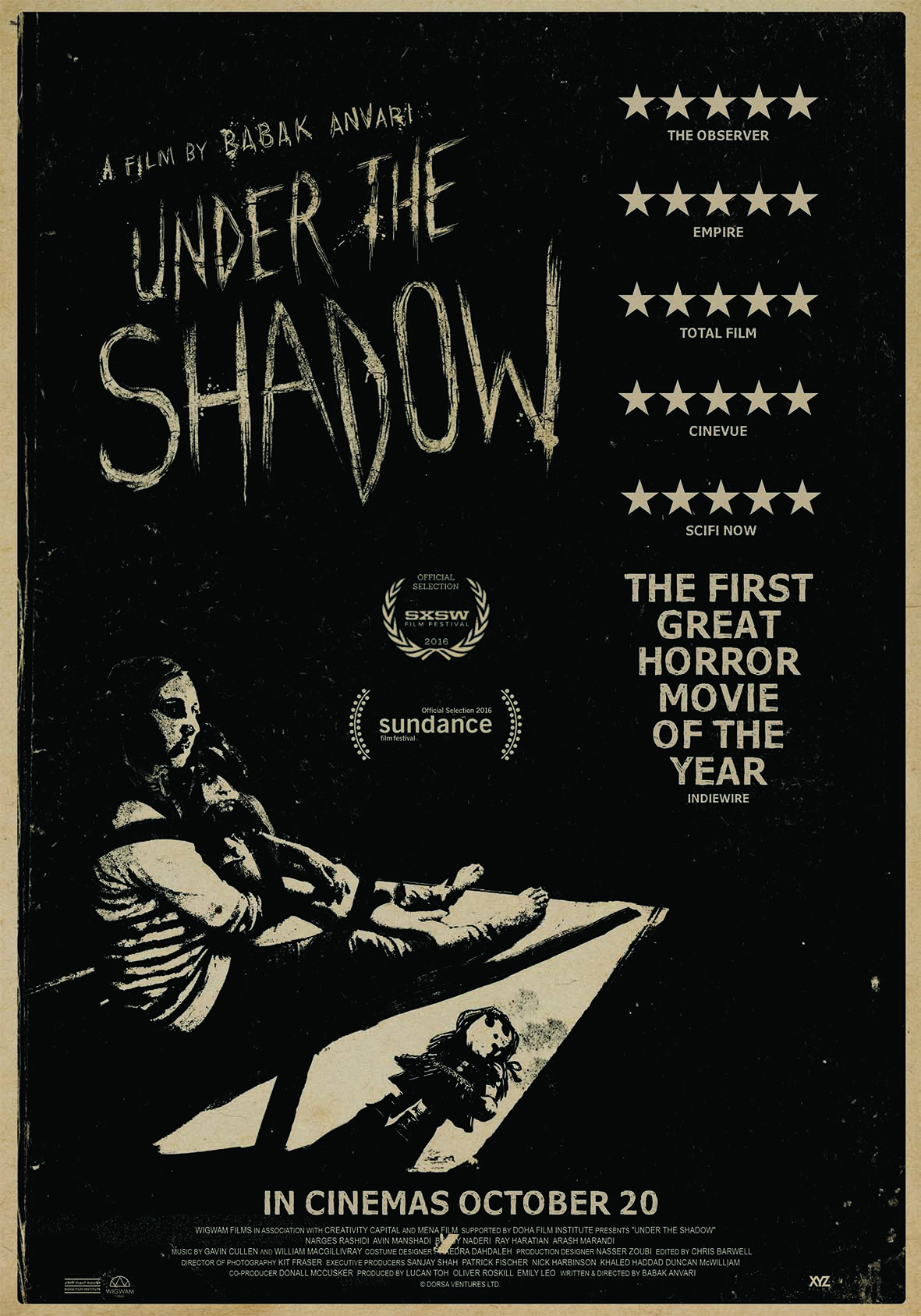
Tehran, the late Eighties. Shideh (Rashidi) is a former medical student who finds herself unable to resume her studies due to her prior involvement with left-wing political groups. She disposes of most of her old medical books but keeps one that was a gift from her mother. With the city under continual threat from random bomb attacks by Iraq, Shideh still wants to stay where she is with her daughter, Dorsa (Manshadi). Her husband, Iraj (Naderi), wants them to go and live with his parents away from the shelling, but Shideh refuses. When Iraj is conscripted, the matter becomes a moot point, but before he leaves, he tells Dorsa that her favourite doll, Kimia, will keep her safe from harm.

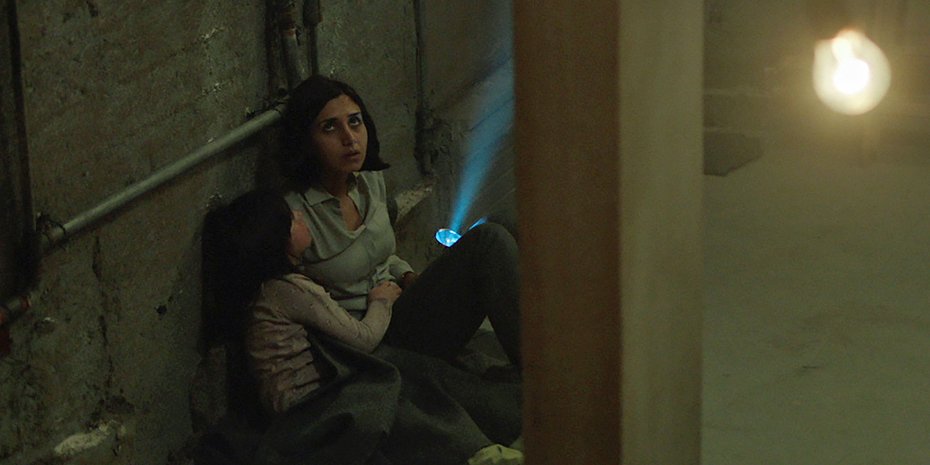
Soon after, neighbours the Ebrahimis take in an orphaned cousin, a young boy. During an air raid, he whispers something in Dorsa’s ear and hands her a charm meant to ward off evil spirits. Shideh finds it later in Dorsa’s room and throws it away. Afterwards, Dorsa develops a fever and begins having nightmares; Shideh has similar dreams as well. When a missile strikes the building they live in, causing a large crack in the ceiling, the impact also renders Dorsa unconscious; at the same time, Kimia goes missing. As a result, Dorsa’s behaviour becomes erratic, and she keeps trying to get into the flat on the floor above, insisting that Kimia is inside. She also tells Shideh that someone is moving around in their own flat, a mysterious woman that only she can see.

b0b8dcdd8222b22c985a1104c4c02164-1000x563

From one of their remaining neighbours, Shideh learns that a djinn can possess a person, and will steal a favourite item in their efforts to ensnare and take control of that person. Soon, Shideh and Dorsa are the only people left in the building. Shideh’s nightmares increase in both frequency and intensity, until she has no choice but to leave and go to Iraj’s parents. But Dorsa won’t leave unless she has Kimia back. Shideh makes one last desperate search for the doll, and in the process learns a horrifying truth: that the one last medical text book she kept is no longer in the locked drawer where she had hidden it, but has been replaced by Dorsa’s doll. Even more intent on leaving, the pair attempt to do so but find that it’s not so easy, and that the supernatural force Shideh has tried to deny, is determined to stop them.

Under the Shadow has proven to be a surprise hit since its first screening at the 2016 Sundance Film Festival, what with a glowing critical reception, and audiences finding themselves entranced by the low-key, thoughtful approach adopted by writer/director Babak Anvari. Having recently won a BAFTA for Outstanding Debut by a British Writer, Director or Producer, the movie is a subtle, menacing chiller that takes a simple premise and builds on it in such a way that when the terror of Shideh and Dorsa’s situation begins to form in earnest, the tension builds with it until it becomes almost unbearable. Anvari succeeds at this by keeping the scares to a minimum and using them to punctuate the narrative instead of making them the focus. As the tension mounts, each scare or shock adds to the overall effect, and increases the sense of dread that the movie has created.

under-the-shadow-sundance-film-festival-final

It’s a movie where the atmosphere inside Shideh’s flat is stifling and claustrophobic right from the start. Her relationship with Iraj is strained, his lack of understanding of how she feels when her studies are curtailed a prime mover in her decision to remain in Tehran. But Shideh herself is equally lacking in empathy when Iraj is conscripted, more concerned that he’s kept it from her until the last moment. With her marriage on rocky ground, Shideh focuses on Dorsa, but finds that their relationship has become even more strained than it is with her husband. Dorsa’s insistence on finding Kimia and the presence of someone else in the flat challenges Shideh’s attempts at keeping order in both the flat and her life. As she becomes more and more affected by her nightmares, and the growing sense that Dorsa may be right – despite everything her practical mind tells her – Shideh’s ability to tell reality from fantasy becomes increasingly fraught.

Where a mother’s determination to protect her daughter from harm is a staple of dramas the world over, here it’s made all the more effective by Anvari’s considered approach to both Shideh and Dorsa and the unexpected relationship that develops between them as their situation becomes more and more imperilled. There are moments where Dorsa is fully in control and Shideh is behaving in thrall to her daughter’s obsessive needs over Kimia. Anvari makes these moments credible through Shideh’s own need to keep Dorsa safe at all costs, and while Shideh resists the idea that there’s a supernatural reason for her daughter’s “condition”, her struggle to maintain a sense of normalcy drives her to make concessions when necessary. She doesn’t necessarily agree with her daughter’s claims, but she does recognise that her daughter believes what’s she’s saying.

undertheshadow_trailer1

The effectiveness of Shideh and Dorsa’s relationship is a key component of Anvari’s script, but it’s also his development of the danger that threatens them that makes as much of an impact. The disintegration of their nuclear family gives way to a more serious threat, as the djinn’s presence in the building promotes fear and anxiety on a level that permeates the narrative, and which also allows the level of dread to grow and develop at a slow, deliberate pace that makes things all the more intimidating and terrifying. By the time they try to leave the building, Anvari has made the presence of the djinn – represented by the spookiest chador you’re ever likely to see – such a palpably unnerving entity that it’s very nature: ordinary yet intrinsically threatening, makes it a truly terrifying opponent.

The movie is also effective because of its background, a period of Iranian history where the country was experiencing constant strife thanks to the ongoing hostilities with Iraq. The missile that crashes into the building is seen as the means by which the djinn arrives, as if it were a chemical weapon attached to the shell and designed to spread confusion and terror amongst the Tehran populace. Shideh’s inappropriate political leanings also reflect the non-status of many women at the time, their role reduced to that of being a mother, and with all the social restrictions that apply (after a particularly vivid nightmare, Shideh escapes outside but is apprehended by the police for not being covered up in public; when she is brought home, she does her best to hide the shame she feels but doesn’t want to feel).

Kit Fraser’s deliberately drab, minimalistic cinematography highlights the uphill struggle experienced by Shideh in trying to keep Dorsa safe, and his use of shadow and light in certain shots evokes an uneasiness that Anvari exploits to the movie’s full advantage. Likewise, the score by Gavin Cullen and Will McGillivray is used to support the growing, unhealthy atmosphere inside Shideh’s flat, and to punctuate those moments when the djinn’s evil aura adds dismay and menace to the proceedings. It’s all wrapped up by Anvari neatly and convincingly, and at a modest running time, is easily one of the best horror movies of recent years.

Rating: 9/10 – expertly constructed by its writer/director (making his feature debut), Under the Shadow is a goosebump-inducing tale of paranoia and possession that makes the most of its limited resources; a refreshing take on the home invasion/urban terror sub-genre of horror movies, the movie succeeds by playing it straight, and by layering everything that happens with sincerity and a large helping of credibility.

Share this:

  • Click to share on X (Opens in new window) X
  • Click to share on Facebook (Opens in new window) Facebook
  • More
  • Click to print (Opens in new window) Print
  • Click to email a link to a friend (Opens in new window) Email
Like Loading...

Rosewater (2014)

17 Friday Oct 2014

Posted by dullwood68 in Movies

≈ 1 Comment

Tags

2009 Election, Drama, Gael García Bernal, Imprisonment, Iran, Jon Stewart, Kim Bodnia, Maziar Bahari, Mir-Hossein Mousavi, President Ahmadinejad, Review, Tehran, Then They Came for Me, True story

Rosewater

D: Jon Stewart / 103m

Cast: Gael García Bernal, Kim Bodnia, Shohreh Aghdashloo, Haluk Bilginer, Golshifteh Farahani, Claire Foy, Dimitri Leonidas, Nasser Faris, Jason Jones

An Iranian-born journalist, Maziar Bahari (Bernal), travels to Tehran in June 2009 to cover the Presidential election for Newsweek.  In the run up he speaks to supporters of both President Ahmadinejad and his main rival Mir-Hossein Mousavi, and while his own opinions favour Mousavi, he remains outwardly neutral in his reporting, even when on the day of the election he finds himself barred from an open polling station at the same time that news is being broadcast that Ahmadinejad has won.

In the days that follow, Bahari films on the streets as the Iranian people protest against what they feel have been rigged elections.  During one such protest, Bahari films a crowd outside a military barracks that come under fire from the militia in the building.  He arranges for the footage to be seen outside Iran.  On June 21, while staying with his mother, Moloojoon (Aghdashloo), Bahari is arrested and taken to Evin prison where he is charged with being a spy.

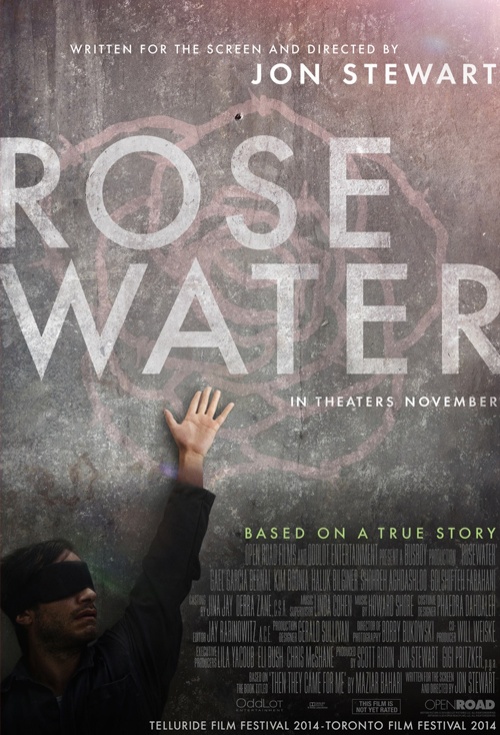
Kept in solitary confinement, Bahari is regularly taken to a room where he is made to sit facing a wall but with a blindfold on.  Here his interrogator (Bodnia) keeps asking him who he is spying for, and is it with the aim of trying to undermine and/or overthrow the Iranian government.  Bahari rejects the idea, and does his best to convince his interrogator that he is just a journalist but the interrogator, in turn, rejects his assertions.  Days pass in this way as various forms of psychological and physical torture are used to break Bahari and get him to confess.  Eventually, after several weeks he makes a televised confession that he is a spy.

Despite being what the Iranian authorities have wanted all along, the confession serves only to highlight Bahari’s plight on an international level, and helps his pregnant wife, Paola (Foy), with her campaign to get him released.  Back in the prison, the interrogations continue but now Bahari begins to regain some level footing by making up stories about his travels, stories that his interrogator believes wholeheartedly.  And then, on October 20, after a hundred and eighteen days, Bahari is offered a chance at freedom: agree to be a spy for the Iranian government and he will be released.

Rosewater - scene

Based on the memoir, Then They Came for Me, that Bahari co-wrote with Aimee Molloy, Rosewater is a compelling, occasionally provocative drama that benefits from solid performances, a clever script courtesy of first-time writer/director Stewart, and a skilful re-creation of the events that led up to Bahari’s confinement.  The movie begins with Bahari’s arrest, a tense scene that carries an uncomfortable hint of menace towards his mother.  From there we flash back to Bahari preparing to leave London for Tehran; the audience gets to see how confidently Stewart is able to set up the story, explaining concisely the basic political situation in Iran, and the importance for the people of the election.

The concise nature of the opening scenes allows the audience to spend more time with Bahari in Evin prison, and it’s here that the movie explores the surprising nature of captivity and its effect on the individual.  Bahari is never conventionally tortured.  There are no beatings, no physical restraints put in place (other than the blindfold), and only one attempt at violence that is conducted more out of frustration on the interrogator’s part than from any premeditated action.  But it has a profound psychological effect on Bahari, and Stewart – aided greatly by Bernal – shows how he did his best to survive by creating interior dialogues with his deceased father and sister.  These scenes are among the most effective in the movie as, for the most part, despite it seeming that Bahari is able to come up with a constructive way of dealing with his captors, by and large he’s unable to do so.  These dialogues allow him to feel and be strong in his own mind, but not in the interrogation room.  It’s a subtle acknowledgment – that often, our strength is something we can only convince ourselves of – but one that Stewart pulls off with deliberately muted style.

With much of the prison scenes allowing little of the outside world to creep in, Bahari’s loneliness and isolation is powerfully presented, though as time goes on and he becomes almost inured to the passage of time, Stewart gradually opens up the movie to show us what’s been going on in the meantime.  Again, it’s a clever move, and adds to the sense that time is passing slowly (which, for Bahari, it must have done).  It’s not until a guard refers to him as “Mr Hillary Clinton” that we – and he – begin to realise that he’s not been quite as alone as it’s seemed.  From there the movie begins to gain pace as the prospect of Bahari’s release becomes more likely, and Stewart allows the tension to unwind.  It’s a slightly counter-intuitive approach but it works in the movie’s favour.

Rosewater - scene2

With Stewart so firmly in control of the material it’s good to see he’s also firmly in control of the performances.  Bernal is an actor who continually impresses, and here he inhabits Bahari with ease, displaying his nervousness and fear and desperation with conviction (though perhaps his best moment is when he dances around his cell to a song only he can hear).  It’s a measured, contemplative performance, one that brings a greater depth to Bahari as a man than audiences might expect.  As his nemesis, and user of the titular liquid, Bodnia is also on fine form, a more traditional style of interrogator who would usually favour a more physical approach, but who finds himself increasingly out of his comfort zone.  When Bahari talks about his “obsession” with sexual massages, his willingness to believe these stories is both comic and pathetic.  The two actors spar around each other with skill, and both are equally mesmerising in their scenes together.

The rest of the cast haven’t quite as much to do in comparison, though Leonidas stands out as Bahari’s “driver”, Davood, and Faris plays the interrogator’s boss with patronising detachment.  Aghdashloo and Bilginer are persuasive as always as Maziar’s parents, though as his sister, Farahani has too little screen time to make any real impression.  This being a Jon Stewart movie there’s also plenty of humour to be had in amongst all the drama, and one scene will have audiences laughing out loud thanks to Bernal and Bodnia’s skill as actors.  The photography is sharply detailed and the movie is brightly lit throughout, at odds with the more gloomy aspects of events.  There’s also an effective score courtesy of Howard Shore that adds weight to the emotional content, but doesn’t overwhelm it.  A couple of gripes aside – Bahari’s hair and beard remain the same throughout the entire hundred and eighteen days he’s imprisoned, the interrogator seems a little too out of his depth to be kept on board the whole time – this is riveting, engrossing stuff, and a triumph for all concerned.

Rating: 9/10 – Rosewater takes a tale of imprisonment and loss of personal freedom but somehow makes it completely accessible and not in the least claustrophobic, while still reinforcing the seriousness of the situation; a great debut for Stewart and one that  succeeds with apparent ease.

Share this:

  • Click to share on X (Opens in new window) X
  • Click to share on Facebook (Opens in new window) Facebook
  • More
  • Click to print (Opens in new window) Print
  • Click to email a link to a friend (Opens in new window) Email
Like Loading...

Blog Stats

  • 486,842 hits

Recent Posts

  • 10 Reasons to Remember Bibi Andersson (1935-2019)
  • Fantasia (1940)
  • Dances With Wolves (1990) – The Special Edition
  • Kiss of the Spider Woman (1985)
  • The Three Musketeers (1973)

Top Posts & Pages

  • Lost for Life (2013) - Another Look
    Lost for Life (2013) - Another Look
  • Lost for Life (2013)
    Lost for Life (2013)
  • About
    About
  • A Brief Word About La La Land (2016)
    A Brief Word About La La Land (2016)
  • Exposed (2016)
    Exposed (2016)
  • Cardboard Boxer (2016)
    Cardboard Boxer (2016)
  • Irrational Man (2015)
    Irrational Man (2015)
  • The Monuments Men (2014)
    The Monuments Men (2014)
  • Removal (2010)
    Removal (2010)
  • My Top 10 Guilty Pleasures
    My Top 10 Guilty Pleasures
Follow thedullwoodexperiment on WordPress.com

Blogs I Follow

  • Rubbish Talk
  • Film 4 Fan
  • Fast Film Reviews
  • The Film Blog
  • All Things Movies UK
  • Interpreting the Stars
  • Let's Go To The Movies
  • Movie Reviews 101
  • TMI News
  • Dan the Man's Movie Reviews
  • Film History
  • Jordan and Eddie (The Movie Guys)

Archives

  • April 2019 (13)
  • March 2019 (28)
  • February 2019 (28)
  • January 2019 (32)
  • December 2018 (28)
  • November 2018 (30)
  • October 2018 (29)
  • September 2018 (29)
  • August 2018 (29)
  • July 2018 (30)
  • June 2018 (28)
  • May 2018 (24)
  • April 2018 (21)
  • March 2018 (31)
  • February 2018 (25)
  • January 2018 (30)
  • December 2017 (30)
  • November 2017 (27)
  • October 2017 (27)
  • September 2017 (26)
  • August 2017 (32)
  • July 2017 (32)
  • June 2017 (30)
  • May 2017 (29)
  • April 2017 (29)
  • March 2017 (30)
  • February 2017 (27)
  • January 2017 (32)
  • December 2016 (30)
  • November 2016 (28)
  • October 2016 (30)
  • September 2016 (27)
  • August 2016 (30)
  • July 2016 (30)
  • June 2016 (31)
  • May 2016 (34)
  • April 2016 (30)
  • March 2016 (30)
  • February 2016 (28)
  • January 2016 (35)
  • December 2015 (34)
  • November 2015 (31)
  • October 2015 (31)
  • September 2015 (34)
  • August 2015 (31)
  • July 2015 (33)
  • June 2015 (12)
  • May 2015 (31)
  • April 2015 (32)
  • March 2015 (30)
  • February 2015 (37)
  • January 2015 (39)
  • December 2014 (34)
  • November 2014 (34)
  • October 2014 (36)
  • September 2014 (25)
  • August 2014 (29)
  • July 2014 (29)
  • June 2014 (28)
  • May 2014 (23)
  • April 2014 (21)
  • March 2014 (42)
  • February 2014 (38)
  • January 2014 (29)
  • December 2013 (28)
  • November 2013 (34)
  • October 2013 (4)

Blog at WordPress.com.

Rubbish Talk

Film 4 Fan

A Movie Blog

Fast Film Reviews

The Film Blog

The official blog of everything in film

All Things Movies UK

Movie Reviews and Original Articles

Interpreting the Stars

Dave Examines Movies

Let's Go To The Movies

Film and Theatre Lover!

Movie Reviews 101

Daily Movie Reviews

TMI News

Latest weather, crime and breaking news

Dan the Man's Movie Reviews

All my aimless thoughts, ideas, and ramblings, all packed into one site!

Film History

Telling the story of film

Jordan and Eddie (The Movie Guys)

Movie Reviews & Ramblings from an Australian Based Film Fan

Privacy & Cookies: This site uses cookies. By continuing to use this website, you agree to their use.
To find out more, including how to control cookies, see here: Cookie Policy
  • Subscribe Subscribed
    • thedullwoodexperiment
    • Join 481 other subscribers
    • Already have a WordPress.com account? Log in now.
    • thedullwoodexperiment
    • Subscribe Subscribed
    • Sign up
    • Log in
    • Report this content
    • View site in Reader
    • Manage subscriptions
    • Collapse this bar
 

Loading Comments...
 

    %d