
Tags
1941-1970, Australian cinema, Australian Film Awards, Australian Film Institute, Cattle drove, Charles Chauvel, Chips Rafferty, Cinesound Productions, Daphne Campbell, Ealing, Jedda, Kokoda Front Line!, Michael Powell, Northern Territory, The Overlanders, They're a Weird Mob, True story, World War II
Australian Cinema Part III – 1941-1970
With Australia’s entry into the Second World War in 1939, movie production dwindled in support of the war effort. Movies continued to be made but they were few and far between, and were dependent on their producers’ confidence in claiming enough of the domestic and international markets to be worthwhile in making. Cinesound Productions, though they’d stopped making feature length movies, were still making newsreels, and in 1942 they won the Oscar for Best Documentary for their full-length edition of the Cinesound Review entitled Kokoda Front Line! Other, fictional, propaganda movies were made (in keeping with similar efforts made in other countries at war); these included Forty Thousand Horsemen (1940), and The Rats of Tobruk (1944). (Both movies were directed by Charles Chauvel, and ever since 1992, the Brisbane International Film Festival has awarded a Chauvel Award for distinguished contributions to Australian cinema.) But once the war was over, any expected upturn in production failed to materialise, as can be seen by the release of just one movie in 1948, Always Another Dawn.
The Forties did see the emergence of homegrown stars who would go on to have international careers, actors such as Peter Finch (actually born in England) and Chips Rafferty. Rafferty was the star of one of Australia’s finest movies of the Forties, a saga of drovers transporting a large herd of cattle across 1600 miles of inhospitable outback. Produced by Ealing, it was very, very successful at the box office, with an estimated 350,000 Australians having seen it by February 1947, six months after its release.
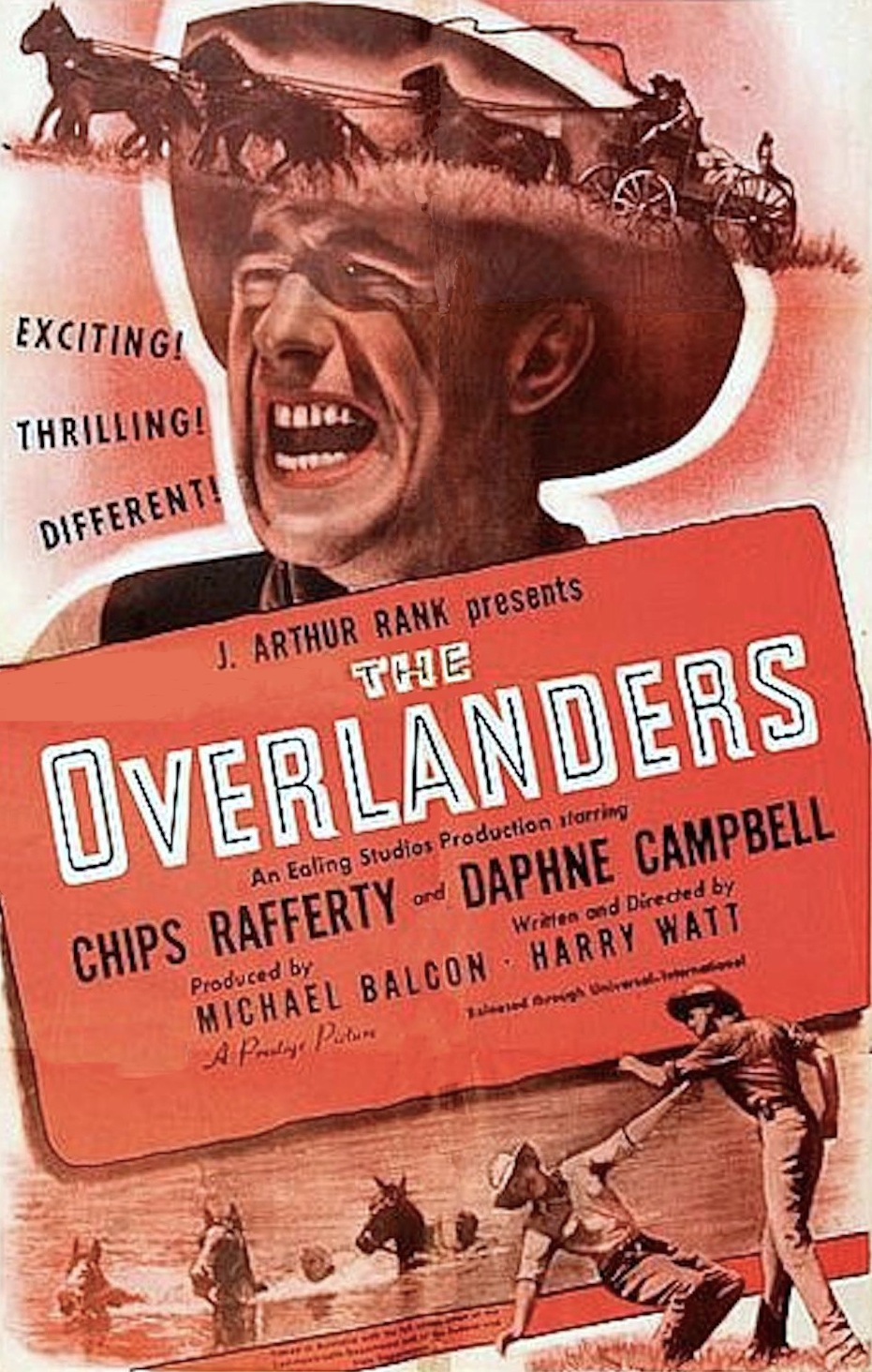
The Overlanders (1946) / D: Harry Watt / 91m
Cast: Chips Rafferty, John Nugent Hayward, Daphne Campbell, Jean Blue, Helen Grieve, John Fernside, Peter Pagan, Frank Ransome, Stan Tolhurst, Clyde Combo, Henry Murdoch
1942. With the threat of invasion by Japanese forces, many Australians feel it’s only a matter of time before they’re overrun. People in the north of the country begin evacuating their homes to head south and burning them in a kind of “scorched earth” policy. One such family are the Parsons: Bill (Hayward), his wife (Blue), and their two daughters, Mary (Campbell) and Helen (Grieve).
Meanwhile, in the Kimberley District of Western Australia, a meat export centre has been directed to pack up its operation and for its men to head south. When the manager (Tolhurst) tells cattle man Dan McAlpine (Rafferty) that the cattle will need to be shot, Dan comes up with an alternative: to drive the cattle – all 958 of them – overland to Queensland, a distance of 1500 miles. He manages to enlist some of his co-workers to help him, including a sailor, Sinbad (Pagan) a couple of aborigines, Jacky (Combo) and Nipper (Murdoch), and generally work-shy Corky (Fernside). As they make plans to set out, the Parsons’ join them.
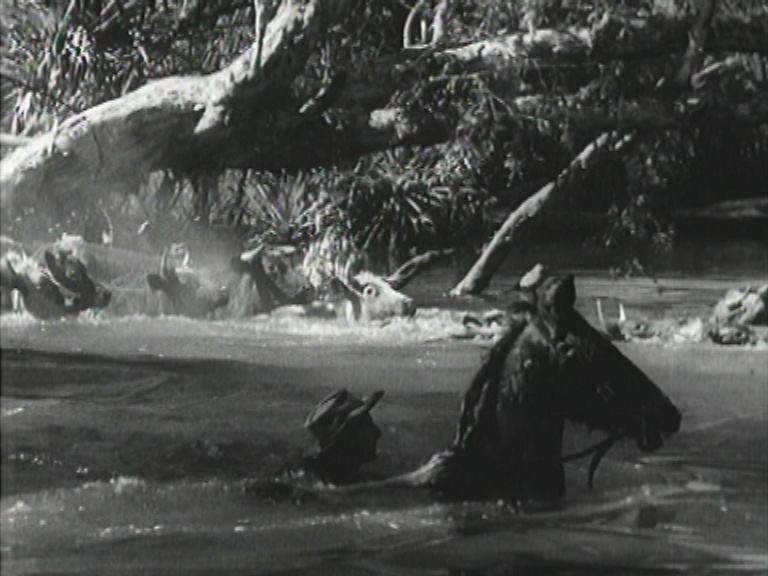
At first, the drove is slow going. A couple of months pass of fairly easy travel before they reach the North-South Road, but a week later they encounter the first obstacle to reaching the East Coast, a crocodile-infested river that they need to cross. The crossing goes well with no loss of cattle, but on the other side the drove finds its second obstacle, scrubland that gives the cattle little to feed on; this also slows them down to making only five miles a day instead of an average ten or twelve. A little while later, a tragedy leaves them short of horses, but salvation proves to be at hand (and close by) in the form of a group of brumbies (wild horses). They trap and break enough of them to allow the drove to continue on, and soon they arrive at an outpost, Anthony’s Lagoon where they get fresh supplies.
The next leg of the drove proves even harder, with no surface water or much feed for the cattle, but all goes well though tempers are frayed due to the conditions. When they reach the Queensland border they have to stop so that the cattle can be inoculated. While this is done, Corky reveals his plans following the war to set up a company for the exploitation of land and mineral rights in the Northern Territory, a plan Dan is none too happy to hear about. That same night, Sinbad and Mary reveal their feelings for each other, and the cattle are spooked, causing a stampede. In the attempt to halt them, Sinbad is badly injured; Mary tries to alert the inoculation team who are leaving on the plane that brought them there, but they take off before she can reach them.
With no other option open to them, Sinbad is put on the back of the supply wagon and Mrs Parsons and Helen leave the drove to take him to the nearest place with a wireless that can summon the flying doctor. The drove then faces another setback at the next watering hole which is dry. Needing to water the cattle in the next two days or face losing them all, Dan must take a risk in taking them over a range of rocky hills along a track more suited for goats than cattle.
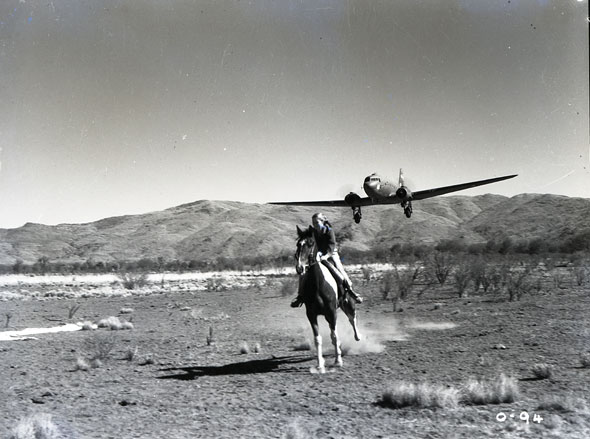
Though shot in black and white, The Overlanders was the first Australian movie to be filmed almost entirely outdoors. This allowed the makers to shoot some of the most rugged and breathtaking scenery in the country’s northern states, as well as providing audiences with a realistic look at a cattle drove and the problems it might face. It was based on an actual event that occurred in 1942 where 100,000 cattle were driven 2,000 miles to avoid the (expected) Japanese invasion. Although the movie had to scale back those numbers out of necessity – though 958 is quoted as the number of cattle on the drove, Ealing only used 500 – it’s still an impressive looking sight, especially when the drove is seen from a distance.
The sheer physical effort involved in bringing the movie to the screen is impressive, with the river crossing a particular highlight. The cast look the part too (though Pagan’s hairstyle marks him out as the matinee idol in the making), with Rafferty looking so at home in the saddle, and giving such a natural performance it’s no surprise that Ealing signed him to a long-term contract before the movie was even released. He’s possibly the quintessential pre-1970’s Australian actor, honest, as rugged as the country around him, and refreshingly no-nonsense in his approach to the art of acting. He’s an actor for whom a false note would be impossible, and here his condemnation of the plan to exploit the Northern Territory’s resources shows an impassioned side that is as plainly felt as it is expressed.
With the movie’s verisimilitude firmly in place and the location photography adding to the effectiveness of the overall drama, writer/director Watt’s decision to spend around eighteen months preparing the movie paid off handsomely (he even spent 1944 following the route of the original drove). His script is one of the most succinct and straightforward of the period, and is so lean it feels effortless in its construction. His original ending was more cynical than the one used but it wouldn’t have felt out of place; underneath all the belated pro-Australian war effort propaganda, there’s an undeniable sense that the country was on the cusp of some profound and far-reaching changes.
The movie does start out a little slowly, but sets out its stall with a minimum of fuss, and while the first hour sees everything go well, the inevitable setbacks and life-threatening situations make the movie more gripping, although in a matter-of-fact way that, weirdly, is entirely apposite. It speaks to the Aussie mentality of “let’s just get it done”, and shows the characters almost welcoming the adversity as a way of proving either their manhood (if male) or their unspoken capability (if female). Mary is congratulated on heading off the stampede, but she shrugs it off as no more appropriate than if she’d made dinner for everyone, so confident is she in her own abilities. It’s a small, neat touch that says everything you need to know about the characters’ inner strengths, and not just Mary’s, as they’re all so attuned to what they’re doing (and even if Corky is looking much further ahead than the others).
There’s a rousing score by English composer John Ireland that manages to be evocative at the same time, and the photography, so ravishing to look at, comes courtesy of Osmond Borradaile, a Canadian whose experience in shooting location footage more than justified Watt’s decision to hire him. And though Watt was unhappy with the way Inman Hunter edited the movie and brought in Leslie Norman to take over, whatever the final percentage of each man’s work, the movie is seamless and the decision doesn’t show in the finished product. And you have to admire a movie that includes the line, “bullocks are more important than bullets”.
Rating: 9/10 – an engrossing, simply told tale that highlights the strengths of the Australian movie industry at the time, The Overlanders is a tribute to both the men and women who lived through the threat of Japanese occupation and did their best to live outside the shadow of that dreadful possibility; with the Australian outback looking both daunting and alluring, it’s a movie that celebrates the country and its people’s apparently unflagging fortitude, and does so in such a skilful way that it stays in the memory long after it’s seen.
In the Fifties, Australia became the place to make movies if you were a foreign production company (such as Ealing). But there was a degree of irony attached to this development, as movie makers from around the world came to Australia to make movies that depicted Australian life and culture, or were adaptations of Australian stories or literature. Chief amongst these were the likes of A Town Like Alice (1956) and The Shiralee (1957), but while they were made in Australia, they weren’t Australian movies; they were made by British or American companies and so were British or American movies. One movie made in the Fifties that was wholeheartedly Australian, funding and all, was Jedda (1955), notable for being the first Australian movie shot in colour, and for its casting of two Aboriginal actors – Ngarla Kunoth and Robert Tudawali – in the lead roles (it was also the last movie to be directed by Charles Chauvel).
Elsewhere though, indigenous movie making was struggling to make any kind of an impact. Robbery Under Arms (1957) was an exception, but otherwise there were few production companies that were willing or able to make movies that would have bolstered the industry’s standing, or made any headway at the box office. In 1958, the Australian Film Institute was founded, its mission to promote the industry both at home and abroad. The Institute also set up the annual AFI Awards which were designed in part to “improve the impoverished state of Australian cinema”. That first year there were seven categories: Documentary, Educational, Advertising, Experimental Film, Public Relations, and an Open category for any movie that didn’t fit any of the other criteria. Such was the parlous state of the industry at the time – and on into the Sixties – that it wasn’t until 1969 and Jack and Jill: A Postscript that a feature movie was given an award.
The Sixties began with a rare fillip for the industry in the form of Fred Zinnemann’s The Sundowners (1960), but it was a US/UK/Australian production, and without Zinnemann’s passion for the project, unlikely to have been made under other circumstances. The situation worsened as the decade continued. Clay (1965) was entered for the Palm Award at the Cannes Film Festival, but again this was a rare event that provided a momentary boost for an otherwise moribund industry. Even They’re a Weird Mob (1966), directed by Michael Powell, and featuring familiar faces such as Chips Rafferty, Ed Devereaux, John Meillon and Clare Dunne, couldn’t do much to stem the tide of inertia (though some say it was an inspiration to the generation of movie makers who would follow in the Seventies). (Look closely and you can see Jeanie Drynan and Jacki Weaver in early roles.)
Powell would return to Australia to make Age of Consent (1969) but as the decade drew to an end there was no sign that the movie industry was going anywhere but as steadily downhill as it had been since the late Forties.
 thedullwoodexperiment