• 10 Reasons to Remember…
  • A Brief Word About…
  • About
  • For One Week Only
  • Happy Birthday
  • Monthly Roundup
  • Old-Time Crime
  • Other Posts
  • Poster of the Week
  • Question of the Week
  • Reviews
  • Trailers

thedullwoodexperiment

~ Viewing movies in a different light

thedullwoodexperiment

Tag Archives: The White House

Jackie (2016)

30 Monday Jan 2017

Posted by dullwood68 in Movies

≈ 2 Comments

Tags

Billy Crudup, Biography, Drama, Funeral, Greta Gerwig, Historical drama, Interview, Jacqueline Bouvier Kennedy, Natalie Portman, Pablo Larraín, Peter Sarsgaard, President John F. Kennedy, Review, The White House, True story

14757631562jackie-movie-poster-natalie-portman

D: Pablo Larraín / 100m

Cast: Natalie Portman, Peter Sarsgaard, Billy Crudup, Greta Gerwig, John Hurt, Richard E. Grant, Caspar Phillipson, Beth Grant, John Carroll Lynch, Max Casella

A week after the assassination of President John F. Kennedy (Phillipson) in November 1963, his widow, Jacqueline Bouvier Kennedy (Portman) – otherwise known as Jackie – summoned the journalist Theodore H. White (Crudup) to her home at Hyannis Port. White had won the Pulitzer Prize for general non-fiction with his book The Making of the President, 1960, an account of the election that saw Kennedy win the Presidency. Jackie’s idea was for White to write an article that would be published in Life magazine, and which would show a correlation between her late husband’s administration and King Arthur’s court at Camelot. White agreed, and guided by Jackie’s suggestions, he wrote a thousand word essay that stressed the Camelot comparison.

This is the basis for Jackie, the latest movie to pick over the bones of Kennedy’s assassination and its wake. By using White’s “interview” with Jackie, the movie shows how Jackie dealt with the demands of suddenly becoming a former First Lady, balancing her public persona with her private feelings, arranging her husband’s funeral, and most important of all, protecting and promoting his legacy. It’s this that forms most of the narrative, as Jackie seeks to cement Kennedy’s place in history. Even riding in a hearse with brother-in-law Bobby Kennedy (Sarsgaard) (and this shortly after Kennedy’s body has been released from Parkland Hospital), Jackie is keen to make the point that nobody remembers James A. Garfield or William McKinley, both assassinated while in office, but they do remember Abraham Lincoln – and all because of his legacy as a President.
landscape-1480358441-image-04afa3ee-f8cc-4059-8c62-8208612a44bc

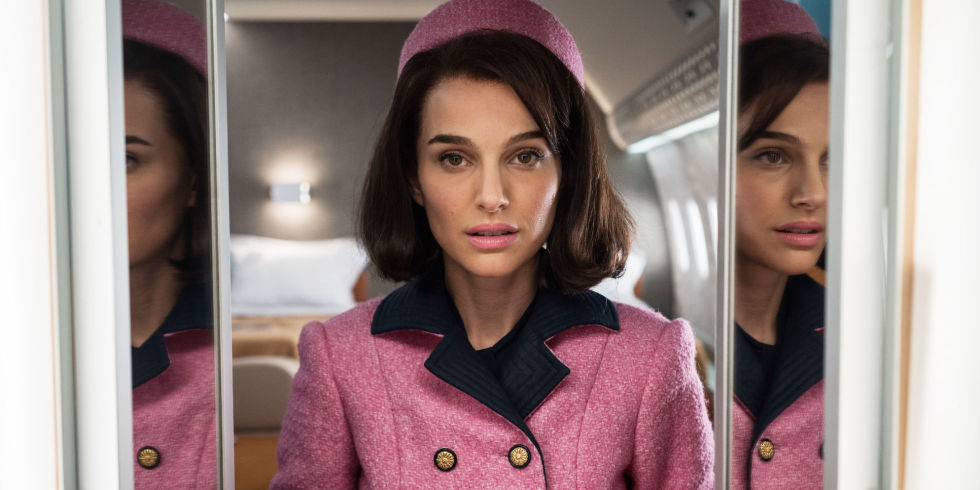
But her husband’s legacy isn’t the only thing she appears focused on. There’s also the matter of what she regards as “the truth”. She wants the American public to see the full horror of what she experienced on 22 November 1963; to this end she doesn’t change out of that famous pink Chanel suit she wore on the day when she’s given the opportunity, and even though it’s spattered with her husband’s blood. She keeps it on for the rest of the day – at Parkland Hospital, during Lyndon B. Johnson’s impromptu inauguration, at the airport in Washington (where she refuses to leave by the back of the plane so as to avoid the reporters), and finally in the White House, where she wanders the various rooms as if only now beginning to come to terms with the enormity of what happened earlier that day in Dallas, Texas.

In the days that follow, we see Jackie behave erratically but with some deep-rooted purpose that only she understands, tackling the issue of whether or not to walk behind the coffin, and what she’ll do once she leaves the White House. She confides in one of her retinue, Nancy Tuckerman (Gerwig), one of the few people who can raise her spirits and bring a smile to Jackie’s face, and a priest, Father Richard McSorley (Hurt), who offers her spiritual comfort. But she remains almost defiantly isolated, determined to continue in her own way, and against the wishes of the new administration when it matters.
maxresdefault

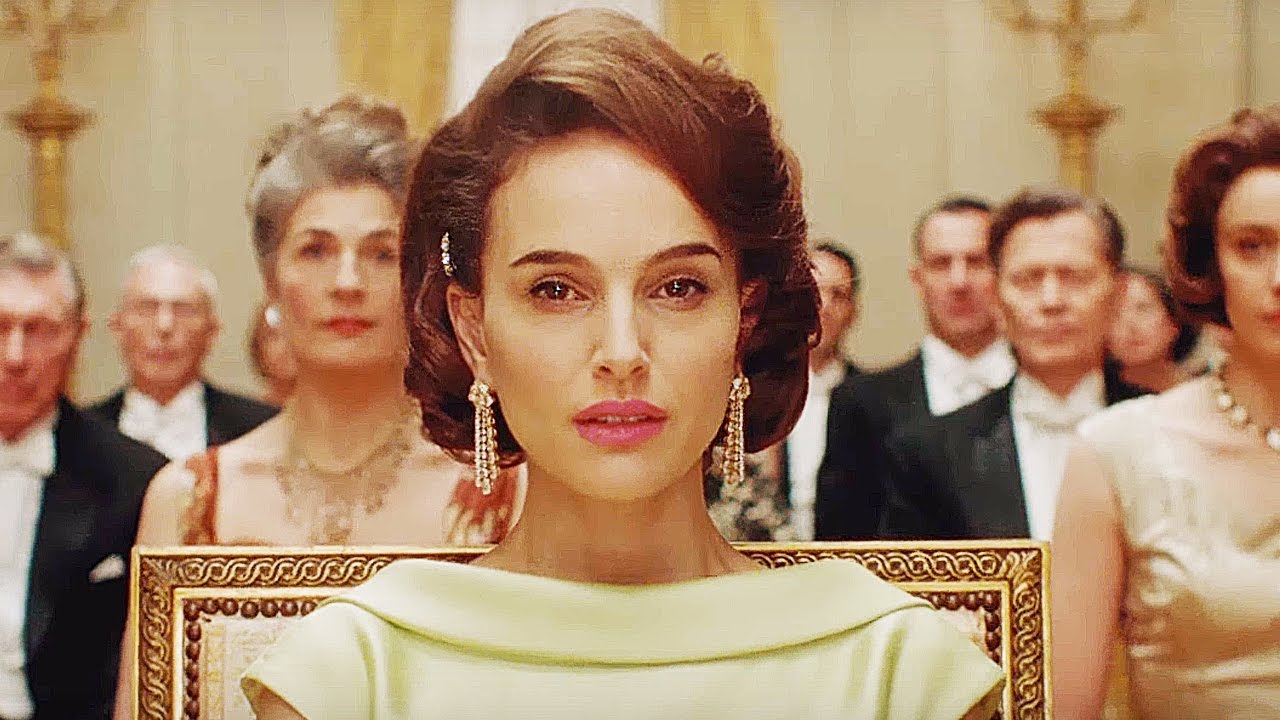
In focusing on Jackie in the hours and days following Kennedy’s assassination, the movie gives the viewer the opportunity to eavesdrop on the very private grief of a very public person, someone who put on a brave face for the cameras, but who also kept herself at a distance, despite wanting people to see “the truth”. It’s this dichotomy that makes Jackie the person endlessly fascinating to observe, and Jackie the movie somewhat disappointing in terms of the narrative. We see Jackie at various points, both in time and in place, throughout the movie. There are scenes in Dallas, in Washington, inside the White House, at Hyannis Port, but many of them feel like snippets of memory, connected discretely to each other by the random nature of Jackie’s thoughts and emotions. When she and White (known only as the Journalist, for some reason, in the credits) sit down to discuss the article, their conversation often goes off at a tangent, and Noah Oppenheim’s screenplay encourages this, as if it will give us a better understanding of Jackie in those four days between JFK’s death and his funeral. But it’s obvious: she’s trying to weather those four days as best she can until she can grieve properly, away from prying eyes.

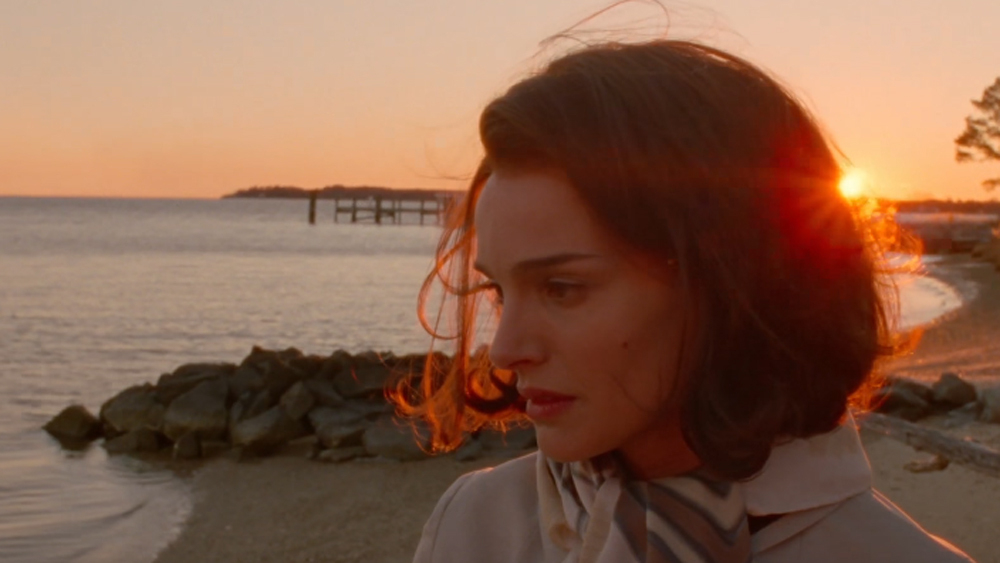
With the script trying to add layers where they’re not needed, it’s left to Natalie Portman to save the movie from its all-too-clever design, and deliver a nigh-on faultless performance, burrowing under Jackie’s skin and finding the nerve centre of someone who was never entirely comfortable being in the public spotlight, but who instinctively knew the public’s perception of JFK as a great President – hence the parallel with Camelot – needed to be kindled as quickly as possible after his death, and that she was the only one who could do it. Portman portrays this single-mindedness with a quiet intensity, perfectly capturing Jackie’s “feisty” nature in private, and her more vulnerable, debutante persona in front of the cameras and/or reporters’ notebooks. There are moments in the movie when you could be forgiven for thinking that Jackie is “absent” from the room, or a conversation. But Portman’s portrayal is more subtle than that, and she gauges these “absences” with an acute awareness that a character’s stillness or silence often means more than is seen on the surface.
movie_jackie-2016

If there’s one problem with Portman’s magnificent performance, it’s that it overshadows everything else the movie attempts or gets right. Jackie, ultimately, stands or falls thanks to Portman’s efforts, because without her command of the character (and Jackie’s odd accent), the movie lacks little else to keep the audience’s attention from wandering. Making his first English language movie, Chilean director Larraín displays an aptitude for scenes of sombre regret, and along with Portman fleshes out Jackie’s character to impressive effect, but there still remains the feeling that Jackie (the person) has been assembled from random aspects of her personality that seem a good fit for the narrative rather than a true representation of what she was really like at the time. At best, this is an interpretation of Jacqueline Bouvier Kennedy; at worst it’s an impression.

On the technical side, Jackie flits between looking stunning, and looking bland depending on the requirements of the script, and the budget. The interiors of the White House, faithfully recreated in a studio outside Paris, France, are dazzling examples of what can be achieved when you have the talents of production designer Jean Rabasse, art director Halina Gebarowicz, and set decorator Véronique Melery on board. And yet, if you contrast these wonderful sets with the motorcade sequences, it’s like the difference between day and night, with the scenes in Dallas looking like they’ve been shot on a closed stretch of road and with only two cars available for filming. And despite the best efforts of cinematographer Stéphane Fontaine, the movie never overcomes these disparities. In contrast, Mica Levi’s tonal, somewhat sepulchral score is a good match for the material, and acts as an emotional undercurrent to Jackie’s grief and displacement.

Rating: 8/10 – fans of low budget independent dramas will enjoy Jackie for its slow, measured pace, refusal to explain everything that’s going on (with Jackie herself), and Portman’s exquisitely detailed performance; an attempt at an intimate portrayal of a very private person, the movie glides majestically along for most of its running time, and gives the impression of being more meanngful than it actually is, but it still has a lot to offer both the casual and the more interested viewer.

Share this:

  • Click to share on X (Opens in new window) X
  • Click to share on Facebook (Opens in new window) Facebook
  • More
  • Click to print (Opens in new window) Print
  • Click to email a link to a friend (Opens in new window) Email
Like Loading...

Elvis & Nixon (2016)

11 Monday Jul 2016

Posted by dullwood68 in Movies

≈ Leave a comment

Tags

21 December 1970, Alex Pettyfer, Colin Hanks, Comedy, Drama, Elvis Presley, Evan Peters, Federal Agent at Large, Johnny Knoxville, Kevin Spacey, Liza Johnson, Meeting, Michael Shannon, Review, Richard Nixon, The Oval Office, The White House, True story

Elvis & Nixon

D: Liza Johnson / 86m

Cast: Michael Shannon, Kevin Spacey, Alex Pettyfer, Johnny Knoxville, Colin Hanks, Evan Peters, Sky Ferreira, Tracy Letts, Tate Donovan, Ashley Benson

It’s one of those tales that has to be filed under Believe-It-Or-Not: when Richard Nixon (Spacey) met Elvis Presley (Shannon) in the White House on 21 December 1970. There’s no doubt that the meeting took place – one of the photographs taken that day is the most requested item in the US National Archives – but even so, if a conspiracy theorist came up to you and said Elvis met Nixon because he wanted to go undercover as an agent for the Bureau of Narcotics and Dangerous Drugs, you’d brush them off with a “Yeah, right,” and promptly move on with your life. But that is exactly what happened, and Liza Johnson’s bright and breezy movie looks at what might have occurred, and what might have been said, during that unexpected meeting (alas, Nixon didn’t start recording conversations in the Oval Office until some months after he met Elvis).

The Elvis Presley we meet at the movie’s beginning is an odd, troubled figure, unamused and made fearful by the revolution being played out on American streets by the youth of the day. To Elvis they’re all being misled, and to him, it’s the drugs that are leading them astray. What better way, thinks Elvis, to help his country and avoid a dire future, than to go to Washington and plead his case to become a Federal Agent at Large, an undercover role that would allow him to infiltrate the various organisations leading the so-called revolution. (And just in case you’re thinking, undercover? Is he mad?, then the answer is, probably. Or at least, very deluded. Very, very deluded.) And what better justification for his going undercover, than the fact that he already has various honorary law enforcement badges which have been given to him over the years (and which he seems to think is all the I.D. he needs wherever he goes – even the White House).

EAN - scene2

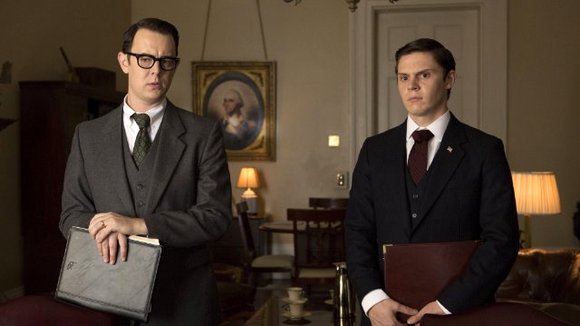
Elvis writes a letter to Nixon that he hand delivers to the North Gate of the White House. The letter reaches one of Nixon’s aides, Dwight Chapin (Peters), who in turn shows it to senior aide Egil “Bud” Krogh (Hanks). At first, Krogh is dismissive, until he realises the benefit to Nixon’s image that a meeting with Elvis might have; but Nixon is dismissive of the idea. It’s only when Elvis’s personal assistant, Jerry Schilling (Pettyfer), suggests that Krogh “let slip” to Nixon’s daughters that their father might be meeting Elvis, that Nixon is emotionally blackmailed into letting the meeting go ahead. And so, the stage is set for one of the most unlikely get-togethers in the history of US politics and entertainment.

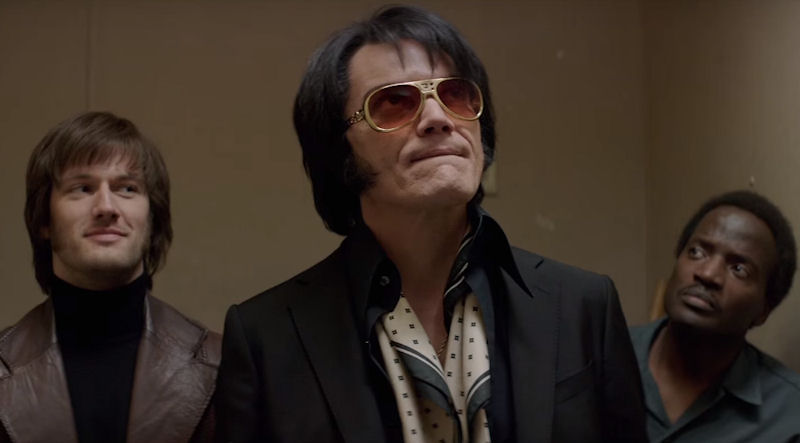
With the movie firmly deciding that Elvis was acting like a fruitcake at the time, and with Shannon playing him like a man who thinks everybody else around him is on the same wavelength – even though it’s doubtful there is a wavelength in the first place – his odd mannerisms and apparent lack of social awareness make for an amusing yet also deeply sad interpretation of the man and his misguided sense of commitment. That he really felt he could go undercover is the clearest guide to how barmy his idea was, but Shannon makes it all seem plausible – to Elvis if no one else. And that so many other people went along with it makes it even more bizarre. But amidst all the extraordinary behaviour, Shannon wisely adds a sense of almost child-like innocence to his portayal of Elvis that helps offset the surface notion that The King has lost his marbles. However you view his “ambition”, what Shannon consolidates in his offbeat, whimsical performance is that Elvis believed in everything he said – completely and without equivocation.

EAN - scene3

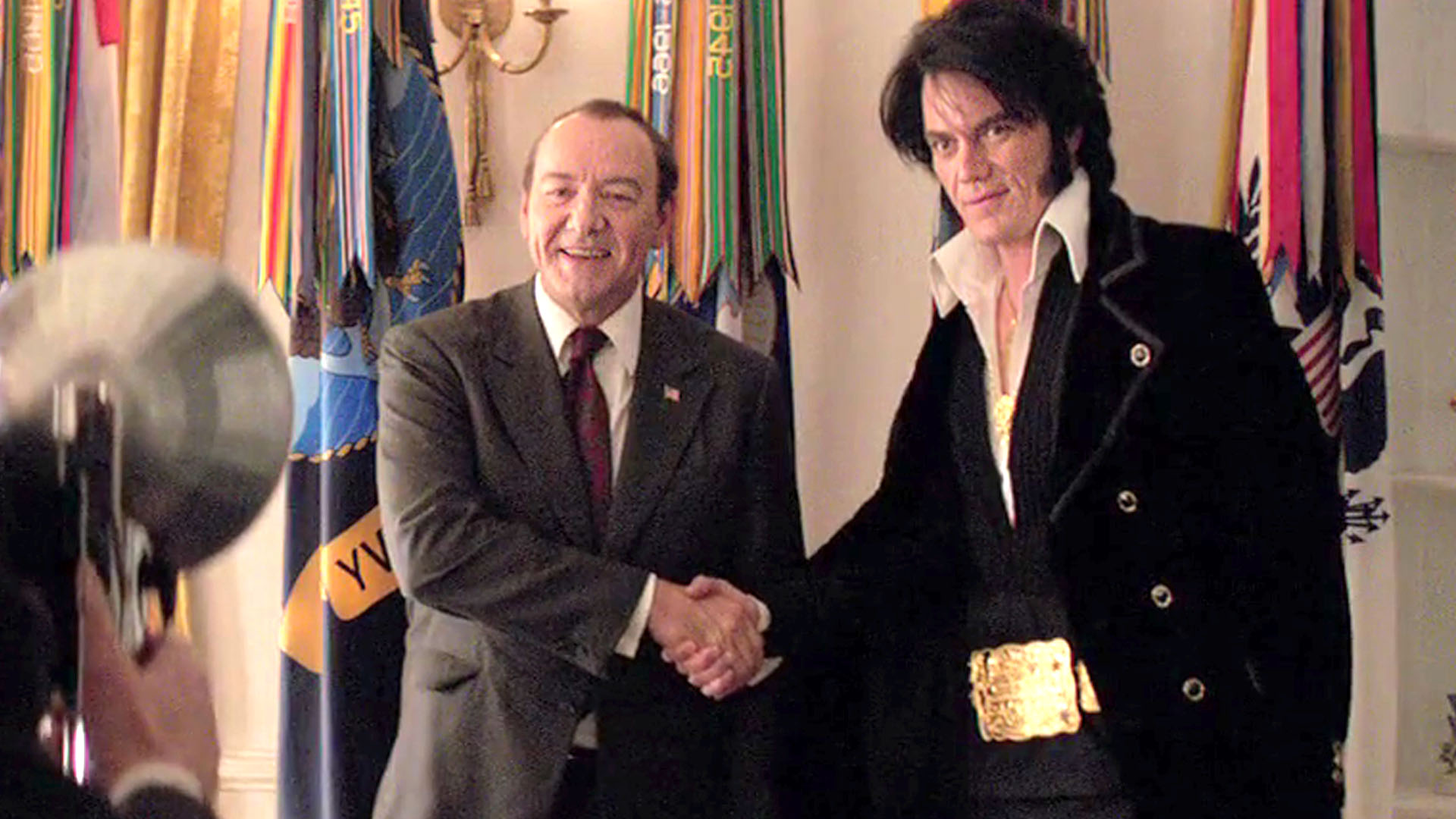
Shannon is probably not everyone’s idea of Elvis Presley, and it’s true that even with a wig, sideburns, and Elvis’s trademark sunglasses the actor still looks nothing like him. But the same is true of Spacey, whose portrayal of the President stops short of being a caricature of the man, and even with the aid of a terrific make-up job, the actor is still recognisable as himself first and foremost. In the end though, it doesn’t matter because the performances of both men are so very good indeed. Separately – and the movie keeps them apart for nearly an hour – they bring to life their real-life characters with a mixture of vocal impersonation, physical posturing, and attention to detail. But when they finally meet, and Nixon’s obduracy gives way to an unforeseen liking for Elvis and his right-wing political views, the apparent differences between the two men fall away, and both actors enjoy the kind of verbal sparring that helps lift the movie over and above its slightly pedestrian beginnings.

Ultimately, Elvis & Nixon only works fully once Elvis actually meets Nixon, and the script by Joey Sagal (who has a memorable cameo as an Elvis impersonator), Hanala Sagal and Cary Elwes (yes, Westley himself) springs into life in a way that makes up for the meandering, inopportune approach taken up until then. Make no mistake, the movie is a lightweight, engaging, yet deliberately frothy concoction, and it’s made in such a way that it’s not meant to be taken too seriously. But there’s an awful lot of running around for no good reason as the movie makes this momentous meeting happen. A subplot involving Schilling’s need to fly home to meet his girlfriend’s father is entirely superfluous, which makes Pettyfer’s presence entirely superfluous as well, while Knoxville’s presence is pared to the minimum. Hanks and Peters fare better, portraying Krogh and Chapin as two guys just trying to do their best, and getting quite a lot of the laughs as a result (however, there’s a sting in the tail when a pre-post credits sequence informs the viewer that both men were jailed for their involvement in the Watergate scandal).

EAN - scene1

Whatever was discussed between Nixon and Elvis on that December day is unlikely to ever be revealed. And even if this particular version has it all wrong, it is reassuring to know that it doesn’t matter. This is a movie where you could almost apply the old adage, “Print the legend!”, and it wouldn’t make any difference. Johnson’s direction is assured if not outstanding but she does coax outstanding performances from her two leads, and if it weren’t for them, the movie wouldn’t be as enjoyable as it is.

Rating: 7/10 – taken with a very large pinch of salt, Elvis & Nixon can be enjoyed for the sugar-coated treat it is, and not as anything more serious; with good performances all round (and not just from Shannon and Spacey), and a pleasing sense of its own silliness, the movie may not linger in the memory once you’ve seen it, but it will delight and impress you while you watch it.

Share this:

  • Click to share on X (Opens in new window) X
  • Click to share on Facebook (Opens in new window) Facebook
  • More
  • Click to print (Opens in new window) Print
  • Click to email a link to a friend (Opens in new window) Email
Like Loading...

Blog Stats

  • 486,528 hits

Recent Posts

  • 10 Reasons to Remember Bibi Andersson (1935-2019)
  • Fantasia (1940)
  • Dances With Wolves (1990) – The Special Edition
  • Kiss of the Spider Woman (1985)
  • The Three Musketeers (1973)

Top Posts & Pages

  • Lost for Life (2013) - Another Look
    Lost for Life (2013) - Another Look
  • Lost for Life (2013)
    Lost for Life (2013)
  • About
    About
  • Mr. Topaze (1961)
    Mr. Topaze (1961)
  • Billy Lynn's Long Halftime Walk (2016)
    Billy Lynn's Long Halftime Walk (2016)
  • Winter's Tale (2014)
    Winter's Tale (2014)
  • The Hitman's Bodyguard (2017)
    The Hitman's Bodyguard (2017)
  • 5 Famous Movie Roles That Nearly Went to Someone Else
    5 Famous Movie Roles That Nearly Went to Someone Else
  • The Layover (2017)
    The Layover (2017)
  • Transcendence (2014)
    Transcendence (2014)
Follow thedullwoodexperiment on WordPress.com

Blogs I Follow

  • Rubbish Talk
  • Film 4 Fan
  • Fast Film Reviews
  • The Film Blog
  • All Things Movies UK
  • Interpreting the Stars
  • Let's Go To The Movies
  • Movie Reviews 101
  • TMI News
  • Dan the Man's Movie Reviews
  • Film History
  • Jordan and Eddie (The Movie Guys)

Archives

  • April 2019 (13)
  • March 2019 (28)
  • February 2019 (28)
  • January 2019 (32)
  • December 2018 (28)
  • November 2018 (30)
  • October 2018 (29)
  • September 2018 (29)
  • August 2018 (29)
  • July 2018 (30)
  • June 2018 (28)
  • May 2018 (24)
  • April 2018 (21)
  • March 2018 (31)
  • February 2018 (25)
  • January 2018 (30)
  • December 2017 (30)
  • November 2017 (27)
  • October 2017 (27)
  • September 2017 (26)
  • August 2017 (32)
  • July 2017 (32)
  • June 2017 (30)
  • May 2017 (29)
  • April 2017 (29)
  • March 2017 (30)
  • February 2017 (27)
  • January 2017 (32)
  • December 2016 (30)
  • November 2016 (28)
  • October 2016 (30)
  • September 2016 (27)
  • August 2016 (30)
  • July 2016 (30)
  • June 2016 (31)
  • May 2016 (34)
  • April 2016 (30)
  • March 2016 (30)
  • February 2016 (28)
  • January 2016 (35)
  • December 2015 (34)
  • November 2015 (31)
  • October 2015 (31)
  • September 2015 (34)
  • August 2015 (31)
  • July 2015 (33)
  • June 2015 (12)
  • May 2015 (31)
  • April 2015 (32)
  • March 2015 (30)
  • February 2015 (37)
  • January 2015 (39)
  • December 2014 (34)
  • November 2014 (34)
  • October 2014 (36)
  • September 2014 (25)
  • August 2014 (29)
  • July 2014 (29)
  • June 2014 (28)
  • May 2014 (23)
  • April 2014 (21)
  • March 2014 (42)
  • February 2014 (38)
  • January 2014 (29)
  • December 2013 (28)
  • November 2013 (34)
  • October 2013 (4)

Create a free website or blog at WordPress.com.

Rubbish Talk

Film 4 Fan

A Movie Blog

Fast Film Reviews

The Film Blog

The official blog of everything in film

All Things Movies UK

Movie Reviews and Original Articles

Interpreting the Stars

Dave Examines Movies

Let's Go To The Movies

Film and Theatre Lover!

Movie Reviews 101

Daily Movie Reviews

TMI News

Latest weather, crime and breaking news

Dan the Man's Movie Reviews

All my aimless thoughts, ideas, and ramblings, all packed into one site!

Film History

Telling the story of film

Jordan and Eddie (The Movie Guys)

Movie Reviews & Ramblings from an Australian Based Film Fan

Privacy & Cookies: This site uses cookies. By continuing to use this website, you agree to their use.
To find out more, including how to control cookies, see here: Cookie Policy
  • Subscribe Subscribed
    • thedullwoodexperiment
    • Join 481 other subscribers
    • Already have a WordPress.com account? Log in now.
    • thedullwoodexperiment
    • Subscribe Subscribed
    • Sign up
    • Log in
    • Report this content
    • View site in Reader
    • Manage subscriptions
    • Collapse this bar
 

Loading Comments...
 

    %d