
Tags
Drama, James Mason, Lionel Atwill, Lucie Mannheim, Military fort, Murder, Review, The General Goes Too Far, Thorold Dickinson, West Africa

D: Thorold Dickinson / 84m
Cast: Lionel Atwill, Lucie Mannheim, Steven Geray, James Mason, Leslie Perrins, Allan Jeayes, Michael Lambart, Kathleen Gibson
In Ireland in 1921, two army majors, Sangye (Atwill) and Challoner (Philip Strange), are caught in an ambush by Republican rebels. With the attack over, and both men the only survivors, Challoner turns on Sangye and threatens him over Sangye’s affair with Challoner’s wife. He also reveals that Sangye is the real father of Challoner’s daughter. Sangye is remorseful but when Challoner tries to shoot him, he’s forced to shoot first, killing Challoner. Sangye covers up his crime, but is unaware that the doctor who saw to Challoner’s body has identified the bullet that killed him as coming from Sangye’s gun.
Sixteen years later, Sangye is now Major-General Sir John Sangye VC, and in charge of a fort located on the West Coast of Africa. With him is his ward, Challoner’s daughter Belinda (Gibson). Feeling that the events in Ireland are far behind him, Sangye is unsettled by the arrival of Major Carson (Perrins) who appears to know what happened all those years ago. In turn, Carson who has travelled to the fort in the company of local businessman’s wife Diana Cloam (Mannheim), is related to Captain Heverall (Mason), one of Sangye’s junior officers. Heverall and Diana are attracted to each other but vow to remain friends for the good of her marriage to jealous husband Martin (Geray). Carson has no such qualms, and actively pursues her. This leads to a misunderstanding that results in Carson’s murder. When it’s revealed that Heverall stands to inherit a fortune as a result of Carson’s death, he is arrested and put on trial by a military court. With Challoner’s murder about to be exposed, and Heverall’s life at stake, Sangye determines to unmask Carson’s killer, and by doing so, redeem himself.
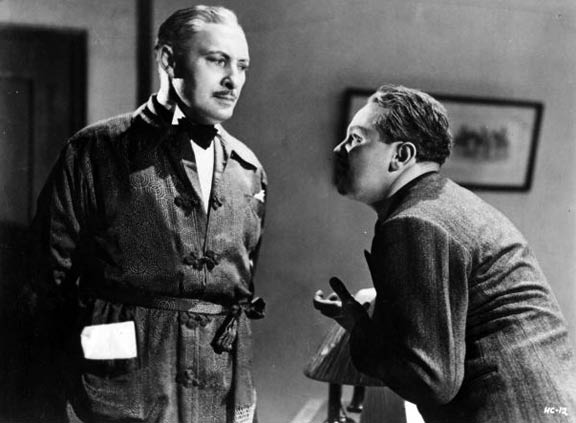
A quickly made drama that belies its low budget, The High Command, once past its awkward exposition-heavy opening, settles into a predictable yet entertaining groove that’s bolstered by a measured performance from Atwill, and fine supporting turns from Mannheim (Miss Smith in Hitchcock’s The 39 Steps) and Jeayes as the Governor who must reluctantly accept the evidence of Sangye’s guilt. It’s actually good to see Atwill at work here; he’s a much underrated actor who deserves far more credit than he’s usually given. As the outwardly composed but inwardly tortured Sangye, Atwill proves a good fit for the part, and rewards the producers for their picking him for the role. Allied to Dickinson’s fluid direction and focus on the emotional undercurrents anchoring the plot, Atwill displays a capacity for vulnerability that most other roles he played didn’t allow him to reveal.
In an early role, Mason is less than convincing as Diana Cloam’s love interest, while Geray narrowly avoids chewing the scenery to tatters as her embittered husband. The subplot involving Sangye being Belinda’s father is left aside in favour of Heverall’s trial, and the introduction of comic relief in the form of trial witness Miss Tuff (Drusilla Wills) almost overshadows the drama of the situation. The identity of Carson’s killer is obvious despite a half-hearted attempt to make it a mystery, the cast contend well with appropriately clipped and/or stilted dialogue, and the minimalist art direction proves occasionally distracting (would a fort be this sparse with its fixtures and furnishings?). With so much clashing going on, Dickinson ably holds it all together with his usual sense of restrained intimacy and a keen eye for the social and military hierarchies and how they commingle.
The High Command adequately reflects the prevailing attitudes of its time and fares well when exposing the hypocrisies of its main characters; pride is a theme that recurs throughout the movie, and the consequences of having too much pride are keenly observed. The script by Katherine Strueby, Walter Meade and Val Valentine from the novel The General Goes Too Far – a much better title – by Lewis Robinson calls for less histrionics than might be expected, and allows the cast to inhabit their roles instead of get bogged down in the usual stuffed shirt theatrics. Otto Heller’s photography is occasionally a little soft but otherwise well-framed, and the music by Ernest Irving ably supports the action.
Rating: 6/10 – raised up by good performances and clever direction, The High Command works best when focusing on Atwill and Mannheim; a minor gem well worth seeking out.
 thedullwoodexperiment