• 10 Reasons to Remember…
  • A Brief Word About…
  • About
  • For One Week Only
  • Happy Birthday
  • Monthly Roundup
  • Old-Time Crime
  • Other Posts
  • Poster of the Week
  • Question of the Week
  • Reviews
  • Trailers

thedullwoodexperiment

~ Viewing movies in a different light

thedullwoodexperiment

Tag Archives: Yorgos Lanthimos

The Favourite (2018)

04 Friday Jan 2019

Posted by dullwood68 in Movies

≈ Leave a comment

Tags

Comedy, Drama, Emma Stone, Hatfield House, History, Olivia Colman, Queen Anne, Rachel Weisz, Review, Yorgos Lanthimos

D: Yorgos Lanthimos / 119m

Cast: Olivia Colman, Emma Stone, Rachel Weisz, Nicholas Hoult, Joe Alwyn, Mark Gatiss, James Smith, Jenny Rainsford

England, 1708. Queen Anne (Colman) is on the throne, but the real power lies with Sarah, Duchess of Marlborough (Weisz), the Queen’s best friend, confidante, and lover. Sarah counsels the Queen on almost every matter that comes before her, and uses Anne’s malleability to promote her own political agenda. The arrival of a destitute cousin of Sarah’s, Abigail Hill (Stone), prompts the beginning of a power struggle between the two women, as they vie for the Queen’s attention, both in and out of the bed chamber. Sarah’s experience proves no match for Abigail’s determination to see her social status restored to her, and the on-going war with France that Sarah is supporting is undermined by Abigail’s mutually beneficial allegiance with politician Robert Harley (Hoult). With Anne’s health worsening due to gout, Abigail aims to supplant Sarah once and for all, and arranges for her to be missing from court. As Anne becomes more and more dependant on Abigail’s presence, and gives her blessing to an advantageous marriage to a courtier, Samuel Masham (Alwyn), Sarah returns to make one last effort to overturn Abigail’s influence, and restore her own position with the Queen…
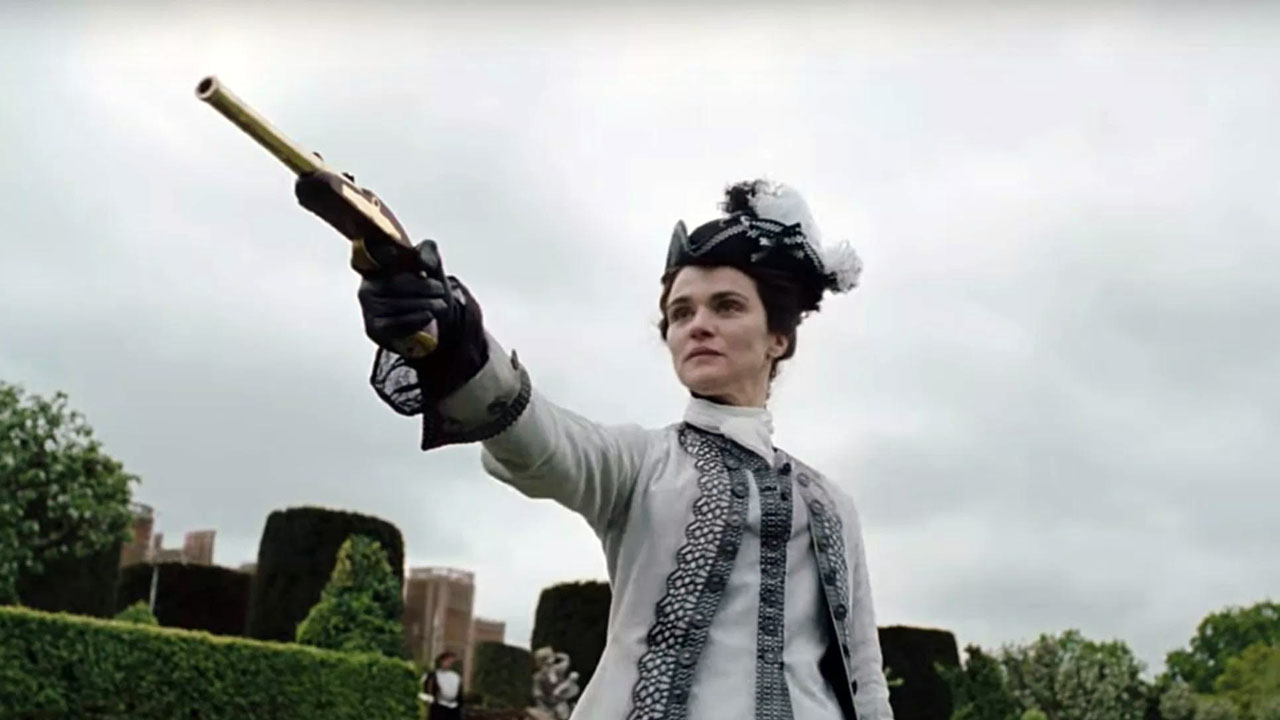
For most people, The Favourite will be seen in 2019. There will be other historical movies that will carry over from 2018 and reach their intended audience, but it’s a sure bet that Yorgos Lanthimos’ ebullient follow up to The Killing of a Sacred Deer (2017) will be unlike any other. A riotous mix of scabrous comedy, intelligently handled drama, bawdy romance, political intrigue, and ferocious oneupmanship (oneupwomanship?), this plays fast and loose with historical accuracy (though the three-way affair depicted actually happened), and instead opts for being a rambunctious send up of both the times and the people who lived through them. Working from a glorious screenplay by Deborah Davis and Tony McNamara, Lanthimos has fashioned his most accessible movie to date, and one that offers a plethora of riches. First and foremost are the fierce, redoubtable performances of its trio of female leads, all of whom attack the material with undisguised relish, and all of whom give superb portrayals of women for whom men are either to be used, or ignored, or both. Harley is the principal male protagonist, and in any other movie he would emerge triumphant with all of his ambitions achieved, and stronger than ever. Here he achieves his ambitions, but the audience knows that it’s just a matter of time before his position will collapse into political and personal ruin.

With gender reversals of this type firmly on display (and encouraged), Lanthimos gives his cast full rein to inhabit their roles with gusto. Weisz is condescending and vampish as Sarah, a career manipulator who finds herself surprisingly ill-equipped to deal with Abigail’s more straightforward manoeuvrings. Stone is a revelation, portraying an historical character so far removed from her previous acting roles that her confidence is often astonishing; she embues Abigail with such a sweet-natured viciousness that you have no idea just what she’ll do next. And then there’s Colman, towering over both of them, her performance a thing of magnificent yet focused excess, railing against imagined injustices one moment, dew-eyed and poignant the next as Anne remembers her seventeen dead children. It all takes place against the sumptuous backdrop of Hatfield House, its rooms and corridors given tremendous presence in the movie thanks to the use of fisheye lenses and wide shots, making it another character altogether, one whose size helps to put the machinations of its human counterparts into stark relief for their transitory nature. But even with all this – and a terrific soundtrack as well – it’s the interlocking relationships between Anne, Sarah and Abigail, all counter turns and devious switches, that hold the attention and prove the most rewarding part of a movie that has so much to offer that it’s almost embarrassing.

Rating: 9/10 – Lanthimos’ auteur leanings are still on display, but here he’s at his most relaxed and amenable, and the result is that The Favourite is easily his best movie so far; a movie to wallow in over and over again, it is richly detailed, formidably acted, wickedly perverse, beautifully shot (by Robbie Ryan), and a pure delight from beginning to end.

Share this:

  • Click to share on X (Opens in new window) X
  • Click to share on Facebook (Opens in new window) Facebook
  • More
  • Click to print (Opens in new window) Print
  • Click to email a link to a friend (Opens in new window) Email
Like Loading...

The Killing of a Sacred Deer (2017)

15 Friday Dec 2017

Posted by dullwood68 in Movies

≈ 1 Comment

Tags

Barry Keoghan, Colin Farrell, Drama, Heart surgeon, Mystery, Nicole Kidman, Raffey Cassidy, Revenge, Review, Thriller, Yorgos Lanthimos

D: Yorgos Lanthimos / 121m

Cast: Colin Farrell, Nicole Kidman, Barry Keoghan, Raffey Cassidy, Sunny Suljic, Alicia Silverstone, Bill Camp

In Yorgos Lanthimos’s follow up to the multi-award winning The Lobster (2015), he teams up again with Colin Farrell to tell a story adapted from Iphigenia at Aulis by the Greek playwright Euripides. Lanthimos is an idiosyncratic writer/director, and his approach to movie making can often seem experimental and/or challenging. That’s certainly the case here, as he shines a light on the aftermath of a man dying during surgery, a man that Farrell’s character, cardiothoracic specialist Steven Moore, operated on. Steven is part of a traditional nuclear family – wife Anna (Kidman), teenage daughter Kim (Cassidy), younger son Bob (Suljic) – is well respected by his peers, and appears to have everything he could need. The only odd thing about his life is his relationship with a teenage boy called Martin (Keoghan). They meet in coffee shops, and though Martin at first seems as if he could be some kind of outpatient that Steven is treating, his openly expressed neediness is at odds with Steven’s more reserved demeanour.

Martin begins to visit the hospital instead of waiting for their meetings outside. He appears without warning, and his beahviour becomes increasingly erratic. In an effort to placate him, Steven invites Martin to his home for dinner. Over time, Martin ingratiates himself into Steven’s family, and wins the affection of Kim. A reciprocal arrangement sees Steven going to dinner at Martin’s home, where he meets Martin’s mother (Silverstone). The evening doesn’t go well, and it prompts Steven to start ignoring Martin’s calls and attempts to meet up. Then one day Bob wakes to find he’s paralysed from the waist down. Soon he’s refusing to eat as well, but despite the best medical treatment that Steven can arrange, there is no physical reason found to explain what’s happening. And then, during choir practice, Kim too loses the use of her legs, and she and her brother find themselves in hospital, in the same room, and facing the same outcome: death.

In adapting Iphigenia at Aulis, Lanthimos has taken the central theme – what would you do if you had to kill a loved one to avert a greater number of deaths – and made it into a psychological thriller that proves difficult to engage with from the very start. Beginning with a close up of a beating human heart that’s been operated on, this is as close as the movie gets to displaying anything like the same kind of “heart” to its characters. As a result, Steven, Anna, Martin et al become chess pieces to be moved around a board of Lanthimos’ design, and with no greater ambition than to reach the endgame. What doesn’t help is the emotional constraint the movie adopts, particularly with Steven, where his dialogue is largely clipped and/or neutral in its relation to other dialogue in any given scene. This makes Steven something of an emotional cipher, physically present in the moment, but otherwise withdrawn or remote from the people around him (he’s more present with his children but then only when they’re doing what he expects of them). And even when he does display any real emotion, such as during a row with Anna, his responses are childish and inappropriate; he’s a man approximating what it is to feel anything.

Steven is also a dissembler, hiding the facts about his relationship with Martin from everyone else until matters dictate he reveal the truth. This should lead to a point from which the audience can begin to have some sympathy for his predicament – in order to save the lives of everyone in his family he must choose to kill one of them deliberately, to make a sacrificial offering as atonement for his sins – but thanks to Lanthimos’ determination to continue on and make Steven’s predicament a tragic one, the movie becomes instead a visual treat if not one that is likely to stir any feelings beyond impatience or apathy. The how and the why of his children falling ill is explained fully and with no room for misunderstanding, but despite this the actual source of their illness remains illogically set up and maintained. As an act of revenge it has its merits (as Euripides knew), but it’s introduced in a way that robs it of any merit as a narrative device; the audience is expected to go along with it because the script doesn’t offer any alternative. It also leaves the inter-relationships between the likes of Martin and Kim, and Steven and Anna – and most notably, Anna and Matthew (Camp), one of Steven’s colleagues – feeling contrived and under-developed.

There are times when it seems as if Lanthimos is more interested in mood and tone than he is in characterisation or narrative meaning, but what this does mean is that the movie has such a strong, consistent visual aesthetic that it compensates for some of the more wayward decisions made in regard to the plot. Each shot is lovingly framed and lit by DoP Thimios Bakatakis, and there are moments of quiet beauty, such as the very high, overhead shot of Anna and Bob that sees them about to leave the hospital after Bob has been allowed to go home, only for him to collapse. The camera stays fixed in place, maintaining its distance, as Anna desperately tries to rouse him. There are other moments where the cinematography excels, but these moments aren’t always in service to the narrative, unless Lanthimos’ intention really is to keep the viewer at a distance, and make it more difficult (than it is already) to engage with the characters.

In the end, and despite Lanthimos’ best efforts, this is a movie that relies on its main character behaving inappropriately and oddly in spite of the gravity of his situation, and Keoghan giving the kind of performance that is technically impressive – and that’s about all. As the movie spirals down towards a scene that is likely to have viewers laughing when they should be horrified, the nature of the material reveals itself to be a carefully constructed farce rather than the psychological mystery thriller that it appears to be (though whether or not this is Lanthimos’ intention is still debatable). Watched as such, the movie makes more sense and is more enjoyable, but if taken at face value it’s more likely to alienate viewers than entice them in with the offer of a probing, insightful melodrama. More simply put, and despite a handful of good performances, it’s a movie that looks very good indeed on the surface, but which lacks the necessary substance when you look more closely.

Rating: 6/10 – an arthouse thriller that takes a step back from its central plot before it’s even begun, The Killing of a Sacred Deer strives for eloquence and meaning, but falls short because of its detachment from the material; Farrell et al are left stranded sometimes by Lanthimos’ approach to the movie’s subject matter, and there are too many occasions where the viewer’s response will be one of bemusement or disbelief at what they’re seeing.

Share this:

  • Click to share on X (Opens in new window) X
  • Click to share on Facebook (Opens in new window) Facebook
  • More
  • Click to print (Opens in new window) Print
  • Click to email a link to a friend (Opens in new window) Email
Like Loading...

Blog Stats

  • 491,496 hits

Recent Posts

  • 10 Reasons to Remember Bibi Andersson (1935-2019)
  • Fantasia (1940)
  • Dances With Wolves (1990) – The Special Edition
  • Kiss of the Spider Woman (1985)
  • The Three Musketeers (1973)

Top Posts & Pages

  • I Origins (2014)
    I Origins (2014)
  • Logan (2017)
    Logan (2017)
  • Cardboard Boxer (2016)
    Cardboard Boxer (2016)
  • Breaking and Exiting (2018)
    Breaking and Exiting (2018)
  • The White Orchid (2018)
    The White Orchid (2018)
  • Bang Gang (A Modern Love Story) (2015)
    Bang Gang (A Modern Love Story) (2015)
  • The Corpse of Anna Fritz (2015)
    The Corpse of Anna Fritz (2015)
  • Poster of the Week - Werewolf of London (1935)
    Poster of the Week - Werewolf of London (1935)
  • Maleficent (2014)
    Maleficent (2014)
  • 5 Famous Movie Roles That Nearly Went to Someone Else
    5 Famous Movie Roles That Nearly Went to Someone Else
Follow thedullwoodexperiment on WordPress.com

Blogs I Follow

  • Rubbish Talk
  • Film 4 Fan
  • Fast Film Reviews
  • The Film Blog
  • All Things Movies UK
  • Interpreting the Stars
  • Let's Go To The Movies
  • Movie Reviews 101
  • TMI News
  • Dan the Man's Movie Reviews
  • Film History
  • Jordan and Eddie (The Movie Guys)

Archives

  • April 2019 (13)
  • March 2019 (28)
  • February 2019 (28)
  • January 2019 (32)
  • December 2018 (28)
  • November 2018 (30)
  • October 2018 (29)
  • September 2018 (29)
  • August 2018 (29)
  • July 2018 (30)
  • June 2018 (28)
  • May 2018 (24)
  • April 2018 (21)
  • March 2018 (31)
  • February 2018 (25)
  • January 2018 (30)
  • December 2017 (30)
  • November 2017 (27)
  • October 2017 (27)
  • September 2017 (26)
  • August 2017 (32)
  • July 2017 (32)
  • June 2017 (30)
  • May 2017 (29)
  • April 2017 (29)
  • March 2017 (30)
  • February 2017 (27)
  • January 2017 (32)
  • December 2016 (30)
  • November 2016 (28)
  • October 2016 (30)
  • September 2016 (27)
  • August 2016 (30)
  • July 2016 (30)
  • June 2016 (31)
  • May 2016 (34)
  • April 2016 (30)
  • March 2016 (30)
  • February 2016 (28)
  • January 2016 (35)
  • December 2015 (34)
  • November 2015 (31)
  • October 2015 (31)
  • September 2015 (34)
  • August 2015 (31)
  • July 2015 (33)
  • June 2015 (12)
  • May 2015 (31)
  • April 2015 (32)
  • March 2015 (30)
  • February 2015 (37)
  • January 2015 (39)
  • December 2014 (34)
  • November 2014 (34)
  • October 2014 (36)
  • September 2014 (25)
  • August 2014 (29)
  • July 2014 (29)
  • June 2014 (28)
  • May 2014 (23)
  • April 2014 (21)
  • March 2014 (42)
  • February 2014 (38)
  • January 2014 (29)
  • December 2013 (28)
  • November 2013 (34)
  • October 2013 (4)

Create a free website or blog at WordPress.com.

Rubbish Talk

Film 4 Fan

A Movie Blog

Fast Film Reviews

The Film Blog

The official blog of everything in film

All Things Movies UK

Movie Reviews and Original Articles

Interpreting the Stars

Dave Examines Movies

Let's Go To The Movies

Film and Theatre Lover!

Movie Reviews 101

Daily Movie Reviews

TMI News

Latest weather, crime and breaking news

Dan the Man's Movie Reviews

All my aimless thoughts, ideas, and ramblings, all packed into one site!

Film History

Telling the story of film

Jordan and Eddie (The Movie Guys)

Movie Reviews & Ramblings from an Australian Based Film Fan

Privacy & Cookies: This site uses cookies. By continuing to use this website, you agree to their use.
To find out more, including how to control cookies, see here: Cookie Policy
  • Subscribe Subscribed
    • thedullwoodexperiment
    • Join 481 other subscribers
    • Already have a WordPress.com account? Log in now.
    • thedullwoodexperiment
    • Subscribe Subscribed
    • Sign up
    • Log in
    • Report this content
    • View site in Reader
    • Manage subscriptions
    • Collapse this bar
 

Loading Comments...
 

    %d