• 10 Reasons to Remember…
  • A Brief Word About…
  • About
  • For One Week Only
  • Happy Birthday
  • Monthly Roundup
  • Old-Time Crime
  • Other Posts
  • Poster of the Week
  • Question of the Week
  • Reviews
  • Trailers

thedullwoodexperiment

~ Viewing movies in a different light

thedullwoodexperiment

Tag Archives: Aliens

Oh! the Horror! – The Giant Gila Monster (1959) and The Trollenberg Terror (1958)

06 Saturday Oct 2018

Posted by dullwood68 in Movies

≈ Leave a comment

Tags

Aliens, Don Sullivan, Drama, Forrest Tucker, Fred Graham, Gila monster, Horror, Hot rods, Janet Munro, Jennifer Jayne, Laurence Payne, Lisa Simone, Quentin Lawrence, Ray Kellogg, Review, Switzerland, Texas, Thriller
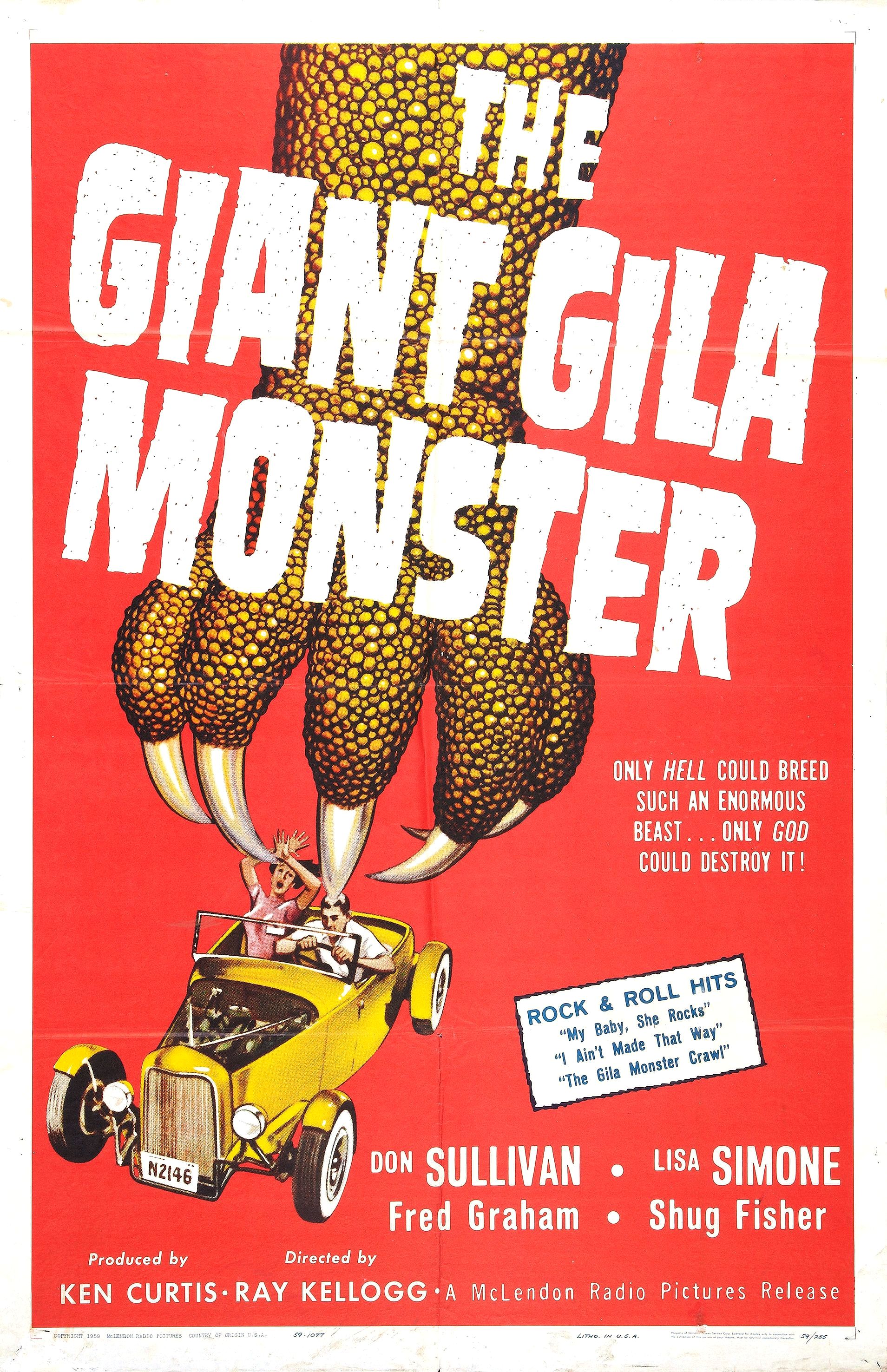
The Giant Gila Monster (1959) / D: Ray Kellogg / 75m

Cast: Don Sullivan, Fred Graham, Lisa Simone, Shug Fisher, Bob Thompson, Janice Stone, Ken Knox, Gay McLendon

In rural Texas, the disappearance of a teenage couple prompts the local sheriff (Graham) to enlist the help of the couple’s friends in determining if something has happened to them, or they’ve maybe eloped. Over the next few days, there are further disappearances, and increasing evidence that something strange is happening out near one particular ravine. When the couple’s car is finally found, there’s no sign of them. By now though, the sheriff and local car mechanic/hot rod enthusiast, Chase Winstead (Sullivan), have come to the conclusion that the cause of all the strange incidents might be some kind of abnormally large animal. The truth is revealed when the town drunk (Fisher) sees a giant gila monster, and it causes a train wreck. Before the sheriff can arrange for the state troopers to help kill the creature, it attacks a platter party being held a barn, an attack that prompts Chase to come up with a way of dispatching the monster once and for all…

Okay, so it’s not a gila monster, it’s a Mexican beaded lizard, and yes, the special effects involving it are shoddy and unconvincing (the trainwreck is not a highlight), but The Giant Gila Monster is definitely a cult classic. With its authentic Texan locations, mutually beneficial cooperation between its teenagers and the sheriff, unexpected rendition of The Mushroom Song by Sullivan (and twice, no less), and more hot rod inspired slang than you can shake a nerf bar at, the movie has a rudimentary charm that more than makes up for its deficiencies elsewhere. The performances are perfectly acceptable, Kellogg’s direction is simple yet effective, and the script by Jay Simms ensures that the characters (mostly) aren’t too one-dmensional. Like so many Fifties sci-fi/horrors it’s let down by the quality of its monster and the model work that surrounds it, and although this is the source of much amusement, there are sufficient good ideas present that if there had been a bigger budget, it would have meant a much more polished movie. It’s also that rare Fifties sci-fi/horror that can be watched more than once, and which remains way more superior than Gila!, the made-for-TV remake that escaped in 2012.

Rating: 6/10 – if you can ignore the low budget trappings, and the lack of any real threat from the titular creature, then The Giant Gila Monster is something of a pleasant surprise; almost gratuitously good-natured in its approach, this really isn’t a sci-fi or a horror movie, but it is more interesting to watch than the majority of its ilk.


The Trollenberg Terror (1958) / D: Quentin Lawrence / 81m

aka The Crawling Eye; Trollenberg Horror

Cast: Forrest Tucker, Laurence Payne, Jennifer Jayne, Janet Munro, Warren Mitchell, Frederick Schiller, Andrew Faulds, Stuart Saunders, Colin Douglas

Following several unexplained climbing deaths on the Swiss mountain of Trollenberg, UN investigator Alan Brooks (Tucker) travels to the observatory there in order to unravel the mystery of both the deaths and the presence of a radioactive cloud that doesn’t appear to move. On his journey he meets sisters Anne and Sarah Pilgrim (Munro, Jayne). Anne is telepathic and finds herself drawn to the mountain, cutting short their planned trip to Geneva. While at the local hotel, the trio encounter an Englishman called Philip Truscott (Payne), as well as a geologist called Dewhurst (Saunders) who is planning a trip up the mountain with a guide called Brett (Faulds). When their trip goes awry and Dewhurst is killed, Brett returns after having been lost overnight. But at the first opportunity he attempts to kill Anne, and when he’s stopped, Brooks and the rest, now assisted by observatory director Dr Crevett (Mitchell), learn that whatever is in the radioactive cloud is targeting anyone who goes onto the Trollenberg – and shows no sign of stopping…

Adapted from the 1956 UK TV series of the same name, The Trollenberg Terror is a sci-fi/horror movie that does its best on a limited budget, and though some of the model effects are particularly shoddy, its alien creature is one of the most effectively designed and realised of its time (those tentacles, though!). It’s played incredibly straight throughout, with its cast seemingly banned from raising a smile unless it’s absolutely necessary (and even then, only with written permission), and the serious nature of the aliens’ threat is emphasised at every turn. However, this doesn’t stop the movie from being enjoyable to watch – in a daft, you couldn’t make it up kind of way – and the performances, though a little po-faced at times, go a long way to selling the absurdity of it all. Lawrence, whose first feature this was, shows a knack for staging the horror elements to ensure maximum impact – the opening scene is grisly without being explicit – and though this is clearly set in Switzerland by way of a studio in Middlesex, there’s a keen sense of time and place.

Rating: 7/10 – let down by a final ten minutes that cruelly exposes its limited budget, The Trollenberg Terror is still a better than most example of late Fifties sci-fi/horror; apparently a partial inspiration for John Carpenter’s The Fog (1980), it’s a movie with some clever ideas, and one that isn’t afraid to throw a number of wild ones in there as well (zombies, anyone?).


Share this:

  • Click to share on X (Opens in new window) X
  • Click to share on Facebook (Opens in new window) Facebook
  • More
  • Click to print (Opens in new window) Print
  • Click to email a link to a friend (Opens in new window) Email
Like Loading...

Rakka (2017)

15 Thursday Jun 2017

Posted by dullwood68 in Movies

≈ Leave a comment

Tags

Action, Aliens, Brain barriers, Drama, Neill Blomkamp, Oats Studios, Review, Sci-fi, Sigourney Weaver

D: Neill Blomkamp / 22m

Cast: Sigourney Weaver, Eugene Khumbanyiwa, Robert Hobbs, Carly Pope, Brandon Auret

In the future, aliens have invaded Earth and set about destroying our world and making it into a facsimile of their own, with giant engines spewing methane into our atmosphere and humans being used as de facto incubators for the aliens themselves. The human resistance is sporadic but determined to fight back with whatever resources it can muster. In Texas in 2020, a small group of resistance fighters led by Jasper (Weaver), hatch a plan that involves the use of helmets called brain barriers that reduce the influence the aliens can have over humans. Enlisting the aid of a bombmaker called Nosh (Auret), Jasper hopes to use the brain barriers and an item made by Nosh to take the fight to the aliens and maybe turn the tide against them.

While Jasper and a handful of her team carry out their mission, a man called Amir (Khumbanyiwa) is tended to by a woman called Sarah. Amir has been rescued from the aliens, but he’s been operated on and his skull is a bio-mechanical fusing of human and alien materials. His condition appears to offer a view into the future, and Sarah attempts to get Amir to tell her what he can see, but though he has visions relating to Jasper’s mission, he’s unable to tell her the outcome he’s privy to.

With District 9 (2009), Neill Blomkamp’s career, previously consisting of shorts, got an impressive boost, and his future as a director seemed assured. But Elysium (2013) and Chappie (2015) didn’t fare so well with audiences and critics alike, and Blomkamp’s long-gestating Alien project found itself cancelled when Ridley Scott decided to reboot the original franchise. Faced with setback after setback and unable to get any projects green-lit with the studios, Blomkamp decided to take matters into his own hands and create his own production company, Oats Studios. With a remit that involves producing a number of short movies that are hoped will go viral and be successful enough to raise enough money for full-length movies to be made, Oats Studios is a brave step for the director, but perhaps a necessary one. By starting out small – returning to his own beginnings perhaps – Blomkamp will be able to retain overall control of any productions made under the Oats Studios banner. And if his distinct visual and narrative style is allowed to flourish under these conditions then it’s possible that he could be responsible for other moviemakers following suit and making their own movies without having to go cap in hand to the major studios.

But as a calling card for his new production company, Rakka isn’t necessarily the best choice to entice further viewers or converts to Blomkamp’s cause. Shot both formally and experimentally – which gives the movie a slightly schizophrenic feel – Rakka is yet another dystopian slice of science fiction that riffs on both District 9 and Chappie through its gritty, effects-heavy visual style and deliberately disjointed editing. Making the most of an obviously low budget, Blomkamp pays close attention to creating a familiar mise en scene for his story to unfold in front of, but forgets to provide as much detail for the characters or the overall storyline. This leads to some scenes appearing out of sync with others, as if the limitations of the budget meant that Blomkamp had to make too many concessions in order to meet the requirements of the running time, and the script suffered as a result. It’s clear that this is a taster for a longer movie, and if it’s ever made it would, hopefully, delve more into the workings of our invaded world, and provide audiences with a clearer picture of what’s happening. But Blomkamp has taken a risk by leaving so much unanswered, and by hoping that he’s done enough to encourage enough interest to get a full-length version made in the future. Too often it’s the substance that suffers in a short movie, and while Rakka is a visually enthralling experience, the alien invasion storyline isn’t as immediately compelling as it could have been.

Rating: 5/10 – though Blomkamp should be applauded for taking his moviemaking career into his own hands, Rakka sees the director revisiting past glories to a much lesser effect; hopefully, other Oats Studios releases will veer away from the recurrent themes and imagery of Blomkamp’s movies so far, and if they’re to be successful, concentrate instead on creating much more original content.

There’s no official trailer for Rakka, but the movie can be seen here:

Share this:

  • Click to share on X (Opens in new window) X
  • Click to share on Facebook (Opens in new window) Facebook
  • More
  • Click to print (Opens in new window) Print
  • Click to email a link to a friend (Opens in new window) Email
Like Loading...

Arrival (2016)

10 Thursday Nov 2016

Posted by dullwood68 in Movies

≈ 4 Comments

Tags

Aliens, Amy Adams, China, Denis Villeneuve, Drama, Forest Whitaker, Jeremy Renner, Literary adaptation, Michael Stuhlbarg, Montana, Mystery, Review, Sci-fi, Shells, Thriller, Translation

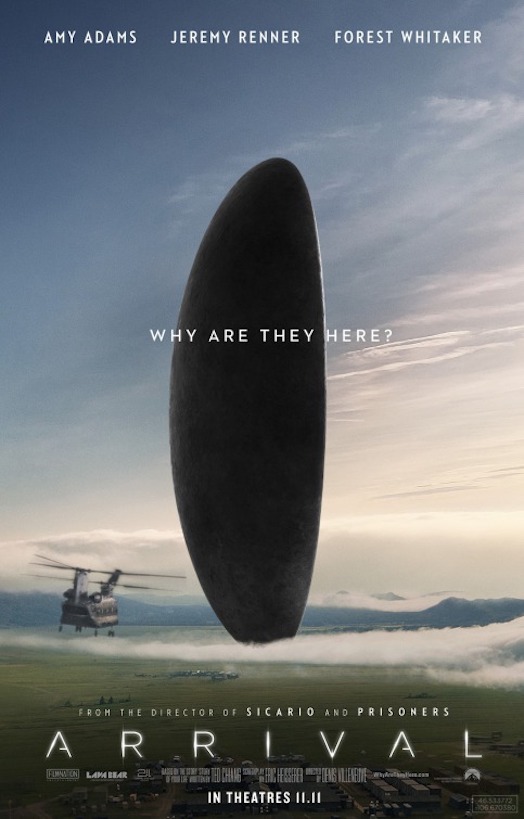
arrival_ver4

D: Denis Villeneuve / 116m

Cast: Amy Adams, Jeremy Renner, Forest Whitaker, Michael Stuhlbarg, Mark O’Brien, Tzi Ma

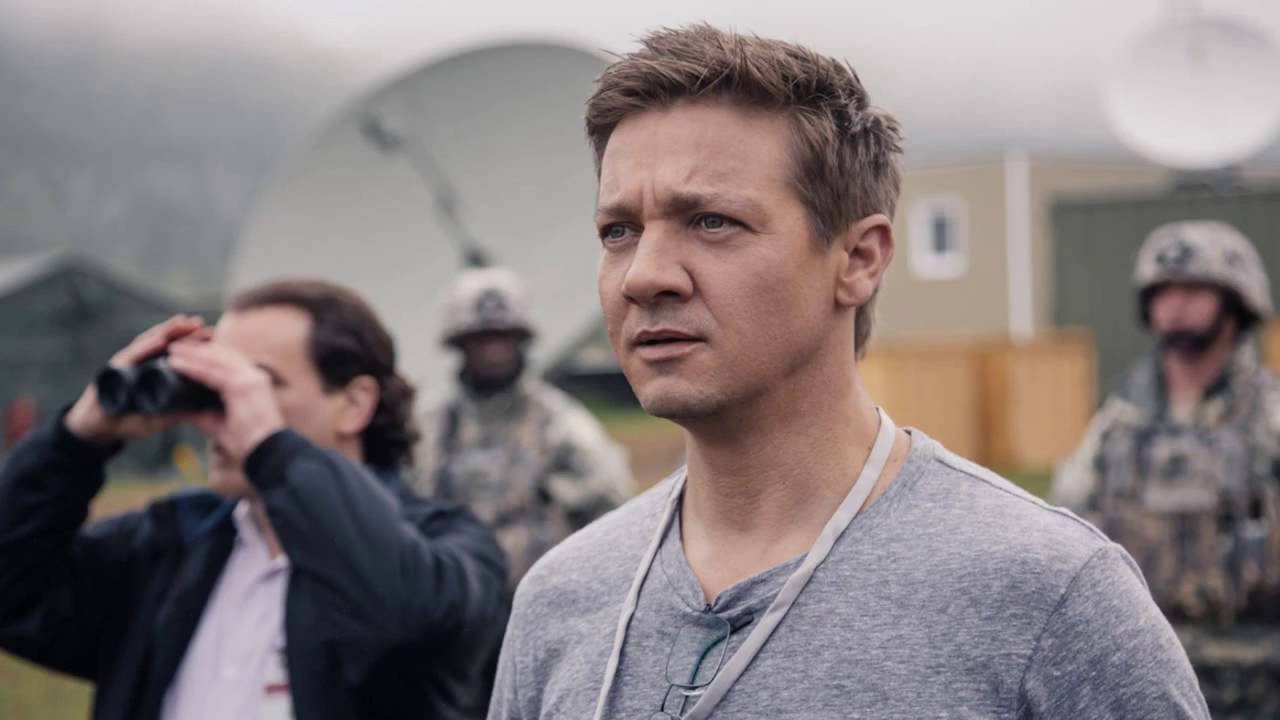
Louise Banks (Adams) is a linguistics professor whose private life has recently been shattered by the break up of her marriage and the death of her daughter from cancer. Getting by but still grieving, Louise is as unprepared as the rest of the world when twelve huge spaceships suddenly appear one day in different locations around the globe. Soon, though, she is approached by the US military – in the form of Colonel G.T. Weber (Whitaker) – to aid in communicating with the aliens on board the ship that hovers over American soil in Montana. The best in her field in terms of linguistics and translations, Louise joins Weber’s team along with mathematician and scientist Ian Donnelly (Renner).

In Montana, Louise and Ian are advised that the most important question is, What do they want? Later, they ascend into the ship – called a “shell” by the military – and have their first encounter with the aliens. A symbol is written on the screen that separates the aliens in their atmosphere from Louise and Ian et al in theirs. Using it as the basis of the aliens’ language, Louise soon deduces that the symbol doesn’t just translate into one word, but into many. From then on she is able to determine much more of how the aliens communicate. Meanwhile, at the other arrival sites, particularly in China, suspicion and distrust of the aliens’ intensions are leading to veiled threats of attack on the shells, while violent unrest occurs around the globe.

arrival-teaser-trailer

Louise begins to have visions of a little girl, who in various ways helps her to understand more of what the aliens are communicating. When she translates a symbol and the meaning is “Offer weapon”, it causes the CIA agent in charge of the whole operation in Montana, Halpern (Stuhlbarg), to order an evacuation. But Louise insists they should stay, to keep faith with the aliens, and to complete the mission to find out why they are here. She returns to the shell by herself, and by coming into direct contact with the aliens, Louise learns why they have arrived, and why she’s having visions of the little girl, a revelation that has a profound effect not just on her, but on her understanding of her marriage and also, her daughter’s death.

There’s a dearth of good, old-fashioned, serious sci-fi in the movies right now – in fact, it’s been that way for some time – but Arrival is here to redress the balance. Playing with notions of time and memory and the nature of happiness, the movie is a thought-provoking treatise on what it is to mourn a life while discovering at the same time that that life has much more to offer even though the person has passed away. It’s a bit of a mindbender at times, but Villeneuve confidently handles the narrative twists and turns of Eric Heisserer’s script – itself an adaptation of the short story Story of Your Life by Ted Chiang and heavily reworked by Villeneuve himself – so that the viewer can still grasp the subtleties of what’s happening and why.

arrival-movie-4-e1471529984165

Along the way, said viewer is treated to an intelligent story and plot that packs an unexpectedly emotional wallop towards the end, as the various strands of Louise’s life are brought into sharp relief, and the aliens’ reason for visiting Earth is revealed. Louise herself is brought to life by Adams in a performance that acts as a reminder that, away from the DC Extended Universe, she is still one of today’s finest actresses. As the emotionally distant Louise, Adams shows just how removed she is from everything going on around her – at first. But as Louise slowly begins to unravel the complex patterns of the aliens’ language, she begins to reconnect with herself and everyone around her; and particularly Ian. Adams is the movie’s chief ingredient for success, her succinct, subtle portrayal of Louise proving layered and intuitive, and deeply moving come the movie’s end.

But while Adams’ performance is the bedrock upon which the movie supports itself, there’s so much more to recommend it. Though she plays the central character, and the rest of the cast have essentially supporting roles, the likes of Renner and Whitaker still manage to contribute well-rounded and credible characters that are necessary to the plot, while even Stuhlbarg’s paranoid (and potentially one-note) CIA agent fits in to the overall set up without feeling extraneous or unnecessarily villainous. Villeneuve also allows each character to display their own fears and concerns, and a corresponding sense of wonder, at being in such close proximity to the aliens and their craft.

Visually, the movie is a gloomy-looking, though consistently well-thought out viewing experience, with Villeneuve choosing to dial down on any bright colours and in doing so, adding texture to the narrative. The aliens operate in a cloudy grey environment and “write” using appendages that produce a black inky substance that is surprisingly vibrant, while at the military base, the various comms rooms and private quarters also lack for vivid colours, with only computer screens providing any brightness to offset the gloom. Villeneuve is making a conscious choice here: the bleak, low-lit hive of activity reflecting the interior of the aliens’ ship, as if to insinuate that there is a greater level of connection between “us” and “them” than is immediately apparent.

maxresdefault

The visuals are more than ably supported by a distinctive sound design that unnerves far more than it reassures, and which also includes a suitably eerie and mournful score by Jóhann Jóhannsson, Villeneuve’s go-to composer. Keeping the viewer on edge as Louise deconstructs the alien message, the visuals and the sound design combine to create a haunting, other-worldly feel that is not only entirely appropriate given the nature of the story, but also serves to highlight the idea that if we aren’t alone in the universe, then ideas of melody and tone may still hold but are likely to be interpreted in completely different ways.

Ultimately though, it’s Villeneuve’s confident handling of the material that impresses the most. He’s not afraid to take his time in telling the story, and doesn’t drip-feed all the relevant information at regular points in the narrative. Instead he lets the story unfold at its own pace, revealing key plot points quietly and without the usual fanfare required in other sci-fi movies, and the result is a measured, affecting tale that contains a major twist, one that perhaps for the first time, is allowed to play out over much of the movie’s running time, rather than just suddenly and without warning, and which in its simplicity and emotional effectiveness, elevates Arrival over and above any other sci-fi movie you’re likely to see this year (and probably for some time to come).

Rating: 9/10 – a beautifully constructed movie with a clever, intelligent script, superb cinematography from Bradford Young, an intense soundtrack, heartfelt performances and all held together by a director at the top of his game, Arrival is a must-see movie that is less about why the aliens are here, and more about why we are here; quite simply, one of this year’s best movies.

Share this:

  • Click to share on X (Opens in new window) X
  • Click to share on Facebook (Opens in new window) Facebook
  • More
  • Click to print (Opens in new window) Print
  • Click to email a link to a friend (Opens in new window) Email
Like Loading...

Independence Day: Resurgence (2016)

04 Monday Jul 2016

Posted by dullwood68 in Movies

≈ 2 Comments

Tags

Action, Aliens, Bill Pullman, Drama, Invasion, Jeff Goldblum, Jessie T. Usher, Judd Hirsch, Liam Hemsworth, Maika Monroe, Review, Roland Emmerich, Sela Ward, Sequel, Spaceships, Thriller, Twenty years, William Fichtner

Independence Day Resurgence

D: Roland Emmerich / 120m

Cast: Liam Hemsworth, Jeff Goldblum, Jessie T. Usher, Bill Pullman, Maika Monroe, Sela Ward, William Fichtner, Judd Hirsch, Brent Spiner, Travis Tope, Charlotte Gainsbourg, Angelababy, Deobia Oparei, Nicolas Wright, Patrick St. Esprit, Chin Han, Vivica A. Fox

The tagline says it all: “We had twenty years to prepare.” And after all the waiting, this is the sequel we get, a bloated, lumbering, obscenely stupid movie that takes its predecessor’s legacy and repeatedly takes a dump on it. It’s a movie that insults the audience’s intelligence, and patience, at almost every turn in its efforts to tell the kind of half-baked story that should have been abandoned at the earliest stage possible. It took five people to pen the screenplay, two of them Emmerich and his long-time producing partner Dean Devlin, and it shows in the way that no two scenes run together seamlessly or with any sense of on-going purpose. Make no mistake about it: Independence Day: Resurgence is not worth your time.

The signs are there early on. Ex-President Whitmore (Pullman) is having dreams that anticipate the aliens returning. Once awake he’s plagued by a vision of an image he takes to be another of the aliens’ spaceships. Meanwhile, in Africa, a tribal warlord Dikembe Umbutu (Oparei), is visited by David Levinson (Goldblum), but there’s no reason given for Levinson’s being there. When Umbutu takes him to the site of a crashed alien spaceship they discover that it’s been sending out a distress call. Uh oh, we all know what that means!

IDR - scene1

Cue the Moon-based planetary defence systems coming under apparent attack from a giant sphere that appears out of some kind of black hole. Taking the approach that it’s safer to shoot first then ask questions later, current US President Lanford (Ward) orders its destruction. Maverick pilot Jake Morrison (Hemsworth), though grounded for saving a weapon from destroying the moon base (don’t ask), “borrows” a spaceship and heads for Africa to pick up Levinson so that he can take a look at the wreckage of the sphere (again, don’t ask). Umbutu tags along, as does Dr Catherine Marceaux (Gainsbourg), Umbutu’s shrink-cum-alien researcher, and a cowardly auditor, Floyd Rosenberg (Wright), who’s followng Levinson around for no other reason than the script has put him there. (Is it bizarre enough yet?)

Other characters are added to the mix. There’s ex-President Whitmore’s daughter, Patricia (Monroe), an ex-fighter pilot now working as part of President Lanford’s entourage. There’s Dylan Hiller (Usher), the son of Steven Hiller, the hero of the first movie who has died in a training exercise; he’s in a relationship with Patricia. Then there’s Dr Brakish Okun (Spiner). He’s been in a coma for the last twenty years since his “close encounter” with one of the aliens. Once the distress call goes out, he wakes up, older certainly, but suffering none of the side effects of being in a coma for such a long time (there’s certainly no muscle atrophy). Falling into line are General Adams (Fichtner), the military leader of the US forces, Dylan’s mother, Jasmine (Fox), who works in a hospital, and Jake’s co-pilot/gunner Charlie Miller (Tope), who acts as a comic alternative to Jake’s more serious demeanour. Oh, and let’s not forget Julius Levinson (Hirsch), David’s father, another character from the first movie who’s shoehorned into this one to add even more familiarity to the proceedings (and who miraculously survives what should be the world’s most destructive tsunami). (And that’s all without even mentioning the giant sphere that proves to have the personality of a stuffy doctor’s receptionist – still not bizarre enough?)

IDR - scene2

All these characters flit in and out of the narrative, adding little beyond their required presence at various points, and only occasionally making an impact. Even Levinson is sidelined by events, while Whitmore fills the role of this movie’s Russell Casse, and President Lanford proves expendable in a sequence that comes and goes without making audiences feel anything other than apathy. Even the movie’s principal hero, Jake, is cruelly underwritten, leaving Hemsworth in the unenviable position of playing a role that highlights his shortcomings as an actor. With the likes of Monroe, Usher and Fichtner reduced to the status of bit part players, the movie ignores its cast for the most part and concentrates on providing more spectacle than you can shake a giant spaceship at.

It’s while Emmerich piles on the destruction that the tagline for Gareth Edwards’ reboot of Godzilla (2014) springs to mind: “Size does matter.” For as the director gets carried away crashing an enormous spaceship into the North Atlantic, and displacing Singapore only as long as it takes to float it halfway around the world and drop it on London, the message comes across loud and clear, that this movie is better because it’s bigger, both in scope and special effects. But it’s all soulless and uninvolving, populated by whizz-bang dogfights and lacklustre retreads of moments from Indepedence Day that only serve to remind viewers just how enjoyable that movie was, and still is.

IDR - scene3

And where Independence Day kept its laughs to a minimum, its bloated but thankfully shorter sequel adds humour and silliness by the bucket load, largely whenever Okun or Floyd is on screen, and in the plethora of one-liners sprinkled throughout the script. This may have seemed like a good idea at the time but this reliance on making the audience laugh undercuts the seriousness of the situation, leaving the movie feeling uneven and, sometimes, crass in its efforts to entertain instead of having us on the edge of our seats. The world is about to end, but that’s okay, here comes Brent Spiner with another less-than-pithy wisecrack.

That this is so woeful proves the old adage, penned by William Goldman, that in Hollywood, “nobody knows anything”. If they did, then Messrs Emmerich and Devlin wouldn’t have transferred such a dreadful script to the screen and attempted to pass it off as a worthy successor to the movie that made both their names. Where Amy Schumer appeared in a movie called Trainwreck (2015), it wouldn’t be inappropriate for this farrago to be re-titled Spaceshipwreck – it’s a far more apt description.

Rating: 3/10 – without a doubt the worst – so far – of this year’s summer blockbusters, Independence Day: Resurgence lacks apppreciable thrills, appreciable drama, appreciable tension or emotion, and any clear idea of the story it wants to tell; frustrating on so many levels, it’s a movie that consistently defies belief, and does the one thing the viewer will be praying it won’t do: set things up for another sequel.

Share this:

  • Click to share on X (Opens in new window) X
  • Click to share on Facebook (Opens in new window) Facebook
  • More
  • Click to print (Opens in new window) Print
  • Click to email a link to a friend (Opens in new window) Email
Like Loading...

The 5th Wave (2016)

13 Wednesday Apr 2016

Posted by dullwood68 in Movies

≈ Leave a comment

Tags

Alex Roe, Alien invasion, Aliens, Chloë Grace Moretz, Drama, J Blakeson, Liev Schreiber, Literary adaptation, Maria Bello, Nick Robinson, Review, Rick Yancey, Sci-fi, Thriller, Wright Patterson Air Force Base, YA novel

The 5th Wave

D: J Blakeson / 112m

Cast: Chloë Grace Moretz, Nick Robinson, Alex Roe, Liev Schreiber, Maria Bello, Ron Livingston, Maggie Siff, Zackary Arthur, Maika Monroe, Tony Revolori, Talitha Bateman, Cade Canon Ball, Alex MacNicoll, Nadji Jeter, Gabriela Lopez

It’s actually hard to know where to start with The 5th Wave. (It’s equally hard to know where to finish as well.) Yet another adaptation of the first in a trilogy of YA novels – this time by Rick Yancey – the movie has so many problems, and so many flaws it’s almost embarrassing. Up front and centre there’s Chloë Grace Moretz, an actress whose career has evolved – somehow – out of calling a bunch of goons “c*nts”, and who lacks the wherewithal to cry properly when her character’s father dies (look closely and you’ll find that Moretz’s face is not the definition of “tear-streaked”). Moretz just isn’t convincing enough as Cassie, the nominal heroine of the novels and the movie, and every time she’s asked to show some emotion it’s like there’s a war of attrition going on in her head, as she struggles to work out which facial expression will fit the bill. Often she settles for confused, or confused and angry, almost like they’re default modes for acting.

The 5th Wave - scene2

Then there’s the supporting cast, a mix of relative newcomers and veterans who all should have known better and sought employment elsewhere. On the veterans side there’s Liev Schreiber and Maria Bello, two very good, accomplished actors who are more than capable of giving award-winning performances (and they have). But here it’s a very different story (much like this adaptation of Yancey’s novel). Schreiber, playing a US military commander, looks bored and sounds bored throughout, as if he’s committed to the movie before reading the script and is now regretting the decision completely. Bello, on the other hand, at least has the luxury of being almost unrecognisable as another member of the military, but even she can’t bring anything resembling an effective portrayal to a role that requires her to jab her co-stars with a needle gun or spit out her lines as if they were poisonous.

On the relative newcomers side, it’s disheartening to see the likes of Revolori, excellent as the bellboy in The Grand Budapest Hotel (2014), and Monroe, also excellent as the heroine of It Follows (2014), reduced to making ends meet by playing characters who are either unmemorable (Revolori) or stereotypically superficial (Monroe – the tough as nails female who doesn’t take shit from anyone). If this is the best movie they could get to work on in 2015 then they need to seriously rethink who’s representing them. As the two male leads, Robinson (as Cassie’s high school crush, Ben) opts for sulky and remote, while Roe (as Evan, who helps Cassie when she’s injured) aims for a combination of Theo James and Ansel Elgort from the Divergent series, and misses them both by a mile.

The 5th Wave - scene3

The look of the movie is also a problem. At the beginning, as Cassie provides an overview of the alien invasion and the various waves that have occurred so far, there’s a definite feel of money being well-spent, and the movie has an exciting buzz about it. But once that section is over, and Cassie, her father (Livingston), and her younger brother Sam (Arthur), arrive at the refugee camp it all becomes very generic in terms of both the art direction and the cinematography. And by the movie’s end, the cast are consigned to running around empty underground corridors in a volley of scenes that could be taking place in any post-apocalyptic low-budget sci-fi movie.

All this can be laid firmly at the door of the script, a mishmash of YA tropes and sci-fi melodrama that’s been cobbled together by three writers, all of whom should have been able to do a better job than this. Susannah Grant wrote the script for Erin Brockovich (2000) and was nominated for an Oscar, while Jeff Pinkner has an envious track record on TV shows such as Lost and Fringe. And then there’s Akiva Goldsman, an Oscar winner for A Beautiful Mind (2001), and a recent participant in YA adaptations with the script for Insurgent (2015). But when all three can’t stop a movie from sounding like it was written by a trio of people who believe caricature and cliché are the best options, then the movie is pretty much abandoning all hope and waving a surrender flag.

The 5th Wave - scene1

But all this pales in comparison to the flaccid direction foisted on the movie by Blakeson. Making only his second feature after The Disappearance of Alice Creed (2009), Blakeson has trouble making any of it sound or look convincing, from the tepid romance between Cassie and Evan, to the video game sequences where Ben and his squad try and hunt down the aliens – possibly the worst example of the movie’s haphazard approach to editing – whatever the requirement, Blakeson finds some way to spoil it or prevent it from reaching its full potential. When you can’t even find a way of making Liev Schreiber look menacing, or inject any excitement into the destruction of a major air force base then you’ve got real problems. Maybe there’s a budgetary explanation for some of this but in the main, nothing works as well as it should.

Rating: 3/10 – its opening salvo of disaster aside, The 5th Wave works best as a cautionary tale to other makers of dystopian YA movies, in that they should avoid replicating this movie’s mistakes and do exactly the opposite of what it does here; limp and unappealing, with yet another inexplicable lead role for Moretz, it’s a movie that redefines the term “lacklustre” and has hopefully done enough to dissuade any sequels from being made.

Share this:

  • Click to share on X (Opens in new window) X
  • Click to share on Facebook (Opens in new window) Facebook
  • More
  • Click to print (Opens in new window) Print
  • Click to email a link to a friend (Opens in new window) Email
Like Loading...

10 Cloverfield Lane (2016)

22 Tuesday Mar 2016

Posted by dullwood68 in Movies

≈ 2 Comments

Tags

Aliens, Car crash, Cloverfield, Dan Trachtenberg, Drama, Fallout shelter, John Gallagher Jr, John Goodman, Mary Elizabeth Winstead, Review, Thriller

10 Cloverfield Lane

D: Dan Trachtenberg / 103m

Cast: John Goodman, Mary Elizabeth Winstead, John Gallagher Jr, Suzanne Cryer

Much like its unofficial predecessor, 10 Cloverfield Lane arrives out of the blue with little fanfare but carrying the huge weight of anticipation. In these days of overhyped mega-budget superhero-thons and the perception that the public needs to know everything about a movie before it’s released, the fact that this latest from producer J.J. Abrams has slipped so easily under the radar is a very welcome fact indeed. While some movies thrive on the hype that accompanies them, this blend of claustrophobic thriller and sci-fi action movie has been released to a world that barely knew it was waiting for it. So how does it fare?

Well, the first thing to mention is that this isn’t a sequel to Cloverfield (2007). Yes, Cloverfield is in the title, but this exists in a different world to that movie, and while the notion of marauding aliens is present – in the final twenty minutes at least – what we have here is a decent thriller that pulls off a couple of neat narrative tricks on its way to an unnecessary, tacked-on finale. It begins with Michelle (Winstead) deciding to leave her husband, Ben. She takes off in her car and is soon driving through some very deserted countryside. It gets dark and as she navigates both the road ahead and calls from Ben, a truck collides with her and her car goes off the road. When she comes to she’s in a small, bare room and her right leg, which is strapped up, is chained to the wall.

10CL - scene1

Her rescuer proves to be called Howard (Goodman), a survivalist who tells her that she’s in a fallout shelter that he’s had built, and that there’s been an attack which has left the atmosphere poisonous and unsafe. Disbelieving at first, Michelle learns that she and Howard aren’t alone. Also there is Emmett (Gallagher Jr), a young man who helped Howard build the shelter, and who “fought” his way in when Howard was about to seal it up. He corroborates Howard’s story of an attack, but it’s clear that he doesn’t really know what’s happening above ground, and as Michelle increasingly suspects, neither does Howard.

In time, Michelle manages to steal Howard’s keys and incapacitate him long enough to reach the shelter’s main door. As she does so, a woman (Cryer) appears at the door, apparently suffering from radiation burns and demanding to be let in. Now afraid that Howard has been right all along, Michelle retreats back down into the shelter. In the days that follow, Howard makes mention of his daughter, Megan. He shows Michelle a picture of her and laments that his wife left him and took Megan with her to Chicago. But a problem with the air filtration unit leads to Michelle finding an earring that Megan was wearing in the photo. She tells Emmett what she’s discovered, but he has further worrying news for her, news that prompts them to collude in getting one of them out of the shelter and going for help.

10CL - scene2

What’s fresh and exciting about 10 Cloverfield Lane is the very fact that it’s not taking place in the same world as Cloverfield, and where that movie was one long example of undesirable shaky-cam, this has been made under more traditional means, with carefully composed shots and fluid camerawork throughout. For some this will be a relief but in reality the storyline doesn’t support such an approach, and it would have looked idiotic. And the movie’s tagline, “Monsters come in many forms”, has a neat vibe to it that underlines the events that happen in Howard’s shelter all too cleverly.

Thanks to a well-constructed screenplay by Josh Campbell and Matthew Stuecken, with input from Damien Chazelle (Whiplash), the movie works well as a tense thriller, and a survivalist drama. Once inside Howard’s shelter, Michelle’s back story is abandoned, and deliberately so; it’s her life now that’s important. Along with Emmett she has to adjust to being confined for possibly two years with a man who has violent mood swings and a Messiah complex. Howard is a frightening creation, his ability to justify his actions with an icy yet contemplative calm one of the main things the movie gets completely right. Goodman is superb in the role – his finest for quite some time – and he takes full advantage of a part that allows him to flex his considerable acting muscles and remind people just how good a dramatic actor he is. Whether he’s being sociable or psychotic, Howard is someone you just can’t take your eyes off of, and Goodman makes sure you don’t.

10CL - scene3

Winstead is equally impressive, imbuing Michelle with a resourcefulness and a determination to survive that matches Howard’s. Gallagher Jr has the smaller role, and while Emmett isn’t as pivotal to proceedings as Howard and Michelle are, the actor is still able to make the character’s presence in the shelter both credible and necessary. Otherwise, there are a couple of minor roles and for viewers with a good ear for voices, a cameo by Bradley Cooper as Ben. By paring down the cast and concentrating on the dynamics of living underground with someone who may or may not be a homicidal monster, the movie ratchets up the tension and proves completely absorbing.

And then, it all goes wrong. The last twenty minutes find Michelle outside the shelter at last but now faced with fending off a creature attack that changes both the movie’s tone and its sense of purpose. The unlucky viewer now has to contend with a crash course in action movie clichés that all hurt the movie, and leave the ending feeling like the set-up for a third entry (The Final Cloverfield, perhaps?). It’s as if the makers have suddenly remembered that the connection to Cloverfield needs to be addressed, and they’ve scripted accordingly. And Trachtenberg, who has done a sterling job up til now, doesn’t have the answer to combat this uneasy transition. It’s unfortunate, and undermines everything that’s gone before.

But there’s still plenty to recommend the movie, not the least of which is a killer sound design that emphasises the effects of loud noises in the shelter, as well as external sounds that are both ominous and sinister at the same time. And Ramsey Avery’s production design, allied with Michelle Marchand II’s set decoration, gives the shelter a degree of verisimilitude that benefits the movie greatly. There’s always something to look at, and the level of detail is very impressive indeed.

Rating: 7/10 – two separate stories spliced together to make an unfortunate whole, 10 Cloverfield Lane quickly runs out of ideas once it lets its heroine out of the shelter; however, Goodman’s performance is worth the price of admission by itself, and there’s a sense of impending doom that the movie maintains effectively throughout its time below ground.

Share this:

  • Click to share on X (Opens in new window) X
  • Click to share on Facebook (Opens in new window) Facebook
  • More
  • Click to print (Opens in new window) Print
  • Click to email a link to a friend (Opens in new window) Email
Like Loading...

Short Movies Volume 1

27 Friday Nov 2015

Posted by dullwood68 in Movies

≈ Leave a comment

Tags

Aliens, Andrea Jensen, Animation, Blue Sky, Brian Dietzen, Camera, Casino, Christmas Scrat-tastrophe, Dave Calub, David Mead, Devon Avery, Documentary, Erinn Hayes, Galen Chu, Gambling, History, Horror, Invasion, Is This Free?, Jack Hawkins, Lauris Beinerts, Matthew Kalish, Megan Prescott, Mike Thurmeier, One-Minute Time Machine, Ransom Riggs, Reviews, Romance, Ryder Bach, Salton Sea, Scrat, Short movies, Spaceship, The Accidental Sea, The Plan (2008), Time travel, Turn Around When Possible

The short movie is an oft-neglected aspect of movie viewing these days, with fewer outlets available to the makers of short movies, and certainly little chance of their efforts being seen in our local multiplexes (the exceptions to these are the animated shorts made to accompany the likes of Pixar’s movies, the occasional cash-in from Disney such as Frozen Fever (2015), and Blue Sky’s Scrat movies (see below). Otherwise it’s an internet platform such as Vimeo, YouTube (a particularly good place to find short movies, including the ones in this post), or brief exposure at a film festival. Even on DVD or Blu-ray, there’s a dearth of short movies on offer. In an attempt to bring some of the gems that are out there to a wider audience, here is the first in an ongoing series of posts that will focus on short movies. Who knows? You might find one that becomes a firm favourite – if you do, please let me know.

One-Minute Time Machine (2014) / D: Devon Avery / 6m

Cast: Brian Dietzen, Erinn Hayes

One-Minute Time Machine

Rating: 9/10 – A comedy about a young man who invents a time machine in order to impress the girl of his dreams, this brief but inventive short is like a sci-fi version of Groundhog Day, but with a humorous sting in the tale. The two leads are well chosen, with Dietzen (NCIS‘s Jimmy Palmer) playing the lovelorn geek to perfection, and Hayes proving to be an equally effective sparring partner. It does make up its own rules about time travel but that’s no bad thing, and Avery makes a virtue of the way in which he cuts between his two characters. A rewarding little movie that is well worth watching.

Turn Around When Possible (2014) / D: Dave Calub, David Mead / 7m

Cast: Megan Prescott, Holly Hoyland

Turn Around When Possible

Rating: 7/10 – Two young women trust their sat-nav too much in this British short that sees them lost in the forest and at the mercy of something strange lurking in the undergrowth. Just what is lurking in the undergrowth is very reminiscent of a creature you shouldn’t get wet or feed after midnight, and the acting is a little amateurish, but this is still an atmospheric, well-shot movie that also manages to provide viewers with a surprisingly ambiguous ending.

Is This Free? (2011) / D: Lauris Beinerts / 8m

Is This Free?

Cast: Jack Hawkins, Tarryn Meaker, Abdiel LeRoy, Cornelia Baumann, Julian Lamoral-Roberts, David Cullinane, Chloe Massey, Katie Goldfinch, Véronique Sevegrand

Rating: 8/10 – Observational comedy is the focus here as Hawkins’ Luka illustrates the various responses he gives to people who ask if the seat next to him is free. Ranging from the risible – woman agrees to pay £2 to avoid someone else getting the seat – to the awkwardly humorous – Luka allows someone to sit next to him on a bench but tells them they’re being watched – Beinerts makes the most of his central idea, and it’s put together with a great deal of heart. And of course Luka doesn’t get it all his own way, which helps the movie avoid being too clever for its own good.

The Plan (2008) / D: Matthew Kalish / 4m

Cast: Ryder Bach, Andrea Jensen

Plan, The

Rating: 8/10 – Mitch (Bach) is unhappy with his life and decides to ditch his job, his girlfriend, and travel to Las Vegas to bet everything’s he’s got on red. Along the way he meets a young woman (Jensen) who steals his camera, but proves to be an augur of a better future. Shot in black and white, and with a Fifties feel to it that adds to the movie’s overall charm, this is both romantic and transformative at the same time, and despite Kalish’s predilection for unnecessary camera angles.

The Accidental Sea (2011) / D: Ransom Riggs / 6m

Accidental Sea, The

Rating: 8/10 – The writer of the Miss Peregrine’s Home for Peculiar Children‘s trilogy provides a potted history of California’s Salton Sea, from its origins as a major engineering mistake to its heyday as a holiday destination before the sea became too salty to sustain the surrounding infrastructure. Of particular interest thanks to Riggs’ modern day footage, where the area looks like the aftermath of the end of the world, the only fault is the sudden appearance of an old man who’s been making art out of the area’s refuse, and who isn’t on screen for nearly long enough. Haunting and wistful, this is a documentary short that is visually arresting and endlessly fascinating.

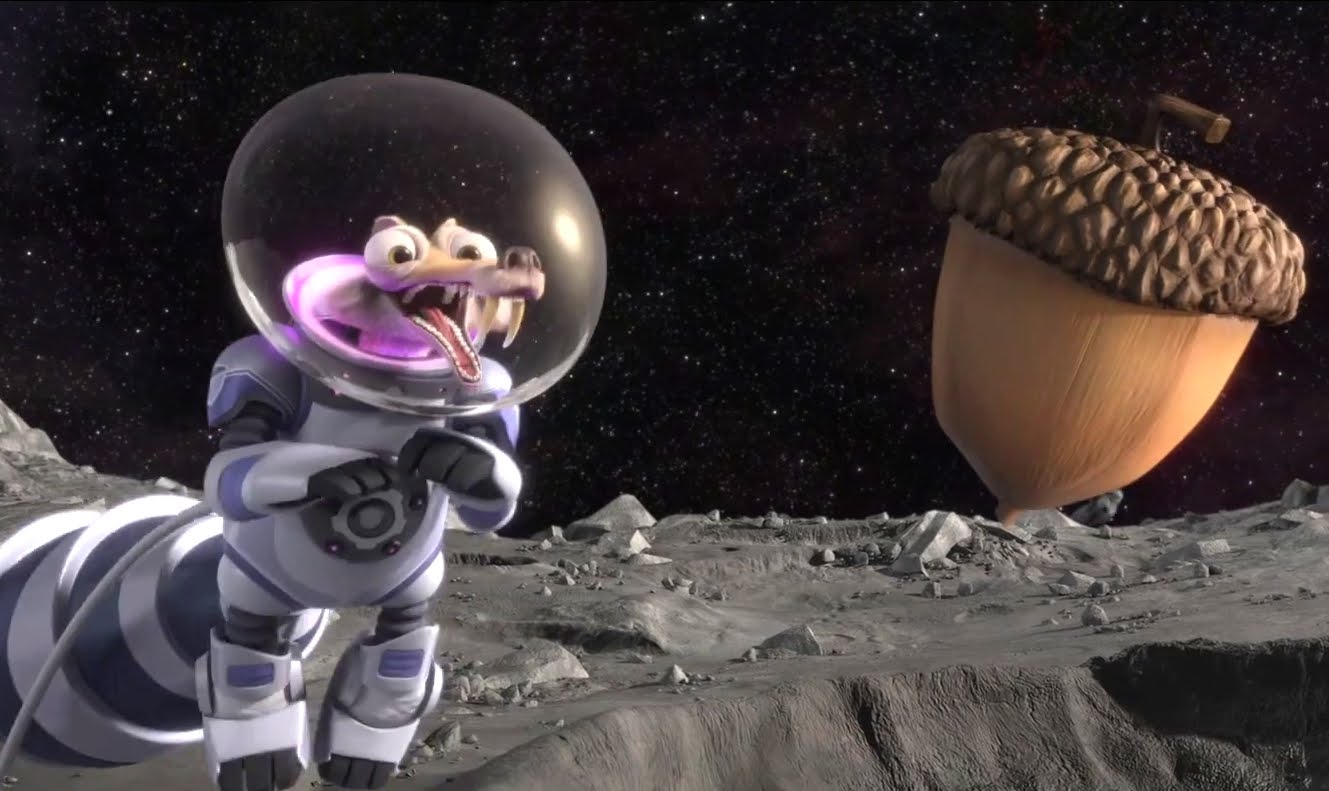
Christmas Scrat-tastrophe (2015) / D: Mike Thurmeier, Galen Chu / 5m

Cast: Ray Romano, John Leguizamo, Denis Leary, Chris Wedge

Christmas Scrat-tastrophe

Rating: 9/10 – Scrat’s back, and this time his obsession with keeping his nut all to himself leads to his being aboard the spaceship we glimpsed in the first Ice Age movie. From there, Scrat heads off into space to play havoc with the planets and go for a space walk, with predictably disastrous effects. Unabashedly entertaining (and with a complete disregard for physics and astrodynamics), this is top-notch stuff that, unfortunately, serves as a reminder that Scrat’s solo adventures are still far more entertaining than the full-length movies he has a supporting turn in.

Share this:

  • Click to share on X (Opens in new window) X
  • Click to share on Facebook (Opens in new window) Facebook
  • More
  • Click to print (Opens in new window) Print
  • Click to email a link to a friend (Opens in new window) Email
Like Loading...

Evolution (2001)

01 Saturday Nov 2014

Posted by dullwood68 in Movies

≈ Leave a comment

Tags

Aliens, Comedy, David Duchovny, Glen Canyon, Ivan Reitman, Julianne Moore, Meteor, Orlando Jones, Review, Sci-fi, Seann William Scott

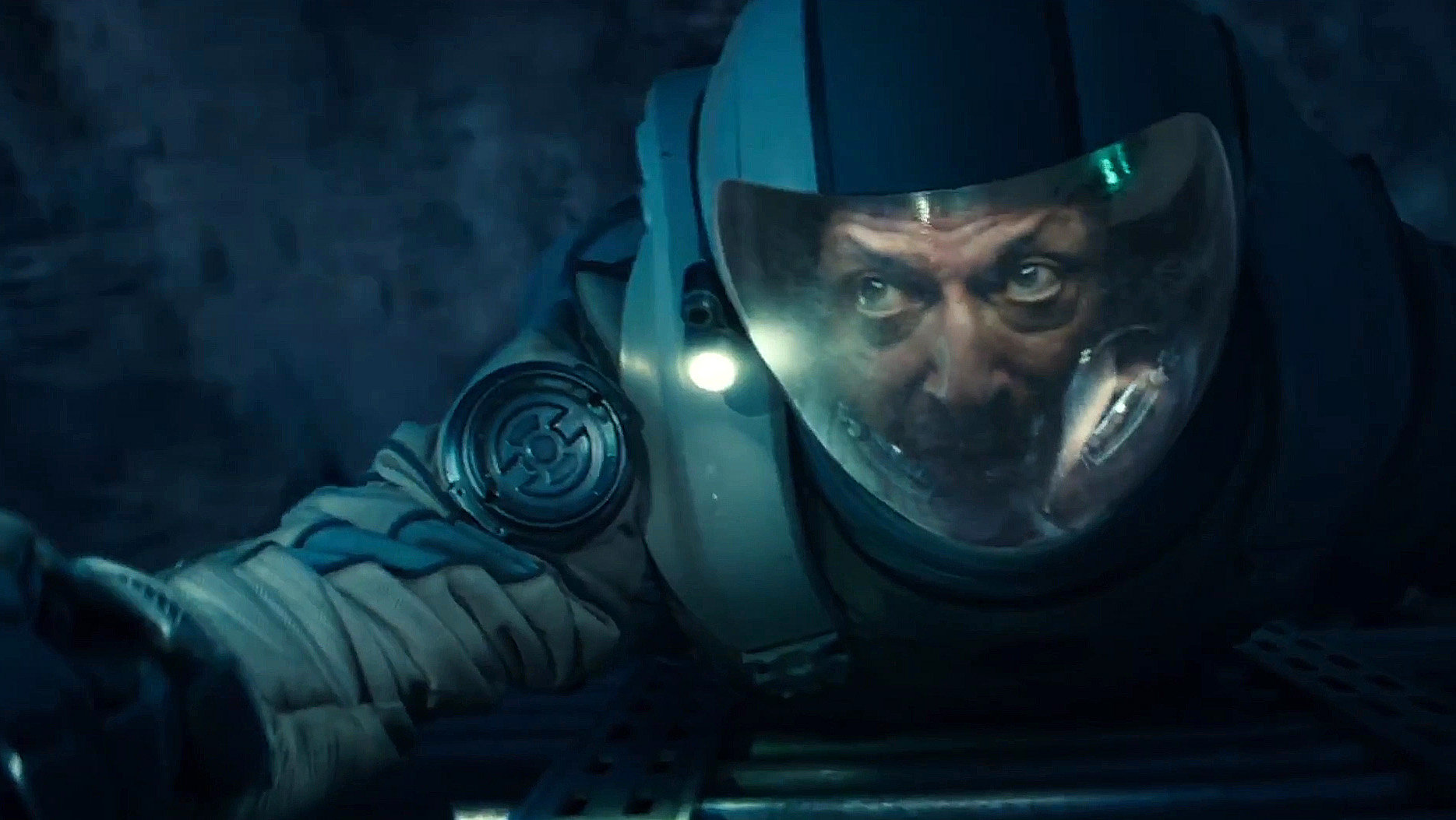
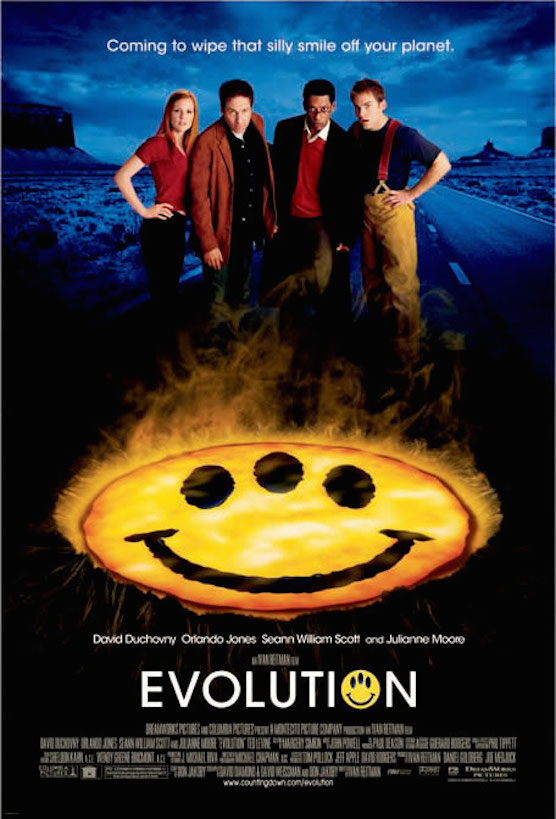
Evolution

D: Ivan Reitman / 101m

Cast: David Duchovny, Julianne Moore, Orlando Jones, Seann William Scott, Ted Levine, Ethan Suplee, Michael Bower, Pat Kilbane, Ty Burrell, Dan Aykroyd, Katharine Towne

A meteor crash lands outside of the small Arizona town of Glen Canyon, punching a hole through the ground and coming to rest in a cavern.  A professor at the local university, Harry Block (Jones), is also a member of the US Geological Service.  When he hears about the meteor he heads for the site with his friend and fellow professor, ira Kane (Duchovny).  They meet Wayne (Scott) who was there when the met or landed.  Harry and Ira descend into the cavern and find that the meteor is still warm, and when they begin taking a sample from it, they also discover that it releases a strange blue liquid, almost as if it were bleeding.  They take the sample back to Ira’s lab where he discovers that the liquid contains micro-organisms that appear to be single-celled, and which are definitely extraterrestrial in origin.

He breaks the news to Harry and they go back to the crash site with some of their students on the pretence of conducting a field trip (and to remove the meteor).  They find the beginnings of an entirely new eco-system, as well as evidence of evolutionary advances that are happening far too quickly.  When a flatworm dies from excess oxygen, Ira realises the importance of what they’ve discovered, and convinces Harry to  keep things to themselves until they can assess matters further (it helps that Harry is focused on a potential Nobel prize at some time in the future).

Meanwhile, while working at the local country club, Wayne sees evidence of the flatworms having spread further than the meteor site but he doesn’t say anything to anyone.  Harry and Ira return again to the cavern but are stopped when they find the site has been turned into a restricted military area overseen by General Woodman (Levine).  It turns out that Woodman was once Ira’s boss and that Ira has a checkered past involving an experimental virus that produced some unfortunate side effects.  Helped by Center for Disease Control scientist Alison Reed (Moore), Woodman takes over the site and bars ira and Harry from any further involvement.

While the military continue to monitor the cavern’s growing eco-system, and the creatures that are evolving there, other creatures are finding their way into the local community.  At the country club, one of the members is killed by a creature that is in turn killed by Wayne.  He takes the corpse to Ira and Harry; they later learn that dozens of creatures have died near the meteor site due to being oxygen intolerant.  When one gives birth to its offspring, a dragon-like creature, before dying, the newborn proves able to breathe properly and it flies off to cause mayhem at a nearby shopping centre.  Harry, Ira and Wayne track it down and kill it before warning General Woodman about the growing menace.  Under increasing pressure from the state governor (Aykroyd), Woodman advocates napalming the cavern and the tunnels that spur off from it.  But when Ira and co discover that heat speeds up the creatures’ evolutionary process, they face a race against time to stop them from over-running the planet.

Evolution - scene

An often raucous, good-natured sci-fi romp, Evolution is the type of comic fantasy that makes no bones about how absurd or ridiculous it might be, and throws caution, logic and plausibility as far out of the window as it can manage.  There’s a boisterous, almost schoolboy aesthetic going on, with Jones’ sex-obsessed geology teacher, Scott’s not-so-bright would-be fireman, and Duchovny’s good-natured ex-military scientist proving a good mix, and bolstered by Moore’s clumsy, well-meaning disease expert.  All four are clearly having fun and their enthusiasm, added to the script’s sense of mischief (courtesy of Don Jakoby, David Diamond and David Weissman), makes for an entertaining monster movie that flaunts its lack of scientific realism with wild abandon.

With its focus on making things as fun as possible, Evolution plays out like a movie whose basic concept was probably much simpler, but which, luckily, ended up being a whole lot more involved and wonderfully, gloriously silly.  There’s almost too much to enjoy: Wayne’s practice run at saving a woman from a burning building; Harry’s one-liners – “There’s ALWAYS time for lubricant!” – and extravagant facial expressions; Ira’s mooning of General Woodman; an encounter with Ira’s ex-girlfriend (played by Sarah Silverman); and Aykroyd’s pissed off state governor.  Amidst all the human levity, it would be easy to forget that there are some pretty weird alien creatures to deal with as well, but Reitman co-ordinates things with his trademark ease, and grounds the action with just enough unexpected gravitas to make the threat more credible than it might initially appear.

With the cast on top form, and Reitman orchestrating things with his usual aplomb, the occasional lapse can be forgiven – a cringe-inducing amount of sexist behaviour from Harry, Suplee and Bower being in Ira’s class in the first place (though it’s still funny) – and some of the creature effects are poorly integrated into the action, but there are some great desert locations that are beautifully photographed by Michael Chapman, and John Powell’s stirring score complements the movie throughout.

Rating: 8/10 – preposterous and silly, Evolution is nevertheless the kind of guilty pleasure you can brag about to your friends; even if you only watch it for Harry’s rectal procedure, it will still have been all worthwhile.

Share this:

  • Click to share on X (Opens in new window) X
  • Click to share on Facebook (Opens in new window) Facebook
  • More
  • Click to print (Opens in new window) Print
  • Click to email a link to a friend (Opens in new window) Email
Like Loading...

Edge of Tomorrow (2014)

01 Sunday Jun 2014

Posted by dullwood68 in Movies

≈ 2 Comments

Tags

Action, Aliens, Bill Paxton, Brendan Gleeson, Doug Liman, Emily Blunt, Exo-skeleton, Live Die Repeat, Mimics, Review, Sci-fi, The Louvre, Tom Cruise

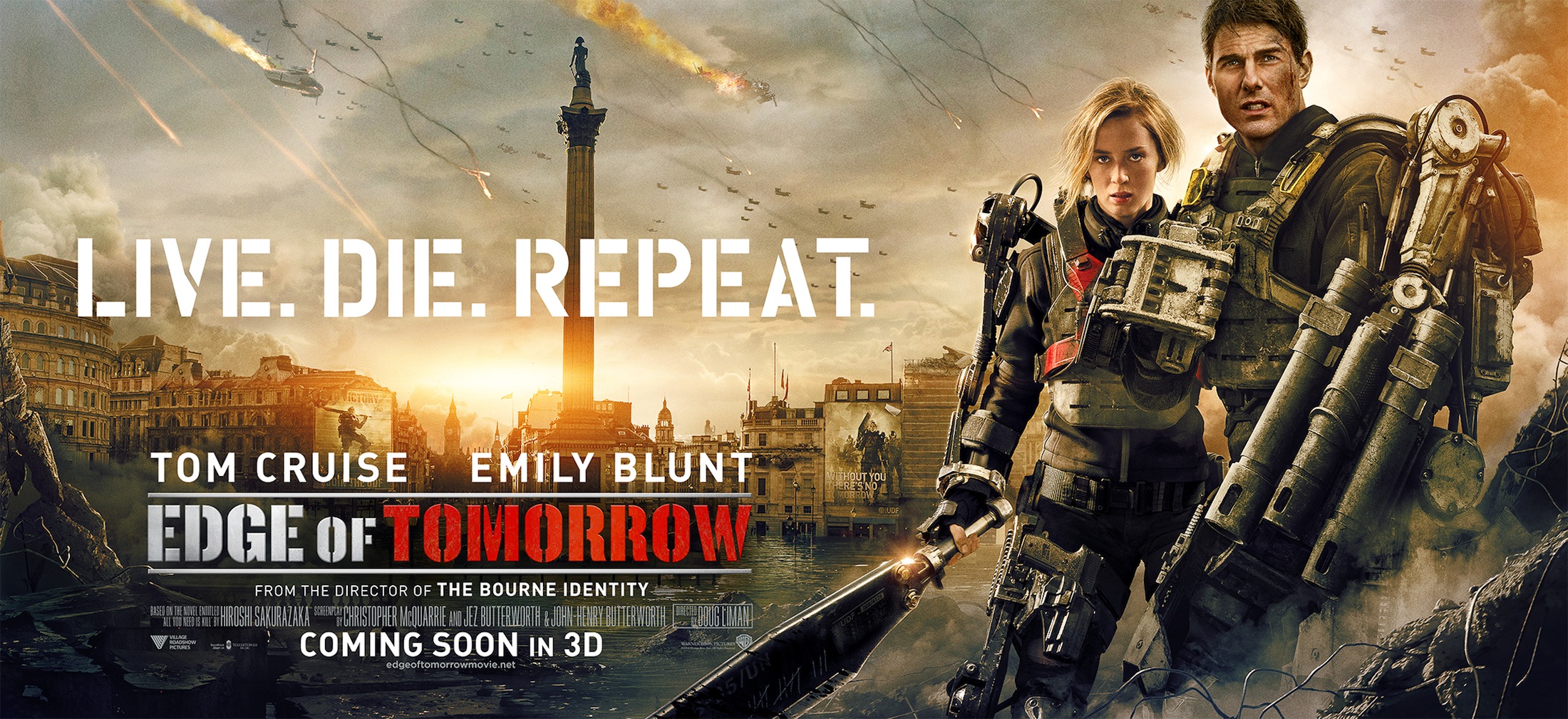
Edge of Tomorrow

D: Doug Liman / 113m

Cast: Tom Cruise, Emily Blunt, Brendan Gleeson, Bill Paxton, Noah Taylor, Kick Gurry, Jonas Armstrong, Charlotte Riley, Tony Way, Franz Drameh, Dragomir Mrsic, Masayoshi Haneda

Sometime in the near future, a meteor crashes to earth in Europe, bringing with it an alien race called Mimics.  The Mimics set about taking over the planet, swiftly conquering Europe, with the UK next in line.  Military forces under the command of General Brigham (Gleeson) are preparing for a full-scale counter attack on French soil.  When Lt. Col. Bill Cage (Cruise) arrives in London to continue the PR drive he’s orchestrated from the US, he’s shocked to find he’s expected to do so from the Front and will be going in with the first wave of the attack.  His attempts to avoid this end up with him being busted down to private and made to join J Squad, under the auspices of Master Sergeant Farell (Paxton).  With no combat training or experience, Cage has a crash course in using the exo-skeletons the military provides and finds himself in a troop carrier the very next morning.  The attack is ambushed by the Mimics; Cage survives for a few minutes before he’s confronted by an Alpha Mimic.  He manages to kill the Alpha, getting the alien’s blood on him in the process.  Instead of dying as well, Cage wakes up back at the base in the UK on the day before the attack and has to relive the exact same experience all over again.

Despite still getting killed again and again, Cage does learn to anticipate events on the battlefield.  When he saves the life of Sergeant Rita Vrataski, the military’s poster girl and with more Mimic kills than any other soldier, Vrataski is obviously shocked and tells him to find her when he wakes up.  When he does, Cage learns that what is happening to him happened to Vrataski but she lost the ability after receiving a blood transfusion.  He also learns that the reason the Mimics have been so successful in conquering Europe is due to their ability to reset time; they are a hive race controlled by what is described as an Omega creature, like a queen.  Thanks to the Alpha’s blood, Cage is linked to the aliens, and Vrataski sees a chance for them to be defeated, using their ability to reset time to anticipate their actions and change the outcome of the attack.  But Cage’s continuous efforts prove fruitless; no matter how hard he trains with Vrataski or memorises the details of what happens during the attack, he still dies.

When Dr Carter (Taylor) tells Cage and Vrataski they need to find and eliminate the Omega alien, they realise they have to get away from the battle and track it down.  This proves harder than expected, but eventually they trace the Omega to the sub-cellars of the Louvre.  With the aid of J Squad, Cage and Vrataski mount an attack on the alien hideout.

Edge of Tomorrow - scene

A mash-up of Groundhog Day (1993), D-Day the Sixth of June (1956) and Starship Troopers (1997), Edge of Tomorrow is by no means an original concept, but thanks to a whip-smart script by Christopher McQuarrie and Jez and John-Henry Butterworth, it’s easily one of the more enjoyable sci-fi movies of recent years.  There are some inconsistencies – it’s never made clear exactly why Cage is reliving the same day over and over again when the Omega appears to reset time only when necessary – but this is such a gung-ho ride that it doesn’t matter.  From the moment Cage tries to blackmail Brigham into getting out of going with the first wave (with Cruise’s cowardly efforts proving no match for Gleeson’s blank-faced indifference), Edge of Tomorrow sweeps up the viewer and doesn’t let them down until the movie’s satisfying, if slightly corny, ending.

A lot of this is down to Cruise and Blunt, who make a great team.  Cruise is in his element, all cocky charm and mega-wattage smile at the beginning, then increasingly serious as the movie progresses, his physicality predominant in the action scenes, and his generosity as an actor evident in his scenes with Blunt and the rest of the cast.  (Cruise may have his detractors but even they should find little to confirm their doubts about him here.)  It’s a well-rounded performance, giving Cruise a chance to display a variety of moods and emotions, some that rarely get a look in during big budget sci-fi spectaculars.  There are a couple of quiet moments where it’s just him and Blunt, and the warmth of those scenes makes their characters’ relationship all the more credible, and shows two actors elevating what could have been just a couple of moments where the movie slows down to take a breather.  Blunt is just as good, taking a straightforward, no-nonsense soldier and giving her an emotional strength that strikes a necessary balance with her obvious physical strength (and she must have had fun killing Cruise over and over again).  In addition, Blunt may not be everyone’s idea of a bad ass, but she’s very convincing, and if the casting director on the upcoming female Expendables movie is still looking for some cast members, well, they need to sign up Blunt right away.

As marshalled by a reinvigorated Liman – after the twin disappointments of Jumper (2008) and Fair Game (2010) – the production is handsomely mounted with some of the most effective use of London locations this side of 28 Days Later… (2002) (and those of us in the UK will know just how much was filmed on Saturday and Sunday mornings, as well as how under-developed Heathrow is).  The hardware is a credible mix of low-tech – the exo-skeletons still shoot live rounds – and high-tech – the troop carriers – while communications in London are still carried out largely by telephone (a nice touch), and the colour scheme is a steely blue/grey mix that suits the mood entirely.  The Mimics are mostly a rapid blur and all the more scary for it, and the replayed scenes are given enough of a visual spin – different camera angles, close ups etc. – that they never become tiresome.  There’s plenty of wry humour to be had, as well as a couple of laugh-out-loud moments on the battlefield that should feel incongruous but aren’t, and Cruise displays a knack for comic timing that might surprise some people.  The action sequences are inventive and  well-staged, and the special effects are impressive throughout.

What makes Edge of Tomorrow so effective in the long run though is its ability to take elements from various other movies and sources and meld them into an action-packed, exhilarating fun ride of a movie that is as broadly entertaining as any other big budget mainstream movie, and adds a generous dash of heart and soul to the mix as well.  It’s an accomplished piece of movie-making and an early highlight in a (so far) largely disappointing year.

Rating: 8/10 – a must-see on the big screen (and even better in IMAX 3D), Edge of Tomorrow has all the ingredients of a smart, self-aware movie designed to entertain at maximum levels; a couple of dodgy plot twists aside, this is exhilarating stuff and an almost perfect way to spend a couple of hours.


Share this:

  • Click to share on X (Opens in new window) X
  • Click to share on Facebook (Opens in new window) Facebook
  • More
  • Click to print (Opens in new window) Print
  • Click to email a link to a friend (Opens in new window) Email
Like Loading...

Killers from Space (1954)

25 Monday Nov 2013

Posted by dullwood68 in Movies

≈ Leave a comment

Tags

50's sci-fi movie, Alien threat, Aliens, Atom bomb, Drama, Peter Graves, Review, Sci-fi, Thriller, W. Lee Wilder

killers-from-space_39ecf069

D: W. Lee Wilder / 71m

Cast: Peter Graves, James Seay, Steve Pendleton, Frank Gerstle, John Frederick (as John Merrick), Barbara Bestar, Shepard Menken

Following an A-bomb test, scientist Dr Doug Martin (Graves) goes missing when the plane he was in collating data about the blast, crash lands, killing the pilot. A while later he returns to the base where he works overseeing the bomb tests. He can’t remember what has happened to him after the plane went into a nose-dive, or how he got a surgical scar on his chest that he didn’t have before. Given an initially clean bill-of-health by both the military – represented by Colonel Banks (Seay) and medic Major Clift (Menken), as well as FBI agent Briggs (Pendleton) – Martin is sent home with his wife, Ellen (Bestar) to recuperate. Instead, Martin becomes anxious about being able to work on the next bomb test, and attempts to get himself back on the team. Still considered a security risk by Colonel Banks and Briggs, Martin resorts to breaking into the safe where his colleague Dr Kruger (Gerstle) keeps the test data – well, he doesn’t exactly break in, as he knows the combination; as a perceived security risk, you’d have thought someone would have changed it straight away to avoid such a thing happening.

Martin then takes the information – on a scrap of paper, no less – out into the desert where he is surprised by Briggs. Following a short sequence where Martin tries to evade everyone looking for him, he is taken back to the base and given sodium amytal in an attempt to find out what happened to him after the plane crash. What Martin reveals is the presence of aliens on Earth, aliens with a plan to take over our planet, and who are hiding in the caves near the test site; they need the energy from the atomic tests to further their plans. Even after this, Martin isn’t believed. Can he save the day and thwart the aliens?

Killers from Space - scene

The answer is obvious; this is a 50’s sci-fi movie after all. And yes, it is as laughable as it sounds, and yes, the acting and the script and the direction and the photography and the sets and the dodgy rear projection and the aliens themselves – bug-eyed men who do become unsettling the more you look at them – all border on the dire, but Killers from Space, like the majority of 50’s sci-fi movies, plays everything straight, no matter how absurd or loony it looks and sounds. There’s no irony involved, no campy humour (such as began creeping in in the 60’s), and no attempt to make any more of its basic premise than it does. In short, it’s not aiming to be profound.

It’s fitfully entertaining, suffers from an extended sequence where Martin, trying to escape from the caves where the aliens are hiding out, encounters all manner of giant insects and lizards and tries to look suitably horrified (but fails), and has too many scenes that are stretched to ensure the movie doesn’t run at least fifteen minutes shorter (Martin, while hiding in his office until Kruger leaves, opens the door so many times to look out that you almost wish someone would see him, just to put an end to it all). As noted, the acting is borderline dire with only Pendleton and Graves showing any aptitude for the material, though not consistently. The ultra-low budget scuppers any attempt at making the movie look halfway professional, and Wilder’s direction proves that that his younger brother Billy definitely inherited the talent gene.

Rating: 3/10 – woeful, woeful, woeful, why fore art thou woeful? KIllers from Space wouldn’t have turned out quite so bad if anyone on the production side had had any idea of what they were doing; alas, they didn’t, and while Peter Graves and 50’s sci-fi completists should track it down, there’s nothing here for pretty much everyone else, even if you treat it as an unintentional comedy.

Share this:

  • Click to share on X (Opens in new window) X
  • Click to share on Facebook (Opens in new window) Facebook
  • More
  • Click to print (Opens in new window) Print
  • Click to email a link to a friend (Opens in new window) Email
Like Loading...

Zeta One (1969)

18 Monday Nov 2013

Posted by dullwood68 in Movies

≈ Leave a comment

Tags

Aliens, Angvians, Charles Hawtrey, Comedy, James Robertson Justice, Michael Cort, Nudity, Review, Sci-fi, Sexploitation, Spies, Zeta magazine

Zeta One

aka The Love Factor

D: Michael Cort / 84m

Cast: James Robertson Justice, Charles Hawtrey, Robin Hawdon, Yutte Stensgaard, Anna Gaël, Brigitte Skay, Dawn Addams, Wendy Lingham, Valerie Leon, Lionel Murton

Based on a story published in Zeta, a short-lived magazine from the 60’s that specialised in glamour/art photography, Zeta One concerns a race of women called the Angvians who live in a separate dimension to ours and kidnap women to ensure their race doesn’t die out. Secret agent James Word (Hawdon) is tasked with finding out where they come from, and to stop the nefarious Major Bourdon (Justice) and his henchman Swyne (Hawtrey) from succeeding with their own plans for the Angvians.

At this point I should mention that Zeta One is a sexploitation movie with sci-fi and spy movie trappings. So there’s plenty of partial and occasionally full-frontal nudity (though thankfully not involving either Justice or Hawtrey), and the kind of plot that involves nubile young women running around in next to nothing for no particular reason at all. There’s also a pantechnicon that serves as the device that enables trans-dimensional travel, a talking lift that won’t deposit anyone on the thirteenth floor because it’s superstitious, Angvian women who can kill by “shooting” with their hands, and Walter Sparrow as a strip club employee who repeats that all the girls inside are “lovely” and makes it look as if he got his lines mixed up.

The main storyline involves Bourdon trying to get a spy into the Angvians’ lair. He discovers that the Angvians’ next target is a stripper, Edwina Strain (Lingham). He kidnaps her first, gets her to swallow a tracking device (in pill form), then allows her to be kidnapped again (this time by the Angvians). The leader of the Angvians, Zeta (Addams), is aware of Bourdon’s game – though not the tracking device – and also the involvement of Word. She monitors everything and bides her time until one of her agents, Clotho (Gaël), is about to be killed by Bourdon. Then she instructs several barely clothed Angvians to eliminate Bourdon and his henchmen.

Zeta One - scene

Zeta One was obviously a low-budget movie (there certainly wasn’t much spent on wardrobe), and the deficiencies of such a shoot are there to see on screen. Seen now, over forty years after it was first shown, it has a fascinating my-god-did-they-really-do-that quality. Hawdon spends most of his screen time in bed with either Stensgaard or Gaël, and turns up at Bourdon’s base of operations after Bourdon’s been defeated (and only after he’s put on some waders!). Justice and Hawtrey look embarrassed and non-plussed respectively, while Addams does the least she can in each scene she’s in. Why any of them are in the movie is a good question.

So the movie itself is cheesy, not even remotely prurient, and while there is a lot of female flesh on display these aren’t supermodels we’re talking about.  It’s also slow in parts, notably at the beginning, and Michael Cort’s direction is hit-and-miss, the same as his script (he co-wrote it with Alistair MacKenzie), and the locations are underused. And yet… there are still things to enjoy, or that resonate. There’s the aforementioned lift, which comes completely out of left field; Word vs a revolving door; Hawtrey peering out of a phone box; Justice being kneed in the balls by Gaël and calling her a “little bitch”; the strip poker game that neither Hawdon or Stensgaard can win; and most disturbingly, the sight of Justice and Hawtrey standing over a topless Angvian who’s tied to a rack. On reflection it’s these little moments that make watching the movie worthwhile.

Rating: 5/10 – better perhaps than it should be and only because of its quirkiness (which I’m still not sure was entirely deliberate).

Originally posted on thedullwoodexperiment website.

Share this:

  • Click to share on X (Opens in new window) X
  • Click to share on Facebook (Opens in new window) Facebook
  • More
  • Click to print (Opens in new window) Print
  • Click to email a link to a friend (Opens in new window) Email
Like Loading...

Mojave Phone Booth (2006)

01 Friday Nov 2013

Posted by dullwood68 in Movies

≈ Leave a comment

Tags

Aliens, Annabeth Gish, Drama, Greta, Indie film, John Putch, Mojave Desert, Mojave Phone Booth, Relationships, Review, Steve Guttenberg

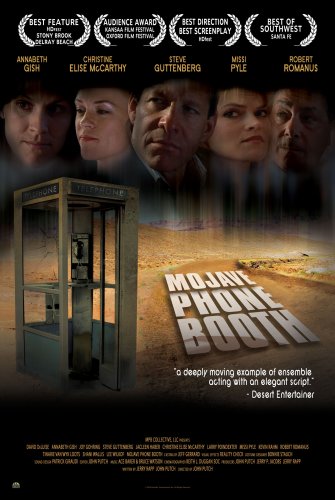
Mojave Phone Booth

D: John Putch / 88m

Cast: Annabeth Gish, Christine Elise, Tinarie van Wyk Loots, Robert Romanus, Steve Guttenberg, Missi Pyle, Joy Gohring, David DeLuise, Jacleen Haber, Kevin Rahm, Larry Poindexter, Shani Wallis

Based around a real phone booth that was situated in the Mojave desert and which people would call in the hope that someone would answer, Mojave Phone Booth tells four stories set in and around Las Vegas. The first concerns Beth (Gish). Beth is in a relationship she is having trouble committing to; she’s also overly curious about all the audio tape that litters the area; she can’t help but wonder why these tapes have been discarded, and what may be on them. The second story concerns Mary (Loots). Mary is in financial trouble. When she gets fired she goes to stay with her friend Rachel (Haber). Rachel offers her a chance to make some money and get herself out of trouble. But there’s a catch…

The third story concerns Alex (Elise). Alex is in a relationship with Glory (Gohring), but Glory is convinced she is being persecuted by aliens. When she meets Michael (DeLuise), online and he tells her he can help her, Alex and Glory’s relationship is put under further strain. The last story concerns Richard (Romanus). Richard’s marriage has broken down. He tries desperately to win back his wife Sarah (Pyle) by compiling a videotape of what he believes are happy moments in their marriage, and showing it to her. All four main characters use the titular phone booth to speak to the mysterious Greta (Wallis).

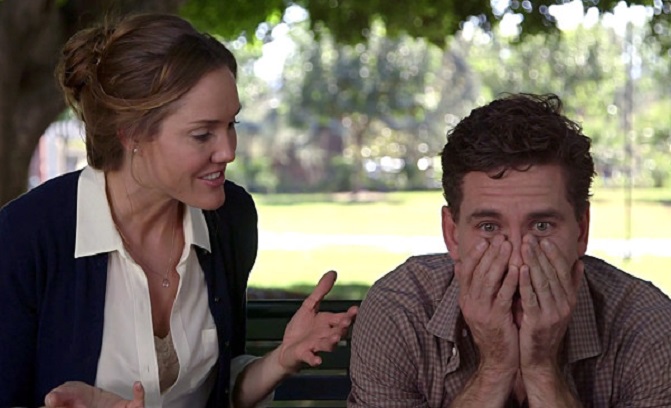
Mojave Phone Booth - scene

Mojave Phone Booth begins slowly, with Beth’s story appearing somewhat elliptical.  Her relationship with Tim (Rahm) revolves around his wanting Beth to move in with him, but Beth is unsure if she should. There’s an understated reluctance by Beth to engage with Tim on an emotional level, and Gish plays her with an instinctive fragility of character. Mary’s story is more straightforward. She is struggling to get by and wants to get into real estate. When Rachel offers her a way of overcoming her problems, a way that involves both women sleeping with businessman Barry (Guttenberg), the internal struggle that results is credibly portrayed. Loots gives a fine performance, imbuing Mary with a toughness that belies the character’s vulnerability.

The story of Alex and Glory is the lightest in tone, with its alien parasite conceit, and the growing certainty that Michael isn’t all he seems. Elise and Gohring both put in good performances, and there’s a connection between the two actresses that helps their on-screen relationship tremendously. Lastly, Richard’s story is the darkest, his descent into post-marital depression both pathetic and affecting in equal measure. Romanus matches his female co-stars for quality, while Pyle makes the most of her brief screen time.

The stories are the key here, and the movie’s running time helps ensure that none outstay their welcome. They’re all made entirely believable by the sharpness of the script by director Putch and co-writer Jerry Rapp. The characters’ emotional lives are well-drawn and depicted, and the sporadic inclusions of humour ensure the drama doesn’t overwhelm the narrative. The performances are exemplary, with special mentions going to Gish and Romanus. Mojave Phone Booth is an indie treat – by turns intelligent, funny, thought-provoking, and absorbing from start to finish.

Rating: 8/10 – deserving of a wider audience, Mojave Phone Booth works on several levels and makes it all look easy; it’s a bona fide gem.

Originally posted on thedullwoodexperiment website.

Share this:

  • Click to share on X (Opens in new window) X
  • Click to share on Facebook (Opens in new window) Facebook
  • More
  • Click to print (Opens in new window) Print
  • Click to email a link to a friend (Opens in new window) Email
Like Loading...

Blog Stats

  • 456,974 hits

Recent Posts

  • 10 Reasons to Remember Bibi Andersson (1935-2019)
  • Fantasia (1940)
  • Dances With Wolves (1990) – The Special Edition
  • Kiss of the Spider Woman (1985)
  • The Three Musketeers (1973)

Top Posts & Pages

  • Lost for Life (2013) - Another Look
    Lost for Life (2013) - Another Look
  • Unbroken (2014)
    Unbroken (2014)
  • The Wall (2017)
    The Wall (2017)
  • Too Late (2015)
    Too Late (2015)
  • In the Blood (2014)
    In the Blood (2014)
  • Mini-Review: The Good Dinosaur (2015)
    Mini-Review: The Good Dinosaur (2015)
  • Legend (2015)
    Legend (2015)
  • Rakka (2017)
    Rakka (2017)
  • Momentum (2015)
    Momentum (2015)
  • Inside Llewyn Davis (2013)
    Inside Llewyn Davis (2013)
Follow thedullwoodexperiment on WordPress.com

Blogs I Follow

  • Rubbish Talk
  • Film 4 Fan
  • Fast Film Reviews
  • The Film Blog
  • All Things Movies UK
  • Interpreting the Stars
  • Let's Go To The Movies
  • Movie Reviews 101
  • TMI News
  • Dan the Man's Movie Reviews
  • Film History
  • Jordan and Eddie (The Movie Guys)

Archives

  • April 2019 (13)
  • March 2019 (28)
  • February 2019 (28)
  • January 2019 (32)
  • December 2018 (28)
  • November 2018 (30)
  • October 2018 (29)
  • September 2018 (29)
  • August 2018 (29)
  • July 2018 (30)
  • June 2018 (28)
  • May 2018 (24)
  • April 2018 (21)
  • March 2018 (31)
  • February 2018 (25)
  • January 2018 (30)
  • December 2017 (30)
  • November 2017 (27)
  • October 2017 (27)
  • September 2017 (26)
  • August 2017 (32)
  • July 2017 (32)
  • June 2017 (30)
  • May 2017 (29)
  • April 2017 (29)
  • March 2017 (30)
  • February 2017 (27)
  • January 2017 (32)
  • December 2016 (30)
  • November 2016 (28)
  • October 2016 (30)
  • September 2016 (27)
  • August 2016 (30)
  • July 2016 (30)
  • June 2016 (31)
  • May 2016 (34)
  • April 2016 (30)
  • March 2016 (30)
  • February 2016 (28)
  • January 2016 (35)
  • December 2015 (34)
  • November 2015 (31)
  • October 2015 (31)
  • September 2015 (34)
  • August 2015 (31)
  • July 2015 (33)
  • June 2015 (12)
  • May 2015 (31)
  • April 2015 (32)
  • March 2015 (30)
  • February 2015 (37)
  • January 2015 (39)
  • December 2014 (34)
  • November 2014 (34)
  • October 2014 (36)
  • September 2014 (25)
  • August 2014 (29)
  • July 2014 (29)
  • June 2014 (28)
  • May 2014 (23)
  • April 2014 (21)
  • March 2014 (42)
  • February 2014 (38)
  • January 2014 (29)
  • December 2013 (28)
  • November 2013 (34)
  • October 2013 (4)

Create a free website or blog at WordPress.com.

Rubbish Talk

Film 4 Fan

A Movie Blog

Fast Film Reviews

The Film Blog

The official blog of everything in film

All Things Movies UK

Movie Reviews and Original Articles

Interpreting the Stars

Dave Examines Movies

Let's Go To The Movies

Film and Theatre Lover!

Movie Reviews 101

Daily Movie Reviews

TMI News

Latest weather, crime and breaking news

Dan the Man's Movie Reviews

All my aimless thoughts, ideas, and ramblings, all packed into one site!

Film History

Telling the story of film

Jordan and Eddie (The Movie Guys)

Movie Reviews & Ramblings from an Australian Based Film Fan

Privacy & Cookies: This site uses cookies. By continuing to use this website, you agree to their use.
To find out more, including how to control cookies, see here: Cookie Policy
  • Subscribe Subscribed
    • thedullwoodexperiment
    • Join 481 other subscribers
    • Already have a WordPress.com account? Log in now.
    • thedullwoodexperiment
    • Subscribe Subscribed
    • Sign up
    • Log in
    • Report this content
    • View site in Reader
    • Manage subscriptions
    • Collapse this bar
 

Loading Comments...
 

    %d