• 10 Reasons to Remember…
  • A Brief Word About…
  • About
  • For One Week Only
  • Happy Birthday
  • Monthly Roundup
  • Old-Time Crime
  • Other Posts
  • Poster of the Week
  • Question of the Week
  • Reviews
  • Trailers

thedullwoodexperiment

~ Viewing movies in a different light

thedullwoodexperiment

Tag Archives: American Civil War

Jane Got a Gun (2015)

19 Saturday Mar 2016

Posted by dullwood68 in Movies

≈ Leave a comment

Tags

American Civil War, Drama, Ewan McGregor, Gavin O'Connor, Joel Edgerton, Natalie Portman, Production problems, Review, The Bishop Gang, Western
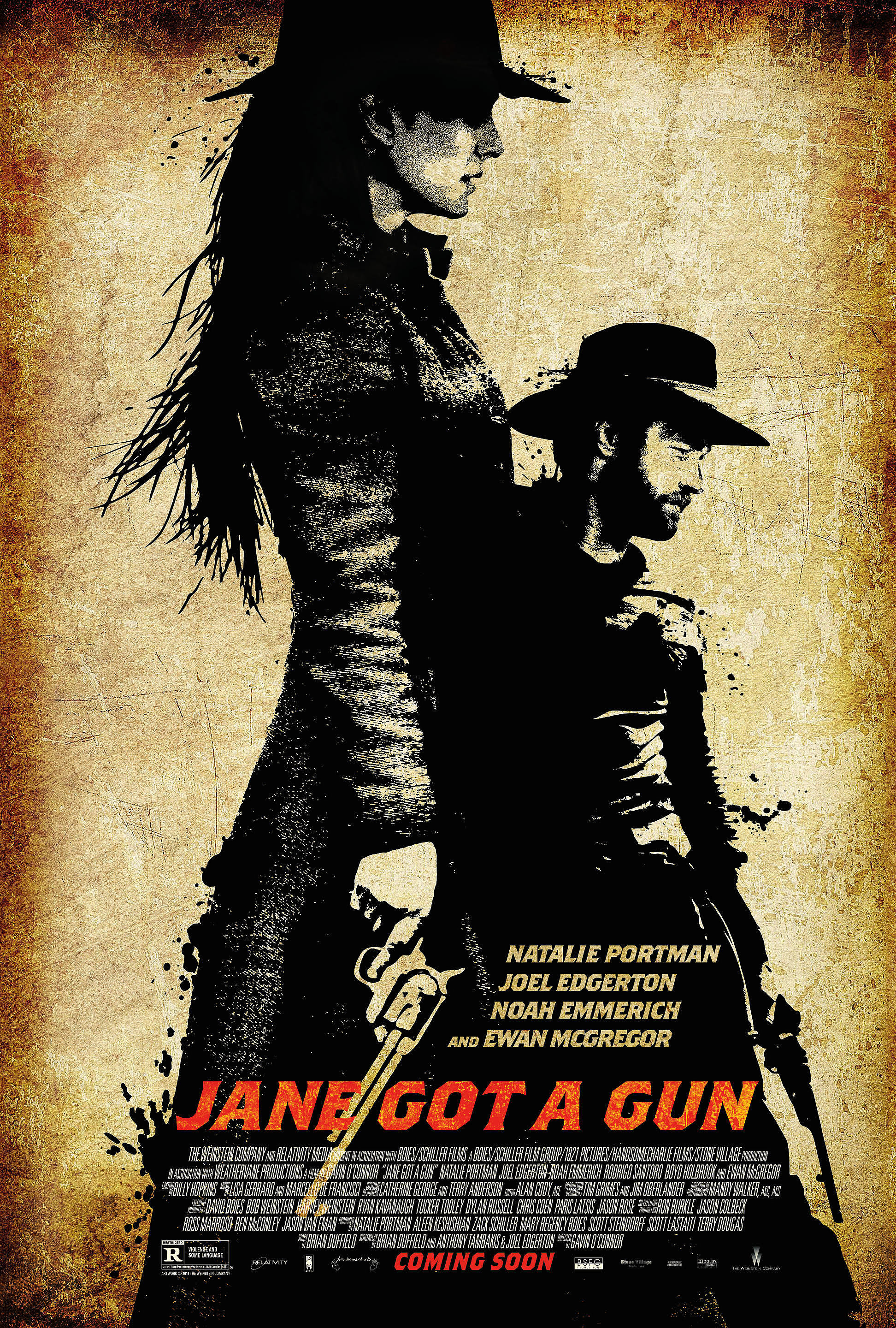
Jane Got a Gun

D: Gavin O’Connor / 98m

Cast: Natalie Portman, Joel Edgerton, Ewan McGregor, Noah Emmerich, Rodrigo Santoro, Boyd Holbrook

Since its announcement back in 2012, Jane Got a Gun has had a difficult production history. Lynne Ramsay was the movie’s original director, but with a week to go before actual filming began, disagreements with the producers caused her to leave the project. Natalie Portman remained attached to the project, while her male co-stars changed almost as quickly as they were announced. Michael Fassbender was cast as Jane’s ex-lover, Dan Frost, but had to drop out thanks to scheduling conflicts with X-Men: Days of Future Past (2014). Joel Edgerton, originally cast as the movie’s villain, John Bishop, was recast as Frost. And to take over the vacated role of Bishop, Jude Law was brought on board. However, Law had only signed on because Ramsay was directing; when she left the production, so did Law. Next up as Bishop was Bradley Cooper, but scheduling conflicts would again rob the movie of one of its stars, as the actor was needed on American Hustle (2013) (thank God Ewan McGregor wasn’t too busy).

The script also underwent a rewrite. Brian Duffield’s original screenplay, which had appeared on the 2011 Blacklist, was given an overhaul by Anthony Tambakis and Edgerton, and just in case the changes in acting personnel weren’t enough, first choice DoP Darius Khondji left the project along with Ramsay and was replaced by Mandy Walker. With Gavin O’Connor on board as the movie’s new director, the New Mexico shoot went off relatively smoothly, and a mid-2014 release was pencilled in. But this was pushed back to early 2015, and then delayed again until September. A further delay saw the world premiere arranged for 16 November in Paris, but the terrorist attacks that occurred three days before caused the premiere to be postponed. And to add insult to injury, when the movie was finally released in the US by the Weinstein Company it proved to be the worst wide release in the company’s history.
JGAG - scene1

But what of the movie itself? Is its tortured production and release history reflected in the quality of the movie, or has it managed to overcome all the setbacks that waylaid it over the course of three years? The answer – unsurprisingly – is yes and no. Even if you’re not aware of the movie’s history, watching it will soon give the impression that something’s not quite right, that there’s something missing, something that went astray during filming. And it won’t take the interested viewer long to realise that part of that “something” is cohesion.

Jane Got a Gun takes a non-linear approach to its narrative, offering flashbacks at every opportunity in order to fill in its back story and explain its characters’ motives. While it’s not the first movie to adopt this strategy, it is one that makes a particularly awkward fist of it. And it does so in such a piecemeal fashion that it’s hard to work out if it was a deliberate decision by Tambakis and Edgerton, or was present in Duffield’s original script. Either way, the narrative lacks momentum and comes across as unavoidably fractured. The basic story – frontier wife seeks ex-lover’s help when the gang her husband double-crossed comes looking for them – is strong enough to withstand too much tampering, but here the back story of Jane and Dan just gets in the way. A more straighforward storyline would have benefitted the movie greatly, and maybe there’s another cut of the movie out there somewhere where that approach has been adopted, but otherwise, Jane Got a Gun too often lacks focus in the time it takes for Bishop and his gang to reach Jane’s home.
JGAG - scene2

The movie also struggles with the quality of its dialogue. Some viewers might be convinced that Brian Duffield is a pseudonym for George Lucas, such is the arch, clichéd nature of some of the lines (or that Tambakis and Edgerton shouldn’t be allowed to collaborate on a script ever again) and there are too many moments where the by now trapped viewer will be wincing at some of the utterances that were allowed to stay in place. Whether or not anyone noticed seems irrelevant now given the whole raft of other problems the movie had to deal with, but sometimes the dialogue is so clunky and uninspired that anyone watching will wonder if it had to be that bad.

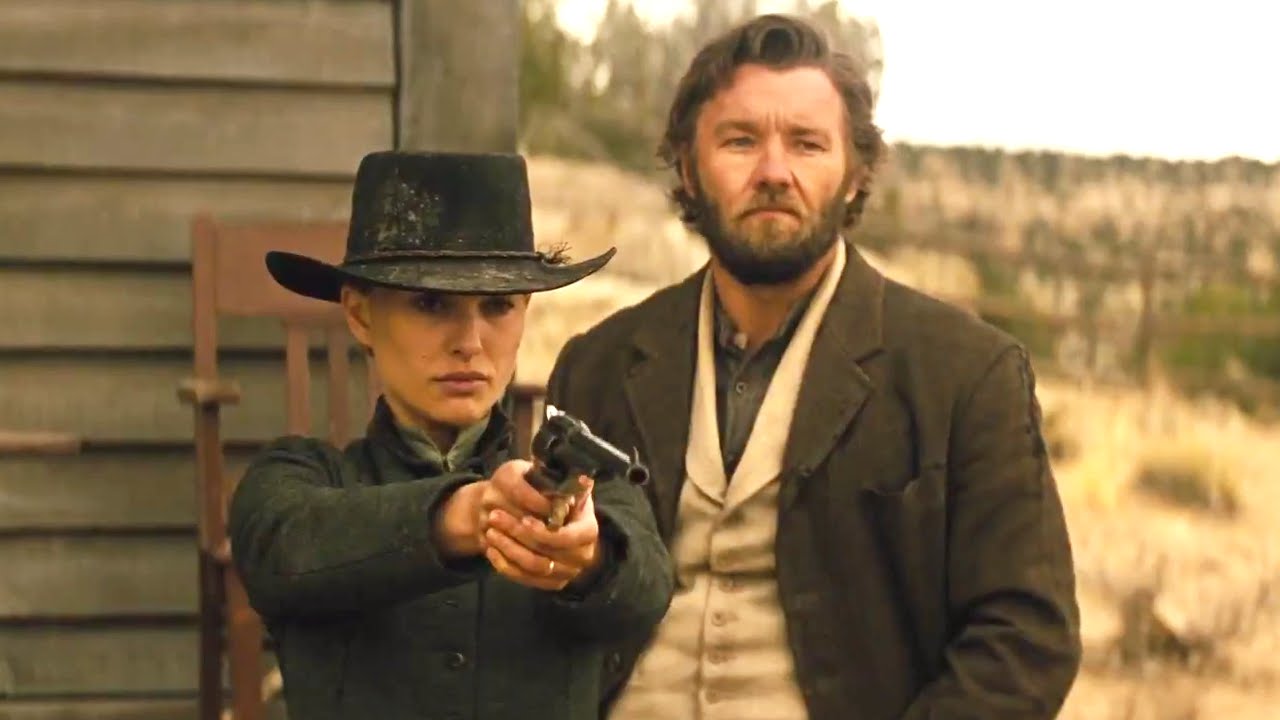
Thankfully, though, the movie isn’t that bad all the way through. As the beleaguered and heavily put upon Jane of the title, Portman maintains a stoicism and a sense of her rightful place (by her husband) that when Frost’s past relationship with her becomes clearer, along with the undercurrents that bind them together, these aspects give the movie an emotional depth that is pleasantly surprising (and welcome). Portman also knows when to rely on her passivity to speak volumes for the character, as in the early scenes where Jane’s pride is put aside due to the necessity of speaking to Frost. For his part, Edgerton matches Portman for moody introspection, paring Frost down emotionally and physically, letting his injured feelings seep out through the looks and glances he gives Jane. Together, Jane and Frost make for an affecting couple, both tied down by the bad decisions that each has made, and Portman and Edgerton both show the limiting effects those decisions have had, and the overwhelming sense of regret that comes with them.

JGAG - scene3

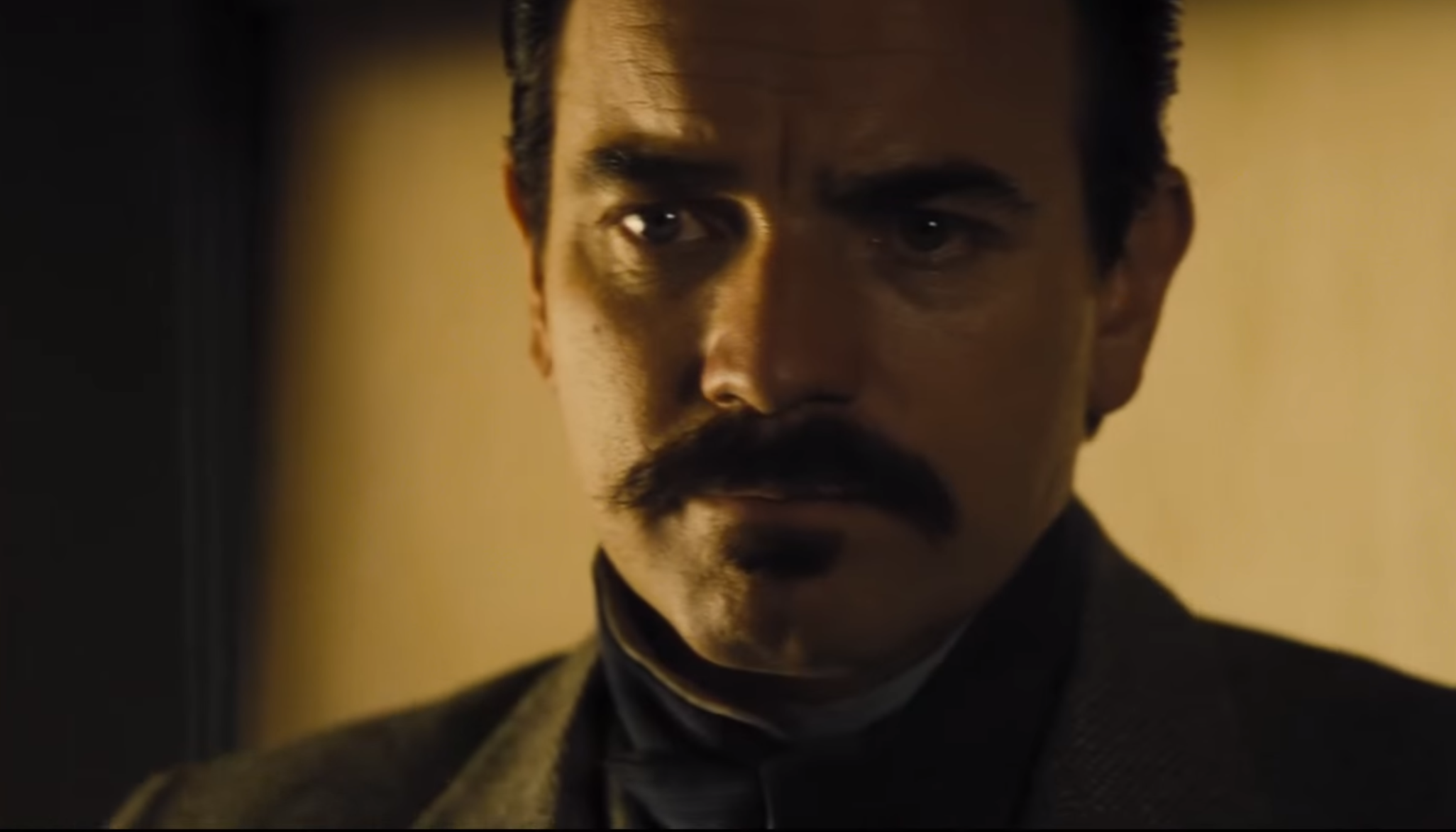
As the villainous trail boss and outlaw Bishop, McGregor has a hard time making him less unctuous and more intimidating than the character appears at first, and he’s not helped by the kind of moustache that cries out to be twirled (while he makes mwah-hah-hah sounds). Emmerich’s role is fleshed out by the flashbacks, and there are efficient turns in minor roles from Santoro and Holbrook, otherwise it’s all Portman and Edgerton, one decision the script gets right all along. There’s a fiery showdown that is let down slightly by the same shot being included twice, and a twist in the tale that facilitates a happy ending the movie didn’t really need, but all in all the tone and the pacing allow the movie to breathe when it needs to, and gives the viewer the chance to appreciate the movie’s better qualities, buried as they are beneath some of the less effective narrative decisions.

In addition it’s beautifully shot by Walker, and the editing by Alan Cody, who did some excellent work on the mini-series The Pacific (2010), matches the laconic, melancholy mood so perfectly at times that, again, you wish the script had been tighter. O’Connor doesn’t give the audience anything too spectacular or impressive to look at – what Ramsay would have made of the material remains a tantalising prospect – but he does keep a firm rein on proceedings and doesn’t make the mistake of including too many obvious directorial flourishes (though there are a few too many moments where the action is seen through a window or is distorted by glass). Backed up by a low-key yet expressive score from Lisa Gerrard and Marcello De Francisci, Jane Got a Gun may not be a movie that has overcome its troubled production history entirely, but it does get more things right than wrong.

Rating: 6/10 – good Westerns are hard to find these days, and while Jane Got a Gun suffers from a lack of cohesion in its story elements, it still contains enough good material to be worth watching; with good performances from Portman and Edgerton to help things along, this is one movie that deserves to be known for something more than the difficulties it faced in getting made.

Share this:

  • Click to share on X (Opens in new window) X
  • Click to share on Facebook (Opens in new window) Facebook
  • More
  • Click to print (Opens in new window) Print
  • Click to email a link to a friend (Opens in new window) Email
Like Loading...

The World Made Straight (2015)

06 Friday Feb 2015

Posted by dullwood68 in Movies

≈ 1 Comment

Tags

Adelaide Clemens, American Civil War, David Burris, Drama, Drugs, Jeremy Irvine, Minka Kelly, Noah Wyle, North Carolina, Review, Shelton Laurel Massacre, Steve Earle, Thriller

World Made Straight, The

D: David Burris / 119m

Cast: Noah Wyle, Jeremy Irvine, Minka Kelly, Adelaide Clemens, Steve Earle, Marcus Hester, Haley Joel Osment, Alex Van, Robin Mullins

North Carolina, the early Seventies. Travis Shelton (Irvine) is seventeen and without much of a future ahead of him. He’s a high school dropout, can’t hold down a job, and spends most of his time hanging out with his friends. When he discovers some marijuana plants growing in back of a property in the woods, he takes a few and sells them to local small-time drug dealer, Leonard Shuler (Wyle). When he goes back to get some more he steps into a bear trap and passes out. When he comes to he finds himself confronted by Carlton Toomey (Earle) and his son Hubert (Hester), the owners of the marijuana plants and the area’s most prominent – and feared – drug dealers. Toomey strikes a bargain with Travis: in return for his silence about the plants, they’ll take him to the nearest hospital. Travis agrees.

While he recovers at the hospital Travis meets Lori (Clemens), a nurse he was in school with. They begin a tentative relationship that continues once he’s allowed home… which proves to be out of bounds, due to an argument Travis had with his father (Van) before his accident. With nowhere else to go, Travis persuades Leonard to let him stay with him for a while. His stay isn’t appreciated by Leonard’s girlfriend, Dena (Kelly), but he and Leonard form an unlikely friendship, with Leonard’s interest in local Civil War history, in particular the Shelton Laurel massacre, piquing Travis’s enthusiasm. As he delves deeper into what happened during the massacre he learns that several of his ancestors were killed there, including a thirteen year old called David Shelton.

He and Leonard visit the site and discover a pair of glasses that might have belonged to David. Dena becomes increasingly annoyed at Travis’s presence; one night while they’re all at a carnival, she disappears. Later on at Leonard’s she returns, accompanied by Toomey, to collect her things. Much later, Travis and two of his friends go to Toomey’s to score some drugs; there he discovers that Dena has been forced into letting men have sex with her to settle a debt Toomey says he owes her. Travis returns to free her, and he takes her to Leonard. Knowing that Toomey will come looking for her, he tells them to make a run for it. And sure enough, shortly after they leave, Toomey arrives looking for restitution.

World Made Straight, The - scene

The second screen adaptation of a novel by author Ron Rash in four months – the other being Serena (2014) – The World Made Straight is a meditation on the prolonged effects of the past on the present. It highlights the ways in which past events can influence the behaviour of people even a hundred years after they’ve happened, and emphasises the toll such an influence can have.

In Travis we have a main character who – surprisingly, given the nature of his Appalachian heritage – is unaware of the massacre and his family’s unfortunate involvement. But this is a journey of discovery, one that takes Travis away from his cloistered home life and into a world where he struggles even further to make any headway. His unexpected friendship with Leonard (who helps him pass his GED test) and his romance with Lori both point to a brighter future, but his increasing obsession with the massacre and his family’s history keeps holding him back, his need to know what happened there and why stopping him from moving forward. Irvine plays him with a swagger he hasn’t earned yet, and keeps Travis from becoming too irritating because of the mistakes he makes. It’s a rough and ready performance, in keeping with the character, and allows for a depth of feeling that pays off when Travis and Leonard visit the massacres site.

He’s not the only one haunted by the past, though. Leonard is a small-time drug dealer who was once a schoolteacher. He lost his job when a student he’d caught cheating on a test and failed, hid some drugs in his car. There’s an irony in his current “career path” and it’s not lost on him. His fascination with the past is seen as a by-product of this turn of events, as if by seeking answers to the events of the past he can find answers to his own predicament. Through Travis, Leonard is hoping to make some small amends for the way in which his life has taken a wrong turn, and for the way in which he let it happen. Wyle gives a quietly compelling performance, making Leonard’s sadness with his life all the more effective due to the losses he’s suffered. He has some difficult choices to make at the end, and while one of them seems designed more to provoke the eventual denouement, he still makes it work – just.

Sadly, while Travis and Leonard are characters given the room to live and breathe within the movie’s narrative, the same can’t be said for Dena and Lori. Dena’s drug addiction makes her manipulative and self-absorbed, almost a caricature, particularly when she attempts to seduce Travis. Lori is the wholesome alternative to Dena, her fresh-faced appearance and blonde locks the opposite of Dena’s sallow complexion and lifeless hair. Kelly struggles to make more of Dena than the script will allow, and Clemens is hamstrung by Lori’s less than consistent presence in the narrative (she’s a glimpse of what Travis could have, but little more). However, the movie does have one performance that is authoritative and commanding, and that’s provided by the singer Steve Earle, whose portrayal of Toomey is soft spoken, low-key and infinitely more menacing as a result.

Shane Danielsen’s script leaves some plot lines dangling – at one point, Dena tells Travis that Leonard is his kin even though he has a different name and family background – and just why Travis becomes so enthralled by the massacre and its connection to his family is never really explained (or explored). Also, the relationship between Leonard and Dena creates its own problem as it’s difficult to work out why he’d be with her. And the ending, while not entirely unexpected, is arrived at by a series of convoluted changes of character but remains surprisingly satisfying.

World Made Straight, The -scene2

Making his feature debut, Burris directs things with one eye on the performances and one eye on the beautiful North Carolina countryside. Thanks to some stunning compositions, Burris and DoP Tim Orr make the movie a pleasure to watch, even if there’s an often wintry feel to the locations used, and there are several shots of a river that acts as a metaphor for the passage of time. It all makes the movie look more impressive than it is, but it’s not for want of trying. Burris has a good feel for the subject matter but can’t overcome the deficiencies in Danielsen’s script, and while the sense of history weighing down on the present is occasionally overdone, it doesn’t detract from the fact that, as debuts go, this is a pretty good start.

Rating: 7/10 – slow paced and not fully realised, The World Made Straight is still an auspicious debut from Burris, and lingers in the memory; worth seeing for Earle’s cobra-like performance and an atmosphere that builds to a conclusion that is both febrile and understated.

Share this:

  • Click to share on X (Opens in new window) X
  • Click to share on Facebook (Opens in new window) Facebook
  • More
  • Click to print (Opens in new window) Print
  • Click to email a link to a friend (Opens in new window) Email
Like Loading...

My Top 10 Movies – Part Nine

18 Tuesday Feb 2014

Posted by dullwood68 in Movies

≈ Leave a comment

Tags

American Civil War, Buster Keaton, Clyde Bruckman, Comedy, Kevin Brownlow, Marion Mack, National Film Theatre, Review, Silent film, The General (1926)

The General (1926)

General, The

D: Clyde Bruckman, Buster Keaton / 75m

Cast: Buster Keaton, Marion Mack, Glen Cavender, Jim Farley, Frederick Vroom, Charles Henry Smith, Frank Barnes

A lot of my earliest movie memories are of watching silent comedians such as Charlie Chaplin, Roscoe “Fatty” Arbuckle, Harold Lloyd, and Laurel and Hardy.  When I was growing up, their movies  were a major part of the programming during the mornings on the UK’s BBC 2 channel, along with the Flash Gordon serials, Tarzan movies, and later, Charlie Chan features.  Silent short films were often included in the schedules as filler, but for me they were more welcome than most of the feature length, talking pictures that were shown.  The Tarzan movies starring Johnny Weissmuller seemed interchangeable after a while, and when Andy Hardy and Dr. Kildare entered the fray, their small-town dramatics quickly felt repetitive.  No, it was Chaplin et al. who were my preferred choice, and I did my best to make sure I didn’t miss any that were shown (this was before the advent of video).

At first, it was the antics of Laurel and Hardy that I liked most.  Then, I saw a short called The Haunted House (1921), followed (a few days later) by One Week (1920).  Now I was asking myself, Who is this Buster Keaton?  (And why don’t the BBC show more of his movies?)  I kept checking the schedules for any more Keaton movies, eventually seeing only a half dozen or so more.  It was frustrating, especially as I now knew he’d made feature length movies as well; where were they when a budding cineaste needed them?

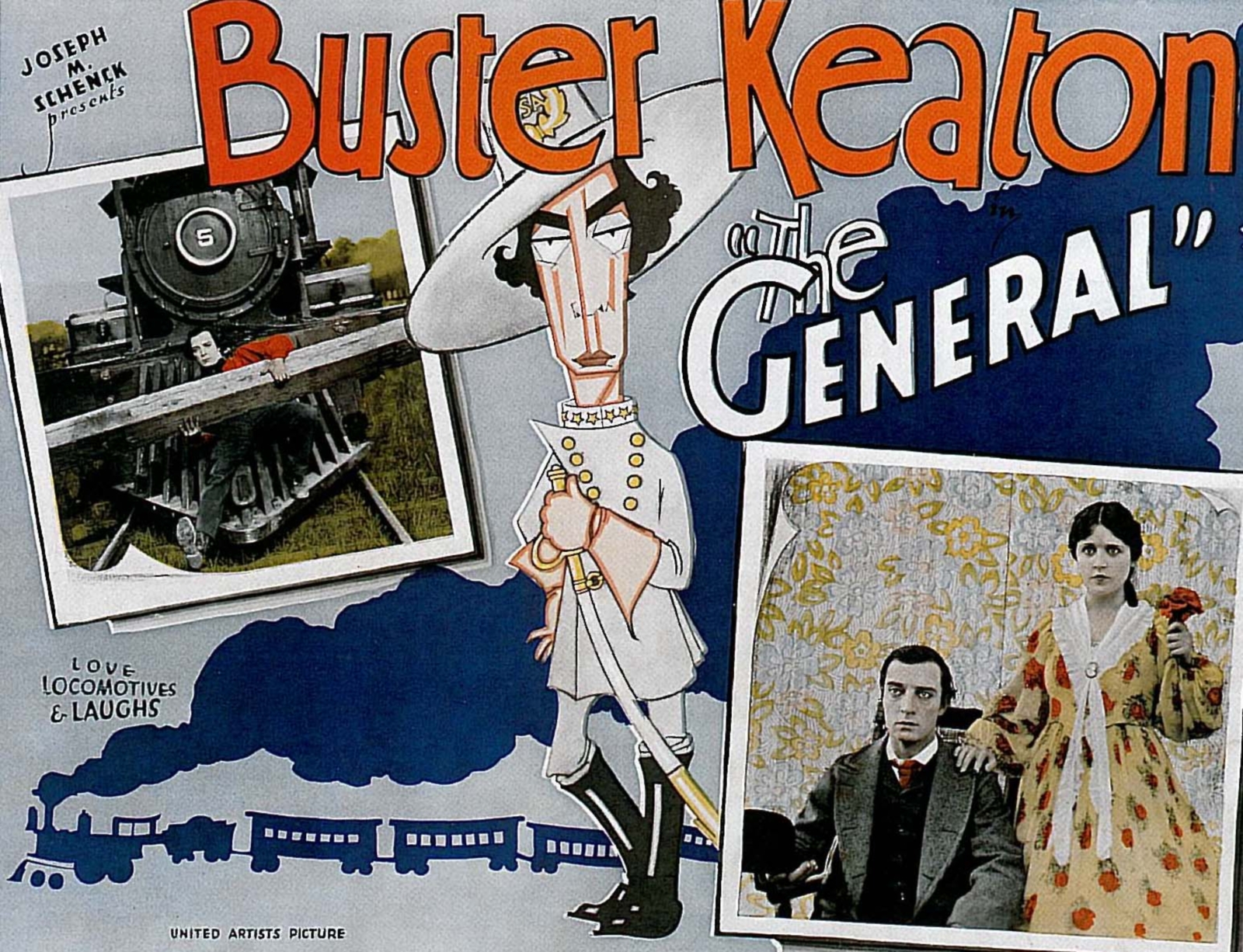
Here my memory becomes a little less reliable.  I know that College (1927) was the first of his features that I saw, but when The General came along, that moment is lost in the mists of early onset Alzheimers.  But it was a pivotal moment, because like the true aficionado of silent film that I believed I was – I wasn’t Kevin Brownlow, but as a self-taught teenager, I didn’t think I was doing too badly – when I saw The General I knew I was watching Keaton’s masterpiece, the movie he will always be remembered for above all his other movies.

General, The - scene

What I liked straight away was the level of detail, the lengths that Keaton and his co-director, the (for me) much underrated Clyde Bruckman had gone to in order to recreate the American Civil War, and to re-enact a famous event from that period.  So often comedy exists in its own little “bubble”, a place where a joke or a gag can have the most effect.  But here, Keaton uses the War as the grounding for all the jokes to come, all the visual gags and physical stunts, so that when you’re watching them they don’t seem as far-fetched as they would do if they were presented purely by themselves.  For me, there will never be a greater physical stunt/gag than when he sits on the train’s cowcatcher and flips railroad ties out of the way of the approaching General; knowing this was done for real with no camera trickery involved just makes it all the more impressive (and frightening if it had gone wrong).

There’s a subtlety to The General, as well, a sense that Keaton was aiming higher by making the comic elements arise organically from the overall mise-en-scène, along with the romantic and action elements.  Having taken an event from the War that a lot of people would either still remember or be well aware of, he takes what was, ultimately, a tragic tale, and elevates it.  In the process he provides us with an uplifting, surprisingly emotional experience that makes us laugh and urge him on, and it’s all done with a seeming effortlessness that we know can’t have been the case.  And I don’t think Keaton’s stoic features have ever been used to better effect than here.  He’s often accused of being expressionless, but in The General you’re never in any doubt as to how he’s feeling, or what he’s thinking.  Again, it’s the subtlety that makes this so fascinating to watch.

A few years ago, I took a friend to see The General at London’s National Film Theatre. It was having what they like to call an Extended Run, playing several times a day for around six weeks.  My friend has a passion for movies but he’s very much a “modern day” moviegoer; he likes the sturm und drang of today’s multiplex fare.  With this in mind I thought it would be a great idea to take him to see The General.  He had some reservations, not least because it was a silent movie, but because it was so far out of his comfort zone (even the fact that it was “only” seventy-five minutes long didn’t entirely persuade him he would be fine).  And while we waited for the movie to start he was visibly nervous (I wish I’d been able to video this).  When the movie ended, he turned to me and said, “That was incredible.  I can’t believe how incredible that was.”  Vindicated, and feeling on top of the world for seeing the movie for the first time on the big screen, I couldn’t help but feel that here was the true strength of Keaton’s masterpiece: that it can captivate and envelop anyone who comes to it.

Rating: 9/10 – not just a comedy, The General works on so many levels it’s almost embarrassing; one of the finest silent movies ever made, and as breathtaking today for its perfection as it was back in 1926.

Share this:

  • Click to share on X (Opens in new window) X
  • Click to share on Facebook (Opens in new window) Facebook
  • More
  • Click to print (Opens in new window) Print
  • Click to email a link to a friend (Opens in new window) Email
Like Loading...

Renegade Girl (1946)

25 Monday Nov 2013

Posted by dullwood68 in Movies

≈ Leave a comment

Tags

Alan Curtis, American Civil War, Ann Savage, Drama, Edward Brophy, Quantrill's Raiders, Ray Corrigan, Review, Simi Valley, Western, William Berke

D: William Berke / 65m

Cast: Ann Savage, Alan Curtis, Edward Brophy, Russell Wade, Jack Holt, Claudia Drake, Ray Corrigan, Chief Thundercloud

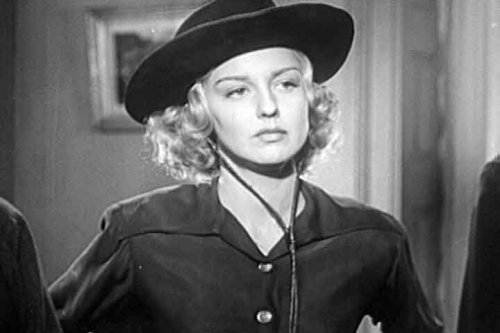
Opening in 1864, Renegade Girl is a mixed bag of a Western featuring Savage as Jean Shelby, a notorious road agent working with Quantrill’s raiders. She and her brother Bob (James Martin) have been passing information to Quantrill (Corrigan) in their fight against the North. When Bob is killed by renegade Cherokee, White Cloud (Chief Thundercloud), she vows revenge against him. At the same time she meets and falls in love with a Yankee captain, Fred Raymond (Curtis). Saving him from Quantrill and his men she ends up being wounded during an encounter with White Cloud.

Her recovery takes her a year. The war is over but Jean receives a visit from two of Quantrill’s men, Jerry Long (Wade) and Bob Crandall (Brophy). They tell her that the survivors of Quantrill’s band are hiding in the nearby hills and are looking to target people who helped the North win the war. Long has amorous intentions towards Jean and wants her to join them; at first she rebuffs him, but not having seen or heard from Raymond since she was wounded, she decides to join them on the understanding that they help her find White Cloud and kill him once and for all…

Renegade Girl - scene

Filmed on Corrigan’s own ranch in Simi Valley, California, Renegade Girl is entertaining enough but suffers from too many close-ups of the dour, stony-faced Savage. While the character of Jean is meant to be proud, self-sufficient and courageous, Savage plays her instead as petulant and wilful. It’s not a great choice as Jean is a strong character with a good story arc and plenty of dramatic moments for any actress to sink her teeth into. Savage also adopts a kind of angry monotone to many of her lines and this approach soon becomes tiresome to hear. Supporting her, Curtis is largely colourless as her love interest, Wade brings an insouciant menace not often seen in low-budget Westerns as the devious Long, while Brophy shines – as always – as the loyal sidekick/comic relief; there’s a lovely, touching scene between him and Savage that’s worth watching all by itself. As the renegade Indian, Chief Thundercloud is badly underused and wears an unfeasibly tall black hat to mark him out as the main villain.

Otherwise, the script by Edwin V. Westrate is more than adequate, and while not entirely original, does take a few unexpected turns, as well as maintaining its moral through-line. There is redemption and sacrifice, and the decisions made by Jean are considered before she moves ahead with them. There’s even a short sequence where she has a kind of mental breakdown over something she’s caused to happen (Savage doesn’t play it particularly well though).

Berke – who directed five other movies in 1946, including the bizarrely named Ding Dong Williams – has a fluent shooting style and stages the various action sequences with a greater conviction than perhaps was expected by the budget. Occasionally his blocking of a scene leads to too many bodies being in the frame at the same time, but this is a minor quibble. The photography by James S. Brown Jr shows off Corrigan’s ranch to good effect, and the music by Darrell Calker adds to the mood of the movie without overwhelming it.

Despite the miscasting of Savage in the lead role, Renegade Girl is an enjoyable Western that zips along quite well and doesn’t outstay its welcome. Berke is a director to keep an eye out for, and while some of the more overtly romantic aspects of the script may cause advanced tooth decay in some viewers – Jean goes all googly-eyed over Raymond from the moment she first sees him – this is still a fun to way spend sixty-five minutes.

Rating: 6/10 – undone by Savage’s inability to understand her character, Renegade Girls is still far better than it appears on paper, and works best when focused on Jean’s almost primal need for revenge.

Share this:

  • Click to share on X (Opens in new window) X
  • Click to share on Facebook (Opens in new window) Facebook
  • More
  • Click to print (Opens in new window) Print
  • Click to email a link to a friend (Opens in new window) Email
Like Loading...

Blog Stats

  • 486,537 hits

Recent Posts

  • 10 Reasons to Remember Bibi Andersson (1935-2019)
  • Fantasia (1940)
  • Dances With Wolves (1990) – The Special Edition
  • Kiss of the Spider Woman (1985)
  • The Three Musketeers (1973)

Top Posts & Pages

  • Lost for Life (2013) - Another Look
    Lost for Life (2013) - Another Look
  • Lost for Life (2013)
    Lost for Life (2013)
  • About
    About
  • Mr. Topaze (1961)
    Mr. Topaze (1961)
  • Winter's Tale (2014)
    Winter's Tale (2014)
  • Shock and Awe (2017)
    Shock and Awe (2017)
  • Billy Lynn's Long Halftime Walk (2016)
    Billy Lynn's Long Halftime Walk (2016)
  • The Hitman's Bodyguard (2017)
    The Hitman's Bodyguard (2017)
  • BFI London Film Festival 2015
    BFI London Film Festival 2015
  • Spider-Man: Homecoming (2017)
    Spider-Man: Homecoming (2017)
Follow thedullwoodexperiment on WordPress.com

Blogs I Follow

  • Rubbish Talk
  • Film 4 Fan
  • Fast Film Reviews
  • The Film Blog
  • All Things Movies UK
  • Interpreting the Stars
  • Let's Go To The Movies
  • Movie Reviews 101
  • TMI News
  • Dan the Man's Movie Reviews
  • Film History
  • Jordan and Eddie (The Movie Guys)

Archives

  • April 2019 (13)
  • March 2019 (28)
  • February 2019 (28)
  • January 2019 (32)
  • December 2018 (28)
  • November 2018 (30)
  • October 2018 (29)
  • September 2018 (29)
  • August 2018 (29)
  • July 2018 (30)
  • June 2018 (28)
  • May 2018 (24)
  • April 2018 (21)
  • March 2018 (31)
  • February 2018 (25)
  • January 2018 (30)
  • December 2017 (30)
  • November 2017 (27)
  • October 2017 (27)
  • September 2017 (26)
  • August 2017 (32)
  • July 2017 (32)
  • June 2017 (30)
  • May 2017 (29)
  • April 2017 (29)
  • March 2017 (30)
  • February 2017 (27)
  • January 2017 (32)
  • December 2016 (30)
  • November 2016 (28)
  • October 2016 (30)
  • September 2016 (27)
  • August 2016 (30)
  • July 2016 (30)
  • June 2016 (31)
  • May 2016 (34)
  • April 2016 (30)
  • March 2016 (30)
  • February 2016 (28)
  • January 2016 (35)
  • December 2015 (34)
  • November 2015 (31)
  • October 2015 (31)
  • September 2015 (34)
  • August 2015 (31)
  • July 2015 (33)
  • June 2015 (12)
  • May 2015 (31)
  • April 2015 (32)
  • March 2015 (30)
  • February 2015 (37)
  • January 2015 (39)
  • December 2014 (34)
  • November 2014 (34)
  • October 2014 (36)
  • September 2014 (25)
  • August 2014 (29)
  • July 2014 (29)
  • June 2014 (28)
  • May 2014 (23)
  • April 2014 (21)
  • March 2014 (42)
  • February 2014 (38)
  • January 2014 (29)
  • December 2013 (28)
  • November 2013 (34)
  • October 2013 (4)

Create a free website or blog at WordPress.com.

Rubbish Talk

Film 4 Fan

A Movie Blog

Fast Film Reviews

The Film Blog

The official blog of everything in film

All Things Movies UK

Movie Reviews and Original Articles

Interpreting the Stars

Dave Examines Movies

Let's Go To The Movies

Film and Theatre Lover!

Movie Reviews 101

Daily Movie Reviews

TMI News

Latest weather, crime and breaking news

Dan the Man's Movie Reviews

All my aimless thoughts, ideas, and ramblings, all packed into one site!

Film History

Telling the story of film

Jordan and Eddie (The Movie Guys)

Movie Reviews & Ramblings from an Australian Based Film Fan

Privacy & Cookies: This site uses cookies. By continuing to use this website, you agree to their use.
To find out more, including how to control cookies, see here: Cookie Policy
  • Subscribe Subscribed
    • thedullwoodexperiment
    • Join 481 other subscribers
    • Already have a WordPress.com account? Log in now.
    • thedullwoodexperiment
    • Subscribe Subscribed
    • Sign up
    • Log in
    • Report this content
    • View site in Reader
    • Manage subscriptions
    • Collapse this bar
 

Loading Comments...
 

    %d