• 10 Reasons to Remember…
  • A Brief Word About…
  • About
  • For One Week Only
  • Happy Birthday
  • Monthly Roundup
  • Old-Time Crime
  • Other Posts
  • Poster of the Week
  • Question of the Week
  • Reviews
  • Trailers

thedullwoodexperiment

~ Viewing movies in a different light

thedullwoodexperiment

Tag Archives: Benedict Cumberbatch

Doctor Strange (2016)

25 Tuesday Oct 2016

Posted by dullwood68 in Movies

≈ 3 Comments

Tags

Action, Astral plane, Baron Mordo, Benedict Cumberbatch, Chiwetel Ejiofor, Cloak of Levitation, Drama, Fantasy, Mads Mikkelsen, Magic, Marvel, Marvel Cinematic Universe, Rachel McAdams, Review, Scott Derrickson, Sorcerer Supreme, The Ancient One, Tilda Swinton
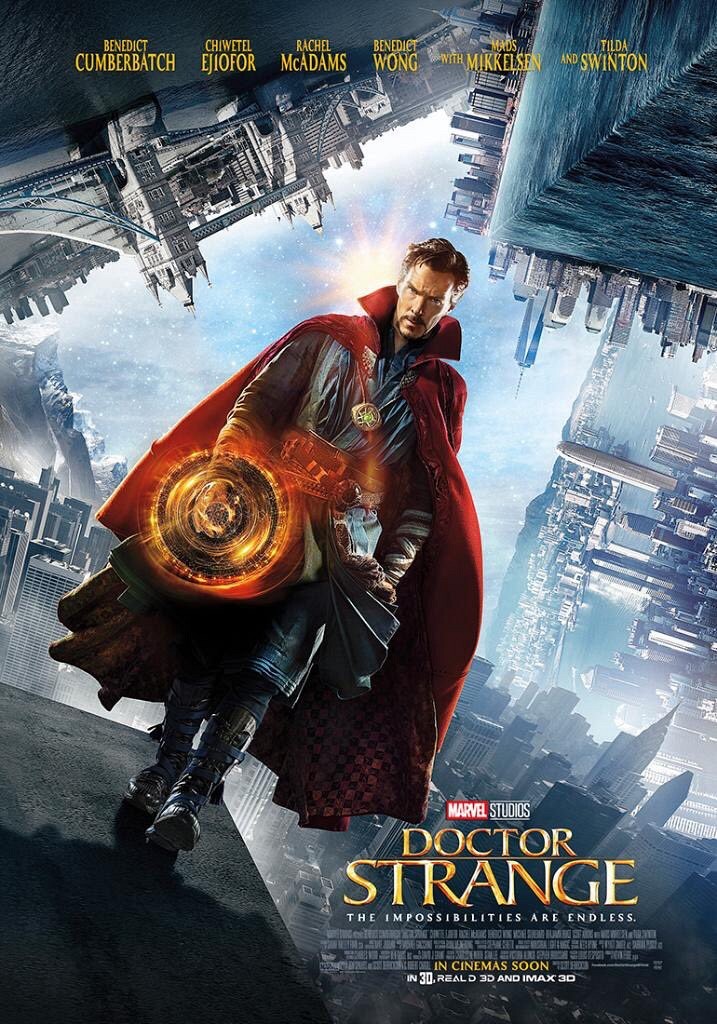
doctor-strange-2016-poster-impossibilities

D: Scott Derrickson / 115m

Cast: Benedict Cumberbatch, Chiwetel Ejiofor, Rachel McAdams, Tilda Swinton, Mads Mikkelsen, Benedict Wong, Michael Stuhlbarg, Benjamin Bratt, Scott Adkins

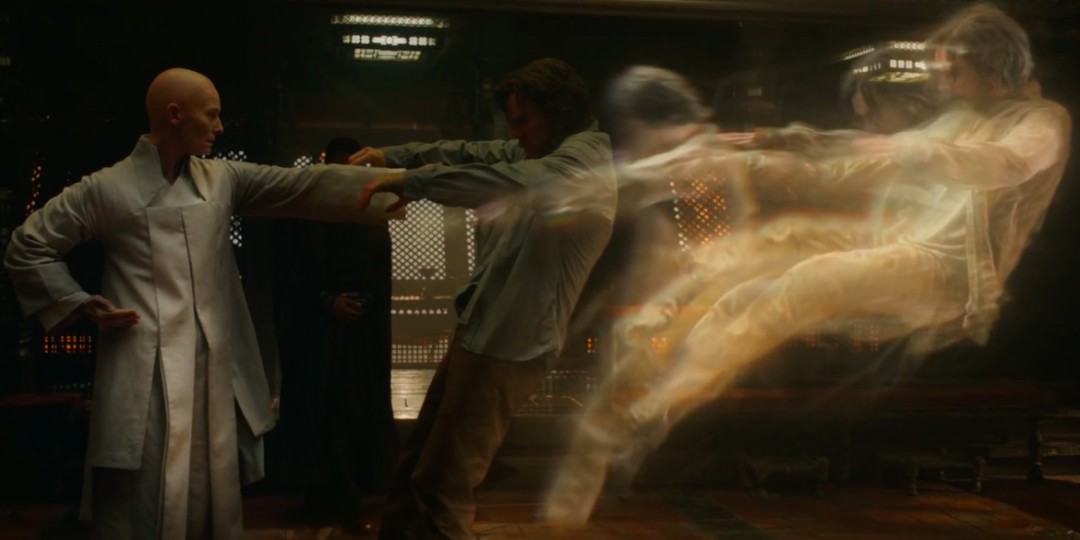
Stephen Strange (Cumberbatch) is a gifted neurosurgeon. He’s also an arrogant pain in the ass. His ego is on a par with Tony Stark’s, and he enjoys reminding people just how good he is. But one rainy evening, Strange’s car ends up in the river and his hands are so badly damaged that he’ll never be able to operate again. Angry and full of self-pity, Strange learns of a man who suffered a severed spine and was paralysed from the chest down, but who somehow managed to walk again. Strange tracks the man (Bratt) down, and is told of a monastery in Kathmandu, Nepal, where he learned how to walk again. Strange travels there and meets The Ancient One (Swinton), a mystic who teaches him that their plane of existence is one of many, and that Strange must let go of everything he thinks he knows in order to achieve “enlightenment”.

Strange proves to be an eager and willing (if still slightly sceptical) pupil. He learns how to cast spells, how to travel from one place to another by visualising it in his mind and creating a portal through which to get there, and the existence of a former pupil, Master Kaecilius (Mikkelsen), who believes he can gain immortality by helping a creature from the Dark Dimension, Dormammu, take over the Earth. As Strange’s powers grow, Kaecilius begins attacking the three sanctums that help keep Dormammu and his like from entering our world. Aided by another Master, Baron Mordo (Ejiofor), Strange attempts to stop Kaecilius from bringing about the end of the world; he also receives help from an unlikely source: the Cloak of Levitation, which chooses Strange as its master.
13-120647-marvel_debuts_doctor_strange_teaser_trailer

But the London sanctum falls to Kaecilius’s onslaught, and he moves on to attack the sanctum in Hong Kong. Strange and Mordo arrive too late to avoid its destruction and the arrival of Dormammu in our world, but Strange has an idea that will counter-act all the death and destruction that has followed in Dormammu’s wake. If he fails, however, it will mean the end of all life on Earth…

Another Marvel movie, another origin story. But Stephen Strange has always been the odd character out in the Marvel Universe (cinematic or otherwise), a humbled physician redeemed by the power of magic and able to deal with the kind of villains that would give the likes of Iron Man and Captain America more than a run for their money. (Not that Strange is in any immediate danger here; Kaecilius isn’t exactly the most threatening villain Marvel has come up with, but he is good at running a lot.) With Phase Three of the Marvel Cinematic Universe now under way, this gives Marvel the opportunity to add fresh characters to the roster, and take their ongoing series of movies in a new direction.

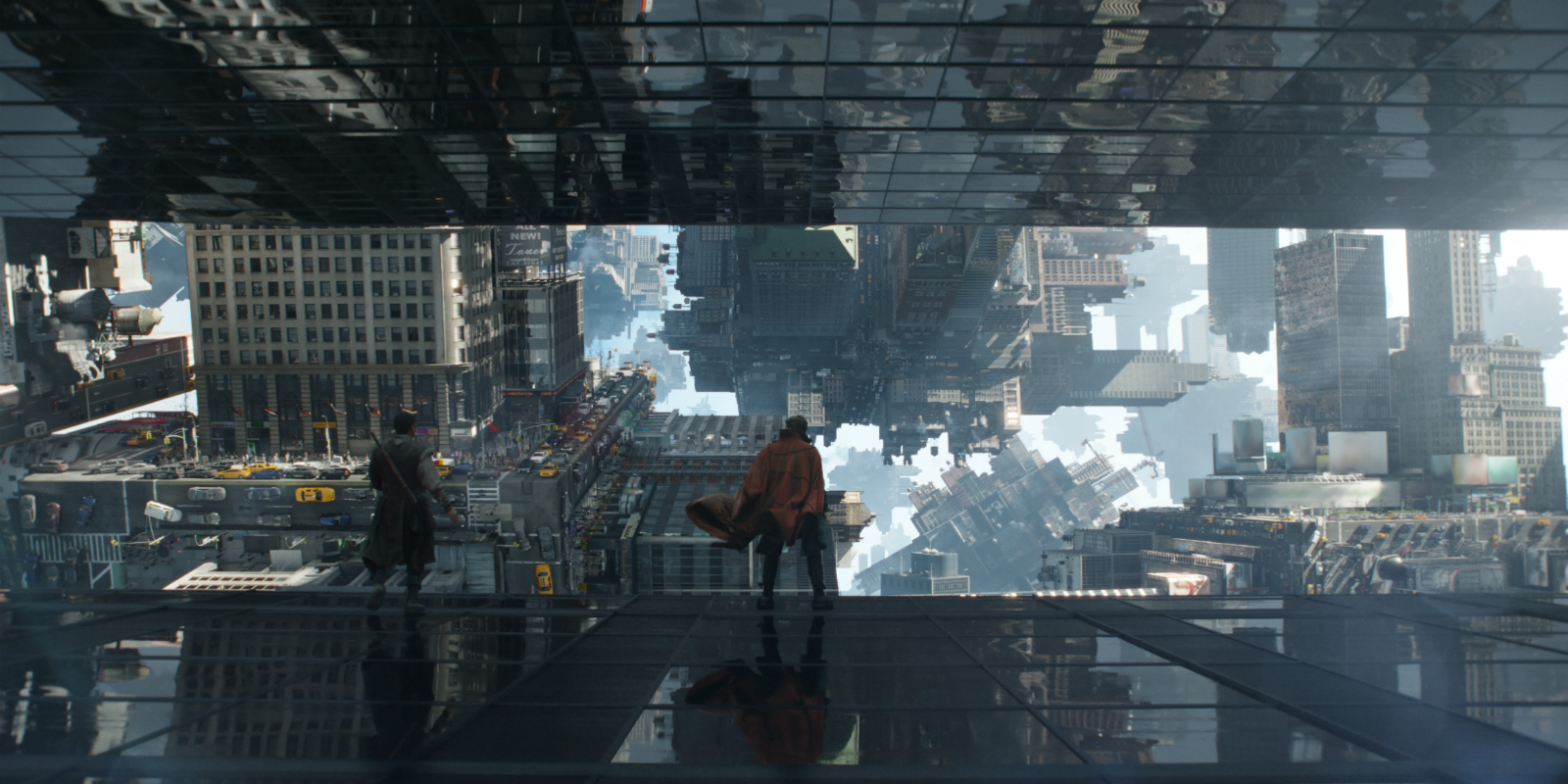
But is it any good? Well, predictably, the answer is Yes – for the most part. The standard Marvel formula is firmly in place, although there is less humour to be had this time round, and while the template is tweaked here and there, most viewers will be reassured that the House of Spidey hasn’t strayed too far from the formula that has made their movies so successful in the past. What is different, and markedly so, is the visual style adopted for the movie. Away from all the mind-bending, Inception-style graphics, Doctor Strange is both darker in tone and look. Even the hospital where Strange works isn’t as brightly lit as you might expect. But it’s not a gloomy movie over all, it’s just that for once, Marvel have realised that – scenes involving the Cloak of Levitation aside, and Strange’s “borrowing” habits in the library – this needs to be a serious piece above all.
doctor-strange-movie-image-gallery

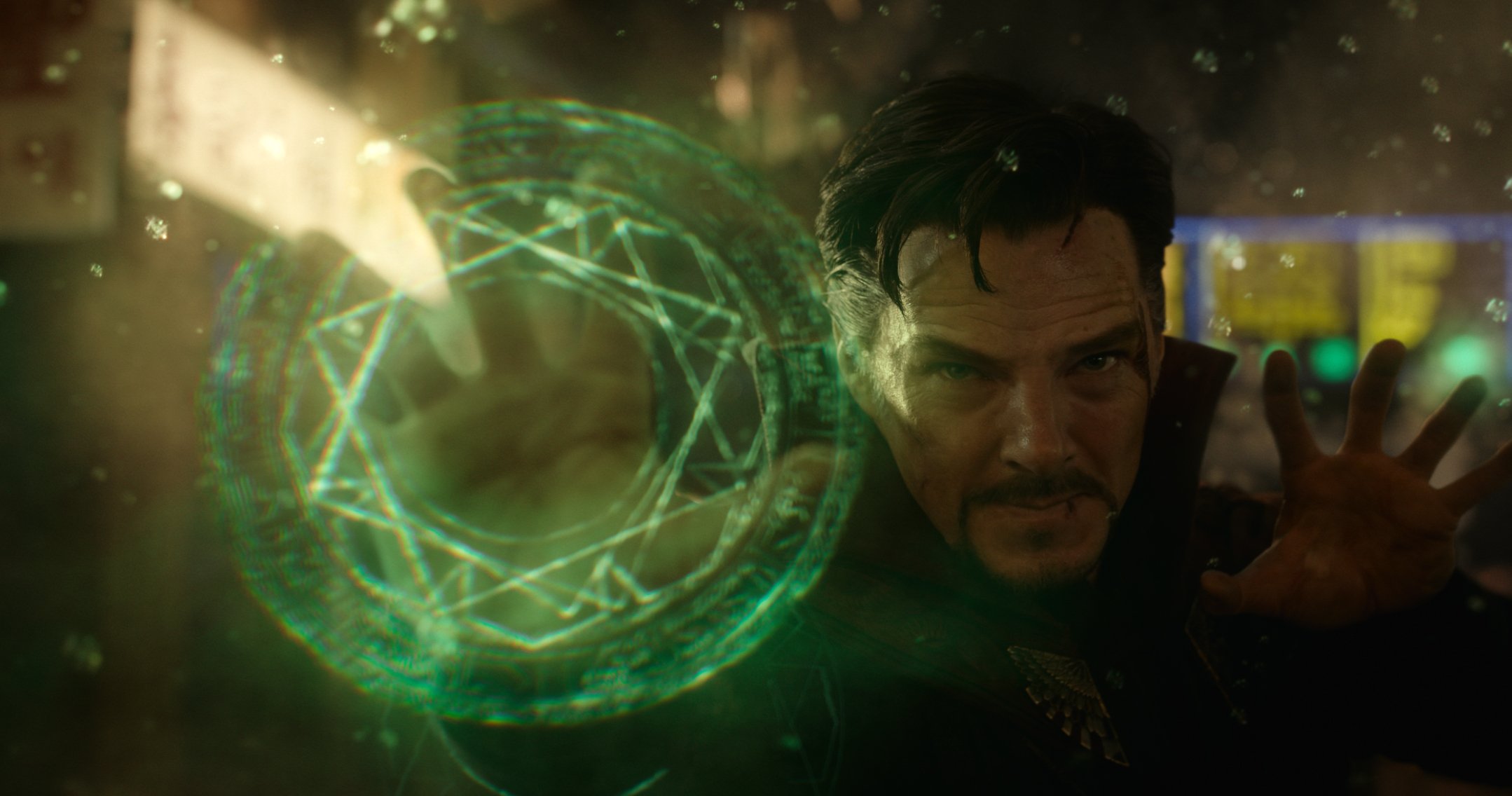
Strange’s arrogance, and then his anger, in the beginning gives Cumberbatch the opportunity to play unlikeable with an unexpected fierceness. One scene in particular with McAdams as Strange’s one-time significant other, Christine Palmer, sees the actor deliver cruel lines of dialogue in a way that hasn’t been done before in a Marvel movie (he’s the hero and he’s being delberately objectionable). Even when he begins to accept that magic really does exist, he’s still an egotist, making snarky, caustic comments, but thanks to the script – by Derrickson, Jon Spaihts, and C. Robert Cargill – he’s also on a journey of self-discovery, and this comes across more and more effectively as the movie progresses.

With the main character in good hands (Cumberbatch inhabits the role with his customary panache, and even slips in an Alan Rickman tribute for those paying attention), it’s a shame that the rest are painted in such broad strokes. Baron Mordo, Strange’s arch-nemesis in the comics, is here very much a secondary character whose time will come in a later movie, while The Ancient One, despite being well-played by Swinton, is burdened with some astonishingly po-faced dialogue (“I spent so many years peering through time… looking for you.”) that you start to wonder if the half-smile Swinton adopts at times is in acknowledgment of how daft some of her lines truly are. As mentioned before, Mikkelsen’s master-turned-bad is not one of Marvel’s best villains, while McAdams is sidelined for much of the movie, though at least she’s not there as a damsel in need of being rescued.
null

The visuals are, unsurprisingly, stunning. The folding of cityscapes and the weird monstrosities glimpsed in the Dark Dimension are both equally impressive, but there is one sequence which stands head and shoulders above all the others: when Strange reverses the destruction of the Hong Kong sanctum. If anyone wants a clue as to why Marvel is more successful at the box office, and critically, than DC, then it’s this particular sequence that should be watched for one of the answers. Both DC and Marvel have been guilty of going down the destruction-porn road before, and audiences have begun to voice their dislike of these big, CGI-driven demolition extravaganzas. But here, we don’t see the destruction of the Hong Kong sanctum, just the aftermath, and then, in a complete stroke of genius, we see the destruction in reverse – and it’s so much more effective for being shown in this way. Clearly, someone at Marvel is listening.

Where Stephen Strange will fit into the wider Marvel Cinematic Universe remains to be seen (though a pre-end credits scene points him in one particular direction), and he won’t be back in another solo outing for some time, but as an introduction to a character with so much more to be explored, Doctor Strange has to be considered a success. Like most of Marvel’s output in the last eight years, though, it does have its fair share of pitfalls, and it does stumble at times in trying to simplify the more esoteric aspects of playing with magic, but overall this is an exciting, well-crafted, rewarding, and enjoyable first outing for the future Sorcerer Supreme.

Rating: 8/10 – superb spectacle can’t compensate for some poor decisions when it comes to the secondary characters, or the tangled logic surrounding Kaecilius’ need to bring Dormammu into this world, but these are minor gripes in a movie that takes a challenging character and does him justice from start to finish; by doing more than enough with the formula to make it more interesting, Doctor Strange becomes a movie that contradicts the claim that Marvel are just churning out the same movie over and over again.

Share this:

  • Click to share on X (Opens in new window) X
  • Click to share on Facebook (Opens in new window) Facebook
  • More
  • Click to print (Opens in new window) Print
  • Click to email a link to a friend (Opens in new window) Email
Like Loading...

The Imitation Game (2014)

11 Sunday Jan 2015

Posted by dullwood68 in Movies

≈ 1 Comment

Tags

Alan Turing, Benedict Cumberbatch, Bletchley Park, Christopher, Code breaking, Drama, Enigma, History, Homosexuality, Joan Clarke, Keira Knightley, Matthew Goode, Morten Tyldum, Review, True story, World War II

Imitation Game, The

D: Morten Tyldum / 114m

Cast: Benedict Cumberbatch, Keira Knightley, Matthew Goode, Rory Kinnear, Allen Leech, Matthew Beard, Charles Dance, Mark Strong, James Northcote, Tom Goodman-Hill, Steven Waddington, Alex Lawther, Jack Bannon, Tuppence Middleton

Manchester, 1951. A robbery at the home of maths professor Alan Turing (Cumberbatch) leads to the police, particularly Detective Robert Nock (Kinnear), having suspicions that he is hiding something.

1939. Turing arrives for a job interview at Bletchley Park. He is aloof, humourless, arrogant, and quickly stirs the ire of his interviewer, Naval Commander Denniston (Dance). On the verge of being thrown out because of his behaviour, Turing mentions Enigma, the “unbreakable” encryption device being used by the Germans; if it can be cracked, it will turn the tide of the war in Britain’s favour. Impressed, but still against his better judgment, Denniston hires Turing. He becomes part of a team that is headed by chess prodigy Hugh Alexander (Goode), and includes cryptographers John Cairncross (Leech) and Peter Hilton (Beard), though there is friction from the start as Turing prefers to work alone; instead of trying to decipher the hundreds of messages they intercept each day in the hope of breaking the code, Turing works at constructing a machine that will be able to analyse and decode the 159 million million million possible settings the Enigma machine uses.

Denied the funds to build his machine by Alexander, Turing approaches Denniston but is rebuffed. He gets a letter to Winston Churchill via MI6 overseer Stewart Menzies (Strong) and ends up in charge of the programme at Bletchley Park. He fires part of the team but then realises they need more staff. He has a difficult crossword puzzle published in the newspapers; anyone who solves it is asked to attend a further test/interview at Bletchley. Through this he meets Joan Clarke (Knightley), who proves to be a match for him intellectually, and despite some resistance from her parents, he arranges for her to work on the project.

1951. Nock gains a copy of Turing’s military file, only to find there’s nothing in it. He tells his superior, Superintendent Smith (Waddington) that he believes Turing could be a Communist spy. Smith allows Nock to investigate further.

1940. Turing arrives at the hut the team uses to find Denniston and some MPs going through his desk. Apparently there is a spy at Bletchley, but the search reveals nothing out of the ordinary, though Denniston makes it clear his suspicions lie firmly with Turing. Tensions between the group are heightened as Turing spends more and more time building his machine and isolating himself. Joan tells him he needs to be more friendly otherwise he won’t get the help he needs. He does so, and a little while later receives a suggestion from Alexander that is beneficial. A confrontation between Turing and Denniston leads to the rest of the team backing him and his machine (against the threat of being fired); Denniston tells them they have a month to prove it works.

With the month nearly up and no progress made with the machine (named Christopher after Turing’s schoolboy friend), Turing finds himself talking to Helen (Middleton), one of Joan’s friends, and someone who intercepts the German messages. She reveals that her German counterpart always uses the same phrase in their messages. It proves to be the breakthrough Turing and the team have needed. Now, instead of searching through all the possible settings, Christopher only has to search for ones that contain words that they know will be in the messages. They test their theory… and it works. But that isn’t the end of it, and a terrible decision has to be made. And in 1951, Nock discovers that what Turing is trying to hide isn’t that he’s a Communist spy, but that he’s a homosexual.

Imitation Game, The - scene1

There are two things that can be said about Alan Turing: that without him the Germans could well have won the war, and the circumstances of his post-war life led to a terrible tragedy. It’s to The Imitation Game‘s credit that it explores these aspects of his life with both candour and a lack of sentimentality. Exploring for the most part his work at Bletchley Park, the movie doesn’t ignore his formative years, nor the events that led to his untimely death in 1954, but its the way in which each part of his life is integrated that makes the movie so effective. The different periods dovetail with precision, Graham Moore’s intelligent, well-constructed screenplay – albeit one that contains a great deal of invention (the character of Nock and his investigation for example) – picking out the highs and lows of Turing’s life with exemplary attention to detail.

The importance of Turing’s work during the war can’t be stressed enough; historians have gauged that breaking the Enigma code shortened the war by at least two years. The size of the problem, the sheer enormity of it all, is given due importance, and the various setbacks add to the tension, but it’s the movie’s focus on Turing and his team that adds immeasurably to the drama. Turing is portrayed as an arrogant boor, dismissive of anyone less intelligent than himself (and that’s most people), and so single-minded in his pursuit of a solution to the Enigma code that his arrogance increases tenfold. His interaction with Alexander is initially antagonistic, but the growing respect they gain for each other is handled with care and sincerity, and brings Turing out of his shell. As well there’s his relationship with Joan, as unlikely a collaboration as could be imagined during the war, but as richly rewarding for each other as it is for the viewer (and beautifully played by Cumberbatch and Knightley).

Turing is brought to life by an amazing performance from Cumberbatch, immersing himself completely in the role and proving mesmerising to watch. Moore’s script allows for a lot of humour in the movie’s early scenes, mostly at the expense of Turing’s humourlessness (and Denniston’s apprehension at his behaviour). Both actors relish their sharp, witty dialogue, and while it all helps to make Turing more sympathetic than he would be otherwise, it also serves to introduce the Enigma project in such a way that the seriousness of the situation, when it becomes more pronounced, doesn’t leave the audience missing the humour. And the drama reaches a peak in a scene where the terrible consequences of cracking the code means a heart-rending decision has to be made that affects Hilton’s brother. It’s a chilling moment, with victory swiftly replaced by despair, and perfectly highlights some of the difficult decisions that have to be made during wartime.

In terms of biographical continuity, the movie flits between 1926, the war and 1951. Turing’s time at Sherborne School, where his friendship with Christopher Morcom leads to the first intimation of his homosexuality, is given weight by the later use of “Christopher” as the name of the code-breaking machine. It also paints a rather amiable picture of boarding school life and shows the younger Turing struggling to come to terms with his own emotions and the love he feels for his friend. These scenes are the equivalent of the kind of rosy childhood memories we all think we experienced but which in actuality were probably worse than we remember, but they serve as a way of showing how disappointment and regret have allowed the older Turing to become so haughty and withdrawn. The post-war sequences, almost entirely invented for the movie, give a passing hint at how Turing may have died but then states at the end that he committed suicide, which was the official cause of death at the time, but which has since been revealed to be not entirely conclusive.

It’s these distortions and fabrications of the historical period that, inevitably, do the most harm to the movie, and while a degree of dramatic licence is to be expected in a drama “based” on true events, the range and number of historical inaccuracies is worrying.  In truth, Turing was not as disliked as the movie shows, and he did have a recognised sense of humour. He didn’t lead the team at Bletchley Park, nor did he write a letter to Churchill asking for funds to build his machine (which in reality had already been designed in 1938 by Marian Rejewski, a Polish cryptographer). Clarke’s involvement was not as pronounced as shown in the movie, and Hilton had no brother, while the character of Helen is entirely fictional too. It’s understandable that these aspects of Moore’s script are there to enhance the drama, but when you have a true story of wartime heroics to tell, the need for such embellishments – or falsehoods if you will – seems unnecessary. And Turing’s homosexuality, while not overplayed, is treated somewhat like an unfortunate character trait, with everyone at Bletchley aware of it but ever so respectful at the same time – one wonders if that would really have been the case.

Imitation Game, The - scene3

Despite issues with the script, the cast are uniformly excellent. As mentioned above, Cumberbatch is mesmerising, portraying Turing’s strength of will and sense of purpose with such skill and confidence that the character’s quirks and odd physicality seem entirely natural. He dominates every scene he’s in, causing his co-stars to up their game considerably; as a result The Imitation Game contains a raft of performances that are so good it may well be the best acted movie of 2014. Knightley is appealing as Joan (even if she bears no resemblance to the real Joan Clarke), and plays her with a determination and inner strength that matches Turing’s irascibility and overcomes it. Goode, Leech and Beard, as Turing’s main collaborators, all get their chance to shine but it’s their group scenes and their interaction with each other that work best. Kinnear has an awkward role that he copes well with, as a detective representing our modern approach to the adversity that Turing suffered after the war; it’s the one role that doesn’t entirely convince and seems shoehorned into the movie to make the point about how badly Turing – a war hero – was treated after hostilities ceased. And Dance and Strong, as the twin faces of the Establishment, provide effortless support throughout (as you’d expect).

Fresh from his adaptation of Jo Nesbø’s Headhunters (2011), Tyldum displays an appreciation for recent British history, and handles the complexities of the story in such a way that nothing seems too intellectual to understand. He keeps the action very contained, focusing instead on the characters and their personalities, showing how people from often very different backgrounds could, and did, make such a vital difference in how the war was eventually won. The various periods of Turing’s are recreated with admirable authenticity (some wartime scenes were actually shot at Bletchley Park), and are lensed to very good effect by Oscar Faura. There’s also a subtly evocative score by Alexandre Desplat that enriches each scene it plays over or supports.

Rating: 9/10 – despite taking a huge number of historical liberties, The Imitation Game is gripping, thought-provoking, ambitious movie making, and one of the finest dramas of recent years; with stellar performances from all concerned – including Cumberbatch’s career-defining turn – this (mostly) true story scales new heights in the genre of historical drama, and can’t be recommended highly enough.

Share this:

  • Click to share on X (Opens in new window) X
  • Click to share on Facebook (Opens in new window) Facebook
  • More
  • Click to print (Opens in new window) Print
  • Click to email a link to a friend (Opens in new window) Email
Like Loading...

Penguins of Madagascar (2014)

13 Saturday Dec 2014

Posted by dullwood68 in Movies

≈ Leave a comment

Tags

Animation, Benedict Cumberbatch, Eric Darnell, John Malkovich, Kowalski, Madagascar, Octopus, Private, Review, Rico, Simon J. Smith, Skipper, The North Wind, Tom McGrath

Penguins of Madagascar

D: Eric Darnell, Simon J. Smith / 92m

Cast: Tom McGrath, Chris Miller, Christopher Knights, Conrad Vernon, John Malkovich, Benedict Cumberbatch, Ken Jeong, Annet Mahendru, Peter Stormare

Antarctica: three wilful penguins, Skipper (McGrath), Kowalski (Miller) and Rico (Vernon) rescue an egg from an abandoned ship full of leopard seals. The egg hatches to reveal a baby penguin they call Private (Knights). After seeing off the seals they find themselves adrift on a small patch of ice.

Ten years later – and following on from the events in Madagascar 3: Europe’s Most Wanted (2012) – the team decide to leave the circus. They break into Fort Knox so that they can celebrate Private’s birthday by treating him to some Cheezy Dibbles, a snack that has been discontinued but which can still be found in one of the Reserve’s vending machines. However, the vending machine proves to be a trap and the team are kidnapped by Dave (Malkovich), an octopus bent on revenge against all penguins thanks to his treatment in various zoos where they were the star attraction and not him.

The penguins escape his clutches and find themselves in Venice. Cornered by Dave’s squid “henchmen”, they find themselves rescued by members of the North Wind, a secret, undercover, inter-species task force dedicated to bringing animal villains to justice. Led by Agent Classified (Cumberbatch), they view Skipper and the gang as unreliable and refuse to team up with them; instead they have the gang transported to one of their remote bases (ironically, on Madagascar). But the gang escape and make their way to Shanghai where they manage to capture Dave. He escapes though, and manages to kidnap all the city zoo’s penguins, and Private as well. At his remote island base, Dave shows Private his plan to use a Medusa serum on all the world’s penguins, and which will turn them all into horrible, mutated creatures.

Meanwhile, the penguins and the North Wind argue about the best course of action. They do agree to attempt a rescue mission but are all captured. Private manages to free the North Wind but instead of freeing the penguins they depart for reinforcements. With Dave heading for New York City to release the Medusa-affected penguins on an unsuspecting public, it’s up to Private to find a way of saving his friends, and all the other penguins as well.

Penguins of Madagascar - scene

With Skipper, Kowalski, Rico and Private proving the most popular characters in the Madagascar franchise, it was inevitable that after several short movies and their own TV show, that a feature-length movie would happen eventually (in fact it’s been on the drawing board since 2005). Thankfully, all the well established quirks and traits of the characters have been retained, along with their Bond-style theatrics, and at the service of a half-decent plot that, while not entirely too imaginative, still makes for a lot of fun and keeps the movie entertaining as a whole.

There’s a lot going on in Penguins of Madagascar: it’s an origin story (not that it was really needed), a revenge tale, a spy caper, a personal empowerment yarn (Private feels like a lesser member of the team because he doesn’t have a specific skill), and a family saga. Mixing all these elements could have led to the movie having an identity crisis, but under the auspices of Darnell and Smith, the movie weaves these various strands to such good effect that each one plays out with to its full potential. It’s good to see so many elements in a movie given enough space to work effectively, and not feel under-developed. And even if these elements are entirely familiar or lack a degree of originality, there’s enough verve and vitality about them to offset any disappointment.

With a lot going on, there’s also a lot to enjoy, though some of it – such as the inclusion of several movie star names amongst Dave’s instructions to his squid squad, e.g. “Nicolas! Cage them!” – may require repeat viewings to fully appreciate or pick up on. (There’s been some criticism that with so much going on this leads to some of the humour being hit and miss, that if one joke fails it’s not a problem as there’ll be another one along in a minute. Not to be too obvious about it, but it’s a rare movie that has a 100% hit rate when it comes to jokes or visual humour.) But as with most big budget studio animation these days, it’s all part of the enjoyment to be had, with references for kids and adults alike, making the movie work on several levels, and providing entertainment for as broad an age range as possible.

Whatever your reaction to the material may be, Penguins of Madagascar is still a fast, funny, visually inventive movie that is a treat to watch. The glossy, vibrant animation is sharp and richly detailed, and has a spirited zest to it that makes watching the movie a complete pleasure. From the crisp whiteness of Antarctica, to the  bright, colourful showdown in New York City, this is animation that zings and pops off the screen with fizzy, glorious abandon. The various set pieces are handled with skill and imagination, and the characters are so cleverly drawn and animated that certain habits almost go unnoticed (Agent Classified can’t say “penguin”; instead he says “pengwings”). With so much going on visually, it’s fitting that the voice cast is able to match the animators with their performances. Cumberbatch and Malkovich are great choices, their vocal styles complementing their characters’ looks perfectly and adding a further layer of richness to the proceedings. As the titular team, McGrath (who created the characters), Miller, Knights and Vernon have been doing this for so long that they don’t put a flipper wrong throughout, and there’s solid support from the likes of Jeong and Stormare (and yes, the documentary filmmaker at the beginning is Werner Herzog; who knew he liked penguins so much?).

It looks like it’ll be a while before we see Skipper and the gang again – not until Madagascar 4 reaches us in 2018 – but for now this outing for the spy-centric birds acts as a wonderfully anarchic, hugely enjoyable showcase for their particular brand of well-meaning chaos. Heartwarming at times, highly silly at others, and with something for everyone packed into its ninety-two minute running time, this is an exuberant, rewarding di-version (or should that be div-ersion?) that succeeds admirably in expanding the world of four very individual penguins.

Rating: 8/10 – glorious fun throughout, Penguins of Madagascar is another sure-fire success from Dreamworks Animation; it may lack depth and play fast-and-loose with subtlety – “No one breaks the Wind” – but as an exercise in well-crafted lunacy, this fits the bill entirely.

Share this:

  • Click to share on X (Opens in new window) X
  • Click to share on Facebook (Opens in new window) Facebook
  • More
  • Click to print (Opens in new window) Print
  • Click to email a link to a friend (Opens in new window) Email
Like Loading...

Mini-Review: The Fifth Estate (2013)

09 Sunday Mar 2014

Posted by dullwood68 in Movies

≈ Leave a comment

Tags

Anthony Mackie, Benedict Cumberbatch, Bill Condon, Daniel Berg, Daniel Brühl, Internet, Julian Assange, Laura Linney, Leaked documents, Review, WikiLeaks

Fifth Estate, The

D: Bill Condon / 128m

Cast: Benedict Cumberbatch, Daniel Brühl, Anthony Mackie, Laura Linney, David Thewlis, Alicia Vikander, Peter Capaldi, Moritz Bleibtreu, Carice van Houten, Jamie Blackley, Stanley Tucci

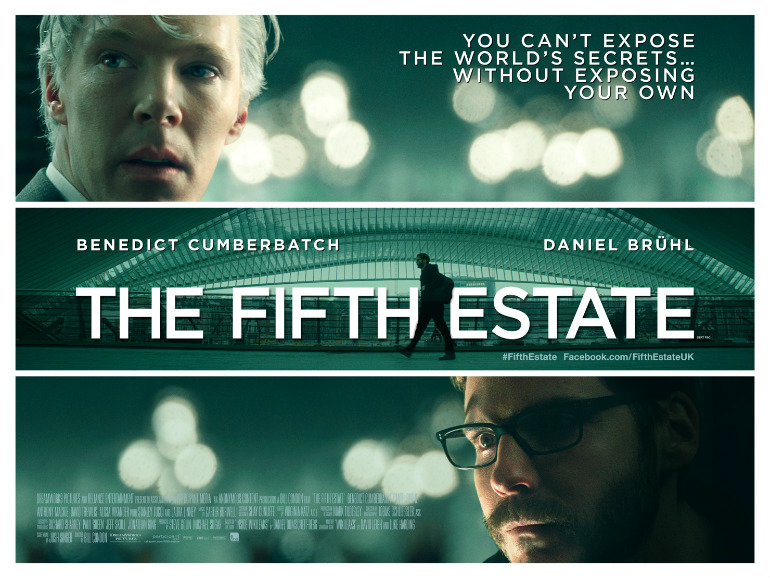
Remarkably similar in tone and circumstance to the creation of Facebook as shown in David Fincher’s The Social Network, The Fifth Estate shows how WikiLeaks became such a global phenomenon.

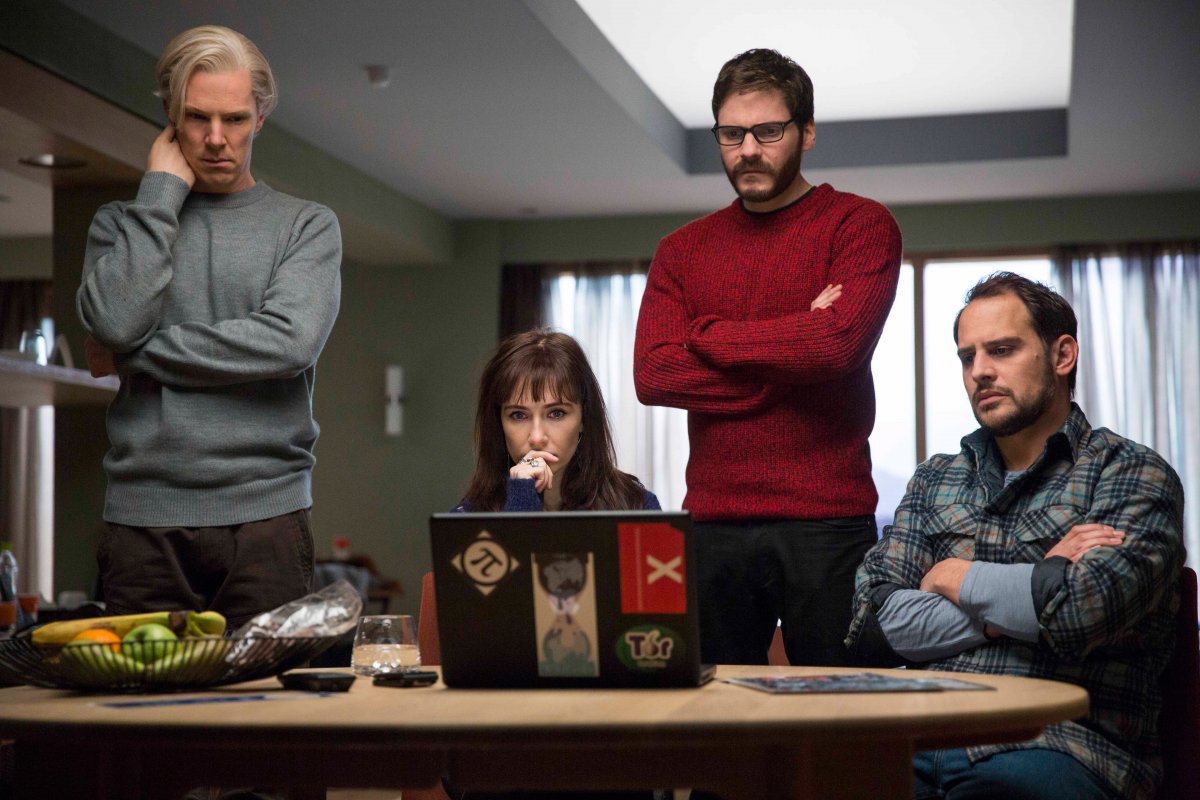
In the beginning, Julian Assange (Cumberbatch) is shown struggling to get his site acknowledged by the wider Internet community. A fortuitous meeting with Daniel Berg (Brühl), a bored IT expert, gives Assange the help he needs in expanding and publicising WikiLeaks, and sets them on the road to international notoriety. Along the way they expose dictatorships, a tax-avoiding Swiss bank, rigged elections, and more. Then comes the tipping point: over 250,000 leaked documents relating to the US war crimes in Afghanistan, and diplomatic cables that describe the US’s real feelings about the various governments and world leaders it deals with. Assange and Berg fall out over how to disseminate the information, and the future of WikiLeaks is brought into sharp relief.

Fifth Estate, The - scene

Already disowned by Assange, The Fifth Estate shows WikiLeaks’ creator to be narcissistic, arrogant, paranoid, and a user of other people. Cumberbatch plays him superbly, all grating Australian accent and sneering condescension; but how close a representation of the man it really is, is difficult to tell. Based in part on Berg’s own book, the movie skirts perilously close to demonising the man, while Berg comes out of it looking whiter than white. For a film about a man with a burning desire to show people “the truth” about the world they live in, it’s a dangerous approach to take. This is one-sided reportage, and the film ends with Cumberbatch as Assange making reference to the film itself and dismissing it; it’s an uncomfortable coda, even though Assange has made his feelings clear about the movie.

That said, the movie is a gripping retelling of recent events and holds the attention throughout. The cast are uniformly excellent, and even though the script by Josh Singer contains large chunks of exposition, it’s all presented in an easy-to-follow manner. Condon, fresh off the challenges of the final two Breaking Dawn movies, directs confidently and with a clear eye for the complexities of the material. It’s a movie that will attract controversy for some time to come, but as a jumping off point for the wider issues involved, this is where the movie really succeeds.

Rating: 8/10 – powerful, with two mesmerising lead performances, The Fifth Estate is thought-provoking, intelligent and remarkable; while it’s not as rigorous in its approach as it would like to be, it’s still a fascinating examination of a recent global phenomenon.

Share this:

  • Click to share on X (Opens in new window) X
  • Click to share on Facebook (Opens in new window) Facebook
  • More
  • Click to print (Opens in new window) Print
  • Click to email a link to a friend (Opens in new window) Email
Like Loading...

12 Years a Slave (2013)

10 Friday Jan 2014

Posted by dullwood68 in Movies

≈ 1 Comment

Tags

Benedict Cumberbatch, Chiwetel Ejiofor, Edwin Epps, Lupita Nyong'o, Michael Fassbender, Patsey, Paul Dano, Plantation, Review, Sarah Paulson, Slavery, Solomon Northup, Steve McQueen, True story, US history, Whipping

12 Years a Slave

D: Steve McQueen / 134m

Cast: Chiwetel Ejiofor, Michael Fassbender, Lupita Nyong’o, Benedict Cumberbatch, Paul Dano, Sarah Paulson, Adepero Oduye, Paul Giamatti, Garret Dillahunt, Brad Pitt, Alfre Woodard, Scoot McNairy, Taran Killam

In 2013 the movie that drew most people to the cinema was the third solo outing for Marvel’s high-tech reboot of the Tin Man, Iron Man 3. That movie was fun, a well-made piece of confectionery that was hyped, trailed and previewed to within an inch of its life. Enjoyable as it was though, it was still the equivalent of a Big Mac and fries, offering a quick fix for the Geek Squads and providing little or no nourishment for anyone not au fait with Marvel’s plan for Cinematic World Domination. But if 2013 is to be remembered as the year a man in a can was seen by more people than any other movie, what of that other way of remembering any given year: by the movie that was easily the best the year had to offer.

In some years, that “choice” has been easy. In 1930, All Quiet on the Western Front. In 1945, Les enfants du paradis. In 1962, Lawrence of Arabia. In 1974, The Godfather Part II. In 1993, Schindler’s List. And in 2013…a movie most of us won’t see until 2014. A movie called 12 Years a Slave.

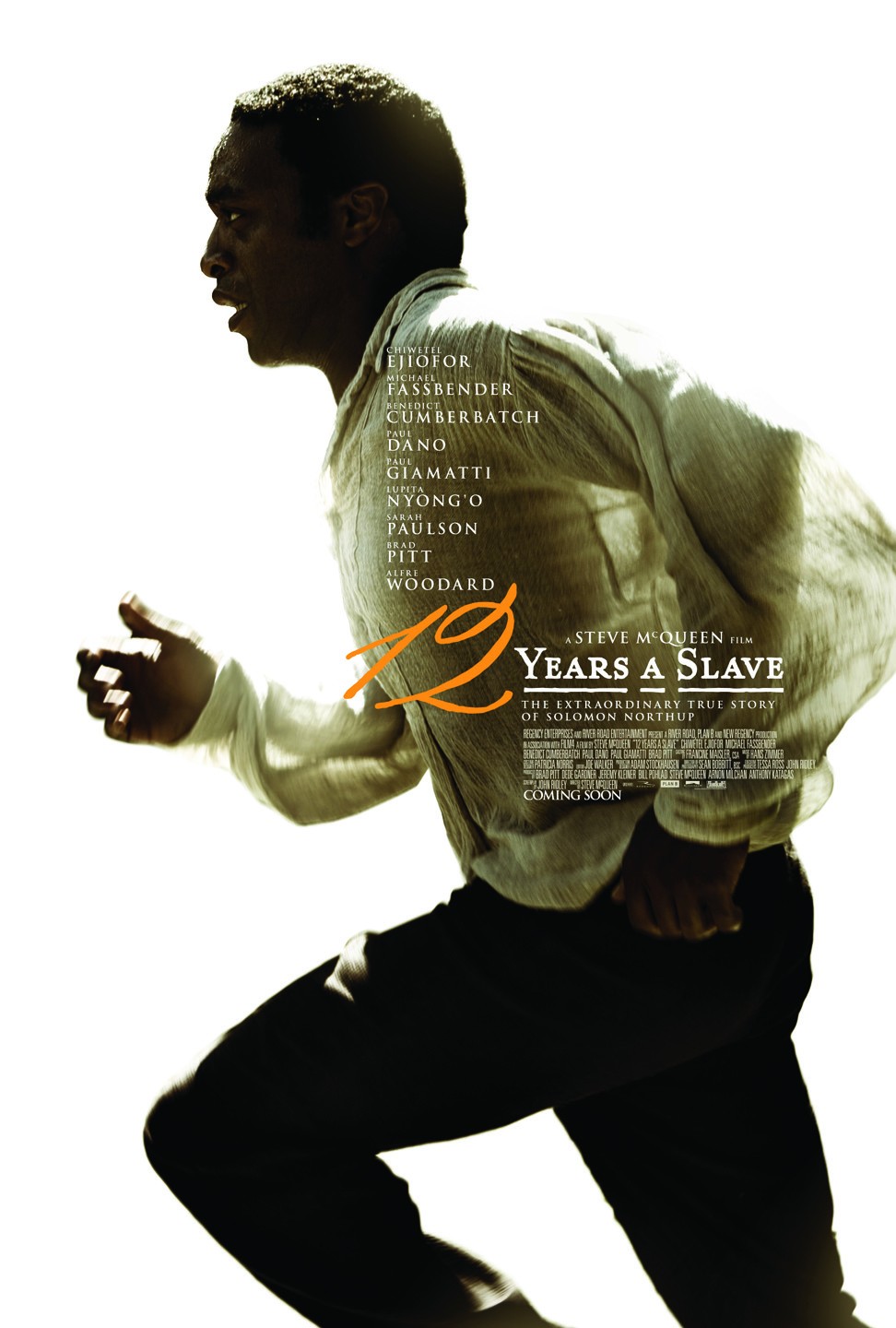
Directed by McQueen from the account written by Solomon Northup, a free man living in New York with his wife and two children in 1841, 12 Years a Slave is a devastating account of one man’s abduction into slavery, and his subsequent experiences on the plantations of Louisiana. Northup is an accomplished musician, well-respected, and flattered when two members of a circus troupe approach him to join their company.  He journeys from New York to Washington with them only to wake up after a night’s drinking to find himself in chains and told he is now a slave; his name is also denied him and he is told he is to answer to Platt.  At first he finds himself at the mercy of (the ironically named) slave trader Freeman (Giamatti), until he is sold, along with a woman called Eliza (Oduye), to plantation owner Mr Ford (Cumberbatch).  Ford is in the process of adding extra buildings to his land, and has a master carpenter Tibeats (Dano) who oversees the construction. Northup impresses Ford with his engineering skills but soon makes an enemy of Tibeats.  Before long, Tibeats pushes Northup too far and Northup beats him with his own whip. Tibeats swears revenge against Northup and returns with two men; they proceed to hang Northup but are stopped by Ford’s overseer, Chapin (J.D. Evermore).  Although Chapin stops Northup from being killed, he leaves him hanging from the tree with his toes barely touching the ground to save himself from being strangled; it’s only when Ford returns at the end of the day that he is cut down.  But Ford’s leniency comes at a price: he must sell Northup on in order to save his plantation from Tibeats’ wrath.

Where Ford has been a considerate and compassionate man, Northup’s new owner, Edwin Epps is anything but.  He has his slaves  whipped if they don’t make the daily quota for picking cotton, and when his wife complains that he is paying too much attention to one of the female slaves, Patsey (Nyong’o), he tells her coldly that he will see the back of her before he will rid himself of Patsey.  Northup becomes Patsey’s confidante, and he does his best to keep Epps from bothering her, but it doesn’t always work.  It’s only when a carpenter named Bass (Pitt) comes to work on the plantation, and speaks of equality, that Northup takes courage and explains his situation.  Bass agrees to help him, and some time later, Northup is freed and reunited with his family.

12 Years a Slave - scene

From the outset, 12 Years a Slave grabs the attention and keeps its audience riveted.  The topic of slavery is one that has been only fitfully addressed in cinema, and while movies such as Amistad (1997), and Amazing Grace (2006) have taken a political approach to the issue, there hasn’t been a movie that has looked at it from both the financial side of things, and the actual day-to-day living experience.  Throughout the movie it’s made clear that slavery is a business, and a lucrative one for people such as the trader Freeman, and for the plantation owners who invest in slaves as a means of reaping huge profits.  Against this wellspring of money, a slave’s life is worth nothing at all, and the movie delivers this message on several occasions.  When Northup is on tiptoe trying not to hang, it’s heartbreaking to see the other slaves carry on with their tasks as if he isn’t there; only by going about their business can they add value to their lives.

12 Years a Slave is also quite graphic in its depiction of the violence endemic in slavery, with one on-screen whipping being truly horrifying, and its the casual nature of it all that the movie depicts so well, along with the hateful racism that fuelled so much of it.  Early on, before Northup is placed with Freeman, he is beaten with a paddle.  The scene is shocking both for what happens to Northup, and for the sustained nature of the beating.  Epps’s wife throws a decanter in Patsey’s face, her racism mixed with jealousy and injured pride.  There are other moments where violence escalates from nothing, and there is a palpable sense of the violent undercurrents that were prevalent during this period.  If the movie presents these aspects unflinchingly, then it is to show the full horror of the constant threat of injury or death that slaves experienced.  (And to anyone who feels these scenes were unnecessary or uncomfortable to watch, then you are missing the point.  The life of a slave was far worse than anything depicted here, and by showing us the things that we do see, the movie reinforces the fact that, so far removed from both those times and those circumstances as we are in our daily lives, we can easily fail to realise how terrible slavery actually was.)

Thankfully, in amongst the brutal violence and the despair there are quiet moments of hope to offset the horror.  Northup’s relationship with Patsey is affecting and desperately sad at the same time, and shows how two people can still retain a measure of their humanity despite existing under appalling conditions.  Thanks to both Ejiofor and Nyong’o, their scenes together are both emotionally charged and riveting viewing.

The heart of the film is Ejiofor’s towering performance, a career best that is breathtaking to watch as he depicts a man who somehow retains his dignity and his sense of self through twelve years of degradation and terror.  Ejiofor holds the attention in every scene he’s in, deflecting focus even from Fassbender, whose performance as Epps is mesmerising in its intensity.  The audience is drawn to Ejiofor as their moral compass and guide; without him, the movie would be a series of vignettes without a central point of reference.  He displays a clear understanding of the emotions that governed Northup’s reactions and response to his situation: the despair, the anger, the resignation to his plight, the fear, the barely acknowledged hope of regaining his freedom, the sadness, the sense of loss, and most effective of all, the will to survive.  It’s a magnificent achievement.

As already mentioned, Fassbender is on brilliant form as the tortured, torturing Epps, adding layers to a character who could have been portrayed more matter-of-factly and with less attention to nuance and interpretation.  His performance is mercurial, adding a sense of uncertainty to Epps that makes his unpredictable nature more dangerous.  His scenes with Ejiofor are akin to an acting masterclass.  In the various supporting roles, Dano stands out as the mealy-mouthed, insecure Tibeats, all puffed-up pride and coiled hostility, while Cumberbatch continues to impress as the fair-minded, socially conscious Ford.  Paulson also impresses as Mistress Epps, her eyes never once betraying any emotion other than disgust.  And making her feature debut, Nyong’o is superb as the object of Epps’s lust, imbuing Patsey with an inner strength and determination that offsets the cruelty she receives at the hands of Epps and his wife.

This is McQueen’s third feature – after Hunger (2008) and Shame (2011) – and serves to reinforce how talented a director he is.  His control of the material is confident and assured, and he elicits strong performances from everyone in the cast.  In conjunction with cinematographer Sean Bobbitt, McQueen places the camera in exactly the right place in each scene, framing the action expertly and with close attention to the physical and emotional requirements of each set-up.  His decision to make 12 Years a Slave has proved to be a wise one, and the way in which he’s overcome the difficulties inherent in telling such a complex story is compelling.

12 Years a Slave is a harrowing, disturbing look at a shameful period in US history, and while some people might say that we don’t need to see the barbarity of the times to know it was evil, a reminder as powerful as this one is should always be welcome.  With stand-out performances, an insightful, intricate script courtesy of John Ridley, and a score by Hans Zimmer that perfectly supports the emotional and dramatic moments in the film, 12 Years a Slave is a movie deserving of everyone’s attention.

Rating: 9/10 – a modern masterpiece, with much to say about the nature of evil as the will to survive it; an engrossing, deeply moving account of one man’s journey through a contemporary hell and his eventual salvation.

Share this:

  • Click to share on X (Opens in new window) X
  • Click to share on Facebook (Opens in new window) Facebook
  • More
  • Click to print (Opens in new window) Print
  • Click to email a link to a friend (Opens in new window) Email
Like Loading...

The Hobbit: The Desolation of Smaug (2013)

23 Monday Dec 2013

Posted by dullwood68 in Movies

≈ 1 Comment

Tags

Benedict Cumberbatch, Bilbo Baggins, Evangeline Lilly, Ian McKellen, J.R.R. Tolkien, Legolas, Literary adaptation, Martin Freeman, Orlando Bloom, Review, Smaug, The Hobbit, The Lord of the Rings

Hobbit The Desolation of Smaug, The

D: Peter Jackson / 161m

Cast: Martin Freeman, Ian McKellen, Richard Armitage, Ken Stott, Benedict Cumberbatch, Orlando Bloom, Evangeline Lilly, Lee Pace, Luke Evans, Stephen Fry, Sylvester McCoy

The Hobbit: An Unexpected Journey (2012) was, in some ways, a difficult movie to appreciate.  As the beginning of what is effectively now a six-film series, the difference in tone and approach threw some viewers who were expecting a match for The Lord of the Rings (2001-3).  Jackson and co-scriptwriters Fran Walsh and Philippa Boyens, and Guillermo del Toro, took the more humorous elements of Tolkien’s novel and weaved them into the story with accomplished ease.  They made several key decisions with the characterisations of the dwarves that left audiences unsure if the comedic aspects were appropriate or in keeping with the overall tone of the trilogy (not to mention the darker trilogy that follows it).  What seemed to be forgotten in the rush to criticise the movie was that it was the first of three: making any kind of criticism at this early stage was actually irrelevant.  As the first two Lord of the Rings movies were largely ignored at the Oscars, only for the third to be so heavily rewarded, so we should wait until all three parts of The Hobbit are released.  Then we can make a proper decision.

What is clear is that with The Hobbit: The Desolation of Smaug, Jackson has hit his stride, and as a result, the trilogy has hit its stride as well.  The exposition of the first movie is largely dismissed with, and the introduction of new characters such as Thranduil (Pace) and Tauriel (Lilly) is handled concisely and with greater attention than before.  There is an even greater focus on action, with the barrel-rolling sequence a highlight, and a greater sense that this movie’s events fit in with, or more appropriately foreshadow, the events of The Lord of the Rings.

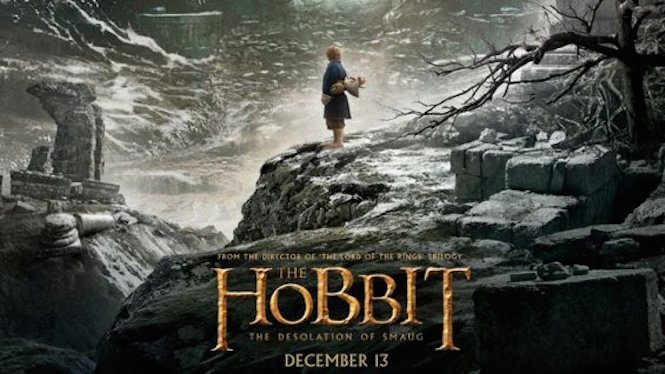
Having survived the attack by orcs at the end of the first movie, Bilbo (Freeman), Thorin (Armitage) and the rest of the dwarves set off into Mirkwood where spiders – and not just any spiders – inhabit the forest.  Meanwhile, Gandalf (McKellen) heads off to Dol Guldur to face the rising power of the Necromancer (Cumberbatch).  The dwarf company, or überfellowship, make it out of Mirkwood only to find themselves captured by elves.  With Bilbo’s help, they escape, and are pursued by orcs, Tauriel – who has developed a bit of a crush on dwarf Kili (Adrian Turner) – and Thranduil’s son Legolas (Bloom).  At Dol Guldur, Gandalf meets up with Radagast the Brown (McCoy) and finds that the Necromancer is preparing an orc army to march against the lands of the west.    The dwarves evade the orcs with the help of Bard the Bowman (Evans).  Bard lives in Lake-town, and he takes Thorin and his band there where they can both tend to Kili, who has been hit by a poisoned orc arrow, and plan the next step of their journey to the Lonely Mountain.  The orcs attack again but not before Thorin has left; Bard helps the dwarves that have been left behind and Tauriel and Legolas join the fray as well.  Bilbo finds the way into the Lonely Mountain where he encounters the dragon Smaug (Cumberbatch), and despite their best attempts the dwarves fail to kill him.  Enraged, Smaug breaks free of the mountain and heads to Lake-town to wreak his revenge.

The movie ends there, rather abruptly too, with only Bilbo’s anguished “What have we done?” to see out proceedings.  As might be expected there has been a large amount of criticism of the movie ending this way, but watching The Desolation of Smaug, and with Smaug’s entrance occurring around the two-hour mark, anyone even half aware of the movie’s running time would have known a resolution to the problem of Smaug was always going to be unlikely.  And it means that The Hobbit: The Battle of the Five Armies (2014) is going to have one hell of a start.

Hobbit The Desolation of Smaug, The - scene

The ending aside, the movie does still suffer from “middle child syndrome”, with too many storylines set up to be resolved in the next one, and the running time feeling a little too long.  Gandalf is sidelined for much of the movie (fairly reflecting the novel), while some of the dwarves are given very little to do indeed – anyone know something specific that Ori or Bifor did?  Radagast gets a cameo this time round (and repeats his bird under the hat trick), Azog (Manu Bennett) cedes his quest for Thorin’s head to Bolg (Lawrence Makoare), and the worst kept secret in town: the identity of the Necromancer, is revealed at last.  Oh, and there’s the weird matter of Legolas sporting contact lenses; it makes him look slightly alien rather than Elvish.

These minor quibbles aside, The Desolation of Smaug is a terrific addition to the complete saga, thrilling, intense, spectacular to look at with even more beautiful New Zealand scenery to devour, a continued line of humour that complements the increasing sombre tone (Legolas’ dismay at seeing a picture of Gloin’s son), the introduction of Lilly as Tauriel (this trilogy’s Arwen), Jackson’s complete mastery of both the material and the visual language needed to present it, a cast that more than matches him for commitment and artistry, and of course, the mighty Smaug, without doubt the most realistic, most impressive dragon ever imagined.  Voiced by Cumberbatch, Smaug is the movie’s highlight: an arrogant, vain, greedy, vicious, preening monster who trades verbal barbs with Bilbo in the movie’s best scenes.  Both Freeman and Cumberbatch are on superb form here, adding layers to their performances that bring out all the subtleties of the dialogue, and keeping the audience riveted as they spar back and forth.

With another year to go before the trilogy’s conclusion, The Hobbit: The Desolation of Smaug is a more than satisfying instalment that works well and impresses on a regular basis.  There’s little doubt that Jackson and co are firing on all cylinders, and if the purists out there are still complaining about the increasing lack of fidelity to the original novel then they’re missing the point: this is an adaptation, and a wonderful one at that.

Rating: 9/10 – a rousing blend of action and spectacle that moves at breakneck pace, The Hobbit: The Desolation of Smaug rarely disappoints; event cinema that we see too little of these days and absolutely best seen in 48hfr on an IMAX screen.

Share this:

  • Click to share on X (Opens in new window) X
  • Click to share on Facebook (Opens in new window) Facebook
  • More
  • Click to print (Opens in new window) Print
  • Click to email a link to a friend (Opens in new window) Email
Like Loading...

Blog Stats

  • 491,450 hits

Recent Posts

  • 10 Reasons to Remember Bibi Andersson (1935-2019)
  • Fantasia (1940)
  • Dances With Wolves (1990) – The Special Edition
  • Kiss of the Spider Woman (1985)
  • The Three Musketeers (1973)

Top Posts & Pages

  • Cardboard Boxer (2016)
    Cardboard Boxer (2016)
  • I Origins (2014)
    I Origins (2014)
  • Carrie (2013)
    Carrie (2013)
  • Hickey (2016)
    Hickey (2016)
  • Logan (2017)
    Logan (2017)
  • Speak (2004)
    Speak (2004)
  • Poster of the Week - For a Few Dollars More (1965)
    Poster of the Week - For a Few Dollars More (1965)
  • Jaws of Justice (1933)
    Jaws of Justice (1933)
  • Lone Survivor (2013)
    Lone Survivor (2013)
  • Iris (2016)
    Iris (2016)
Follow thedullwoodexperiment on WordPress.com

Blogs I Follow

  • Rubbish Talk
  • Film 4 Fan
  • Fast Film Reviews
  • The Film Blog
  • All Things Movies UK
  • Interpreting the Stars
  • Let's Go To The Movies
  • Movie Reviews 101
  • TMI News
  • Dan the Man's Movie Reviews
  • Film History
  • Jordan and Eddie (The Movie Guys)

Archives

  • April 2019 (13)
  • March 2019 (28)
  • February 2019 (28)
  • January 2019 (32)
  • December 2018 (28)
  • November 2018 (30)
  • October 2018 (29)
  • September 2018 (29)
  • August 2018 (29)
  • July 2018 (30)
  • June 2018 (28)
  • May 2018 (24)
  • April 2018 (21)
  • March 2018 (31)
  • February 2018 (25)
  • January 2018 (30)
  • December 2017 (30)
  • November 2017 (27)
  • October 2017 (27)
  • September 2017 (26)
  • August 2017 (32)
  • July 2017 (32)
  • June 2017 (30)
  • May 2017 (29)
  • April 2017 (29)
  • March 2017 (30)
  • February 2017 (27)
  • January 2017 (32)
  • December 2016 (30)
  • November 2016 (28)
  • October 2016 (30)
  • September 2016 (27)
  • August 2016 (30)
  • July 2016 (30)
  • June 2016 (31)
  • May 2016 (34)
  • April 2016 (30)
  • March 2016 (30)
  • February 2016 (28)
  • January 2016 (35)
  • December 2015 (34)
  • November 2015 (31)
  • October 2015 (31)
  • September 2015 (34)
  • August 2015 (31)
  • July 2015 (33)
  • June 2015 (12)
  • May 2015 (31)
  • April 2015 (32)
  • March 2015 (30)
  • February 2015 (37)
  • January 2015 (39)
  • December 2014 (34)
  • November 2014 (34)
  • October 2014 (36)
  • September 2014 (25)
  • August 2014 (29)
  • July 2014 (29)
  • June 2014 (28)
  • May 2014 (23)
  • April 2014 (21)
  • March 2014 (42)
  • February 2014 (38)
  • January 2014 (29)
  • December 2013 (28)
  • November 2013 (34)
  • October 2013 (4)

Create a free website or blog at WordPress.com.

Rubbish Talk

Film 4 Fan

A Movie Blog

Fast Film Reviews

The Film Blog

The official blog of everything in film

All Things Movies UK

Movie Reviews and Original Articles

Interpreting the Stars

Dave Examines Movies

Let's Go To The Movies

Film and Theatre Lover!

Movie Reviews 101

Daily Movie Reviews

TMI News

Latest weather, crime and breaking news

Dan the Man's Movie Reviews

All my aimless thoughts, ideas, and ramblings, all packed into one site!

Film History

Telling the story of film

Jordan and Eddie (The Movie Guys)

Movie Reviews & Ramblings from an Australian Based Film Fan

Privacy & Cookies: This site uses cookies. By continuing to use this website, you agree to their use.
To find out more, including how to control cookies, see here: Cookie Policy
  • Subscribe Subscribed
    • thedullwoodexperiment
    • Join 481 other subscribers
    • Already have a WordPress.com account? Log in now.
    • thedullwoodexperiment
    • Subscribe Subscribed
    • Sign up
    • Log in
    • Report this content
    • View site in Reader
    • Manage subscriptions
    • Collapse this bar
 

Loading Comments...
 

    %d