• 10 Reasons to Remember…
  • A Brief Word About…
  • About
  • For One Week Only
  • Happy Birthday
  • Monthly Roundup
  • Old-Time Crime
  • Other Posts
  • Poster of the Week
  • Question of the Week
  • Reviews
  • Trailers

thedullwoodexperiment

~ Viewing movies in a different light

thedullwoodexperiment

Tag Archives: Community

The Golem (2018)

12 Tuesday Feb 2019

Posted by dullwood68 in Movies

≈ Leave a comment

Tags

Community, Doron Paz, Drama, Hani Furstenberg, History, Horror, Ishai Golan, Israel, Lithuania, Plague, Review, Yoav Paz

D: Yoav Paz, Doron Paz / 95m

Cast: Hani Furstenberg, Ishai Golan, Kirill Cernyakov, Brynie Furstenberg, Lenny Ravich, Alexey Tritenko, Adi Kvetner, Mariya Khomutova, Veronika Shostak, Konstantin Anikienko

Lithuania, 1763. In a small isolated village made up of an entirely Jewish community, Hanna (Hani Furstenberg) and Benjamin (Golan), are a couple who are struggling to have a second child following the death of their first born, Joseph, seven years before. Their marriage seems mired in the expectations of the village elders, one of whom suggests Benjamin should renounce Hanna and take another wife. However, these considerations take a backseat with the arrival of Vladimir (Tritenko). Vladimir has come from a nearby, plague-ravaged village and his eldest daughter is dying, while no one in Hanna’s community is affected. Threatening to kill everyone and burn their village to the ground unless his daughter is saved, the task is taken up by the village’s healer, Perla (Brynie Furstenberg). But Hanna bristles under Vladimir’s threats, and challenges the elders to create a Golem, an ancient creature out of Jewish myth that could defend them. When they refuse, Hanna takes matters into her own hands, and brings the creature to life herself. What she doesn’t expect is the form the Golem takes: that of a young boy who reminds her too much of her lost son…
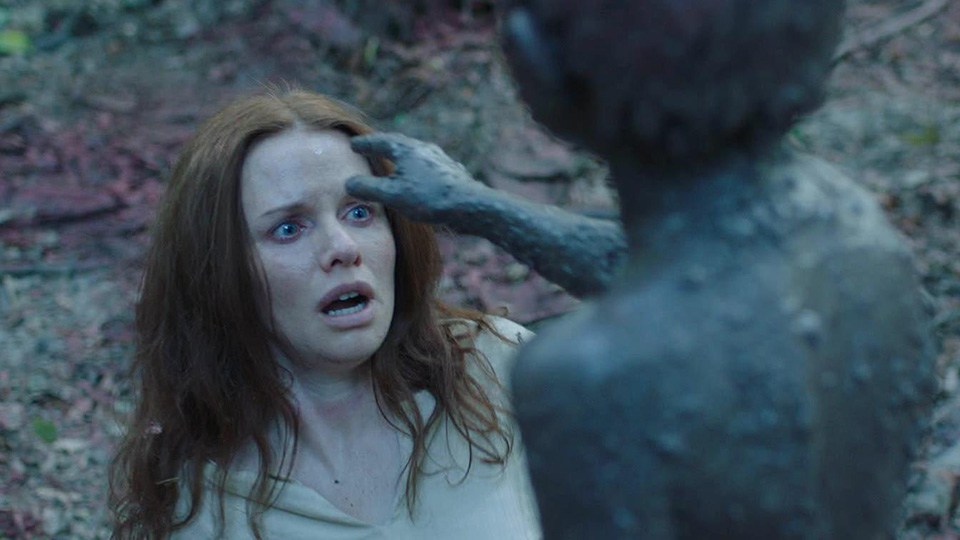
Taking some of its inspiration from The Witch (2015), the latest outing from the Paz brothers – fans of Jeruzalem (2015) will be pleased to know there’s a sequel in the works – is a sterling effort that does its best to explore the myth of the Golem, while placing the creature within a convincing setting. Though it doesn’t explain why Jewish lore would have such an acknowledged demon at its (potential) disposal, Ariel Cohen’s screenplay does highlight the circumstances under which it might be called upon, and then mixes those circumstances with the grief and sadness felt by Hanna over the death of her son. Though Hanna does come across as something of a modern day heroine, and her challenges to the orthodoxy of her community go unpunished, her motives are predominantly maternal; she’s being protective, albeit in a way that may prove more dangerous to the community than Vladimir’s murderous intentions. Her motives devolve with the Golem’s arrival, and the bond they share reawakens the feelings she had when Joseph was alive. And through all of this, there’s a palpable sense of threat from the Golem, its blank stare hiding much darker intentions than those it has been brought to life for.

Hanna’s maternal instincts inevitably lead to tragedy, and thanks to a first-rate performance from Hani Furstenberg, there’s an emotive undercurrent to events that lifts the material and makes it more than just a period horror movie with a generous sampling of gore effects. The Paz brothers also know when to focus on character over action, and the opening scenes establish both the sense of a tight-knit community, and a number of the stories that exist within that community, from the neighbouring widow who may be the second wife Benjamin needs, to Hanna’s sister who is on the verge of getting married. Vladimir’s arrival allows the movie to add a layer of historical persecution to the mix (his threats amount to a promise of a pogrom), and to highlight the elders’ belief in the power of prayer, but without forgetting that sometimes violence has to be met with violence. That these elements are present is a tribute to the density and complexity of Cohen’s screenplay, and the Paz brothers’ approach to the material, making the movie as a whole more involving and more effective as a result. With bleak, shadowy cinematography by Rotem Yaron, and  a pervading sense of menace throughout, this is necessarily grim stuff, and all the better for it.

Rating: 8/10 – it’s not often that a horror movie takes the time to explore the nature of evil, but it’s one of many surprises that The Golem has to offer, along with a lead female character who drives the story forward, and an ending that is both poignant and bittersweet; though there are moments where the dialogue sounds altogether too modern, and Hanna’s actions appear to be in defiance of historical accuracy, this is still an impressive outing from the Paz brothers, and one that augurs well for their future projects.

Share this:

  • Click to share on X (Opens in new window) X
  • Click to share on Facebook (Opens in new window) Facebook
  • More
  • Click to print (Opens in new window) Print
  • Click to email a link to a friend (Opens in new window) Email
Like Loading...

The Giver (2014)

07 Sunday Dec 2014

Posted by dullwood68 in Movies

≈ 3 Comments

Tags

Brenton Thwaites, Community, Drama, Jeff Bridges, Katie Holmes, Literary adaptation, Lois Lowry, Meryl Streep, Phillip Noyce, Review, Sci-fi, The Ruin

Giver, The

D: Phillip Noyce / 97m

Cast: Brenton Thwaites, Jeff Bridges, Meryl Streep, Alexander Skarsgård, Katie Holmes, Odeya Rush, Cameron Monaghan, Taylor Swift, Emma Tremblay

In the future, an event known as the Ruin has left the remains of North American society living in communities with rigid rules and hierarchies, and with no memory of the past. The stronger emotions such as love and fear have been quelled, leaving the world a literally grey, colourless place. On their eighteenth birthdays, friends Jonas (Thwaites), Fiona (Rush) and Asher (Monaghan), attend a ceremony that determines their roles as adults in the community. Fiona is given the role of Nurturer, working with newborns in the Nurturing Centre, while Asher is chosen to be a drone pilot. Jonas, however, is initially passed over, until the Chief Elder (Streep) decrees that he will become the next Receiver of Memories.

The next day, Jonas begins his training with an old man who is the current Receiver (Bridges). The old man – the Giver – explains that he is the repository of all the memories of the past, from even before the Ruin, and this knowledge is used by the Elders to provide them with advice and guidance. Meanwhile, Jonas’s father (Skarsgård), a doctor at the Nurturing Centre, has brought home a sickly infant called Gabriel in the hope that more personal care can improve his health.

Jonas’s training continues and slowly the emotions that emerge lead to Jonas beginning to see colours instead of the grey. As Jonas starts to share his newfound experiences with Fiona and Asher, his increasingly erratic behaviour (by community standards) begins to attract the attention of the Chief Elder. She becomes worried that Jonas’ training won’t be successful, and stresses this to the Giver. To make matters more complicated, Jonas discovers that Gabriel has the same birthmark that he does, and that this means Gabriel will grow up to be a Receiver.

However, the next stage of Jonas’ training sees him learn about warfare and death, and he comes to realise that the community practices selective euthanasia as a way of maintaining the status quo, and of weeding out any infants who are too weak or sickly. When he learns this, he wants nothing more to do with being a Receiver, but then Gabriel is returned to the hospital to be “released”. Unable to let Gabriel be killed, Jonas has no option but to rescue the infant, and head for the boundary between the community and the rest of the world. If he can get them both safely across the boundary, then they will both be safe, and the community will undergo the very change the Elders are most frightened of.

Giver, The - scene

While very similar in its set up to Divergent (2014), The Giver – based on the young adult novel by Lois Lowry – is lacking in many of the areas that made that particular movie so surprisingly effective. Even though the script is a largely faithful adaptation by screenwriters Michael Mitnick and Robert B. Weide, The Giver suffers from having a bland central character in Jonas, a social structure that clearly hasn’t done away with the emotions it abhors, and chief amongst a myriad of other problems, doesn’t even attempt to make any sense.

This is an adaptation where the faults of the original novel have been translated directly onto the screen, and where the novel’s flawed logic has been allowed to dictate events that should have been tightened up dramatically, and which should have seen the characters given a lot more to do than behave as nothing more than genre stereotypes. Good science fiction that depicts a future society – especially one born out of the ruins of an older social structure – always links back to that previous structure in ways that resonate and make an audience either blink in recognition or baulk in horror at the mistakes being repeated. All The Giver does is say, Here’s the community, here’s the set up, no one sees colours, nobody understands the concept of death, parents aren’t really parents, and there’s a whole other world out there but no one’s allowed to see it. And then: just accept it.

But even if the audience were to accept the world of The Giver, even if disbelief could be suspended, it would have to be suspended with pretty much every single scene. There are too many occasions where the viewer’s credulity is stretched to breaking point. Throughout, Jonas behaves as if he’s forgotten the community is littered with surveillance cameras, choosing to carry out his small rebellions while being watched continually. And then, the extent of what he’s been doing is only discovered once he’s chosen to flee with Gabriel (wasn’t anyone watching up ’til then? If not, why not?). It’s also clear that infants such as Gabriel aren’t allowed to stay with families they’re not assigned to, so why is Jonas’s father allowed to bring him home (other than to suit the needs of the story)? And why, in a society that is apparently crime-free and has never been the subject of attack from any other survivors of the Ruin, does it have a security force, or fighter drones to patrol its airspace? These and many more questions remain unanswered, but perhaps the biggest question of all is one reserved for the extended sequence that occurs once Jonas and Gabriel have fled the community and are on their way to the boundary: namely, when were pyramids built in North America?

With the material proving so shoddy and conflicted, audiences are likely to fall back on the performances for comfort but even here they’ll be disappointed. Thwaites seems a good choice for Jonas but within the first ten minutes it becomes obvious that the few demands of the role aren’t going to be met. He’s adequate, but in the way that allows some actors to appear to be giving a more competent performance than they really are. Surprisingly, he’s matched by Streep. Here, the three-time Oscar winner dons an unflattering wig and adopts the air of someone who’s signed on without realising just how bad the script is. As the Giver, Bridges – for whom this has been something of a pet project over the years – brings a gravelly voice and the occasional flash of emotion to his role, but even he can’t inject any life into proceedings, leaving his scenes with Thwaites as near to lifeless as you can get without needing to call an ambulance. (And spare a thought for Holmes, required to do little more than frown a lot and remind Jonas to be more precise in his speech; what a stretch.)

In the hands of veteran Noyce, The Giver has that Hollywood sheen that keeps things looking interesting even when they’re not, and with editor Barry Alexander Brown, manages to keep things moving, especially during a difficult final third that sees the script ramp up the awkwardness and the clumsiness of proceedings to such a point that some viewers may give up out of mounting frustration. It is a handsomely mounted production however (once the grey gives way to full colour), and Marco Beltrami’s score adds a much needed fillip to the overall blandness, but these are minor successes in a movie that remains sluggish and uninspired.

Rating: 4/10 – an unsuccessful adaptation that tests the patience of its audience, and which raises too many questions it has no intention of answering, The Giver is yet another teen vision of a future dystopian society that offers complacency of ideas over originality of thought; dull and meandering, this is one future tale that rarely warrants the attention it’s seeking.

Share this:

  • Click to share on X (Opens in new window) X
  • Click to share on Facebook (Opens in new window) Facebook
  • More
  • Click to print (Opens in new window) Print
  • Click to email a link to a friend (Opens in new window) Email
Like Loading...

Apron Strings (2008)

04 Tuesday Nov 2014

Posted by dullwood68 in Movies

≈ 1 Comment

Tags

Community, Drama, Estrangement, Homophobia, Indian cuisine, Indian culture, Jennifer Ludlam, Laila Rouass, Leela Patel, Nathan Whitaker, New Zealand, Racism, Review, Scott Wills, Sisters, Vaele Sima Urale

Apron Strings

D: Vaele Sima Urale / 90m

Cast: Laila Rouass, Scott Wills, Jennifer Ludlam, Nathan Whitaker, Leela Patel, Jodie Rimmer, Kate Harcourt, Peter Elliott, Gary Young

Michael (Whitaker) is a young Indian student whose mother, Anita (Rouass) is estranged from her sister, Tara (Patel).  On the pretext of doing a college project, he visits his aunt at the restaurant she runs, while keeping his visit a secret from Anita.  He and Tara hit it off and he visits more often until she offers him a job there.  Anita, meanwhile, is at odds with the producers of the TV cookery programme she hosts: about the content, about the recipes, and about the costumes she’s asked to wear.

One of Tara’s regular customers is Barry (Wills).  He’s a middle-aged man still living at home with his mother, Lorna (Ludlam) and his Nan (Harcourt).  Barry is drifting through life looking for one get-rich-quick scheme to pay off after another, and he sponges off his mother – who runs a cake shop – with unvarying results: the money is always wasted.  Lorna’s attempts at tough love are undermined by her soft-hearted nature, even when Barry gets into debt through his attempts to get local baker Minh (Young) to buy out his mother’s business.

As Michael gets to know his aunt, and the family history, he begins to pull away from his mother.  This only adds to the anger she feels over her cookery programme, and their relationship suffers even further.  Michael spends more time at Tara’s restaurant until, suspicious of what her son has been doing, Anita follows him there.  Meanwhile, Lorna also has to deal with the return of her daughter, Virginia (Rimmer), several months pregnant and refusing to take on her mother’s ideas of conformity.  With passions running high in both families, each member has to look at themselves before they can make peace with each other.  But can they?

MCDAPST EC005

A subtly ambitious tale that takes in themes of racism, community, homophobia – Michael is gay – injured pride, personal responsibility and motherhood, Apron Strings is a small-scale drama that tells its various stories with simple precision throughout.  Both main stories involve mothers who have become distant from their sons, and who no longer understand them.  The blame for this seems squarely laid at the doors of Anita and Lorna, but it’s offset by their unswerving love for their children, as both women strive to ensure their children are happy.  The movie shows how difficult it can be to be both supportive and unsupportive depending on the situation, and how walking such a tightrope can backfire on the mother.

The movie also shows us how striking out on their own can undermine the best intentions of the two sons.  Michael aims to reunite Anita and Tara but he’s unprepared for the emotions that learning about his aunt and his mother’s fractured relationship are awakened in him.  He finds it difficult to reconcile the image he has of his mother with that of the proud young woman who made a difficult choice in her youth and has fought hard not to let that decision define her.  With Michael so sure of his racial identity, and having such a strong sense of family, that his mother has turned her back on all that, proves too much of a shock.  And yet, by being gay, he runs the risk of his own community rejecting him, making his own need to make a decision about his future all the more important.

Alternately, Barry is a lazy conniver, a wastrel who thinks being rich will solve all his problems, and the problems he perceives his mother has.  He’s the classic underachiever who thinks he’ll make his mother proud by hitting the jackpot, but he fails to recognise that she loves him all the same, and would do even if he was working at a mundane nine-to-five job, and as long as he was content.  But Barry is restless, with no chance of getting a job, or beginning a relationship, and with no pride in his appearance.  He struggles with himself and rebels against his mother’s hopes for him, failing time after time and never learning from the experience.

As the two mothers trying hard to connect with their sons, Rouass and Ludlam both turn in polished performances that make the audience waver in their sympathies for them, as each woman is allowed to appear strong and determined and yet flawed at the same time.  Rouass is at her best when railing against the constraints Anita believes her cultural background have placed on her, and she simmers with an anger that clearly has deep-seated roots.  It’s an impressive performance, a precise, detailed characterisation that is at once charming and distressing in its emotional candour.  Ludlam is equally good, Lorna’s tired efforts to rein in her best intentions and play the hard line blunted continually by what she sees as the need to be a caring, though accommodating mother.  She too is suffused with anger, but it’s an anger that has been compromised over time and it no longer carries the emotional weight that would enable Lorna to overcome the inadequacies she feels in dealing with her son (and her daughter).

Apron Strings - scene2

With two such strong, committed performances, it’s reassuring that under the equally strong and committed direction of Urale – making her feature film debut – the other performances aren’t overwhelmed in the process.  Wills plays Barry as a sad, desperate individual with few redeeming qualities but who is strangely sympathetic as well, a neat trick given the levels of perfidy that Barry will stoop to.  Patel provides the cultural and racial grounding that informs the audience, and paints a moving portrait of a woman whose sense of family obligation has paved the way for her own happiness and sense of purpose in life.  And Michael’s sense of confusion and anger over what he perceives is his mother’s betrayal of her heritage is neatly handled by Whitaker, as well as his conflicted emotions.

Each of these performances wouldn’t be quite so good if it wasn’t for the carefully constructed and multi-layered screenplay by Shuchi Kothari.  Her only feature length screenplay to date, it contains – and maintains – a level of detail that makes it easy for Urale to deliver an affecting, quietly moving piece that looks at the generational divide evident in today’s society, and which does its best to show that bridges can be built when the willingness is there on both sides.

Rating: 8/10 – a moving portrait of two families struggling to deal with the emotional fallout from unfulfilled dreams and desires, Apron Strings is a finely tuned drama that deserves a wider audience; and the scenes of Indian food being prepared are as mouth-watering as you’d expect.

Share this:

  • Click to share on X (Opens in new window) X
  • Click to share on Facebook (Opens in new window) Facebook
  • More
  • Click to print (Opens in new window) Print
  • Click to email a link to a friend (Opens in new window) Email
Like Loading...

Blog Stats

  • 486,609 hits

Recent Posts

  • 10 Reasons to Remember Bibi Andersson (1935-2019)
  • Fantasia (1940)
  • Dances With Wolves (1990) – The Special Edition
  • Kiss of the Spider Woman (1985)
  • The Three Musketeers (1973)

Top Posts & Pages

  • Lost for Life (2013) - Another Look
    Lost for Life (2013) - Another Look
  • Lost for Life (2013)
    Lost for Life (2013)
  • About
    About
  • Mr. Topaze (1961)
    Mr. Topaze (1961)
  • Shock and Awe (2017)
    Shock and Awe (2017)
  • Hunt for the Wilderpeople (2016)
    Hunt for the Wilderpeople (2016)
  • Cardboard Boxer (2016)
    Cardboard Boxer (2016)
  • Billy Lynn's Long Halftime Walk (2016)
    Billy Lynn's Long Halftime Walk (2016)
  • Winter's Tale (2014)
    Winter's Tale (2014)
  • 10 Reasons to Remember Arthur Hiller (1923-2016)
    10 Reasons to Remember Arthur Hiller (1923-2016)
Follow thedullwoodexperiment on WordPress.com

Blogs I Follow

  • Rubbish Talk
  • Film 4 Fan
  • Fast Film Reviews
  • The Film Blog
  • All Things Movies UK
  • Interpreting the Stars
  • Let's Go To The Movies
  • Movie Reviews 101
  • TMI News
  • Dan the Man's Movie Reviews
  • Film History
  • Jordan and Eddie (The Movie Guys)

Archives

  • April 2019 (13)
  • March 2019 (28)
  • February 2019 (28)
  • January 2019 (32)
  • December 2018 (28)
  • November 2018 (30)
  • October 2018 (29)
  • September 2018 (29)
  • August 2018 (29)
  • July 2018 (30)
  • June 2018 (28)
  • May 2018 (24)
  • April 2018 (21)
  • March 2018 (31)
  • February 2018 (25)
  • January 2018 (30)
  • December 2017 (30)
  • November 2017 (27)
  • October 2017 (27)
  • September 2017 (26)
  • August 2017 (32)
  • July 2017 (32)
  • June 2017 (30)
  • May 2017 (29)
  • April 2017 (29)
  • March 2017 (30)
  • February 2017 (27)
  • January 2017 (32)
  • December 2016 (30)
  • November 2016 (28)
  • October 2016 (30)
  • September 2016 (27)
  • August 2016 (30)
  • July 2016 (30)
  • June 2016 (31)
  • May 2016 (34)
  • April 2016 (30)
  • March 2016 (30)
  • February 2016 (28)
  • January 2016 (35)
  • December 2015 (34)
  • November 2015 (31)
  • October 2015 (31)
  • September 2015 (34)
  • August 2015 (31)
  • July 2015 (33)
  • June 2015 (12)
  • May 2015 (31)
  • April 2015 (32)
  • March 2015 (30)
  • February 2015 (37)
  • January 2015 (39)
  • December 2014 (34)
  • November 2014 (34)
  • October 2014 (36)
  • September 2014 (25)
  • August 2014 (29)
  • July 2014 (29)
  • June 2014 (28)
  • May 2014 (23)
  • April 2014 (21)
  • March 2014 (42)
  • February 2014 (38)
  • January 2014 (29)
  • December 2013 (28)
  • November 2013 (34)
  • October 2013 (4)

Blog at WordPress.com.

Rubbish Talk

Film 4 Fan

A Movie Blog

Fast Film Reviews

The Film Blog

The official blog of everything in film

All Things Movies UK

Movie Reviews and Original Articles

Interpreting the Stars

Dave Examines Movies

Let's Go To The Movies

Film and Theatre Lover!

Movie Reviews 101

Daily Movie Reviews

TMI News

Latest weather, crime and breaking news

Dan the Man's Movie Reviews

All my aimless thoughts, ideas, and ramblings, all packed into one site!

Film History

Telling the story of film

Jordan and Eddie (The Movie Guys)

Movie Reviews & Ramblings from an Australian Based Film Fan

Privacy & Cookies: This site uses cookies. By continuing to use this website, you agree to their use.
To find out more, including how to control cookies, see here: Cookie Policy
  • Subscribe Subscribed
    • thedullwoodexperiment
    • Join 481 other subscribers
    • Already have a WordPress.com account? Log in now.
    • thedullwoodexperiment
    • Subscribe Subscribed
    • Sign up
    • Log in
    • Report this content
    • View site in Reader
    • Manage subscriptions
    • Collapse this bar
 

Loading Comments...
 

    %d