• 10 Reasons to Remember…
  • A Brief Word About…
  • About
  • For One Week Only
  • Happy Birthday
  • Monthly Roundup
  • Old-Time Crime
  • Other Posts
  • Poster of the Week
  • Question of the Week
  • Reviews
  • Trailers

thedullwoodexperiment

~ Viewing movies in a different light

thedullwoodexperiment

Tag Archives: Confession

The Third Murder (2017)

04 Wednesday Apr 2018

Posted by dullwood68 in Movies

≈ Leave a comment

Tags

Confession, Crime, Drama, Fukuyama Masaharu, Japan, Kore-eda Hirokazu, Murder, Review, Sandome no satsujin, Thriller, Trial, Yakusho Kôji
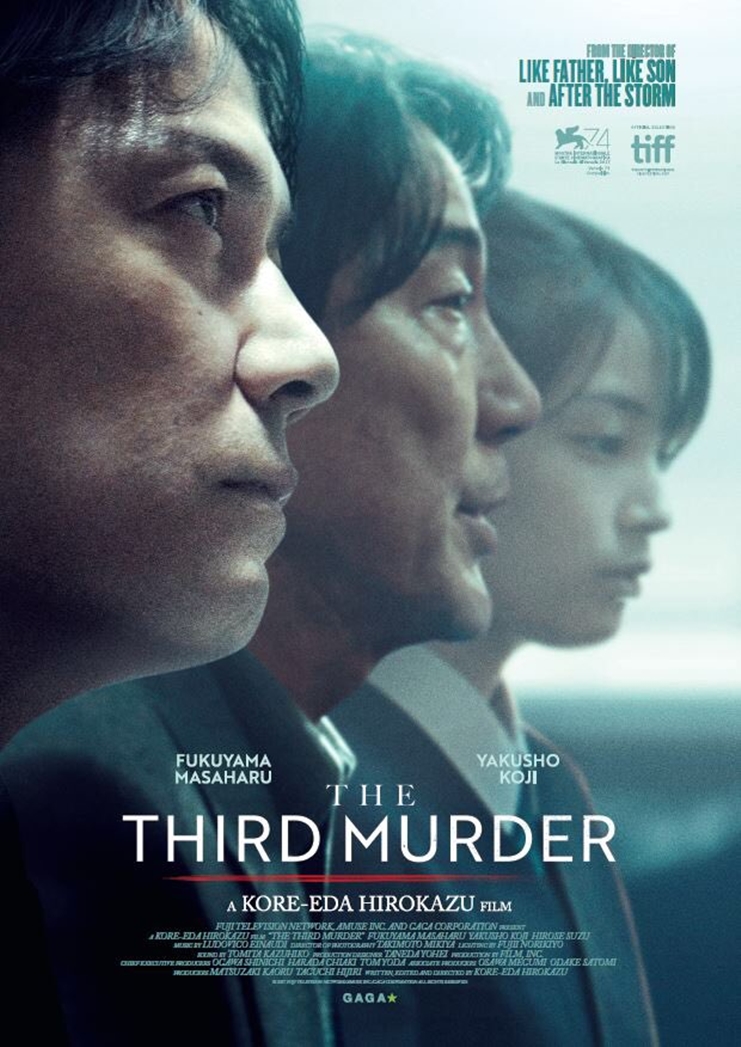
Original title: Sandome no satsujin

D: Kore-eda Hirokazu / 125m

Cast: Fukuyama Masaharu, Yakusho Kôji, Hirose Suzu, Saitô Yuki, Yoshida Kōtarō, Mitsushima Shinnosuke, Matsuoka Izumi, Ichikawa Mikako, Makita Aju

An apparently disgruntled ex-employee persuades the chairman of the company that fired him to go with him to the side of a river at night. There, the ex-employee, named Misumi (Yakusho), kills the chairman and sets light to the body. Misumi is arrested and charged with robbery with homicide (the chairman’s wallet is found on him). Misumi confesses to the crime, though when his initial lawyer Settsu (Yoshida) brings in a hot shot lawyer called Shigemori (Fukuyama), Shigemori begins to have doubts about Misumi’s confession and what actually happened when the chairman was killed. Soon, the chairman’s wife, Yamanaka (Saitô), and his daughter, Sakie (Hirose), are revealed to have things to hide, while there are echoes of a previous crime committed by Misumi thirty years before when he killed two debt collectors. In the run up to the trial, Misumi’s story changes at various times, making it difficult to get at the truth of what happened, and making it difficult for Shigemori to mount a good defence. With his client obscuring matters at every turn, Shigemori finds himself almost desperate to learn if Misumi is really guilty or truly innocent…
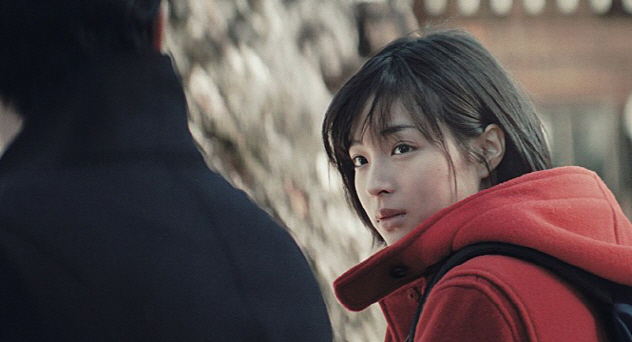
A legal drama-cum-thriller, The Third Murder isn’t quite the riveting experience you might hope for – its pace is too slow for that – but it is a compelling examination of the Japanese legal system, where the accused’s guilt or innocence isn’t as important as getting the charges right (or sometimes, the wording of the charges). Of course, the complexities of the Japanese legal system don’t seem like a viable basis for a legal thriller, but in the hands of Kore-eda (who spent several months observing lawyers carrying out mock trials in order to write the screenplay), they form the bedrock on which the wider story is told. With Kore-eda showing us the murder right at the start, and making it clear that Misumi is responsible, doubt is sown through the exploration of the circumstances leading up to the crime. Some of Misumi’s story appears contradictory, and circumstantial evidence appears to paint a potentially different story. And when the chairman’s wife and daughter appear to have colluded in their own separate ways with Misumi, his motive for the murder becomes less straightforward than it had at the beginning. With the narrative shifting at random, the truth – whatever that may be – becomes something that’s slippery and indistinct.

Kore-eda assembles the various layers of Misumi’s story with a great deal of skill, and puts particular emphasis on the scenes where Shigemori visits Misumi in prison. Thanks to Kore-eda’s skill as a director, and Fukuyama and Yakusho’s committed performances, these scenes are less a battle of wits and more a battle for understanding on both sides. There’s a genuine emotional heft to these scenes, and the final confrontation between them sees Kore-eda overlay their heads in a shot that highlights just how important their relationship has become to them. As already mentioned, the movie is slow-paced, but effectively so, and there’s a melancholy feel to much of the material that suits it. The movie looks tremendous as well, thanks to Kore-eda’s decision to shoot in the CinemaScope format, something the writer-director hasn’t used before. As a result, Takimoto Mikiya’s cinematography is often absurdly beautiful to look at, especially when Shigemori and his assistant, Kawashima (Mitsushima) visit the snow-covered area where Misumi committed his first two murders. There’s much more to enjoy, including a fine, understated performance from Hirose, and a subtly emotive score from the under-used Ludovico Einaudi.

Rating: 8/10 – perhaps not everyone will be enamoured of Kore-eda’s latest feature, but The Third Murder sees him on very good form indeed, and creating an intelligent and challenging movie that doesn’t go out of its way to explain everything that’s happening; with its themes of trust and culpability running throughout the movie and affecting how the main characters behave, this is absorbing stuff indeed, and well worth watching if you’re in the mood for something a little different.
Share this:

  • Click to share on X (Opens in new window) X
  • Click to share on Facebook (Opens in new window) Facebook
  • More
  • Click to print (Opens in new window) Print
  • Click to email a link to a friend (Opens in new window) Email
Like Loading...

Murder on a Sunday Morning (2001)

09 Sunday Jul 2017

Posted by dullwood68 in Movies, Review

≈ Leave a comment

Tags

Ann Finnell, Brenton Butler, Confession, Documentary, Jacksonville, Jean-Xavier de Lestrade, Murder trial, Oscar winner, Patrick McGuinness, Review, True story

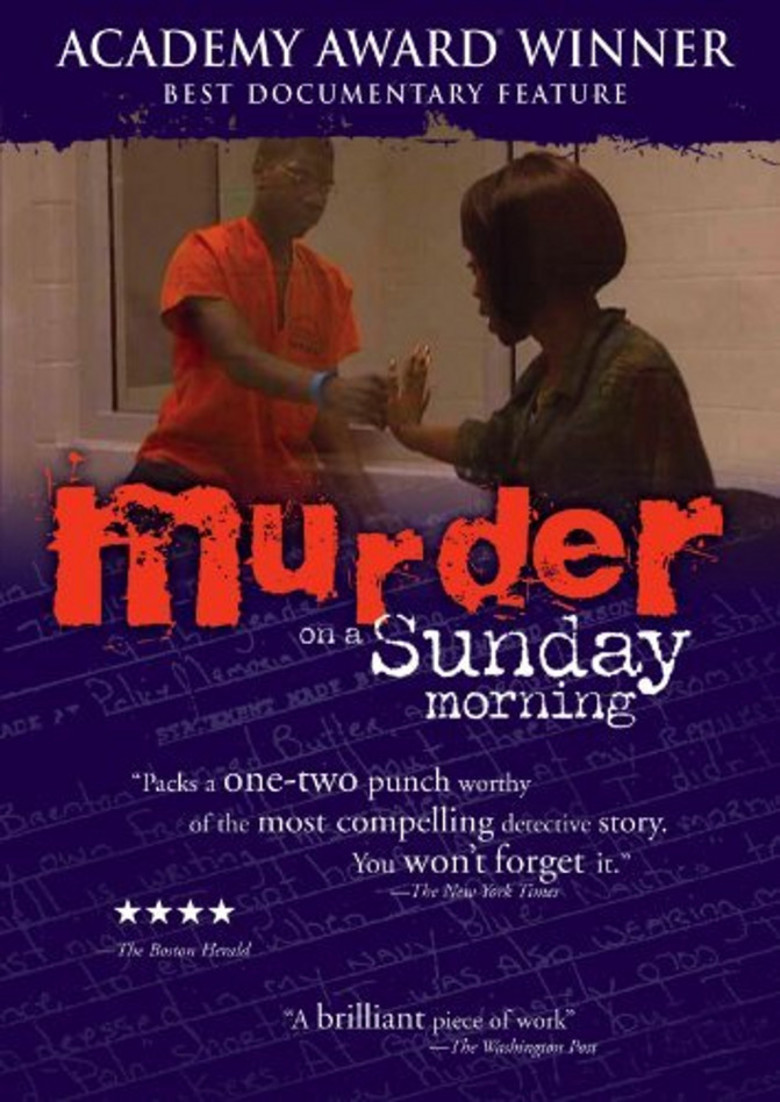
Original title: Un coupable idéal

D: Jean-Xavier de Lestrade / 111m

With Patrick McGuinness, Ann Finnell, James Williams, Michael Glover, Dwayne Darnell, Brenton Butler, Melissa Butler, James Stephens

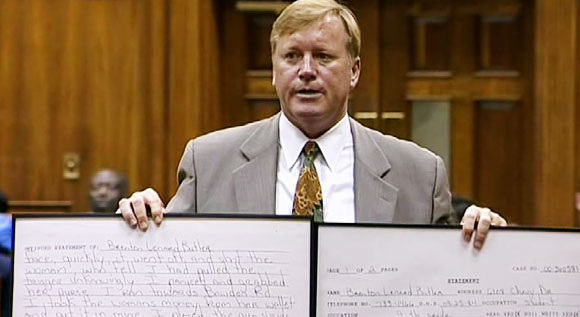
On May 7th 2000, outside a Ramada Inn in Jacksonville, Florida, a vacationing couple, James and Mary Ann Stephens, were accosted by a black man with a gun. Within seconds he had shot Mary Ann Stephens in the face, killing her instantly. He ran off with her bag, which contained her purse (which had around $1200 inside it), and other items. The murder took place at approximately 7:30 in the morning. A description of the assailant was broadcast to police vehicles in the area, with the warning that he was likely to be armed and dangerous. Around two and a half hours later, fifteen-year-old Brenton Butler was stopped by two officers in a police cruiser; he was on his way to a local Blockbuster Video store to drop off a job application. He was taken to the Ramada Inn where James Stephens identified him as the man who had killed his wife. Butler was duly arrested, and during his questioning by the detectives assigned to the case, he signed a confession. The case went to trial later on in 2000.

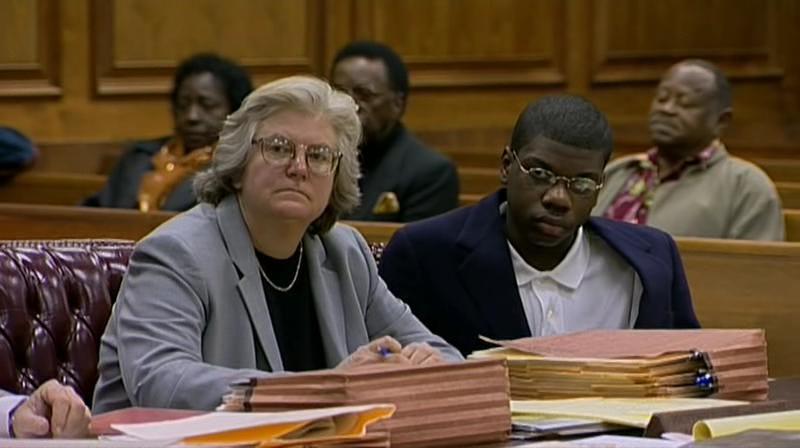
An open and shut case, yes? Certainly the Jacksonville Sheriff’s Department thought so. Thanks to James Stephens and the certainty he showed in identifying Butler as the killer, the police looked no further than the teenager they had in custody. Not so surprising you might say. And you’d wouldn’t necessarily be wrong. But Murder on a Sunday Morning highlights the dreadful way in which the detectives on the case, James Williams and Dwayne Darnell, along with a colleague, Michael Glover, did nothing to properly investigate the case, but did all they could to coerce Butler into making a confession (which, in reality, he never did). As a miscarriage of justice, it’s frightening. As a cautionary tale about the perils of “swift justice” it’s also alarming. As a vindication of “the best legal system in the world” (a direct quote from the trial judge, Wendell Waddell III), it’s on shakier ground. This is a case that should never have gone to trial. The police knew they didn’t have a case, the State Attorney knew they didn’t have a case, but the trial went ahead anyway.

Thank heavens then, for Patrick McGuinness and Ann Finnell, two lawyers appointed by the Public Defenders Office to represent Butler at trial. It didn’t take them long to realise that the prosecution’s case was flimsy, and it didn’t take them long to work out a strategy for Butler’s defence that would be effective in exposing the police investigation for what it really was: non-existent. And thanks to Jean-Xavier de Lestrade’s excellent documentary, we can see how McGuinness and Finnell took on the prosecution’s case and dismantled it piece by piece. de Lestrade and his French crew were there from the time McGuinness and Finnell were appointed, all the way through the pre-trial period as they made their own enquiries, and then at the trial itself, recording the key exchanges that highlighted the police’s laissez faire attitude and their unwillingness to mount a proper investigation.

The movie adopts a straightforward, linear approach that allows the viewer to become increasingly involved with the case and the trial, and with Butler’s family as they try to come to terms with the enormity of what’s happened to their son. The courtroom scenes are mesmerising. McGuinness is like a quietly spoken pitbull, prodding and poking at the detectives and getting them to admit to their own inadequacies as police officers. Away from the courtroom, the chain-smoking McGuinness reveals his disdain for the detectives, and points out that if he has no respect for a police officer then he won’t address him by his rank; McGuinness wants that officer to be annoyed, to become antagonistic perhaps, because then they’ll trip themselves up and make his job that much easier. He doesn’t have to worry, or put so much effort in. Williams and Darnell and Glover – they do all the work for him. Their complacency is his best weapon.

As well as its linear approach, the movie is free from any frills or unnecessary embellishments, and it’s this plain and simple way of addressing the material that makes Murder on a Sunday Morning such a compelling documentary. When the story is this good, you don’t need to make it overly dramatic or accentuate certain points to be effective, and de Lestrade is wise enough to let the story tell itself. As the depth and breadth of the police’s ineptitude is revealed, the viewer is likely to be shaking their head in disbelief and wondering how on earth Butler’s arrest and subsequent trial could have been allowed to happen in the first place. But de Lestrade and his team show you exactly how it happened, and why (hey, let’s make sure this murder doesn’t affect the number of tourists that visit each year), and they also ensure that nothing is either lost in translation or through Ragnar Van Leyden and Pascal Vernier’s rigorous editing. Each point that the defence raises in opposition to the prosecution’s case is recorded precisely and with as much impact as possible.

By the time the trial reaches its conclusion and the jury retires to consider its verdict, the movie has delivered a crushing blow to anyone who may have believed in law enforcement officers as fair-minded, dedicated, and professional (at least in the Jacksonville Sheriff’s Department). In exposing the failings of a murder investigation, and the officers who put more effort into railroading a fifteen-year-old into confessing to a crime he didn’t commit than they did looking for someone else who actually fitted the description James Stephens gave them originally, the movie proves compelling, gripping and powerful. And when the trial is over and the verdict is in, the movie has one more ace up its sleeve, a postscript that provides further evidence of the incompetence of the police.

Rating: 9/10 – sincere and expertly assembled, Murder on a Sunday Morning is absorbing, meticulous, moving, and profoundly shocking (count how many times Michael Glover lies under oath); the level of access that de Lestrade and his team had throughout the time that McGuinness and Finnell were involved is phenomenal, and even though this is a case that can be looked up on the Internet in seconds, it manages to keep you guessing as to what the verdict will be – and that’s no mean feat in today’s media-saturated society. (9/31)

Share this:

  • Click to share on X (Opens in new window) X
  • Click to share on Facebook (Opens in new window) Facebook
  • More
  • Click to print (Opens in new window) Print
  • Click to email a link to a friend (Opens in new window) Email
Like Loading...

Blog Stats

  • 486,528 hits

Recent Posts

  • 10 Reasons to Remember Bibi Andersson (1935-2019)
  • Fantasia (1940)
  • Dances With Wolves (1990) – The Special Edition
  • Kiss of the Spider Woman (1985)
  • The Three Musketeers (1973)

Top Posts & Pages

  • Lost for Life (2013) - Another Look
    Lost for Life (2013) - Another Look
  • Lost for Life (2013)
    Lost for Life (2013)
  • About
    About
  • Mr. Topaze (1961)
    Mr. Topaze (1961)
  • Billy Lynn's Long Halftime Walk (2016)
    Billy Lynn's Long Halftime Walk (2016)
  • Winter's Tale (2014)
    Winter's Tale (2014)
  • The Hitman's Bodyguard (2017)
    The Hitman's Bodyguard (2017)
  • 5 Famous Movie Roles That Nearly Went to Someone Else
    5 Famous Movie Roles That Nearly Went to Someone Else
  • The Layover (2017)
    The Layover (2017)
  • Transcendence (2014)
    Transcendence (2014)
Follow thedullwoodexperiment on WordPress.com

Blogs I Follow

  • Rubbish Talk
  • Film 4 Fan
  • Fast Film Reviews
  • The Film Blog
  • All Things Movies UK
  • Interpreting the Stars
  • Let's Go To The Movies
  • Movie Reviews 101
  • TMI News
  • Dan the Man's Movie Reviews
  • Film History
  • Jordan and Eddie (The Movie Guys)

Archives

  • April 2019 (13)
  • March 2019 (28)
  • February 2019 (28)
  • January 2019 (32)
  • December 2018 (28)
  • November 2018 (30)
  • October 2018 (29)
  • September 2018 (29)
  • August 2018 (29)
  • July 2018 (30)
  • June 2018 (28)
  • May 2018 (24)
  • April 2018 (21)
  • March 2018 (31)
  • February 2018 (25)
  • January 2018 (30)
  • December 2017 (30)
  • November 2017 (27)
  • October 2017 (27)
  • September 2017 (26)
  • August 2017 (32)
  • July 2017 (32)
  • June 2017 (30)
  • May 2017 (29)
  • April 2017 (29)
  • March 2017 (30)
  • February 2017 (27)
  • January 2017 (32)
  • December 2016 (30)
  • November 2016 (28)
  • October 2016 (30)
  • September 2016 (27)
  • August 2016 (30)
  • July 2016 (30)
  • June 2016 (31)
  • May 2016 (34)
  • April 2016 (30)
  • March 2016 (30)
  • February 2016 (28)
  • January 2016 (35)
  • December 2015 (34)
  • November 2015 (31)
  • October 2015 (31)
  • September 2015 (34)
  • August 2015 (31)
  • July 2015 (33)
  • June 2015 (12)
  • May 2015 (31)
  • April 2015 (32)
  • March 2015 (30)
  • February 2015 (37)
  • January 2015 (39)
  • December 2014 (34)
  • November 2014 (34)
  • October 2014 (36)
  • September 2014 (25)
  • August 2014 (29)
  • July 2014 (29)
  • June 2014 (28)
  • May 2014 (23)
  • April 2014 (21)
  • March 2014 (42)
  • February 2014 (38)
  • January 2014 (29)
  • December 2013 (28)
  • November 2013 (34)
  • October 2013 (4)

Create a free website or blog at WordPress.com.

Rubbish Talk

Film 4 Fan

A Movie Blog

Fast Film Reviews

The Film Blog

The official blog of everything in film

All Things Movies UK

Movie Reviews and Original Articles

Interpreting the Stars

Dave Examines Movies

Let's Go To The Movies

Film and Theatre Lover!

Movie Reviews 101

Daily Movie Reviews

TMI News

Latest weather, crime and breaking news

Dan the Man's Movie Reviews

All my aimless thoughts, ideas, and ramblings, all packed into one site!

Film History

Telling the story of film

Jordan and Eddie (The Movie Guys)

Movie Reviews & Ramblings from an Australian Based Film Fan

Privacy & Cookies: This site uses cookies. By continuing to use this website, you agree to their use.
To find out more, including how to control cookies, see here: Cookie Policy
  • Subscribe Subscribed
    • thedullwoodexperiment
    • Join 481 other subscribers
    • Already have a WordPress.com account? Log in now.
    • thedullwoodexperiment
    • Subscribe Subscribed
    • Sign up
    • Log in
    • Report this content
    • View site in Reader
    • Manage subscriptions
    • Collapse this bar
 

Loading Comments...
 

    %d