• 10 Reasons to Remember…
  • A Brief Word About…
  • About
  • For One Week Only
  • Happy Birthday
  • Monthly Roundup
  • Old-Time Crime
  • Other Posts
  • Poster of the Week
  • Question of the Week
  • Reviews
  • Trailers

thedullwoodexperiment

~ Viewing movies in a different light

thedullwoodexperiment

Tag Archives: Custody battle

Gifted (2017)

17 Wednesday May 2017

Posted by dullwood68 in Movies

≈ 1 Comment

Tags

Chris Evans, Custody battle, Drama, Jenny Slate, Lindsay Duncan, Marc Webb, Mathematics, Maths prodigy, Mckenna Grace, Navier-Stokes problem, Octavia Spencer, Review

D: Marc Webb / 97m

Cast: Chris Evans, Mckenna Grace, Lindsay Duncan, Octavia Spencer, Jenny Slate, Glenn Plummer, John M. Jackson, John Finn, Elizabeth Marvel, Keir O’Donnell

In a small town in Florida, seven-year-old Mary Adler (Grace) is reluctantly preparing to go to school for the first time. Up until now she’s been homeschooled by her uncle Frank (Evans). Brighter and more precocious than the other children, Mary still has a lot to learn about social interaction and the rules she needs to abide by. Her first day doesn’t go entirely well, but she does catch the attention of her maths teacher, Bonnie Stevenson (Slate), who starts to suspect that Mary is a maths prodigy. An incident involving Mary and a boy on the school bus nearly sees her expelled; in turn it causes Mary’s grandmother, Evelyn (Duncan), to visit.

There is no love lost between Frank and Evelyn (his mother). In his own words, Evelyn is uncompromising, and she hasn’t seen Mary ever before. Her reason for showing up soon becomes obvious: she wants to take Mary under her wing and cultivate her gift with complex mathematics, just as she did with Mary’s mother, Diane. But Diane – who was just as gifted as her daughter, and working on the Navier-Stokes problem (one of seven Millennium Prize Problems) – committed suicide soon after Mary’s birth, and Frank blames himself for not seeing how unhappy she was. He also blames Evelyn for not letting Diane grow up like a normal child, something that he’s determined won’t happen to Mary. But Evelyn is truly uncompromising, and soon a custody battle is under way.

Frank and Bonnie begin seeing each other, while the custody hearing sees both sides in with a chance of winning. When Frank’s lawyer (Plummer) approaches him with a deal that’s been devised by Evelyn, and which involves Mary going to live with foster carers, Frank wavers in his commitment to his niece, and eventually agrees to the plan because he’s not sure he can give her the life she needs (even though he’s done really well so far). When the day comes for her to move in with the foster carers, Mary is understandably sad, and feels betrayed. With no other recourse at his disposal it takes a notice posted at Mary’s school to push Frank into getting Mary back, and revealing something about Diane that will ensure Evelyn relinquishes her claim on Mary.

Surprisingly, Gifted is only Marc Webb’s fourth feature, and it’s telling from the movie’s poster that any mention of a certain web-slinger isn’t going to be relevant here. But an acknowledgment that Webb made the terrific indie charmer (500) Days of Summer (2009) certainly is, as this tale of a troubled family, though genial and passively compelling, has the ebb and flow of Webb’s first movie rather than the bloated excesses of the last two Spider-Man movies. Where Webb’s skill and voice as a director was lost in the hubbub of taking on a Marvel icon, here he’s regained that voice and made a movie that’s more in keeping with his moviemaking sensibilities.

The crux of the matter in Tom Flynn’s straightforward, no frills script is whether or not Mary should be treated as the maths genius she undoubtedly is, or as a normal child who just happens to be good with exponential equations. Frank wants her to have a regular childhood, where she plays outside, has friends, and isn’t nose deep in a book of mathematical problems all the time. Evelyn wants Mary to eschew all that and devote her life – even at such a young age – to developing her skills and attaining the kind of recognition that Diane was beginning to achieve before she killed herself. The movie is keen to highlight the pros and cons of both sides of the argument, but as the relationship between Frank and Mary is a loving one, and the script makes Evelyn into a hard-hearted shrew from the moment she appears, there’s no prizes for guessing which way the movie wants the viewer to vote. (In fairness, the script doesn’t allow Evelyn any kind of redemption, and makes her self-serving and callous all the way to the end.)

Of course, the overall conclusion is that Mary should be allowed to have and be both, a child prodigy and an ordinary child at the same time. The signs are already there when we first meet her, and there are dozens of clues littered throughout the movie, from her karaoke nights with neighbour Roberta (Spencer), to the empathy she shows towards a boy in her class who’s the victim of bullying. As the movie progresses and Frank opens up to Bonnie about his sister, and the responsibility he took on in looking after Mary, his self-doubt becomes apparent, but the good work he’s done in raising Mary is also apparent. He may have sacrificed a lot to be a single parent, but he’s done a remarkable job, but the script never allows him a moment of true personal triumph; he’s never sure about what he’s doing, or if it’s the right thing. This does add to the drama of the piece, but when it’s relayed so often you just want to yell, “Get over yourself, man!”

Frank’s insecurities aside, there are too many times when Evans and the character are required to provide substantial amounts of exposition that slow the movie down. Evans is a more than capable actor but here he’s required to either dial back on Frank’s feelings, or limit any angry outbursts to one every half an hour of running time. The movie is on firmer ground whenever Grace is on screen. Whether pulling a frown that would have the Joker asking “Why so serious?”, or smiling with undisguised glee, Grace is yet another child actor who can’t strike a false note even if she tried. She’s the focus and the heart of the movie, and she gives a moving performance that at times is reminiscent of Ricky Schroder in The Champ (1979). As mentioned above, Duncan is the villain of the piece, and she does well to make Evelyn occasionally sympathetic in her desire to take over Mary’s life, but there are too many moments where the character’s humanity (seen occasionally) is pushed aside in order for her to behave appallingly yet again.

Spencer and Slate are given the odd scene to remind us they’re still taking part, though it’s hard to work out why Spencer’s character is there in the first place. Slate’s role diminshes the longer the movie plays out, and by the end Bonnie is there just to listen to Frank complain about the raw deal he and Mary have been dealt (even though he agreed to it in the first place). These are two very good actresses and it’s a shame to see them relegated to playing such under-developed characters. Webb handles it all with a surety and a conviction that helps overcome some of the movie’s more clichéd moments – Mary spots the deliberate mistake in a smug professor’s equation, Evelyn gets to make an impassioned speech on the witness stand that goes unchallenged – and keeps the movie from tipping over into unrestrained mawkishness, in particular during a scene set in a hospital waiting room – one that has a powerful, sentimental payoff.

There are times when the movie feels slighter than it needs to be, and other times where the drama threatens to overwhelm the relaxed nature of much of the movie. It’s not a movie that offers much in the way of originality but it does have a charm and a likeable nature that makes it eminently watchable, and Evans, despite the limitations of his character, remains an engaging, dependable presence. Littered with enough heartstring-tugging moments designed to have viewers teary-eyed and reaching for the nearest box of tissues, Gifted does pack an emotional wallop at times, and it does provide enough food for thought in terms of its central dilemma to offset some of the thoughtless moralising that passes back and forth between Frank and Evelyn. But it’s still a simple story, told well enough to hold the viewer’s attention throughout, and is a welcome return by Webb after too many years in the mainstream wilderness.

Rating: 7/10 – a largely effective exercise in manipulating an audience’s emotions, Gifted coasts in places and isn’t as focused in its second half as it is during the first; it’s still a good movie though, full of dry humour, winning performances, a sense of its own conventional nature, and overall, a more than pleasant experience.

Share this:

  • Click to share on X (Opens in new window) X
  • Click to share on Facebook (Opens in new window) Facebook
  • More
  • Click to print (Opens in new window) Print
  • Click to email a link to a friend (Opens in new window) Email
Like Loading...

Oh! the Horror! – Paranormal Activity: The Ghost Dimension (2015) and Sinister 2 (2015)

25 Monday Jan 2016

Posted by dullwood68 in Movies

≈ Leave a comment

Tags

Brit Shaw, Bughuul, Chris J. Murray, Ciarán Foy, Custody battle, Dan Gill, Demons, Drama, Ex-deputy So-and-So, Gregory Plotkin, Horror, Ivy George, James Ransone, Murder, Sequels, Shannyn Sossamon, The Midwives, Toby

Paranormal Activity The Ghost Dimension

Paranormal Activity: The Ghost Dimension (2015) / D: Gregory Plotkin / 88m

Cast: Chris J. Murray, Brit Shaw, Ivy George, Dan Gill, Olivia Taylor Dudley, Chloe Csengery, Jessica Tyler Brown, Don McManus, Michael Krawic, Hallie Foote

Promoted as the series’ entry that ties everything together and explains all that’s happened in the previous five movies, Paranormal Activity: The Ghost Dimension has arrived at a point where rounding off the convoluted storyline begun (quite simply) back in 2007 has ceased to be of any interest. It’s likely that most people, even fans, gave up after Paranormal Activity 3 (2011), as the producers attempted to make each instalment part of a bigger whole. This led to Katie Featherston’s character popping up in unlikely places to ensure some kind of continuity, and the slow but inevitable decline in both plausibility and scares.

But with this concluding entry, the makers have decided to ignore the events of Paranormal Activity 4 (2012) and Paranormal Activity: The Marked Ones (2014) and bring back the younger versions of Katie (Csengery) and Kristi (Brown) in a game of video charades. With a new couple, Ryan (Murray) and Emily (Shaw), who move in to a new home with their young daughter Leila (George), set up as prospective victims of the entity now known as Toby, the movie adds a semi-live-in nanny, Skyler (Dudley) and Ryan’s visiting brother Mike (Gill) to the mix, and once a box full of old video tapes and a video camera that looks like a parody of a boombox is found, begins to wrap things up very untidily indeed.

PATGD - scene2

As Ryan becomes obsessed with going through the tapes, strange things begin to happen in the house – strange, that is, if you haven’t seen the previous five movies (though perhaps the strangest thing is the Xmas tree, which keeps changing in size throughout – now that’s spooky). It soon becomes obvious that Leila is the focus for all this weird activity, and Ryan and Mike set up cameras around the house to film it all. It’s not long before we see a strange black figure coalescing in Leila’s room at night, or emanating from the upstairs ceiling. It’s aggressive, it’s trying to become fully formed, and it doesn’t register on every camera (this is meant to be unnerving, but serves only to make us watch even more static shots where nothing is happening). And amongst a whole slew of “explanations” for what’s happening, Ryan and Emily discover that the house they’re in has been built over the location of Katie and Micah’s house (from the first movie) that burnt down (which again is meant to be unnerving, but just seems like one “coincidence” too far).

Thanks to the familiarity and the structures of the previous movies, this (hopefully) final movie soon finds itself painted into a corner. Toby makes more progress toward human form in this movie than in all the others combined, which makes you wonder why it’s taken him this long. The scares still consist of things rushing at or past one of the cameras, and the slow build of tension that made the first movie so effective, has now become so devalued that instead of feeling anxious, the viewer is more likely to feel bored. And the characters still insist on carrying cameras around with them when the ectoplasm hits the fan, a problem none of the movies has been able to address with any confidence.

PATGD - scene1

If this is to be the last in the franchise – and there’s no reason it should be, given the final outcome – then it will qualify as the least in the series thanks to the tired nature of the narrative, and an unwillingness to do anything that might be innovative or surprising. And as if to confirm – if confirmation were needed – just how devoid of originality the movie is, the Ghost Dimension, so hyped up before the movie’s release, proves to be just… another… room.

Rating: 3/10 – unable even to sign off satisfactorily, Paranormal Activity: The Ghost Dimension sees the series grind to a creative halt amid a welter of dull scenes that rarely relate to each other let alone the rest of the franchise; with such a disregard for its own legacy, the series deserves to be laid to rest now, but if a seventh movie is on the cards, then it needs to ignore everything that’s gone before and come up with a brand new story entirely – because this one is broken beyond all repair.


Sinister 2

Sinister 2 (2015) / D: Ciarán Foy / 97m

Cast: James Ransone, Shannyn Sossamon, Robert Daniel Sloan, Dartanian Sloan, Lea Coco, Tate Ellington, John Beasley, Lucas Jade Zumann, Nicholas King

The original Sinister (2012) was a surprise, both in its inventive storyline and writer/director Scott Derrickson’s confidence with the material. Its principal villain, the demon Bughuul (King) – looking like a badly scarred Nick Cave – was kept largely in the shadows and his motives went largely unrevealed. It was a mostly effective mix of horror movie and mystery drama, and was bolstered by Ethan Hawke’s committed performance. But as with any horror movie that achieves even limited success at the box office, the inevitable sequel is here at last.

With Hawke’s character no longer around for the viewer to follow up with, we’re left with Ransone’s secondary, unnamed character as our guide to what follows. As the now ex-deputy (called So-and-So in the credits), he’s begun following the trail of killings related to Bughuul and is travelling around the US burning the buildings that these killings have taken place in, the idea being that Bughuul’s legacy can’t be continued in the same place by future inhabitants. At one such place he encounters Courtney (Sossamon), a mother with two sons, Dylan (R. Sloan) and Zach (D. Sloan), who is hiding from her abusive husband (Coco) pending a custody battle. Of course, the ex-deputy is already too late. Dylan is spending most nights in the basement watching snuff movies with the likes of Bughuul protégé Milo (Zumann) and his equally dead friends. Once Dylan has watched all the movies they have to offer, then he can make his own and become the latest in the long line of Bughuul’s victims.

Sinister 2 - scene1

The movie cheats a bit at the start by showing us a snuff movie that we’ll see the making of later on (and which turns out differently), and it delves perhaps too deeply into the origins of its villain, making him into a kind of globetrotting malevolent entity who can pop up anywhere, and in any culture. Thanks to the same judicious use of his appearance in the movie as the first one though, Bughuul remains as scary in appearance as he did before, but with the sense of threat firmly linked to Milo and the other children, his occasional appearances lack the intensity of the first movie.

The central plot – Dylan’s recruitment by Milo – is enhanced by the snuff movies he’s encouraged to watch. These are the movie’s grim highlights, their 16mm nature proving as effective as they did in part one. One, Fishing Trip, is perhaps the nastiest (and well made), though Sunday Service gives it a run for its money. But when the movie stops for us to see one of them, it serves also as a reminder that this is where the movie really works, not with its soap opera style romance between the ex-deputy and Courtney, nor the domestic violence dramatics once Courtney and the kids are back with daddy. These are necessary to pad out the running time and give us some breathing space between the moments of horror, but are equally those moments you wish the movie would get through more quickly.

Sinister 2 - scene2

The performances are average, with Ransone’s shy, reclusive nature soon becoming annoying, and Sossamon finally eschewing the ragged fringe look we’ve seen way too often. The brothers Sloan are okay, with Dartanian looking at times like a younger Ryan Lee, but Zumann gives such a mannered and off-putting portrayal as Milo that you wish he had less screen time (this is definitely not one of those movies where the children give easily the best performances).

In the end, Sinister 2 has a hard time justifying its existence beyond being an opportunistic cash-in on the back of an unexpected success (though some horror movie sequels have been made for even less exalted reasons). It doesn’t further the original story in any meaningful way, and has less to say about the nature of evil, something the original did with some degree of interest and flair. There are no prizes for guessing the outcome, nor that the last scene will feature a groan-inducing “scare”, and equally there’s very little chance that this will be a movie you’ll want to come back to, even if someone asks you to.

Rating: 5/10 – horror sequels such as Sinister 2 exist in a parallel world of movie making where it’s assumed that people want more of something that’s been successful, but really, that’s rarely the case; a largely by-the-numbers approach that will remind many viewers of horror sequels from the Nineties, this is a movie that never tries to be anything but a movie trying to be successful off the back of its predecessor.

Share this:

  • Click to share on X (Opens in new window) X
  • Click to share on Facebook (Opens in new window) Facebook
  • More
  • Click to print (Opens in new window) Print
  • Click to email a link to a friend (Opens in new window) Email
Like Loading...

Carol (2015)

16 Friday Oct 2015

Posted by dullwood68 in Movies

≈ Leave a comment

Tags

1950's, Cate Blanchett, Custody battle, Drama, Kyle Chandler, Lesbianism, Literary adaptation, Love, Patricia Highsmith, Review, Road trip, Rooney Mara, The Price of Salt, Todd Haynes

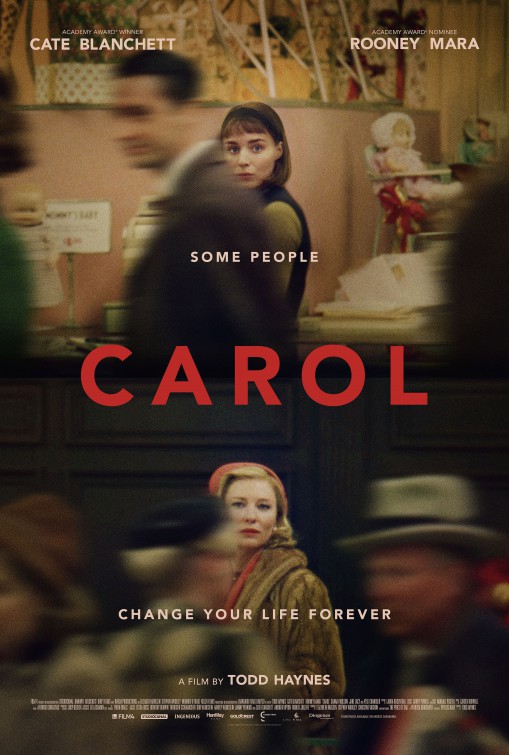
Carol

D: Todd Haynes / 118m

Cast: Cate Blanchett, Rooney Mara, Kyle Chandler, Sarah Paulson, Jake Lacy, Nik Pajic, John Magaro, Cory Michael Smith, Carrie Brownstein

Therese (pronounced Ter-rez) Belivet (Mara) is young, has a devoted boyfriend, Richard (Lacy), works in a department store, but is unsure of her future. One day a female customer in the store engages her in conversation, and even though the customer makes mention of being married with a young child, it’s clear to Therese that there’s a mutual attraction. When the woman leaves her gloves behind, Therese goes to the effort of finding the woman’s address and sending them to her. This act of kindness leads to the woman, whose name is Carol Aird (Blanchett), inviting Therese to lunch. They meet, and a friendship begins, one that starts to cause problems between Therese and Richard, as she begins to lose interest in a planned trip to Europe with him, and spends more time with Carol.

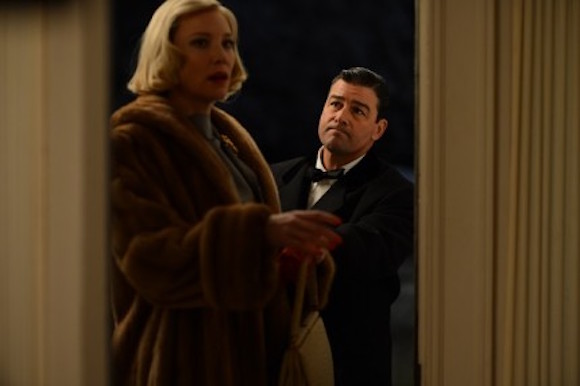
Unbeknownst to Therese, Carol and her husband, Harge (Chandler) have separated due to his awareness that his wife has had an affair with her best friend, Abby (Paulson). Willing to overlook this “indiscretion” if she stays with him, Harge warns her that if she doesn’t then he’ll seek sole custody of their little girl, Rindy. With Xmas approaching, he takes Rindy to his parents for the holiday period; Carol decides to invite Therese to come stay with her. Although nothing happens, Harge returns home unexpectedly and sees them together. Fearing that Carol is embarking on another lesbian relationship, he files for divorce and sole custody of Rindy. Unable to see her child until the custody hearing, which will take two or three months to happen, Carol invites Therese on a road trip, where they can spend some time together, and where Harge can’t find them.

They stay in a succession of motel rooms, at first staying in separate rooms. At one particular motel they stay in the Presidential suite; the next morning, Therese gets to talking with a travelling salesman called Tommy (Smith). Although he tries to sell them something from his sales kit, he has no joy, though Therese wishes him well in the future. At the next motel, she and Carol finally make love. But a telegram Carol receives the next morning reveals Harge’s awareness of where she is, and the fact that she and Therese are now lovers. Unable to risk the now serious possibility of losing the custody hearing, Carol decides she has to return home to face Harge, and sends Abby in her place to see Therese gets home safely. But for both women, returning to their old lives proves unsatisfactory…

Carol - scene

There’s a moment in Todd Haynes’ beautifully crafted Carol, an adaptation of Patricia Highsmith’s novel The Price of Salt, when it looks certain that the title character and Therese will make love for the first time. It’s a moment that the movie is clearly heading toward, and it’s a moment that audiences will be expecting, but Haynes, along with screenwriter Patricia Nagy, holds off from that first time and maintains the sense of anticipation that both characters (and viewers) must be feeling. For the audience, it’s also a moment – among many others – that shows just how much control Haynes has over both the material and its emotional centre, and how finely calibrated it all is, for Carol is without a doubt, one of 2015’s finest movies.

Of course, with previous projects such as Far from Heaven (2002) and the TV version of Mildred Pierce (2011), Haynes has already shown an affinity for what used to be termed “women’s pictures”, but here his immersion in a time – the 1950’s – when lesbianism was still something to be kept hidden, and where male attitudes towards the issue were still highly aggressive, feels also like a snapshot of an era where female empowerment was beginning to gain the upper hand, despite the so-called Lavender Scare that was prevalent at the time. Through Carol’s determination not to be defined by her sexuality, we get to see an example of what, in historical terms, was a turning of the tide, and also a love story that is simply that: a love story.

This simplicity is at the heart of Haynes’ confident handling of the story, and it shows in every scene, with every look and every gesture, and in the way that he brings Carol and Therese together within the frame – these moments where they’re “close but not touching” are so charged with pent-up emotion and increasing desire that the idea that they might be kept apart by Harge’s machinations becomes intolerable. These scenes are so expertly handled, with repressed longing so forcefully expressed, that the viewer is swept along with the characters’ desire to live freely and without sanction. Haynes makes great use of the era’s sense of propriety, using it as a touchstone against which Carol and Therese’s affair can be measured in both intensity and necessity. Therese quizzes Richard about same sex relationships but he has no point of reference, and has no understanding of why they occur; he loves her unequivocally but can’t see that two women – or two men for that matter – might feel the same way about each other as he does about Therese. It’s another of those moments where the audience can see just how difficult it was to live a life outside the (perceived) norm.

With the historical and social background of the story firmly in place, and with Nagy’s script making it clear that lesbians were expected to pretend to be happy in heterosexual relationships or face the social consequences, the movie paints an honest portrait of two women, both of whom gain increased confidence in themselves through their relationship, who come together at a point in both their lives where they’re looking for a way to find future happiness. That they find it in each other, if only briefly, and with such passion, gives value to the idea that any relationship is worth pursuing or fighting for. And even though Carol leaves Therese to fight for custody of her child, it’s not the end of their affair, but rather an interruption (albeit for Therese an unexpected one), and even though the younger woman is upset by it, her feelings remain, and though the movie tries for an air of ambiguity in its final scene, viewers won’t be fooled at where Carol and Therese’s relationship is likely to find itself.

Carol -scene3

The difference in ages might feel like it should be an issue but it’s left unexplored, and with good reason: it doesn’t matter. Love is love, and though an argument could be made that Therese is looking for a guide or a mentor first and foremost, it’s not the role Carol adopts in their relationship. As the “older woman”, Blanchett gives yet another astonishing, awards-worthy performance, striking the right balance between heartfelt longing for an honest life and acknowledging the difficulties that longing entails. Her brittle, striking features show the pain of Carol’s situation without too much need of more overt playing, but in those moments when overt emotion is required, Carol’s fears and hopes are etched indelibly on those striking features. It’s a magnificent performance, sincere, heartbreaking at times, and riveting.

She’s matched by Mara, whose portrayal of the unmoored, ingenuous Therese is so finely tuned that watching her blossom, however slowly, into a stronger, more confident young woman is like watching a flower grow out of the shadows to its full height. There are moments where the camera focuses on her smooth, unlined features and the only expression is there in the eyes, but Mara uses this approach to such good effect that the viewer is never in doubt as to what Therese is thinking or feeling. And as the movie progresses, Mara subtly shifts the weight of Therese’s longing for love so that it becomes a part of her, and not the whole, leaving her a character as strong in her own right as Carol is in hers.

With two such commanding performances, it would be a shame if the supporting cast were overshadowed, but Chandler, in what is superficially the “villain” role, brings out Harge’s pain and sense of loss over Carol with such force that his actions are less stereotypical than expected and driven more by his own deep love for her. In the same way that society says Carol can’t have Therese (in public at least), it also says that Harge can’t have Carol because of her “sexual impropriety”. Both characters are in danger of losing what they want most, and both are suffering as a result. Chandler is unexpectedly moving in the role, and his scenes with Blanchett are so emotionally charged it’s like an intense version of force majeure. Meanwhile, Paulson comes late to matters as Abby, but gives a brief but potent performance as Carol’s longtime friend, confidant and ex-lover, filling in the gaps of Therese’s knowledge about Carol, and providing further context for Carol’s emotional and sexual desires.

Carol - scene2

It’s all beautifully filmed by Edward Lachman, with lots of bright primary colours mixed in with rich earthy tones, making the period seem so alive as to be almost intoxicating, and acting as a dynamic background to the impassioned nature of Carol and Therese’s relationship. There’s some equally impressive attention to historical detail, and Haynes makes the era come alive as a result; this is a fully realised world, even if it does appear at first to be bathed in nostalgia (the scenes in the department store appear right out of a Fifities child’s fantasy of what such a store should look like), but in many ways it was a simpler time, and the script reflects this with aplomb. And the whole thing is embraced by a smoothly nonchalant yet spirited score by Carter Burwell that complements the on-screen proceedings with well orchestrated brio.

Rating: 9/10 – a firm contender for Movie of the Year, Carol is a masterpiece of mood and repressed emotional yearning, with two outstanding performances, and a director on the absolute top of his form; a model of period movie making, and rewarding in every department you can possibly think of, this is a movie that should go to the top of everyone’s must-see list.

Share this:

  • Click to share on X (Opens in new window) X
  • Click to share on Facebook (Opens in new window) Facebook
  • More
  • Click to print (Opens in new window) Print
  • Click to email a link to a friend (Opens in new window) Email
Like Loading...

The Trials of Cate McCall (2013)

14 Sunday Sep 2014

Posted by dullwood68 in Movies

≈ 1 Comment

Tags

Alcoholism, Anna Anissimova, Appeal case, Courtroom drama, Custody battle, James Cromwell, Karen Moncrieff, Kate Beckinsale, Lawyer, Murder, Nick Nolte, Review, Thriller

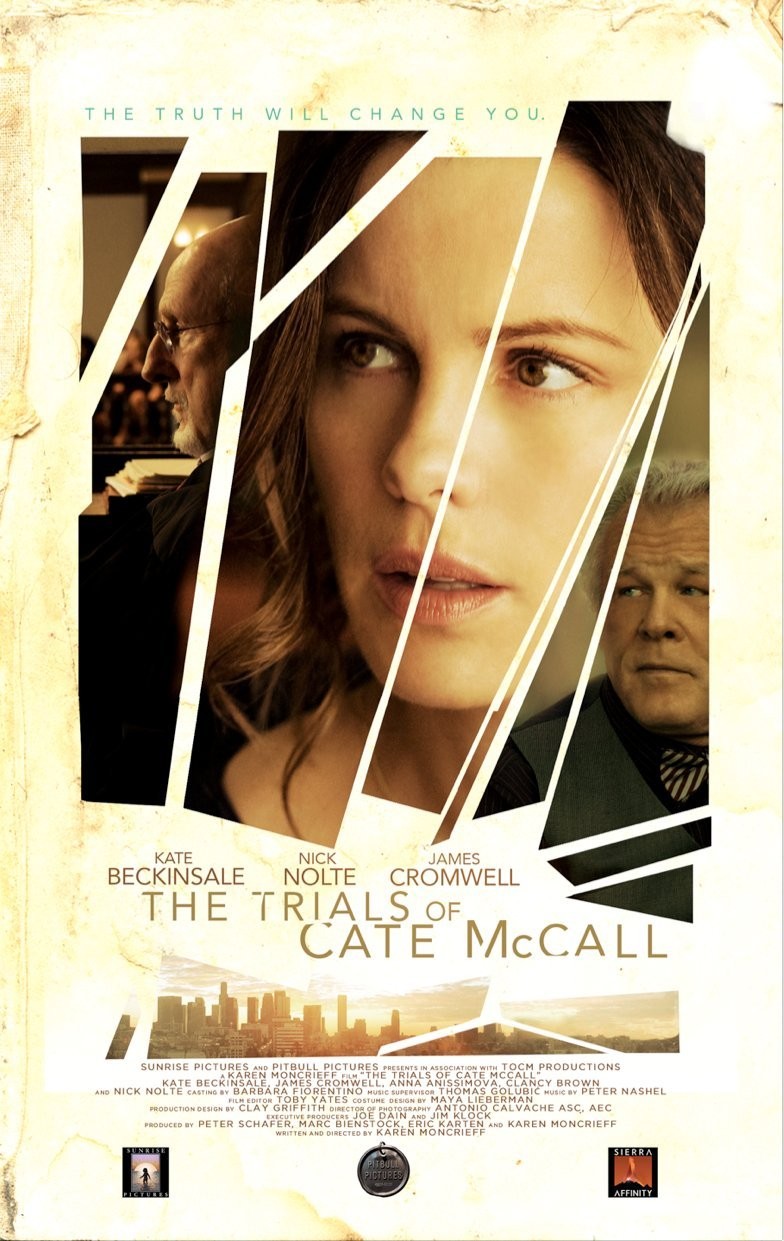
Trials of Cate McCall, The

D: Karen Moncrieff / 89m

Cast: Kate Beckinsale, Nick Nolte, James Cromwell, Mark Pellegrino, Anna Anissimova, Taye Diggs, Kathy Baker, Clancy Brown, Brendan Sexton III, David Lyons, Ava Kolker, Isaiah Washington, Dale Dickey, Amanda Aday

Cate McCall (Beckinsale) has her fair share of problems.  Despite being a talented lawyer, she has a serious drink problem that has resulted in her being put on probation and assigned to work in a small law office.  She’s also trying to retain custody of her daughter Augie (Kolker) following the break up of her marriage to Josh (Lyons).  As she fights to regain control of her life, Cate is assigned an appeal case involving Lacey Stubbs (Anissimova).  Lacey has been convicted of murder, but claims she was set up by the lead detective on the case, Welch (Pellegrino).  She also alleges that, while in prison, she was raped by a guard.

With the help of her mentor, Bridges (Nolte), Cate begins to look into the case and finds quickly that some of the witness testimonies don’t match up, and that there are problems with the police evidence.  Lacey maintains her innocence, while Welch proves evasive and aggressive when Cate talks to him.  As Cate begins to suspect a miscarriage of justice has taken place, the pressure of trying to deal with both the case and spending time with Augie begins to affect her ability to maintain her sobriety.

The appeal hearing sees Lacey’s case upheld, but Cate’s success is short-lived.  No sooner is the hearing over than she begins to uncover further evidence that Lacey has been lying all along.  But can she trust this new evidence?  Now Cate has to find out whether or not she was used by Lacey, and in the process, decide if being a part of Augie’s life is appropriate for her daughter while she still has a drink problem.

Trials of Cate McCall, The - scene

From the outset, The Trials of Cate McCall tries hard to be different from all the other courtroom-based dramas out there, and in terms of its title character, it certainly succeeds.  Cate McCall is, frankly, a bit of a mess, and while the reason for her drinking problem is adequately explained, the movie’s determination to make things difficult for her at almost every turn borders on the sadistic.  It’s only within the confines of the courtroom that she’s allowed to hold it together and have any success; outside, and she makes mistake after mistake, sometimes deliberately.  There is an element of masochism as well in these moments, as if Cate is punishing herself, and while on a psychological level this is all completely understandable, it makes for a somewhat frustrating viewing experience.  It’s not long into the movie before the viewer will be wondering, just how much more can this character take before she puts her head in the oven?

But Cate’s work keeps her going, even while she screws up everything else in her life.  The two worlds she inhabits, her professional and private lives, are addressed with equal gravitas, and thanks to Beckinsale’s committed, earnest portrayal, the movie is on solid ground when Cate tries to deal with the responsibilities of both (even if she fails more often than not).  It’s an unselfish performance from Beckinsale, an actress who can do a lot more than wear tight-fitting black leather and make fangs look sexy, and she’s at her best when the script piles on the setbacks (she even ends up in jail at one point, that’s how bad things get for her).  Beckinsale is also clever enough to ensure that Cate isn’t entirely sympathetic, and this helps make the character more credible.

She’s ably supported by the likes of Nolte (grizzled, understanding), Cromwell (sanguine, duplicitous), Anissimova (nervy, put-upon), and Pellegrino (arrogant, shady), and there’s a winning performance from six year old Kolker as Cate’s troubled daughter (Augie though – really?).  With such a good cast – and one that can find room for actors such as Brown and Baker in minor roles – the movie’s mix of domestic drama and courtroom machinations is handled well by writer/director Moncrieff, even if there are moments where plausibility is stretched so thin it’s practically see-through (the prosecution’s withholding of exculpatory evidence is a case in point; the ease with which Cate and Welch bury their differences is another).

But all in all, the movie is a worthwhile watch though it plays flat through certain stretches – the repetitive bickering between Cate and Josh, the subplot involving Cromwell’s lecherous judge – and the issue of Lacey’s guilt can be guessed from the beginning, but away from the courtroom there’s enough to keep an audience engaged and wanting to find out what happens next.  Ultimately though, and aside from the reliability of its cast, the material isn’t solid enough to withstand close scrutiny (or cross-examination), and while it’s entirely respectable in its aims and intentions, it doesn’t quite hit the mark.

Rating: 6/10 – with alcoholism, murder and a custody battle occupying the time of its main character, The Trials of Cate McCall is actually less intriguing than it thinks it is; Beckinsale is the movie’s major asset, and while there’s nothing to suggest this might be the beginning of a series, another visit with Cate could still be something to look forward to.

Share this:

  • Click to share on X (Opens in new window) X
  • Click to share on Facebook (Opens in new window) Facebook
  • More
  • Click to print (Opens in new window) Print
  • Click to email a link to a friend (Opens in new window) Email
Like Loading...

Blog Stats

  • 486,544 hits

Recent Posts

  • 10 Reasons to Remember Bibi Andersson (1935-2019)
  • Fantasia (1940)
  • Dances With Wolves (1990) – The Special Edition
  • Kiss of the Spider Woman (1985)
  • The Three Musketeers (1973)

Top Posts & Pages

  • Lost for Life (2013) - Another Look
    Lost for Life (2013) - Another Look
  • Lost for Life (2013)
    Lost for Life (2013)
  • About
    About
  • Mr. Topaze (1961)
    Mr. Topaze (1961)
  • Shock and Awe (2017)
    Shock and Awe (2017)
  • Billy Lynn's Long Halftime Walk (2016)
    Billy Lynn's Long Halftime Walk (2016)
  • Winter's Tale (2014)
    Winter's Tale (2014)
  • Hunt for the Wilderpeople (2016)
    Hunt for the Wilderpeople (2016)
  • Spider-Man: Homecoming (2017)
    Spider-Man: Homecoming (2017)
  • BFI London Film Festival 2015
    BFI London Film Festival 2015
Follow thedullwoodexperiment on WordPress.com

Blogs I Follow

  • Rubbish Talk
  • Film 4 Fan
  • Fast Film Reviews
  • The Film Blog
  • All Things Movies UK
  • Interpreting the Stars
  • Let's Go To The Movies
  • Movie Reviews 101
  • TMI News
  • Dan the Man's Movie Reviews
  • Film History
  • Jordan and Eddie (The Movie Guys)

Archives

  • April 2019 (13)
  • March 2019 (28)
  • February 2019 (28)
  • January 2019 (32)
  • December 2018 (28)
  • November 2018 (30)
  • October 2018 (29)
  • September 2018 (29)
  • August 2018 (29)
  • July 2018 (30)
  • June 2018 (28)
  • May 2018 (24)
  • April 2018 (21)
  • March 2018 (31)
  • February 2018 (25)
  • January 2018 (30)
  • December 2017 (30)
  • November 2017 (27)
  • October 2017 (27)
  • September 2017 (26)
  • August 2017 (32)
  • July 2017 (32)
  • June 2017 (30)
  • May 2017 (29)
  • April 2017 (29)
  • March 2017 (30)
  • February 2017 (27)
  • January 2017 (32)
  • December 2016 (30)
  • November 2016 (28)
  • October 2016 (30)
  • September 2016 (27)
  • August 2016 (30)
  • July 2016 (30)
  • June 2016 (31)
  • May 2016 (34)
  • April 2016 (30)
  • March 2016 (30)
  • February 2016 (28)
  • January 2016 (35)
  • December 2015 (34)
  • November 2015 (31)
  • October 2015 (31)
  • September 2015 (34)
  • August 2015 (31)
  • July 2015 (33)
  • June 2015 (12)
  • May 2015 (31)
  • April 2015 (32)
  • March 2015 (30)
  • February 2015 (37)
  • January 2015 (39)
  • December 2014 (34)
  • November 2014 (34)
  • October 2014 (36)
  • September 2014 (25)
  • August 2014 (29)
  • July 2014 (29)
  • June 2014 (28)
  • May 2014 (23)
  • April 2014 (21)
  • March 2014 (42)
  • February 2014 (38)
  • January 2014 (29)
  • December 2013 (28)
  • November 2013 (34)
  • October 2013 (4)

Create a free website or blog at WordPress.com.

Rubbish Talk

Film 4 Fan

A Movie Blog

Fast Film Reviews

The Film Blog

The official blog of everything in film

All Things Movies UK

Movie Reviews and Original Articles

Interpreting the Stars

Dave Examines Movies

Let's Go To The Movies

Film and Theatre Lover!

Movie Reviews 101

Daily Movie Reviews

TMI News

Latest weather, crime and breaking news

Dan the Man's Movie Reviews

All my aimless thoughts, ideas, and ramblings, all packed into one site!

Film History

Telling the story of film

Jordan and Eddie (The Movie Guys)

Movie Reviews & Ramblings from an Australian Based Film Fan

Privacy & Cookies: This site uses cookies. By continuing to use this website, you agree to their use.
To find out more, including how to control cookies, see here: Cookie Policy
  • Subscribe Subscribed
    • thedullwoodexperiment
    • Join 481 other subscribers
    • Already have a WordPress.com account? Log in now.
    • thedullwoodexperiment
    • Subscribe Subscribed
    • Sign up
    • Log in
    • Report this content
    • View site in Reader
    • Manage subscriptions
    • Collapse this bar
 

Loading Comments...
 

    %d