• 10 Reasons to Remember…
  • A Brief Word About…
  • About
  • For One Week Only
  • Happy Birthday
  • Monthly Roundup
  • Old-Time Crime
  • Other Posts
  • Poster of the Week
  • Question of the Week
  • Reviews
  • Trailers

thedullwoodexperiment

~ Viewing movies in a different light

thedullwoodexperiment

Tag Archives: Emily Watson

The Happy Prince (2018)

30 Tuesday Oct 2018

Posted by dullwood68 in Movies

≈ Leave a comment

Tags

Biography, Colin Firth, Colin Morgan, Drama, Edwin Thomas, Emily Watson, France, History, Oscar Wilde, Passion project, Review, Rupert Everett
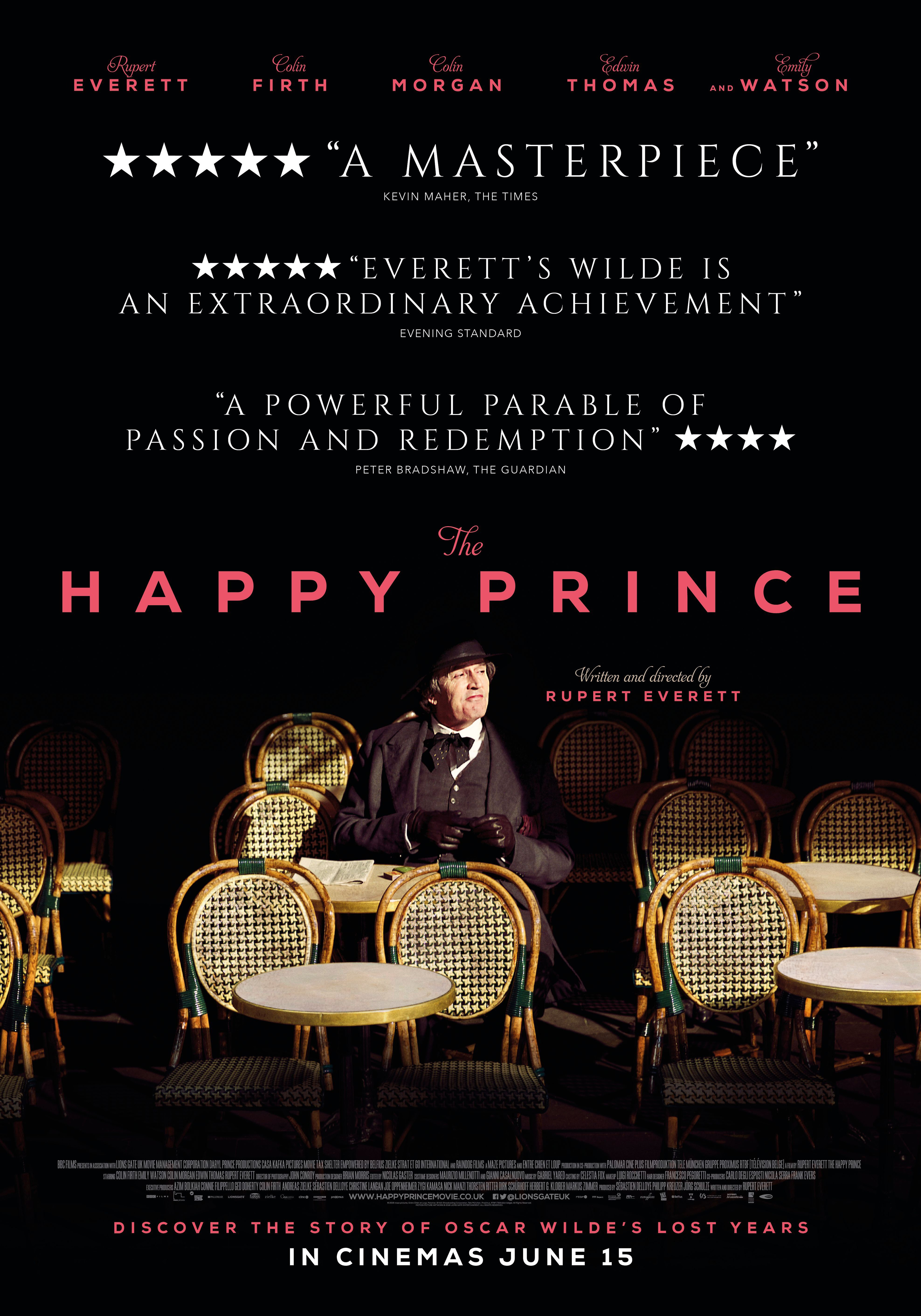
D: Rupert Everett / 106m

Cast: Rupert Everett, Colin Firth, Emily Watson, Colin Morgan, Edwin Thomas, Tom Wilkinson, Béatrice Dalle, Anna Chancellor, Julian Wadham, John Standing, Ronald Pickup

Oscar Wilde (Everett) has served his time in Reading Gaol and is living in France, supported by the kind attentions of one of his few remaining friends, Robbie Ross (Thomas). Suffering from ill health as a result of his stay in prison, Wilde is a shadow of his former self, wracked by torment and disillusionment, and his passion for writing exhausted. Against the better judgment and advice of his friends, including Reggie Turner (Firth), and his estranged wife, Constance (Watson), Wilde is reunited with the source of his downfall, Lord Alfred ‘Bosie’ Douglas (Morgan). They live together, though the relationship is strained, and Douglas’s selfish behaviour begins to drive an irreversible wedge between them. When their families each threaten to remove their financial support for the pair, the relationship founders completely, and Wilde becomes a lonely figure wandering from café to café spending what little money he has on alcohol. With his health deteriorating even further, Wilde becomes incapacitated, and is forced to see out the remainder of his days in a dingy Paris hotel room…
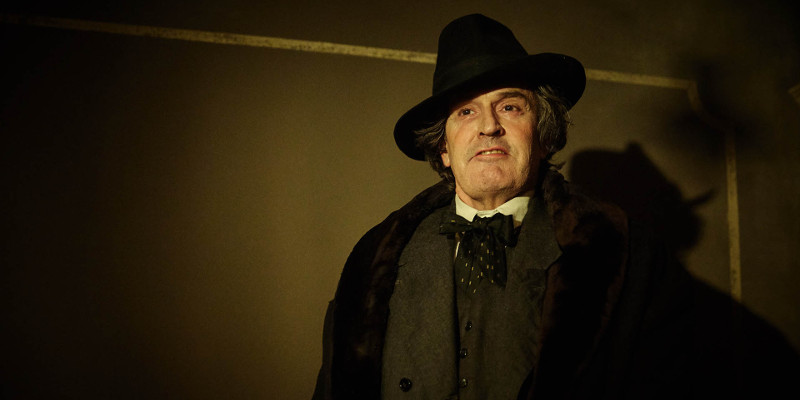
When actors or directors announce that their next movie will be a long cherished passion project, it’s often time to nod sagely and mutter, “that’ll be nice”. Rupert Everett had been trying to get a movie made about the final three years in the life of Oscar Wilde for over five years, and he’s finally succeeded. You can imagine the pitch to potential investors, though: a movie about an alcoholic writer in the decrepitude of his final years, and without any chance of a happy ending. Full marks then to Everett for his perseverance, because despite the downbeat nature of the material, and the sadness of seeing a once great man reduced to abject penury, The Happy Prince is a fascinating and poignant examination of the last three years of Wilde’s life, and how those years took a further, irrevocable toll on him after two years in prison. It’s a largely melancholy, subdued account, but there are moments of joy and laughter and hope in amongst the heartbreak and despair, as Wilde reflects on his success and his subsequent downfall. Unafraid to show Wilde at his worst, and with the worst happening to him, Everett presents an unflinching portrait of the artist as an old man robbed of all his powers.
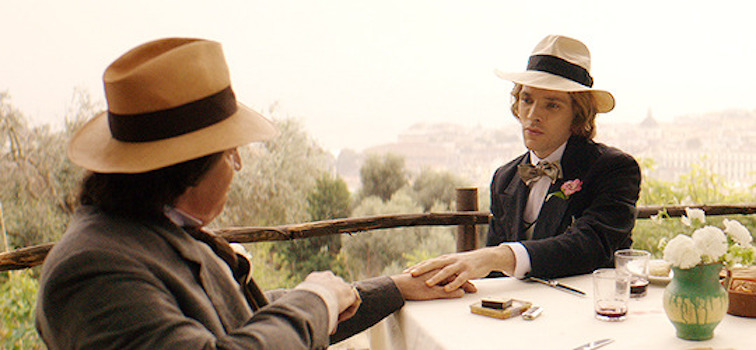
The movie has all the hallmarks of a grim tragedy, from Wilde, Turner and Ross being pursued in Italy by English thugs looking to intimidate and bully a great man brought low, to the inevitability of Douglas’ rejection of Wilde when money becomes an issue. Everett is magnificent in a role that he’s often unrecognisable in, the quality of the make up obliterating the actor/director’s angular features; he’s like a poster child for rampant, self-inflicted dissolution. What Everett captures perfectly is the sense of a man who knows his life is effectively over, but who clings to it, desperately, and however he can, even if it’s inappropriate (his drinking etc.). Everett, who also wrote the script, is a confident, detailed director, and he has a good eye for composition that some more practiced directors would be envious of. He’s an unselfish actor too, allowing the likes of Morgan and Thomas to shine in roles that might otherwise have appeared to be in subservience to the orbit of Everett’s own. That the movie isn’t as heavy going as it looks is another testament to the skill with which Everett assembles the various elements of Wilde’s post-prison experiences, and the way he weaves the story of the Happy Prince through the narrative, and has it reflect the state of Wilde’s own life depending on where the story has gotten to. For a first-time writer/director, Everett has revealed himself to be someone who should be encouraged to get behind the camera again as quickly as possible.

Rating: 8/10 – though the movie examines the tragedy of Wilde’s final years, The Happy Prince isn’t the depressing, maudlin experience that some viewers might be expecting, and instead is a quietly powerful expression of the will to survive in the bleakest of circumstances and surroundings; with effective supporting turns from the likes of Firth, Watson and Wilkinson, and appropriately gloomy cinematography by John Conroy, this is yet another potent reminder of Wilde the man, and his legacy.

Share this:

  • Click to share on X (Opens in new window) X
  • Click to share on Facebook (Opens in new window) Facebook
  • More
  • Click to print (Opens in new window) Print
  • Click to email a link to a friend (Opens in new window) Email
Like Loading...

A Royal Night Out (2015)

15 Sunday Nov 2015

Posted by dullwood68 in Movies

≈ Leave a comment

Tags

Airman, Bel Powley, British royalty, Comedy, Drama, Emily Watson, Jack Reynor, Julian Jarrold, King George VI, Military escort, Princess Elizabeth, Princess Margaret, Review, Rupert Everett, Sarah Gadon, True story, VE Day, World War II

A Royal Night Out

D: Julian Jarrold / 97m

Cast: Sarah Gadon, Bel Powley, Jack Reynor, Rupert Everett, Emily Watson, Jack Laskey, Jack Gordon, Roger Allam, Ruth Sheen

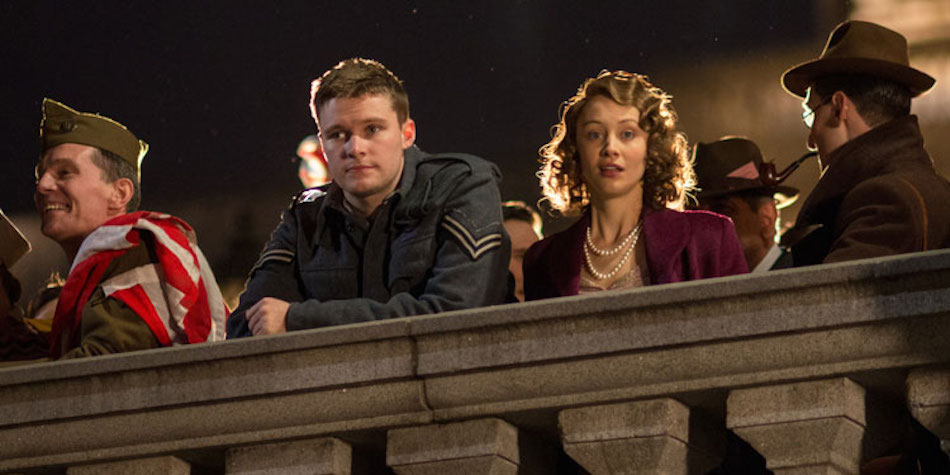
A Royal Night Out is based on real events: on V.E. Day, May 8 1945, Princess Elizabeth and Princess Margaret went out in a group that included their nanny, several friends, and a military detail as protection (one of whom was Group Captain Peter Townsend, who would later have a relationship with Margaret). They were charged by their father, King George VI, to be home by one a.m. – which they were. Nothing of any real significance happened, and the evening passed off without incident.

But in an attempt to overcome this disappointing outcome, A Royal Night Out chooses to paint an entirely different portrait of what happened that night, and in doing so, pushes the boundaries of credibility at every turn. It’s a movie that embraces the newspaper cry of “Print the Legend!”, and has no intention of worrying about just how far-fetched or unlikely it all is. And thanks to one of the most careless and poorly constructed screenplays of recent years – courtesy of Trevor De Silva and Kevin Hood – the movie limps from one unconvincing scene to another, and never once provides a moment’s plausibility.

From the moment that Gadon’s Elizabeth and Powley’s Margaret are introduced – responsible and carefree respectively – it’s clear that these characterisations aren’t going to change much as the movie progresses. Elizabeth is the thoughtful, considerate sister, always looking out for her younger, less mature sibling. Margaret is a pleasure-seeker, stifled by the conventions of royal life, and looking for a chance to express her more extrovert nature. Although there is some truth in both these approaches – Margaret definitely liked a good party – by reducing both young women to such paper-thin representations of their real counterparts, the movie avoids asking its audience to identify with them at all.

A Royal Night Out - scene1

What the movie does to compensate is to infuse the action with liberal dollops of comedy. Surprisingly, a lot of it works, even though it’s often corny, and relies on the idea that Elizabeth and Margaret are so far removed from “ordinary” folk that they’re unable to deal with the simplest of social interactions. The humour is also derived in part from a lazy interpretation of the social divide between the princesses and the people they meet. Margaret is far too trusting, while Elizabeth becomes acutely aware of how little she really knows about everyday people. It’s predictable stuff, and if it wasn’t for the jokes, the movie would be dangerously difficult to sit through.

As well as De Silva and Hood’s just-enough-done-to-get-by script, there’s Jarrold’s lacklustre direction to contend with. There are moments when it really seems as if he settled for the first take and had no interest in finding out if the actors had anything else to offer. Whole stretches of the movie play out at a sedated pace that deadens each scene it touches, and it makes the performances seem stilted and free from nuance. Jarrold, whose last theatrical feature was the similarly underwhelming Brideshead Revisited (2008), misses almost every opportunity to make the movie relevant to its time frame, and concentrates instead on various levels of slapstick and farce to push the narrative forward. It leaves the movie feeling disjointed and as unconcerned about itself as Margaret is when she goes off with a man she doesn’t know.

97-Girls Night Out-Photo Nick Wall.NEF

There are issues with the various relationships as well. Elizabeth meets AWOL airman Jack (Reynor) who helps her find Margaret after they’re separated. You can tell straight away that the script wants them to get together, but at the same time it wants to stay true to historical events, so what we’re left with is an attraction that can’t (and doesn’t) lead anywhere, and which is entirely redundant as a plot device. The same can be said for Jack’s AWOL status, a dramatic angle that is resolved with the neatness of a parcel tied up with string. (There really isn’t anything in the movie that the viewer won’t be able to guess the outcome of – and long before it happens.)

Elsewhere, Laskey and Gordon play their military detail roles as if they were auditioning for an X Factor comedy special, with Laskey mugging for all he’s worth, and Gordon’s Lieutenant Burridge behaving in such an inappropriate manner it’s ridiculous. Allam is introduced late on as a mix of low-rent pimp and black marketeer who Margaret calls Lord Stan, but it’s the fanciful way in which her royal status is exploited that raises a chuckle, as Stan uses her to get some of his working girls inside the Chelsea Barracks, and circulating amongst the guests at a party there. Again it’s this kind of non-threatening, breezy plotting that hampers the movie and stops it from having any kind of edge.

A Royal Night Out - scene3

The cast are left adrift to fend for themselves, with Watson coming off best by (ostensibly) directing herself, while the likes of Everett, Allam and Powley are stranded playing caricatures. Reynor can’t do anything with his establishment-baiting airman, and Gadon looks bewildered throughout, as if she can’t quite believe what she’s being asked to do (though, to be fair, her bewilderment could be down to the demands of the script).

Away from the uninspired direction and unimaginative script, A Royal Night Out struggles to rise above its TV movie look and feel, and some of the myriad night shots look like they were filmed during the day. And with the best will – or art direction – in the world, Hull is no substitute for London, leaving several scenes feeling incomplete in terms of the movie’s visual style. As a result, Christophe Beaucarne’s photography is choppy at best, though it suits the muddy compositions. And Luke Dunkley’s editing is so haphazard in its approach that a lot of scenes lack that all-important through line.

Rating: 4/10 – even though it’s an interpretation of what “might” have happened on the night of 8 May 1945, A Royal Night Out‘s script shows such a lack of imagination almost any other interpretation would be preferable; saved entirely by its sense of humour, and despite its being entirely nonsensical at times, the movie is one of those ideas that seemed like a good one at the time, but which should have been left well alone by all concerned.

Share this:

  • Click to share on X (Opens in new window) X
  • Click to share on Facebook (Opens in new window) Facebook
  • More
  • Click to print (Opens in new window) Print
  • Click to email a link to a friend (Opens in new window) Email
Like Loading...

Everest (2015)

14 Monday Sep 2015

Posted by dullwood68 in Movies

≈ 1 Comment

Tags

Adventure Consultants, Baltasar Kormákur, Climbing, Drama, Emily Watson, Himalayas, Jason Clarke, John Hawkes, Josh Brolin, Keira Knightley, May 1996, Mountain Madness, Review, Rob Hall, Scott Fischer, Storm, True story

Everest

D: Baltasar Kormákur / 121m

Cast: Jason Clarke, Josh Brolin, John Hawkes, Emily Watson, Robin Wright, Keira Knightley, Jake Gyllenhaal, Sam Worthington, Michael Kelly, Martin Henderson, Thomas M. Wright, Ingvar Eggert Sigurðsson, Naoko Mori, Elizabeth Debicki

The brainchild of New Zealand mountaineer Rob Hall (Clarke), Adventure Consultants is a company that takes people to the summit of Mount Everest. In April 1996, Rob and his team, led by base camp manager Helen Wilton (Watson), plan to take eight clients to the summit. Among them are Texan climber Beck Weathers (Brolin) and Doug Hansen (Hawkes), a postman seeking to inspire the pupils at an elementary school where he lives, and Jon Krakauer (Kelly), a journalist from Outside magazine that Hall has persuaded to write an article about them in return for a gratis trip. When they arrive at base camp, Hall regales them with the necessary rules and warns them all of the dangers of ascending to a height where their bodies will literally begin to die.

The group make three acclimatisation climbs before starting off for the summit on the morning of May 10. They are joined by a group led by Scott Fischer (Gyllenhaal) of the rival company Mountain Madness. Together they aid each other in climbing the mountain, making it to each Camp in good time. The camaraderie between the climbers helps them to keep going the further up they climb, but after they leave Camp IV, they begin to encounter problems. Fischer becomes unwell and starts to struggle, while Weathers develops an eyesight problem that causes him to remain on the side of the mountain until the other climbers come back down. As they near the summit, they reach the Balcony and find there are no fixed ropes; and again when they reach the Hillary Step. With time being eaten away by these delays the strain of the climb begins to tell on more and more of the climbers, including Hansen who lags behind everyone else.

The two groups persevere though and the first person to reach the summit – from Fischer’s group – gets there around 1pm. With everyone needing to start back down by 2pm in order to make it back to Camp IV, Hall finds himself ignoring his own rules and helping Hansen reach the summit. Now over an hour late in leaving, and with Hansen getting weaker and weaker due to a lack of oxygen, Hall is faced with an even worse problem: a terrible storm rushing in from the southwest. With the blizzard making the effort to descend even harder, Hall and Hansen make it back to the Hillary Step, while Fischer’s group and the rest of Hall’s group find themselves battling the blizzard and struggling to stay alive. With no help available from the base camp, all anyone can do is hope that the storm abates soon, and gives them all a chance to get back down.

Everest - scene

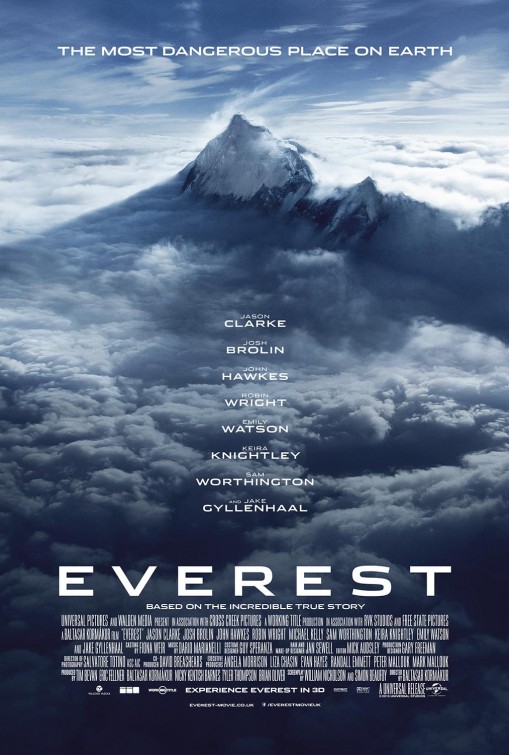
Based on a true story, and with a script by William Nicholson and Simon Beaufoy that’s been collated from various sources, Everest is a disaster movie that highlights the natural beauty of the Himalayas, and the ever-present danger that lies hidden and waiting for the unwary (or even the experienced). It’s an intelligent, cleverly constructed and judiciously maintained tale of unexpected tragedy that is also unexpectedly moving. And thanks to the decision to film as much of the movie on location as possible, it allows the viewer to become embroiled in the effort to reach the summit and then to stay alive against the odds.

Much will be made of Everest‘s stunning vistas and gasp-inducing scenery, and while this is entirely appropriate, they’re still the backdrop for a tragic endeavour that was doomed from the moment that the groups found that there were no fixed ropes in two sections where they were needed. With the climb having gone so well up til then, this presentiment of doom adds a chill to events that augments the sub-zero temperatures, and makes the rest of the movie dreadful and fascinating to watch at the same time.

As the resulting tragedy unfolds, it becomes an agonising experience as the various climbers we’ve come to know and empathise with, face terrible hardships brought on by the brutal weather, and find the limits of their endurance pushed beyond measure. The inclusion of Hall’s partner, Jan (Knightley), and Beck’s wife, Peach (Wright), both removed from the action but still linked to their men by tremendous love and commitment, allows the movie to show how the events on Everest had a wider consequence. Jan is pregnant with hers and Rob’s first child, while Peach moves heaven and earth to ensure her husband has a chance of returning home. Their fears and concerns add an extra layer of tragic drama to proceedings, and in the capable hands of Knightley and Wright, both women show fear, strength, determination and sadness with admirable clarity. And they’re matched by Watson, who puts in yet another faultless performance.

Amongst the men, Clarke plays Hall as an altruistic, methodical leader whose love of climbing defines him the most. When Hall decides to help Hansen reach the summit, his thoughts are writ clearly on his face: it’s the wrong decision, and Clarke shows Hall’s understanding of this with such resignation that it heightens the impending tragedy, and makes their twin fates all the more affecting. Hawkes gives another low-key yet determined performance as the most unlikely climber in the group, while Brolin’s cocky, bullish attitude soon reveals a deeper layer of insecurity that Weathers would rather keep hidden. Gyllenhaal and Worthington have minor roles in comparison and we don’t get to know their characters as well, but with so many to keep track of, it would be unfair for the script to try and focus on too many at one time.

Making his most complete and effective movie to date, Kormákur ratchets up the tension as the storm hits and survival becomes everything. But he never loses sight of the human will to overcome and conquer adversity, and as the treacherous descent is begun, most viewers are likely to have at least one character they’ll want to see reach Camp IV. Whether they do or not is another matter, and it would be fair to say that billing is no guarantee of survival, but again Kormákur keeps the viewer on the edge of their seat as to just who will make it and who won’t, and each death carries with it its own devastating emotional “punch”.

The production is handsomely mounted and is supported by Salvatore Totino’s superb photography, Dario Marianelli’s subtle, non-intrusive score, and Mick Audsley’s fine-tuned editing. With only a few dodgy green screen shots to break the illusion, and some confusion as to what’s happening to whom once the blizzard hits, Everest remains a compelling, gripping account of an unfortunate, avoidable tragedy.

Rating: 8/10 – whatever your views on the mistakes made on May 10 1996, there’s no doubting the courage shown by all those on the mountain that day, and Everest is a tribute to all those who perished, and the survivors as well; with an emotional core that steals up on the viewer, it’s a movie that reaffirms the risks of climbing “the most dangerous place on Earth”, and the sense of profound achievement that it provides.

Share this:

  • Click to share on X (Opens in new window) X
  • Click to share on Facebook (Opens in new window) Facebook
  • More
  • Click to print (Opens in new window) Print
  • Click to email a link to a friend (Opens in new window) Email
Like Loading...

Belle (2013)

20 Friday Jun 2014

Posted by dullwood68 in Movies

≈ 3 Comments

Tags

Amma Asante, British history, Captain John Lindsay, Dido Elizabeth Belle, Emily Watson, Gugu Mbatha-Raw, Lord Chief Justice, Lord Mansfield, Racism, Review, Slavery, Tom Wilkinson, True story, Zong

Belle

D: Amma Asante / 104m

Cast: Gugu Mbatha-Raw, Tom Wilkinson, Emily Watson, Sam Reid, Sarah Gadon, Penelope Wilton, Miranda Richardson, James Norton, Tom Felton, Matthew Goode

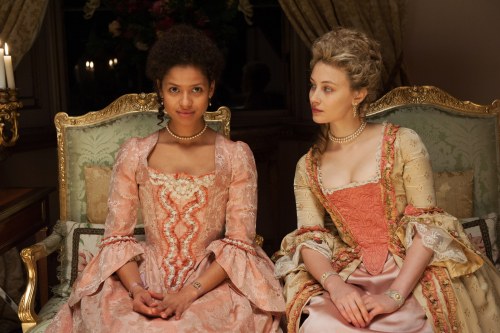
The illegitimate offspring of Royal Navy captain John Lindsay (Goode) and an African slave woman named Maria Bell, young Dido Elizabeth Belle is sent to live with his uncle, Lord Mansfield (Wilkinson) and his wife (Watson) at Kenwood House.  Despite her mixed race heritage, Dido is brought up as one of the family though some social – or possibly, household – conventions are upheld: Dido is unable to take part in dinner parties but is allowed to take coffee with guests afterwards.  She grows up in the company of her cousin, Elizabeth, who is also a ward of Lord Mansfield.  When both girls become of age, Dido (Mbatha-Raw) and Elizabeth (Gadon) expect to “come out” and find a husband.  However, Lord Mansfield has other ideas: with Dido having received a substantial inheritance upon the death of her father, he feels that her financial independence would only frighten off any potential suitors; he wants her to stay on at Kenwood and run the household.

While Elizabeth attracts the attention of James Ashford (Felton), it is his brother, Oliver (Norton) who finds himself drawn to Dido.  Unfortunately for Oliver, Dido has affections for John Davinier (Reid), a headstrong young lawyer-in-training who Lord Mansfield takes under his wing.  When the two men fall out over a ruling Lord Mansfield has to give – he’s the Lord Chief Justice – on the matter of the Zong slave ship (where slaves were cast deliberately overboard to drown), Dido endeavours to help Davinier as much as she can.  While the Mansfield household resides in London in their efforts to secure a husband for Elizabeth, Dido secretly meets with Davinier and his pro-abolitionist comrades and supplies them with as much information as she can about the case.  As the time approaches for Lord Mansfield to give his ruling, Dido’s involvement is revealed and Oliver Ashford proposes marriage.  With her future happiness hanging in the balance, Dido must decide if the life she requires will be dictated to her by social expectations or by her own desires.

Gugu Mbatha-Raw Sarah Gadon

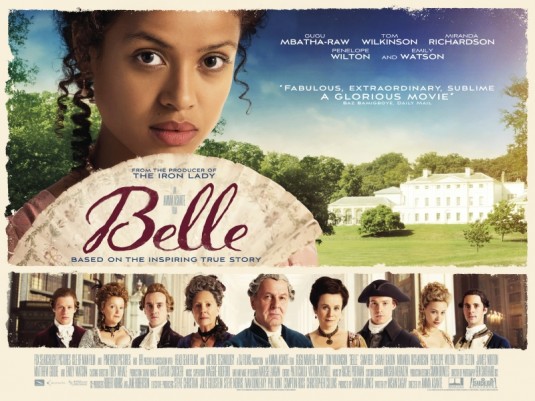
Based – very, very, very loosely – on a true story, Belle is a handsomely mounted, beautifully lensed movie that tackles its subject matter with intelligence and a keen eye for the vagaries of the social hierarchy of Britain in the late 1700s.  The ingrained racism of the times is depicted far more subtly than expected, and is best expressed in the actions and thoughts of Lord Mansfield as he displays public disgust over the concept and practice of slavery, but in the privacy of his own home, represses Dido with his notions of correct social etiquette (and that’s without mentioning the implicit sexism of his position as well).  With the crusading Davinier to root for, and his “colour blindness”, the movie gives the viewer someone to help navigate the maze of 18th century politics, and just as Dido herself has an awakening in this matter, it’s one of the strengths of Misan Sagay’s heartfelt screenplay that matters become as clear as they do.

With the racism and the politics and the social niceties of the period so well rendered, it’s disappointing that the romantic aspects of the movie aren’t as strongly defined or developed.  Elizabeth is the trusting young hopeful, an almost stock character of the period whose lack of experience with men is redeemed by her telling Dido, “We are but their property”.  Against this, Dido is necessarily more confident and aware of the pitfalls of relationships though her confidence is established too easily, and there are times when the movie’s need for her to be a support for Elizabeth becomes irritating (Elizabeth isn’t exactly vapid but she is unremittingly naive).  Davinier’s ardent pursuit of Dido is too avid at times, and his passion for both the cause of abolition and Dido’s freedom from social strictures, as written, leaves the character looking almost (but not quite) insufferable.

In the title role, Mbatha-Raw gives a perceptive, masterful performance that is both emotionally honest and fiercely intelligent, and she is skilfully supported by Wilkinson and Watson, the former imbuing a cleverly written and yet difficult character with sincerity and charm.  Reid is earnest and declamatory (thanks to the script), and Gadon’s coquettish take on Elizabeth is occasionally affecting but she too is hindered by the restrictions of the script.  Wilton, Richardson and Norton flesh out their roles to good effect but Felton is stifled by a character who is never allowed to be anything more than the stock villain (not only is he an outspoken racist but he assaults Dido as well, as if his odiousness was in some way in doubt).

In the director’s chair, Asante shows an assured and substantial understanding of the issues being examined, and is particularly impressive when exploring the curious anomalies of Dido’s life at Kenwood House.  Under her committed and often powerful guidance, Belle overcomes its romantic Georgian soap opera elements to become a potent, articulate condemnation of a period in British history when endemic racism and the commerce of slavery was beginning to be challenged both socially and in law.

Rating: 8/10 – the aforementioned romantic elements and Rachel Portman’s often intrusive score aside, Belle is a vivid, impassioned look at the often complex life of a woman whose social position meant she was too low to eat with her family and at the same time, too high to eat with servants; a powerful, accomplished movie from a powerful, accomplished director.

Share this:

  • Click to share on X (Opens in new window) X
  • Click to share on Facebook (Opens in new window) Facebook
  • More
  • Click to print (Opens in new window) Print
  • Click to email a link to a friend (Opens in new window) Email
Like Loading...

The Book Thief (2013)

19 Wednesday Mar 2014

Posted by dullwood68 in Movies

≈ 3 Comments

Tags

Brian Percival, Emily Watson, Geoffrey Rush, Germany, Jewish refugee, Library, Liesel Meminger, Markus Zusak, Nazis, Review, Sophie Nélisse, World War II

Book Thief, The

D: Brian Percival / 131m

Cast: Geoffrey Rush, Emily Watson, Sophie Nélisse, Ben Schnetzer, Nico Liersch, Levin Liam, Rainer Bock, Barbara Auer, Roger Allam

Literary adaptations are a perilous thing, both for filmmakers and audiences alike. For every Schindler’s List there’s a Bonfire of the Vanities. Some are critically bulletproof, such as the Harry Potter series; despite the turgid nature of the first two movies featuring the bespectacled wizard, they were huge box office successes and paved the way for the remaining instalments (which, effectively, meant they were commercially bulletproof as well). Most fall somewhere in-between, neither success nor failure but an often strange combination of the two e.g. The Mortal Instruments: City of Bones or Smilla’s Sense of Snow, one moment distilling the essence of the original novel, the next demolishing that moment with an ill-judged sequence or change from the source material. Others simply die on the screen (the aforementioned Bonfire of the Vanities, The Osterman Weekend, the Jack Black version of Gulliver’s Travels).

Most try to be faithful to the novel they’re adapting but sometimes this is the very thing that stops the movie from being a success: by cleaving to the set-up, the characters and the events depicted in the novel, the movie somehow misses the spark that made the book a must-read. Instead of a must-see movie, audiences are presented with an adaptation that keeps the essential components but fails to breathe cinematic life into them.

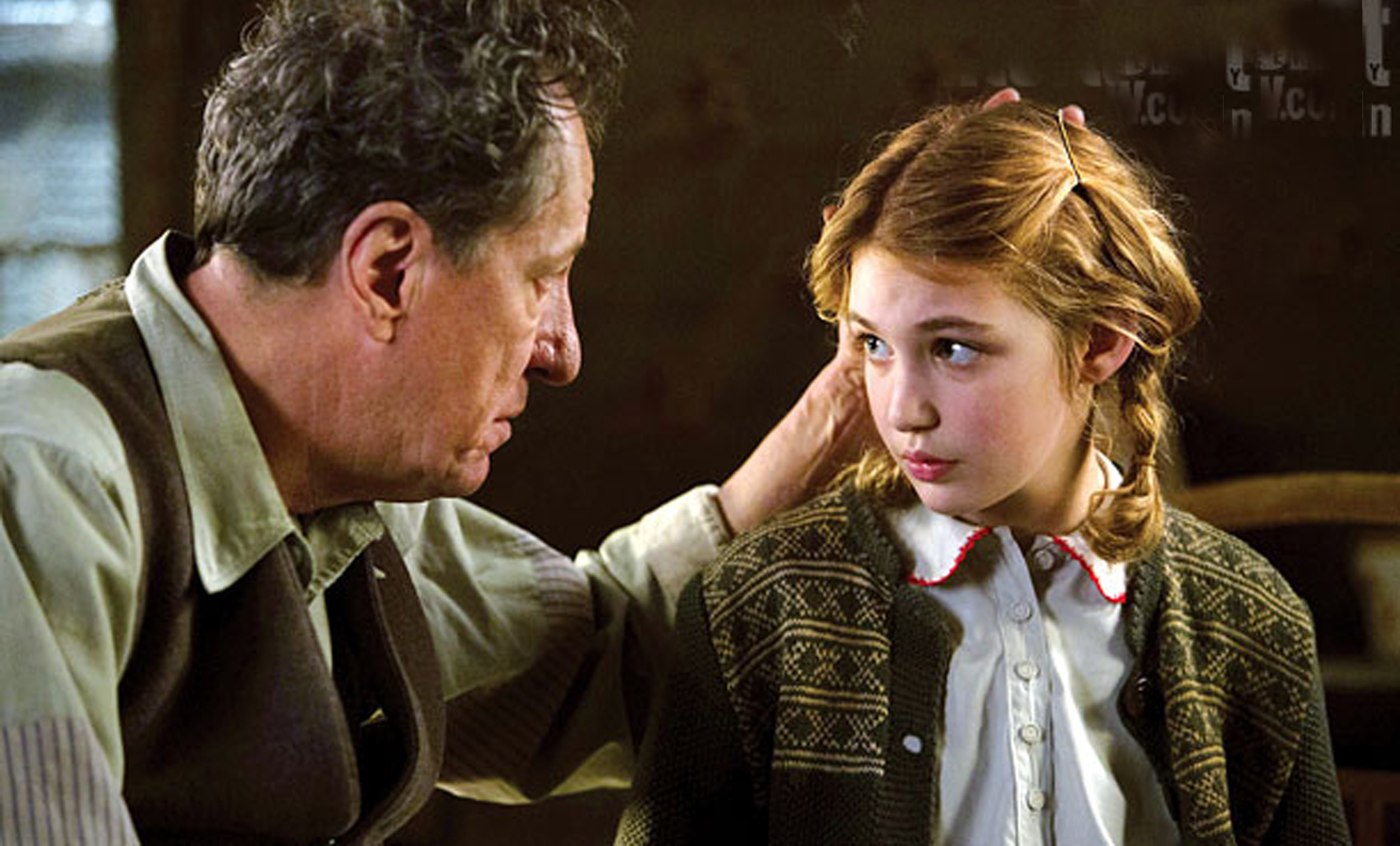
DF-05687.JPG

And so it is with The Book Thief. Adapted from the novel by Markus Zusak, The Book Thief in question is Liesel Meminger (Nelisse), a young girl who is given up for adoption by her mother (who may or may not be a communist) during the Second World War. She is taken in by the Hubermanns, Hans (Rush) and Rosa (Watson). Hans is a gentle, encouraging man who teaches Liesel how to read; from this Liesel develops her love of books. Rosa is stern and constantly criticising Liesel’s behaviour (though you know she has a soft spot for her, however horrid she might be). As time goes by and Liesel settles in to life with her new Mama and Papa, the war that seems to be going on in a separate part of Germany altogether, begins to encroach on their daily lives.

One day a young Jewish man called Max Vandenburg (Schnetzer) comes to their house. On the run from the Nazis, he is hurt and needs a place to hide. Owing a debt to his father, the Hubermanns at first hide him in Liesel’s room, then transfer him to the basement. There is an anxious occasion when a Nazi officer visits them and asks to see the basement but he goes away pretty quickly and has no idea that Max is there (and it turns out he’s not even looking for him). Helped back to nearly full health by Rosa’s administrations and Liesel’s reading to him (through books stolen from the burgermeister’s library), Max leaves before he can put them in greater danger. Then Hans is conscripted, despite his age. With the war getting nearer and nearer, Liesel’s future looks increasingly uncertain.

The Book Thief is a curiously flat, dramatically sterile movie that sticks to the same pace from its strikingly photographed opening to its let’s-try-and-be-upbeat-even-though-the-ending’s-a-downer conclusion. There’s very little drama here, very little of what the Germans refer to as sturm und drang (“storm and drive”). Michael Petroni’s adaptation is as dull and uneventful as a trip to a colour chart museum. There’s the visit by the Nazi officer, which should have the viewer on the edge of their seat, but as there’s so little invested in Max’s character, it doesn’t come across as a tense moment at all; it would have been more dramatic by this point if he had been discovered. The only other source of “trouble” that Liesel faces is from school bully and Nazi Youth member Franz Deutscher (Liam), and all he does is make empty threats about “reporting” her (and literally does no more than that). With such an absence of tension throughout, The Book Thief – while remaining true to its source – ends up being a collection of scenes that relate to each other but do little to involve the viewer at any particular point.

As a result, Rush and Watson have to fall back on their expertise to raise their characters from the level of caricatures or cardboard cut-outs, while newcomer Nelisse actually manages to impress even though she has as little to work with as her more experienced co-stars. Percival’s direction does nothing to improve things and is workmanlike at best, though the production – on a technical level – makes up for the emotional detachment, and is often lovely to look at. And there should be one final word for the narrator. Step forward, Death, as voiced by Roger Allam. If there is any further proof required that The Book Thief doesn’t work as well as it should, then take a listen to the dreadful dialogue Allam has to give voice to. If you’re not cringing after the first few sentences (right at the start of the movie) then you’ll probably enjoy The Book Thief a lot more than most.

Rating: 5/10 – dull as the proverbial ditchwater, and spoilt by a lack of engagement from its director and its writer; saved by the professionalism of its cast and crew, but a major disappointment nevertheless.

Share this:

  • Click to share on X (Opens in new window) X
  • Click to share on Facebook (Opens in new window) Facebook
  • More
  • Click to print (Opens in new window) Print
  • Click to email a link to a friend (Opens in new window) Email
Like Loading...

Blog Stats

  • 486,575 hits

Recent Posts

  • 10 Reasons to Remember Bibi Andersson (1935-2019)
  • Fantasia (1940)
  • Dances With Wolves (1990) – The Special Edition
  • Kiss of the Spider Woman (1985)
  • The Three Musketeers (1973)

Top Posts & Pages

  • Lost for Life (2013) - Another Look
    Lost for Life (2013) - Another Look
  • Lost for Life (2013)
    Lost for Life (2013)
  • About
    About
  • Mr. Topaze (1961)
    Mr. Topaze (1961)
  • Shock and Awe (2017)
    Shock and Awe (2017)
  • Hunt for the Wilderpeople (2016)
    Hunt for the Wilderpeople (2016)
  • Billy Lynn's Long Halftime Walk (2016)
    Billy Lynn's Long Halftime Walk (2016)
  • Winter's Tale (2014)
    Winter's Tale (2014)
  • Exposed (2016)
    Exposed (2016)
  • A Brief Word About La La Land (2016)
    A Brief Word About La La Land (2016)
Follow thedullwoodexperiment on WordPress.com

Blogs I Follow

  • Rubbish Talk
  • Film 4 Fan
  • Fast Film Reviews
  • The Film Blog
  • All Things Movies UK
  • Interpreting the Stars
  • Let's Go To The Movies
  • Movie Reviews 101
  • TMI News
  • Dan the Man's Movie Reviews
  • Film History
  • Jordan and Eddie (The Movie Guys)

Archives

  • April 2019 (13)
  • March 2019 (28)
  • February 2019 (28)
  • January 2019 (32)
  • December 2018 (28)
  • November 2018 (30)
  • October 2018 (29)
  • September 2018 (29)
  • August 2018 (29)
  • July 2018 (30)
  • June 2018 (28)
  • May 2018 (24)
  • April 2018 (21)
  • March 2018 (31)
  • February 2018 (25)
  • January 2018 (30)
  • December 2017 (30)
  • November 2017 (27)
  • October 2017 (27)
  • September 2017 (26)
  • August 2017 (32)
  • July 2017 (32)
  • June 2017 (30)
  • May 2017 (29)
  • April 2017 (29)
  • March 2017 (30)
  • February 2017 (27)
  • January 2017 (32)
  • December 2016 (30)
  • November 2016 (28)
  • October 2016 (30)
  • September 2016 (27)
  • August 2016 (30)
  • July 2016 (30)
  • June 2016 (31)
  • May 2016 (34)
  • April 2016 (30)
  • March 2016 (30)
  • February 2016 (28)
  • January 2016 (35)
  • December 2015 (34)
  • November 2015 (31)
  • October 2015 (31)
  • September 2015 (34)
  • August 2015 (31)
  • July 2015 (33)
  • June 2015 (12)
  • May 2015 (31)
  • April 2015 (32)
  • March 2015 (30)
  • February 2015 (37)
  • January 2015 (39)
  • December 2014 (34)
  • November 2014 (34)
  • October 2014 (36)
  • September 2014 (25)
  • August 2014 (29)
  • July 2014 (29)
  • June 2014 (28)
  • May 2014 (23)
  • April 2014 (21)
  • March 2014 (42)
  • February 2014 (38)
  • January 2014 (29)
  • December 2013 (28)
  • November 2013 (34)
  • October 2013 (4)

Blog at WordPress.com.

Rubbish Talk

Film 4 Fan

A Movie Blog

Fast Film Reviews

The Film Blog

The official blog of everything in film

All Things Movies UK

Movie Reviews and Original Articles

Interpreting the Stars

Dave Examines Movies

Let's Go To The Movies

Film and Theatre Lover!

Movie Reviews 101

Daily Movie Reviews

TMI News

Latest weather, crime and breaking news

Dan the Man's Movie Reviews

All my aimless thoughts, ideas, and ramblings, all packed into one site!

Film History

Telling the story of film

Jordan and Eddie (The Movie Guys)

Movie Reviews & Ramblings from an Australian Based Film Fan

Privacy & Cookies: This site uses cookies. By continuing to use this website, you agree to their use.
To find out more, including how to control cookies, see here: Cookie Policy
  • Subscribe Subscribed
    • thedullwoodexperiment
    • Join 481 other subscribers
    • Already have a WordPress.com account? Log in now.
    • thedullwoodexperiment
    • Subscribe Subscribed
    • Sign up
    • Log in
    • Report this content
    • View site in Reader
    • Manage subscriptions
    • Collapse this bar
 

Loading Comments...
 

    %d