
Tags
Artificial intelligence, Drama, Geena Davis, Humour, Jon Hamm, Lois Smith, Memory, Michael Almereyda, Review, Tim Robbins
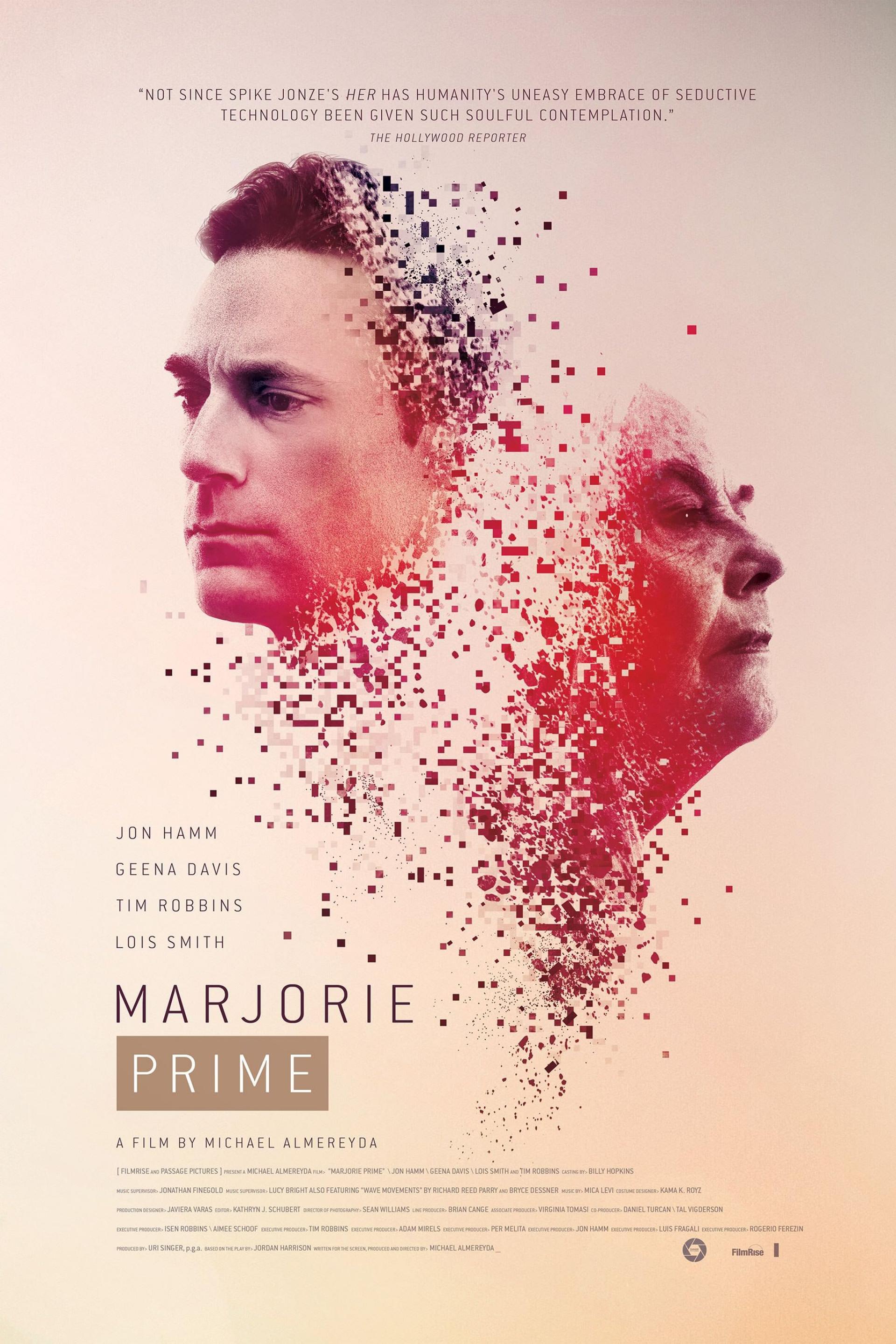
D: Michael Almereyda / 99m
Cast: Jon Hamm, Lois Smith, Geena Davis, Tim Robbins, Stephanie Andujar, Hannah Gross
How much do you trust your memories? Or rather, how much can you trust your memories? And where do they come from? Are they exclusively made up of your own recollections, or are they a combination of what you can remember and the recollections of others? And can they ever be really regarded as true memories, an accurate representation of something that happened in the past? These are just some of the questions that Marjorie Prime asks as it ponders the nature of memory, its provenance, and its importance in our lives.
Michael Almereyda’s latest movie is a challenging examination of how we remember things, and why. The why is perhaps more important than the how, but it’s how our memories shape our character and our personalities, and help us connect our past and present lives that seems to be more important. But if memory can be elusive, if it can be confusing, or contrary, or unreliable, then how can we know if a memory carries the weight that it should do? How can it retain the meaning it relies on to be an accurate memory? Almereyda’s answer – adapted from the Pulitzer Prize-nominated play by Jordan Harrison – is that, ultimately, we can’t be sure of anything related to memory because there are just too many variables. And many of those variables are the memories of other people.

The movie begins with Marjorie (Smith) having a conversation with a younger facsimile of her late husband, Walter (Hamm) (Walter is a computer programme, an example of artificial intelligence used as memory therapy). Together they probe various memories and attitudes towards memory that are largely to do with Marjorie’s attempts at building a coherent narrative out of her past. Walter is a computer-driven replica of Marjorie’s husband at the time of their engagement. He already knows a lot about Marjorie and the man he represents, but his knowledge is far from complete. In order to further his knowledge, and his usefulness to Marjorie – whose own memory is under threat from the early onset of Alzheimer’s – he discusses their shared past and allows her to correct him whenever he gets something wrong. Walter at first believes that they were watching My Best Friend’s Wedding (1997) when he proposed to her, but Marjorie is eqaully sure that it was Casablanca (1942), or at least that Michael Curtiz’s perennial classic seems more likely. Marjorie’s memory of that event is eluding her, so she creates a memory that sounds like it could be true, and once it’s accepted by the programme acting as Walter, then it passes into memory, and into truth.
And then there’s the input from Marjorie’s daughter, Tess (Davis), and her husband, Jon (Robbins). Both talk to Walter and both express their own feelings and views on events that happened to Marjorie during her life, and they don’t confine themselves to moments that they have direct knowledge or recollection of. Walter accepts what they tell him without verification or any kind of fact-checking being carried out. And when he relays their recollections to Marjorie – like him – she accepts these as having really happened. But how can such memories truly be “real” when they’re an amalgam of various sources? With the frailty of the human mind being explored in this way, Almereyda shows us how unreliable our memories really are, and how our need to provide context for them can often mean we overlook any contentious issues that may arise from remembering them. The more we remember, Almereyda seems to be saying, the more we actually forget.
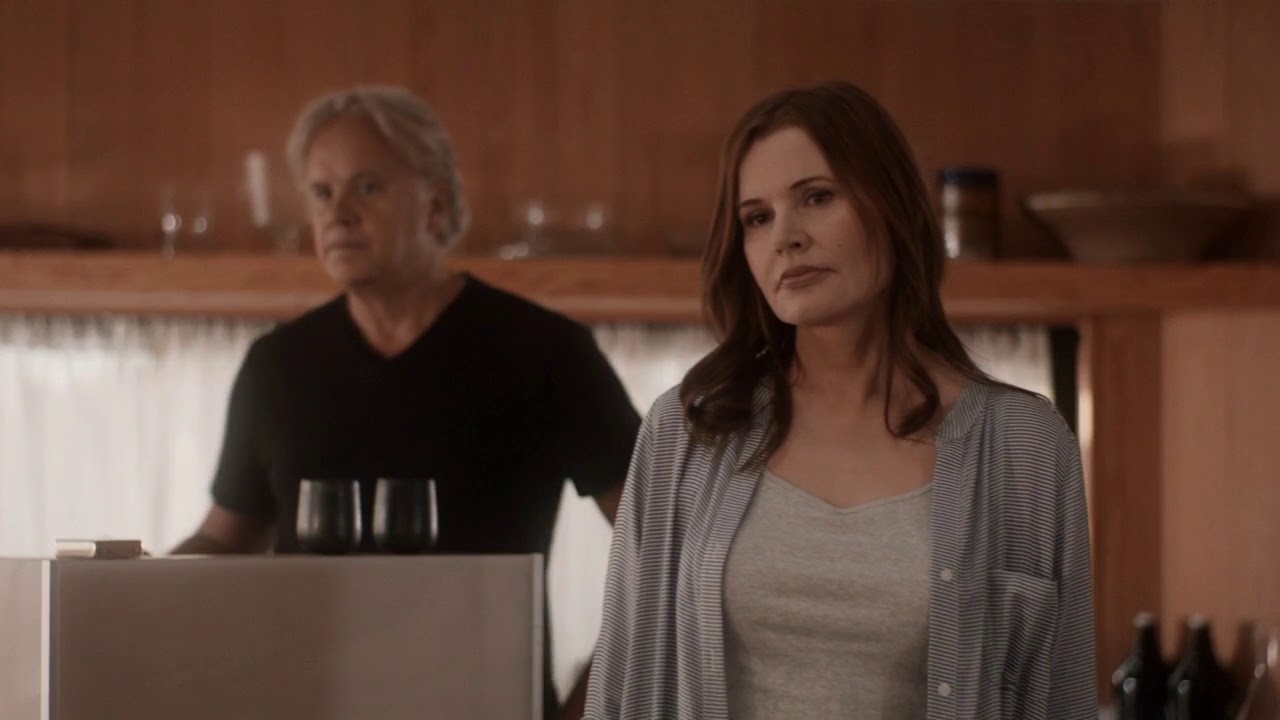
By showing the pitfalls of allowing future technology to “guide” us through the labyrinth of our reminiscences, Marjorie Prime highlights just how memory and truth can be ephemeral and an unreliable witness to our own experiences. Tess refers to the way in which we remember the emotion of an experience rather than the fact of it, and how this informs the details of that experience. From this we can understand that feelings and emotions are often more important than the facts, and can help us to derive a better appreciation or understanding of what we’re trying to remember. But these impressions can be just as subjective or erroneous as the memory itself, and as the movie progresses, and focuses more and more on Tess and Jon’s relationship and their own recollections, Almereyda uses the shift in perspective to show how relative memory really is. And there are further narrative shifts that provide even more examples of how memory can collude with us in providing the kind of recollections that help us make sense of our world and the world around us (and especially, other people). Layer upon layer upon layer, and soon the source can no longer be recognised. But is that a good thing or a bad thing?
Sensibly, Almereyda doesn’t provide the viewer with any conclusions, merely more and more questions, some of which can be answered within the narrative itself, and others that remain a mystery, fleeting notions of recognition that may or may not be reliable. The movie regards these questions as components in a kind of mental jigsaw puzzle, and in trying to piece them together, the characters all behave as though their own memories are more credible than others. Even Marjorie, whose moments of lucid behaviour grow fewer and further apart, believes what she remembers, and when she discusses with Walter their shared history, there are moments where she is creating rather than looking back. The same can be said for Tess and Jon, who want to help Marjorie retain her memory for as long as possible, but who also create incidents and details out of a misguided sense of being supportive. As in so many areas of life, lies become truth, and the boundaries between the two become irrevocably blurred, no matter how good the original intention.

Marjorie Prime is a small movie about big ideas, but important ones nevertheless, and the dialogue is smart, funny and precise in its statements and observations. The cast all give measured, thoughtful performances, with Smith (reprising her role in the original stage production) offering a particularly sprightly portrayal of Marjorie that is both sympathetic and endearing. Against this, Hamm has the more challenging role as Walter, a synthetic approximation of a person who has no life experience except that which is given to him by others. As the sometimes feuding Tess and Jon, Davis and Robbins give expression to the rituals that they go through in order to provide certainty for their own memories, and then Marjorie’s as well, but without seeing the problems inherent in doing this. All four actors are mesmerising, especially Davis, who plays a character who’s increasingly conflicted over the benefits of (re-)constructed memories, and who is stricken by memories of her own that are unwanted.
Viewers may find the opening exchange between Marjorie and Walter a little slow going, and the introduction of several minor characters later on may make the movie feel a little fragmented, but otherwise this is intelligent, thought-provoking stuff that isn’t afraid to tackle big ideas head on. It has a wintry, melancholy feel to it, highlighted by the starkly beautiful cinematography of Sean Price Williams, and a deftly supportive, and unobtrusive score by Mica Levi that provides an effective counterpoint to the emotional turmoil experienced by the characters. But it’s Almereyda’s confident, assured direction that remains the movie’s most impressive element, and proof – if it were needed – that he is one of the most distinctive and talented voices working in movies today.
Rating: 9/10 – an award winner at this year’s Sundance Film Festival, few movies made at the moment have the rigorousness or the attention to detail that infuses Marjorie Prime and which make it a movie to admire and to lose oneself in; if you’re a fan of cinema as a reflection of real life and all its flaws and imperfections, then this is a movie that will reward you over and over again.
 thedullwoodexperiment