• 10 Reasons to Remember…
  • A Brief Word About…
  • About
  • For One Week Only
  • Happy Birthday
  • Monthly Roundup
  • Old-Time Crime
  • Other Posts
  • Poster of the Week
  • Question of the Week
  • Reviews
  • Trailers

thedullwoodexperiment

~ Viewing movies in a different light

thedullwoodexperiment

Tag Archives: Gillian Flynn

Dark Places (2015)

02 Sunday Aug 2015

Posted by dullwood68 in Movies

≈ Leave a comment

Tags

1985, Charlize Theron, Chloë Grace Moretz, Christina Hendricks, Corey Stoll, Crime, Drama, Gilles Paquet-Brenner, Gillian Flynn, Kansas, Literary adaptation, Murder, Nicholas Hoult, Review, Satanism, The Kill Club

Dark Places

D: Gilles Paquet-Brenner / 113m

Cast: Charlize Theron, Nicholas Hoult, Christina Hendricks, Tye Sheridan, Chloë Grace Moretz, Corey Stoll, Sterling Jerins, Sean Bridgers, Andrea Roth, Shannon Kook, Drea de Matteo

In 1985, in a small rural community in Kansas, a single mother and two of her daughters are all killed one night at their farmhouse; later, the surviving daughter, Libby (Jerins), tells the police her brother Ben (Sheridan) did it. After his arrest and during his trial, Ben offers no defence and he’s sent to prison for the rest of his life.

In 2015, the adult Libby (Theron) is down on her luck and counting on her minor celebrity status to keep her afloat. When she’s contacted by Lyle Wirth (Hoult) with the offer of $500 for a speaking engagement, she arranges to meet with him first. Lyle tells her he belongs to a group called The Kill Club, an organisation of volunteers who look into old unsolved murders, or cases where they believe an innocent person has been put in jail. She attends one of their meetings and finds that several members believe Ben didn’t commit the murders, and Libby finds herself challenged over her version of events that night. Angry at first, Libby agrees to help the group look into the  case, and begins her own investigation alongside theirs.

Lyle convinces her to visit her brother, something she’s never done. Ben (Stoll) is happy to see her, but Libby’s resentment of him means the visit goes badly. Back in her hometown she tries to find her father, Runner (Bridgers), who abandoned them when she was much younger. She also looks into the possibility of Ben having been part of a Satanic cult at the time, and why a young girl named Krissi Cates is relevant to what happened. As she learns more and more, she discovers Ben had a girlfriend called Diondra (Moretz). With Lyle’s help, Libby begins to put all the pieces together, and finds that what she believed happened all those years ago is far more complicated than she could ever imagined – and the repercussions of those events are still being played out in the present.

Dark Places - scene

Adapted from the novel by Gillian Flynn, author of Gone Girl, Dark Places is a murder mystery where what appears to be a simple, unexplainable crime proves to be something a lot more complicated and strange, and with a bewildering set of coincidences that make up the solution to the murders. Paquet-Brenner’s adaptation keeps the narrative skipping backwards and forwards between 1985 and 2015, showing us the events that led to the murders in 1985, and linking these scenes to the discoveries Libby makes in the present. As the story gradually unfolds, and we see the drama that played out in the past, we gain a greater understanding of the whys and hows that govern the actions of Libby and those people who were involved.

It’s a delicate balancing act at times, with the structure dictating that there be some degree of repetition throughout, as what we see in the past is explained in the future. Thankfully, Paquet-Brenner avoids such a hazard by making each new discovery as confusing as the last, and by throwing in so many suspects it almost seems as if the entire community could have done it. As Libby’s investigation leads to some unsavoury truths and revelations, the director makes it clear that her memories of that night have always been tainted, but to what degree she and the audience have to find out for themselves.

The dark places of the title are the ones we go to in our minds when we contemplate issues of murder and perceived guilt. The movie explores these avenues via the adult Libby’s increasingly fractured certainty that Ben killed his mother and sisters. And while the script plants a very big clue early on as to what really happened, it’s more concerned with the various ways in which we, through Libby, justify our actions and sense of culpability. Libby is tormented by having not been able to do anything to stop Ben, but as his innocence becomes more and more likely, her own assertions (the ones that have carried her through all these years) begin to crumble and she’s faced with the daunting prospect that her testimony condemned her brother to prison for the rest of his life.

But it proves not to be so simple. Ben has his own reasons for staying quiet, and so we, like Libby, have to seek answers in those dark places mentioned already. Thanks to a tight, focused script, and a clutch of telling performances, the movie shifts and turns with every passing minute, making it more and more difficult to work out what actually happened. Theron is impressive as the outwardly angry but internally uncomfortable Libby, her strained features and abrasive attitude in keeping with a survivor who only has her celebrity to keep her going; without it she’d be aimless (another reason why she agrees to help the Kill Club). As Lyle, Hoult brings a determined optimism to the role that offsets and complements Libby’s antagonistic approach, while Hendricks stands out as the harried mother struggling to keep her home and family together in the face of impending financial ruin. With more than able support from the likes of Sheridan, Moretz and de Matteo as the older Krissi, Dark Places succeeds in making each character credible, even when they’re sometimes asked to behave in ways that don’t make sense until the final reveal.

To add to the effectiveness of the script, the acting and Paquet-Brenner’s solid, unshowy direction, the movie is filmed in a gloomy, downlit style by DoP Barry Ackroyd, his compositions and framing illustrating proceedings with confidence and giving scenes an eerie quality that makes it seem that there’s other, stranger stuff we should know about happening just out of frame. With a running time that allows more than sufficient time to detailing events in both time periods, and a score by Gregory Tripi that subtly adds a level of foreboding to the material, Dark Places is an intelligent thriller that holds the attention and makes for avid viewing.

Rating: 8/10 – riveting in a sombre, calculated way, Dark Places maintains its gloomy, oppressive mise en scene to good effect throughout, and makes its audience work hard to solve the mystery; a better than average adaptation that showcases another fine performance from Theron, and flits between the past and the present with assured clarity and focus.

Share this:

  • Click to share on X (Opens in new window) X
  • Click to share on Facebook (Opens in new window) Facebook
  • More
  • Click to print (Opens in new window) Print
  • Click to email a link to a friend (Opens in new window) Email
Like Loading...

Gone Girl (2014)

09 Thursday Oct 2014

Posted by dullwood68 in Movies

≈ 1 Comment

Tags

Amazing Amy, Ben Affleck, David Fincher, Drama, Gillian Flynn, Literary adaptation, Marital problems, Murder, Neil Patrick Harris, Relationships, Review, Rosamund Pike, Thriller, Unhappy marriage

Gone Girl

D: David Fincher / 149m

Cast: Ben Affleck, Rosamund Pike, Neil Patrick Harris, Tyler Perry, Carrie Coon, Kim Dickens, Patrick Fugit, David Clennon, Lisa Banes, Missi Pyle, Emily Ratajkowski, Casey Wilson, Lola Kirke, Boyd Holbrook, Sela Ward, Scoot McNairy

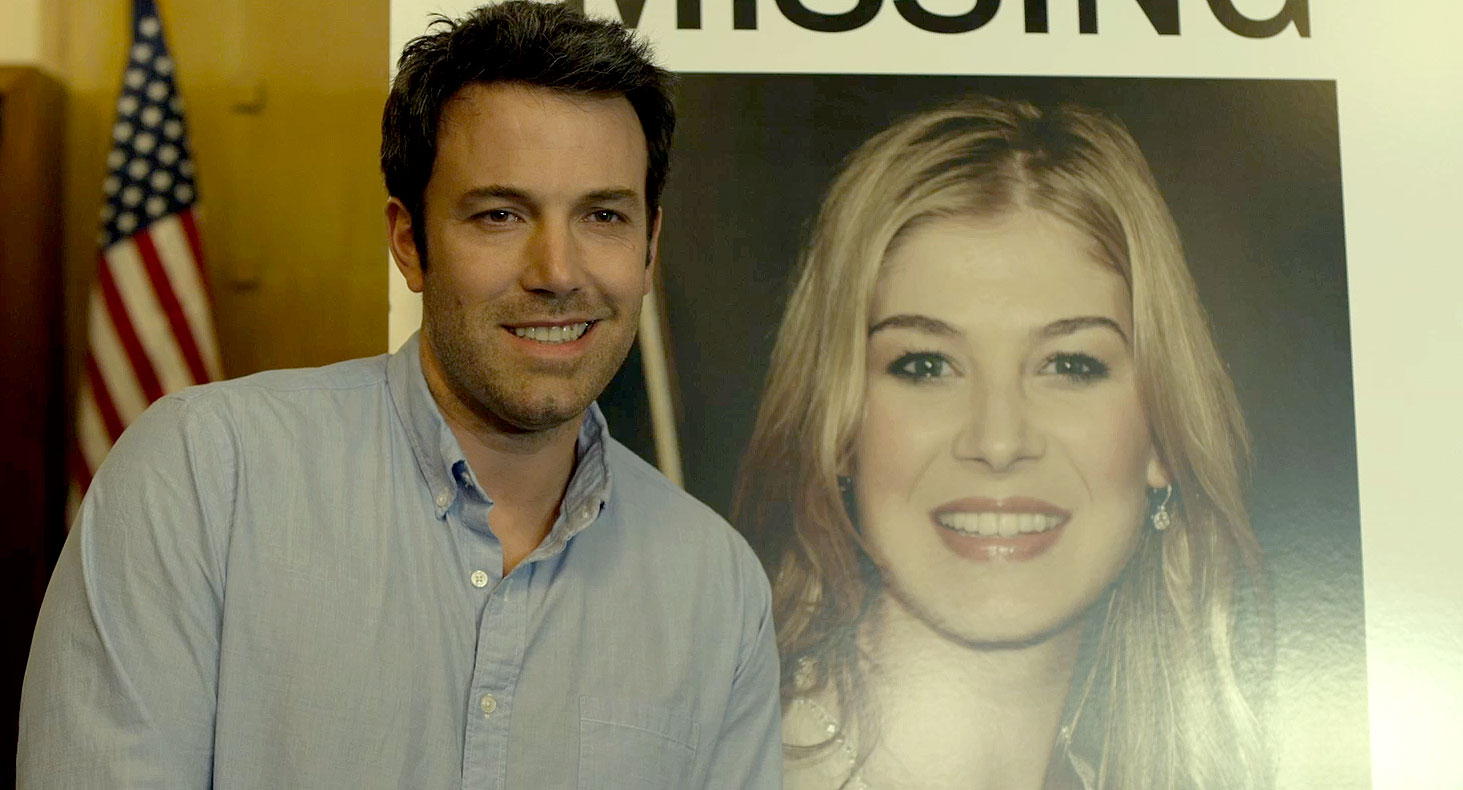
One morning in July, Nick Dunne (Affleck) comes home to find signs of a violent struggle and his wife, Amy (Pike), missing.  He calls the police and when they arrive, Detective Boney (Dickens) and Officer Gilpin (Fugit), soon find further evidence that something bad has happened.  Soon, Amy’s face is everywhere, and while it’s assumed at first that she’s been abducted, Nick’s behaviour doesn’t ring true and he becomes a suspect in what may be his wife’s death.  With evidence building up against him, Nick and his sister Margo (Coon) try to figure out what’s going on, but they’re stumped at every turn.  It’s only when they make a startling discovery in a woodshed on Margo’s property that they begin to realise what’s really happening.

At this point in the movie, as well as in Gillian Flynn’s original novel, there is a major plot twist, and both incarnations of the story begin to move in a new direction, opening out what is a fairly claustrophobic small-town mystery into something that strains credulity and begins to founder under the weight of its attempts to be cleverer than it needs to be.  There are many, many problems with the plot against Nick Dunne, not least Nick’s conveniently inappropriate responses in front of the police and the media, but also the introduction of Amy’s diary.  This offers a disjointed view of Nick and Amy’s marriage that’s meant to put doubts in the minds of the audience as to Nick’s innocence, but which has its effectiveness rendered null and void by the aforementioned plot twist.

It’s not unusual to watch a thriller and find yourself questioning the logic of what’s happening, but with Gone Girl it’s a constant process.  There’s little doubt that Flynn’s tale of marital discord has a degree of cultural relevancy, and her examination of the hidden duplicities and feelings within a marriage is sharper than expected, but ultimately, what we’re talking about here is an above averagely presented potboiler that marries trenchant observations on the media and modern marriage with more traditional thriller elements, and which muddles its way through to an ending which can be seen as either depressingly nihilistic or just desserts for a character – Nick – who has been outclassed from the beginning (though it seems at first glance that it’s all happening because the person doing it all really holds a grudge).

Gone Girl - scene

What happens in the movie’s second half, as Nick attempts to regain control of his life, and defend himself from the police and the media, is confidently arranged and presented by Fincher, but with what the audience knows is happening elsewhere, the movie maintains its measured, effective pacing but at the expense of the tension that’s been built up before.  It’s not the movie’s fault; it is, after all a very faithful adaptation by Flynn of her own novel, and Fincher seems happy to go along with the twists and turns and her reliance on dramatic licence to steer her characters through.  The weaknesses that plague the second half of the novel are present in the movie, and have the same effect: they make everything too unbelievable, and lead to a denouement that will either have audiences who haven’t read the novel shaking their heads in disbelief and asking, “Is that it?”, or audiences who have read the novel shaking their heads in disbelief and asking, “Is that still it?”

So – is Gone Girl then a bad movie?  The answer is very definitely No.  In Fincher’s hands, Gone Girl overcomes it’s cod-psychological thriller origins to become a dark, unsettling movie that picks at the conventional notions of love and marriage and finds murky, troubled waters flowing just below the surface.  As an examination of how two people can fall out of love with each other so easily, and be so ready to hurt each other in the process, the movie scores on all counts.  Nick and Amy, once so right for each other, are now adversaries, both looking to come out on top.  It’s an unfair fight; after all, if Nick was a box-cutter, he’d be the last one you’d use to open up something (he’s just not that sharp).  But Amy is sharp, smart as a whip in fact.  She’s Amazing Amy, the ultimate version of herself that her parents created when she was a little girl, a prodigy who always excels, who always ends up the winner, just because she’s Amazing Amy.  (Amy has always been in competition with her literary alter-ego, but the movie only mentions it in passing, while the novel explores the idea in greater, and more rewarding, depth.  It’s important to take in, though.)

Fincher excels at fleshing out the characters.  Nick is smug and stupid and reckless and self-satisfied and callow and foolish, and he has no idea how idiotically he behaves.  He’s like Bambi in a hunter’s sights, a prize just waiting to be claimed.  Affleck gives perhaps his best performance in years, earning our initial sympathy then dashing it to the ground in one superbly orchestrated scene that pulls the rug out from under the audience with undisguised pleasure.  Nick is twitchy, nervous, anxious, panicky – all the things you’d expect when someone is increasingly viewed as having killed their wife, but Affleck never puts a foot – or an inappropriate grin – wrong, imbuing Nick with an easy-to-warm-to naïveté that hardens as the movie plays out, his nervous energy transformed into a need for redemption in the public’s eye.  As mentioned before, Nick is a frustratingly obtuse character, but Affleck makes it a positive.  Even when Nick is doing or saying something witless, like posing with a woman for a selfie, it’s witless because it’s part of his nature, his way of dealing with people.  He’s like a puppy: he just wants to be loved.

Gone Girl - scene2

Conversely, Amy has always been loved, her parents’ books about her excelling alter-ego having made her treasured by default.  But that affection comes with an expectation that everyone around Amy will feel the same way about her, and if she’s in a relationship then it’s all or nothing, her way or no way.  Pike is a revelation here: as we learn more and more about Amy, she reveals more and more of the fractured person Amy really is.  It’s a role that would test any actress, but Pike – who probably wasn’t most people’s first choice for the part – claims the role as her own and pulls off a devastating performance.  She’s an actress who shows everything with her eyes; watch those and you’ll know everything her character is thinking and feeling, and some things you might not want to know.  She complements Affleck’s performance superbly, and she even manages to make some of Flynn’s more tortured dialogue sound appropriate and convincing.

In support, Dickens is excellent as the detective who never feels entirely satisfied with the way things keep happening, her experience telling her that there’s more going on than meets the eye.  As one of Amy’s old boyfriends, Desi Collings, Harris is awkwardly emotional and manipulative at the same time, the kind of creepy paramour most women would run a mile from.  Coon offers solid support as Nick’s sister but the role is  stereotypically rendered: she believes in him no matter what, even when he does something really stupid.  And Perry – as Nick’s lawyer, Tanner Bolt – has fun with a role that could have done with a bit more bluster, and he provides some much needed levity from the seriousness of the situation.

Marshalling the production into something much greater than its origins, though, is Fincher, a director able to elevate any material he’s given – save Alien³ (1992) – and make it riveting to watch.  In hand with cinematographer Jeff Cronenweth, Fincher makes Gone Girl an impressively visual experience, with shots and images that linger in the memory, and never so cleverly as with Nick and Amy’s home, a large, airy property that serves to highlight how far apart from each other they actually are.  Fincher also takes the more outlandish aspects of Flynn’s story and makes them more credible (though even he’s powerless to override the flimsy psychology that underpins the ending), and he makes the audience want to know what happens next, even if it might be obvious.  With two commanding central performances as well, Gone Girl cements Fincher’s reputation even further, and if at some point down the road Flynn decides to revisit Nick and Amy’s marriage, there shouldn’t be any question as to who should direct the movie version.

While it may divide some audiences – especially those who like their endings to be unequivocal (although this is, in its way) – Gone Girl is nonetheless superior movie-making, and should be regarded as such.  Fincher shows a complete understanding of the characters and their motivations, and delivers one of the most unexpectedly energised movies of the year.  It’s a thriller, yes, but at its heart it’s a movie about the expectations of love and the slow decay of a relationship, where passion turns to pain and love turns to hate.  And it’s relentless.

Rating: 8/10 – the script’s deficiencies knock this one down a point, but this is still very impressive stuff indeed; a taut, engrossing thriller that impresses with every scene, Gone Girl is that rare movie that grips the audience despite its faults and becomes a movie that everyone will want to talk about afterwards.

Share this:

  • Click to share on X (Opens in new window) X
  • Click to share on Facebook (Opens in new window) Facebook
  • More
  • Click to print (Opens in new window) Print
  • Click to email a link to a friend (Opens in new window) Email
Like Loading...

Blog Stats

  • 486,528 hits

Recent Posts

  • 10 Reasons to Remember Bibi Andersson (1935-2019)
  • Fantasia (1940)
  • Dances With Wolves (1990) – The Special Edition
  • Kiss of the Spider Woman (1985)
  • The Three Musketeers (1973)

Top Posts & Pages

  • Lost for Life (2013) - Another Look
    Lost for Life (2013) - Another Look
  • Lost for Life (2013)
    Lost for Life (2013)
  • About
    About
  • Mr. Topaze (1961)
    Mr. Topaze (1961)
  • Winter's Tale (2014)
    Winter's Tale (2014)
  • Billy Lynn's Long Halftime Walk (2016)
    Billy Lynn's Long Halftime Walk (2016)
  • The Hitman's Bodyguard (2017)
    The Hitman's Bodyguard (2017)
  • Shock and Awe (2017)
    Shock and Awe (2017)
  • 5 Famous Movie Roles That Nearly Went to Someone Else
    5 Famous Movie Roles That Nearly Went to Someone Else
  • The Layover (2017)
    The Layover (2017)
Follow thedullwoodexperiment on WordPress.com

Blogs I Follow

  • Rubbish Talk
  • Film 4 Fan
  • Fast Film Reviews
  • The Film Blog
  • All Things Movies UK
  • Interpreting the Stars
  • Let's Go To The Movies
  • Movie Reviews 101
  • TMI News
  • Dan the Man's Movie Reviews
  • Film History
  • Jordan and Eddie (The Movie Guys)

Archives

  • April 2019 (13)
  • March 2019 (28)
  • February 2019 (28)
  • January 2019 (32)
  • December 2018 (28)
  • November 2018 (30)
  • October 2018 (29)
  • September 2018 (29)
  • August 2018 (29)
  • July 2018 (30)
  • June 2018 (28)
  • May 2018 (24)
  • April 2018 (21)
  • March 2018 (31)
  • February 2018 (25)
  • January 2018 (30)
  • December 2017 (30)
  • November 2017 (27)
  • October 2017 (27)
  • September 2017 (26)
  • August 2017 (32)
  • July 2017 (32)
  • June 2017 (30)
  • May 2017 (29)
  • April 2017 (29)
  • March 2017 (30)
  • February 2017 (27)
  • January 2017 (32)
  • December 2016 (30)
  • November 2016 (28)
  • October 2016 (30)
  • September 2016 (27)
  • August 2016 (30)
  • July 2016 (30)
  • June 2016 (31)
  • May 2016 (34)
  • April 2016 (30)
  • March 2016 (30)
  • February 2016 (28)
  • January 2016 (35)
  • December 2015 (34)
  • November 2015 (31)
  • October 2015 (31)
  • September 2015 (34)
  • August 2015 (31)
  • July 2015 (33)
  • June 2015 (12)
  • May 2015 (31)
  • April 2015 (32)
  • March 2015 (30)
  • February 2015 (37)
  • January 2015 (39)
  • December 2014 (34)
  • November 2014 (34)
  • October 2014 (36)
  • September 2014 (25)
  • August 2014 (29)
  • July 2014 (29)
  • June 2014 (28)
  • May 2014 (23)
  • April 2014 (21)
  • March 2014 (42)
  • February 2014 (38)
  • January 2014 (29)
  • December 2013 (28)
  • November 2013 (34)
  • October 2013 (4)

Blog at WordPress.com.

Rubbish Talk

Film 4 Fan

A Movie Blog

Fast Film Reviews

The Film Blog

The official blog of everything in film

All Things Movies UK

Movie Reviews and Original Articles

Interpreting the Stars

Dave Examines Movies

Let's Go To The Movies

Film and Theatre Lover!

Movie Reviews 101

Daily Movie Reviews

TMI News

Latest weather, crime and breaking news

Dan the Man's Movie Reviews

All my aimless thoughts, ideas, and ramblings, all packed into one site!

Film History

Telling the story of film

Jordan and Eddie (The Movie Guys)

Movie Reviews & Ramblings from an Australian Based Film Fan

Privacy & Cookies: This site uses cookies. By continuing to use this website, you agree to their use.
To find out more, including how to control cookies, see here: Cookie Policy
  • Subscribe Subscribed
    • thedullwoodexperiment
    • Join 481 other subscribers
    • Already have a WordPress.com account? Log in now.
    • thedullwoodexperiment
    • Subscribe Subscribed
    • Sign up
    • Log in
    • Report this content
    • View site in Reader
    • Manage subscriptions
    • Collapse this bar
 

Loading Comments...
 

    %d