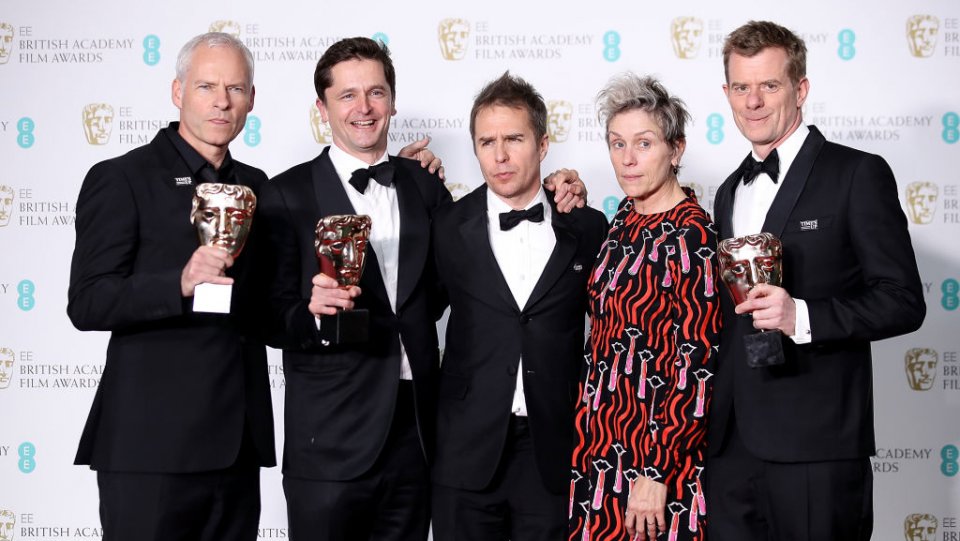
Can someone – anyone – please explain this to me? While it’s great to see Three Billboards Outside Ebbing, Missouri win five awards – Best Film, Outstanding British Film, Leading Actress, Supporting Actor, Original Screenplay – how does it compute that Martin McDonagh didn’t nab the Director award as well? With all due respect to Guillermo del Toro, how does he win the award when The Shape of Water is only recognised in two other categories (Original Music, Production Design)? If we accept the auteur theory – which certainly applies to both McDonagh and del Toro in these instances – then splitting their movie’s achievements seems ridiculous. But even if we don’t accept the auteur theory then it still doesn’t make sense. How can the director of the movie that’s acknowledged as the Best of an entire year lose out to the director of another movie that doesn’t receive that same accolade?
Perhaps it’s a bit like those Lifetime Achievement awards that the Oscars give out. You know the ones, where someone who’s never won an Oscar is given an honorary one as a soft apology for not being recognised sooner (or before they die). Perhaps it’s out of some random idea of fair play, a sense that it would be somehow awful if one movie swept the board so completely. Or perhaps – and maybe this is the worst of all – it’s all arbitrary, and instead of full consideration being given to each director’s individual merits in relation to the movie they’ve made, it’s purely the luck of the draw. (Yes, I know each category is voted for, but still, really…?)
If I were Martin McDonagh, and I was given the opportunity to reveal my true deep-down feelings about losing to Guillermo del Toro, then I would be saying, “What the f#@k happened? What the holy f#@k just happened?” I would be checking with my lawyer to see if I could sue BAFTA and anyone who had a hand in del Toro’s victory, and I would be erecting three billboards of my own outside 195 Piccadilly, London: 1) Snatched while watching, 2) And still no questions?, and then 3) How come, BAFTA?
Cast: Sally Hawkins, Michael Shannon, Richard Jenkins, Octavia Spencer, Michael Stuhlbarg, Doug Jones, David Hewlett, Nick Searcy, Lauren Lee Smith
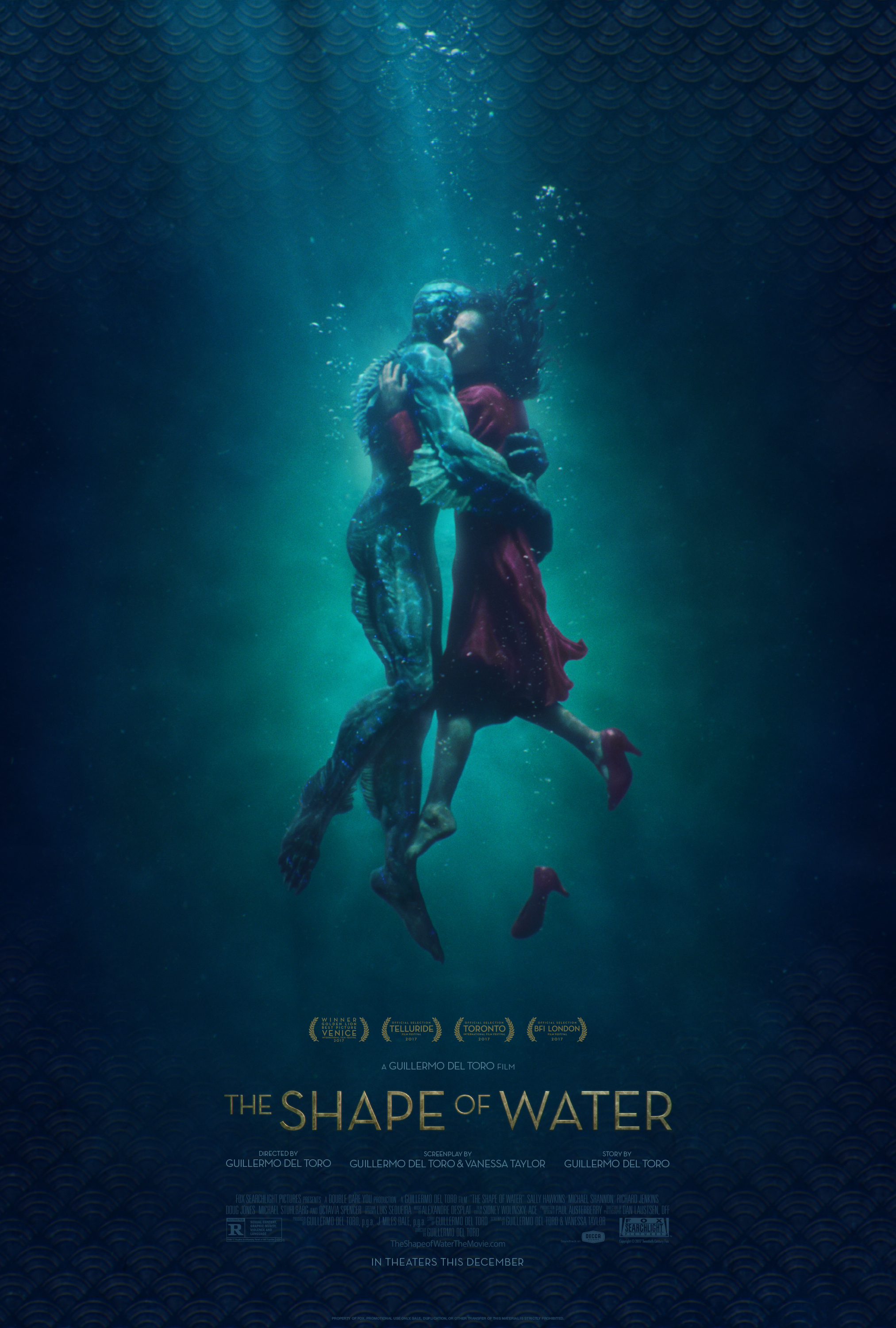
A romantic fairy tale set during the Cold War era of the Sixties, Guillermo del Toro’s latest feature is set in a secret government laboratory in Baltimore. Elisa Esposito (Hawkins) is a cleaner who works the night shift. She’s also mute from birth. One night the laboratory receives a new “asset”, an amphibious creature (Jones) captured in the Amazon river by military man Richard Strickland (Shannon). The creature proves to be humanoid, and though it’s ostensibly dangerous, Elisa develops a bond with it, and even uses sign language to communicate with it on a basic level. With the creature able to breathe in and out of water, the intricacies of its anatomy lead to the decision to have it vivisected. Elisa is horrified by this, and with the aid of her fellow cleaner, Zelda (Spencer), and her neighbour, elderly artist Giles (Jenkins), she determines to free the creature and return it to the sea. As she puts her plan into action, she finds unexpected assistance from one of the scientists at the laboratory, Dr Hoffstetler (Stuhlbarg), and unwanted attention from Strickland.
Fully and firmly back on track after the disappointment that was Crimson Peak (2015), Guillermo del Toro has made perhaps his best movie yet. The Shape of Water is a veritable treasure trove of delights. By turns funny, dramatic, sad, tender, exciting, joyous, imaginative, bold, romantic, uplifting, and poignant, it’s a movie that crams so much into its two hour running time that it should feel heavy-handed. Instead it feels like the lightest of confections, even with the overtly darker undertones that are threaded throughout the narrative and which help the movie add a credible and palpable sense of menace to the overall tone. del Toro has long wanted to make a movie inspired by Creature from the Black Lagoon (1954), but it’s unlikely even he could have predicted just how good the end result would be. From Paul D. Austerberry’s masterful period production design, to the efforts of the set dressers (so much detail), this is a movie that is constantly inviting the viewer to come nearer and peer closely at all the objects that fill each frame. And then there are the small yet seemingly effortless moments that pepper the movie, moments such as Elisa and Giles’ seated dance routine, or the man at the bus stop with the partially eaten cake. It all adds up to a richness of texture that is nigh-on faultless.
But the movie isn’t just beautiful to look at, it’s also an old-fashioned love story (an inter-species love story, to be fair, but hey, so what? As Joe E. Brown says at the end of Some Like It Hot (1959), “Nobody’s perfect”). It would have been so easy to misjudge the tone and the mood in presenting this romance, but del Toro and co-screenwriter Vanessa Taylor handle it perfectly, combining elements of magical realism and the aforementioned fairy tale aspect to wonderful effect. Hawkins – for whom the role of Elisa was written – gives a mesmerising performance, passionate and vulnerable, determined and caring, and capable of expressing any of Elisa’s emotions through the delicate shading of her features. As the principal villain, Shannon gets to add unexpected psychological layers to the role of Strickland, something that keeps the part from being that of a stereotypical bad guy, while Jenkins provides the majority of the laughs (and a great deal of pathos) as Giles, an elderly gay man still hoping to find love himself. Everything is rounded off by the music, as del Toro harks back to the golden era of Hollywood musicals. And just when you think he can’t squeeze in anything else, he gives us a black and white dance number featuring Elisa and the creature which is a tribute to Follow the Fleet (1936). This all leaves just one option: this much confidence must be applauded.
Rating: 9/10 – made with an intense amount of love and affection for its central characters, and with an elegance that shines throughout, The Shape of Water is a triumph of both style and substance; look closely, though, and you’ll find del Toro being quietly and unobtrusively subversive: ask yourself – which other movie are you likely to see where the heroes are in turn disabled, gay, black, and a Communist?
Cast: Mia Wasikowska, Jessica Chastain, Tom Hiddleston, Charlie Hunnam, Jim Beaver, Burn Gorman, Leslie Hope, Doug Jones, Jonathan Hyde, Bruce Gray
When Edith Cushing (Wasikowska) is a young child her mother dies unexpectedly. After the funeral, Edith is visited by the ghost of her mother who warns her to “beware of Crimson Peak”. Fourteen years later, Edith is trying to establish herself as a writer. She has written a novel about ghosts but her intended publisher wants her to include a romance (though she feels this is unnecessary). Her father (Beaver), a self-made industrialist, is supportive of her efforts, and lets her type up her manuscript at his offices. There she meets Sir Thomas Sharpe, a visiting aristocrat from England, who is looking for financial backing for an invention of his that will aid in the mining of red clay at his home in Northumberland. But while Edith finds herself attracted to Thomas, her father takes a dislike to him and refuses to back him.
When a secret about Thomas is discovered it leads to the death of Edith’s father. Heartbroken, she turns to Thomas and his sister, Lady Lucille (Chastain) for support, and soon agrees to marry him. Together, they travel to England and the Sharpe family home, a towering gothic edifice called Allerdale Hall. The house is falling apart, and stands atop a clay mine that it is slowly sinking into. As she settles into her new life, Edith comes to discover that the house harbours secrets that neither Thomas nor Lucille want her to know about. Meanwhile, back in New York, Edith’s childhood friend Dr Alan McMichael (Hunnam), already suspicious of the way in which her father died, begins his own investigation.
Plagued by ghostly visions, Edith begins to unravel the secrets of Allerdale Hall, secrets that lead her to believe that Thomas’s mother was murdered there, and that there is some connection with his recent trips to places such as Edinburgh and Milan. The discovery of luggage engraved with the initials E.S. provides a further clue that links to the visions she has. At the same time she begins to fall ill, while McMichael learns the same secret that led to her father’s death and believing Edith to be in danger, he decides to leave for England.
A project that del Toro has been looking to film since 2006, Crimson Peak arrives with a great deal of anticipation and hype preceeding it, and with the enviable status of being the only movie of its kind – a gothic romance with distinct horror overtones – to be released in 2015. It’s a movie that splits its narrative in two, and in the process ends up making the first part more effective than the second, which has the unfortunate effect of leaving viewers with the impression that del Toro and co-screenwriter Matthew Robbins had a firmer grasp of what they were trying to achieve with the scenes set in New York than they did with the ones at Allerdale Hall.
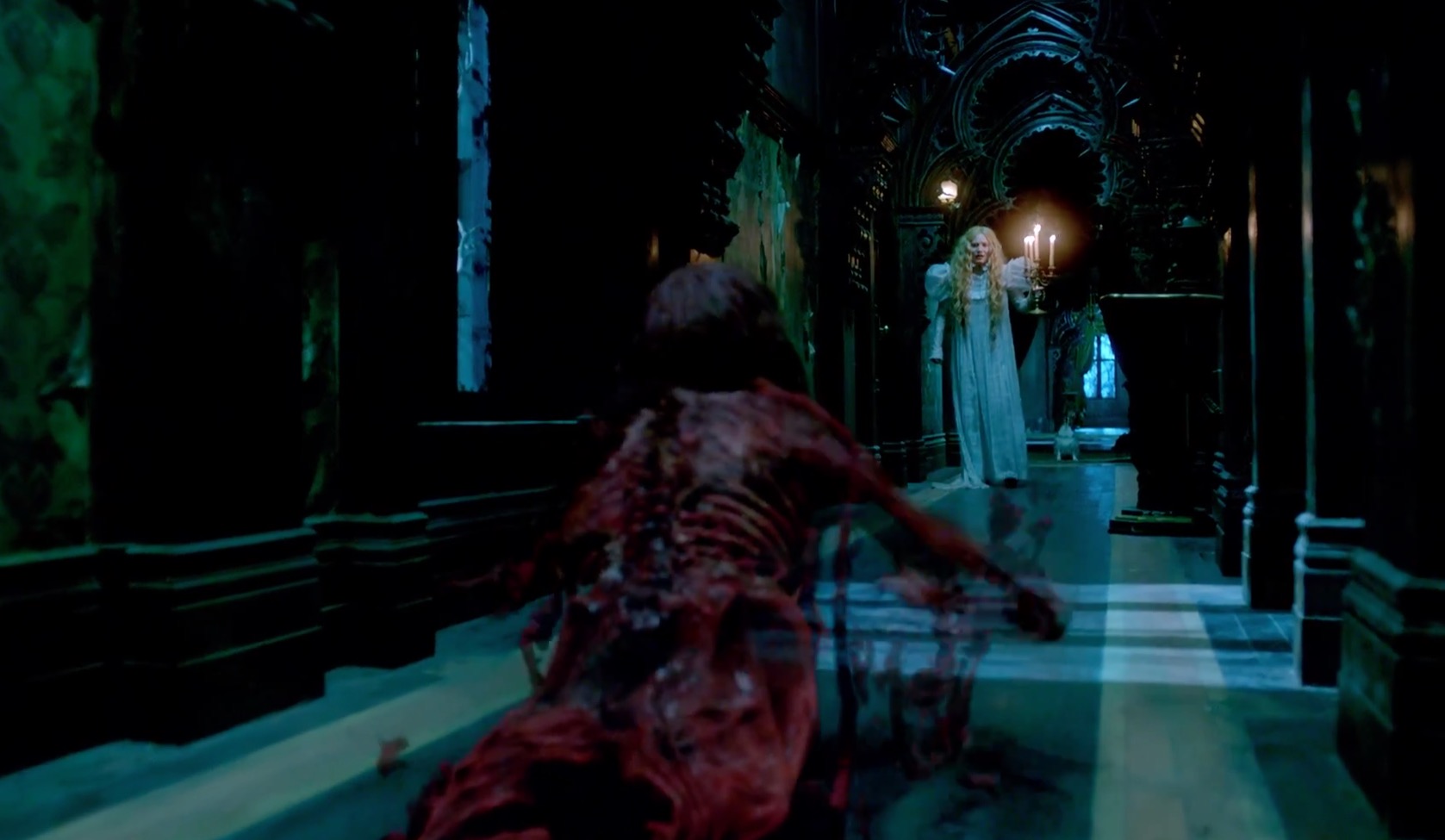
This leads to the movie lacking a sense of true development once we’re ensconced in the Sharpe ancestral family home. It should be the other way round but while del Toro and Robbins expand on the mystery behind Thomas and Lucille’s motives, it soon becomes apparent that the ghostly visions Edith experiences are less of a threat to her and more of a series of clues as to what has happened at the Hall in the past. With this in mind, it’s puzzling that del Toro has decided to make these apparitions as scary as possible, and in particular the spectral wraith that is Edith’s mother (played by the erstwhile Doug Jones), a depiction that seems at odds with her role as a guardian in death of her daughter’s safety – did she have to be so frightening?
But while the recreation of pre-1900 New York is achieved with considerable success, it’s not until we reach Allerdale Hall that del Toro reveals the true focus of the movie: making that towering creation feel like a living, breathing character in its own right. The Hall is a triumph of production and set design, and is endlessly fascinating in its construction, with darkness leeching from the walls and corridors that look like they’ve been carved out of the vertebrae and rib cages of dead whales. Everywhere you look there’s another interesting detail to take in, some new quirk of the architecture to observe, but so good is this attention to detail that it overwhelms the story, leaving Edith’s plight of secondary importance. And with a subterranean level thrown in for good measure, the house and its “personality” become far more interesting than the pallid-by-comparison storyline involving Edith and the conspiring Sharpes (though you might wonder where all the leaves that tumble continuously through the roof are coming from, as the house is shown to sit proudly alone at the top of a hill).
As a gothic romance, the movie is on better ground, with Thomas’s pursuit of Edith feeling more than expedient from the beginning, and as he becomes less and less sure of the path that he and Lucille have embarked upon, it becomes obvious that his true feelings will cause his doom. Hiddleston relays the torment and indecision that Thomas endures with a great deal of yearning for a chance to be free of his family burden, and makes the character more sympathetic than his initial actions would warrant. As the wounded and betrayed Edith, Wasikowska ensures her would-be author isn’t shown as too soft or easily dominated, but is still asked to rein in Edith’s assertiveness in moments where the script requires it. She and Hiddleston do well in making their characters’ relationship more credible than most, but despite their good work there’s just not enough passion on display to make their feelings for each other too convincing.
The same can’t be said for Chastain, an actress who it seems can turn her hand to any character in any genre. As the taciturn and tightly controlled Lucille she’s a riveting presence in any scene she’s in, even when she’s in the background. By the movie’s end she’s asked to abandon all the subtleties she’s imbued her performance with in favour of a more traditional approach required by the material. Before this, Chastain is quietly chilling, her manipulative, simmering-with-anger personality more compelling in its intensity than any of the house’s blood-slicked apparitions. (In comparison, Hunnam is the movie’s anodyne hero, and one who almost operates as an historical forerunner of Hallorann from Kubrick’s The Shining.)
By the time the mystery has been revealed and the machinations of the plot (loosely) explained and sewn up, the movie has descended into the kind of bloody, violent showdown that audiences will be expecting, but it isn’t the best showdown you’re ever likely to see, and it lacks vitality. Partly this is due to the pacing, and partly due to the editing, which never picks up the pace, and never seems likely to add any kind of punch to proceedings. It all leads to an oddly melancholy ending that befits a gothic romance, but not the thriller this movie has become. With so much effort having gone into the look and feel of the movie, viewers may well feel let down by this half-hearted denouement, and they’d be right to, but the movie retains a strange fascination even at the end, and one that lingers long after the closing credits.
Rating: 7/10 – not as chilling or impressive on the plot or storyline front as it is when it comes to how the movie looks, Crimson Peak falls short on delivering the chills and thrills it promises to provide; del Toro has made better movies, and will probably make better ones in the future, but for now this will have to serve as a reminder, however disappointing, that there’s no one else out there who can make this kind of movie and with this kind of ardour.





 thedullwoodexperiment