• 10 Reasons to Remember…
  • A Brief Word About…
  • About
  • For One Week Only
  • Happy Birthday
  • Monthly Roundup
  • Old-Time Crime
  • Other Posts
  • Poster of the Week
  • Question of the Week
  • Reviews
  • Trailers

thedullwoodexperiment

~ Viewing movies in a different light

thedullwoodexperiment

Tag Archives: Harrison Ford

Blade Runner 2049 (2017)

07 Saturday Oct 2017

Posted by dullwood68 in Movies

≈ 2 Comments

Tags

Ana de Armas, Denis Villeneuve, Drama, Harrison Ford, Jared Leto, Replicants, Review, Ryan Gosling, Sci-fi, Sequel, Thriller

D: Denis Villeneuve / 163m

Cast: Ryan Gosling, Harrison Ford, Ana de Armas, Sylvia Hoeks, Jared Leto, Robin Wright, Mackenzie Davis, Hiam Abbass, Carla Juri, Lennie James, Barkhad Abdi, Dave Bautista, Edward James Olmos

Perhaps the most anticipated sequel of 2017, Blade Runner 2049 is finally with us, having been in development – in one form or another – since 1999. It’s a fascinating movie to watch, built as it is on the legacy of its predecessor, and it’s received a lot of praise from critics and fans alike. But it’s not entirely successful in the goals it’s set itself, and despite some terrific performances, Villeneuve’s inspired direction, and sterling efforts from all concerned with the movie’s look and design, the movie struggles at times to maintain proper focus and to make more of its story elements than it actually does. The style is tremendous, then, but the story it supports isn’t as well worked out as it initially looks. Partly this is to do with decisions made at the pre-production stages, and partly to do with a script – by returning scribe Hampton Fancher, and Michael Green – that rarely tries to flesh out its themes or tease out the inherent subtleties within them. This is being touted as intelligent sci-fi and a worthy successor to its predecessor (and on the whole, it is), but in reality it’s a movie that looks amazing, but can’t make its mind up about the story it wants to tell.

It seems straightforward enough. Modern replicants are now being used as blade runners, and are tasked with tracking down and eliminating any remaining Nexus-8 models that are still out there. K (Gosling) is one such replicant, and he’s generally regarded as good at his job. But then what should be a simple “retirement” throws up an unexpected development in the form of buried human remains. But the truth is stranger still: the bones are those of a female replicant who has given birth, something that was, and is still, regarded as impossible, due to it not being a part of their bio-engineering. K’s superior, Lieutenant Joshi (Wright), fearing such information would be catastrophic if it were made public, orders K to destroy all evidence relating to the case, and locate and kill the child. K visits replicant manufacturer Nyander Wallace (Leto), who identifies the remains as those of Rachael, a replicant who thirty years before, had an affair with a blade runner called Deckard (Ford). Wallace, who can’t manufacture replicants fast enough to match the demand for them both on Earth and on the Off-Worlds, instructs his enforcer, Luv (Hoeks), to follow K and locate the child before it can be “retired”.
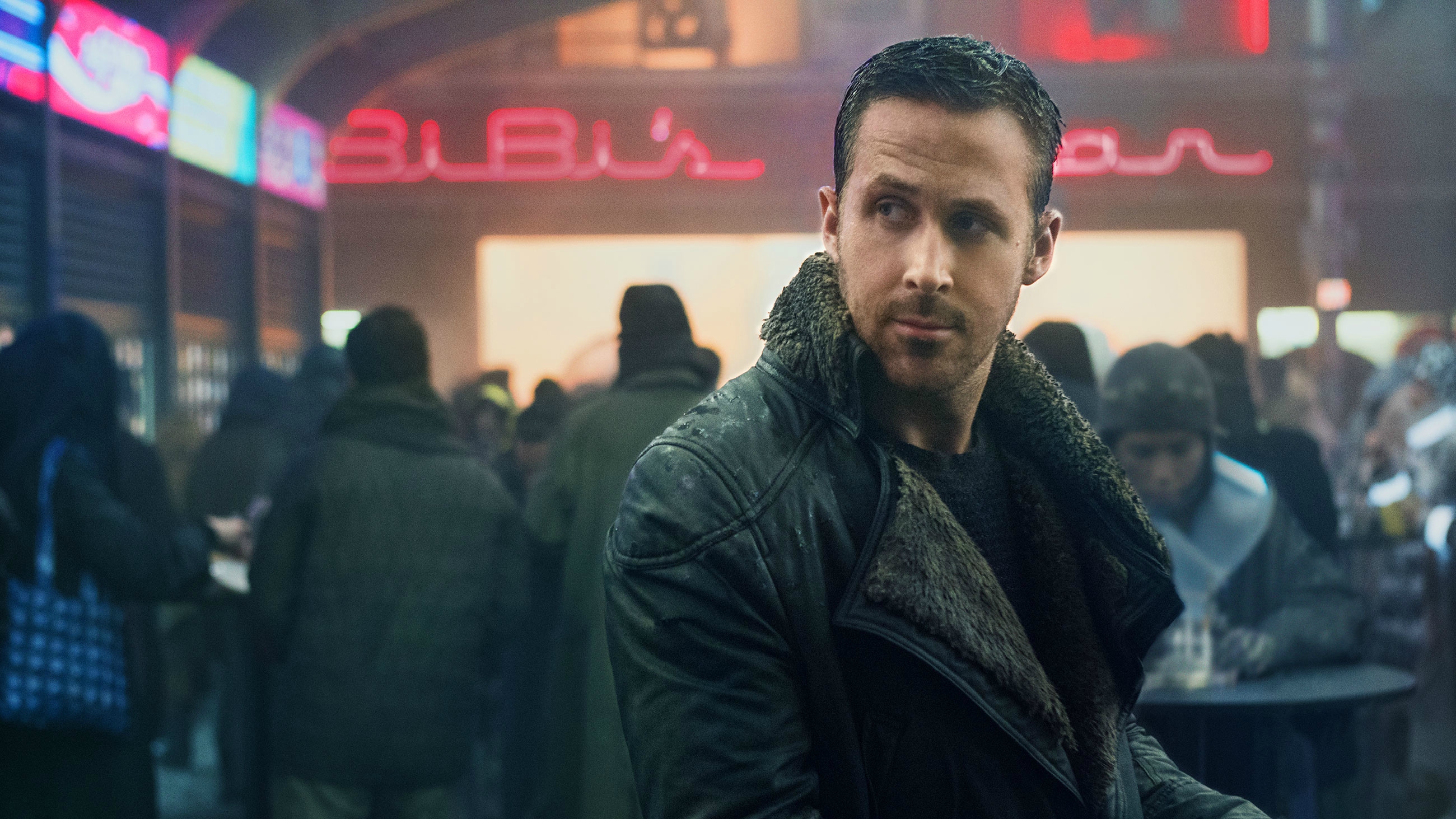
And so the stage is set for a race against time in the search for the child (now clearly an adult but referred to as a child throughout). Except Fancher and Green’s script isn’t too concerned about this, and despite the amount of time it’s taken to set it all up. Instead we’re treated to extended passages concerning K’s relationship with a hologram called Joi (de Armas), evidence that K might be the child everyone (including himself) is seeking, meditations on the nature of memory and its veracity, an encounter with what could charitably called the Popular Replicant’s Front of Judea, and further oblique references to Joshi’s insistence that social upheaval will be the result of the child’s existence being made public. Some of this is interesting on a superficial, let’s-not-think-about-this-too-closely level, but that’s also why it remains at a superficial level. The idea that there’ll be a breakdown in the way that replicants are treated comes only from Lieutenant Joshi, but as there doesn’t seem to be anyone that she reports to (she and K could be the only two people in the blade runner department; we never see anyone else), this can only be looked on as her assumption, or her prejudice. But as neither idea is addressed or delved into, the viewer is left with the understanding that if she hadn’t raised it conveniently as an issue, then the movie would struggle to provide audiences with a strong plot.

Out of this, there’s still the confusing issue of whether or not replicants having children is a good or a bad thing. With nothing to suggest that it’s a bad thing – even though the viewer is asked to go along with this idea on faith alone – the fact that Wallace wants to crack this particular genetic anomaly in order to beef up his workforce in the off-world colonies (which would be a benefit for everyone), doesn’t seem such a bad idea at all. But the script insists that he has to behave badly in order to solve this issue  and move forward (actually Luv behaves badly, and deliberately so, while Wallace is confined to the sidelines for much of the movie). As a result, tension and discord amongst the characters is encouraged instead of any détente, and once K finds Deckard hiding out amid the ruins of Las Vegas, the movie remembers it’s also a thriller as well as a romantic drama (K and Joi), and it ramps up the action accordingly.
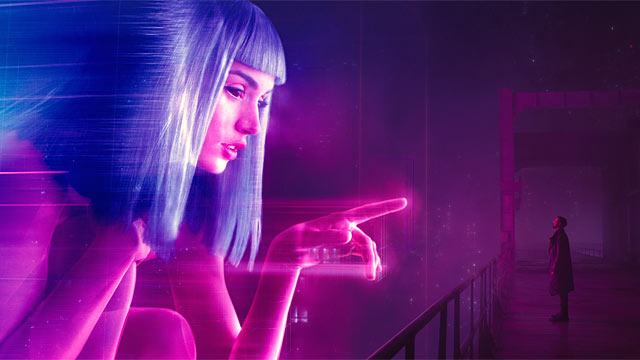
From this it could be assumed that Blade Runner 2049 is a movie that doesn’t make a lot of sense when you look at it closely – and this is true. Fancher and Green’s script doesn’t always delve as deeply as it could do, particularly as replicants are still being treated as slave labour, a situation that should resonate but which is soundly ignored. But fortunately, the movie has Villeneuve as its director, and if he’s not able to smooth overt the cracks in the plot successfully, what he is able to do is make this sequel one of the most visually impressive movies of the last five/ten/fifteen (delete as applicable) years. Along with DoP Roger Deakins, Villeneuve has created a world that has devolved even further in the last thirty years, and which is alternately breathtaking and disconcerting. Dennis Gassner’s production design should be singled out for praise as well, as he makes every last aspect of 2049 life feel immediate and yet compromised, as if everyone is living in a world that’s becoming more and more withdrawn from their day-to-day reality. Large areas surrounding Los Angeles are now wastelands to varying degrees, and there’s still that perpetual rain to remind you of how bad things have remained, and the movie widens its horizons appropriately as it tells its bigger, broader story.

There are good performances throughout, with Gosling proving a good choice as K, his initially blank features slowly giving way to pained resignation mixed with profound hope as to his possibly being “the child”. It’s another outsider-looking-in portrayal, the kind of role that Gosling is so good at playing, and here he doesn’t disappoint. Ford is terrific as well, reconnecting with a role that he hasn’t played in thirty-five years but which he infuses with a grizzled intensity, and a great deal of sympathy. It’s good to see him embracing a part in a way that, Han Solo aside, he hasn’t done for quite some time. There’s great support from the likes of de Armas (in a role that is intended to make K’s replicant nature more human, but which remains surplus to requirements, no matter how hard the screenplay tries), and Hoeks as the movie’s resident replicant psycho. Leto wears odd contact lenses that contribute to his character’s blindness, and aims for urbane but still bizarro villain and largely succeeds thanks to his decision to underplay the role, while Wright, ultimately, is given too little to do other than repeat dire warnings about the child etc. etc.

A sequel to Blade Runner (1982) may have been on a lot of people’s wish lists over the years, but now that it’s here, there’s something of a temptation to praise it for what it does do – look astounding on too many occasions to count, have a score that complements Vangelis’ original score while being its own thing, create several worlds in one – instead of admitting that what it doesn’t do harms it too often (and on a couple of occasions, irreparably). Yes, it’s an incredible movie visually, and the makers should be congratulated, and awarded, for their efforts, but the script isn’t as convincing as it could have been. Still a movie to watch on the biggest screen possible (though not in 3D, which doesn’t add anything to the experience), and one to discuss for some time to come, this is one sequel that could have been bolder in its approach, and more complex in its ruminations.

Rating: 7/10 – though hugely effective for long stretches, Blade Runner 2049 does get bogged down in too many needless secondary plot lines during its middle section, but rallies to provide an exciting action sequence that rounds things off satisfactorily (even if it’s a long time coming); with many scenes that could have been trimmed or excised altogether, this is still a triumph for Villeneuve and his two male leads, and serves as another example of a movie that strives to be different from the rest of its multiplex brethren, even if it’s not fully successful.

Share this:

  • Click to share on X (Opens in new window) X
  • Click to share on Facebook (Opens in new window) Facebook
  • More
  • Click to print (Opens in new window) Print
  • Click to email a link to a friend (Opens in new window) Email
Like Loading...

Star Wars: The Force Awakens (2015)

21 Monday Dec 2015

Posted by dullwood68 in Movies

≈ 1 Comment

Tags

Adam Driver, Anthony Daniels, BB8, C-3PO, Carrie Fisher, Chewbacca, Daisy Ridley, Darth Vader, Drama, Episode VII, Finn, Harrison Ford, J.J. Abrams, Jakku, John Boyega, Kylo Ren, Lightsabre, Luke Skywalker, Mark Hamill, Oscar Isaac, Peter Mayhew, Poe Dameron, R2-D2, Review, Rey, Sci-fi, Star Wars, The First Order, The Force

Star Wars The Force Awakens

D: J.J. Abrams / 135m

Cast: Daisy Ridley, John Boyega, Adam Driver, Harrison Ford, Oscar Isaac, Domhnall Gleeson, Carrie Fisher, Lupita Nyong’o, Andy Serkis, Peter Mayhew, Anthony Daniels, Mark Hamill, Max von Sydow, Gwendoline Christie, Greg Grunberg, Warwick Davis, Simon Pegg, Harriet Walter, Iko Uwais

The Lucasfilm logo appears. The screen fades to black. Then the opening crescendo of the Star Wars theme in perfect sync with the Star Wars logo sends a welcome shiver down the spine. And then the subtitle: Episode VII The Force Awakens appears, followed by a summary of recent events that tells us Luke Skywalker is missing and Princess (now General) Leia has sent her best man to find him. With everyone up to speed we see a familiar sprinkling of stars against the inky blackess of space. The camera begins its equally familiar pan down until a planet comes into view. Then an ominous sound can be heard, and a dark shadow falls across the planet, only this is no shadow, it’s a huge starship; this can’t be good.

And it isn’t. But we all know it isn’t. This is Star Wars, and huge starships are always bad news, because it’s a sure sign the bad guys are up to no good. But wait – haven’t the bad guys been defeated? Wasn’t the evil Emperor, Palatine, killed by Darth Vader at the end of Episode VI? And didn’t the Rebel Alliance take charge of the galaxy, and restore order where previously there had been tyranny and unfair trade embargoes? Isn’t this a brave new future we’re looking at?

SWTFA - scene3

Well, actually, no, it isn’t. Thirty years have passed since the Emperor’s death, thirty years in which a lot has obviously happened, but for some reason the Rebels are still fighting, this time against a pernicious new regime, the First Order, and they don’t seem to have been in charge of anything, or made any difference to the galaxy they fought so hard to free from oppression. Just what have they been doing all this time? (We learn what Luke has been doing, and Han Solo, but Leia? That’s a little less clear.) So with no one having ensured peace and prosperity are the “first order” of the day, we’re back to a frighteningly familiar situation: the bad guys are running things and a small group of rebels are the only thing standing between them and – wait, that’s a little less clear as well. Just what are the First Order planning to do, other than show off their fancy new weapon (or the Mark III as it might be known)?

Now, don’t get me wrong, I really liked Star Wars: The Force Awakens. It’s a fantastic thrill ride, for fans new and old, but instead of The Force Awakens it should be titled Another New Hope, because this is what writers J.J. Abrams, Lawrence Kasdan and Michael Arndt have given us, a retread of Episode IV with some fancy new trimmings. The similarities between the two movies are unavoidable, and are sometimes as unavoidable as the crashed star destroyers we see in the deserts of Jakku. Where we might have hoped that this new trilogy would strike out in a bold, new direction, instead it retreats back into the previous trilogy and gives us a kind of Star Wars Greatest Hits movie, with storylines lifted clean out of Episode IV, dusted down and given a shiny retooling, and references galore to the earlier episodes (“Is there a trash compactor?”).

As there may still be some people who haven’t seen the movie yet, I’m not going to spoil things by listing all the ways in which Abrams et al have cribbed from George Lucas’s original vision (not in this post anyway), but it’s relevant to say that he is very much present throughout, almost as if Abrams and his co-writers have continually asked themselves, what would George come up with next? So we have a movie that looks new but feels old at the same time, and it’s a tribute to Abrams – can the mantle of franchise viagra be stripped from Dwayne Johnson and given to Abrams now? – that despite this the movie feels as invigorarting as it does. It fizzes and pops in all the right places, and if it doesn’t quite have anything that really gets the audience saying “Wow!”, then you can put that down to the number of big-budget sci-fi spectaculars we’ve become overly familiar with since 1977 (and that includes the other five Star Wars movies).

SWTFA - scene2

What it does have that raises the bar for the franchise as a whole, are three new characters who audiences can relate to, and who have been developed with great care by… yes, Abrams et al. First there’s Rey, waiting for her parents to return to the planet of Jakku where she ekes out a living trading scrap for food. Then there’s Finn, a stormtrooper whose conscience won’t allow him to serve the First Order any more. And lastly, there’s this trilogy’s über-bad guy, Kylo Ren, a follower of the Dark Side who boasts Darth Vader as an inspiration. These three characters’ fates become intertwined, and it will be interesting to see how their storylines play out over the course of Episodes VIII and IX.

Thanks to some very astute casting – Ridley as Rey, Boyega as Finn, and Driver as Ren – these characters should prove to be as popular as Luke, Han and Leia, and its their diversity which is a major plus for the franchise as a whole. Rey is fearless and largely unimpressed by the testosterone she’s surrounded by (including Han Solo), and it’s great to see a female character so unencumbered by stereotypical programming at the forefront of such a huge movie. The same can be said for Finn, his character torn between doing the right thing and getting as far away as possible from the First Order. As for Ren, well, let’s just say he has issues and they’re not going anywhere anytime soon, and it’s good to see a level of emotional complexity that you don’t normally see in what’s effectively a space opera.

With the new cast members proving so effective – except for Isaac, alas, whose role as Leia’s “best man” Poe Dameron is sidelined for much of the movie – what of the old guard? Without giving too much away, it’s only Ford and Mayhew who grab much screen time, but it’s good to see them back, and there’s a moment in the cockpit of the Millennium Falcon that should bring a tear to the eye of every diehard fan of the series. This feels very much like a transition movie, and though one “old” character should be at the forefront of Episode VIII, it’s the new ones who’ve already proved they can connect with fans and it’s their journey that (hopefully) will drive the trilogy to its conclusion (and even if it seems clear already where those journeys will converge and end).

SWTFA - scene1

A good job, then, and imbued with the sense of wonder that made Episode IV such a breath of fresh air back in 1977. It has a modern day sheen to it, and is effortlessly funny in places, with Abrams’ trademark sense of humour applied liberally throughout, but it’s unmistakably a Star Wars movie, from John Williams’ magical score to the inclusion of so many different alien races and species, to the exhilarating aerial battles between T.I.E.’s and X-Wing fighters. And of course there’s the Force, so integral to everything that happens, and still the guiding factor for everyone concerned. It’s so good to know that it’s woken up at last.

Rating: 8/10 – not entirely the joyous celebration everyone wanted it to be, but still standing head and shoulders over every other sci-fi series, Star Wars: The Force Awakens is a welcome return to form after the po-faced seriousness of the prequel trilogy; with more than enough on display to make fans feel that the remaining two episodes are in good hands, this is easily the best feelgood movie of 2015, and if you don’t come out of the cinema with a big smile on your face, then you shouldn’t have gone in the first place.

Share this:

  • Click to share on X (Opens in new window) X
  • Click to share on Facebook (Opens in new window) Facebook
  • More
  • Click to print (Opens in new window) Print
  • Click to email a link to a friend (Opens in new window) Email
Like Loading...

The Age of Adaline (2015)

24 Sunday May 2015

Posted by dullwood68 in Movies

≈ Leave a comment

Tags

29 years old, Adaline Bowman, Aging, Blake Lively, Drama, Fantasy, Harrison Ford, History, Lee Toland Krieger, Lightning, Michiel Huisman, Review, Romance, Romantic drama, Snowstorm

Age of Adaline, The

D: Lee Toland Krieger / 107m

Cast: Blake Lively, Michiel Huisman, Harrison Ford, Ellen Burstyn, Kathy Baker, Amanda Crew, Linda Boyd, Hugh Ross, Anthony Ingruber

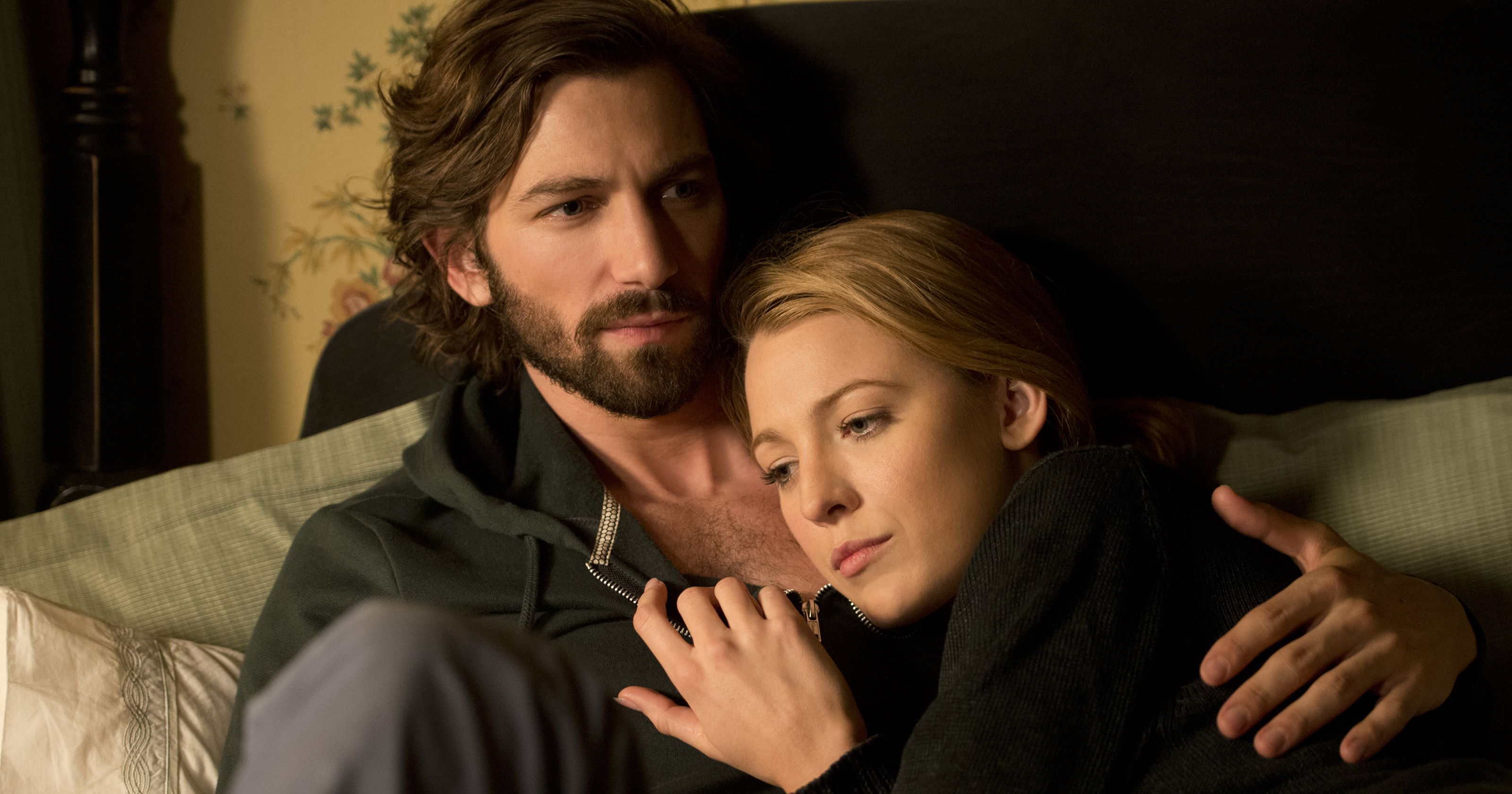
On New Year’s Eve 2014, Jennifer Larson (Lively) purchases a set of fake I.D.’s before heading off to work at a library’s archive office. There she’s given a collection of old newsreels that need to be digitised. She begins viewing them, and as the footage unfolds, Jennifer remembers her life, one that began on New Year’s Day 1908 when she was born Adaline Bowman. She remembers getting married and having a child, and then her husband dying. And she remembers the fateful trip that saw her spin off the road during a freak snowstorm and plunge into a freezing river – where she died – and the lightning strike that struck her and revived her, causing her to remain twenty-nine from that day onward.

That night she attends a New Year’s Eve party, where she attracts the attention of a handsome man called Ellis (Huisman), who shares an elevator ride with her; she rebuffs his advances. But she is surprised to find him turn off at her office the next day in the guise of a generous benefactor. He asks her out on a date, which she refuses. In retaliation Ellis tells her he’ll withdraw his donation if she doesn’t. This time she agrees and he manages to convince her to see him again; when she does she stays over at his apartment. Afterwards, and despite Ellis’s best intentions, she avoids his calls and is cold to him when they meet in the street.

Eventually, Jennifer relents and agrees to see him again. When they do he asks her to come with him for the weekend to help celebrate his parents’ fortieth wedding anniversary. When they arrive, Ellis’s father, William (Ford) is shocked by her resemblance to a woman he met in England in the Sixties, a woman he knew as Adaline Bowman. Jennifer pretends that Adaline was her mother. William is unable to get over how much she looks like the woman he knew, but everyone else accepts the coincidence. The next day, Jennifer and William are talking when he notices a scar on her left hand that matches one Adaline had, and which was caused while they were hiking together. He confronts her, but even though he does his best to reassure her, she leaves as quickly as she can. A lifetime of hiding her real identity has left Adaline constantly fearful of exposure, and so she aims to disappear yet again, using the fake I.D.’s she’s recently purchased. But as she heads back to her home, and with Ellis chasing after her, another freak bout of snow starts to fall…

Age of Adaline, The - scene

At the New Year’s Eve party, a young man tries out an old pick-up line on Adaline. When he realises she’s heard it before, she confirms it by saying “Just once, from a Bing Crosby … type.” It’s one of those offhand, slightly clever moments you’d expect from a movie that features a character who’s been around for over a century, but thankfully it’s the only example the movie trots out, settling instead for Adaline being incredibly knowledgeable about world events (and picking up the odd extra language). It’s a restrained approach to material that could have focused more on past events than the modern day romance that rightly takes centre stage.

With Adaline’s past consigned to occasional, yet relevant, flashbacks, and with a narrator (Ross) to act as our guide at equally relevant moments, The Age of Adaline is a romantic drama that grounds its fantasy elements in the everyday and the banal: Adaline keeps a succession of King Charles Spaniels; she works in a library; she worries about her daughter, Flemming (Burstyn), now an old woman considering moving into a retirement community. It’s the attempts Adaline makes to live a normal, ordinary life that makes the movie so easy to believe in, and with Lively’s wonderful performance to back it all up, her predicament so credible.

Which makes the central romance all the more disappointing, as Huisman’s so-good-he-can’t-be-real Ellis is such a perfect partner that aside from Adaline’s initial reservations about seeing him, there’s no drama involved at all. It takes Adaline’s past coming back to haunt her to provide any real drama and that doesn’t arrive until over an hour has passed. Until then it’s all build up, and a fairly pedestrian, nearly superficial build up at that. Thank goodness for Lively, who elevates the material by emphasising the tragedy of Adaline’s life, often just by looking pensive and lonely. There’s a depth of feeling in Lively’s eyes during these moments that helps immensely, and leaves Huisman’s easy smile and carefree physicality looking as if the actor is barely trying. It’s Lively’s movie from start to finish, and the actress takes every opportunity to stamp her authority on the role.

She’s matched by Ford who turns in his best performance in years, the moments when William is remembering Adaline and the time they spent together, showing the character’s vulnerability and emotional honesty in a way that is entirely realistic. The scene where William confronts Adaline is a small master class in screen acting. In support, Burstyn does well as Adaline’s daughter but is required to be too wise on too many occasions for comfort, and Baker is left with the unenviable task of making William’s wife (also Kathy) more than an add-on.

But while the supporting characters pale against the attention given to Adaline, the script by J. Mills Goodloe and Salvador Paskowitz, is never less than absorbing, and keeps the viewer interested, even during those repetitive early scenes where Adaline keeps rejecting Ellis over and over. It scores highly when examining themes of love and loss and sacrifice, and maintains an impassioned tone throughout. Krieger directs with a confidence and a firm control of the material that benefits the more fantastical elements, and evokes a strong sense of time and place in the flashback scenes. He’s aided by often evocative cinematography by David Lanzenberg, laudable costume designs for Adaline through the decades by Angus Strathie, and fluid, assured editing by Melissa Kent. All go together to make the movie a rich, rewarding experience, and one of the finest romantic dramas of recent years.

Rating: 8/10 – an intriguing premise given a stronger outing than expected, The Age of Adaline is a worthy throwback to the “women’s pictures” of the Thirties and Forties but with an appropriately modern sheen; with a superb performance from Lively, this is a movie that, thankfully, has more to it than meets the eye.

Share this:

  • Click to share on X (Opens in new window) X
  • Click to share on Facebook (Opens in new window) Facebook
  • More
  • Click to print (Opens in new window) Print
  • Click to email a link to a friend (Opens in new window) Email
Like Loading...

The Expendables 3 (2014)

15 Friday Aug 2014

Posted by dullwood68 in Movies

≈ Leave a comment

Tags

Action, Antonio Banderas, Arms dealer, Arnold Schwarzenegger, Barney Ross, Conrad Stonebanks, Harrison Ford, Jason Statham, Mel Gibson, Patrick Hughes, Review, Sequel, Sylvester Stallone, War criminal

Expendables 3, The

D: Patrick Hughes / 127m

Cast: Sylvester Stallone, Jason Statham, Antonio Banderas, Jet Li, Wesley Snipes, Dolph Lundgren, Kelsey Grammer, Harrison Ford, Mel Gibson, Randy Couture, Terry Crews, Arnold Schwarzenegger, Kellan Lutz, Ronda Rousey, Glen Powell, Victor Ortiz, Robert Davi

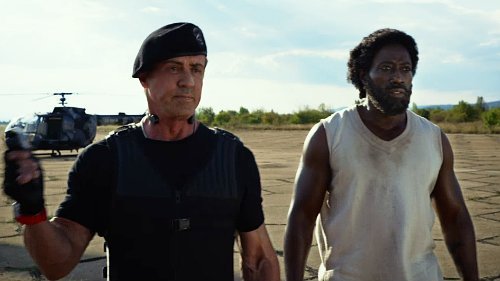
Having rescued old friend Doc (Snipes), who’s been in prison in a foreign country for eight years, Barney (Stallone) and part of his team of Expendables head for Somalia in order to stop an arms deal that the US government – represented by Drummer (Ford) – wants foiled; they also have to capture arms dealer Victor Mins in the process.  But the plan goes wrong when Victor Mins turns out to be Conrad Stonebanks (Gibson), co-founder of the Expendables, and a man Barney thought he’d killed years before.  As Barney and his team come under increasing firepower, Stonebanks targets Caesar (Crews) and shoots him, wounding him badly.  They manage to escape but the experience prompts Barney to “retire” the rest of his team, even his closest friend Lee (Statham).  With Drummer still anxious to get Mins/Stonebanks, Barney enlists the help of Bonaparte (Grammer) in putting together a newer, younger team.  Once assembled, Barney and his new recruits go after Stonebanks.  They manage to capture him but their getaway is prevented by Stonebanks’ men who rescue him, and in a reversal of fortune, seize Barney’s young team.

With at first only Galgo (Banderas), a mercenary desperate to prove himself, and Trench (Schwarzenegger) to help him, Barney finds his old team refusing to let him go without them; he also finds himself backed up (unofficially) by Drummer.  The group heads for Stonebanks’ military training complex.  Getting in proves to be easy, but with Stonebanks’ men plus an army ranged against them, getting back out is a whole different matter.

Expendables 3, The - scene

The first Expendables movie was an okay affair bolstered by the concept itself: take a number of ageing action stars and put ’em all together and see how much fun can be had.  The follow up was more of the same and had an extended airport shootout that was bizarrely unexciting.  Now, with Hollywood’s current penchant for making trilogies out of almost any movie idea, we have the latest – and hopefully last – testosterone-fuelled outing for the getting-on-a-bit daredevils.

For anyone who’s seen the first two movies, the lack of a solid storyline won’t come as a surprise, nor will the lack of credible characters, residing as they do in such an incredible world (perhaps Barney and his team should be called The Incredibles – no, wait, that’s already been taken).  The returning viewer will also see that the dialogue has been kept at a first draft stage, character motivations remain simplistic at best, and the performances are as one-note as before.  In short, there’s been as much effort put into this movie as the first two.

It’s an amazing achievement when a movie is the culmination of all the bad things of its predecessors, and then adds a few more bad things for good measure.  With The Expendables 3, Stallone and co-writers Clayton Rothenberger and Katrin Benedikt have taken the witlessness of these movies and instead of reining it all in, have instead ramped it up another notch.  There’s the opening sequence where Doc is rescued from a heavily guarded train: he’s been in prison for eight years – why is it only now that Barney decides to free him?  In Somalia, Barney’s jeopardises the mission when he sees Stonebanks and tries to kill him (it’s Stallone’s “Khan!” moment).  When he assembles his new team, Barney awkwardly swaps his old friends for “kids” he feels a paternal responsibility for – so in either case he’s trying to people he cares about from getting hurt, so why the need to change the team (other than as a script requirement)?  Surely it would be more dramatic if it’d been the other way round and Barney was using the new team to rescue the old one.

And then there’s the big bad villain himself, Conrad Stonebanks, a vicious, preening, self-deluded ex-mercenary turned arms dealer who doesn’t exactly hide from the world – at one point he’s seen attending a museum exhibition in the middle of Moscow – but whom the US government appears to have no knowledge of and worse yet, no photos of him.  And yet Drummer tracks him down to Bucharest with apparent ease and the new team track his movements – again, with ease.  But before all this, nothing?  No clue?  Not one photograph to run through a Facial Recognition programme?  No?  Really?

It’s disheartening when you see so little effort going into something that cost $90 million to make (though really it’d be disheartening whatever the budget; the makers of these movies aren’t exactly inexperienced).  But where the script founders and sinks under the weight of its own (limited) expectations, the hoped-for rescue from complete viewing drudgery courtesy of some slam-bang action sequences also fails to materialise.  Just how many times can these guys go through the same motions, the same fights, wade through hundreds of run-into-the-line-of-fire extras and stuntmen, without themselves wondering if it’s all worth it?  And how many times can the audience?

In terms of the cast, the Expendables themselves walk through it all without pausing to act, while newcomers Ford, Banderas and Grammer – we’ll leave Lutz et al. as they’re not allowed to contribute very much – do their best to inject some energy into the proceedings, though Ford’s grumpy turn serves only to reinforce every off screen curmudgeon story you’ve ever heard about the man.  Only Banderas seems to have gauged the mediocrity of the situation and decided to ignore it all; Galgo is the only character you can even remotely warm to (and he’s essentially a big motor mouth).

In the director’s chair, Hughes – who’s been tapped for the upcoming remake of The Raid (2011) (as if we need it) – shows a grasp of how to assemble an impressive action sequence but doesn’t bring anything new to the equation, instead falling back on tried and tested shots, camera angles and set ups.  Of the various showdowns at Stonebanks’ hideout, a two-hander featuring Banderas and Rousey taking on all-comers is more effective than most, and the eventual brawl between Barney and Stonebanks is a severe let-down, less of a brawl and more of a slightly “harder” version of patty-cake.

With The Expendables 4 already rumoured to happen, there’s a sense that whatever box office returns this outing secures, the series is going to continue until Stallone says otherwise (he’s also prepping further Rambo and Rocky sequels).  But unless he hands the writing reins over to somebody else, the law of diminishing returns may well dictate otherwise.

Rating: 4/10 – loud, dumb, unadventurous, and reworking a whole raft of already tired scenarios, The Expendables 3 proves that however much fun a bunch of actors are having on a movie, it doesn’t mean the audience will have the same experience watching it; short on ingenuity and with the now de rigueur extended action sequence to round things off, this is one movie that doesn’t know when to quit.

Share this:

  • Click to share on X (Opens in new window) X
  • Click to share on Facebook (Opens in new window) Facebook
  • More
  • Click to print (Opens in new window) Print
  • Click to email a link to a friend (Opens in new window) Email
Like Loading...

Ender’s Game (2013)

10 Monday Feb 2014

Posted by dullwood68 in Movies

≈ 1 Comment

Tags

Abigail Breslin, Asa Butterfield, Ben Kingsley, Colonel Graff, Drama, Ender, Formics, Gavin Hood, Harrison Ford, International Force, Orson Scott Card, Review, Sci-fi

Ender's Game

D: Gavin Hood / 114m

Cast: Asa Butterfield, Harrison Ford, Hailee Steinfeld, Viola Davis, Ben Kingsley, Abigail Breslin, Nonso Anozie

Adapted from Orson Scott Card’s novel of the same name, Ender’s Game places us at a time in the future when Earth has been attacked by an alien race called the Formics. Having repelled them but with the threat of their return looming, an International Force has been formed to address the issue and prepare for the Formics return.  Believing that children with the best tactical minds will provide the best possible offence agains the Formics, a Battle School has been set up in orbit around Earth.  Taking part is Andrew “Ender” Wiggin (Butterfield).  Watched over by Colonel Graff (Ford), Ender shows promise but is weighed down by feelings of guilt and self-doubt brought on by being a “third”; his older brother and sister have both attended the training programme but failed to make the grade.  But Graff fast-tracks his progress, seeing in Ender’s tough, unwavering approach to dealing with combat situations the key to defeating the Formics.

At Command School, on the edge of the Formic territory, Ender confirms Graff’s opinion of his abilities and under the tutelage of war hero Mazer Rackham (Kingsley).  Ender takes part in several simulated attacks but doesn’t always come out on top.  With one last simulation left in which to prove himself, Ender has to use all his skills to defeat Rackham’s programme.

With Card’s novel having gained so much prestige over the years, and with Card himself regarding it as unfilmable for so long, his involvement in this production is baffling.  Under Hood’s guidance, Ender’s Game is something of a disappointment, dragged down as it is by flaccid pacing and a script that lacks tension throughout.  The opening sequence, with its Formic attack looking too much like an outtake from Independence Day (1996), lacks the level of excitement required to make the Formic threat a viable one for the audience.  It’s a short sequence and they’re defeated almost straight away, so where’s the threat that everyone’s so worried about?

Ender's Game - scene

The rest of the movie never really resolves this issue, or makes the Formics anything other than a glorified boogeyman, and while this later proves to be the point, the fact that there’s so little actual “threat” undermines the movie and takes away a lot of the intended drama.  As it is, we’re left with war simulations set in zero gravity, Graff insisting Ender is the “one” at every turn, a video game (with some worryingly Nineties graphics) that may or may not be reflecting Ender’s inner emotional turmoil, and an increasing sense that the movie is more padding than substance.  It all looks good, and the zero gravity sequences are well-staged but as there’s no doubt that Ender will triumph each time, even those sequences fail to excite as much as they should.

Hood’s adaptation ultimately undermines the cast and gives them little to do except spout clumsy lines of dialogue, or struggle to find an emotional through-line.  Ford, in particular, is saddled with a character so badly written he’s a hair’s-breadth away from being one-dimensional.  Secondary characters such as Viola Davis’s Major Anderson and Ender’s sister, Valentine (Breslin) fare even less well, given only limited screen time and even less opportunity to make an impression or a valuable contribution to the  plot.  But it’s Ender himself who comes off worst, portrayed by Butterfield as a martinet in short pants, a little Napoleon who has no empathy for anyone but Valentine, and whose attempts at concern for others comes off as stilted and unconvincing.  Faced with a leading character that the audience has trouble identifying with, Ender’s Game fails to engage on an emotional level, and the movie is reduced to a series of video game-style simulations and war games that are muddled in execution and less than thrilling.

Given that Card’s novel came under fire for its violence, and this adaptation strays away from any graphic depictions, there’s still the underlying theme of genocide propping up the plot.  Poorly handled at the movie’s conclusion, this theme would have added more depth to proceedings if it had been brought more to the fore, and much earlier on.  Instead, we have a movie that is more family-oriented and possessed of much less bite.

Rating: 4/10 – not a complete disaster but close enough as to make very little difference; adaptations of sci-fi classics rarely turn out well and Ender’s Game does nothing to disprove the theory.

Share this:

  • Click to share on X (Opens in new window) X
  • Click to share on Facebook (Opens in new window) Facebook
  • More
  • Click to print (Opens in new window) Print
  • Click to email a link to a friend (Opens in new window) Email
Like Loading...

Anchorman 2: The Legend Continues (2013)

05 Sunday Jan 2014

Posted by dullwood68 in Movies

≈ 1 Comment

Tags

Comedy, David Koechner, Global News Network, Harrison Ford, Kristen Wiig, News anchor, Paul Rudd, Review, Ron Burgundy, San Diego, Sequel, Steve Carell, Will Ferrell

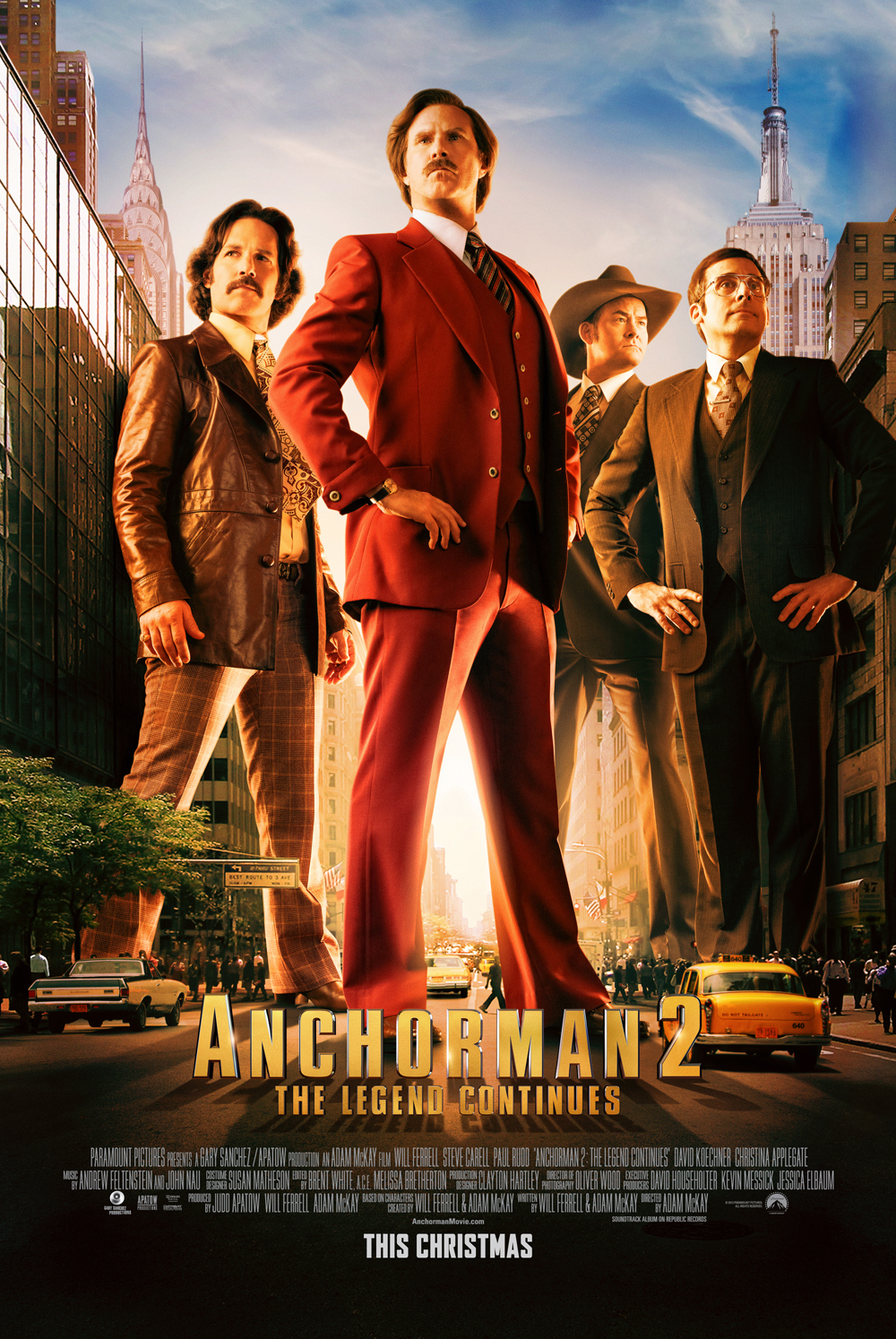
Anchorman 2 The Legend Continues

D: Adam McKay / 119m

Cast: Will Ferrell, Steve Carell, Paul Rudd, David Koechner, Christina Applegate, Meagan Good, James Marsden, Josh Lawson, Kristen Wiig, Dylan Baker, Judah Nelson, Greg Kinnear, Harrison Ford

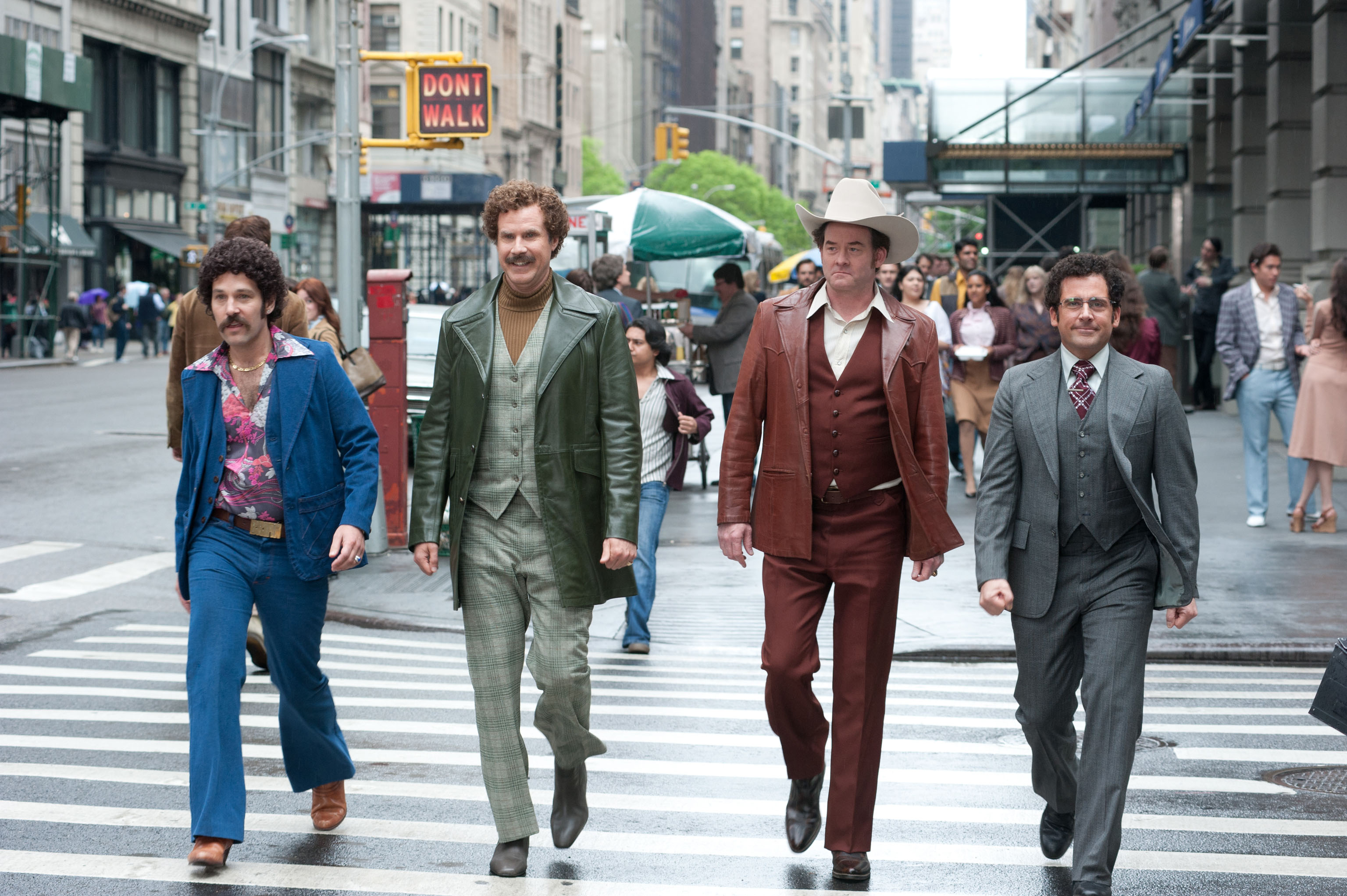
Nine years after Ron Burgundy’s first outing, the news anchor with the salon quality hair is back, still unrepentantly sexist, still with an ego the size of San Diego, and still oblivious to the chaos he causes around him.  Happily married to Veronica Corningstone (Applegate) and sharing the lead anchor spot with her at the World Broadcast news station, Ron’s life is devastated when news boss Mack Tannen (Ford) promotes Veronica to lead anchor and fires Ron.  Forcing Veronica to choose between him and her promotion, she chooses the job and Ron leaves her and their son Walter (Lawson).  After a stint at San Diego’s Sea World, Ron is approached by Freddie Shapp (Baker) to come work for Global News Network and be part of the first ever 24-hour news channel.  Ron agrees on the proviso that he can assemble his own news team.  He tracks down Brian Fantana (Rudd), Champ Kind (Koechner) and Brick Tamland (Carell), and with his team around him, he sets about regaining his position at the top of the news tree.

The success of Anchorman: The Legend of Ron Burgundy, a slow-build process fuelled by home video and extensive word of mouth, brought with it the fans’ desire for a sequel.  On its own merits, the first movie can be seen as a “happy accident”, an uneven mixture of stupidity and witlessness that was nevertheless funny at the same time.  Ron was crass and boorish in a “who-let-the-moron-out?” kind of way, while his news team almost matched him low IQ for low IQ.  Carell, then still climbing the comedy ladder, was endearing as the intellectually challenged Brick, Rudd was boyishly charming as Brian, and Koechner was – intentionally? by accident? – the funniest of all of them as Champ Kind, a man who has never heard a woman speak before.  Ferrell created a fantastic character, a vain popinjay with delusions of adequacy, and milked the character for all he was worth.  The performances made the movie, and over the years, have firmly lodged themselves in our collective comedy memories, so much so that we remember them with excessive fondness.

Sadly, that’s how they should have remained.  Anchorman 2: The Legend Continues trades heavily on our love of the characters but holds them in a kind of developmental stasis; in nearly ten years they haven’t changed a bit.  Ron is still vain, Brian is still the scent-fixated ladies man, Champ is still the least developed of the four, and Brick is still an idiot.  Veronica, having challenged Ron’s supremacy in the first movie, is demoted back to the same role again.  The secondary characters are used as a foil for the news team’s shenanigans – not least Kristen Wiig’s uncomfortable turn as Brick’s love interest, Chani – and even Ron’s nemesis at GNN, Jack Lime (Marsden), is given little to make him a serious rival for the news anchor crown.  And as with the first movie, Ron’s “story arc” is that he learns not to be so self-centred.

Anchorman 2: The Legend Continues

A re-tread then rather than a true sequel, Anchorman 2 arrives with a tremendous weight of expectation and reveals itself as more of a vanity project for Will and the gang (including director/co-writer McKay).  There are laughs but as most of them are repeats of gags and scenes from the first movie, it’s hard to look upon them as anything but nostalgic or, worse still, lazy.  Add the awkwardness of Carell’s performance – the line between exploiting Brick’s “disability” and treating him kindly is crossed time and time again – plus two sequences that inflate the running time beyond what’s necessary, and a recurring sense that the script was a first draft, and you have a movie that never quite gels in the way its makers had hoped.  There’s an attempt at lampooning the public’s appetite for sensationalist news but it’s only briefly explored, and whatever criticism is implied by the need for ratings success over quality content is given short shrift also.

The movie does have a professional sheen to it, however, and the technical side of things is adequately handled but there are times when it even has the feel of a TV show.  Ferrell acquits himself well, despite the limitations of his own script, and is ably supported by his cast mates.  McKay directs ably enough, and the soundtrack throws up a few Eighties gems despite itself.  And as for the final, cameo-studded battle of the news stations, what starts out as a glorious free-for-all, ends up as a let-down with a poor ending…and this is, ultimately, the main fault with the movie: scenes begin strongly but soon peter out.  Once or twice in a two-hour movie is forgivable, but not all the way through.  With this much talent involved, a better return would have been expected.

Rating: 5/10 – a huge disappointment and a perfect example of when cherished, much-loved movies should be left to stand alone; uninspired, derivative and overlong.

Share this:

  • Click to share on X (Opens in new window) X
  • Click to share on Facebook (Opens in new window) Facebook
  • More
  • Click to print (Opens in new window) Print
  • Click to email a link to a friend (Opens in new window) Email
Like Loading...

Paranoia (2013)

04 Wednesday Dec 2013

Posted by dullwood68 in Movies

≈ Leave a comment

Tags

Amber Heard, Commercial fraud, Communications, Drama, Gary Oldman, Harrison Ford, Liam Hemsworth, Review, Robert Luketic, Smart phone, Thriller

Paranoia

D: Robert Luketic / 106m

Cast: Liam Hemsworth, Gary Oldman, Amber Heard, Harrison Ford, Lucas Till, Embeth Davidtz, Julian McMahon, Josh Holloway, Richard Dreyfuss

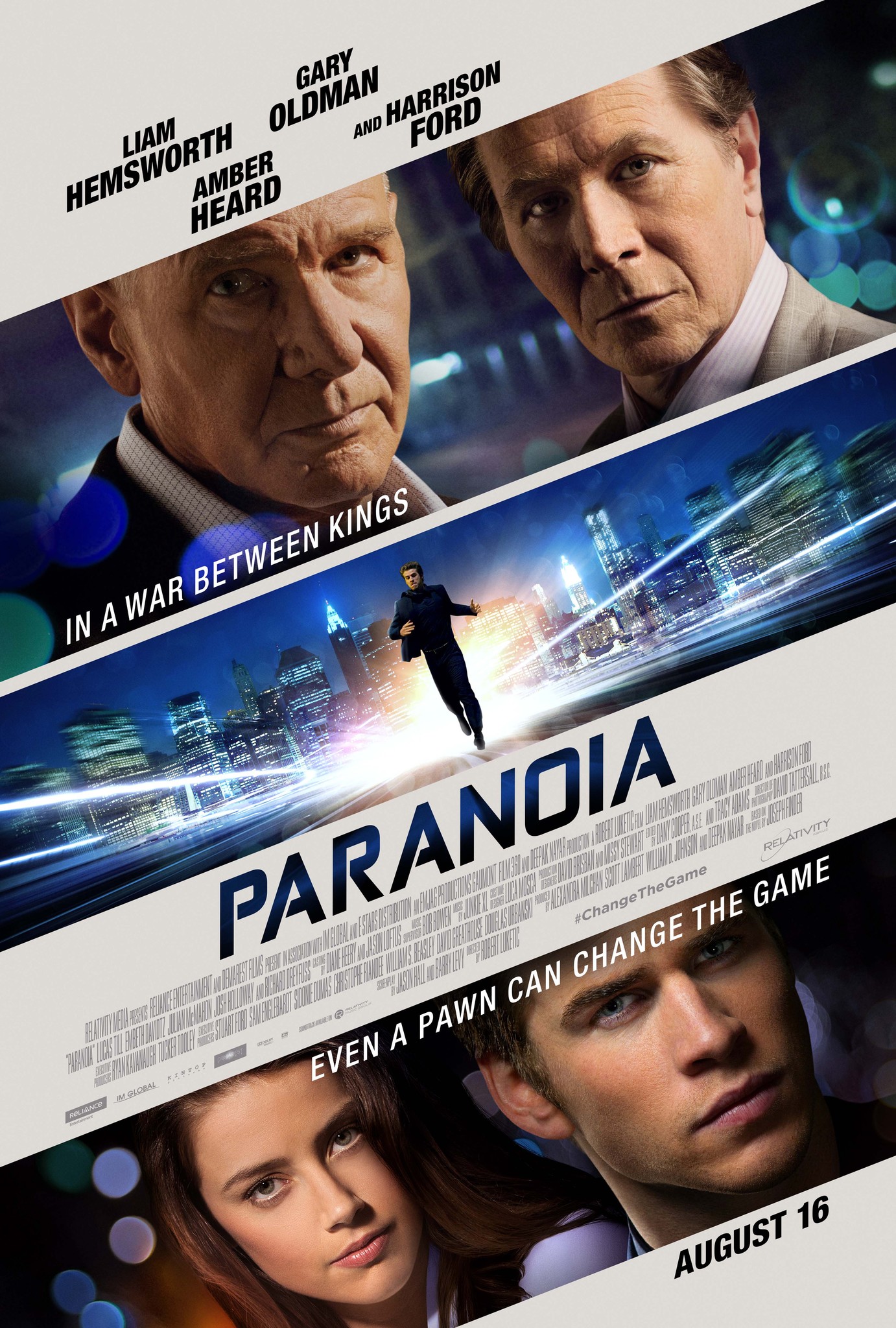
When the final history of movies comes to be written, and all the various genres and sub-genres are assessed and valued, one type of movie will probably be given short shrift by its assessors: the industrial espionage thriller. In the real world, the cut and thrust of commercial enterprise, with often billions – and companies’ reputations – at stake, must play out with some degree of dramatic potential, but when it comes to the movies, this dramatic potential is all too often squandered for the sake of cinematic familiarity. And so it goes with Paranoia, a thriller based around the power play between two communications empires and the youngish would-be player who gets caught in the middle.

The player is Adam Cassidy (Hemsworth), an entry-level employee working for Nicolas Wyatt (Oldman). When a pitch to secure a position at Wyatt’s company fails disastrously, Adam decides to have one last splurge on his company credit card.  $16,000 later, he finds himself being blackmailed by Wyatt into going to work for Wyatt’s long-time rival, Jock Goddard (Ford). Once he has Goddard’s trust and knows his way around the company, Adam’s task is to steal details of the new, revolutionary smart phone that Goddard is planning to release onto the market. Along the way Adam meets and falls for Emma Jennings (Heard), an executive at Goddard’s company. As Wyatt increases the pressure on Adam to get the info he needs, Adam must decide if the path he has chosen is the right one.

PARANOIA

The problem with Paranoia – aside from the fact that the movie is mis-titled – is that we don’t care about anyone in the movie…at all. We’re supposed to feel sorry for Adam because his dad Frank (Dreyfuss) is ill and it’s a struggle for them to pay for the mounting medical bills. But Frank, who is on oxygen a lot of the time, continues to smoke; it’s this that gets him hospitalised and pushes the costs up. When Adam loses his job with Wyatt he doesn’t consider his responsibilities, he just goes out with his team and runs up a huge bill, another one he can’t pay.  So when Wyatt blackmails Adam into working for him as an industrial spy, there’s no sympathy for him at all. (I wanted him to really suffer as the movie went on but Adam is the “hero” in the movie, so that only goes so far.) Even when Wyatt threatens to hurt Frank if Adam doesn’t go along with his plan, you’re left thinking “yeah, that’s fair enough”. Adam is a slightly older version of the ‘callow youth’ the movies like to put in peril every so often, but here it doesn’t work. He’s simply not a good enough person for the audience to get behind.  Even when he begins to realise the real position he’s in, it’s still a case of “you got yourself into this mess…”.

As Adam, Hemsworth fails to make any connection with the audience, playing him as someone who thinks he’s smart but who actually hasn’t learnt anything in his twenty-seven years on the planet. Hemsworth is not the greatest actor in the world – watch how he tries to explain to Emma that he’s done some things he should have told her about – and there are times when the relevant emotion comes along a beat or two after it’s required, but as the character isn’t fully formed anyway – thanks to Jason Dean Hall and Barry L. Levy’s unconvincing screenplay – he does the best he can under the circumstances. Oldman uses an awkward mix of Cockney and mid-Atlantic vocal swagger as the keystone of his performance, while Heard, an actress who has yet to realise her full potential, is given little to do other than appear vapid and superficially strong. It’s Ford who impresses most, although that’s not saying much; he’s saddled with some of the most turgid dialogue this side of Star Wars (so he’s probably used to it), but at least he puts some energy and commitment into his performance, even if it counts, ultimately, for nothing. In a supporting role, McMahon exudes icy menace as Wyatt’s enforcer, Meechum, but Davidtz, as Wyatt’s PA, looks embarrassed throughout.

The direction by Robert Luketic is low-key and close to pedestrian, while the photography offers an almost wintry, subdued look that matches the downbeat aspects of the storyline and the grubby nature of the proceedings. The script struggles to add depth or texture to both events and characters, and the outcome can be seen from a mile off (you could even say it was phoned in). As a thriller, Paranoia never really hits the mark, and as a drama it’s too undercooked to be effective. Everyone involved has done better elsewhere, and probably will do again. What matters here is whether or not a hundred and five minutes of your time could be used doing something better instead.

Rating: 5/10 – an unimaginative thriller that goes through the motions for most of its running time, Paranoia never engages its audience or provides a way in to become involved; a shame then considering the talent taking part.

Share this:

  • Click to share on X (Opens in new window) X
  • Click to share on Facebook (Opens in new window) Facebook
  • More
  • Click to print (Opens in new window) Print
  • Click to email a link to a friend (Opens in new window) Email
Like Loading...

Blog Stats

  • 486,528 hits

Recent Posts

  • 10 Reasons to Remember Bibi Andersson (1935-2019)
  • Fantasia (1940)
  • Dances With Wolves (1990) – The Special Edition
  • Kiss of the Spider Woman (1985)
  • The Three Musketeers (1973)

Top Posts & Pages

  • Lost for Life (2013) - Another Look
    Lost for Life (2013) - Another Look
  • Lost for Life (2013)
    Lost for Life (2013)
  • About
    About
  • Mr. Topaze (1961)
    Mr. Topaze (1961)
  • Billy Lynn's Long Halftime Walk (2016)
    Billy Lynn's Long Halftime Walk (2016)
  • Winter's Tale (2014)
    Winter's Tale (2014)
  • The Hitman's Bodyguard (2017)
    The Hitman's Bodyguard (2017)
  • 5 Famous Movie Roles That Nearly Went to Someone Else
    5 Famous Movie Roles That Nearly Went to Someone Else
  • The Layover (2017)
    The Layover (2017)
  • Transcendence (2014)
    Transcendence (2014)
Follow thedullwoodexperiment on WordPress.com

Blogs I Follow

  • Rubbish Talk
  • Film 4 Fan
  • Fast Film Reviews
  • The Film Blog
  • All Things Movies UK
  • Interpreting the Stars
  • Let's Go To The Movies
  • Movie Reviews 101
  • TMI News
  • Dan the Man's Movie Reviews
  • Film History
  • Jordan and Eddie (The Movie Guys)

Archives

  • April 2019 (13)
  • March 2019 (28)
  • February 2019 (28)
  • January 2019 (32)
  • December 2018 (28)
  • November 2018 (30)
  • October 2018 (29)
  • September 2018 (29)
  • August 2018 (29)
  • July 2018 (30)
  • June 2018 (28)
  • May 2018 (24)
  • April 2018 (21)
  • March 2018 (31)
  • February 2018 (25)
  • January 2018 (30)
  • December 2017 (30)
  • November 2017 (27)
  • October 2017 (27)
  • September 2017 (26)
  • August 2017 (32)
  • July 2017 (32)
  • June 2017 (30)
  • May 2017 (29)
  • April 2017 (29)
  • March 2017 (30)
  • February 2017 (27)
  • January 2017 (32)
  • December 2016 (30)
  • November 2016 (28)
  • October 2016 (30)
  • September 2016 (27)
  • August 2016 (30)
  • July 2016 (30)
  • June 2016 (31)
  • May 2016 (34)
  • April 2016 (30)
  • March 2016 (30)
  • February 2016 (28)
  • January 2016 (35)
  • December 2015 (34)
  • November 2015 (31)
  • October 2015 (31)
  • September 2015 (34)
  • August 2015 (31)
  • July 2015 (33)
  • June 2015 (12)
  • May 2015 (31)
  • April 2015 (32)
  • March 2015 (30)
  • February 2015 (37)
  • January 2015 (39)
  • December 2014 (34)
  • November 2014 (34)
  • October 2014 (36)
  • September 2014 (25)
  • August 2014 (29)
  • July 2014 (29)
  • June 2014 (28)
  • May 2014 (23)
  • April 2014 (21)
  • March 2014 (42)
  • February 2014 (38)
  • January 2014 (29)
  • December 2013 (28)
  • November 2013 (34)
  • October 2013 (4)

Create a free website or blog at WordPress.com.

Rubbish Talk

Film 4 Fan

A Movie Blog

Fast Film Reviews

The Film Blog

The official blog of everything in film

All Things Movies UK

Movie Reviews and Original Articles

Interpreting the Stars

Dave Examines Movies

Let's Go To The Movies

Film and Theatre Lover!

Movie Reviews 101

Daily Movie Reviews

TMI News

Latest weather, crime and breaking news

Dan the Man's Movie Reviews

All my aimless thoughts, ideas, and ramblings, all packed into one site!

Film History

Telling the story of film

Jordan and Eddie (The Movie Guys)

Movie Reviews & Ramblings from an Australian Based Film Fan

Privacy & Cookies: This site uses cookies. By continuing to use this website, you agree to their use.
To find out more, including how to control cookies, see here: Cookie Policy
  • Subscribe Subscribed
    • thedullwoodexperiment
    • Join 481 other subscribers
    • Already have a WordPress.com account? Log in now.
    • thedullwoodexperiment
    • Subscribe Subscribed
    • Sign up
    • Log in
    • Report this content
    • View site in Reader
    • Manage subscriptions
    • Collapse this bar
 

Loading Comments...
 

    %d