You can’t help but watch the trailer for 55 Steps and think: shameless Oscar-bait. And then hard on the heels of that thought is: and it was released last year?
In truth, the movie received its premiere at the 2017 Toronto International Film Festival on 7 September. But since then, Bille August’s latest feature has made an appearance at the Moscow International Film Festival on 20 April 2018, had a limited release in Germany on 3 May (where it’s known as Eleanor & Colette), and a further appearance at Belgium’s Filmfestival Oostende on 8 September. The question arises: if it’s been seen at a handful of festivals (and you’d think festival programmers would be a bit more savvy than most movie watchers), then why such a delayed release?
Well, the trailer does give it away. Although “based on a true story”, and featuring Helena Bonham Carter and Hilary Swank in the lead roles, this has all the hallmarks of an old-fashioned David vs Goliath story, with Swank as the ambitious and out of her depth lawyer taking on the medical establishment, and Carter as the client who behaves oddly but endearingly, and who, despite having mental health problems that would have most people in real life crossing the street to avoid her, is presented here as someone who’s actually really lovely when you get to know her. It’s depressingly predictable, and potentially patronising, and though there’s a serious issue buried deep in the trailer – the risk of prescribed medication causing more problems than the illness or condition it’s meant to treat – you know that the movie’s real focus is going to be on the two women’s friendship, and the positive impact they have on each other’s lives. What’s wrong with that, you might ask. But if you do, then you’re not seeing how formulaic and depressingly banal this movie already looks, and in a format that’s supposed to promote it and persuade people to pay money to see it.
And one final word: when a trailer adds a quote that calls a performance “transformative”, it’s something of an insult to the make up, hair and costume departments who in this case clearly helped Helena Bonham Carter create her character’s look. Instead of praising the actor or actress, how about acknowledging the work of the production team instead?
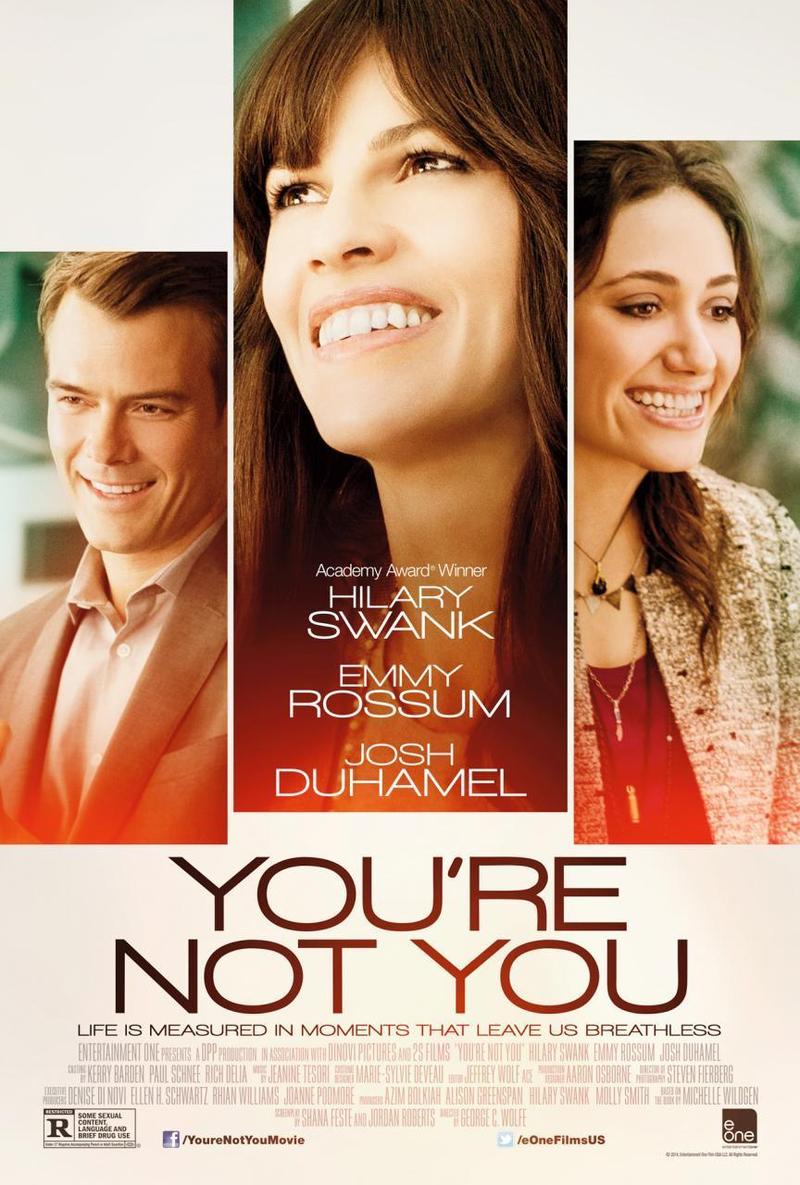
Cast: Hilary Swank, Emmy Rossum, Josh Duhamel, Stephanie Beatriz, Jason Ritter, Julian McMahon, Frances Fisher, Marcia Gay Harden, Ali Larter, Andrea Savage, Loretta Devine, Ernie Hudson, Ed Begley Jr
Kate (Swank) is a successful classical pianist who begins to experience muscle spasms in her hands that affect her playing. Eighteen months later, Kate has been diagnosed with Amyotrophic Lateral Sclerosis (ALS) and needs daily personal care. With her regular caregiver having left, Kate is being looked after by her husband, Evan (Duhamel), but he works full-time and is unable to look after her during the day. Kate makes arrangements to interview a replacement caregiver. The first interviewee is Bec (Rossum), a college student who, despite her lack of experience, makes enough of an impression on Kate to be hired. And despite a first day that goes less than smoothly, and against Evan’s objections, Kate determines that Bec should continue as her caregiver.
While Bec and Kate get used to each other and develop a bond, they also learn that Evan has had a short affair with one of the women in his office. It leads to Kate feeling that she’s holding Evan back; she tries to get Bec to take her to an assisted living facility but Bec refuses to go through with the visit and instead they go to Evan’s office where Kate tells him she wants a divorce. Meanwhile, Bec has relationship problems of her own: she’s been sleeping with one of her tutors, Liam (MacMahon), but while she wants to end things, he doesn’t. And she’s attracted the interest of a young man named Wil (Ritter), who she believes is too nice for her.
Kate and Bec meet another couple where the wife has ALS, Marilyn (Devine) and John (Hudson). Their positive attitude and obvious love for each other give Kate the boost she needs to deal with her illness more effectively and she becomes more outgoing; she even allows Evan to express his feelings and regrets to her. At Xmas, Bec’s parents pay a visit, but a heated conversation between Bec and her mother (Harden) has Kate feeling that she’s holding Bec back from living her own life. Consequently, she fires Bec and arranges for her mother, Gwen (Fisher) to look after her. When Kate’s breathing becomes so bad she ends up hospitalised, Gwen wants her to be put on a ventilator but it’s revealed that Kate has given Bec authority to make any medical decisions relating to treatment or care. Knowing that being on a ventilator isn’t what Kate wants, and against Gwen and Evan’s wishes, she takes Kate home…
Adapted from the novel by Michelle Wildgen, You’re Not You provides pretty much everything you could ever want from a movie trying its very best to make having a debilitating disease seem not so bad. This type of movie – or indeed any type of movie where the protagonist faces a difficult personal battle – always strives to “accentuate the positive”, making the illness/life changing event/seemingly insurmountable problem/horrible setback the trigger that allows the affected character to display resilience and fortitude in the face of such a terrible obstacle. It’s wish fulfilment on an adversarial basis, where triumph of the will trumps, if only temporarily, the problem that can’t be beaten (or which will require a high level of personal sacrifice). And so it proves, with Swank’s ALS sufferer fighting her husband’s selfishness, her dwindling social status, her own growing physical disablement, and a script that coats everything with the rosy glow of female empowerment.
This is a movie that ticks all the boxes. Main character shows stubborn attitude to dealing with illness? Check. Secondary main character shows increased ability to deal with own issues as a result of spending time with main character? Check. Family and friends of main character show complete lack of understanding re: issue main character is dealing with? Check. Main character has “dark moment” where suicide seems like an attractive option? Check. These and more pop up throughout the movie, making it seem like a “greatest hits” disease movie, rather than the heartfelt drama it wants to be.
What doesn’t help as well is that we never really get to know Kate as a person. Sure, she’s an accomplished pianist, and sure she’s bright and funny in the way that accomplished people are, and sure she appears to have reconciled herself to the eventual outcome having ALS dictates, but all this has happened before Bec comes on the scene. Swank is an accomplished actress but even she struggles to make Kate more than a cypher to hang an illness on. And when her speech necessarily worsens, Kate – and Swank – becomes even less of a presence in the movie. Thanks to Jordan Roberts and Shana Feste’s superficial screenplay, there’s no real depth that allows Swank to adequately portray anything like the absolute terror someone must feel as their body slowly but surely shuts down. All we’re left with is a selection of expressions that show patient acceptance or occasional, brief disappointment.
Rossum fares better, but that’s because she has more screen time (and not because Bec’s problems are any more interesting than Kate’s), while Duhamel flits in and out of the narrative as the penitent Evan, looking sheepish and lost for the most part, and blander than a beige throw rug. The rest of the cast come and go without making much of an impact, and as we head toward the inevitable outcome, emotions rise to a level where heartstrings are plucked to predictable effect but still without any depth behind them. Wolfe – making only his second feature – adopts a slightly diffident, low key approach to the material that keeps the audience from getting too involved, and which stops the movie from being as dramatic as it should be. Ultimately, it’s a movie that flirts with the tragedy of Kate’s dilemma without fully embracing it.
Rating: 5/10 – too derivative of every other “disease of the week” movie, You’re Not You struggles to attain any dramatic traction, and wastes the talents of its star; a so-so attempt that is likely to leave viewers wondering how patient they have to be before they’ll be able to connect with the storyline.
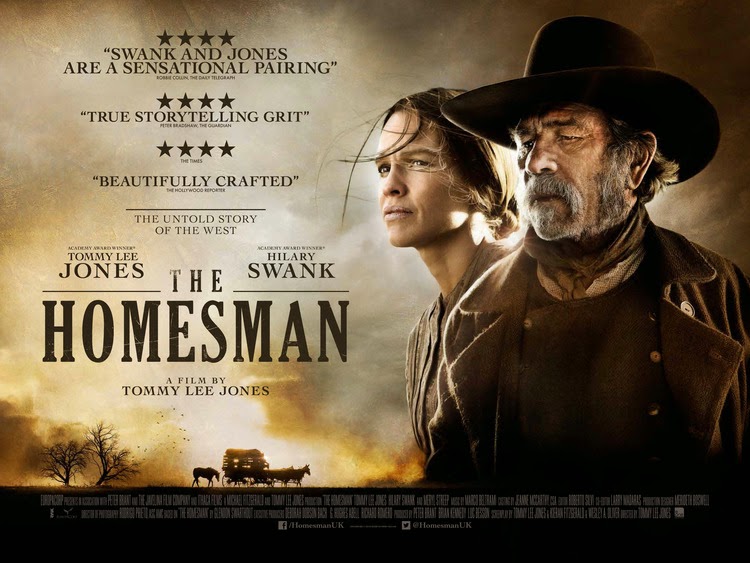
Cast: Tommy Lee Jones, Hilary Swank, Grace Gummer, Miranda Otto, Sonja Richter, Jo Harvey Allen, Barry Corbin, David Dencik, William Fichtner, Evan Jones, Caroline Lagerfelt, John Lithgow, Tim Blake Nelson, Jesse Plemons, James Spader, Hailee Steinfeld, Meryl Streep
In the Nebraska Territory in the 1850’s, three women – Arabella Sours (Gummer), Theoline Belknap (Otto), and Gro Svendsen (Richter) – fall victim to madness after enduring various hardships. Their pastor, Reverend Dowd (Lithgow), calls upon one of their husbands to take them to Hebron, Iowa where there is a church that will take care of them. With one refusing to do it at all, and the other two proving less than ideal, spinster and homesteader Mary Bee Cuddy (Swank) accepts the task, hoping that the “adventure” will help with her own feelings of isolation and depression.
Buddy encounters George Briggs (Jones), and saves him from being hanged for using another man’s home. She persuades him to accompany her and promises him $300 if they make it to Hebron. Briggs agrees but makes for surly company, and challenges Cuddy at every opportunity. However, they come to a mutual understanding, and Briggs’ experience proves invaluable when problems arise, such as one of the women wandering off and being found by a man (Nelson) who wants her for his own, and when they find themselves being watched by Indians.
However, when they find the desecrated grave of an eleven year old girl, Cuddy elects to restore it while Briggs continues on with the women. But Cuddy loses her way and finds herself back at the child’s grave. When she finally catches up with Briggs, she suggests to him that they should marry, but he rejects her offer, telling her – like som many other men before him – that she is too plain and too bossy. Later, she comes to him naked and they have sex. The next morning, Briggs makes a terrible discovery, one that changes the whole nature of the trek to Hebron.
Achingly stark yet beautiful at the same time, Jones’ adaptation of the novel by Glendon Swarthout, The Homesman, is a melancholic, richly detailed portrait of the hardships of frontier life in the 1850’s, and the different ways in which loneliness can affect even the strongest and most determined of people. Through the journey that Cuddy, Briggs and the three women make, the movie delves into notions of longing, despair, loss and, more curiously, faith (though to a lesser degree than the others). It’s a confident, expertly constructed and devised movie, and it features a handful of strong, finely detailed performances – from Jones, Swank, Streep and Lithgow – and also features some stunning photography courtesy of Rodrigo Prieto, but ultimately it’s a movie that plays too much to convention.
Part of the problem lies in the relationship between Briggs and Cuddy, two people for whom loneliness has become their lives. But where Briggs is comfortable in being alone, Cuddy isn’t, and strives to match herself with someone (at the beginning of the movie it’s another homesteader (Evan Jones), but her desperation is alienating). When she and Briggs meet it’s inevitable that she will offer him the same proposal of marriage it seems she’s made to everyone else. That Briggs will refuse her is another inevitability, and one that robs the moment of any dramatic tension; it also makes Cuddy’s willingness to strip naked and sleep with him too desperate (that Briggs would agree to this approach is unsurprising). What follows is robbed of any potency by Jones’ not allowing any build up to it – it’s presented so matter-of-factly that it makes Cuddy’s importance to the narrative seem irrelevant.
And so the focus remains on Briggs, a curmudgeonly old fox who lacks several degrees of decency, and who develops an unlikely sense of responsibility to the three madwomen (and purely, it seems, because they’ll follow him wherever he goes, a development that’s never really explained). He’s otherwise a selfish, mean-spirited man with no measure of social conscience, but who seems to gain said social conscience without a second thought, and who tries to echo Cuddy’s desperate need to fit in and be accepted by making a similar (uncomfortable) proposal to Steinfeld’s waitress. In Jones’s hands, he’s meant to be a sympathetic character overall, but his personality and way with others is too wayward to afford consistency, and Briggs’ initial roguishness gives way to behaving in whichever way the script needs him to.
With Jones the actor hamstrung by Jones the co-writer – along with Kieran Fitzgerald and Wesley A. Oliver – it’s left to Jones the director to save the day. If there’s one aspect that he’s very, very good at, it’s in the look of his movies. As in The Three Burials of Melquiades Estrada (2005), Jones’ mastery of the frame is simply superb, each shot crafted with a care and attention to light and shade and detail that is consistently impressive. His use of perspective is also finely attuned, the various landscape shots peppered throughout the movie displaying a level of natural beauty married to the width and depth of the image that is often breathtaking. And it’s no different in medium or close up shots: Jones displays such a sure knowledge of what’s he doing and how he’s presenting it that each scene has a rare quality to it, one that few other directors would be able to reproduce.
The movie moves along at a measured pace that gives the cast adequate time to make an impression, and which shows Jones to be generous when sharing the screen with someone else. He gives supporting actors such as Spader, Fichtner and Steinfeld plenty of room to impress, and stands well back to let them do their thing. Though the script gives them little to do except stare off into the distance, Gummer, Otto and Richter, are effective as the three women driven mad by circumstance and hardship (particularly Richter, who has a chilling and very disturbing scene with a sowing needle). They don’t quite achieve the prominence the story allows them at the beginning, but all three characters are convincingly portrayed throughout.
There are casual nods to the sexism of the times, and the grim nature of trying to survive in what was an often harsh, unforgiving environment is well depicted. The final twenty minutes serve more as a coda than a final act, and some viewers may feel this section is a little off-centre as a result, as the three madwomen arrive at their destination and Streep’s affable pastor’s wife takes centre stage (her performance is a reminder, if any were needed, of just how good an actress she is). And the final scene itself ends the movie on an awkward, offhand note that smacks of contrivance rather than a satisfying end to the story.
Rating: 7/10 – absorbing if uneven, The Homesman scores highly because of Jones’ ability as a director and his often glorious use of the camera; with its story often straying off into some unwanted dead ends, this journey is only occasionally involving, and only occasionally matches the commitment made by its cast.




 thedullwoodexperiment