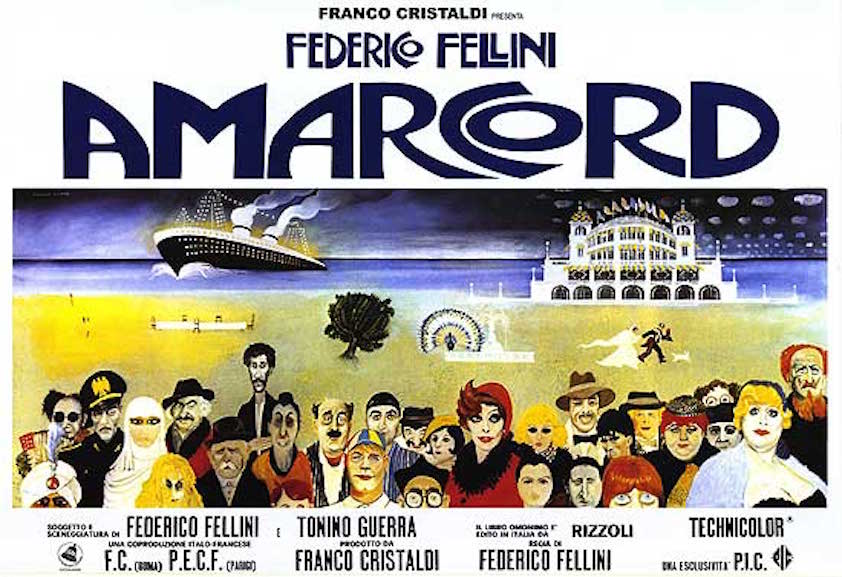
There are several great posters out there for Fellini’s movies, and while some of them have a caché that can’t be beat – I’m talking I vitelloni (1953) for one – this particular poster appeals to me in ways that have crept up on me over the years. (Some historical background: I saw the majority of Fellini’s movies over a period of four months back in 2002, and while learning more about them, saw the variety of designs allocated to the posters for his movies; most of them are really expressive and charming.)
Here it’s the breadth of the design, coupled with the number of references to characters, places and events in the movie that impresses the most, along with the clever way in which the eye is drawn to each component of the poster in a way that allows one to focus on one aspect without losing sight of the whole. The dark-hued sky with its portentous colouring is wonderfully dramatic, hinting at some of the conflict contained within the movie, and then there’s the space between the characters and the sea, sparingly dotted with images, a brighter stretch of colour that looks more optimistic.
It also serves as the backdrop for one of the most incredible assemblies of characters from a movie you’re ever likely to see. They’re all there: from Ciccio Ingrassia’s mad uncle, to Magali Noël’s beautiful Gradisca, to Maria Antonietta Beluzzi’s impossibly bosomed tobacconist – an intimate series of representations that border on good-natured caricature yet retain the essence of that character, allowing their personalities to be hinted at or confirmed (to find out which you have to see the movie). It’s like a rogues gallery except that these are all people you’d be intrigued to meet.
And then there’s the bold, swirling script used for the director’s name and the title, a magnificently cursive grouping of letters that maintains its own identity and oversees the image like a proud, protective parent. It all adds up to an audacious, striking movie poster that perfectly reflects the movie it represents.
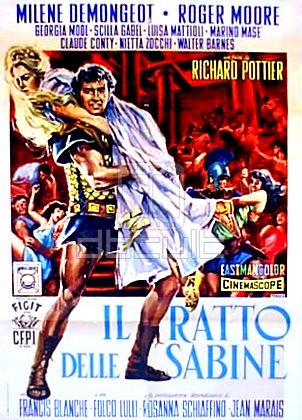
Cast: Roger Moore, Mylène Demongeot, Folco Lulli, Georgia Moll, Scilla Gabel, Luisa Mattioli, Marino Masé, Claude Conty, Nietta Zocchi, Francis Blanche, Walter Barnes, Rosanna Schiaffino, Jean Marais
Following on from the same year’s Romolo e Remo, Romulus and the Sabines is a roughly faithful retelling of the rape of the Sabine women, when the men of Rome, under their king Romulus (Moore), kidnapped the women of neighbouring Sabine in order that they could have wives and so ensure Rome’s future growth and prosperity. (The term “rape” should really read “abduction” as that is the literal translation of the original Latin.)
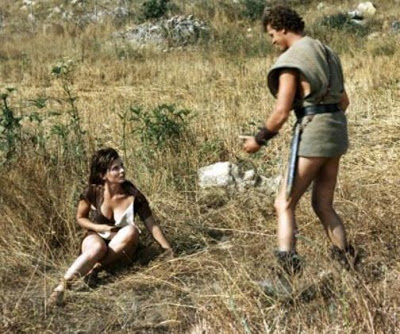
As the movie begins the men of Rome are bewailing their lack of women. Looking at the motley band of extras the Italian filmmakers have come up with for the movie, you’d be forgiven for thinking, pity the poor women who have to deal with that lot. After a few examples of King David-like problem solving, Romulus is informed that intruders to Rome have landed nearby. During the skirmish that follows, a woman, Dusia (Gabel) is discovered. She makes her escape, only to be found by Romulus later on. Within moments they have fallen in love and Romulus is helping her hide in a cave. Romulus sends ambassadors to the Sabine king Titus (Lulli) asking for the Sabine women to be given over to Rome. Titus refuses, leading Romulus to plot their abduction at a festival held by the Sabines. Distracted by wine provided by the Romans, the Sabines have little chance to stop the abduction of their women, including Titus’s daughter Rea (Demongeot).
Romulus, upon seeing Rea, promptly forgets all about Dusia, and falls head over heels in love (again). The Sabine women are given their pick of the Roman men, and the future of Rome is secured. While all this is going on however, Dusia, who has found a secret entrance into Rome and seen Romulus making googly-eyes at Rea, frees Rea and then helps the Sabines to enter Rome and mount an attack.
There are anomalies here, of course. The character of Dusia never existed (she’s a stand-in for Tarpeia, the daughter of the governor of the citadel on the Capitoline hill). When the Sabines attacked Rome it was after two other tribes had already failed in the same endeavour. And it was the new brides of Rome who stopped the battle by coming between the opposing sides and reconciling them (here the battle is stopped in a different way but the outcome is the same). If you know your early Roman history, then I’m sure there are even more things that are anachronistic or just plain wrong, but as the movie is intended primarily as entertainment rather than as a faithful recreation of events, the filmmakers can probably be excused their remissions and embellishments.
What is harder to forgive is the sight of Moore with one of the silliest hairstyles seen in any peplum movie. Amazingly, Moore was thirty-four when he made Romulus and the Sabines, but he looks ten years younger and has the curly hair of a teenager just learning to use a comb. Whenever he’s on screen – and that’s approximately sixty per cent of the time – it’s all you can focus on. Even Gabel’s heaving bosom doesn’t attract the eye as much… well, okay, maybe it does. There are early examples of the raised eyebrow school of acting, as well as completely unconvincing attempts to act tough or angry. It’s actually difficult to properly gauge Moore’s performance as he alternates between entering into the spirit of things, and looking as uncomfortable in a short skirt as only a grown man can. (This was Moore’s first Italian movie, and he would make only one more, Un branco di vigliacchi (aka No Man’s Land), the following year.
As for the rest of the cast, Demongeot pouts a lot and provides a one-note performance, while Gabel smoulders as much as is humanly possible without spontaneously combusting. Comic relief is provided by the near-sighted Blanche, and gravitas comes courtesy of Lulli. Pottier’s direction is merely average (this was his only peplum movie), and the photography meets the standards required for this type of movie with this type of budget. The art direction depicts a Rome that is both rich and pastoral – often in the same shot – and the outdoor sequences are filmed with an eye for the beauty of the surrounding countryside. All in all, Romulus and the Sabines is no better and no worse than all the other historical epics being made at the time in Italy. It has its humorous moments, mostly unintentional, but it does a fair job of telling its (mostly) true story.
Rating: 5/10 – despite Moore’s uneasiness in the title role, Romulus and the Sabines isn’t as daft as it might have been; perfect for passing the time on a rainy afternoon when there’s nothing else on.
Originally posted on thedullwoodexperiment website.
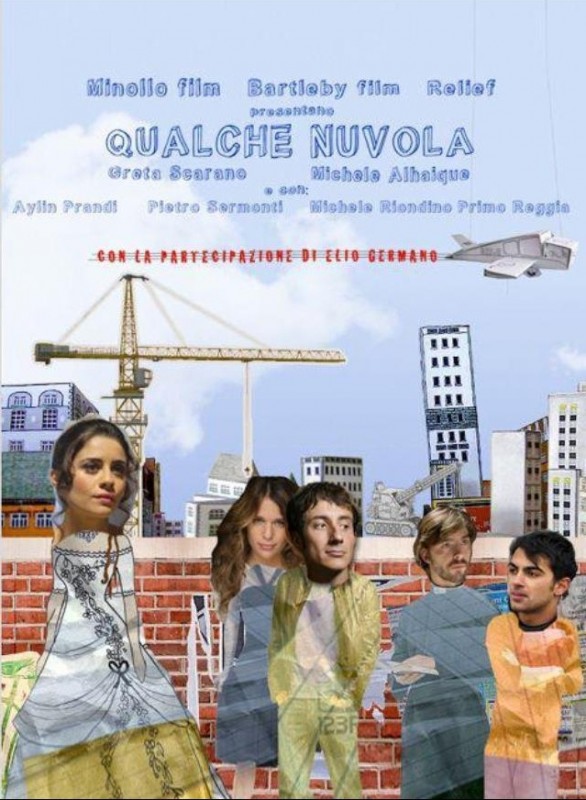
Cast: Michele Alhaique, Greta Scarano, Aylin Prandi, Giorgio Colangeli, Michele Riondino, Paola Tiziana Cruciani, Paolo De Vita
Diego (Alhaique) and Cinzia (Scarano) have been engaged for ten years and finally their wedding is approaching. Diego is having second thoughts about getting married, and while he loves Cinzia, he has the usual young man’s doubts about committing himself. He works as a builder, and while working on a housing project for a Ristoratore (Nick Nicolosi), he’s asked to do some work on the apartment of the man’s niece Viola (Prandi). For Diego, meeting her is like a bolt out of the blue. Viola is a free spirit, a contrast to the practical-minded Cinzia. Where Cinzia’s focus is purely on the wedding, Viola is carefree and artistic; she and Diego go for walks, she gives him a book to read (Haruki Murakami’s Sputnik Sweetheart), and eventually their relationship becomes more intimate. Soon, Diego is leading a double life, and his relationship with Cinzia begins to break down. And then her friend Maria (Cruciani) sees Diego and Viola together…
Scattered Cloud is an engaging, simply told movie that holds the attention but for most of its running time doesn’t really offer anything new (although it does wrong foot the viewer a couple of times). The two relationships – Diego and Cinzia, Diego and Viola – are given equal screen time, and all three actors give good performances. Alhaique portrays both his reluctance to marry and his infatuation with Viola skilfully and with confidence, while Scarano ensures that Cinzia, who could have been just a scold, is shown as being tough and vulnerable at the same time. Prandi does well also with a largely underwritten role, providing Viola with a child-like intensity that allows Diego to see the world around him a little bit differently. (It comes as no surprise when the Ristoratore warns Diego that Viola is “unstable”, but this isn’t taken any further.)
Di Biagio handles things with ease, and directs his cast with a confidence that allows them to expand on the characters as written (he also wrote the script). The movie’s visual style is naturalistic, with an emphasis on low-key lighting and tight close-ups on the characters’ faces. While the script anchors the movie in too-familiar territory, including a sub-plot involving discontented workers at Diego’s workplace, there’s enough here to engage the viewer and keep things interesting, even if, at times, you can anticipate a lot of the dialogue. A mention too for Francesco Cerasi’s score, sparsely but effectively used, and using subtle motifs to highlight the characters’ moods.
Rating: 7/10 – an almost traditional romantic drama, with flashes of humour, that is easy to watch but lacks any real depth or packs any real emotional heft; a pleasant enough diversion that relies heavily on its performances.

 thedullwoodexperiment