• 10 Reasons to Remember…
  • A Brief Word About…
  • About
  • For One Week Only
  • Happy Birthday
  • Monthly Roundup
  • Old-Time Crime
  • Other Posts
  • Poster of the Week
  • Question of the Week
  • Reviews
  • Trailers

thedullwoodexperiment

~ Viewing movies in a different light

thedullwoodexperiment

Tag Archives: Jeffrey Tambor

The Death of Stalin (2017)

26 Thursday Oct 2017

Posted by dullwood68 in Movies

≈ Leave a comment

Tags

Armando Iannucci, Central Committee, Comedy, Drama, Jeffrey Tambor, Literary adaptation, Michael Palin, Moscow, Olga Kurylenko, Review, Simon Russell Beale, Soviet Russia, Steve Buscemi

D: Armando Iannucci / 106m

Cast: Steve Buscemi, Simon Russell Beale, Jeffrey Tambor, Michael Palin, Andrea Riseborough, Olga Kurylenko, Jason Isaacs, Rupert Friend, Dermot Crowley, Paul Whitehouse, Paul Chahidi, Paddy Considine, Adrian McLoughlin

The Death of Stalin could have easily been subtitled Fear and Loathing in Moscow, such are the high levels of animosity and opposition that ensue following the death of Soviet leader, “Uncle Joe” Stalin (McLoughlin). As the various members of the Central Committee scramble to establish a way forward – and more importantly, decide which one of them will be the country’s new leader – loyalties are tested, schemes are hatched, alliances are forged, but political manoeuvring continues unabated (it’s just that some of the goals, and the goalposts themselves, are changed from moment to moment). Under the satirical gaze of writer/director Armando Iannucci, the events that took place in the wake of Stalin’s death provide the basis for a movie that combines very black humour with a surprisingly serious approach to the material that helps the movie operate effectively on two separate levels, both comedic and dramatic.

While not everything happened in the way that Iannucci portrays it, some things did, and it’s the way in which he emphasises the absurdity of these real events that adds greatly to the effectiveness of the screenplay which has been co-written by Iannucci, David Schneider and Ian Martin, with additional material by Peter Fellows, and which itself is based on a screenplay by original source material writer Fabien Nury (The Death of Stalin has been adapted from the comic book of the same name). One such event occurs following the stroke Stalin suffered on 1 May 1953. When he’s found the next morning, it takes around twelve hours for a doctor to be called, as each member of the Central Committee refuses to make a decision by themselves in case Stalin recovers and takes them to task for their actions. It’s only when all the Committee members are in agreement that a doctor is needed that anything more is done. But then there’s another issue: thanks to the recent Doctors’ Plot, where prominent doctors were accused of conspiring to assassinate Soviet leaders, all the good, well regarded physicians in Moscow have been either imprisoned or executed. So, who to call? It’s moments like these, absurdist moments that challenge the perception of what’s real and what’s invented that makes the movie so enjoyable to watch.

But Iannucci isn’t solely interested in pointing out how ridiculous some of the events surrounding Stalin’s death were, but also how deadly serious that milieu was and how nothing could be taken for granted, be it a job, a reputation, or worse still, a life. Iannucci is quick to show the darker side of Soviet life in the Fifties, with Stalin’s Head of Security, Lavrentiy Beria (Beale), relishing his role as a combination accuser,  torturer, and executioner, whether he’s chasing down real enemies of the state or fabricating evidence to convict the innocent through political expediency. With Stalin’s full support while he’s alive, Beria has attained a position of power that he seeks to build on once his mentor is dead, and as he manipulates the Deputy Leader, the fragile minded Georgy Malenkov (Tambor), it’s left to Nikita Khrushchev (Buscemi) to put a stop to Beria’s ambitions.

One of the more absurdist notions of Iannucci’s movie is that it puts forth Nikita Khrushchev as its hero, but this was Khrushchev’s time, the moment where he took power in the wake of Stalin’s death and set about making long-lasting reforms. Here he’s a worried politician who wants to see an end to the tyranny of Stalin’s rule, and fears that Beria’s influence on Malenkov will see an unnecessary continuation of past horrors. Iannucci makes it clear that fear is the one overwhelming motivator in Soviet life, no matter what level you’re at. There’s fear of saying the wrong thing, fear of being seen with the wrong person, fear of ignorance and knowledge together, and fear of being in the wrong place at the wrong time. The movie shows how stressful this must have been, and how easy it must have been to make a simple honest mistake that might mean the difference between life and death, and how either outcome could shift according to whim or will.

Such a dark period in Soviet history (one of many though, to be fair) might not be the best subject for a dark comedy, but The Death of Stalin is more than that, and as well as its exploration of a society living in fear, it also seeks to examine how power corrupts those who look for it above all else – Beria seals his fate by threatening each of the other Committee members with what he knows about them. These dramatic moments, where the political jockeying turns brittle and ugly, allows the humour to have even more of an impact; if you didn’t laugh, you’d have to acknowledge the tragedy and the terrible nature of what’s happening. But Iannucci knows when to raise a laugh and when to keep the drama humour-free. It’s a delicate tightrope that he traverses, but he does it with style and confidence, creating a restrained yet also panic-ridden atmosphere for his characters to operate in. He also finds time to highlight the self-serving hypocrisy of the Committee members, something that’s best expressed through the attitude of Vyacheslav Molotov (Palin), who denounced his wife for the good of the party – and his own position within it.

With Iannucci and his co-writers putting together such a good script, and Iannucci himself proving that he’s firmly in control of both the tone and the pace of the movie, things are made even more impressive by the cast that he’s assembled. Buscemi is terrific as Khrushchev, a bureaucrat holding the fate of a nation within his hands, while Tambor’s turn as Malenkov is a delight, even if you have to wonder how such a dimwit got onto the Committee in the first place. There are first-rate supporting turns from Isaacs as a very gruff, very Yorkshire-sounding Head of the Red Army, Georgy Zhukov; Riseborough as Stalin’s daughter, Svetlana; Considine as an under threat theatre manager who really needs to record a live concert; and Palin, who gives such a subtle reading of his character that it serves as a reminder that when he’s not travelling the world, he’s a very accomplished actor indeed. But if anyone stands out it’s Beale as the venal, grotesque Beria, a character who seems fully formed from the moment we first see him, flinging horrible caustic remarks about with no concern for the feelings of others, and telling the audience everything they need to know about him in one perfect line of dialogue: “Have a long sleep, old man. I’ll take it from here.” It’s a performance that’s unlikely to win any awards thanks to the nature of the movie, but if Beale did win an award, it would be entirely justified. It’s the perfect cap to a movie that operates effectively on so many levels, and which has a lot more going on below the surface both in terms of the narrative, and its recreation of a period when laughing at senior Soviet politicians would have meant a swift trip to a gulag…or worse.

Rating: 8/10 – a movie that treats its historical backdrop with a great deal of respect (even when it alters certain facts to suit the material), The Death of Stalin is a small, unassuming gem of a movie that is both horrifying and amusing at the same time, and without either element undermining the other; with its clutch of richly perceptive performances, cleverly constructed humour, and astute direction, it’s a movie that may not find the wider audience it deserves, but is nevertheless a must-see for anyone who likes their political satire barbed and ready to sting.
Share this:

  • Click to share on X (Opens in new window) X
  • Click to share on Facebook (Opens in new window) Facebook
  • More
  • Click to print (Opens in new window) Print
  • Click to email a link to a friend (Opens in new window) Email
Like Loading...

The D Train (2015)

22 Saturday Aug 2015

Posted by dullwood68 in Movies

≈ Leave a comment

Tags

Andrew Mogel, Banana Boat, Comedy, Commercial, Drama, High School, Jack Black, James Marsden, Jarrad Paul, Jeffrey Tambor, Kathryn Hahn, Reunion, Review

D Train, The

D: Jarrad Paul, Andrew Mogel / 101m

Cast: Jack Black, James Marsden, Kathryn Hahn, Jeffrey Tambor, Russell Posner, Mike White, Henry Zebrowski, Kyle Bornheimer

Dan Landsman (Black) is the self-styled chairman of his high school reunion committee. He enjoys what limited prestige comes with the position (which isn’t much), but can’t get the respect from his fellow committee members that he thinks he deserves. This is due to his overbearing, self-important approach to organising the reunion, and the fact that he was never popular in high school. As he and the rest of the committee call up their peers and are continually let down, Dan finds a solution in the unlikeliest of places: a Banana Boat commercial. The “star” of the commercial is none other than Oliver Lawless (Marsden), the most popular guy in high school. Dan reasons that if he can get Oliver to attend the reunion, everyone will.

Dan determines that a face-to-face approach is needed, but Oliver lives in L.A., while he lives in Pittsburgh. Under the pretence of going there for an important business meeting, Dan books a flight and gets ready to go. But his boss, Mr Schurmer (Tambor), insists on coming with him to help facilitate the deal that Dan has supposedly set up. Unable to persuade his boss to stay in Pittsburgh, he has no choice but to make it seem as if the deal has fallen through. Dan tracks down Oliver and they spend the night on the town, going from club to club and bar to bar and getting drunk and high. Dan goes back to his hotel room but in the early hours, Oliver, feeling down, pays him a visit. Dan reveals the true reason for his visit, and even tells Oliver about the so-called business deal; Oliver agrees to attend the reunion.

The next morning, Oliver poses as the businessman Dan has been dealing with, but instead of killing the deal as Dan needs him to, he tells Schurmer that it’s a go. Oliver apologises, but tells Dan he can easily put a stop to things when he’s back in Pittsburgh. That night they go out on the town again, but this time they end up back at Oliver’s apartment. To Dan’s surprise, Oliver makes a pass at him. What happens next leaves Dan bewildered and confused. Back home he finds his boss spending lots of money on the business in expectation of the deal going through, his fourteen year old son Zach (Posner) experiencing problems of the heart, and his wife Stacey (Hahn) pleased for him for landing the deal and Oliver’s attendance at the reunion.

But when Oliver arrives for the reunion and stays at Dan’s home, Dan begins behaving erratically, and he starts to alienate his wife and son, and the members of the committee (who don’t like him that much anyway). As the reunion draws nearer, he tries his best to behave normally but the events in L.A. have had a greater impact on him than even he’s aware of. And it’s at the reunion itself that Dan’s behaviour causes the greatest upset as he and Oliver confront each other over what happened, and Dan is left feeling isolated and alone, and wondering what he can do to make things right with the people he cares about.

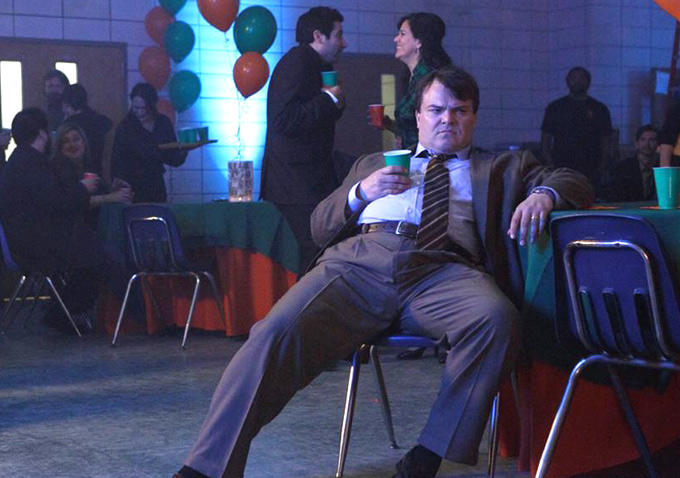
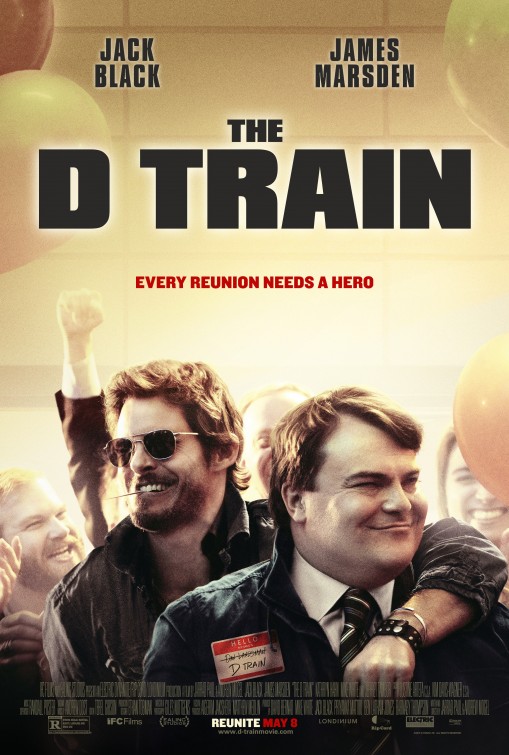
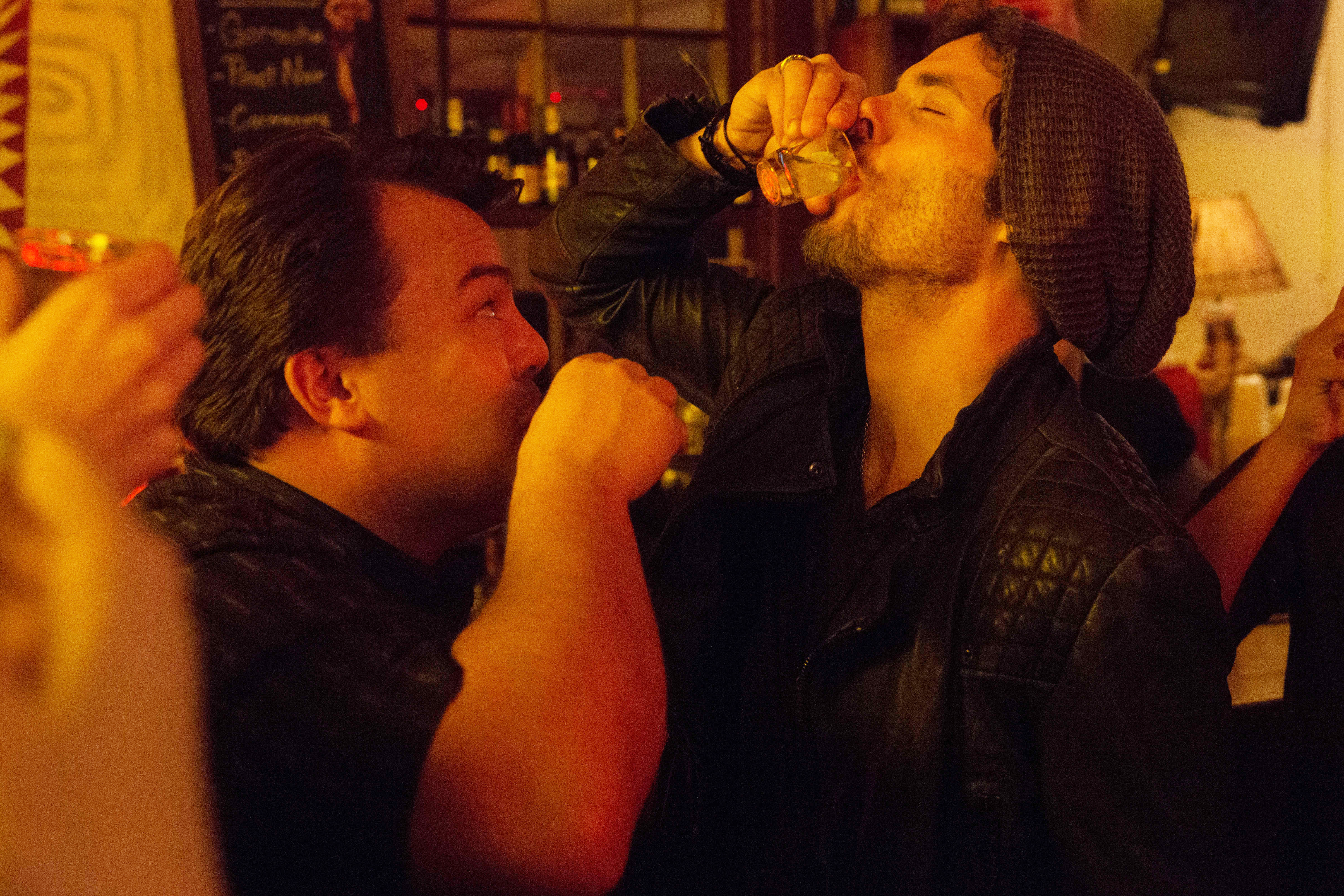
THE D TRAIN - 2015 FILM STILL - Jack Black (Dan Landsman) and James Marsden (Oliver Lawless) - Photo Credit: Hilary Bronwyn Gayle. An IFC Films release.

Having previously worked on the script for Yes Man (2008), writers/directors Jarrad Paul and Andrew Mogel have upped their game somewhat for The D Train, and the result is a clever, sometimes very funny comedy drama that gives Black his best role since Bernie (2011) (though to be fair he has only made two other movies in that time). It’s also smart, knowing and occasionally tragic in its look at its main character’s constant need for respect and approbation, and the lengths he’ll go to in order to be acknowledged.

The social misfit is perhaps Black’s niche role (it can only be a matter of time before he plays a serial killer), and as in Bernie he’s uncomfortably comfortable in the role of a man whose social standing is based on his lack of popularity in high school (when we see him calling his fellow alumni not one of them appears to remember him without the benefit of some heavy prompting). Away from the reunion committee he’s in a respected position at work, with his boss happy to defer to Dan’s judgement on matters, while his home life appears secure as well. But it’s his lack of social presence that bothers him, and why he’s never fit in. Meeting Oliver in L.A. reminds him he can be a fun guy, that he can be good company, and more importantly, that those traits have always been inside him; it’s just needed someone of Oliver’s carefree nature to bring them out of him.

But with freedom comes (no, not great responsibility) a complete misunderstanding of the nature of friendship and many of the unspoken rules that go with it. Back in Pittsburgh, Dan displays all the signs of someone who’s been abandoned or had their favourite toy taken away from them; he just doesn’t know how to deal with all the raw feelings he’s experiencing. He overcompensates in the bedroom (not that Stacey minds), but then rudely ignores Zach when he needs some fatherly advice. The situation at work becomes unmanageable, and when Oliver shows himself to be a better father figure, Dan over-reacts and tells him to leave. It’s in these moments when Dan’s insecurities and jealousy of Oliver’s “cool” attitude shows him for the desperately needy person that he is.

Black is superb in the role, and he’s matched by Marsden who portrays Oliver’s shallow lifestyle with a thread of sadness lurking beneath the rampant hedonism. Hahn, who goes from strength to strength with each movie she makes, delivers a polished if largely restrained performance that makes for an effective counterpoint to Black’s anguished social walrus. And Tambor is terrific as Dan’s boss, a confirmed Luddite whose puppy-dog adoption of computers and the Internet contributes to Dan’s downfall.

But while the performances are all above average, and while the basic premise is a sound one given enough room for considered examination, the movie does have its faults, and in the same way that Paul and Mogel’s script is on solid ground when dissecting Dan’s motives and behaviour, it’s less so when it introduces moments and scenes of crass humour. One scene in particular stands out, when Oliver gives Zach advice on how to manage in a threesome. Despite the obvious humour to be had from such a scene, it’s still at odds with the tone of the rest of the movie, and there’s nothing the directors can do to offset the awkwardness of having a man in his late Thirties giving sex advice to a fourteen year old (it’s also strange that the script thinks it’s entirely likely that Zach would ask his dad about such a subject while at the dinner table). And at the reunion, Dan snorts cocaine in the bathroom before being discovered by Jerry (White), one of the committee members. Dan rambles on and Jerry’s surprise at Dan’s behaviour evaporates as quickly as it occurs. And Mr Schurmer’s subdued reaction to the potential loss of his company is meant to be quietly tragic but seems instead to be a case of the script not wanting to follow that particular plot thread any further (the same goes for Stacey’s reaction to the revelation of what happened in L.A.).

D Train, The - scene 2

With the characters routinely involved in scenes that don’t always have a logical follow-on, or betray the emotion of a scene (e.g. when Oliver leaves for L.A. and says goodbye to two of the committee members), the movie tries for hard-edged adult humour too often at the expense of the more important dramatic aspects. While the humour is mostly very funny indeed, a lot of it feels shoe-horned in, as if they were added to the script somewhere in the pre-production phase. As a result the movie feels disjointed at times, and lacks the overall focus afforded the drama, leaving audiences to wonder if the humour is there to provide some relief from the themes of social inequality, self respect, alienation, and personal inadequacy. If it is, then unfortunately the way in which it’s been done lacks authority.

Rating: 7/10 – deficiencies in the script leave The D Train feeling like it’s falling short of its original intentions; Black is on terrific form however, keeping the movie afloat through some of its more unlikely moments, and perfectly judging the pathos needed to avoid Dan being completely unlikeable.

Share this:

  • Click to share on X (Opens in new window) X
  • Click to share on Facebook (Opens in new window) Facebook
  • More
  • Click to print (Opens in new window) Print
  • Click to email a link to a friend (Opens in new window) Email
Like Loading...

Blog Stats

  • 486,575 hits

Recent Posts

  • 10 Reasons to Remember Bibi Andersson (1935-2019)
  • Fantasia (1940)
  • Dances With Wolves (1990) – The Special Edition
  • Kiss of the Spider Woman (1985)
  • The Three Musketeers (1973)

Top Posts & Pages

  • Lost for Life (2013) - Another Look
    Lost for Life (2013) - Another Look
  • Lost for Life (2013)
    Lost for Life (2013)
  • About
    About
  • Mr. Topaze (1961)
    Mr. Topaze (1961)
  • Hunt for the Wilderpeople (2016)
    Hunt for the Wilderpeople (2016)
  • Shock and Awe (2017)
    Shock and Awe (2017)
  • Billy Lynn's Long Halftime Walk (2016)
    Billy Lynn's Long Halftime Walk (2016)
  • Winter's Tale (2014)
    Winter's Tale (2014)
  • BFI London Film Festival 2015
    BFI London Film Festival 2015
  • 10 Reasons to Remember Arthur Hiller (1923-2016)
    10 Reasons to Remember Arthur Hiller (1923-2016)
Follow thedullwoodexperiment on WordPress.com

Blogs I Follow

  • Rubbish Talk
  • Film 4 Fan
  • Fast Film Reviews
  • The Film Blog
  • All Things Movies UK
  • Interpreting the Stars
  • Let's Go To The Movies
  • Movie Reviews 101
  • TMI News
  • Dan the Man's Movie Reviews
  • Film History
  • Jordan and Eddie (The Movie Guys)

Archives

  • April 2019 (13)
  • March 2019 (28)
  • February 2019 (28)
  • January 2019 (32)
  • December 2018 (28)
  • November 2018 (30)
  • October 2018 (29)
  • September 2018 (29)
  • August 2018 (29)
  • July 2018 (30)
  • June 2018 (28)
  • May 2018 (24)
  • April 2018 (21)
  • March 2018 (31)
  • February 2018 (25)
  • January 2018 (30)
  • December 2017 (30)
  • November 2017 (27)
  • October 2017 (27)
  • September 2017 (26)
  • August 2017 (32)
  • July 2017 (32)
  • June 2017 (30)
  • May 2017 (29)
  • April 2017 (29)
  • March 2017 (30)
  • February 2017 (27)
  • January 2017 (32)
  • December 2016 (30)
  • November 2016 (28)
  • October 2016 (30)
  • September 2016 (27)
  • August 2016 (30)
  • July 2016 (30)
  • June 2016 (31)
  • May 2016 (34)
  • April 2016 (30)
  • March 2016 (30)
  • February 2016 (28)
  • January 2016 (35)
  • December 2015 (34)
  • November 2015 (31)
  • October 2015 (31)
  • September 2015 (34)
  • August 2015 (31)
  • July 2015 (33)
  • June 2015 (12)
  • May 2015 (31)
  • April 2015 (32)
  • March 2015 (30)
  • February 2015 (37)
  • January 2015 (39)
  • December 2014 (34)
  • November 2014 (34)
  • October 2014 (36)
  • September 2014 (25)
  • August 2014 (29)
  • July 2014 (29)
  • June 2014 (28)
  • May 2014 (23)
  • April 2014 (21)
  • March 2014 (42)
  • February 2014 (38)
  • January 2014 (29)
  • December 2013 (28)
  • November 2013 (34)
  • October 2013 (4)

Create a free website or blog at WordPress.com.

Rubbish Talk

Film 4 Fan

A Movie Blog

Fast Film Reviews

The Film Blog

The official blog of everything in film

All Things Movies UK

Movie Reviews and Original Articles

Interpreting the Stars

Dave Examines Movies

Let's Go To The Movies

Film and Theatre Lover!

Movie Reviews 101

Daily Movie Reviews

TMI News

Latest weather, crime and breaking news

Dan the Man's Movie Reviews

All my aimless thoughts, ideas, and ramblings, all packed into one site!

Film History

Telling the story of film

Jordan and Eddie (The Movie Guys)

Movie Reviews & Ramblings from an Australian Based Film Fan

Privacy & Cookies: This site uses cookies. By continuing to use this website, you agree to their use.
To find out more, including how to control cookies, see here: Cookie Policy
  • Subscribe Subscribed
    • thedullwoodexperiment
    • Join 481 other subscribers
    • Already have a WordPress.com account? Log in now.
    • thedullwoodexperiment
    • Subscribe Subscribed
    • Sign up
    • Log in
    • Report this content
    • View site in Reader
    • Manage subscriptions
    • Collapse this bar
 

Loading Comments...
 

    %d