• 10 Reasons to Remember…
  • A Brief Word About…
  • About
  • For One Week Only
  • Happy Birthday
  • Monthly Roundup
  • Old-Time Crime
  • Other Posts
  • Poster of the Week
  • Question of the Week
  • Reviews
  • Trailers

thedullwoodexperiment

~ Viewing movies in a different light

thedullwoodexperiment

Tag Archives: Joan Allen

Room (2015)

13 Saturday Feb 2016

Posted by dullwood68 in Movies

≈ Leave a comment

Tags

Abduction, Brie Larson, Drama, Emma Donoghue, Escape, Jack, Jacob Tremblay, Joan Allen, Lenny Abrahamson, Literary adaptation, Ma, Old Nick, Review, Sean Bridgers

Room

D: Lenny Abrahamson / 118m

Cast: Brie Larson, Jacob Tremblay, Sean Bridgers, Joan Allen, Tom McCamus, William H. Macy, Amanda Brugel

Ma (Larson) and Jack (Tremblay) live in what they refer to as Room, literally a single room environment that they haven’t been outside of since Ma was abducted and brought there seven years before, and Jack’s birth five years ago. Everything in Room is functional or adapted to be functional. There’s a TV but Ma has told Jack that the people and places and things he sees there aren’t real, and that there isn’t any outside world, only space. This doesn’t quite explain the visits of Old Nick (Bridgers) who brings supplies and ensures the power stays on, but as a constant in their lives, Jack doesn’t question his appearances, or why he has to sleep in the closet when Old Nick pays Ma “special attention”.

The door to Room is always locked; Old Nick uses a combination keypad to get in and out, and Ma doesn’t know the code. With Jack now five years old, and of an age where he can begin to understand the concept of a larger world outside Room – even if he doesn’t believe it can be true – Ma decides it’s time for them to leave and begin to lead a normal life. One night when Old Nick pays them a visit she arranges for Jack to appear sick. Old Nick refuses to do anything more than bring more painkillers the next night. But Ma persuades Jack to play dead and be wrapped up in a rug – her idea is that Old Nick will take Jack’s body somewhere to bury it; when he stops his truck at a road junction, Jack is to jump out and run to the first person he sees and ask for help.
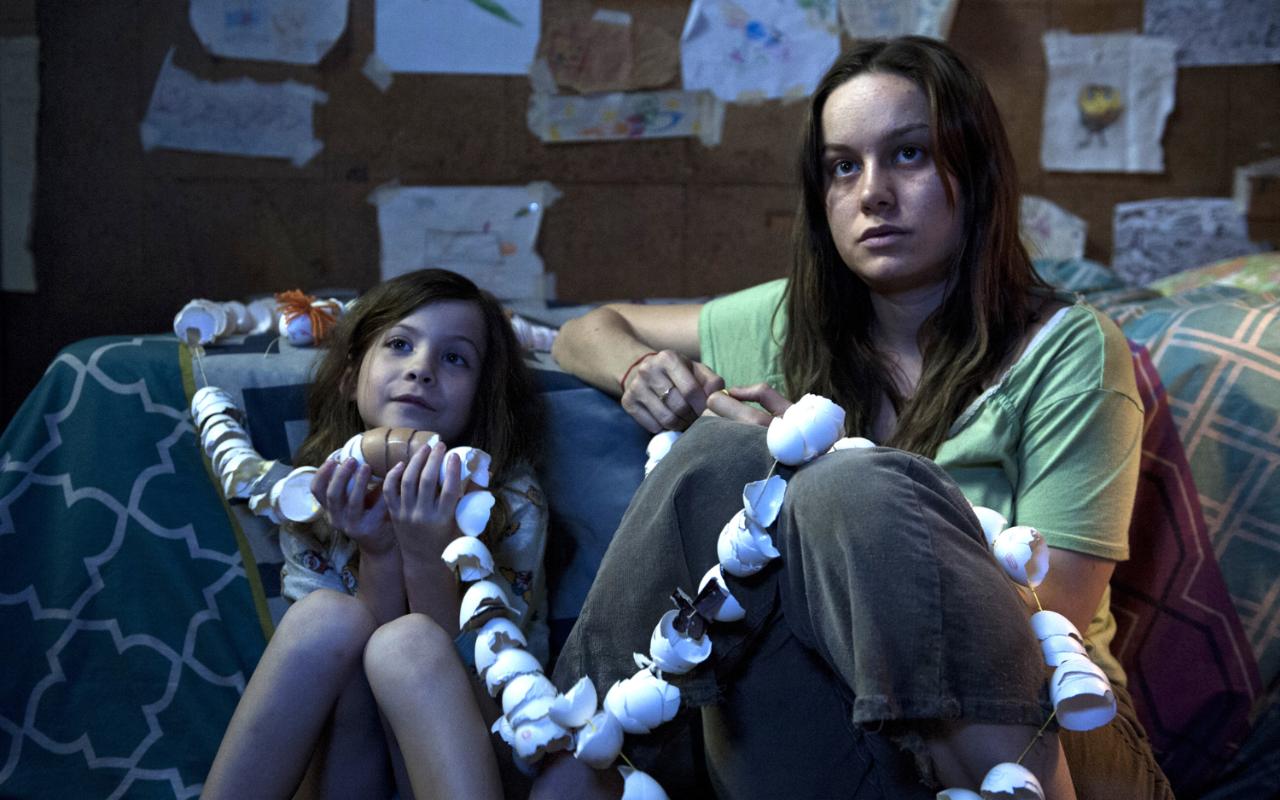
Room - scene1

Old Nick is fooled by Ma’s assertion that Jack has died, and takes out the rug with Jack inside it. In the back of Old Nick’s truck, Jack frees himself from the rug, and after a few missed opportunities, jumps from the truck. Old Nick chases him but they encounter a man walking his dog. Seeing that something is wrong, the man challenges Old Nick who throws Jack to the ground and speeds off in his truck. The police are called, and a supportive officer (Brugel) manages to work out from what Jack tells her, just where Ma is. The two are reunited, and at last they can begin to build a new life for themselves.

Without spoiling anything for anyone who hasn’t seen Room yet, it’s a movie of two unequal parts, both in running time and in content. For the first forty-five minutes (approximately), we’re sequestered in Room with Ma and Jack, stuck like they are within four unforgiving walls. But while you might be expected to feel confined or claustrophobic, it’s rarely the case because Ma and Jack don’t see it that way – Jack because he’s never known anything else, and Ma because she’s adapted after seven years to her environment. Neither feels trapped (or at least Ma never gives any indication that she does), and neither appears unhappy with their lot. They have each other, and live in a world that, Old Nick aside, is theirs alone. For Jack it’s a normal life given the parameters Ma has made for him, and for Ma it’s the only life she can have because she wants to protect Jack.

Once Jack and Ma are free of Room, and free to go wherever they wish (once the media has lost interest in them at least), they find themselves confined in a different environment, Ma’s childhood home, now inhabited by her mother, Nancy (Allen) and her new partner, Leo (McCamus) (her father, Robert (Macy) lives abroad, though he returns when he learns Ma – whose real name is Joy – has been rescued). The remaining hour and a quarter finds Joy and Jack finding their way in this new world. There are clever moments of adjustment, such as Jack learning to navigate stairs, but Joy retreats from everyone. And while this may seem like an unexpected turn of events – that Joy should have the most trouble adapting to being back in the “real world” – it’s actually entirely predictable.

Room - scene2

This lessens the drama of the second part, as we watch Jack assimilate slowly but surely, and with much more inner confidence than his mother. While Joy becomes dissociative and withdrawn, Jack begins to blossom, aided by his grandmother and Leo (and a very cute dog called Seamus). In fact, it’s the way in which Jack adapts so quickly to his new life that causes the movie to lose some of the dramatic intensity it’s built up until that point. And with Joy missing for a while, the movie has little choice but to show just how Jack’s bonding with Leo and his grandmother is replacing his formerly rock-solid relationship with his mother. It’s a natural progression, perhaps – Jack makes his first friend during this period as well – but given the vigour and the power of the movie’s first part, it also feels like a bit of a letdown. Just how easily can Jack and Joy be separated from each other? As it turns out, quite easily.

Room has been adapted by Emma Donoghue from her novel of the same name, but what works on the page doesn’t translate so well to the screen. Jack provides random smatterings of narration to explain his feelings, but while these interior monologues work in the novel, here they’re another example of insecurities built in to the script. Far more effective is Jack’s wide-eyed astonishment at seeing an impossibly vast sky as he lies in the back of Old Nick’s truck. Inside Room we’re seeing this insular world almost entirely from Jack’s perspective, and thanks to the strength of the material, and Abrahamson’s masterly direction, these scenes have a depth and a profundity that the outside world lacks. Once we’re out of Room the movie loses its way and never recovers the compelling aspect that propels those first forty-five minutes.
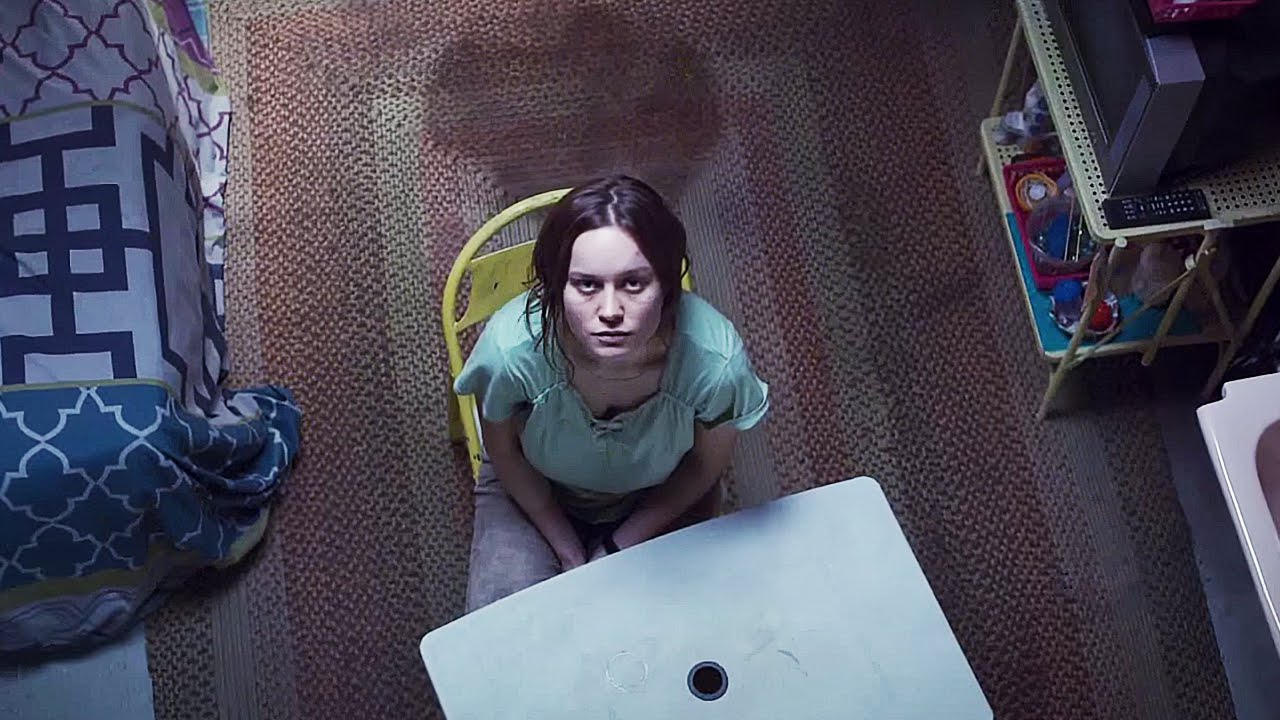
Room - scene3

Thankfully, the two central performances, despite being hamstrung by the change in narrative direction, are uniformly superb. Larson is possibly the finest actress in her age group working today, and here she’s simply breathtaking, finding aspects and nuances of her character that aren’t always apparent from the script, and making Joy’s eventual struggle with “normality” less formulaic than it is as written. Matching her is Tremblay, giving the kind of honest, uninhibited performance that only a child actor can give. He provides such an intelligent, forthright portrayal that the viewer can only look on in wonder at how effortlessly he does it all. Just watch his reactions to being asked questions by the police officer: they’re a mini-masterclass in conflicting emotions forcing themselves past overwhelming shock.

In the director’s chair, Abrahamson (thankfully not calling himself Leonard anymore) excels at portraying the insular world of Room, and maintains an uneasy tension throughout these scenes and Jack’s escape. And with the aid of Danny Cohen’s exemplary camerawork, he allows the viewer to prowl in and around Room as if they were living there too. But once the movie settles down at Nancy’s home, his confidence and control over the material lessens and leads to several scenes lacking any kind of resonance at all. And as a result, newcomers to the story such as Allen and McCamus are left largely to fend for themselves. It’s clear that Abrahamson and Donoghue have forged a good working partnership, but it’s also clear that they couldn’t recognise or overcome the deficiencies that so hurt the movie’s second act. In the end, the relationship the viewer has built up with Ma and Jack in their captivity is ruined by their freedom, and in essence, that’s too much of a price to pay when that relationship has been so immediate and so powerful.

Rating: 7/10 – let down by an injudicious approach to its second part, Room wastes the tremendous amount of goodwill it acquires during the first part, and becomes a movie that sinks under the weight of its own capitulation; however, it does boast two hugely impressive performances from Larson and Tremblay, and an opening forty-five minutes that are among the most remarkable of any movie in recent years – so see it just for them.

Share this:

  • Click to share on X (Opens in new window) X
  • Click to share on Facebook (Opens in new window) Facebook
  • More
  • Click to print (Opens in new window) Print
  • Click to email a link to a friend (Opens in new window) Email
Like Loading...

A Good Marriage (2014)

29 Wednesday Oct 2014

Posted by dullwood68 in Movies

≈ Leave a comment

Tags

Anthony LaPaglia, Beadie, Drama, Joan Allen, Literary adaptation, Marriage, Murder, Peter Askin, Review, Serial killer, Stephen King, Stephen Lang, Thriller

Good Marriage, A

D: Peter Askin / 101m

Cast: Joan Allen, Anthony LaPaglia, Stephen Lang, Cara Buono, Kristen Connolly, Theo Stockman

Darcy and Bob Anderson (Allen, LaPaglia) are the perfect couple: loving, considerate, still attracted to each other, and with two bright, well-adjusted children, Petra (Connolly) and Donnie (Stockman). Everyone says what a good marriage they have. On their twenty-fifth wedding anniversary, Bob gives Darcy a pair of earrings that represent her birth sign of Pisces. Darcy is delighted by them.  In return she offers to purchase a coin that avid collector Bob has been looking for but he tells her he’d rather wait for it to turn up in some change.  Both happy in their affection for each other, their lives continue as normal, with Darcy running a mail order business that sells rare coins, and Bob working as an accountant who often has to travel away.

In the news is a serial killer called Beadie who has just claimed his tenth victim, a woman named Marjorie Duvall.  Beadie kidnaps and tortures his victims before killing them and dumping their bodies; later he sends any I.D. cards they had to the police with a note taunting them for not being able to catch him.

One night, while Bob is away on a trip, the TV remote won’t work and Darcy goes out to the garage where the spare batteries are kept.  While looking for them she dislodges a box under a bench.  She sees some magazines inside the box and pulls them out, as some of them are ones she’s been looking for.  She also finds an S&M magazine that shows pictures of women being bound and humiliated.  And at the very back underneath the bench is a hole in the wall that contains a box that Petra made for Bob when she was younger – a box that contains Marjorie Duvall’s I.D.

Shocked and horrified, Darcy can’t believe what she’s found.  She Googles Beadie and his killings, and becomes completely convinced that Bob is Beadie when she sees a picture of Marjorie Duvall wearing the same earrings Bob got her for their anniversary. And then Bob comes home early from his trip, and the truth about Beadie is revealed. But now Darcy has an even bigger dilemma…

Good Marriage, A - scene

Adapted by King from his novella of the same name (and which can be found in his short story collection Full Dark, No Stars), A Good Marriage is a slow-burn thriller that lights the blue touch paper very early on but which, sadly, never really bursts into flame at any point.  As with the original novella, King focuses on the little details and inherent rhythms of the Andersons’ life together, leaving the thriller elements to (almost) fend for themselves.  They’re only brought in when King needs to drive the story forwards, but otherwise they seem of secondary importance, whereas the relationship between Darcy and Bob takes centre stage.  To some degree this is entirely necessary, but it also stops the movie from being as dramatic as it could have been.

Part of the problem with A Good Marriage is Darcy’s reaction – and subsequent actions – when Bob arrives home and she learns all about Beadie.  For some viewers it will appear unconvincing and contrived (it will help if you’ve read the novella), while others will find it completely unbelievable.  Even if the viewer gives Darcy some considerable leeway for her behaviour, it still hurts the movie to see her behaving in the way that she does.  Even Allen, an actress with more smarts than most, can’t quite pull it off, and the movie’s middle section slows down even further, making a movie that is already moving at a slow, steady pace now almost glacial.

While the audience waits for things to pick up, and Beadie to claim another victim, King and director Askin throw in an unexpected twist that turns the movie on its head and proves to be A Good Marriage‘s standout, bravura moment, a quintessential King literary moment made uncomfortable flesh, and which is reminiscent of that scene in Hitchcock’s Torn Curtain (1966).  With that moment out of the way, it’s time to properly introduce Lang’s supporting character, a retired detective who thinks he knows who Beadie is, and have him provide quite a bit of extraneous exposition.  It all leads to a final scene that – on screen at least – appears entirely superfluous and adds nothing to what’s gone before.

As Darcy and Bob, Allen and LaPaglia at least share a degree of chemistry, and their early scenes together are well played and playful at the same time.  As the movie darkens, Allen becomes more distant as Darcy, while if anything, LaPaglia takes the opposite approach and makes Bob seem like he’s permanently on a cheerful streak.  If this sounds awkward to watch, and difficult to believe, then it is, but King is too clever a writer to make it appear too incredible, and it suits the mood of the movie as the viewer waits to see what’s going to happen next.  Both stars put in good performances on the whole, though it must be said, Allen – who doesn’t always look like herself from certain angles – has the harder job, and she doesn’t always nail it in the way she would normally.

The supporting cast aren’t given much to do – this would work well as a two-hander on stage – and Lang’s detective aside, are interchangeable in terms of their importance to the story.  Buono’s saucy neighbour is a potential victim for all of a minute, while Connolly and Stockman fail to make much of an impact, and are sidelined at the halfway mark.  Askin, along with DoP Frank G. DeMarco keeps things visually subdued as befits the material, and while the pace of the movie is kept deliberately slow, Colleen Sharp’s astute editing makes each scene, individually at least, interesting to watch.  However, the score, by Saunder Juriaans and Danny Bensi is too generic to add much to the proceedings.

Rating: 5/10 – while it’s very faithful to the original novella, A Good Marriage still isn’t the best example of a Stephen King adaptation, even if it is penned by the man himself; some parts are extraneous, while others are meant to increase the tension but fail to do so making the movie – on the whole – a bit of a disappointment.

Share this:

  • Click to share on X (Opens in new window) X
  • Click to share on Facebook (Opens in new window) Facebook
  • More
  • Click to print (Opens in new window) Print
  • Click to email a link to a friend (Opens in new window) Email
Like Loading...

Blog Stats

  • 491,407 hits

Recent Posts

  • 10 Reasons to Remember Bibi Andersson (1935-2019)
  • Fantasia (1940)
  • Dances With Wolves (1990) – The Special Edition
  • Kiss of the Spider Woman (1985)
  • The Three Musketeers (1973)

Top Posts & Pages

  • Cardboard Boxer (2016)
    Cardboard Boxer (2016)
  • I Origins (2014)
    I Origins (2014)
  • Carrie (2013)
    Carrie (2013)
  • Hickey (2016)
    Hickey (2016)
  • Speak (2004)
    Speak (2004)
  • Poster of the Week - For a Few Dollars More (1965)
    Poster of the Week - For a Few Dollars More (1965)
  • Jaws of Justice (1933)
    Jaws of Justice (1933)
  • Lone Survivor (2013)
    Lone Survivor (2013)
  • Iris (2016)
    Iris (2016)
  • Happy Hunting (2017)
    Happy Hunting (2017)
Follow thedullwoodexperiment on WordPress.com

Blogs I Follow

  • Rubbish Talk
  • Film 4 Fan
  • Fast Film Reviews
  • The Film Blog
  • All Things Movies UK
  • Interpreting the Stars
  • Let's Go To The Movies
  • Movie Reviews 101
  • TMI News
  • Dan the Man's Movie Reviews
  • Film History
  • Jordan and Eddie (The Movie Guys)

Archives

  • April 2019 (13)
  • March 2019 (28)
  • February 2019 (28)
  • January 2019 (32)
  • December 2018 (28)
  • November 2018 (30)
  • October 2018 (29)
  • September 2018 (29)
  • August 2018 (29)
  • July 2018 (30)
  • June 2018 (28)
  • May 2018 (24)
  • April 2018 (21)
  • March 2018 (31)
  • February 2018 (25)
  • January 2018 (30)
  • December 2017 (30)
  • November 2017 (27)
  • October 2017 (27)
  • September 2017 (26)
  • August 2017 (32)
  • July 2017 (32)
  • June 2017 (30)
  • May 2017 (29)
  • April 2017 (29)
  • March 2017 (30)
  • February 2017 (27)
  • January 2017 (32)
  • December 2016 (30)
  • November 2016 (28)
  • October 2016 (30)
  • September 2016 (27)
  • August 2016 (30)
  • July 2016 (30)
  • June 2016 (31)
  • May 2016 (34)
  • April 2016 (30)
  • March 2016 (30)
  • February 2016 (28)
  • January 2016 (35)
  • December 2015 (34)
  • November 2015 (31)
  • October 2015 (31)
  • September 2015 (34)
  • August 2015 (31)
  • July 2015 (33)
  • June 2015 (12)
  • May 2015 (31)
  • April 2015 (32)
  • March 2015 (30)
  • February 2015 (37)
  • January 2015 (39)
  • December 2014 (34)
  • November 2014 (34)
  • October 2014 (36)
  • September 2014 (25)
  • August 2014 (29)
  • July 2014 (29)
  • June 2014 (28)
  • May 2014 (23)
  • April 2014 (21)
  • March 2014 (42)
  • February 2014 (38)
  • January 2014 (29)
  • December 2013 (28)
  • November 2013 (34)
  • October 2013 (4)

Blog at WordPress.com.

Rubbish Talk

Film 4 Fan

A Movie Blog

Fast Film Reviews

The Film Blog

The official blog of everything in film

All Things Movies UK

Movie Reviews and Original Articles

Interpreting the Stars

Dave Examines Movies

Let's Go To The Movies

Film and Theatre Lover!

Movie Reviews 101

Daily Movie Reviews

TMI News

Latest weather, crime and breaking news

Dan the Man's Movie Reviews

All my aimless thoughts, ideas, and ramblings, all packed into one site!

Film History

Telling the story of film

Jordan and Eddie (The Movie Guys)

Movie Reviews & Ramblings from an Australian Based Film Fan

Privacy & Cookies: This site uses cookies. By continuing to use this website, you agree to their use.
To find out more, including how to control cookies, see here: Cookie Policy
  • Subscribe Subscribed
    • thedullwoodexperiment
    • Join 481 other subscribers
    • Already have a WordPress.com account? Log in now.
    • thedullwoodexperiment
    • Subscribe Subscribed
    • Sign up
    • Log in
    • Report this content
    • View site in Reader
    • Manage subscriptions
    • Collapse this bar
 

Loading Comments...
 

    %d