Cast: Logan Lerman, Elle Fanning, Michelle Monaghan, Kyle Chandler, Blake Jenner, Nathan Lane, Yahya Abdul-Mateen II, Margaret Qualley, Janina Gavankar, Tim Blake Nelson, Darren Pettie
A publishing phenomenon, Sidney Hall (Lerman) writes a first novel called Suburban Tragedy that is nominated for a Pulitzer Prize; he’s only eighteen when he starts writing it. By the time he’s twenty-four, he’s written a follow-up, State of Execution; both novels sit atop the New York Times Best Seller list. But Sidney isn’t happy. His past, and in particular, the source of inspiration for Suburban Tragedy, haunts him. He has married his teenage sweetheart, Melody (Fanning), but is unable to resist the attentions of his publisher’s daughter, Alexandra (Qualley), leading to an affair. As time passes, Sidney becomes more and more reclusive, until he disappears altogether. Soon after, a spate of arson attacks in bookshops and libraries, where the only books burnt are Hall’s, attracts the attention of a police detective (Chandler). Tracing the arson attacks across the Midwest, the detective becomes convinced that the perpetrator is Hall himself. But why would he do such a thing, and why disappear in the first place? What could have made Sidney Hall throw away everything he’d achieved?
Non-linear stories such as The Vanishing of Sidney Hall have two benefits: they can tease out important plot points in a way that keeps the viewer intrigued and wanting to know more, and they can reshape a movie’s storyline to ensure a greater emotional or dramatic impact when the mystery (whatever it is) is finally revealed. Shawn Christensen’s second feature aims for both, and is moderately successful as a whole, but makes one fatal flaw that stops the movie from achieving the goals Christensen has set for it: it makes Hall himself too miserable – and unrelentingly so – for the viewer to feel much sympathy for him. While the roots of his melancholy lie in a terrible tragedy that he feels responsible for, it’s a long time before the movie reveals this. And by the time that it does, and those all important plot points have been left as clues for us to piece together, the movie has become lethargic and banal. A late-on reveal feels forced (and less than entirely credible), while key moments are replayed without ever adding any greater emotional or dramatic impact. At the same time, the movie’s structure is both its best and worst component.
Something of a labour of love for Christensen, the movie often wears its heart on its sleeve, and though Hall is the kind of tortured literary genius we’ve seen so many times before, the co-writer/director surrounds him with a number of supporting characters that often prove more interesting. Sidney’s mother (Monaghan) is the kind of toxic parent who blames their child for being born and ruining their life, while his English teacher (Abdul-Mateen II) is so desperate to ride Hall’s coat-tails to literary success that his neediness is embarrassing. These are stories that, on their own, could comprise a number of separate movies, but Christensen keeps them in Sidney’s orbit, satellites bouncing off his celebrity, and feeling hard done by because of it. In the end, Sidney’s determination to punish himself pushes everyone away from him (hence, in part, his disappearance), but the script always makes it feel deserved. As the complex literary genius, Lerman is a solid presence, better at playing him as a teenager than as an adult, while Fanning offers strong support as the love of his life. There are good performances throughout, and the movie is beautifully photographed by Daniel Katz, but in its themes and ambitions, it lacks the overall cogency needed to make it all gel.
Rating: 6/10 – a worthy attempt at portraying the devastating effects of one tragic event on a young man’s much deserved success, The Vanishing of Sidney Hall falls short thanks to its title character’s unnecessary (and hard to condone) self-flagellation; with its insistence on breaking the story down into bite-size chunks of culpable exposition, it’s also a movie that says a lot but forgets to add enough substance to back it all up.
Cast: Casey Affleck, Michelle Williams, Kyle Chandler, Lucas Hedges, C.J. Wilson, Gretchen Mol, Kara Hayward, Anna Baryshnikov, Tate Donovan, Heather Burns, Josh Hamilton, Matthew Broderick
Lee Chandler (Affleck) works as a janitor in the Boston suburb of Quincy. He lives alone, he can be rude to some of the residents he comes into contact with (which causes problems with his supervisor), and he picks fights in bars. He’s withdrawn, melancholy, and difficult to get to know. Then, one day, he receives news that his brother, Joe (Chandler), who still lives in their hometown of Manchester by the Sea, has had a massive heart attack. He rushes to the hospital, but by the time he gets there, Joe has died. Lee doesn’t really know how to react, but an old friend, George (Wilson), helps him out and between the two of them, family and friends are contacted, and the funeral is arranged.
Joe has a sixteen year old son, Patrick (Hedges). Lee’s plan is to stay with him until the funeral takes place and then head back to Quincy, but circumstances conspire to keep him in Manchester for longer: the ground is too hard for Joe to be buried, so his body has to go into cold storage until the spring, and Joe’s lawyer (Hamilton) informs Lee that under the terms of Joe’s will, Lee is to be Patrick’s legal guardian until he’s eighteen. Accepting the role of Patrick’s guardian means Lee moving to Manchester permanently, something that he doesn’t want to do; the reason he left Manchester in the first place, was in the wake of a personal tragedy, one that he has no wish to revisit by being in the one place that is a constant reminder.
While Lee tries to find an alternative solution to being Patrick’s guardian, including Patrick living with him in Quincy, his nephew continues with his life, and appears to be dealing with it all quite well. He has two girlfriends (neither knows about the other), and he spends time with them both, while one of them tries to set Lee up with their mother (Burns). At the same time, Patrick is secretly in touch with his mother, Elise (Mol). She and Joe divorced years before due to her being an alcoholic, and while Lee doesn’t trust Elise because of her past behaviour, when Patrick asks to visit her, Lee agrees to take him. When they arrive they find that Elise has remarried, to Jeffrey (Broderick), and is now a devout Christian. Patrick has hopes of living with her, but the visit goes badly, and later Jeffrey advises against further direct contact between them.
When the funeral can finally go ahead, Lee is reunited with his ex-wife, Randi (Williams). She is pleased to see him, but their past keeps him at a distance, and sometime later, when they run into each other in the street, Randi reveals how she truly feels about him after everything that happened. It’s an uncomfortable moment for Lee, but it is his last encounter with her, as a resolution is arrived at as to the question of whether or not Lee will be Patrick’s guardian.
There is a moment in Manchester by the Sea that takes place at Joe’s funeral. Lee and George are standing off to one side and greeting people as they arrive. Randi arrives with her new husband, Josh. While Randi embraces George, Lee looks at Josh as if he can’t understand why this man is there, at his brother’s funeral. And then it’s his turn to be embraced by Randi. We see his face over her shoulder, and his eyes are looking away from her, as if by looking away he could actually be away, anywhere else in fact. It’s a small moment, tiny even, but so indicative of Lee’s state of mind: he cannot connect with anyone, complete stranger or onetime intimate. If any viewer is in any doubt about what afflicts Lee Chandler, it’s way beyond everyday ennui; this is almost debilitating emotional sadness, and so profound that you can’t help but wonder how he gets out of bed each day, how he manages to motivate himself to do anything. He’s given up on life, on his future, and worst of all, he’s given up on himself.
With that in mind, you’d expect his return to Manchester to be all about personal redemption, that his relationship with Patrick (already well established thanks to a series of flashbacks) would enable Lee to begin to rebuild his life, and to put the terrible tragedy that happened to him and Randi firmly in the past. But this isn’t that kind of movie. By the movie’s end, Lee isn’t transformed, he isn’t “saved”, in fact he’s still very much the same man we see at the beginning, shovelling snow off of the path outside his home. Lee’s journey isn’t one of renewal or acceptance, and it’s not one where his return home provides him with a restorative environment. What’s important to remember is that Lee is living the life he believes is right for him. Is he happy? Clearly not. Is he contented? Probably not that, either. But is he settled? Well, perhaps not even that, but living and working in Quincy – for Lee – may be the best answer he has to what ails him.
That said, Lonergan’s hugely impressive script does allow Lee opportunities for rehabilitation, but it also recognises that Lee is someone who doesn’t want them. And as the movie unfolds, and we meet the other characters, we learn that moving on isn’t something that anyone else is able to do with any conviction either. Randi has residual feelings for Lee that she hasn’t been able to deal with; Elise has supposedly conquered her demons thanks to her relationship with Jeffrey but it’s clear her newfound faith doesn’t bear up under scrutiny; and Patrick, who has inherited his father’s rundown boat, won’t sell it because it holds too many memories. Too many times we see instances where regret has taken hold of someone and they’ve not been able to shake it off. And too many times, that regret has settled like a heavy mantle across people’s shoulders.
Despite the apparent doom and gloom surrounding Lee’s return home, and despite the themes of guilt, loss and emotional trauma that the movie explores in some depth, Manchester by the Sea is leavened by a tremendously dry sense of humour (at one point, when asked if it’s okay for Patrick to have one of his girlfriends stay the night, Lee replies, “Am I supposed to tell you to use a condom?”). Here, the humour arises from the characters themselves rather than any situational approach, and Lonergan is able to insert these much-needed moments of levity when they’ll have the most effect, making the movie a little less predictable, and a whole lot more enjoyable than expected. Sometimes it requires a delicate balancing act, but Lonergan is as confident a director as he is an intelligent screenwriter, and he handles each comic moment with ease.
As the emotionally disabled Lee, Affleck gives the finest performance of his career and of 2016. He was in two other movies in 2016 – The Finest Hours and Triple 9 – and in both he wasn’t allowed to match his talent to the material. But here he gets to provide us with a multi-layered portrayal that makes those movies look like poorly set up practice runs. It’s a largely internal performance, with Affleck using his eyes to powerful effect to display just how disengaged he is from everything around him. He’s equally effective at communicating his grief at what happened in the past, and he achieves this by physically withdrawing into himself at moments when that grief is too near the surface, almost as if he’s trying to squeeze it back inside, or push it down. And there’s a fragility to Lee that’s exposed from time to time, leaving the character with an anguished, wounded expression that Affleck conveys so convincingly you can easily forget he’s an actor playing a role. As Lee’s ex-wife, Randi, Williams is on equally fine form, although she has much less to do and is off screen for two thirds of the movie. However, the scene where she reveals her feelings for Lee is one of the most searing and compelling moments not just of the movie itself, but of any other movie you care to mention.
Credit is due to Hedges as well, putting in a mature, richly textured performance as Patrick that highlights the character’s teenage naïvete while also showing signs of the emerging adult that he’ll become. It’s a fearless portrayal in places, brave and audacious, particularly in a scene involving a freezer compartment and a stack of frozen meat that comes out of left field but which perfectly expresses the feelings and concerns that Patrick is experiencing. Elsewhere, Chandler is good in what is very much a secondary role as Joe, while Mol excels as both incarnations of Elise.
In the end, Manchester by the Sea is a triumph for all concerned, a multi-faceted, engrossing, and surprisingly sweet in places movie that doesn’t offer its characters any easy answers to their dilemmas, and which provides an incredible amount of food for thought for its viewers. It’s a defiantly mature piece of movie making, with a raft of standout performances, a perfectly assembled, nuanced script, and direction from Lonergan that subtly orchestrates and highlights each emotional downbeat and upturn, and which also draws out the varied strands of dismay and bitter experience that keep Lee and everyone else trapped in their own versions of Manchester by the Sea. If it sounds like a tough movie to watch, rest assured it isn’t. Put simply, it’s one of the finest movies out there at the moment, and completely deserving of its six Oscar nominations.
Rating: 9/10 – one of the best movies of 2016 – if not the best – Manchester by the Sea is a movie about real people living real lives, and dealing with real and difficult emotions in the best way that they can – and it doesn’t short change them or the audience at any point along the way; funny, sad, poignant, challenging, uplifting, painful, engrossing, bittersweet, and absorbing, this is a movie experience well worth taking up, and which rewards on so many levels it’ll take you by surprise.
Cast: Cate Blanchett, Rooney Mara, Kyle Chandler, Sarah Paulson, Jake Lacy, Nik Pajic, John Magaro, Cory Michael Smith, Carrie Brownstein
Therese (pronounced Ter-rez) Belivet (Mara) is young, has a devoted boyfriend, Richard (Lacy), works in a department store, but is unsure of her future. One day a female customer in the store engages her in conversation, and even though the customer makes mention of being married with a young child, it’s clear to Therese that there’s a mutual attraction. When the woman leaves her gloves behind, Therese goes to the effort of finding the woman’s address and sending them to her. This act of kindness leads to the woman, whose name is Carol Aird (Blanchett), inviting Therese to lunch. They meet, and a friendship begins, one that starts to cause problems between Therese and Richard, as she begins to lose interest in a planned trip to Europe with him, and spends more time with Carol.
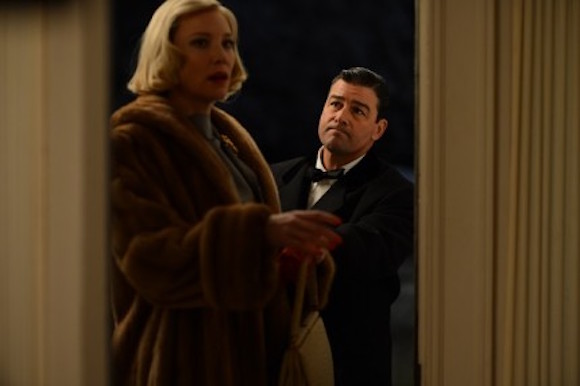
Unbeknownst to Therese, Carol and her husband, Harge (Chandler) have separated due to his awareness that his wife has had an affair with her best friend, Abby (Paulson). Willing to overlook this “indiscretion” if she stays with him, Harge warns her that if she doesn’t then he’ll seek sole custody of their little girl, Rindy. With Xmas approaching, he takes Rindy to his parents for the holiday period; Carol decides to invite Therese to come stay with her. Although nothing happens, Harge returns home unexpectedly and sees them together. Fearing that Carol is embarking on another lesbian relationship, he files for divorce and sole custody of Rindy. Unable to see her child until the custody hearing, which will take two or three months to happen, Carol invites Therese on a road trip, where they can spend some time together, and where Harge can’t find them.
They stay in a succession of motel rooms, at first staying in separate rooms. At one particular motel they stay in the Presidential suite; the next morning, Therese gets to talking with a travelling salesman called Tommy (Smith). Although he tries to sell them something from his sales kit, he has no joy, though Therese wishes him well in the future. At the next motel, she and Carol finally make love. But a telegram Carol receives the next morning reveals Harge’s awareness of where she is, and the fact that she and Therese are now lovers. Unable to risk the now serious possibility of losing the custody hearing, Carol decides she has to return home to face Harge, and sends Abby in her place to see Therese gets home safely. But for both women, returning to their old lives proves unsatisfactory…
There’s a moment in Todd Haynes’ beautifully crafted Carol, an adaptation of Patricia Highsmith’s novel The Price of Salt, when it looks certain that the title character and Therese will make love for the first time. It’s a moment that the movie is clearly heading toward, and it’s a moment that audiences will be expecting, but Haynes, along with screenwriter Patricia Nagy, holds off from that first time and maintains the sense of anticipation that both characters (and viewers) must be feeling. For the audience, it’s also a moment – among many others – that shows just how much control Haynes has over both the material and its emotional centre, and how finely calibrated it all is, for Carol is without a doubt, one of 2015’s finest movies.
Of course, with previous projects such as Far from Heaven (2002) and the TV version of Mildred Pierce (2011), Haynes has already shown an affinity for what used to be termed “women’s pictures”, but here his immersion in a time – the 1950’s – when lesbianism was still something to be kept hidden, and where male attitudes towards the issue were still highly aggressive, feels also like a snapshot of an era where female empowerment was beginning to gain the upper hand, despite the so-called Lavender Scare that was prevalent at the time. Through Carol’s determination not to be defined by her sexuality, we get to see an example of what, in historical terms, was a turning of the tide, and also a love story that is simply that: a love story.
This simplicity is at the heart of Haynes’ confident handling of the story, and it shows in every scene, with every look and every gesture, and in the way that he brings Carol and Therese together within the frame – these moments where they’re “close but not touching” are so charged with pent-up emotion and increasing desire that the idea that they might be kept apart by Harge’s machinations becomes intolerable. These scenes are so expertly handled, with repressed longing so forcefully expressed, that the viewer is swept along with the characters’ desire to live freely and without sanction. Haynes makes great use of the era’s sense of propriety, using it as a touchstone against which Carol and Therese’s affair can be measured in both intensity and necessity. Therese quizzes Richard about same sex relationships but he has no point of reference, and has no understanding of why they occur; he loves her unequivocally but can’t see that two women – or two men for that matter – might feel the same way about each other as he does about Therese. It’s another of those moments where the audience can see just how difficult it was to live a life outside the (perceived) norm.
With the historical and social background of the story firmly in place, and with Nagy’s script making it clear that lesbians were expected to pretend to be happy in heterosexual relationships or face the social consequences, the movie paints an honest portrait of two women, both of whom gain increased confidence in themselves through their relationship, who come together at a point in both their lives where they’re looking for a way to find future happiness. That they find it in each other, if only briefly, and with such passion, gives value to the idea that any relationship is worth pursuing or fighting for. And even though Carol leaves Therese to fight for custody of her child, it’s not the end of their affair, but rather an interruption (albeit for Therese an unexpected one), and even though the younger woman is upset by it, her feelings remain, and though the movie tries for an air of ambiguity in its final scene, viewers won’t be fooled at where Carol and Therese’s relationship is likely to find itself.
The difference in ages might feel like it should be an issue but it’s left unexplored, and with good reason: it doesn’t matter. Love is love, and though an argument could be made that Therese is looking for a guide or a mentor first and foremost, it’s not the role Carol adopts in their relationship. As the “older woman”, Blanchett gives yet another astonishing, awards-worthy performance, striking the right balance between heartfelt longing for an honest life and acknowledging the difficulties that longing entails. Her brittle, striking features show the pain of Carol’s situation without too much need of more overt playing, but in those moments when overt emotion is required, Carol’s fears and hopes are etched indelibly on those striking features. It’s a magnificent performance, sincere, heartbreaking at times, and riveting.
She’s matched by Mara, whose portrayal of the unmoored, ingenuous Therese is so finely tuned that watching her blossom, however slowly, into a stronger, more confident young woman is like watching a flower grow out of the shadows to its full height. There are moments where the camera focuses on her smooth, unlined features and the only expression is there in the eyes, but Mara uses this approach to such good effect that the viewer is never in doubt as to what Therese is thinking or feeling. And as the movie progresses, Mara subtly shifts the weight of Therese’s longing for love so that it becomes a part of her, and not the whole, leaving her a character as strong in her own right as Carol is in hers.
With two such commanding performances, it would be a shame if the supporting cast were overshadowed, but Chandler, in what is superficially the “villain” role, brings out Harge’s pain and sense of loss over Carol with such force that his actions are less stereotypical than expected and driven more by his own deep love for her. In the same way that society says Carol can’t have Therese (in public at least), it also says that Harge can’t have Carol because of her “sexual impropriety”. Both characters are in danger of losing what they want most, and both are suffering as a result. Chandler is unexpectedly moving in the role, and his scenes with Blanchett are so emotionally charged it’s like an intense version of force majeure. Meanwhile, Paulson comes late to matters as Abby, but gives a brief but potent performance as Carol’s longtime friend, confidant and ex-lover, filling in the gaps of Therese’s knowledge about Carol, and providing further context for Carol’s emotional and sexual desires.
It’s all beautifully filmed by Edward Lachman, with lots of bright primary colours mixed in with rich earthy tones, making the period seem so alive as to be almost intoxicating, and acting as a dynamic background to the impassioned nature of Carol and Therese’s relationship. There’s some equally impressive attention to historical detail, and Haynes makes the era come alive as a result; this is a fully realised world, even if it does appear at first to be bathed in nostalgia (the scenes in the department store appear right out of a Fifities child’s fantasy of what such a store should look like), but in many ways it was a simpler time, and the script reflects this with aplomb. And the whole thing is embraced by a smoothly nonchalant yet spirited score by Carter Burwell that complements the on-screen proceedings with well orchestrated brio.
Rating: 9/10 – a firm contender for Movie of the Year, Carol is a masterpiece of mood and repressed emotional yearning, with two outstanding performances, and a director on the absolute top of his form; a model of period movie making, and rewarding in every department you can possibly think of, this is a movie that should go to the top of everyone’s must-see list.











 thedullwoodexperiment