• 10 Reasons to Remember…
  • A Brief Word About…
  • About
  • For One Week Only
  • Happy Birthday
  • Monthly Roundup
  • Old-Time Crime
  • Other Posts
  • Poster of the Week
  • Question of the Week
  • Reviews
  • Trailers

thedullwoodexperiment

~ Viewing movies in a different light

thedullwoodexperiment

Tag Archives: Lionel Atwill

Old-Time Crime: The Rogues Tavern (1936) and Lady in the Death House (1944)

23 Saturday Sep 2017

Posted by dullwood68 in Movies

≈ Leave a comment

Tags

Barbara Pepper, Crime, Drama, Jean Parker, Lionel Atwill, Murder, Mystery, Old-Time Crime, Review, Robert F. Hill, Steve Sekely, Thriller, Wallace Ford

The Rogues Tavern (1936) / D: Robert F. Hill / 70m

Cast: Wallace Ford, Barbara Pepper, Joan Woodbury, Clara Kimball Young, Jack Mulhall, John Elliott, Earl Dwire, John W. Cowell, Vincent Dennis, Arthur Loft, Ivo Henderson, Ed Cassidy, Silver Wolf

Wise-cracking detective Jimmy Kelly (Ford) is in a hurry to marry ex-store detective Marjorie Burns (Pepper), but has to cross the state line in order to do so. The pair end up at the Red Rock Tavern late one night waiting for a justice of the peace to turn up. Soon, one of the other guests, a man named Harrison (Henderson) has been killed, his throat ostensibly ripped out by a dog (Silver Wolf) that roams around the outside of the inn. When a second murder occurs, Kelly takes charge of the situation, but finds few clues to help him. A third murder, plus the arrival of another guest named Wentworth (Loft), makes things even more confusing, but it’s not long before the inn’s owner, wheelchair bound Mr Jamison (Elliott), points Jimmy in the right direction, and it becomes clear that a conspiracy is in progress and that the guests are all potential murder victims of an unknown assailant. But is that assailant someone who is already there at the inn?

There were literally hundreds (if not thousands) of murder mysteries set in old dark houses during the Thirties and Forties, and they all followed a very predictable formula: a group of people are brought together (some might know each other, most will be strangers to each other) at a remote location, soon their numbers will begin to dwindle as one by one they’re killed off, and one of the assembled guests will prove to be a detective (or amateur sleuth) who will solve the mystery in the last reel (and may even get to sock the villain on the jaw in the process). Along the way there will be the usual amount of red herrings, obvious characters who must be the villain but who will turn out to be innocent, and a leading lady acting as the hero’s annoying, always-getting-into-trouble girlfriend (or if he’s a newspaperman, then she’ll be a rival journalist trying to figure out who the murderer is before he does).

The Rogues Tavern follows that formula very carefully, with its stranded characters arguing amongst each other as the wily murderer picks them off one by one, and the screenplay – an original by Al Martin – seeks to keep the viewer guessing at every turn, and doing a pretty good job of it. The first two murders are blamed on the dog (who looks about as frightening as Lassie), but when it’s in the same room as (nearly) all the others and a third murder is committed, then it’s clear that the movie has something else up its sleeve. This is eventually revealed in the final reel, where the murderer’s identity is uncovered, they laugh maniacally while explaining their dastardly plan for everyone, and are overpowered by Kelly appearing at the last second to save the day. Before then secrets are exposed, Marjorie does her own sleuthing (which pays off), Kelly gets socked on the jaw more than once (and not by the villain), and the inn is revealed to be one big death trap.

Despite its unprepossessing scenario and overly familiar set up, the movie is a sprightly example of what could be achieved on a meagre budget. Hill – who would go on to direct Flash Gordon’s Trip to Mars (1938) – refrains from using too many wide shots and keeps things tight, giving the movie an occasionally claustrophobic feel, an effect that’s helped by the camera staying close to the characters and capturing as many close ups as it can. The cast, many of whom are veterans of this type of movie, play their parts with agreeable gusto, while Ford makes for an enjoyable leading man, his easy-going demeanour and vaudeville background ensuring Kelly isn’t the genre’s usual earnest young hero. Pepper is stranded in blonde-bimboland but acquits herself well, and there’s an opportunity to see silent era star Kimball Young in a small but pivotal role that shows off the skills that, by that stage in her career, were criminally under-used.

Rating: 6/10 – despite its familiar setting and occasionally dodgy line readings, The Rogues Tavern is an entertaining old dark house mystery thriller that offers a handful of surprises to sweeten the experience; there’s comedy too amongst the thrills, and the whole thing is a delightful reminder that not every low budget, minor league thriller from the Thirties was a poor excuse for entertainment.
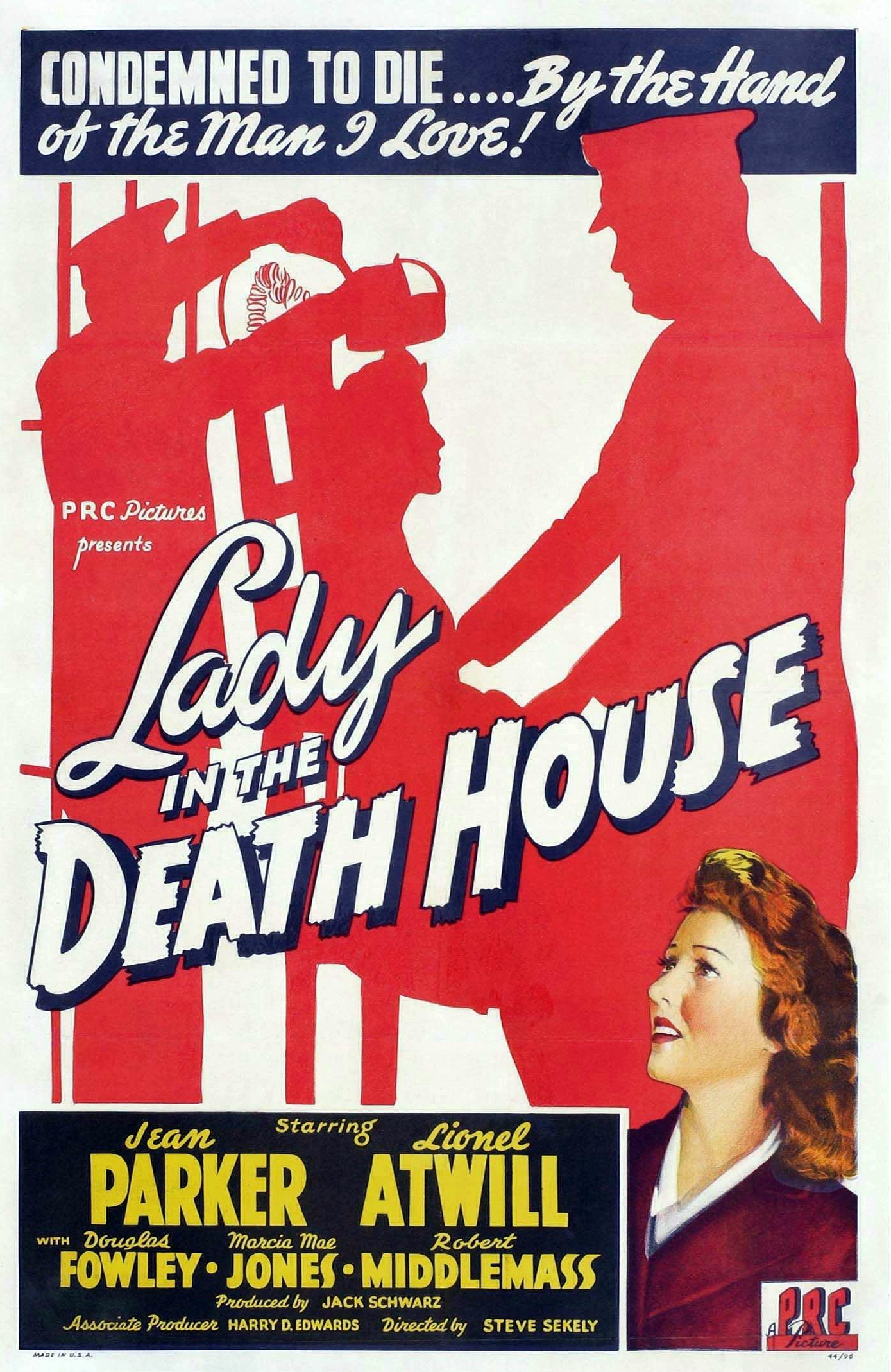
Lady in the Death House (1944) / D: Steve Sekely / 55m

Cast: Jean Parker, Lionel Atwill, Douglas Fowley, Marcia Mae Jones, Cy Kendall, John Maxwell, Robert Middlemass, George Irving

The tag line for Lady in the Death House says it all really: “Condemned to die…by the hand of the man I love!”, and only in a murder mystery from the Forties (oh, okay, and maybe the Fifties as well) would a scenario such as that one even exist. The movie begins with Mary Kirk Logan (Parker) on her way to the electric chair for the murder of a blackmailer. She’s just written a letter to a friend, criminal psychologist Dr Charles Finch (Atwill), who recounts both the details of the letter, and the case, to a group of journalists. We see Finch first meet struggling scientist Dwight Bradford (Fowley), and then they in turn meet Mary. Bradford and Mary soon fall in love but there’s a sticking point to their relationship: in order to make ends meet and further his research into reviving dead tissue, he has a second job as the state executioner (you can see where this is going, can’t you?). Mary won’t marry him while he’s a sanctioned killer, but before they get a chance to patch things up, Mary is sent to prison, and it’s down to Finch and Bradford, aided by Mary’s younger sister, Suzy (Jones), to prove her innocence before she’s executed.

Despite the absurdity of its romantic conundrum, Lady in the Death House is a neat, compelling little murder mystery that packs a lot into its short running time, and is far more rewarding than it has any right to be. A lot of its appeal has to do with the presence of Parker and Atwill, two actors who rarely gave disappointing performances and who should have had much bigger careers than was actually the case. Parker was a very talented actress, and it shows here as she resists the urge to make Mary’s situation one that many other actresses would have decided was ripe for unrestrained melodrama. It’s this very restraint that makes her role all the more sympathetic and credible. Atwill is at his most charming and relaxed, carrying the weight of so much exposition with an ease that most other actors would have wilted under. Like Parker, he divests his character of any melodramatic tendencies, something that for the time wasn’t the norm. When they share a scene together, it’s like a mini acting masterclass, and their performances stand out from those around them.
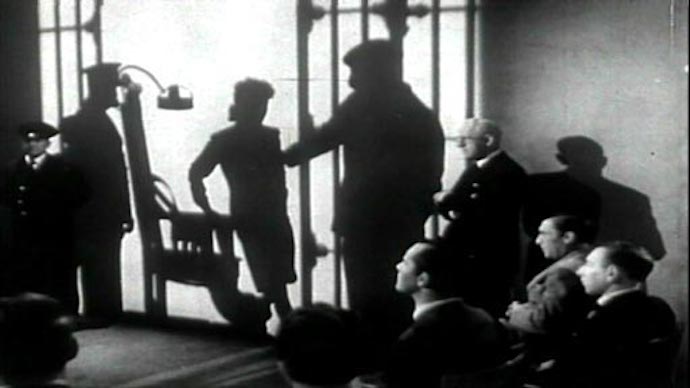
They’re helped immensely by Harry O. Hoyt’s focused screenplay – from a story by Frederick C. Davis – which culminates in a race against time to keep Mary alive. Bradford has a crisis of conscience along the way, but by then it’s too late for the character, who proves to be the movie’s one weak link. Fowley was a capable actor for the most part, but here he’s cruelly exposed by the constraints of a character who can’t or won’t give up his job as state executioner for the woman he loves (because the script says he can’t or won’t). Whenever it’s brought up, Fowley adopts the look of a man suffering from extreme emotional torment and remains quiet, frowning in apparent pain and wishing he was elsewhere. It’s not Fowley’s fault, but Bradford’s avoidance of the subject makes the character appear wilfully stupid.

That one issue aside though, the movie has a consistent, well developed pace that Hungarian-born director Sekely maintains through using effective cutting to provide a sense of urgency. His use of light and shadow is also much more effective than is usual for this kind of movie (see above image), and though this is a Producers Releasing Corporation production – a company more usually associated with so-called Poverty Row releases – it doesn’t look as washed out or as bland as many other movies made on such a small budget. The mystery elements are cleverly and plausibly established (even if there’s a clear miscarriage of justice at the heart of Mary’s trial that’s likely to have modern day audiences yelling at the screen), and the identity of the murderer, and their motive, is revealed in an equally acceptable and plausible way. On the whole, this is a low budget thriller that’s had a lot more attention paid to it than you’d usually expect.

Rating: 6/10 – good performances from Parker and Atwill, and confident direction from Sekely, help tremendously in keeping Lady in the Death House from becoming a pedestrian retread of every other innocent-facing-certain-death mystery movie; a largely polished exercise in small-scale thrills, it may not strike a chord with everyone, but for those who enjoy this sort of thing, there’s plenty to keep them happy.

Share this:

  • Click to share on X (Opens in new window) X
  • Click to share on Facebook (Opens in new window) Facebook
  • More
  • Click to print (Opens in new window) Print
  • Click to email a link to a friend (Opens in new window) Email
Like Loading...

The High Command (1938)

17 Friday Jan 2014

Posted by dullwood68 in Movies

≈ Leave a comment

Tags

Drama, James Mason, Lionel Atwill, Lucie Mannheim, Military fort, Murder, Review, The General Goes Too Far, Thorold Dickinson, West Africa

High Command, The

D: Thorold Dickinson / 84m

Cast: Lionel Atwill, Lucie Mannheim, Steven Geray, James Mason, Leslie Perrins, Allan Jeayes, Michael Lambart, Kathleen Gibson

In Ireland in 1921, two army majors, Sangye (Atwill) and Challoner (Philip Strange), are caught in an ambush by Republican rebels.  With the attack over, and both men the only survivors, Challoner turns on Sangye and threatens him over Sangye’s affair with Challoner’s wife.  He also reveals that Sangye is the real father of Challoner’s daughter.  Sangye is remorseful but when Challoner tries to shoot him, he’s forced to shoot first, killing Challoner.  Sangye covers up his crime, but is unaware that the doctor who saw to Challoner’s body has identified the bullet that killed him as coming from Sangye’s gun.

Sixteen years later, Sangye is now Major-General Sir John Sangye VC, and in charge of a fort located on the West Coast of Africa.  With him is his ward, Challoner’s daughter Belinda (Gibson).  Feeling that the events in Ireland are far behind him, Sangye is unsettled by the arrival of Major Carson (Perrins) who appears to know what happened all those years ago.  In turn, Carson who has travelled to the fort in the company of local businessman’s wife Diana Cloam (Mannheim), is related to Captain Heverall (Mason), one of Sangye’s junior officers.  Heverall and Diana are attracted to each other but vow to remain friends for the good of her marriage to jealous husband Martin (Geray).  Carson has no such qualms, and actively pursues her.  This leads to a misunderstanding that results in Carson’s murder.  When it’s revealed that Heverall stands to inherit a fortune as a result of Carson’s death, he is arrested and put on trial by a military court.  With Challoner’s murder about to be exposed, and Heverall’s life at stake, Sangye determines to unmask Carson’s killer, and by doing so, redeem himself.

High Command, The - scene

A quickly made drama that belies its low budget, The High Command, once past its awkward exposition-heavy opening, settles into a predictable yet entertaining groove that’s bolstered by a measured performance from Atwill, and fine supporting turns from Mannheim (Miss Smith in Hitchcock’s The 39 Steps) and Jeayes as the Governor who must reluctantly accept the evidence of Sangye’s guilt.  It’s actually good to see Atwill at work here; he’s a much underrated actor who deserves far more credit than he’s usually given.  As the outwardly composed but inwardly tortured Sangye, Atwill proves a good fit for the part, and rewards the producers for their picking him for the role.  Allied to Dickinson’s fluid direction and focus on the emotional undercurrents anchoring the plot, Atwill displays a capacity for vulnerability that most other roles he played didn’t allow him to reveal.

In an early role, Mason is less than convincing as Diana Cloam’s love interest, while Geray narrowly avoids chewing the scenery to tatters as her embittered husband.  The subplot involving Sangye being Belinda’s father is left aside in favour of Heverall’s trial, and the introduction of comic relief in the form of trial witness Miss Tuff (Drusilla Wills) almost overshadows the drama of the situation.  The identity of Carson’s killer is obvious despite a half-hearted attempt to make it a mystery, the cast contend well with appropriately clipped and/or stilted dialogue, and the minimalist art direction proves occasionally distracting (would a fort be this sparse with its fixtures and furnishings?).  With so much clashing going on, Dickinson ably holds it all together with his usual sense of restrained intimacy and a keen eye for the social and military hierarchies and how they commingle.

The High Command adequately reflects the prevailing attitudes of its time and fares well when exposing the hypocrisies of its main characters; pride is a theme that recurs throughout the movie, and the consequences of having too much pride are keenly observed.  The script by Katherine Strueby, Walter Meade and Val Valentine from the novel The General Goes Too Far – a much better title – by Lewis Robinson calls for less histrionics than might be expected, and allows the cast to inhabit their roles instead of get bogged down in the usual stuffed shirt theatrics.  Otto Heller’s photography is occasionally a little soft but otherwise well-framed, and the music by Ernest Irving ably supports the action.

Rating: 6/10 – raised up by good performances and clever direction, The High Command works best when focusing on Atwill and Mannheim; a minor gem well worth seeking out.

Share this:

  • Click to share on X (Opens in new window) X
  • Click to share on Facebook (Opens in new window) Facebook
  • More
  • Click to print (Opens in new window) Print
  • Click to email a link to a friend (Opens in new window) Email
Like Loading...

Blog Stats

  • 486,580 hits

Recent Posts

  • 10 Reasons to Remember Bibi Andersson (1935-2019)
  • Fantasia (1940)
  • Dances With Wolves (1990) – The Special Edition
  • Kiss of the Spider Woman (1985)
  • The Three Musketeers (1973)

Top Posts & Pages

  • Lost for Life (2013) - Another Look
    Lost for Life (2013) - Another Look
  • Lost for Life (2013)
    Lost for Life (2013)
  • About
    About
  • Mr. Topaze (1961)
    Mr. Topaze (1961)
  • Winter's Tale (2014)
    Winter's Tale (2014)
  • Hunt for the Wilderpeople (2016)
    Hunt for the Wilderpeople (2016)
  • Shock and Awe (2017)
    Shock and Awe (2017)
  • Billy Lynn's Long Halftime Walk (2016)
    Billy Lynn's Long Halftime Walk (2016)
  • Irrational Man (2015)
    Irrational Man (2015)
  • Exposed (2016)
    Exposed (2016)
Follow thedullwoodexperiment on WordPress.com

Blogs I Follow

  • Rubbish Talk
  • Film 4 Fan
  • Fast Film Reviews
  • The Film Blog
  • All Things Movies UK
  • Interpreting the Stars
  • Let's Go To The Movies
  • Movie Reviews 101
  • TMI News
  • Dan the Man's Movie Reviews
  • Film History
  • Jordan and Eddie (The Movie Guys)

Archives

  • April 2019 (13)
  • March 2019 (28)
  • February 2019 (28)
  • January 2019 (32)
  • December 2018 (28)
  • November 2018 (30)
  • October 2018 (29)
  • September 2018 (29)
  • August 2018 (29)
  • July 2018 (30)
  • June 2018 (28)
  • May 2018 (24)
  • April 2018 (21)
  • March 2018 (31)
  • February 2018 (25)
  • January 2018 (30)
  • December 2017 (30)
  • November 2017 (27)
  • October 2017 (27)
  • September 2017 (26)
  • August 2017 (32)
  • July 2017 (32)
  • June 2017 (30)
  • May 2017 (29)
  • April 2017 (29)
  • March 2017 (30)
  • February 2017 (27)
  • January 2017 (32)
  • December 2016 (30)
  • November 2016 (28)
  • October 2016 (30)
  • September 2016 (27)
  • August 2016 (30)
  • July 2016 (30)
  • June 2016 (31)
  • May 2016 (34)
  • April 2016 (30)
  • March 2016 (30)
  • February 2016 (28)
  • January 2016 (35)
  • December 2015 (34)
  • November 2015 (31)
  • October 2015 (31)
  • September 2015 (34)
  • August 2015 (31)
  • July 2015 (33)
  • June 2015 (12)
  • May 2015 (31)
  • April 2015 (32)
  • March 2015 (30)
  • February 2015 (37)
  • January 2015 (39)
  • December 2014 (34)
  • November 2014 (34)
  • October 2014 (36)
  • September 2014 (25)
  • August 2014 (29)
  • July 2014 (29)
  • June 2014 (28)
  • May 2014 (23)
  • April 2014 (21)
  • March 2014 (42)
  • February 2014 (38)
  • January 2014 (29)
  • December 2013 (28)
  • November 2013 (34)
  • October 2013 (4)

Create a free website or blog at WordPress.com.

Rubbish Talk

Film 4 Fan

A Movie Blog

Fast Film Reviews

The Film Blog

The official blog of everything in film

All Things Movies UK

Movie Reviews and Original Articles

Interpreting the Stars

Dave Examines Movies

Let's Go To The Movies

Film and Theatre Lover!

Movie Reviews 101

Daily Movie Reviews

TMI News

Latest weather, crime and breaking news

Dan the Man's Movie Reviews

All my aimless thoughts, ideas, and ramblings, all packed into one site!

Film History

Telling the story of film

Jordan and Eddie (The Movie Guys)

Movie Reviews & Ramblings from an Australian Based Film Fan

Privacy & Cookies: This site uses cookies. By continuing to use this website, you agree to their use.
To find out more, including how to control cookies, see here: Cookie Policy
  • Subscribe Subscribed
    • thedullwoodexperiment
    • Join 481 other subscribers
    • Already have a WordPress.com account? Log in now.
    • thedullwoodexperiment
    • Subscribe Subscribed
    • Sign up
    • Log in
    • Report this content
    • View site in Reader
    • Manage subscriptions
    • Collapse this bar
 

Loading Comments...
 

    %d