• 10 Reasons to Remember…
  • A Brief Word About…
  • About
  • For One Week Only
  • Happy Birthday
  • Monthly Roundup
  • Old-Time Crime
  • Other Posts
  • Poster of the Week
  • Question of the Week
  • Reviews
  • Trailers

thedullwoodexperiment

~ Viewing movies in a different light

thedullwoodexperiment

Tag Archives: Memory loss

The Bumblebee Flies Anyway (1999)

04 Tuesday Jul 2017

Posted by dullwood68 in Movies

≈ Leave a comment

Tags

Car crash, Catch Up movie, Drama, Elijah Wood, Janeane Garofalo, Literary adaptation, Martin Duffy, Memory loss, Rachael Leigh Cook, Review, Roger Rees, Terminal cancer

D: Martin Duffy / 96m

Cast: Elijah Wood, Janeane Garofalo, Roger Rees, Joe Perrino, George Gore II, Rachael Leigh Cook, Jeffrey Force, Oni Faida Lampley

In pretty much every actor’s filmography there’s usually at least one movie that hardly anyone ever sees, and slips past audiences like a whisper in the night. These movies are often ones that have been made quickly and cheaply, with mid-range stars either on their way up the Ladder of Stardom, or heading back down it. Sometimes they’re movies that have been made for an international market, with said mid-range stars heading up a European or African or Far Eastern cast, and sometimes only appearing for maybe a third of the movie’s running time. And sometimes, those mid-range stars have taken part as a favour to the director, or a producer, or someone else attached to the project. In essence, they’re jobbing gigs, a somewhat easy payday for the actor(s) concerned, and one that they’ll look back on only if pressed.

It’s hard to determine if there really is a market for these kinds of movies. There are enough of them out there to prove that people are willing to invest in them, but often it’s hard to determine who is the target audience (aside from any fans of the stars that appear in them). And one such movie is The Bumblebee Flies Anyway, a feature that appeared at the Deauville Film Festival in September 1999, opened briefly in the US in January 2000, and hasn’t been seen in cinemas anywhere in the world since. If you’re one of the few people who saw it way back then, then you probably already know the reason why it had such a limited exposure. And that’s because it’s bad, so very, very bad.

Adapted from the novel of the same name by Robert Cormier, The Bumblebee Flies Anyway has all the appeal of the kind of car crash it opens with (or actually, that it doesn’t open with; there isn’t the budget to stage a proper car crash). Poorly staged and leaden-footed throughout, the movie is achingly stilted, with careless attempts at characterisations, and a set up that nearly disappears under the weight of its own inconsequence. This is an adaptation that makes less and less sense the longer it goes on, and Jennifer Sarja’s screenplay sacrifices dramatic tension in favour of soap opera theatrics at nearly every opportunity, while also leaving the cast stranded on a desert island of inane dialogue. (This is Sarja’s only credited screenplay, and it’s not difficult to work out why.)

The story itself is puzzlingly obscure, with Elijah Wood’s car crash amnesiac, Barney Snow (no, really) taking part in a medical experiment designed to help him deal with his involvement in the crash and move on with his life. But he’s receiving his treatment in a medical facility for terminal cancer patients, all of whom are teenagers or younger (well, all actually means three). Barney is kept on medication (or “the merchandise” as he keeps calling it for no apparent reason), and is sedated every now and again and taken to a basement room where he undergoes some form of regressive hypnotherapy (which he doesn’t know about). Meanwhile he makes friends with bone cancer sufferer Mazzo (Perrino), kidney cancer victim Billy (Gore II), and undisclosed cancer patient Allie (Force). The movie tries to present their respective illnesses with as much poignancy as it can, particularly Mazzo’s, but does so in a way that makes Billy and Allie look like poster boys for cancer remission. As Mazzo gets worse and worse, he receives a visit from his twin sister, Cassie (Cook). Concerned about her brother she naturally turns to Barney for comfort and they begin a tentative romance (well, what else are they likely to do?).

But Barney has his own problems. He has a memory of the car crash and a woman stepping out in front of his car that just won’t go away. He thinks the woman is his mother but he can’t remember her name. When he does he persuades Billy to help him locate her address, and gets Cassie to drive him there. The visit doesn’t go as planned, and subsequent treatments by Barney’s doctors, Harriman (Garofalo) and Croft (Rees), cause further memories to surface, and in them, Barney learns about the basement room and the inherent contradiction that exists at the heart of his treatment. Soon he has a difficult choice to make, one that will have far-reaching consequences whichever way he decides. But before then he makes another difficult choice, and this time it’s one with the potential to affect everyone around him.

Everything about Barney’s predicament and the so-called medical facility that he resides at is so ridiculous it’s hard to take any of it seriously. Garofalo’s caring doctor advises Barney not to get attached to Mazzo et al, but he finds himself drawn into their worlds almost against his will, and not caring about them doesn’t become an option. None of it however, is compelling or dramatic enough to make the unsuspecting viewer care about any of them, and the cast find themselves endlessly bogged down in scenes that should be affecting but which are so flatly directed by Duffy that they inspire ennui instead. Indeed, the combination of Duffy’s pedestrian direction and Sarja’s lumbering screenplay leaves Wood and his co-stars struggling to inject any purpose into their performances, and any meaningful exchanges between the characters are undermined before they’ve even begun. It all leads to a rooftop “showdown” that is laughable instead of sincere, and insufferably trite instead of emotionally haunting. Not the best outcome for a movie that already has enough strikes against it to warrant an enquiry into just how it received a showing at Deauville in the first place.

Rating: 3/10 – a perfect example of why some movies get the barest of releases, The Bumblebee Flies Anyway is dramatically inert from start to finish and offers proof (if any were needed) that the presence of a “name” actor is no guarantee of quality; shoddy in every department, and with platitudes masquerading as dialogue, it’s not even fascinating in an “oh no they didn’t” kind of way (which might at least make it halfway bearable to watch). (4/31)
Share this:

  • Click to share on X (Opens in new window) X
  • Click to share on Facebook (Opens in new window) Facebook
  • More
  • Click to print (Opens in new window) Print
  • Click to email a link to a friend (Opens in new window) Email
Like Loading...

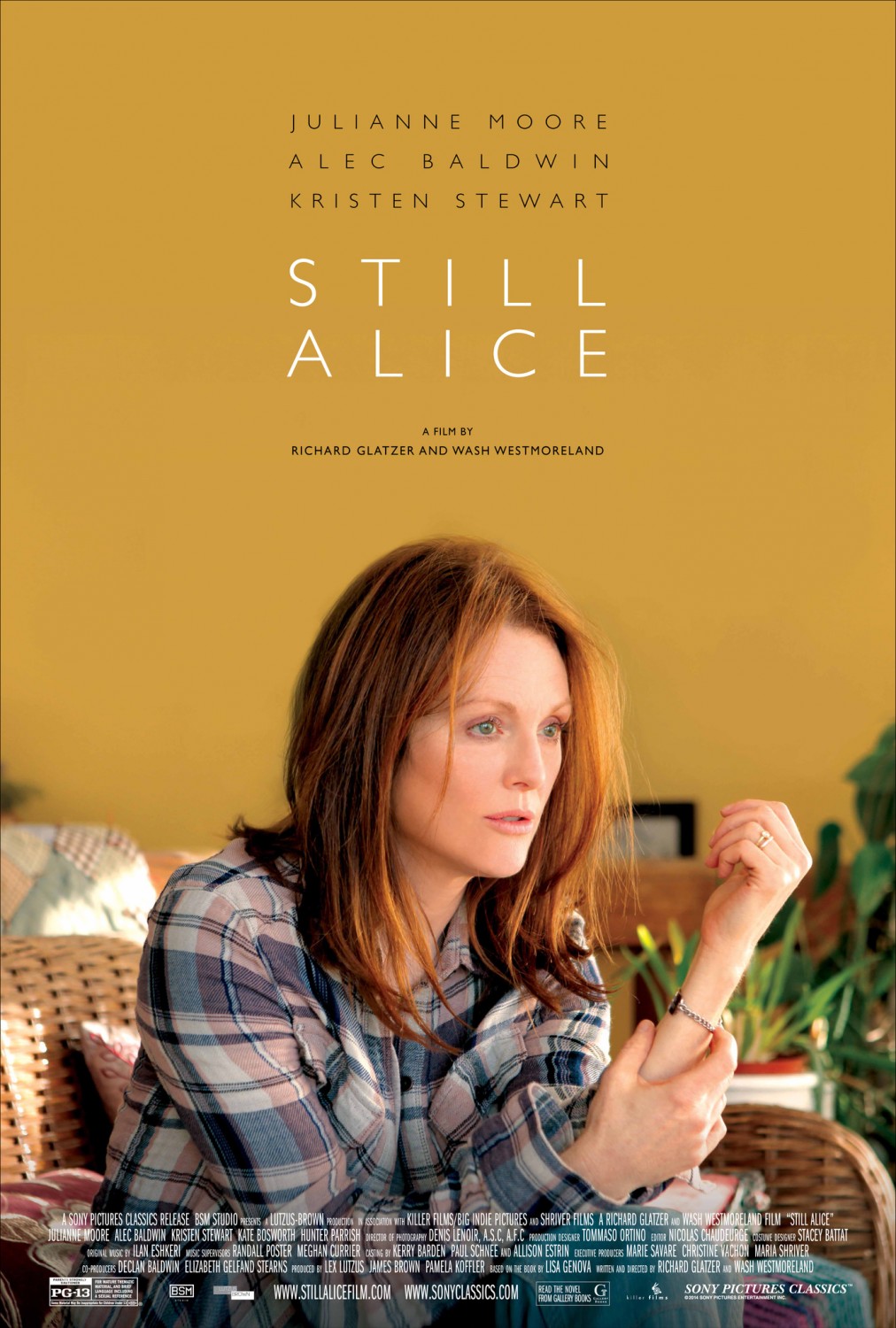
Still Alice (2014)

05 Monday Jan 2015

Posted by dullwood68 in Movies

≈ Leave a comment

Tags

Alec Baldwin, Alzheimers, Drama, Early onset Alzheimers, Julianne Moore, Kate Bosworth, Kristen Stewart, Lisa Genova, Literary adaptation, Memory loss, Review, Richard Glatzer, Wash Westmoreland

Still Alice

D: Richard Glatzer, Wash Westmoreland / 101m

Cast: Julianne Moore, Alec Baldwin, Kristen Stewart, Kate Bosworth, Hunter Parrish, Shane McRae, Stephen Kunken

Alice Howland (Moore) is a respected linguistics professor at Columbia University. She has a loving husband, John (Baldwin), and three grown up children, Anna (Bosworth), Tom (Parrish), and Lydia (Stewart). Shortly after her fiftieth birthday she gives a lecture and forgets the word ‘lexicon’. She brushes it off but when she’s out running one day she reaches the campus and for one disorientating moment she has no idea where she is. She begins to see a neurologist (Kunken) and undergoes various tests. When it comes, the diagnosis is a shock: she has early onset Alzheimers. Further tests also reveal that it’s familial, and her children are at risk of carrying the recessive gene that causes it.

As expected, the news is a blow to Alice’s family, but she is determined to fight the disease for as long as she can. Her children have different reactions: Anna is tested and is positive; she and her husband, Charlie (McRae), are trying for a baby via an infertility clinic and need to know. Tom tests negative, while Lydia, who is a budding actress living on the West Coast and a bit of a free spirit, decides not to find out. But they and their father all do their best to support Alice as she comes to terms with what her life will become.

But the illness is aggressive, and Alice’s initial coping mechanisms of using her mobile phone to record information, and setting herself little memory tests, lose their effectiveness, and she begins to forget even more. Her awareness of the speed at which her illness is affecting her, leads Alice to record a video message advising her future self to commit suicide by taking a bottle of pills. One day, while she and John are at their beach house, she forgets where the bathroom is and wets herself. As she begins to forget more and more, she receives an invitation to speak at an Alzheimers convention. There she gives a moving description of the ways in which the disease is affecting her but also the ways in which she deals with it.

Alice’s deteriorating mental abilities become more and more obvious. When Lydia performs at a local theatre, Alice forgets her name when they meet up afterwards. And she becomes anxious when John receives an offer to work at the Mayo Clinic, which will mean moving. And then Alice discovers the video message she made earlier…

Still Alice - scene

Adapted from the novel by Lisa Genova, Still Alice is a gloomy, yet also affecting look at the debilitating effects of Alzheimers on an intelligent, academically respected individual, and her immediate family. It’s a straightforward, no frills movie that aims to pull no punches regarding the debilitating aspects of the disease, but can’t quite stop itself from trying to salvage a degree of personal triumph out of Alice’s dilemma. In fact, Still Alice tries so hard to make Alice’s fight against Alzheimers laudatory that it almost misses the tragedy that goes with it hand in hand.

In telling Alice’s story, writer/directors Gratzer and Westmoreland have resorted to charting the gradual effects of the disease by signposting them with often clumsy simplicity. First Alice forgets a word in a lecture, next she forgets where she is, then she forgets someone’s name and their address in a test. As each lapse in memory and example of cognitive impairment is trotted out, their presence in the narrative seems to be crying out, “See? She’s getting worse!”, as if the viewer couldn’t work that out for themselves. And when she’s told that her form of Alzheimers, matched by her intelligence and mental acuity, means that the disease will have a more rapid effect on her, it’s almost like kicking someone when they’re down; not only is Alice already unlucky to be suffering at so young an age, but because she’s so smart it’s another point against her.

This kind of unnecessary melodrama hurts the middle third of the movie so much that it’s only thanks to Moore’s superb performance that it remains so affecting and watchable. Even when the script piles on the pain and anguish she remains utterly believable, painting a sincere, credible portrait of a woman losing her sense of herself, and portraying the terrible ramifications of having her personality destroyed from within. The scene where Alice can’t find the bathroom is a powerful example, as the camera stays with her at waist height as she rushes through the house. When she stops the camera focuses on her face and the evident torment she’s experiencing. The viewer knows exactly what’s happening, from the shame and distress Alice is feeling to the moment where the inevitable happens, and when the camera pans back to reveal the stain down the front of her jogging bottoms it’s nowhere near as effective as the acting masterclass that Moore has honoured us with. Simply put, Moore is astonishing, and when the disease has robbed Alice of nearly all cognisance of the world around her, and her eyes are dulled by incomprehension, it’s heartbreaking.

Sadly, Moore is the best thing in a movie that fails to paint convincing portraits of Alice’s family and resorts to their providing implausible levels of support throughout. Not once does any one of them lose their temper, or voice their own distress at what’s happening to her, or display any hesitation in doing what they can. Even when John is offered the job at the Mayo Clinic and Alice states her reluctance of doing so, the scene is set for the kind of antagonism that must surely happen in these situations. But instead, John swallows his disappointment in seconds and the moment passes. It’s an uncomfortable moment because it feels so false, and Baldwin doesn’t pull it off (for once though, we see another character looking as lost as Alice is). But Baldwin isn’t alone. Each of the supporting cast has their “uncomfortable moment”, Stewart early on when Alice and Lydia have one of those awkward mother-daughter conversations about careers that seems to have been cribbed from a thousand and one other similar mother-daughter conversations in the movies, and which leaves Stewart struggling to make her supposedly independent-minded character sound anything other than petulant. In contrast, Bosworth is the waspish eldest daughter, saddled with lines that are largely derogatory of others and with no obvious reason for her being that way. And Parrish is sidelined pretty much throughout as Alice’s son, allowed only a brief moment to shine (but not say much) at the Alzheimers convention.

With Moore’s formidable performance taken out of the equation, Still Alice skirts perilously close to formulaic disease-of-the-week TV movie status. It’s a movie that wants to say something profound about the way in which a disease as awful as Alzheimers can be managed – albeit in its early stages – and while Alice’s address to the conference is genuinely moving, it relies too heavily on her normal mental capability to be completely persuasive. With other dramatic flaws that weigh the movie down, Glatzer and Westmoreland’s efforts remain lumbering and inconsequential. The movie is also curiously bland to watch, with too many neutral colours in the background, and Alice aside, too many characters who evince emotion with restraint. There’s also a mawkish score by Ilan Eshkeri that only occasionally matches the action for poignancy.

Rating: 6/10 – gaining two points because of the sheer brilliance and sensitivity of Moore’s performance, Still Alice is gripping stuff when Moore is onscreen but turgid and lacking validity when she isn’t; if it wasn’t for her this would be one movie that could be so easily forgotten, and without any attendant grief.

Share this:

  • Click to share on X (Opens in new window) X
  • Click to share on Facebook (Opens in new window) Facebook
  • More
  • Click to print (Opens in new window) Print
  • Click to email a link to a friend (Opens in new window) Email
Like Loading...

Blog Stats

  • 491,294 hits

Recent Posts

  • 10 Reasons to Remember Bibi Andersson (1935-2019)
  • Fantasia (1940)
  • Dances With Wolves (1990) – The Special Edition
  • Kiss of the Spider Woman (1985)
  • The Three Musketeers (1973)

Top Posts & Pages

  • Cardboard Boxer (2016)
    Cardboard Boxer (2016)
  • Speak (2004)
    Speak (2004)
  • Carrie (2013)
    Carrie (2013)
  • Hickey (2016)
    Hickey (2016)
  • The Town That Dreaded Sundown (1976)
    The Town That Dreaded Sundown (1976)
  • Where There's a Prank, There's a Pay Off: Spider (2007) and Family Values (2011)
    Where There's a Prank, There's a Pay Off: Spider (2007) and Family Values (2011)
  • The Hippopotamus (2017)
    The Hippopotamus (2017)
  • A Monster Calls (2016)
    A Monster Calls (2016)
  • 7:19 (2016)
    7:19 (2016)
  • Virginity (1937)
    Virginity (1937)
Follow thedullwoodexperiment on WordPress.com

Blogs I Follow

  • Rubbish Talk
  • Film 4 Fan
  • Fast Film Reviews
  • The Film Blog
  • All Things Movies UK
  • Interpreting the Stars
  • Let's Go To The Movies
  • Movie Reviews 101
  • TMI News
  • Dan the Man's Movie Reviews
  • Film History
  • Jordan and Eddie (The Movie Guys)

Archives

  • April 2019 (13)
  • March 2019 (28)
  • February 2019 (28)
  • January 2019 (32)
  • December 2018 (28)
  • November 2018 (30)
  • October 2018 (29)
  • September 2018 (29)
  • August 2018 (29)
  • July 2018 (30)
  • June 2018 (28)
  • May 2018 (24)
  • April 2018 (21)
  • March 2018 (31)
  • February 2018 (25)
  • January 2018 (30)
  • December 2017 (30)
  • November 2017 (27)
  • October 2017 (27)
  • September 2017 (26)
  • August 2017 (32)
  • July 2017 (32)
  • June 2017 (30)
  • May 2017 (29)
  • April 2017 (29)
  • March 2017 (30)
  • February 2017 (27)
  • January 2017 (32)
  • December 2016 (30)
  • November 2016 (28)
  • October 2016 (30)
  • September 2016 (27)
  • August 2016 (30)
  • July 2016 (30)
  • June 2016 (31)
  • May 2016 (34)
  • April 2016 (30)
  • March 2016 (30)
  • February 2016 (28)
  • January 2016 (35)
  • December 2015 (34)
  • November 2015 (31)
  • October 2015 (31)
  • September 2015 (34)
  • August 2015 (31)
  • July 2015 (33)
  • June 2015 (12)
  • May 2015 (31)
  • April 2015 (32)
  • March 2015 (30)
  • February 2015 (37)
  • January 2015 (39)
  • December 2014 (34)
  • November 2014 (34)
  • October 2014 (36)
  • September 2014 (25)
  • August 2014 (29)
  • July 2014 (29)
  • June 2014 (28)
  • May 2014 (23)
  • April 2014 (21)
  • March 2014 (42)
  • February 2014 (38)
  • January 2014 (29)
  • December 2013 (28)
  • November 2013 (34)
  • October 2013 (4)

Create a free website or blog at WordPress.com.

Rubbish Talk

Film 4 Fan

A Movie Blog

Fast Film Reviews

The Film Blog

The official blog of everything in film

All Things Movies UK

Movie Reviews and Original Articles

Interpreting the Stars

Dave Examines Movies

Let's Go To The Movies

Film and Theatre Lover!

Movie Reviews 101

Daily Movie Reviews

TMI News

Latest weather, crime and breaking news

Dan the Man's Movie Reviews

All my aimless thoughts, ideas, and ramblings, all packed into one site!

Film History

Telling the story of film

Jordan and Eddie (The Movie Guys)

Movie Reviews & Ramblings from an Australian Based Film Fan

Privacy & Cookies: This site uses cookies. By continuing to use this website, you agree to their use.
To find out more, including how to control cookies, see here: Cookie Policy
  • Subscribe Subscribed
    • thedullwoodexperiment
    • Join 481 other subscribers
    • Already have a WordPress.com account? Log in now.
    • thedullwoodexperiment
    • Subscribe Subscribed
    • Sign up
    • Log in
    • Report this content
    • View site in Reader
    • Manage subscriptions
    • Collapse this bar
 

Loading Comments...
 

    %d