• 10 Reasons to Remember…
  • A Brief Word About…
  • About
  • For One Week Only
  • Happy Birthday
  • Monthly Roundup
  • Old-Time Crime
  • Other Posts
  • Poster of the Week
  • Question of the Week
  • Reviews
  • Trailers

thedullwoodexperiment

~ Viewing movies in a different light

thedullwoodexperiment

Tag Archives: Noah Baumbach

The Meyerowitz Stories (New and Selected) (2017)

19 Sunday Nov 2017

Posted by dullwood68 in Movies

≈ 2 Comments

Tags

Adam Sandler, Art, Ben Stiller, Comedy, Drama, Dustin Hoffman, Emma Thompson, Family, Netflix, Noah Baumbach, Relationships, Review

D: Noah Baumbach / 112m

Cast: Adam Sandler, Ben Stiller, Dustin Hoffman, Emma Thompson, Elizabeth Marvel, Grace Van Patten, Judd Hirsch, Rebecca Miller, Candice Bergen, Adam Driver, Matthew Shear, Sakina Jaffrey, Gayle Rankin, Michael Chernus

Harold Meyerowitz (Hoffman) is a semi-famous sculptor who hasn’t had a show in years, and who has become somewhat marginalised within the New York art world. His work is admired by those that know of it, but his contemporaries, such as L.J. Shapiro (Hirsch), are still exhibiting and still getting the recognition that Harold thinks they don’t deserve. Harold is on his fourth marriage – to Maureen (Thompson) – and has two children from his first, Danny (Sandler) and Jean (Marvel). Danny is in the midst of separating from his wife, and has a precocious teenage daughter, Eliza (Van Patten), who is about to leave for college. Jean is a spinster but leads an otherwise happy life. Harold has another child from his third marriage, Matthew (Stiller), but he lives in LA, and works as a financial consultant. He’s successful, and has a young son he would like to spend more time with. This is the family Meyerowitz, and despite outward appearances, many of which they foster themselves, they all need help (oh boy, do they need help).

What’s impressive about Noah Baumbach’s latest feature is that he takes a stereotypical dysfunctional family, and spins that stereotype ever so slightly off its axis, so that each nugget of information about any of the characters seems fresh and unexpected, even though a closer inspection reveals tropes and metaphors that we’ve seen countless times before. This is due to Baumbach’s very eloquent and very astute screenplay, a piece of writing that manages to include a number of complex and yet succinct observations on the nature of father-son relationships and the effect that an inwardly scared parent can have on their children. It’s no surprise that Baumbach has chosen to examine the issue of what children need from their parents as this has formed the basis of much of his work in the past, from The Squid and the Whale (2005) to While We’re Young (2014). But this is easily his most impressive and most fully realised project, and it has a smoothness and an ease about it that makes it all the more enjoyable to watch.
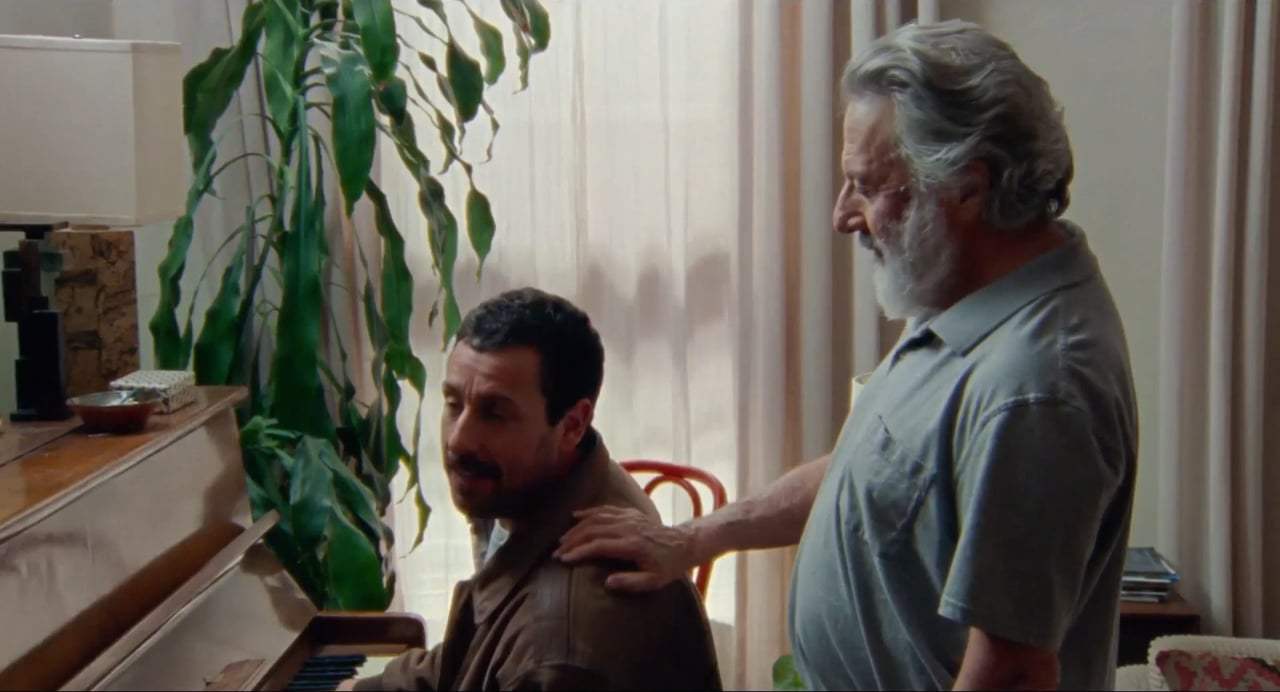
The main focus is, at first, on Danny. With his marriage coming to an end and Eliza going off to college, Danny has to reassess what he’s going to do with his life (he’s been a house husband up until now, having chosen that as his “career” instead of being a musician). He and Jean get involved in arranging a retrospective of Harold’s career, but Baumbach is quick to make the viewer realise that this isn’t being done out of love or affection, and not even necessarily out of respect for their father’s work. Like so many other things connected to Harold that they do, it’s done because they view it as the right thing to do; it’s a familial obligation. But Harold is obsessed with how his work is perceived, because his work is the only thing that, to him, makes him stand out from the crowd. He’s constantly seeking approbation from everyone around him, and insists he receives it from his kids. But if they don’t, then he’s oblivious to both them and their needs. Such is their lives as adults, such was their lives as children.

Harold’s narcissistic expressions about himself, and his short-fuse dismissal of anyone he deems unimportant, has had an unpleasant effect on all three of his children. Danny has spent an enormous amount of time and energy in raising Eliza so that they’re more like friends instead of father and daughter. As a result he’s a better father than Harold was to him, but the irony is that in its own way, it’s as unhealthy as the relationship Danny had with him as a child. Baumbach makes the point well: too little attention or love can be just as bad as too much. But while that may seem obvious (and it is), it’s the way in which Danny tries to strike a balance between the two, and without necessarily being aware that he’s doing it, that makes all the difference. Jean has her own reasons for keeping her life separate, and though it seems that she’s perhaps the most “adjusted” of the three, this later proves to be incorrect. And then there’s Matthew, who professes to be “over” his father’s ability to make him angry for having a successful life (Harold is almost as obsessed by money as he is by maintaining his reputation). Matthew, like Danny, is trying to be a better father than Harold was, but he can’t seem to connect with his son, despite his best efforts.
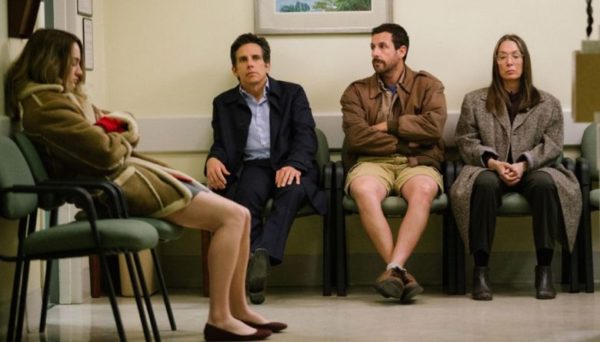
Watching these four people struggle to communicate with each other, and struggle to find the answers that are often in front of them, should be frustrating for the viewer,  but Baumbach, and the sharpness of his script, helps avoid all that. The family dynamic is entirely credible and perfectly judged, with superb performances from all concerned. Sandler has only been better once before, in Punch-Drunk Love (2002), and here he proves that he can be a fine dramatic actor when he wants to be (which isn’t often enough). Sandler displays a warmth and a heartfelt sincerity as Danny that allows the viewer a way in to the Meyerowitz family and its myriad issues. He’s a sweet, caring guy trying to do his best, and he has enough self-awareness to know that he doesn’t always get it right. Stiller is equally as good, channelling Matthew’s anger at being unfairly singled out for Harold’s praise as a child when the praise, and what it related to, wasn’t important to Matthew at all. In support, Marvel, Thompson and Van Patten offer touching performances, while there are a clutch of more minor roles that allow for a few scene-stealing moments (Chernus as a snippy nurse is a treat). But this, perhaps expectedly, is Hoffman’s movie, his portrayal of Harold as a manipulative, emotionally remote artist one of the best things he’s done in years.

Baumbach approaches the material and the characters with a great deal of care and attention, and it’s this that makes the movie so effortlessly dramatic, and so effortlessly funny. Nobody behaves in a manner that might seem odd or inappropriate because that’s how they’ve always behaved. With some questions there’s an answer provided, but many’s the time when Baumbach keeps the viewer in the dark, as if to say, “these characters still need time to figure things out, and it’s not going to happen before the movie’s over”. It all adds up to a remarkably humane and sympathetic look at expectations between the generations, and how personal legacies can hamper the growth of those who are raised in the shadow of them. Thoughtful and considerate of its characters’ foibles and muted aspirations, Baumbach’s latest is a sprightly mix of drama and comedy that succeeds on both fronts, and is his best work yet.

Rating: 9/10 – that rarity: a comedy-drama with heart as well as intelligence, The Meyerowitz Stories (New and Selected) is a cautionary tale that never once feels forced or that it’s struggling to find its own voice; the characters linger in the memory, along with Baumbach’s clever script and fluid direction, and a number of quality performances, making this a movie that everyone should try and see, and especially as an alternative to more mainstream, big-budget moviemaking.

Share this:

  • Click to share on X (Opens in new window) X
  • Click to share on Facebook (Opens in new window) Facebook
  • More
  • Click to print (Opens in new window) Print
  • Click to email a link to a friend (Opens in new window) Email
Like Loading...

Mini-Review: De Palma (2015)

25 Sunday Sep 2016

Posted by dullwood68 in Movies

≈ 1 Comment

Tags

Brian De Palma, Career, Documentary, Interview, Jake Paltrow, Noah Baumbach, Review

de-palma

D: Noah Baumbach, Jake Paltrow / 110m

With: Brian De Palma

It’s a great idea: take a movie maker whose career spans over fifty years, put him in front of a camera, and let him talk about that career in as much detail as he can. It’s a great idea, and it’s a simple one, and Brian De Palma is a perfect choice. He’s had a career with its fair share of ups and downs, critical and commercial successes and failures, and he’s not hesitant about defending some of the “poor choices” he’s made over the years. From his early days making student shorts such as Woton’s Wake (1962), De Palma is captivating and incisive about his work. He talks about each movie he’s made – some in more depth than others – but always with a view to explaining what he feels went right and what went wrong with each movie, and why. He talks about his disagreements with the studios, with screenwriters (De Palma is possibly the only director who worked with Robert Towne and thought he wasn’t doing a good enough job), and occasionally with actors (his remarks about Cliff Robertson are hilarious).

In terms of actual movie making, De Palma is a knowledgeable, avuncular storyteller, able to recall the reasons he made certain movies, the battles he had to fight to get some of them made, and why some weren’t as successful as others. His reasoning at times is a little self-serving (he still thinks The Bonfire of the Vanities (1990) holds up as a movie), and he’s dismissive of the critics and their views (unless that critic is Pauline Kael, who championed his work when few others would). He has some great anecdotes to tell about the likes of Robert De Niro and Sean Connery, and he’s not afraid to talk about the accusations of exploitation and Hitchcockian mimicry that have dogged his career.

de-palma-scene

There are well-chosen clips from each of De Palma’s movies, and most serve as visual references for his opinions and recollections. Here and there are revelations that many people won’t be aware of, or have seen, such as the alternative ending to Snake Eyes (1998), and his use of Michael Caine’s double in Dressed to Kill (1980). There’s a whole mineful of useful, interesting information being relayed here, and De Palma is an engaging, smart, occasionally witty interviewee; listening to him talk about the perils involved in getting a movie off the ground is like a masterclass in itself (and it’s happened to him way too often for comfort). But you also get a good sense of how tenacious he’s been in the past, and how determined he’s been to make the movies he’s wanted to make.

If there’s one issue that De Palma the movie is unable to address, it’s that De Palma the man goes unchallenged throughout. By giving De Palma a free pass, he’s allowed to make several remarks that would normally require further exploration (see The Bonfire of the Vanities). This leads, on occasion, to a number of moments where the viewer may be tempted to ask their own questions in the hope that De Palma somehow picks up on them. Someone once observed that “all directors are egomaniacs”, and while De Palma seems a little less egocentric than most, eagle-eyed viewers will notice that he rarely accepts any blame for those of his movies that didn’t work out so well. But then, De Palma is telling his story, not someone else’s, and like any artist who creates alternate realities for a living, sometimes the line between truth and reality can get blurred by self-interest.

Rating: 8/10 – fans of Brian De Palma will find his reminiscences and opinions of great interest, and even casual admirers will be drawn in by his winning (and occasionally) belligerent approach; as mentioned already, De Palma is a great idea, and one that could (and should) be used to capture the views and experiences of his contemporaries – so, calling Mr Spielberg, and Mr Scorsese, and Mr Coppola…

Share this:

  • Click to share on X (Opens in new window) X
  • Click to share on Facebook (Opens in new window) Facebook
  • More
  • Click to print (Opens in new window) Print
  • Click to email a link to a friend (Opens in new window) Email
Like Loading...

Mistress America (2015)

21 Monday Mar 2016

Posted by dullwood68 in Movies

≈ Leave a comment

Tags

Comedy, Drama, Greta Gerwig, Indie, Investors, Lit Group, Lola Kirke, Matthew Shear, Mom's, Noah Baumbach, Review, Step-sisters

Mistress America

D: Noah Baumbach / 84m

Cast: Greta Gerwig, Lola Kirke, Matthew Shear, Heather Lind, Michael Chernus, Jasmine Cephas Jones, Kathryn Erbe, Cindy Cheung, Dean Wareham

Though not as prolific as Woody Allen, writer/director Noah Baumbach has made a name for himself by operating in the same milieu as Allen (though without the need for including May-December relationships), and for making witty, intelligent comedies that examine the human condition in a warm, deeply rewarding manner. Since his debut with Kicking and Screaming (1995), Baumbach has consistently entertained audiences with his mix of angst-ridden characters facing uncertain futures and sparkling dialogues. He’s a clever, erudite writer and a carefree, spontaneous director, and with movies such as The Squid and the Whale (2005) and Margot at the Wedding (2007) propping up his resumé, he’s a movie maker whose indie sensibilities often make for an enjoyable viewing experience. (By now you’re probably thinking, “there’s a but coming”, and you’d be right, though it’s not coming right now.)

In his latest, Baumbach, along with star and co-writer Gerwig, has fashioned a tale of self-imposed isolation and longing that finds itself butting heads with an examination of self-deception and longing. Tracy (Kirke) is a college student with a superiority complex and a consuming need to be accepted by the Lit Group, the one group she feels are of the same intellectual merit as herself (so it’d be okay to be a member). She submits a short story but is rejected. Faced with spending the approaching Thanksgiving by herself – unsurprisingly, Tracy has no real friends – a reminder from her mother (Erbe) that her soon-to-be step-sister Brooke lives in New York as well leads her to getting in touch and the two of them meeting up.

MA - scene3

In comparison to Tracy’s mostly solitary, mostly unfulfilling existence, Brooke is gregarious, constantly upbeat, well-liked, and in a relationship with a man who is helping her to open a restaurant. Tracy is dazzled by the range of Brooke’s social, personal and business involvements, and the evening (and next morning) they spend together inspires her to write another story for the Lit Group. Before she submits it she shows it to a fellow student who’s also keen to join the Lit Group, Tony (Shear). Tracy once had a crush on Tony but since they met he’s started dating Nicolette (Jones), a development Tracy doesn’t quite understand or agree with.

Tracy begins spending more and more time with Brooke and their sisterly relationship grows stronger and deeper. But Brooke’s plans to open her restaurant are thrown into disarray when her boyfriend dumps her and pulls out of the deal. Advised by a psychic that she needs to reconnect with someone from her past, someone who owes her money, Brooke is convinced she should visit an old friend, Mamie-Claire (Lind). Mamie-Claire not only stole Brooke’s boyfriend, Dylan (Chernus) and married him, she also stole Brooke’s T-shirt design (“hard flowers”) and made a mint out of it. Tracy enlists the aid of Tony (who has a car) to get there, and Nicolette goes too, her jealousy unable to let her stay behind if Tony is going to be alone with two other women.

mistressamerica

At Mamie-Claire’s, Brooke’s old friend proves to be less than agreeable to the idea of investing in the restaurant. Brooke persists, wanting to speak to Dylan who isn’t there. When he finally arrives home he’s more enthusiastic than Mamie-Claire and agrees to lend Brooke the money she needs but not for the same reason as she needs it. Meanwhile, Nicolette confronts Tony over her belief that he and Tracy are sleeping together, and when the opportunity to read Tracy’s story (which is about Brooke and isn’t exactly flattering) presents itself, Nicolette uses it to confront Tracy. In the end, everyone there reads it, but it’s Brooke’s reaction that has the biggest effect on Tracy, an effect that has unexpected implications.

(Now for that but.)

Maybe it’s the involvement of Gerwig in the writing process, or maybe Baumbach was just having an off-script, but Mistress America – the title refers to a female superhero Brooke can see herself being – has one crucial flaw that it never overcomes, or even appears likely to overcome: that in Tracy and Brooke it has two central characters that it’s almost impossible to care about. Tracy is an emotional and social leech, a hanger-on to Brooke’s coat-tails who has little or no discernible personality away from the people she manages to be around. She mirrors everyone and reflects nothing of herself – because there’s nothing to reflect. She should be a sympathetic character because of this, but in the hands of Baumbach and Gerwig she’s just another sad, lonely character who’s chosen to be that way; she doesn’t even try to be different, or change, and at the movie’s end we see exactly the same person we met at the beginning.

Brooke (Greta Gerwig) takes Tracy (Lola Kirke) under her wing in Mistress America.

In contrast, Brooke is so self-absorbed, so lacking in emotional acuity and self-awareness that when she talks about the problems she faces it’s like listening to someone who has no idea that all the things she’s feeling are no different to what anyone else feels. Take this for example: “Of course it’s possible to hurt me. I’m the most sensitive person.” It’s said at a moment when the movie attempts to be dramatic and ironic at the same time, but the irony is miscued and the drama is heavy handed, leaving the viewer to either laugh because it’s probably expected, or shake their heads in disappointment. (It’s also the one time in the movie where the “action” really feels like action and not passive observation, a trait the movie relies on far too often.)

In their roles, Gerwig is garrulous and whiny, while Kirke is listless and needy, four qualities that would cause most people to look the other way, and with Mistress America it’s no different. And faced with such an uphill struggle, the viewer has no choice but to hope that character arcs will be achieved, lessons will be learnt, and personalities will be rebuilt for the better. Alas, Baumbach and Gerwig have other ideas and none of these things happen. In the end it’s better to spend time with Tony and Nicolette, whose romantic war of attrition is one of the movie’s better attractions (Jones in particular is a deadly delight as the disbelieving Nicolette, all spite and anger and acid one-liners). In fact, it’s a better idea to spend time with any of the supporting characters, as they generate far more interest than the movie’s two spinsters in the making.

It also doesn’t help that he movie feels self-congratulatory throughout, as if it’s pulled off a clever piece of artistry. But while there are flashes of the confidence and the brio that Baumbach brought to some of his earlier work, there aren’t enough to make Mistress America more interesting or intriguing. If Brooke had been a little less erratic in her thinking, and Tracy a little less uptight about her social position then the viewer might have had a better understanding and/or liking of them, but without these tweaks it leaves said viewer wondering why they, like Brooke’s business partners, shouldn’t just get up and walk away.

Rating: 5/10 – a misfire that only occasionally engages its audience, Mistress America proves difficult to like thanks to the limited scope of its central characters and their misplaced sense of entitlement; when a line such as “Why don’t you just put pasta up her pussy?” (yes, it’s Nicolette) carries more weight and emotional honesty than the patronising “Being a beacon of hope for lesser people is a lonely business”, then you know something isn’t right in indie land.

Share this:

  • Click to share on X (Opens in new window) X
  • Click to share on Facebook (Opens in new window) Facebook
  • More
  • Click to print (Opens in new window) Print
  • Click to email a link to a friend (Opens in new window) Email
Like Loading...

Blog Stats

  • 486,528 hits

Recent Posts

  • 10 Reasons to Remember Bibi Andersson (1935-2019)
  • Fantasia (1940)
  • Dances With Wolves (1990) – The Special Edition
  • Kiss of the Spider Woman (1985)
  • The Three Musketeers (1973)

Top Posts & Pages

  • Lost for Life (2013) - Another Look
    Lost for Life (2013) - Another Look
  • Lost for Life (2013)
    Lost for Life (2013)
  • About
    About
  • Mr. Topaze (1961)
    Mr. Topaze (1961)
  • Winter's Tale (2014)
    Winter's Tale (2014)
  • Billy Lynn's Long Halftime Walk (2016)
    Billy Lynn's Long Halftime Walk (2016)
  • The Hitman's Bodyguard (2017)
    The Hitman's Bodyguard (2017)
  • Shock and Awe (2017)
    Shock and Awe (2017)
  • 5 Famous Movie Roles That Nearly Went to Someone Else
    5 Famous Movie Roles That Nearly Went to Someone Else
  • The Layover (2017)
    The Layover (2017)
Follow thedullwoodexperiment on WordPress.com

Blogs I Follow

  • Rubbish Talk
  • Film 4 Fan
  • Fast Film Reviews
  • The Film Blog
  • All Things Movies UK
  • Interpreting the Stars
  • Let's Go To The Movies
  • Movie Reviews 101
  • TMI News
  • Dan the Man's Movie Reviews
  • Film History
  • Jordan and Eddie (The Movie Guys)

Archives

  • April 2019 (13)
  • March 2019 (28)
  • February 2019 (28)
  • January 2019 (32)
  • December 2018 (28)
  • November 2018 (30)
  • October 2018 (29)
  • September 2018 (29)
  • August 2018 (29)
  • July 2018 (30)
  • June 2018 (28)
  • May 2018 (24)
  • April 2018 (21)
  • March 2018 (31)
  • February 2018 (25)
  • January 2018 (30)
  • December 2017 (30)
  • November 2017 (27)
  • October 2017 (27)
  • September 2017 (26)
  • August 2017 (32)
  • July 2017 (32)
  • June 2017 (30)
  • May 2017 (29)
  • April 2017 (29)
  • March 2017 (30)
  • February 2017 (27)
  • January 2017 (32)
  • December 2016 (30)
  • November 2016 (28)
  • October 2016 (30)
  • September 2016 (27)
  • August 2016 (30)
  • July 2016 (30)
  • June 2016 (31)
  • May 2016 (34)
  • April 2016 (30)
  • March 2016 (30)
  • February 2016 (28)
  • January 2016 (35)
  • December 2015 (34)
  • November 2015 (31)
  • October 2015 (31)
  • September 2015 (34)
  • August 2015 (31)
  • July 2015 (33)
  • June 2015 (12)
  • May 2015 (31)
  • April 2015 (32)
  • March 2015 (30)
  • February 2015 (37)
  • January 2015 (39)
  • December 2014 (34)
  • November 2014 (34)
  • October 2014 (36)
  • September 2014 (25)
  • August 2014 (29)
  • July 2014 (29)
  • June 2014 (28)
  • May 2014 (23)
  • April 2014 (21)
  • March 2014 (42)
  • February 2014 (38)
  • January 2014 (29)
  • December 2013 (28)
  • November 2013 (34)
  • October 2013 (4)

Create a free website or blog at WordPress.com.

Rubbish Talk

Film 4 Fan

A Movie Blog

Fast Film Reviews

The Film Blog

The official blog of everything in film

All Things Movies UK

Movie Reviews and Original Articles

Interpreting the Stars

Dave Examines Movies

Let's Go To The Movies

Film and Theatre Lover!

Movie Reviews 101

Daily Movie Reviews

TMI News

Latest weather, crime and breaking news

Dan the Man's Movie Reviews

All my aimless thoughts, ideas, and ramblings, all packed into one site!

Film History

Telling the story of film

Jordan and Eddie (The Movie Guys)

Movie Reviews & Ramblings from an Australian Based Film Fan

Privacy & Cookies: This site uses cookies. By continuing to use this website, you agree to their use.
To find out more, including how to control cookies, see here: Cookie Policy
  • Subscribe Subscribed
    • thedullwoodexperiment
    • Join 481 other subscribers
    • Already have a WordPress.com account? Log in now.
    • thedullwoodexperiment
    • Subscribe Subscribed
    • Sign up
    • Log in
    • Report this content
    • View site in Reader
    • Manage subscriptions
    • Collapse this bar
 

Loading Comments...
 

    %d