
Tags
Anthony LaPaglia, Beadie, Drama, Joan Allen, Literary adaptation, Marriage, Murder, Peter Askin, Review, Serial killer, Stephen King, Stephen Lang, Thriller

D: Peter Askin / 101m
Cast: Joan Allen, Anthony LaPaglia, Stephen Lang, Cara Buono, Kristen Connolly, Theo Stockman
Darcy and Bob Anderson (Allen, LaPaglia) are the perfect couple: loving, considerate, still attracted to each other, and with two bright, well-adjusted children, Petra (Connolly) and Donnie (Stockman). Everyone says what a good marriage they have. On their twenty-fifth wedding anniversary, Bob gives Darcy a pair of earrings that represent her birth sign of Pisces. Darcy is delighted by them. In return she offers to purchase a coin that avid collector Bob has been looking for but he tells her he’d rather wait for it to turn up in some change. Both happy in their affection for each other, their lives continue as normal, with Darcy running a mail order business that sells rare coins, and Bob working as an accountant who often has to travel away.
In the news is a serial killer called Beadie who has just claimed his tenth victim, a woman named Marjorie Duvall. Beadie kidnaps and tortures his victims before killing them and dumping their bodies; later he sends any I.D. cards they had to the police with a note taunting them for not being able to catch him.
One night, while Bob is away on a trip, the TV remote won’t work and Darcy goes out to the garage where the spare batteries are kept. While looking for them she dislodges a box under a bench. She sees some magazines inside the box and pulls them out, as some of them are ones she’s been looking for. She also finds an S&M magazine that shows pictures of women being bound and humiliated. And at the very back underneath the bench is a hole in the wall that contains a box that Petra made for Bob when she was younger – a box that contains Marjorie Duvall’s I.D.
Shocked and horrified, Darcy can’t believe what she’s found. She Googles Beadie and his killings, and becomes completely convinced that Bob is Beadie when she sees a picture of Marjorie Duvall wearing the same earrings Bob got her for their anniversary. And then Bob comes home early from his trip, and the truth about Beadie is revealed. But now Darcy has an even bigger dilemma…
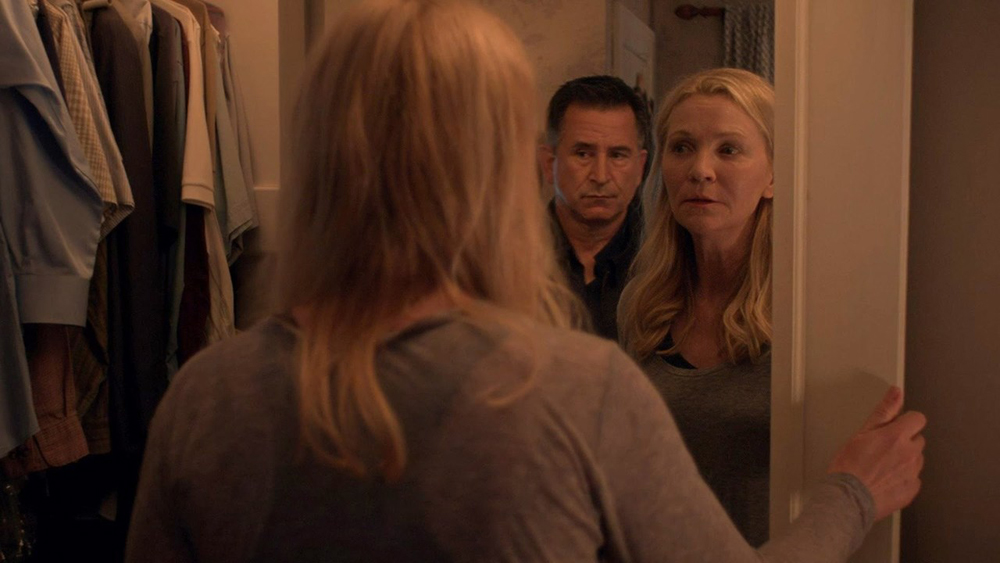
Adapted by King from his novella of the same name (and which can be found in his short story collection Full Dark, No Stars), A Good Marriage is a slow-burn thriller that lights the blue touch paper very early on but which, sadly, never really bursts into flame at any point. As with the original novella, King focuses on the little details and inherent rhythms of the Andersons’ life together, leaving the thriller elements to (almost) fend for themselves. They’re only brought in when King needs to drive the story forwards, but otherwise they seem of secondary importance, whereas the relationship between Darcy and Bob takes centre stage. To some degree this is entirely necessary, but it also stops the movie from being as dramatic as it could have been.
Part of the problem with A Good Marriage is Darcy’s reaction – and subsequent actions – when Bob arrives home and she learns all about Beadie. For some viewers it will appear unconvincing and contrived (it will help if you’ve read the novella), while others will find it completely unbelievable. Even if the viewer gives Darcy some considerable leeway for her behaviour, it still hurts the movie to see her behaving in the way that she does. Even Allen, an actress with more smarts than most, can’t quite pull it off, and the movie’s middle section slows down even further, making a movie that is already moving at a slow, steady pace now almost glacial.
While the audience waits for things to pick up, and Beadie to claim another victim, King and director Askin throw in an unexpected twist that turns the movie on its head and proves to be A Good Marriage‘s standout, bravura moment, a quintessential King literary moment made uncomfortable flesh, and which is reminiscent of that scene in Hitchcock’s Torn Curtain (1966). With that moment out of the way, it’s time to properly introduce Lang’s supporting character, a retired detective who thinks he knows who Beadie is, and have him provide quite a bit of extraneous exposition. It all leads to a final scene that – on screen at least – appears entirely superfluous and adds nothing to what’s gone before.
As Darcy and Bob, Allen and LaPaglia at least share a degree of chemistry, and their early scenes together are well played and playful at the same time. As the movie darkens, Allen becomes more distant as Darcy, while if anything, LaPaglia takes the opposite approach and makes Bob seem like he’s permanently on a cheerful streak. If this sounds awkward to watch, and difficult to believe, then it is, but King is too clever a writer to make it appear too incredible, and it suits the mood of the movie as the viewer waits to see what’s going to happen next. Both stars put in good performances on the whole, though it must be said, Allen – who doesn’t always look like herself from certain angles – has the harder job, and she doesn’t always nail it in the way she would normally.
The supporting cast aren’t given much to do – this would work well as a two-hander on stage – and Lang’s detective aside, are interchangeable in terms of their importance to the story. Buono’s saucy neighbour is a potential victim for all of a minute, while Connolly and Stockman fail to make much of an impact, and are sidelined at the halfway mark. Askin, along with DoP Frank G. DeMarco keeps things visually subdued as befits the material, and while the pace of the movie is kept deliberately slow, Colleen Sharp’s astute editing makes each scene, individually at least, interesting to watch. However, the score, by Saunder Juriaans and Danny Bensi is too generic to add much to the proceedings.
Rating: 5/10 – while it’s very faithful to the original novella, A Good Marriage still isn’t the best example of a Stephen King adaptation, even if it is penned by the man himself; some parts are extraneous, while others are meant to increase the tension but fail to do so making the movie – on the whole – a bit of a disappointment.
 thedullwoodexperiment