Cast: David Brian, Lynette Bernay, Jonathan Haze, Norman Wright, Harry Chang, Gene Bergman, Mel Prestidge
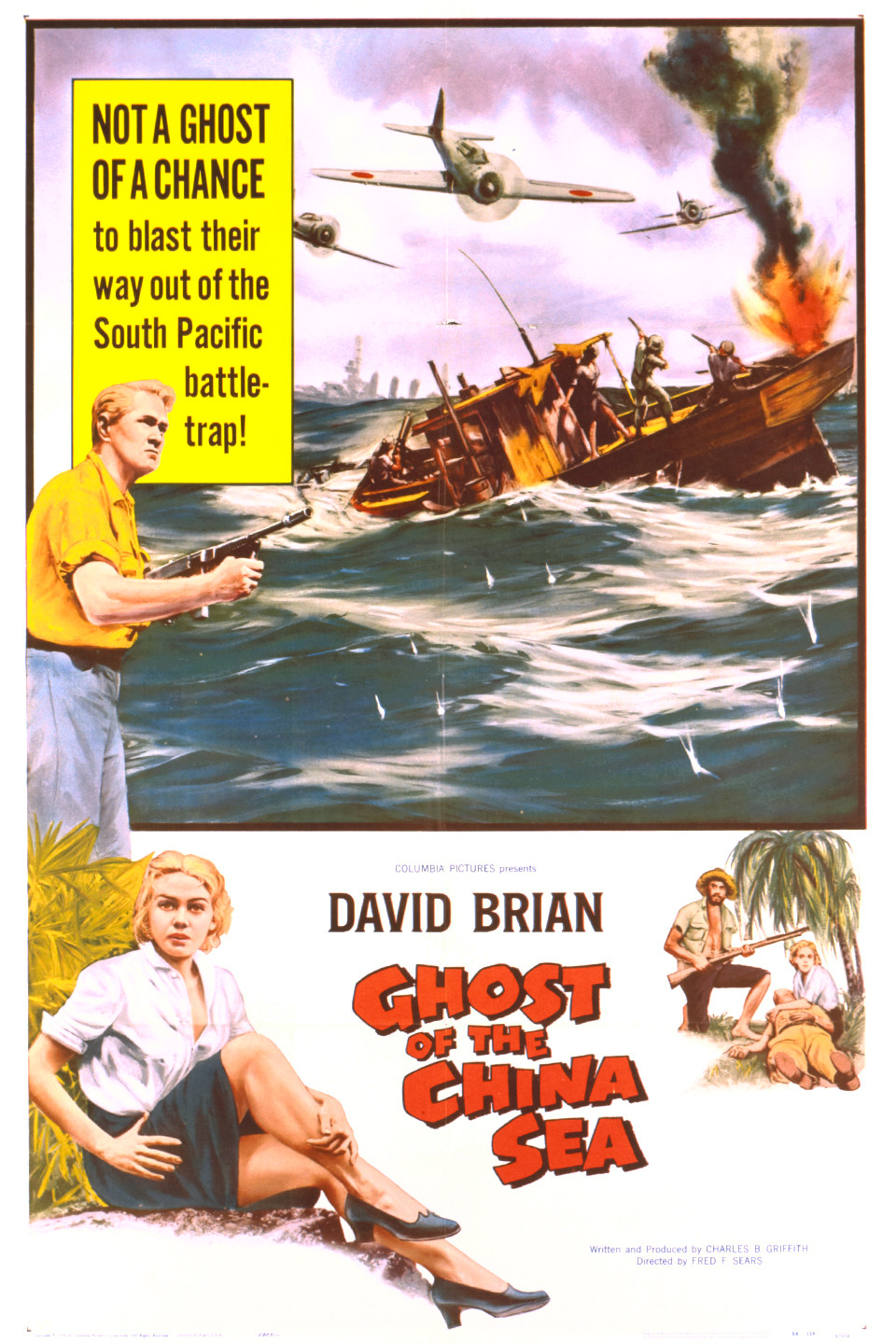
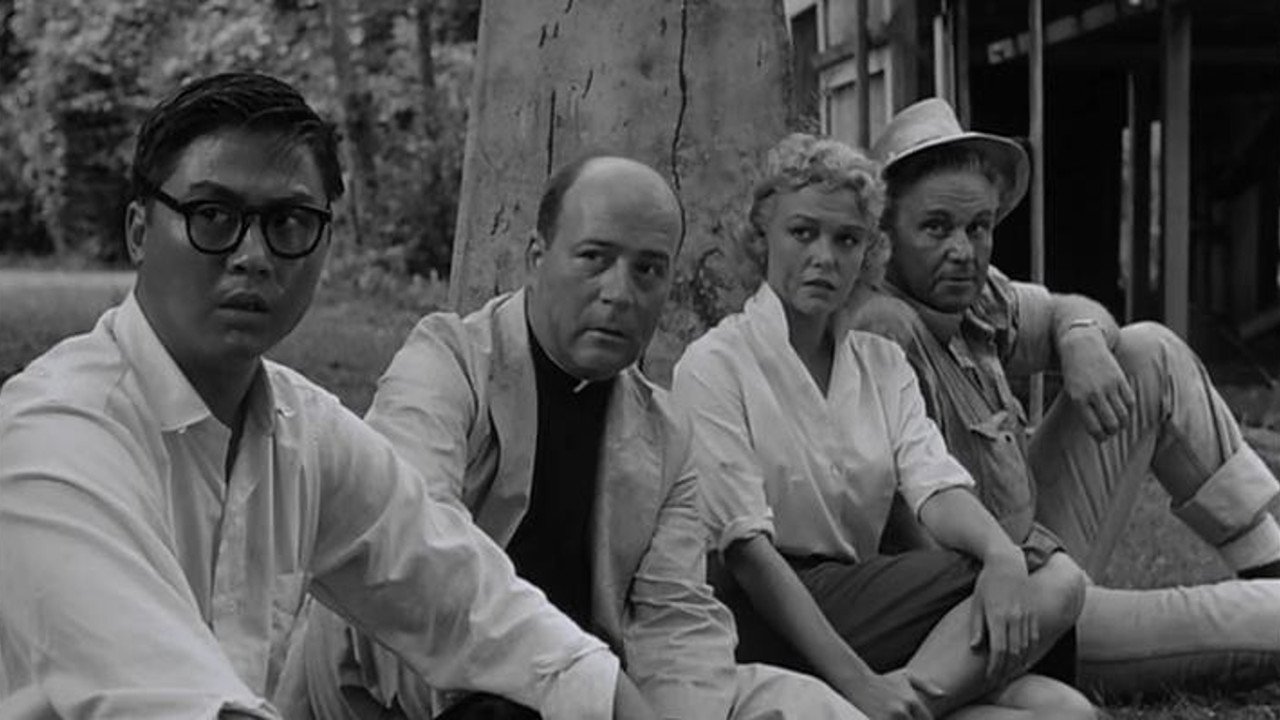
Set in the Philippines during World War II, Ghost of the China Sea is an amiable, if mostly forgettable drama about a group of civilians trying to escape the clutches of the approaching Japanese army. Trapped on an island that has begun to be invaded, and led by rough, tough ex-military man Martin French (Brian), the group – plantation owner Justine (Bernay), pacifist Reverend Darby Edwards (Wright), and plantation bookkeeper Himo Matsumo (Chang) – head for the nearby coast in the hope of finding a boat they can use to find safety on one of the other, numerous islands that make up the Philippines. Along the way they encounter Larry Peters (Haze), a seaman who has become lost on the island, but who saves them when they’re captured by the Japanese.
They help him find his ship, the Ilima, a broken-down vessel that barely qualifies as a navy ship, and which Peters refers to as the “USS Frankenstein”. They set off but soon need supplies, and discover that the Americans are being overrun and destroying any fuel and ammo dumps before moving on. Managing to get what they need, and still being pursued by the Japanese, French and co add a trio of Filipino resistance fighters to their group, and make way again. Along the way, French is challenged by Justine over his dismissive, arrogant attitude towards the others, and as the group is whittled down over time, French comes to realise that he can’t do everything by himself.
Produced and scripted by Charles B. Griffith – better known as the screenwriter of such B-movie classics as Attack of the Crab Monsters (1957), The Little Shop of Horrors (1960), and Death Race 2000 (1975) – and shot in Hawaii, Ghost of the China Sea is as ordinary and unremarkable a wartime drama as you’re ever likely to see. Like many similarly themed movies made in the Fifties, it tells a simple story, populates it with stock characters from the period – the stoic hero, the independent-minded heroine who still needs protecting and/or saving, the comic relief – and puts them all into situations where nothing too unexpected or exciting happens. Griffith himself was unhappy with how the movie turned out, but even so, and despite several reservations that could be mentioned about the movie, it’s still worth watching if you’re interested.
A lot of what makes it worth watching is due to the efforts of its director. This was Sears’ final movie, and the last of five movies to be released following his death in November 1957 (as you can imagine, he had a very busy career). What Sears does best here is to focus on the characters and what few internal struggles they have to contend with. French is all about getting the job done, but has decided that in order to do that he has to shut off from those around him. This makes him practically unlikeable, but thanks to Sears (and Brian), French’s slow reveal as a man of hidden feeling is both believable and a relief. Also, Sears takes Wright’s pacifist reverend and makes his dilemma more heartfelt than perfunctory, and while it’s tempting to view the moment when he has to make a choice (personal integrity vs necessity) as entirely predictable, it’s an affecting moment nevertheless.
Rating: 5/10 – not as corny or pedestrian as it might seem at first glance, Ghost of the China Sea is mildly diverting stuff that benefits greatly from Sears’ direction; unloved perhaps by its writer/producer, it’s a movie that deserves a little better attention than it’s received over the years.
Cast: Chiwetel Ejiofor, Michael Fassbender, Lupita Nyong’o, Benedict Cumberbatch, Paul Dano, Sarah Paulson, Adepero Oduye, Paul Giamatti, Garret Dillahunt, Brad Pitt, Alfre Woodard, Scoot McNairy, Taran Killam
In 2013 the movie that drew most people to the cinema was the third solo outing for Marvel’s high-tech reboot of the Tin Man, Iron Man 3. That movie was fun, a well-made piece of confectionery that was hyped, trailed and previewed to within an inch of its life. Enjoyable as it was though, it was still the equivalent of a Big Mac and fries, offering a quick fix for the Geek Squads and providing little or no nourishment for anyone not au fait with Marvel’s plan for Cinematic World Domination. But if 2013 is to be remembered as the year a man in a can was seen by more people than any other movie, what of that other way of remembering any given year: by the movie that was easily the best the year had to offer.
In some years, that “choice” has been easy. In 1930, All Quiet on the Western Front. In 1945, Les enfants du paradis. In 1962, Lawrence of Arabia. In 1974, The Godfather Part II. In 1993, Schindler’s List. And in 2013…a movie most of us won’t see until 2014. A movie called 12 Years a Slave.
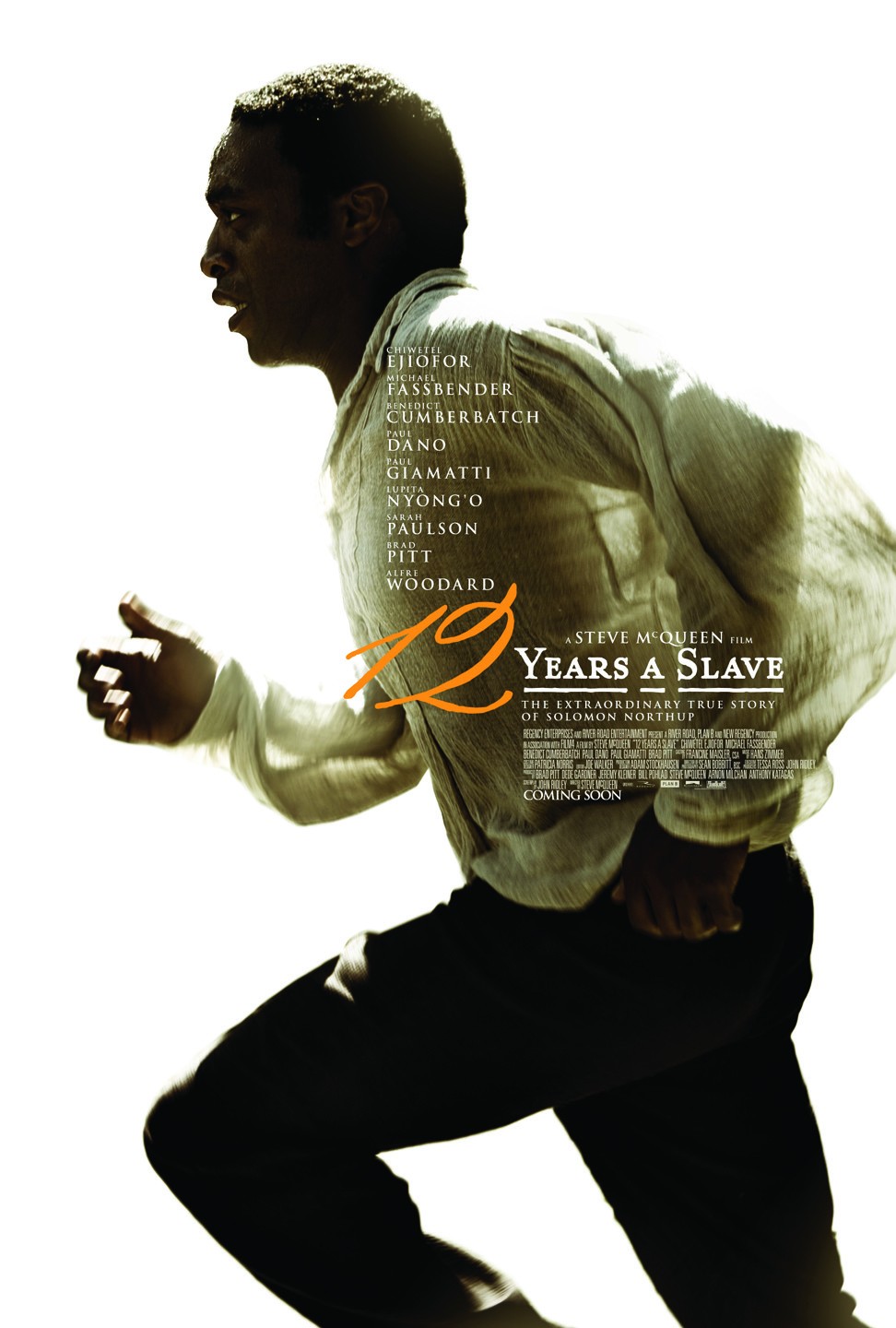
Directed by McQueen from the account written by Solomon Northup, a free man living in New York with his wife and two children in 1841, 12 Years a Slave is a devastating account of one man’s abduction into slavery, and his subsequent experiences on the plantations of Louisiana. Northup is an accomplished musician, well-respected, and flattered when two members of a circus troupe approach him to join their company. He journeys from New York to Washington with them only to wake up after a night’s drinking to find himself in chains and told he is now a slave; his name is also denied him and he is told he is to answer to Platt. At first he finds himself at the mercy of (the ironically named) slave trader Freeman (Giamatti), until he is sold, along with a woman called Eliza (Oduye), to plantation owner Mr Ford (Cumberbatch). Ford is in the process of adding extra buildings to his land, and has a master carpenter Tibeats (Dano) who oversees the construction. Northup impresses Ford with his engineering skills but soon makes an enemy of Tibeats. Before long, Tibeats pushes Northup too far and Northup beats him with his own whip. Tibeats swears revenge against Northup and returns with two men; they proceed to hang Northup but are stopped by Ford’s overseer, Chapin (J.D. Evermore). Although Chapin stops Northup from being killed, he leaves him hanging from the tree with his toes barely touching the ground to save himself from being strangled; it’s only when Ford returns at the end of the day that he is cut down. But Ford’s leniency comes at a price: he must sell Northup on in order to save his plantation from Tibeats’ wrath.
Where Ford has been a considerate and compassionate man, Northup’s new owner, Edwin Epps is anything but. He has his slaves whipped if they don’t make the daily quota for picking cotton, and when his wife complains that he is paying too much attention to one of the female slaves, Patsey (Nyong’o), he tells her coldly that he will see the back of her before he will rid himself of Patsey. Northup becomes Patsey’s confidante, and he does his best to keep Epps from bothering her, but it doesn’t always work. It’s only when a carpenter named Bass (Pitt) comes to work on the plantation, and speaks of equality, that Northup takes courage and explains his situation. Bass agrees to help him, and some time later, Northup is freed and reunited with his family.
From the outset, 12 Years a Slave grabs the attention and keeps its audience riveted. The topic of slavery is one that has been only fitfully addressed in cinema, and while movies such as Amistad (1997), and Amazing Grace (2006) have taken a political approach to the issue, there hasn’t been a movie that has looked at it from both the financial side of things, and the actual day-to-day living experience. Throughout the movie it’s made clear that slavery is a business, and a lucrative one for people such as the trader Freeman, and for the plantation owners who invest in slaves as a means of reaping huge profits. Against this wellspring of money, a slave’s life is worth nothing at all, and the movie delivers this message on several occasions. When Northup is on tiptoe trying not to hang, it’s heartbreaking to see the other slaves carry on with their tasks as if he isn’t there; only by going about their business can they add value to their lives.
12 Years a Slave is also quite graphic in its depiction of the violence endemic in slavery, with one on-screen whipping being truly horrifying, and its the casual nature of it all that the movie depicts so well, along with the hateful racism that fuelled so much of it. Early on, before Northup is placed with Freeman, he is beaten with a paddle. The scene is shocking both for what happens to Northup, and for the sustained nature of the beating. Epps’s wife throws a decanter in Patsey’s face, her racism mixed with jealousy and injured pride. There are other moments where violence escalates from nothing, and there is a palpable sense of the violent undercurrents that were prevalent during this period. If the movie presents these aspects unflinchingly, then it is to show the full horror of the constant threat of injury or death that slaves experienced. (And to anyone who feels these scenes were unnecessary or uncomfortable to watch, then you are missing the point. The life of a slave was far worse than anything depicted here, and by showing us the things that we do see, the movie reinforces the fact that, so far removed from both those times and those circumstances as we are in our daily lives, we can easily fail to realise how terrible slavery actually was.)
Thankfully, in amongst the brutal violence and the despair there are quiet moments of hope to offset the horror. Northup’s relationship with Patsey is affecting and desperately sad at the same time, and shows how two people can still retain a measure of their humanity despite existing under appalling conditions. Thanks to both Ejiofor and Nyong’o, their scenes together are both emotionally charged and riveting viewing.
The heart of the film is Ejiofor’s towering performance, a career best that is breathtaking to watch as he depicts a man who somehow retains his dignity and his sense of self through twelve years of degradation and terror. Ejiofor holds the attention in every scene he’s in, deflecting focus even from Fassbender, whose performance as Epps is mesmerising in its intensity. The audience is drawn to Ejiofor as their moral compass and guide; without him, the movie would be a series of vignettes without a central point of reference. He displays a clear understanding of the emotions that governed Northup’s reactions and response to his situation: the despair, the anger, the resignation to his plight, the fear, the barely acknowledged hope of regaining his freedom, the sadness, the sense of loss, and most effective of all, the will to survive. It’s a magnificent achievement.
As already mentioned, Fassbender is on brilliant form as the tortured, torturing Epps, adding layers to a character who could have been portrayed more matter-of-factly and with less attention to nuance and interpretation. His performance is mercurial, adding a sense of uncertainty to Epps that makes his unpredictable nature more dangerous. His scenes with Ejiofor are akin to an acting masterclass. In the various supporting roles, Dano stands out as the mealy-mouthed, insecure Tibeats, all puffed-up pride and coiled hostility, while Cumberbatch continues to impress as the fair-minded, socially conscious Ford. Paulson also impresses as Mistress Epps, her eyes never once betraying any emotion other than disgust. And making her feature debut, Nyong’o is superb as the object of Epps’s lust, imbuing Patsey with an inner strength and determination that offsets the cruelty she receives at the hands of Epps and his wife.
This is McQueen’s third feature – after Hunger (2008) and Shame (2011) – and serves to reinforce how talented a director he is. His control of the material is confident and assured, and he elicits strong performances from everyone in the cast. In conjunction with cinematographer Sean Bobbitt, McQueen places the camera in exactly the right place in each scene, framing the action expertly and with close attention to the physical and emotional requirements of each set-up. His decision to make 12 Years a Slave has proved to be a wise one, and the way in which he’s overcome the difficulties inherent in telling such a complex story is compelling.
12 Years a Slave is a harrowing, disturbing look at a shameful period in US history, and while some people might say that we don’t need to see the barbarity of the times to know it was evil, a reminder as powerful as this one is should always be welcome. With stand-out performances, an insightful, intricate script courtesy of John Ridley, and a score by Hans Zimmer that perfectly supports the emotional and dramatic moments in the film, 12 Years a Slave is a movie deserving of everyone’s attention.
Rating: 9/10 – a modern masterpiece, with much to say about the nature of evil as the will to survive it; an engrossing, deeply moving account of one man’s journey through a contemporary hell and his eventual salvation.


 thedullwoodexperiment