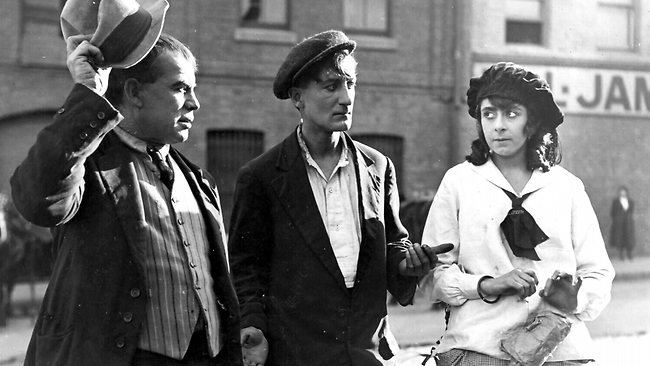
• 10 Reasons to Remember…
  • A Brief Word About…
  • About
  • For One Week Only
  • Happy Birthday
  • Monthly Roundup
  • Old-Time Crime
  • Other Posts
  • Poster of the Week
  • Question of the Week
  • Reviews
  • Trailers

thedullwoodexperiment

~ Viewing movies in a different light

thedullwoodexperiment

Tag Archives: Raymond Longford

For One Week Only: Australian Cinema – Part II

18 Tuesday Aug 2015

Posted by dullwood68 in Movies

≈ Leave a comment

Tags

1921-1940, American movies, Australian cinema, Beaumont Smith, Convicts, Eva Novak, For One Week Only, For the Term of His Natural Life, George Fisher, Historical drama, Literary adaptation, Marcus Clarke, Murder, Norman Dawn, Raymond Longford, Review, Romance

Australian Cinema Part II – 1921-1940

At the beginning of the 1920’s, the Australian movie industry was facing new challenges following the aftermath of World War I. Back in 1912, production companies had merged to form the Australasian Films and Union Theaters, a body which effectively controlled which movies were shown and where. However, it soon became apparent to distributors that there was a decreasing market for Australian movies, a belief that was exacerbated by the relatively cheap cost of importing, say, American movies that had already recouped their budgets in their home market. With local movies being passed over in favour of these imports, the industry began to dwindle. By 1923 this meant that 94% of all movies shown in Australia were American imports.

Movies did continue to be made though, and directors such as Raymond Longford and Beaumont Smith maintained their own standards against the influx of American product. Longford made several well-received movies during the early Twenties, including The Blue Mountains Mystery (1921) and The Dinkum Bloke (1923), but with the death of Lottie Lyell in 1925 his career began to flounder and he never regained the status he’d had in the 1910’s. Beaumont Smith made comedies, quickly and cheaply produced, and this practice earned him the nickname “One Shot Beau”. He too made several movies during the early Twenties, including While the Billy Boils (1921) and The Digger Earl (1924), but like Longford his career began to flounder and he retired officially in 1925 thanks to dwindling profits.

With the US continuing to dominate the market, especially in terms of the emerging “talkies”, Australian movie production maintained a reasonable level but not every movie was as successfully received as they had been in the past. New movie makers arrived on the scene, writer/directors such as Norman Dawn and Paulette McDonagh, and though they too faced an uphill battle to make an impact (or a profit) with their movies, nevertheless they succeeded. Dawn made one of the most impressive Australian movies of the late Twenties, the historical drama For the Term of His Natural Life (1927), yet another movie that showed Australia was just as capable as Hollywood of producing intelligent and compelling movies.
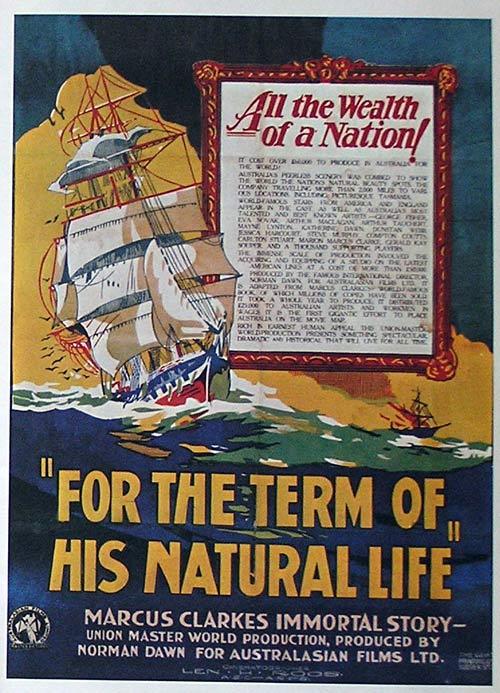
For the Term of His Natural Life

For the Term of His Natural Life (1927) / D: Norman Dawn / 102m

Cast: George Fisher, Eva Novak, Dunstan Webb, Jessica Harcourt, Arthur McLaglen, Katherine Dawn, Gerald Kay Souper, Marion Marcus Clarke, Arthur Tauchert, Mayne Lynton, Compton Coutts

1827, England. A row between Sir Richard Devine and his wife Ellinor (Clarke) leads to the revelation that their son, also Richard (Fisher), is illegitimate and the result of a brief affair with Lord Bellasis. Sir Richard banishes his son, while at the same time Lord Bellasis has an argument with his son, known as John Rex (also Fisher) that leads to John killing his father. Richard chances upon the body but is discovered by some of Lord Bellasis’s men. Accused of his murder, but thinking that Sir Richard has committed it, he remains silent (and helps to keep his mother’s shame from being exposed as well). He gives his name as Rufus Dawes and allows himself to be tried and sentenced to life imprisonment in a penal colony in Australia.

On the voyage a mutiny is organised by none other than John Rex, with the aid of his fiancée, Sarah Purfoy (Harcourt). Purfoy is travelling as nurse to the daughter of the new governor, Major Vickers (Souper) and his wife (Dawn). Rufus overhears the plans for the mutiny and alerts the crew. The mutiny is foiled but the mutineers guess that Rufus informed on them, and they have their revenge by claiming he was the leader. When the ship reaches Macquarie Harbour, Rufus is left in isolation on a nearby island.

Six years pass. The governor’s daughter, Sylvia (Novak) has grown into a beautiful young woman, and has attracted the attention of Captain Frere (Webb). Frere was in command of the penal ship that brought them all to Australia; his distrust of the convicts has made him cruel and merciless. His arrival at the harbour is to inform Major Vickers that he is to decamp to Port Arthur, along with all the convicts. This coincides with Rufus’s decision to end his life by jumping off a high cliff on his island; however, he survives. Meanwhile, Vickers travels with the prisoners on one ship while his wife and daughter, accompanied by Frere, travel on a second ship. This ship is hijacked by Rex and the trio are left on a beach, witjhout supplies, to fend for themselves. Rufus is washed ashore and sets about trying to return them all to the governor. He builds a makeshift boat and they set off, but not before Sylvia’s mother succumbs to a fever. It’s all too much for the young woman, and by the time they’re rescued, Sylvia also has a fever, but one that robs her of the memories of what has happened. Frere takes advantage of this and has Rufus re-imprisoned, and takes the credit for their being alive.

Years pass. Frere and Sylvia are due to be married, while Rex has been apprehended and is to be tried and expected to hang. Purfoy reappears and blackmails Frere into getting his sentence reduced. At the trial Rufus is called to testify, but when it becomes clear that Sylvia doesn’t recognise him, his accusations against Frere go unheeded. With his life spared, Rex plans another escape and asks Rufus to go with him. Rufus declines the offer but asks Rex to take a letter home to his mother. The escape plan is a success, and with Purefoy’s help, Rex gets to Sydney, whereupon he reads Rufus’s letter and discover the truth about their relationship. Realising that this is the reason why they look so much alike, Rex determines to go to England and impersonate Rufus and live his life in the way he’s always wanted…

For the Term of His Natural Life - scene

Based on the novel by Marcus Clarke, and previously adapted for the screen in 1908 and 1911, For the Term of His Natural Life is the most expensive Australian silent movie ever made, and also one of the most gripping. Its tale of doppelgängers, murder, mutinies, dangerous convicts, a scheming captain, a young woman in peril, the twin burdens of shame and regret – all combine to make a movie that grips from beginning to end, and it’s a movie that’s so well filmed for the time that it makes some modern day movies look amateurish in comparison.

The budget aside, Dawn’s adaptation aims high and rarely falls short, capturing the agony and despair of the convicts’ lives and the conditions they’re forced to live in. In this sense the movie doesn’t pull any punches, and as a record of the period it’s remarkably faithful, with the makers’ decision to film in the actual locations depicted adding to the credibility of the outdoor scenes (the Inca, an old sailing ship, was renovated and used for the scenes in Sydney harbour). With such an effort made to make the background as realistic as possible, and with exact copies of contemporary clothing made as well, Dawn’s grounding of the narrative pays off in dividends. It’s like looking through a window into the past.

Dawn is aided immeasurably by his cast, with Fisher a standout as the anguished Rufus and the malicious Rex. The viewer is never in any doubt as to which character is on screen, and even though there are few scenes where the two characters interact, it’s a testament to the efforts of DoP’s Len Roos, John William Trerise and Bert Cross that when they do it’s as seamlessly as possible. Of the two characters, Rufus is the more sympathetic (as you’d expect), but Fisher makes sure Rex’s dastardly behaviour isn’t entirely objectionable. It’s a delicate process, but you only have to look to the scene where his relationship to Rufus is revealed to see the desperate need to be accepted that has driven Rex onwards.

Novak is exquisitely lovely as Sylvia, and displays her character’s amnesia with aplomb, keeping her expressions natural and free from hysteria (or the declamatory style of acting that still afflicted some silent movies of the era). As the cowardly, villainous Frere, Webb is eminently hissable, while Harcourt, formerly a fashion model, is entirely convincing as Purfoy, using her feminine wiles to good effect as she charms and entices a variety of the male characters into doing what she wants. In smaller roles, The Sentimental Bloke‘s Tauchert pops up as a prison warden, while Dawn’s wife, Katherine has a touching death scene as Sylvia’s mother (she was also the movie’s editor).

There’s enough here to make a mini-series, but Dawn apportions the appropriate time needed for each scene and development of the storyline, so that no scene outstays its welcome or feels truncated. There’s a natural rhythm and flow to the narrative, and Dawn handles the crises and lulls with equal attention and commitment. In fact, so confident is he with the material that, when it’s over, you don’t realise just how quickly it’s all happened… and how rewarding it’s all been.

Rating: 9/10 – some very minor quibbles aside – such as Coutts eyeball-rolling performance, or an unnecessary reference to a secondary character’s claims of cannibalism – For the Term of His Natural Life is an exciting, character-driven historical drama that succeeds by virtue of its cast and crew’s commitment to the overall tale; one to be seen both for its confident, considered approach and its exacting take on both the material and the period evoked.

Movies such as For the Term of His Natural Life weren’t common however, and as the Twenties drew to a close, movie production resumed a more familiar pattern of homegrown comedies such as the Dad and Dave series along with turgid dramas such as Tiger Island (1930). It was in 1930 that exhibitor F.W. Thring established Efftee Studios in Melbourne, a production company that made the first Australian talkies, movies such as Diggers (1931), The Haunted Barn (1931), and the generally well received remake of The Sentimental Bloke (1932). But with the Australian government refusing to implement quotas for Australian movies it was difficult for any studio or production company to make a profit, and in 1935 Thring was forced to cease making movies; it was estimated he lost A$75,000 of his own money.

Another movie company, Cinesound Productions was more successful, making seventeen features between 1932 and 1940. Cinesound based their productions on the American model and promoted them well enough that each feature either broke even or made a profit. But while other movies continued to be made independently – e.g. In the Wake of the Bounty (1933), which introduced the world to Errol Flynn – the decline that had begun in the Twenties continued unabated. As fewer movies were made each year, and were less and less profitable, the Australian movie industry was dealt a further blow when the UK decided that Australian movies would no longer be included in the local movie quota, thus causing the loss of a previously guaranteed market.
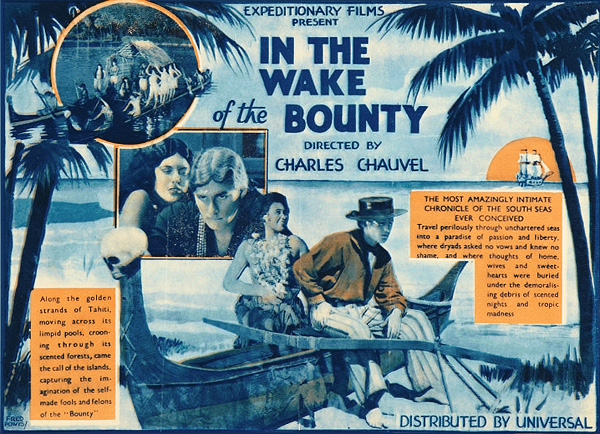
In the Wake of the Bounty

As the Thirties drew to a close with World War II looming on the horizon, the industry began to implement a kind of self-imposed shutdown, recognising that feature length movies would prove too costly to make in the new economic climate. But the future was already uncertain, and though the War did have an impact on movie production, a break was perhaps just what the industry needed.
Share this:

  • Click to share on X (Opens in new window) X
  • Click to share on Facebook (Opens in new window) Facebook
  • More
  • Click to print (Opens in new window) Print
  • Click to email a link to a friend (Opens in new window) Email
Like Loading...

For One Week Only: Australian Cinema – Part I

17 Monday Aug 2015

Posted by dullwood68 in Movies

≈ Leave a comment

Tags

1896-1920, Albert Roche, Arthur Tauchert, Athanaeum Hall, Australian cinema, C.J. Dennis, Drama, For One Week Only, Gilbert Emery, John Gavin, Lottie Lyell, National Film and Sound Archive, Raymond Longford, Restoration, Review, Romance, The Limelight Department, The Sentimental Bloke, The Songs of a Sentimental Bloke

Australian Cinema Part I – 1896-1920

The first cinema presentation in Australia happened in October 1896 at the Athanaeum Hall in Melbourne. It was a short movie (of course), but while Australia and other movie producing countries around the world continued to make and show short movies, it was Australia that would produce the first full-length feature: The Story of the Kelly Gang (1906). Running for approximately sixty minutes, it was directed by Charles Tait, a concert, movie and theatrical entrepreneur, and featured several of his family in key roles. It was a major success, and was shown in New Zealand, Ireland and the UK (alas, only seventeen minutes of footage still survives).

Story of the Kelly Gang, The - scene

While the Athanaeum Hall continued to show movies, Melbourne was also the home of one of the world’s first movie studios, the Limelight Department, which was in use between 1897 and 1910 (and was overseen by the Salvation Army). It made a variety of movies of varying lengths, some three hundred in all, and was, for its time, the biggest producer of movies worldwide. It was responsible for a number of firsts: first feature length documentary, Inauguration of the Commonwealth (1901); first bushranging drama, Bushranging in North Queensland (1904); and first movie combining moving images, glass slides, oratory and music, Soldiers of the Cross (1900). As the Australian movie industry took off, the ensuing boom years of the 1910’s saw the industry flourish, with directors such as John Gavin, Alfred Roche, E.I. Cole and W.J. Lincoln leading the way (and even though some of their efforts may not have been as good as they’d hoped).

In 1911, first-time director Raymond Longford made The Fatal Wedding, a melodrama that proved to be a huge success and which was well received critically. It was also the first Australian movie to claim two particular innovations: that it was the first to use interior sets, and that it featured the first ever close-up. Whether or not this is actually true, it reinforces the view that Australia – despite its distance from the rest of the world’s movie-making community – was forging ahead with new ideas and was creating a robust, popular industry that was the equal of the US, Italy and the UK in terms of movie production and exhibition.

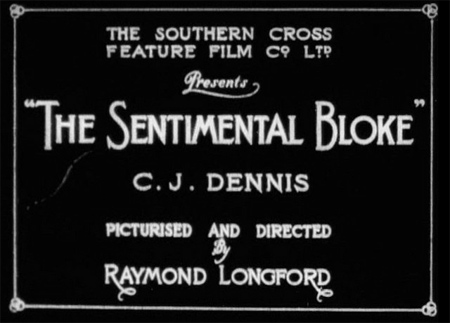
As the decade wore on, more and more movies were made and released, including The Sundowner (1911), Transported (1913), The Martyrdom of Nurse Cavell (1916), Australia’s Peril (1917), and the interestingly titled Does the Jazz Lead to Destruction (1919), but most titles are now considered lost. One movie that has survived, and was the subject of a restoration project in the early 2000’s, is Raymond Longford’s The Sentimental Bloke (1919), viewed as one of the best Australian movies of all time, and based on the poem The Songs of a Sentimental Bloke by C.J. Dennis. Here is a testament to the impressive development of the Australian movie industry, and an example of how advanced this island continent had become.

Sentimental Bloke, The

The Sentimental Bloke (1919) / D: Raymond Longford / 68m

Cast: Arthur Tauchert, Lottie Lyell, Gilbert Emery, Stanley Robinson, Harry Young, Margaret Reid, Charles Keegan, William Coulter, Helen Fergus, C.J. Dennis

Bill (Tauchert) is a larrikin, an uncultivated, mischievous man who behaves as if social conventions don’t apply to him. He drinks – usually with his best friend, Ginger Mick (Emery), and he gambles as well. When he’s caught in a raid on a gambling den, he’s sentenced to six months in gaol. When he gets out he vows to himself that he’ll give up his old life and walk the straight and narrow. He finds work at a market and avoids his old friends. One day he spies a young woman (Lyell) and is instantly smitten with her. But when he approaches her, and uses his usual slang terms to impress her, she rebuffs him. Chastened, and aware that he needs to improve his manners, Bill determines that if she should meet her again he will behave more responsibly.

He learns that the young woman is called Doreen and that she works in a pickle factory, putting labels on the bottles. Through a friend who works there also, Bill arranges a meeting with her, and putting aside his usual way of talking, he shows her that he’s not as bad as she thought previously. They begin seeing each other, but when another man Bill calls the Stror ‘at Coot (Young) starts to pay attention to Doreen as well, his natural belligerence and anger cause him to warn the man off. However, the Stror ‘at Coot persists in seeing Doreen until Bill gets violent with him, a situation that Doreen is unhappy about.

Knowing he’s skating on thin ice, but confused that defending his true love appears to be wrong, Bill assures Doreen that he will try harder. Eventually, after Bill has satisfied the concerns of Doreen’s mother (Reid), they marry and settle down together in their own home. But a chance encounter one night with Ginger Mick leads to Bill lapsing back into his old ways. He gambles away his money, and when he finally gets home in the early hours of the morning, he expects to be chastised for his foolishness. But the next morning brings a surprise, one that allows the couple to move on with their lives and in the fullness of time, to find peace and happiness.

Sentimental Bloke, The - scene

A huge success on its release, The Sentimental Bloke plays like a cross between Charles Dickens and an early Australian soap opera. It’s a charming, easily likeable movie, with a good central performance from Tauchert (who’d only made a couple of short movies before this), and tells its story in a direct, no frills way that makes it all the more enjoyable. In adapting Dennis’s work, Longford and his real life partner Lyell have kept the heart and soul of the poet’s work and translated it to the screen with surprising ease, even to the point of using Dennis’s prose for the intertitles (though some viewers may be put off by the use of colloquialisms and Aussie slang terms).

There’s much to admire, from Tauchert’s naturalistic interpretation of Bill, to Lyell’s considered portrayal of Doreen. Their scenes together reflect Longford’s decision to eschew the usual melodramatic excesses of silent movie acting, and opt for a more realistic approach, leaving Bill and Doreen resembling people that audiences could actually identify with. Tauchert has a wonderfully expressive face (especially when Bill is showing confusion), and Lyell matches him with several moments of pained acceptance, as Doreen’s love for Bill wins out over her reservations about his behaviour. (Sadly, Lyell, who was very very talented, and regarded as Australia’s first movie star, died in 1925 from tuberculosis.) Elsewhere, Emery and Reid provide solid support, but Longford keeps the focus on Bill and Doreen, and rightly so. Their relationship, with its ups and downs and unwavering commitment to each other, is shown without the need for undue or unnecessary emphasis, and is all the more effective for it.

What arises from all this is a great deal of humour to offset the pathos and muted drama. A highlight is a visit to the theatre to see a production of Romeo and Juliet (not something that Bill is too keen on at first). As the couple become wrapped up in the tragedy of Shakespeare’s young lovers, each twist and turn of the story sees them more and more emotionally invested, until the moment when Romeo slays Tybalt and Bill shouts out “Put in the boot!” The movie is stuffed with winning moments like that one, and each adds to the richness of the material.

The movie is also beautifully shot by Arthur Higgins. He was the DoP on The Fatal Wedding, and would work on this movie’s sequel, Ginger Mick (1920). He shows a firm grasp of lighting and composition, and the outdoor sequences have a freshness and vitality about them that few other cinematographers of the period could manage to achieve. It’s a shame that so many of the other movies he shot have since been lost – on this evidence he was exceptionally talented and deserves to be more widely known.

Following its release, The Sentimental Bloke was a success in the UK and Ireland, but not in the US because Dennis’s prose was found to be too difficult to understand. Despite the movie being recut and the intertitles changed, and being called The Story of a Tough Guy, it was quickly withdrawn from distribution. In the Fifties, a fire at a Melbourne movie library resulted in the destruction of all but two boxes of movie negatives. Fortunately, The Sentimental Bloke was saved, and following a transfer of the 35mm nitrate positive to 16mm acetate stock, it was shown to great acclaim at the 1955 Sydney Film Festival (ironically, Longford wasn’t invited to attend as the organisers were unaware he was still alive; he died in 1959).

But that wasn’t the end of the movie’s journey. In 1973 an original 35mm negative was discovered at a Film Archive in Rochester, New York. Even though it was a copy of the American version, the quality was better than any Australian copies (it had also been mislabelled The Sentimental Blonde). And in 2000, Australia’s National Film and Sound Archive embarked on a restoration project that included restoring the original colour tinting as much as possible. The results were shown at the 2004 Sydney Film Festival to further acclaim, proving that Longford and Lyell’s efforts all those years ago will continue to be appreciated – and rightly so.

Rating: 9/10 – a bona fide classic that still stands the test of time, The Sentimental Bloke is Australian silent cinema at its finest: dramatic, funny, emotionally earnest, and heartwarming; as one of the few movies to survive (relatively) intact from the period, it should be required viewing for anyone interested in silent cinema, or just because it’s a beautiful story beautifully told.

Share this:

  • Click to share on X (Opens in new window) X
  • Click to share on Facebook (Opens in new window) Facebook
  • More
  • Click to print (Opens in new window) Print
  • Click to email a link to a friend (Opens in new window) Email
Like Loading...

Blog Stats

  • 486,881 hits

Recent Posts

  • 10 Reasons to Remember Bibi Andersson (1935-2019)
  • Fantasia (1940)
  • Dances With Wolves (1990) – The Special Edition
  • Kiss of the Spider Woman (1985)
  • The Three Musketeers (1973)

Top Posts & Pages

  • Lost for Life (2013) - Another Look
    Lost for Life (2013) - Another Look
  • Lost for Life (2013)
    Lost for Life (2013)
  • About
    About
  • Irrational Man (2015)
    Irrational Man (2015)
  • The Better Angels (2014)
    The Better Angels (2014)
  • Pixels (2015)
    Pixels (2015)
  • Homefront (2013)
    Homefront (2013)
  • Mini-Review: Knock Knock (2015)
    Mini-Review: Knock Knock (2015)
  • Spotlight (2015)
    Spotlight (2015)
  • Green Book (2018)
    Green Book (2018)
Follow thedullwoodexperiment on WordPress.com

Blogs I Follow

  • Rubbish Talk
  • Film 4 Fan
  • Fast Film Reviews
  • The Film Blog
  • All Things Movies UK
  • Interpreting the Stars
  • Let's Go To The Movies
  • Movie Reviews 101
  • TMI News
  • Dan the Man's Movie Reviews
  • Film History
  • Jordan and Eddie (The Movie Guys)

Archives

  • April 2019 (13)
  • March 2019 (28)
  • February 2019 (28)
  • January 2019 (32)
  • December 2018 (28)
  • November 2018 (30)
  • October 2018 (29)
  • September 2018 (29)
  • August 2018 (29)
  • July 2018 (30)
  • June 2018 (28)
  • May 2018 (24)
  • April 2018 (21)
  • March 2018 (31)
  • February 2018 (25)
  • January 2018 (30)
  • December 2017 (30)
  • November 2017 (27)
  • October 2017 (27)
  • September 2017 (26)
  • August 2017 (32)
  • July 2017 (32)
  • June 2017 (30)
  • May 2017 (29)
  • April 2017 (29)
  • March 2017 (30)
  • February 2017 (27)
  • January 2017 (32)
  • December 2016 (30)
  • November 2016 (28)
  • October 2016 (30)
  • September 2016 (27)
  • August 2016 (30)
  • July 2016 (30)
  • June 2016 (31)
  • May 2016 (34)
  • April 2016 (30)
  • March 2016 (30)
  • February 2016 (28)
  • January 2016 (35)
  • December 2015 (34)
  • November 2015 (31)
  • October 2015 (31)
  • September 2015 (34)
  • August 2015 (31)
  • July 2015 (33)
  • June 2015 (12)
  • May 2015 (31)
  • April 2015 (32)
  • March 2015 (30)
  • February 2015 (37)
  • January 2015 (39)
  • December 2014 (34)
  • November 2014 (34)
  • October 2014 (36)
  • September 2014 (25)
  • August 2014 (29)
  • July 2014 (29)
  • June 2014 (28)
  • May 2014 (23)
  • April 2014 (21)
  • March 2014 (42)
  • February 2014 (38)
  • January 2014 (29)
  • December 2013 (28)
  • November 2013 (34)
  • October 2013 (4)

Create a free website or blog at WordPress.com.

Rubbish Talk

Film 4 Fan

A Movie Blog

Fast Film Reviews

The Film Blog

The official blog of everything in film

All Things Movies UK

Movie Reviews and Original Articles

Interpreting the Stars

Dave Examines Movies

Let's Go To The Movies

Film and Theatre Lover!

Movie Reviews 101

Daily Movie Reviews

TMI News

Latest weather, crime and breaking news

Dan the Man's Movie Reviews

All my aimless thoughts, ideas, and ramblings, all packed into one site!

Film History

Telling the story of film

Jordan and Eddie (The Movie Guys)

Movie Reviews & Ramblings from an Australian Based Film Fan

Privacy & Cookies: This site uses cookies. By continuing to use this website, you agree to their use.
To find out more, including how to control cookies, see here: Cookie Policy
  • Subscribe Subscribed
    • thedullwoodexperiment
    • Join 481 other subscribers
    • Already have a WordPress.com account? Log in now.
    • thedullwoodexperiment
    • Subscribe Subscribed
    • Sign up
    • Log in
    • Report this content
    • View site in Reader
    • Manage subscriptions
    • Collapse this bar
 

Loading Comments...
 

    %d